🏬Supersize Online Funeral Retailer🪦1000's of Headstones⚱️Over 10,000 Cremation Urns⚰️Caskets Overnight Delivery🛒Funeral & Memorial Superstore🚚FREE Shipping on ALL Orders👨👩👧👦Helping Families for over 20 Years💰Lowest Price Guarantee🏬Supersize Online Funeral Retailer🪦1000's of Headstones⚱️Over 10,000 Cremation Urns⚰️Caskets Overnight Delivery🛒Funeral & Memorial Superstore🚚FREE Shipping on ALL Orders👨👩👧👦Helping Families for over 20 Years💰Lowest Price Guarantee
🏬Supersize Online Funeral Retailer🪦1000's of Headstones⚱️Over 10,000 Cremation Urns⚰️Caskets Overnight Delivery🛒Funeral & Memorial Superstore🚚FREE Shipping on ALL Orders👨👩👧👦Helping Families for over 20 Years💰Lowest Price Guarantee🏬Supersize Online Funeral Retailer🪦1000's of Headstones⚱️Over 10,000 Cremation Urns⚰️Caskets Overnight Delivery🛒Funeral & Memorial Superstore🚚FREE Shipping on ALL Orders👨👩👧👦Helping Families for over 20 Years💰Lowest Price Guarantee
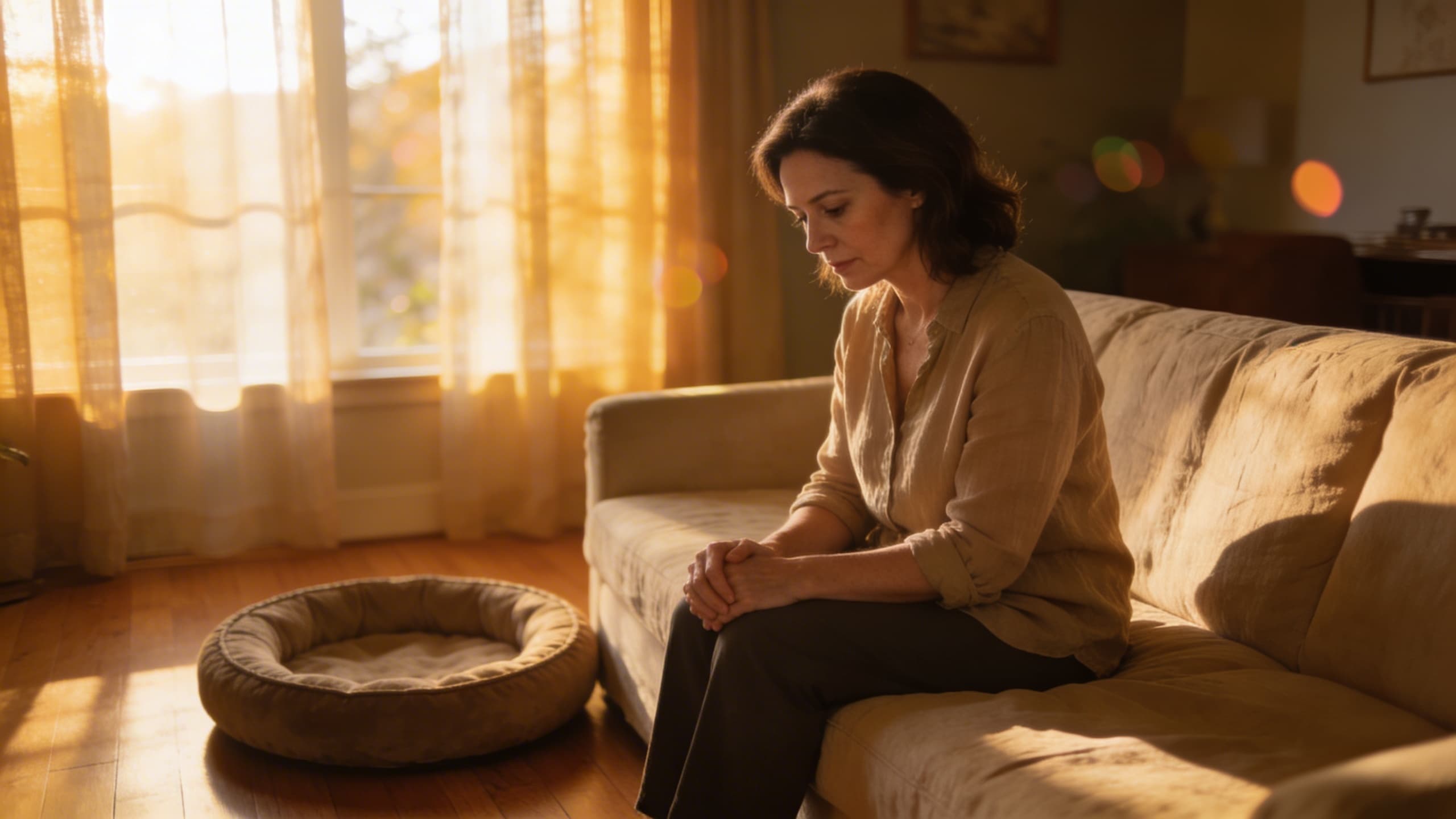
The silence hits first. You walk through the door and no one greets you. The food bowl sits untouched. The spot on the couch where a warm body always curled is painfully, impossibly empty. If you are grieving the loss of a pet right now, you already know that this pain is not small, and it is not silly. It is real, it runs deep, and you deserve space to feel every bit of it.
This article is about the grief process itself — what the stages actually look like when applied to pet loss, how long the pain typically lasts, when grief becomes something more serious, and how honoring your pet's memory can become part of healing. If you are looking for practical coping strategies you can use right now, our companion article walks through specific actions that help. This article goes deeper into understanding what is happening inside you and why.
For families navigating the full range of decisions after a pet's death — from cremation and burial to tributes and keepsakes — our complete guide to pet memorials covers the practical steps alongside the emotional ones.
Why Pet Loss Hurts So Much
The bond between a human and a companion animal is unlike any other relationship. Your pet depended on you entirely for food, shelter, safety, and affection — and in return offered something almost no human relationship can match: truly unconditional love. They did not judge your worst days. They celebrated your return whether you had been gone two hours or two weeks. That consistency created a bond woven into the very fabric of your daily life.
Researchers describe this as the human-animal bond, and studies consistently show that losing a pet can produce grief responses comparable to — and sometimes exceeding — those following the death of a human family member. A 2022 systematic review published in Death Studies synthesized 17 studies on pet bereavement and found that the psychosocial impact of losing a companion animal closely mirrors grief experienced after human loss.
This intensity makes sense when you consider just how present your pet was. Unlike adult children who grow up and move away, a pet remains at your side for its entire life. You are its whole world. When that daily companionship disappears, the void reaches into every routine — morning walks, evening feeding, the weight of a body against your feet while you sleep.
Disenfranchised Grief: When Others Don't Understand
One of the most painful aspects of pet loss is discovering that many people around you do not recognize it as a legitimate source of grief. You may hear well-intentioned but devastating comments: "It was just a dog." "You can always get another one." "At least it wasn't a person."
Psychologists call this disenfranchised grief — grief that society does not openly acknowledge, publicly support, or allow you to freely mourn. The term was first introduced by grief researcher Kenneth Doka, and pet loss is one of the most common examples. There is no standard bereavement leave for a pet's death. Funerals for animals remain uncommon. The social rituals that help people mourn human losses — memorial services, sympathy cards, casseroles on the doorstep — often do not materialize when a pet dies.
This lack of validation can make grieving harder, not easier. When you feel pressure to hide your pain or rush past it, grief does not disappear — it goes underground. Research shows that disenfranchised grief is associated with prolonged sadness, anxiety, guilt, and isolation. Pet owners who feel unsupported often question the legitimacy of their own emotions, asking themselves, "What's wrong with me that this hurts so much?"
Nothing is wrong with you. The depth of your grief is a direct reflection of the depth of your love. You do not need anyone's permission to mourn, and you do not owe anyone an explanation for your pain.
The Stages of Grief Applied to Pet Loss
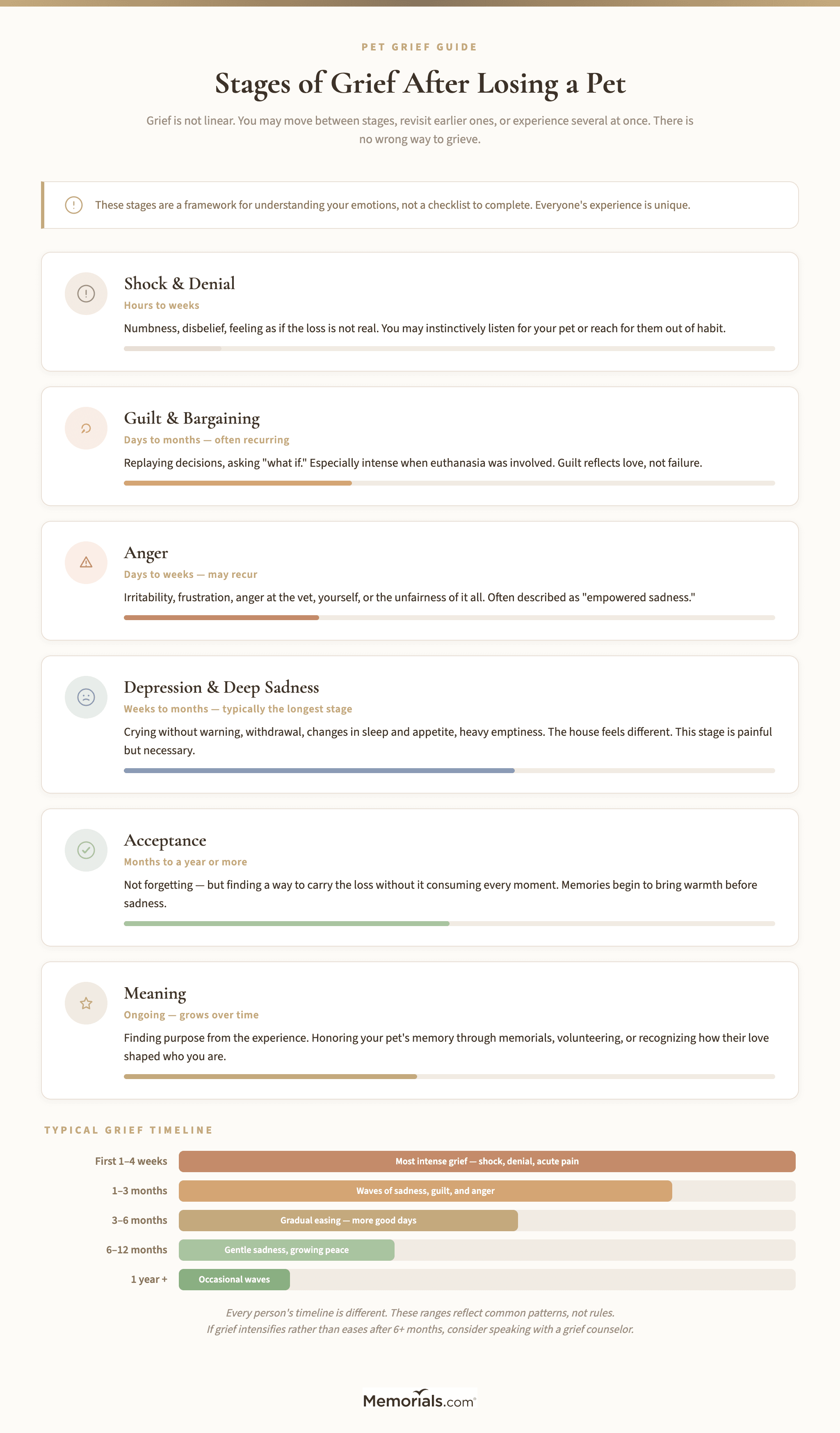
You have probably heard of the five stages of grief — denial, anger, bargaining, depression, and acceptance — originally outlined by Elisabeth Kübler-Ross. More recently, David Kessler, who co-authored work with Kübler-Ross, introduced a sixth stage: meaning. These frameworks can be helpful for putting language to what you are feeling, but it is critical to understand that grief is not linear. You will not move neatly from one stage to the next and check each one off a list.
Pet grief tends to arrive in waves. You may feel acceptance on a Tuesday afternoon and be leveled by raw denial on Wednesday morning when you instinctively reach for the leash. You may cycle through anger and guilt in the same hour. All of this is normal. Here is what each stage often looks like in the context of pet loss:
Shock and Denial
In the first hours and days, many pet owners describe feeling numb, as if moving through a fog. You may catch yourself listening for the click of nails on the floor or glancing toward a favorite sleeping spot. Cornell University's College of Veterinary Medicine notes that this period of numbness can last from hours to weeks and is often described as feeling "unreal." This protective response gives your mind time to absorb what has happened at a pace it can manage.
Guilt and Bargaining
Guilt is an especially powerful force in pet grief. Because you were your pet's sole caretaker, the "what if" questions are relentless. What if I had noticed the symptoms sooner? What if I had chosen a different treatment? For those who faced making the euthanasia decision, the guilt can be particularly acute — even when the decision was clearly made out of love and mercy.
Bargaining often intertwines with guilt. You replay scenarios, searching for a version of events where the outcome changes. This is your mind trying to regain a sense of control in a situation where you had very little.
Anger
Anger may surprise you with its intensity and its targets. You might feel angry at the veterinarian, at yourself, at family members who seem unaffected, at the universe for giving you so little time together. Some people feel a general irritability that colors everything — short tempers, frustration with small inconveniences, difficulty concentrating. Grief experts often describe anger as empowered sadness. It is not a sign that something is wrong; it is your pain demanding to be acknowledged.
Depression and Deep Sadness
This is typically the longest and most painful stage. You may cry without warning, withdraw from activities you once enjoyed, experience changes in appetite or sleep, or feel a heavy emptiness that sits in your chest. The house feels different. The routines feel hollow. You may wonder whether you will ever feel normal again.
You will — but "normal" will be a new version of itself, and reaching it takes time.
Acceptance and Meaning
Acceptance does not mean forgetting. It does not mean the sadness disappears entirely. It means you have found a way to carry the loss without it consuming every waking moment. The memories begin to bring more warmth than pain. You can talk about your pet and smile before the tears come.
The sixth stage — meaning — is about finding purpose or growth from the experience. For many pet owners, this takes the form of honoring their pet's memory in lasting ways, volunteering with rescue organizations, or simply recognizing how their pet's love shaped who they are.
How Long Does Pet Grief Last?
There is no correct timeline. Research suggests that the most intense grief typically occurs within the first one to three months. For many people, a noticeable shift toward more manageable sadness begins around the six-month mark. But grief does not follow a calendar, and waves of pain can resurface years later — on an anniversary, during a quiet evening, or when a certain sound or smell triggers a memory.
Several factors influence how long and how intensely you grieve:
The depth of your bond. A pet you raised from infancy, who was your sole companion through major life events, will leave a larger hole than one you knew for a shorter time. Neither loss is invalid — but the depth of attachment directly affects the intensity of grief.
The circumstances of death. Sudden or traumatic loss — an accident, an unexpected illness — tends to produce more prolonged grief than a death that followed a period of decline where you had time to prepare. Conversely, watching a slow decline carries its own weight through anticipatory grief, which begins before the death itself.
Your support system. People who have others who validate their grief — friends, family, or a pet loss support group — tend to move through the process more smoothly than those who grieve in isolation.
Previous losses. If your pet's death reactivates grief from earlier losses, the experience can feel overwhelming. The current loss and the old ones blend together, creating a heavier emotional load.
The honest answer to "how long will this last?" is: as long as it needs to. The goal is not to stop missing your pet. It is to reach a place where the missing no longer prevents you from living fully.
When Grief Becomes Complicated
For most people, pet grief — no matter how painful — gradually softens. The waves come less frequently. The spaces between them grow longer. Daily functioning returns. But for some, the grief does not follow this pattern.
Complicated grief, sometimes called prolonged grief disorder, occurs when the acute pain of loss does not ease over time and begins to interfere significantly with your ability to function. Signs to watch for include:
Intense longing and preoccupation with your pet that does not diminish after several months. Difficulty accepting the death, even long after it occurred. Persistent feelings of bitterness, anger, or numbness that do not lift. Withdrawal from relationships and activities that previously brought meaning. Intrusive thoughts or images related to the death that feel uncontrollable. A persistent sense that life has no purpose or meaning without your pet.
If you recognize these patterns in yourself — particularly if they persist beyond six months and are worsening rather than easing — reaching out to a grief counselor is not a sign of weakness. It is an act of self-care. Therapists who specialize in pet bereavement understand the unique dimensions of this loss and can provide tools to help you process what you are carrying. The Association for Pet Loss and Bereavement offers free, moderated support groups, and many therapists now list pet loss as a specialty.
Honoring Memory as Part of Healing
For many grieving pet owners, creating a tangible memorial becomes a meaningful step in the healing process. The act of choosing how to honor your pet — deciding what feels right, investing time and thought into the tribute — gives your grief a constructive channel. It transforms the helplessness of loss into something active and intentional.
There is no single right way to memorialize a pet. Some families find comfort in a pet urn displayed on a shelf or mantelpiece, where they can visit the memory daily. Others choose pet cremation jewelry — a small pendant or bracelet that holds a tiny portion of ashes and keeps their companion close in a literal, physical way.
Garden memorials, photo tributes, and dedicated spaces within the home all serve a similar purpose: they create a place — physical or symbolic — where the relationship continues to be honored. Browsing pet memorial ideas can help spark the approach that feels most natural for your family.
Pet memorials and pet keepsakes serve as continuing bonds — a concept in grief psychology that describes how maintaining a connection to the one you have lost can support healthy processing rather than hinder it. Research published in Death Studies found that memorialization and rituals can reduce the intensity of grief and even stimulate personal growth in bereaved pet owners.
The key is that there is no timeline for this step either. Some people find comfort in creating a memorial within days. Others need months before they are ready. Both are valid.
Helping Others Through Pet Loss
If someone you love is grieving a pet, the single most powerful thing you can do is validate their pain. Avoid comparisons ("At least it wasn't your mother"), avoid minimizing ("It was just a cat"), and avoid pushing timelines ("You should be over this by now"). Instead, say something simple and honest: "I know how much they meant to you. I'm sorry."
Two practical follow-ons, if you are the one trying to help: what to say when someone loses a pet sorts the wording by how close you were to them and to the animal, and what to send, and when explains why timing matters more than budget — an engraved keepsake that arrives in the first week usually goes into a drawer.
Children often need special attention during pet loss, as a pet's death may be their first direct encounter with mortality. Their grief is just as intense as an adult's but may manifest differently — through behavioral changes, sleep disturbances, or repeated questions about where the pet went. Our article on helping a child through pet loss offers age-appropriate guidance for these conversations.
If you have other pets at home, be aware that they may also show signs of grief — changes in eating, sleeping, or activity levels. Animals form bonds with one another, and the loss of a companion can be disorienting for them too.
For families facing a recent or sudden death and unsure where to start with practical decisions, our guide on what to do when your dog dies walks through the immediate steps with clarity and care.
Frequently Asked Questions
How long is it normal to grieve a pet?
There is no fixed duration. Most people experience the sharpest grief in the first one to three months, with a gradual easing over six months to a year. But waves of sadness can appear years later, especially around anniversaries or unexpected reminders. If your grief feels like it is intensifying rather than softening after several months, consider speaking with a grief counselor who understands pet bereavement.
What are the stages of grief after losing a pet?
The commonly referenced stages are denial, anger, bargaining, depression, and acceptance, with many grief experts now including a sixth stage — meaning. These stages are not sequential steps. Most people move back and forth between them, sometimes experiencing several in a single day. The framework is a tool for understanding your emotions, not a checklist to complete.
Is it normal to grieve a pet more than a person?
Yes, and it does not diminish any other loss. The human-animal bond is uniquely intimate — your pet depended on you completely and loved you without condition. Researchers have found that some people grieve pet loss more intensely than human loss, particularly when the pet was a primary source of companionship and daily routine.
Why do I feel so guilty after my pet's death?
Guilt is one of the most common responses to pet loss, especially when euthanasia was involved. Because you were responsible for every aspect of your pet's care, it is natural to replay decisions and wonder if you could have done more. In almost every case, the guilt is irrational — it reflects your deep love and sense of responsibility, not any actual failure on your part.
When should I seek professional help for pet grief?
Consider reaching out if your grief is not easing after several months, if it is interfering with your ability to work or maintain relationships, if you are experiencing persistent hopelessness, or if you find yourself unable to function in daily life. A grief counselor who specializes in pet loss can provide support tailored to your experience. The Association for Pet Loss and Bereavement offers free online support sessions.