🏬Supersize Online Funeral Retailer🪦1000's of Headstones⚱️Over 10,000 Cremation Urns⚰️Caskets Overnight Delivery🛒Funeral & Memorial Superstore🚚FREE Shipping on ALL Orders👨👩👧👦Helping Families for over 20 Years💰Lowest Price Guarantee🏬Supersize Online Funeral Retailer🪦1000's of Headstones⚱️Over 10,000 Cremation Urns⚰️Caskets Overnight Delivery🛒Funeral & Memorial Superstore🚚FREE Shipping on ALL Orders👨👩👧👦Helping Families for over 20 Years💰Lowest Price Guarantee
🏬Supersize Online Funeral Retailer🪦1000's of Headstones⚱️Over 10,000 Cremation Urns⚰️Caskets Overnight Delivery🛒Funeral & Memorial Superstore🚚FREE Shipping on ALL Orders👨👩👧👦Helping Families for over 20 Years💰Lowest Price Guarantee🏬Supersize Online Funeral Retailer🪦1000's of Headstones⚱️Over 10,000 Cremation Urns⚰️Caskets Overnight Delivery🛒Funeral & Memorial Superstore🚚FREE Shipping on ALL Orders👨👩👧👦Helping Families for over 20 Years💰Lowest Price Guarantee
Funeral Cost Breakdown: How Much Does a Funeral Cost in 2026?
funeral
Almost every article about funeral cost quotes the same source: a survey the funeral industry publishes about itself. We went and read the price lists instead. In September 2026 we collected and read 461 General Price Lists published by funeral homes in 49 states, and what follows is what those documents actually say.
The short answer is that a funeral with a viewing and a burial costs about $5,475 at the middle price list we read, and half of those homes fall between $4,280 and $6,783. But that number is close to useless on its own, because two funeral homes can quote the same figure for wildly different things. The most important question on any price list is not how much the funeral costs. It is what the price includes.
You will see an average funeral cost quoted almost everywhere, usually a single national number somewhere between $7,000 and $12,000. We deliberately do not publish one. An average invites you to expect a bill, and the spread in these documents is so wide, and so driven by what is bundled in, that a single figure would mislead more than it helped. We publish the middle price, the middle half of the range, and the number of price lists behind each figure, so you can see how much weight any of it carries.
A funeral home's price list covers the room, the staff and the director's time. It does not usually cover the grave, and it often does not cover the casket you are looking at.
If you have never arranged a funeral before, this is the part that makes every price confusing, so it is worth getting straight before looking at a single number. What most people call "the funeral" is bought from up to three different businesses.
The funeral home sells services: collecting and caring for the person who died, the director's time, the paperwork, the use of a room for a viewing or a ceremony, and the hearse. Every price in this article is one of these.
Merchandise is the casket or the urn. The funeral home will sell you one, and you are legally free to buy it anywhere else and have it delivered.
The cemetery or crematory handles what happens to the body: the grave, the opening and closing of it, a vault if the cemetery requires one, and a plot or a niche if cremated remains are being placed somewhere. This is a separate business sending a separate bill, and it is the one families forget.
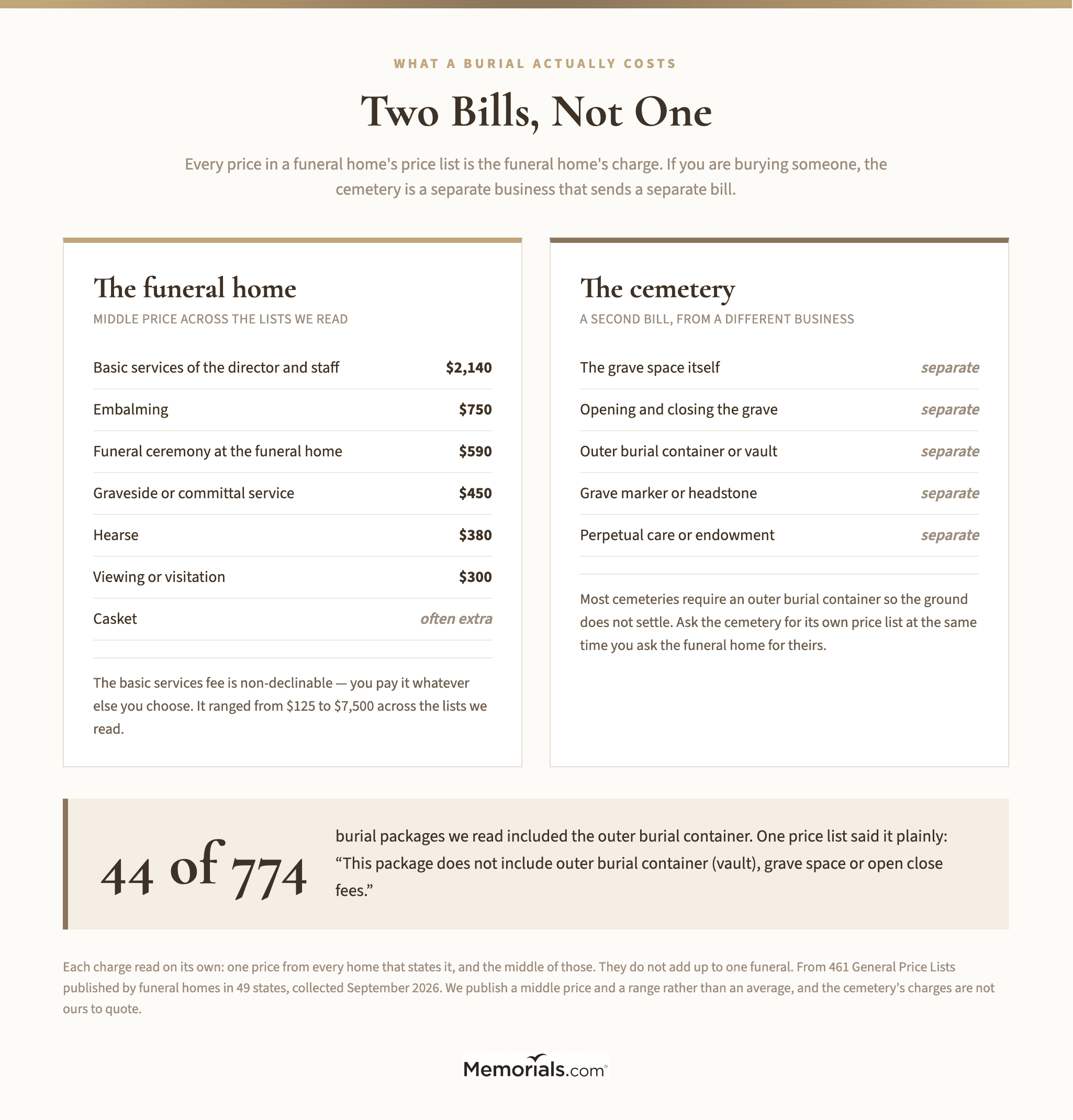
Only 44 of the 774 burial packages we read included the outer burial container. The grave, the opening and closing, and usually the vault arrive on a second bill from the cemetery.
Does a cremation need a plot as well?
Sometimes, and this trips up almost everyone. Cremation is what happens to the body, not where it ends up, and where it ends up is a separate decision with its own cost. Ashes that are scattered or kept at home carry no cemetery charge at all. Ashes that are buried need a plot, usually smaller and cheaper than a full-size grave, and many cemeteries want an urn vault for them. Ashes placed in a columbarium need a niche, bought and priced much like a plot. Our guide to the cost to bury cremated ashes covers those choices, and cemetery plot cost covers what drives the price of the ground itself.
So a cremation can end with no cemetery bill at all, or with a substantial one, depending entirely on where the ashes go. A burial always has one.
What a Funeral Costs, According to 461 Price Lists
Federal law requires every funeral home in the United States to hand you an itemized price list before you agree to anything. Many now publish that list online. These are the prices on the ones we read, collected in September 2026.
Read each row on its own. For a given type of funeral we take one price from every home that sells it, the cheapest version that home offers before any upgrades, and report the middle of those. A home that sells four kinds of funeral therefore appears in four rows, once in each. Not every home sells every type, which is why the counts differ: of the 461 price lists we read, 137 offered a burial with a viewing and ceremony, 190 offered the cremation equivalent, and 334 offered a direct cremation. The number beside each row is how many price lists that row rests on.
Type of funeral
Middle price
Middle half of homes
Full range
Price lists
Burial, with viewing and ceremony
$5,475
$4,280 to $6,783
$2,550 to $12,870
137
Cremation, with viewing and ceremony
$5,150
$3,995 to $6,331
$1,695 to $11,995
190
Burial, graveside service only
$4,108
$3,359 to $5,375
$2,000 to $8,870
84
Direct burial, no service
$2,885
$2,295 to $3,820
$1,099 to $7,180
127
Direct cremation, no service
$1,695
$1,195 to $2,511
$570 to $5,130
334
Two things in that table surprise most families. The first is how little separates a burial funeral from a cremation funeral once there is a viewing and a service: $5,475 against $5,150. The ceremony is most of the cost, not what happens to the body afterward. The second is how far the full range stretches. A $12,870 burial package is real, and so is a $2,550 one. They are not the same product.
The Question That Changes the Price More Than Any Other
Is the casket in the price?
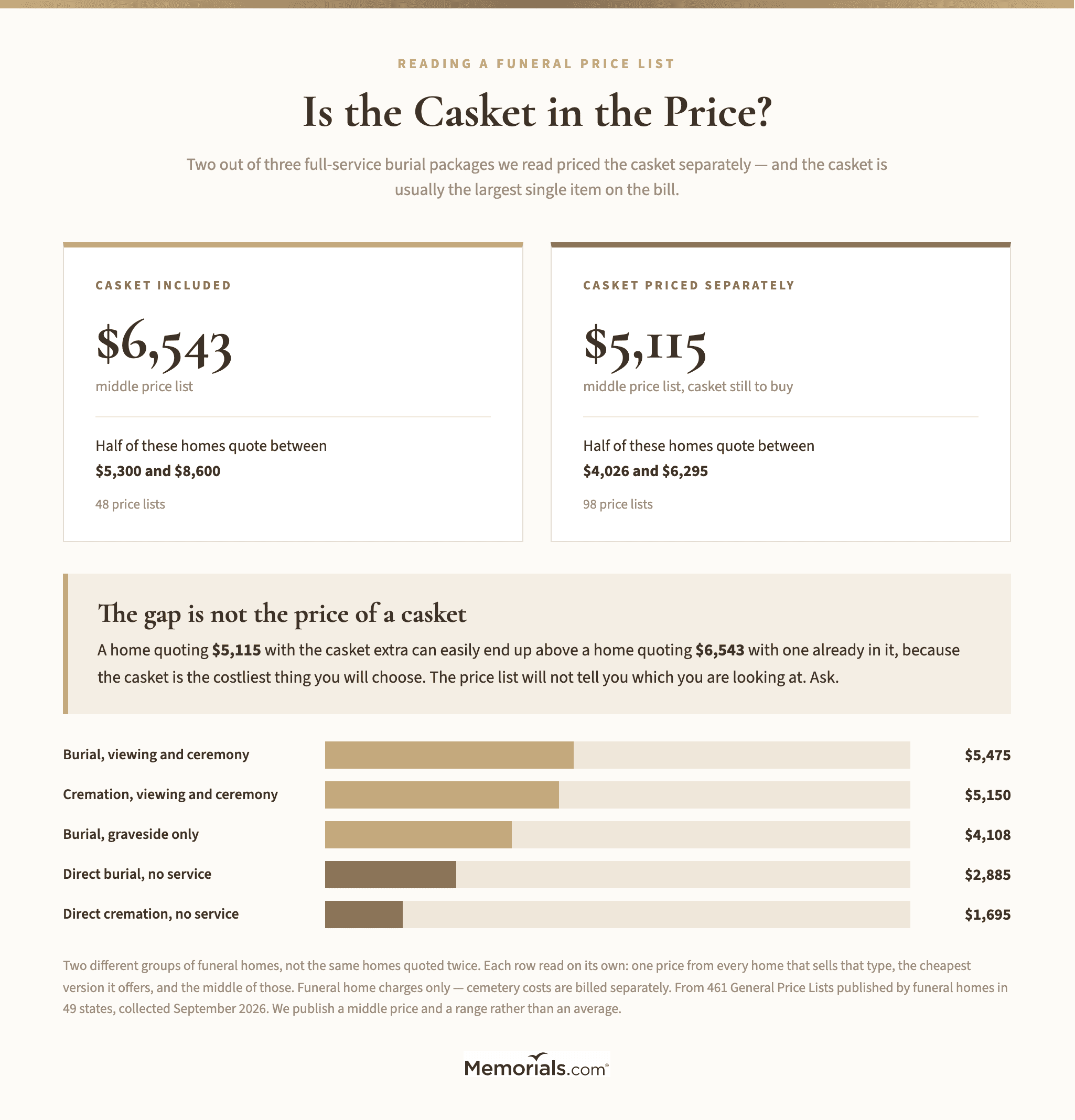
Of the full-service burial packages we read where the price list said one way or the other, two out of three did not include the casket. The package covers the director, the staff, the facilities, the hearse and the ceremony. The casket is quoted separately, from a different list, and it is usually the single most expensive item on the final bill.
Full-service burial package
Middle price
Middle half of homes
Price lists
Casket included in the quoted price
$6,543
$5,300 to $8,600
48
Casket priced separately
$5,115
$4,026 to $6,295
98
The gap between those two rows is not the price of a casket. They are two different groups of funeral homes, not the same homes quoted twice, and a home that bundles a casket bundles whatever entry-level one it stocks. What the rows actually tell you is more useful than a casket price: a package that looks $1,400 cheaper may not be cheaper at all, because the thing missing from it is the most expensive thing you are going to buy.
Two different groups of funeral homes, not the same homes quoted twice. The lesson is not what a casket costs, it is that the cheaper-looking package may be missing the costliest item.
Before comparing two homes on price, find out which of these two things each one is quoting. It is a single question and it moves the answer by thousands.
You Can Buy the Casket Anywhere
This is the most valuable right you have, and the one families use least. Under the Funeral Rule, a funeral home must accept a casket you bought somewhere else, must use it, and cannot charge you a handling fee for doing so. It cannot refuse, and it cannot quietly add a surcharge. The same protection covers an urn.
That matters because the funeral home's casket list is a captive market, presented to you on the worst day of your life, in a room where comparing prices feels inappropriate. Buying a comparable casket online is routinely a fraction of what the same class costs in that room, and it is delivered to the funeral home directly.
For a sense of the real numbers: across our own caskets range we currently list 63 adult caskets from $284 to $13,200, with a middle price of $1,880. Metal caskets are the most commonly chosen, green caskets suit a natural burial, and cremation caskets are built for a viewing that is followed by cremation. If you are weighing a green burial, the casket requirements are different again.
Two practical notes. Order early enough for delivery before the service, and tell the funeral home it is coming. And keep the paperwork: the Funeral Rule protects your right to supply it, but you are the one who will need to point at the rule if anybody hesitates.
Funeral Cost Breakdown, Line by Line
A package price hides the parts. An itemized list shows them, and every funeral home has to give you one. These are the individual charges from the price lists we read, counted the same way: one price from every home that states that charge, with the number of lists beside it. The rows are separate questions, so the six figures below do not add up to one funeral.
Charge
Middle price
Middle half of homes
Full range
Price lists
Basic services of the funeral director and staff
$2,140
$1,346 to $2,895
$125 to $7,500
398
Embalming
$750
$650 to $950
$250 to $2,500
369
Viewing or visitation
$300
$195 to $483
$50 to $1,800
372
Funeral ceremony at the funeral home
$590
$450 to $729
$150 to $1,500
358
Graveside or committal service
$450
$315 to $595
$50 to $1,495
353
Hearse
$380
$295 to $495
$75 to $1,295
371
The basic services fee is the one to understand first. It is non-declinable: you pay it whatever else you choose, because it covers the director's time, the permits, the death certificates and the coordination with the cemetery or crematory. It is also the widest-ranging charge on the list, from $125 to $7,500, and it is the number that most separates an expensive funeral home from a cheap one.
Body preparation other than embalming sits outside that table on purpose. Dressing, casketing, cosmetology and refrigeration are sometimes one charge and sometimes four separate ones, so a single figure would compare a home that itemizes finely against one that does not. Look for all four on the list you are handed.
What the Cemetery Will Add
Every price above is the funeral home's. If anything is being buried, a body or an urn, the cemetery bill is still to come. Of the 774 burial packages we read, only 44 included the outer burial container. One price list put it plainly:
This package does not include outer burial container (vault), grave space or open close fees.
Expect to add:
The grave itself. Plot prices vary more by geography than almost anything else here, and they are the largest of these by some distance.
Opening and closing the grave. A cemetery labor charge, billed by the cemetery, usually several hundred to well over a thousand dollars.
The outer burial container or vault. Most cemeteries require one so the ground does not settle. Compare what they are in our burial vaults range.
A grave marker or headstone, usually chosen later and bought separately. If you are unsure which you need, headstones and grave markers differ in more than name. Our headstones and cemetery products show what they cost outside a cemetery's own list.
An urn, for a cremation. Our cremation urns range shows what the container itself costs, and the funeral home must accept one you supply.
A family that budgets the funeral home's $5,475 and nothing else is going to be short. Ask the cemetery for its own price list at the same time you ask the funeral home for theirs.
The General Price List is the document that matters. You are entitled to keep a copy, take it away, and compare it against another home before you agree to anything.
How Much Does Embalming Cost?
Across the 369 price lists that priced embalming on its own, the middle charge was $750, with half of homes between $650 and $950. The full range ran from $250 to $2,500.
Embalming is not required by law in most circumstances, and no state requires it for every death. A funeral home may require it for a public viewing with an open casket, and it may be necessary when there is a long delay before the funeral or when remains cross state lines. Federal rules forbid a funeral home from telling you it is legally required when it is not, and forbid embalming without permission when you have a choice.
Declining it saves more than the embalming fee alone, because the preparation charges that usually accompany it, dressing, casketing and cosmetology, tend to fall away with it. Choosing a closed casket, a direct cremation or an immediate burial removes the reason for it entirely. If you want to understand what is actually involved before deciding, our guide to the embalming process explains the procedure step by step.
How to Read a Funeral Home's Price List
Comparing two price lists is harder than it should be, and not by accident. Reading 461 of them taught us where the confusion lives. Here is what to watch for.
The same service goes by different names
One home's "Basic Services of Funeral Director and Staff" is another's "Professional Service Fee", another's "Basic Services and Overhead", and another's "Non-Declinable Basic Services Fee". They are the same charge. Likewise "viewing", "visitation" and "use of facilities and staff for viewing" are one item, and "funeral ceremony", "funeral service" and "memorial service" often are too, though a memorial service means the body is not present.
A package named after a service is not that service
This one catches almost everybody. A line reading "Hearse $350" is a hearse. A line reading "Hearse $10,675" is a whole funeral package that the home has named after one of the things inside it. When a figure looks impossibly large for the item beside it, you are looking at a bundle, not a fee.
One package per casket, repeated down the page
Some price lists run to twenty or more "packages" that are the same funeral with a different casket in each. It makes the list look like a menu of services when it is really a menu of merchandise. Find the service you want, compare the cheapest version of it at each home, then choose the casket separately.
"Starting at" is doing a lot of work
A package price that begins with "from" or "starting at" is the entry-level configuration, and the one in the brochure photograph usually is not it. Ask what the quoted number actually buys.
Discounts are quoted as package prices
Several lists we read showed a total, a package discount, and a net price: one showed $7,540 less $4,815 for a price of $2,725. That is a real price, but it is a promotional one, and it is worth asking how long it stands and what it excludes.
The cash advance items are not the funeral home's prices
Clergy honoraria, obituary notices, death certificates, flowers and musicians are often passed through at cost. They appear on the bill and are not really the home's charge, so they are not a fair basis for comparing two homes.
Three questions that settle most of it
Is the casket in this price, and if not, may I see the casket price list?
Is the outer burial container in this price, and does the cemetery require one?
Which charges here are non-declinable, and which can I remove?
You are entitled to prices over the telephone, and to an itemized list before you agree to anything. Asking two homes for the same three items is the fastest comparison there is.
Cremation or Burial: What the Price Lists Show
Cremation is the majority choice in the United States now, and cost is part of the reason, but the saving is smaller than most people expect once a service is involved. A cremation with a viewing and a ceremony had a middle price of $5,150 across 190 price lists, against $5,475 for the burial equivalent across 137.
The real gap is between having a service and not having one. Direct cremation, with no viewing and no ceremony, had a middle price of $1,695. That is the cheapest thing on almost every price list in the country, and it is a third of the cost of the same home's full-service cremation.
Burial also carries the cemetery costs described above, which cremation may avoid entirely or may not, depending on whether the ashes are buried, placed in a niche or kept. Our guides to cremation versus burial cost and to cremation cost by state go further into that comparison.
Ways to Bring the Cost Down
Compare three price lists. The basic services fee alone ranged from $125 to $7,500 in our sample. Two homes a few miles apart can differ by thousands for identical work.
Buy the casket or urn elsewhere. The funeral home must accept it and cannot charge a handling fee. Ours start at $284, against a captive list shown to you in a room where comparing prices feels inappropriate.
Decline embalming if there is no open-casket viewing. It is rarely required by law.
Separate the ceremony from the disposition. A direct cremation followed by a memorial gathering you arrange yourself costs a fraction of the same event run by the funeral home.
Ask about the cemetery separately and early, because it is a second bill that arrives whatever the funeral home charges.
Check what is already paid for. Veterans may be entitled to a free grave, a marker and a burial allowance in a national cemetery; some unions, fraternal orders and employers carry a death benefit nobody remembers.
Paying for It, and Paying in Advance
Most funerals are paid for in the week they happen, which is the worst possible moment to be comparing prices. A few things change that.
Life insurance is not usually fast enough. A policy pays out in weeks, and the funeral home wants settlement far sooner, so families often bridge the gap themselves. An assignment of benefits, where the insurer pays the funeral home directly, is common and worth asking about.
Preneed contracts lock in some prices and not others. A prepaid plan bought from a funeral home typically guarantees that home's own services at today's price. It rarely guarantees the casket you will actually want, and almost never guarantees the cemetery's charges, which are the ones that rise fastest. Ask in writing which items are price-guaranteed and what happens if you move or the home changes hands.
Some costs are already covered. A veteran is generally entitled to a grave, a marker and a committal service in a national cemetery at no charge, which removes the entire cemetery bill described above. Social Security pays a small lump-sum death benefit to a surviving spouse or child. Some states operate an indigent burial fund, and many employers, unions and fraternal organizations carry a death benefit that nobody remembers until someone asks.
The Funeral Rule: What You Are Entitled To
The Federal Trade Commission's Funeral Rule has governed this since 1984, and it exists because these documents are hard to compare. Under it, a funeral home must:
Give you an itemized General Price List, on paper, to keep, before discussing arrangements.
Quote prices over the telephone if you ask.
Let you buy only what you want, rather than requiring a package.
Accept a casket or urn you bought elsewhere, with no handling fee.
Tell you in writing when a state or local law genuinely requires something.
Give you a written statement of everything you selected, with the total, before you sign.
The single most useful of those is the first. You can take the list away, read it somewhere quieter, and compare it with another. Nobody has to decide anything at the table.
Funeral Costs by State
Prices vary by state, and by metropolitan area within a state, more than any national figure can show. We are publishing state-level pages as the price lists we have collected support them, with the number of lists behind each figure printed beside it so you can see how much weight it carries.
In the meantime, the honest guidance is that a national middle price is a starting point for your expectations, not a prediction of your bill. Ask three local homes. The difference between them will be larger than the difference between your state and the next one.
Frequently Asked Questions
How much does a funeral cost on average?
We read 461 price lists in total, and 137 of them offered a burial with a viewing and ceremony. Across those 137, the middle price was $5,475, with half of funeral homes between $4,280 and $6,783. That is the funeral home's charge only. Cemetery costs and, usually, the casket are additional.
Why is the range so wide?
Mostly because the packages are not the same product. Some include the casket and some do not, some are a graveside service and some a full day with a viewing, and a few bundle an expensive casket into the price. The widest figure we recorded was a $12,870 burial package, and it was a genuine price for a genuinely different funeral.
What is the most expensive part of a funeral?
The casket, where it is bought through the funeral home, and the basic services fee, which ranged from $125 to $7,500. Between them they usually account for most of the bill.
Can I really buy a casket somewhere other than the funeral home?
Yes. The Funeral Rule requires the home to accept a casket you bought elsewhere and forbids it from charging you a handling fee. Ours start at $284 and are delivered to the funeral home.
Is embalming required by law?
No state requires embalming for every death. A funeral home may require it for a public open-casket viewing, and it may become necessary with long delays or interstate transport. A home may not tell you it is legally required when it is not.
How can I arrange a funeral for under $2,000?
Direct cremation is the usual route: no viewing and no ceremony, with a middle price of $1,695 across the 334 price lists we read that offered it, and a quarter of homes at $1,195 or less. Families often hold their own memorial gathering afterward at little or no cost.
Does the funeral home's price include the burial plot?
No. The cemetery is a separate business with a separate bill covering the grave, the opening and closing, and usually the required outer burial container. Only 44 of the 774 burial packages we read included the container.
Honoring a Life Within Your Budget
The families who spend the least are rarely the ones who cared the least. They are the ones who saw an itemized list early, understood which charges were theirs to decline, and worked out what the cemetery would want before the funeral home's bill arrived.
Everything in this article came from documents funeral homes publish themselves, because the law says they must. Ask for one. Take it home. Compare it against another. That single habit is worth more than any national average, including ours.
Hub Library: Funeral Cost Resources
Each of these takes one part of the bill and goes further than this page can. They are built from the same 461 price lists.
Before you sign anything
Unnecessary funeral expenses — exactly one charge on a funeral bill cannot be declined. Everything under it is yours to refuse, and this goes through them one at a time.
Why are funerals so expensive — the structural answer rather than the cynical one, starting with a non-declinable fee that runs from $125 to $7,500 for work that does not differ.
Direct burial cost against direct cremation — the two no-service options, and why the printed gap between them understates the real one.
How much does an obituary cost — a newspaper's price, not a funeral home's, billed by the line, the column inch or the word.
Paying for it
Charities that help with funeral costs, plus the Social Security death payment, VA entitlements and county funds, in the order of what each is actually worth.
Prepaid funeral plans — which items a preneed contract guarantees, and which are left exposed to the fastest inflation on the bill.
Prices in this article come from 461 General Price Lists published by funeral homes in 49 states, collected in September 2026. We publish the middle price and the middle half of the range rather than an average, and name the number of price lists behind every figure. Funeral homes that publish their prices online may not be typical of every home in the country.