🏬Supersize Online Funeral Retailer🪦1000's of Headstones⚱️Over 10,000 Cremation Urns⚰️Caskets Overnight Delivery🛒Funeral & Memorial Superstore🚚FREE Shipping on ALL Orders👨👩👧👦Helping Families for over 20 Years💰Lowest Price Guarantee🏬Supersize Online Funeral Retailer🪦1000's of Headstones⚱️Over 10,000 Cremation Urns⚰️Caskets Overnight Delivery🛒Funeral & Memorial Superstore🚚FREE Shipping on ALL Orders👨👩👧👦Helping Families for over 20 Years💰Lowest Price Guarantee
🏬Supersize Online Funeral Retailer🪦1000's of Headstones⚱️Over 10,000 Cremation Urns⚰️Caskets Overnight Delivery🛒Funeral & Memorial Superstore🚚FREE Shipping on ALL Orders👨👩👧👦Helping Families for over 20 Years💰Lowest Price Guarantee🏬Supersize Online Funeral Retailer🪦1000's of Headstones⚱️Over 10,000 Cremation Urns⚰️Caskets Overnight Delivery🛒Funeral & Memorial Superstore🚚FREE Shipping on ALL Orders👨👩👧👦Helping Families for over 20 Years💰Lowest Price Guarantee
Memorial Ideas: Meaningful Ways to Honor Someone Who Died
memorialization
Most memorial ideas fall into four kinds: things you make, things you keep, things you do, and things you give. Almost every list you will find mixes them together, which is why they are hard to choose from — a garden and a donation and a tattoo are not alternatives to each other, they answer different questions.
The other thing lists leave out is maintenance. A memorial is designed in the first month by someone with far more energy than they will have in the eighth, and the ones that survive are almost always smaller than the ones that were planned.
Most ways to memorialize a loved one get listed as a flat menu. This guide sorts them by what they actually ask of you, and every section links to a page that goes properly into it.
Start With Three Questions
Not "what should I do." These three, in order.
Who is it for? A memorial for the immediate family can be private, small and indoors. One for a wider circle — colleagues, a congregation, a town — has to be reachable, and that changes everything about where it goes and what it costs.
Where does it live? On a shelf, in a garden, on a grave, on your body, or nowhere physical at all. This is the single most useful sorting question, because it eliminates most of the list immediately.
Who maintains it, and for how long? A candle lit on anniversaries needs nothing. A garden needs someone with a hose in August. A tree needs somebody for thirty years. Answer this before you buy anything.
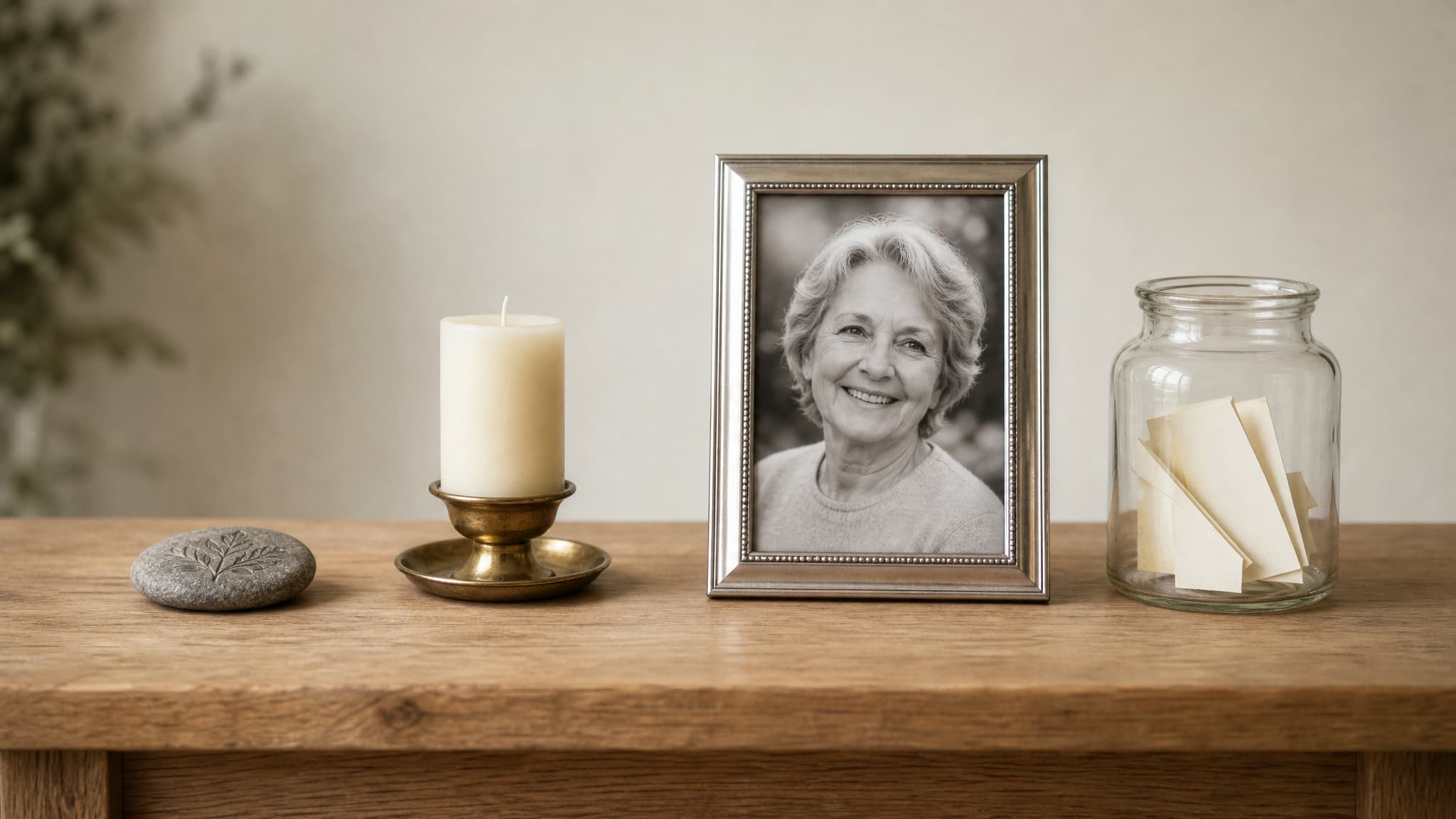
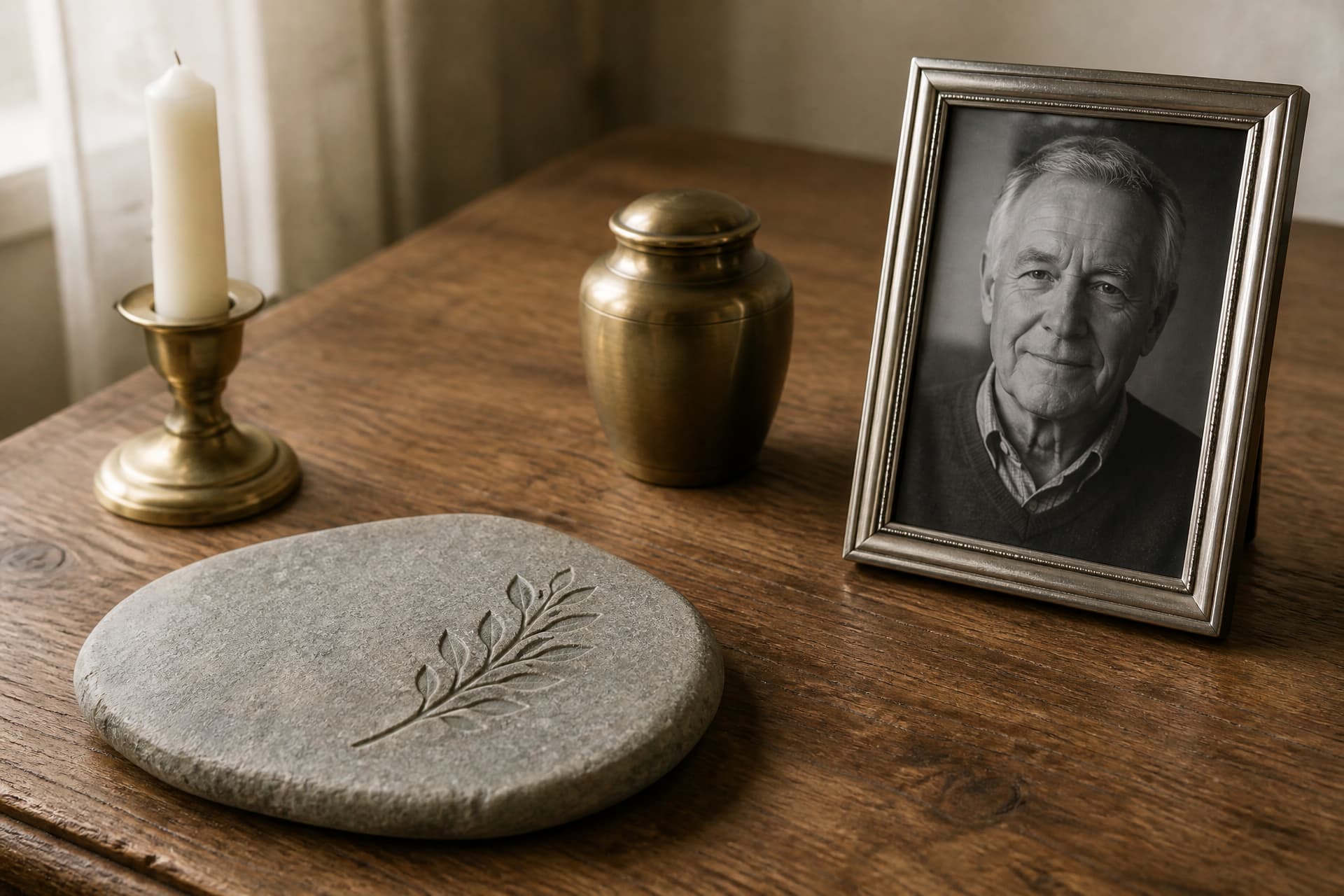
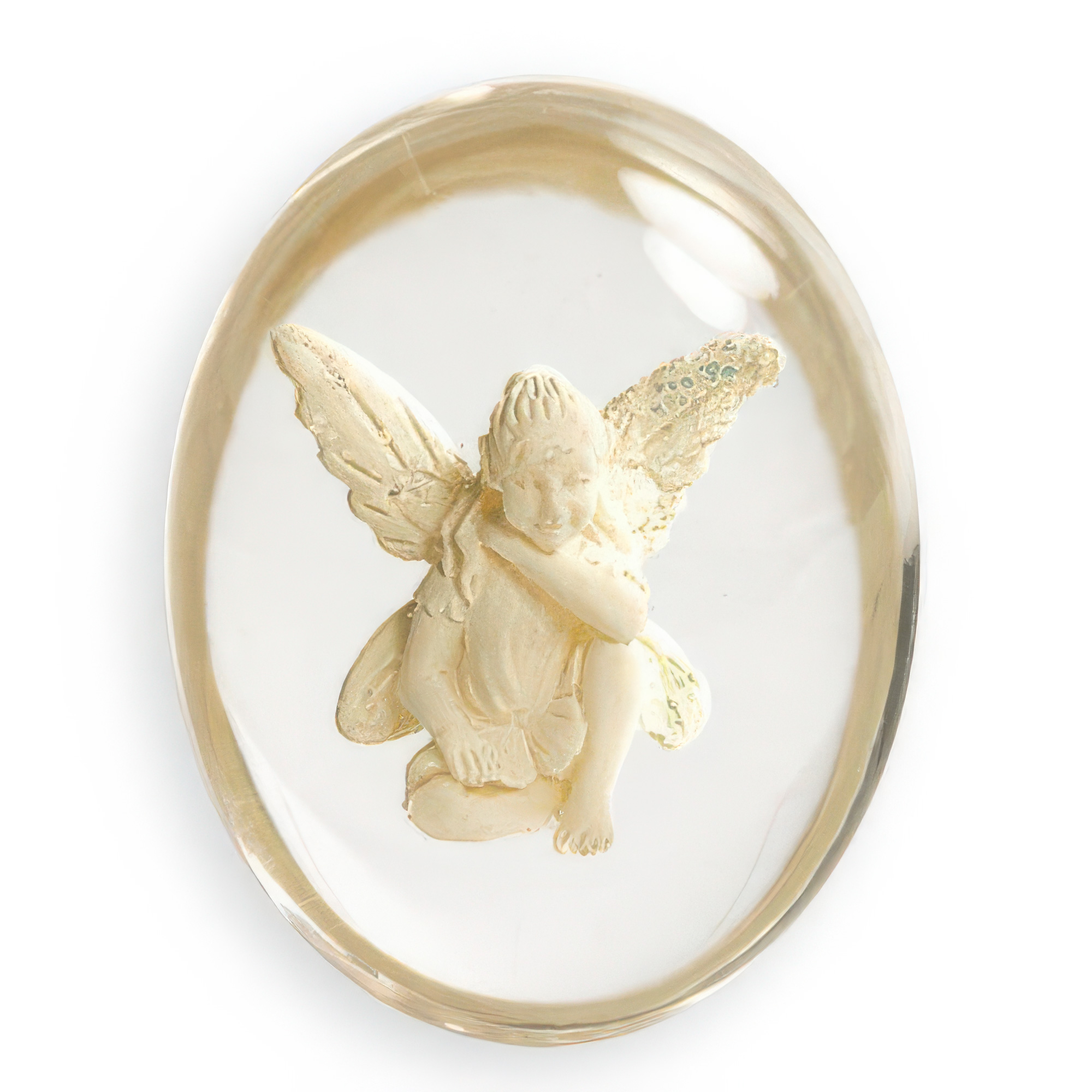
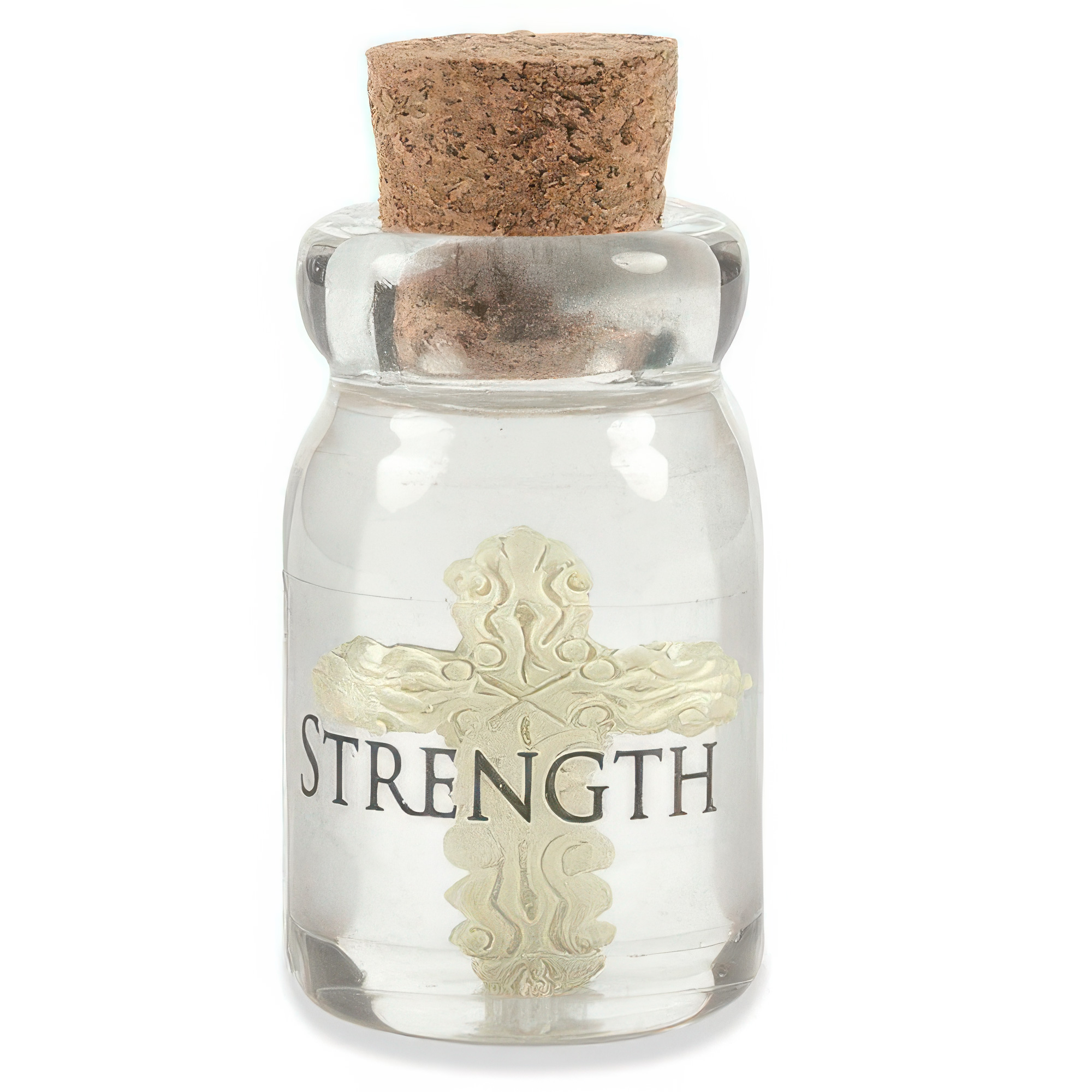
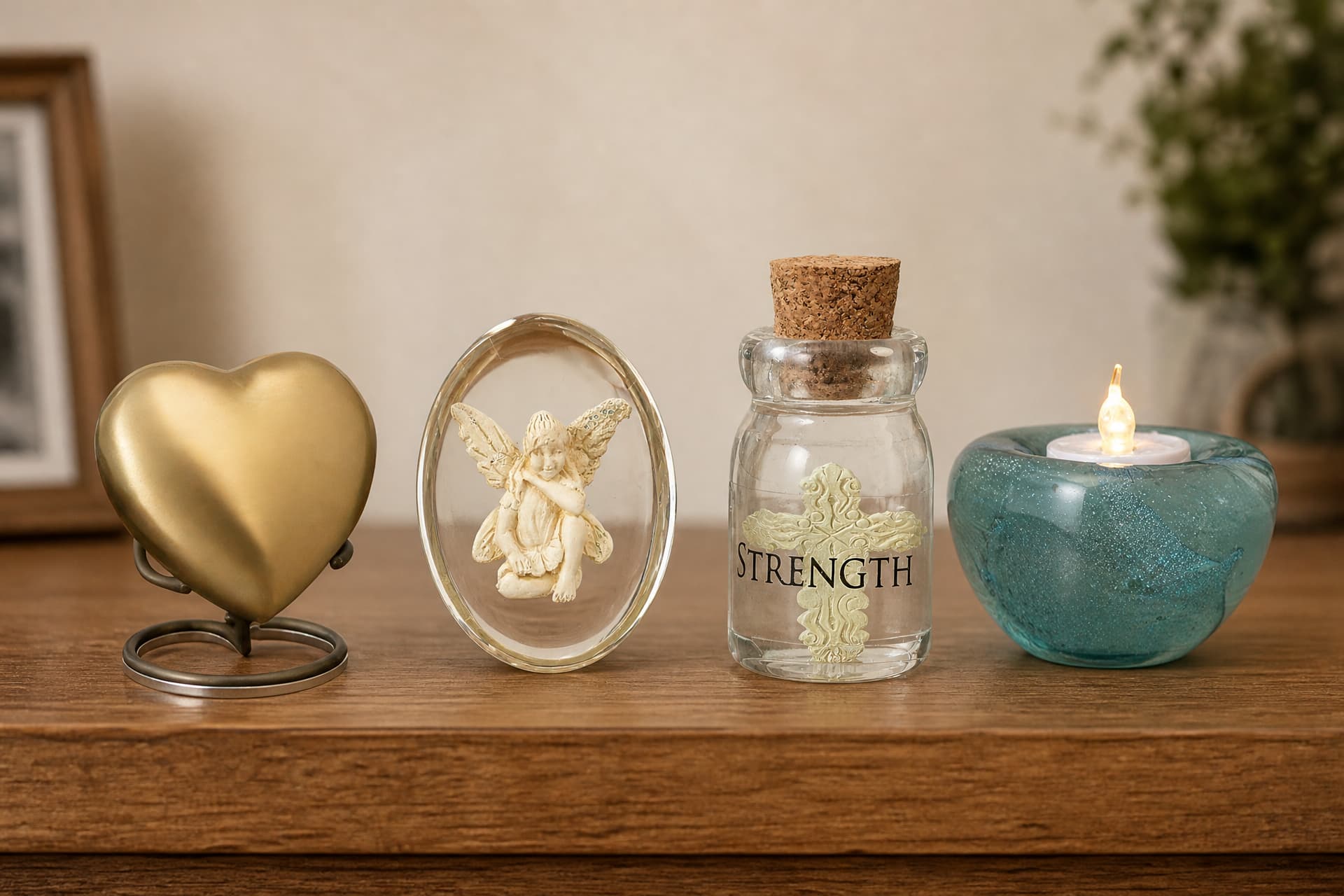
Four objects, four different kinds of memorial — something made, something kept, something you do, something with their name on it. Most families end up with one of each rather than four of any one, and that mix is what makes a memorial feel like a life rather than a gesture.
Shop Memorial Keepsakes
Small enough to give, when several people each want one
The cheapest and the most personal, and the ones people remember helping with.
A memory jar or memory box at the service, where guests write down something they remember. The jar is easy; the card beside it decides whether you get a hundred slips or eleven. Memory jars, boxes and tables covers the prompt that works and what else goes on the same table.
A picture board for the service — thirty to fifty photographs on a trifold, mounted so nothing is destroyed. How to make a funeral picture board covers the layout that reads from six feet and what to do with it afterward, which is where most boards fail.
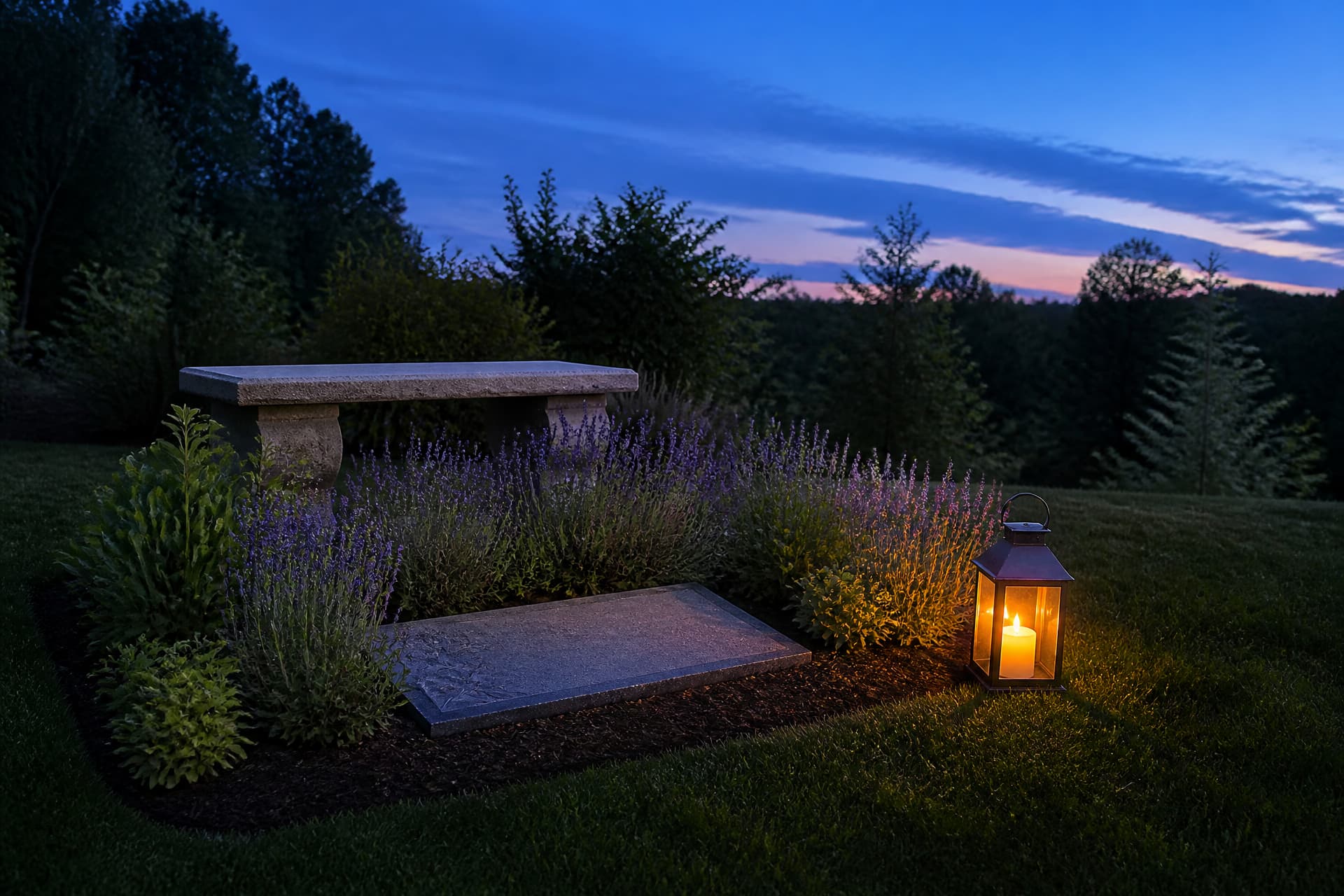
A memorial garden, which is different from putting a memorial in a garden. Memorial garden ideas covers the planting that survives being forgotten for a season, and the four elements that make a garden get visited rather than mown around.
A recipe collection, a playlist, a photo book. All free, all done at a kitchen table, and all reliably more looked at than anything bought.
Things You Keep
The objects, and the part where the decisions are permanent.
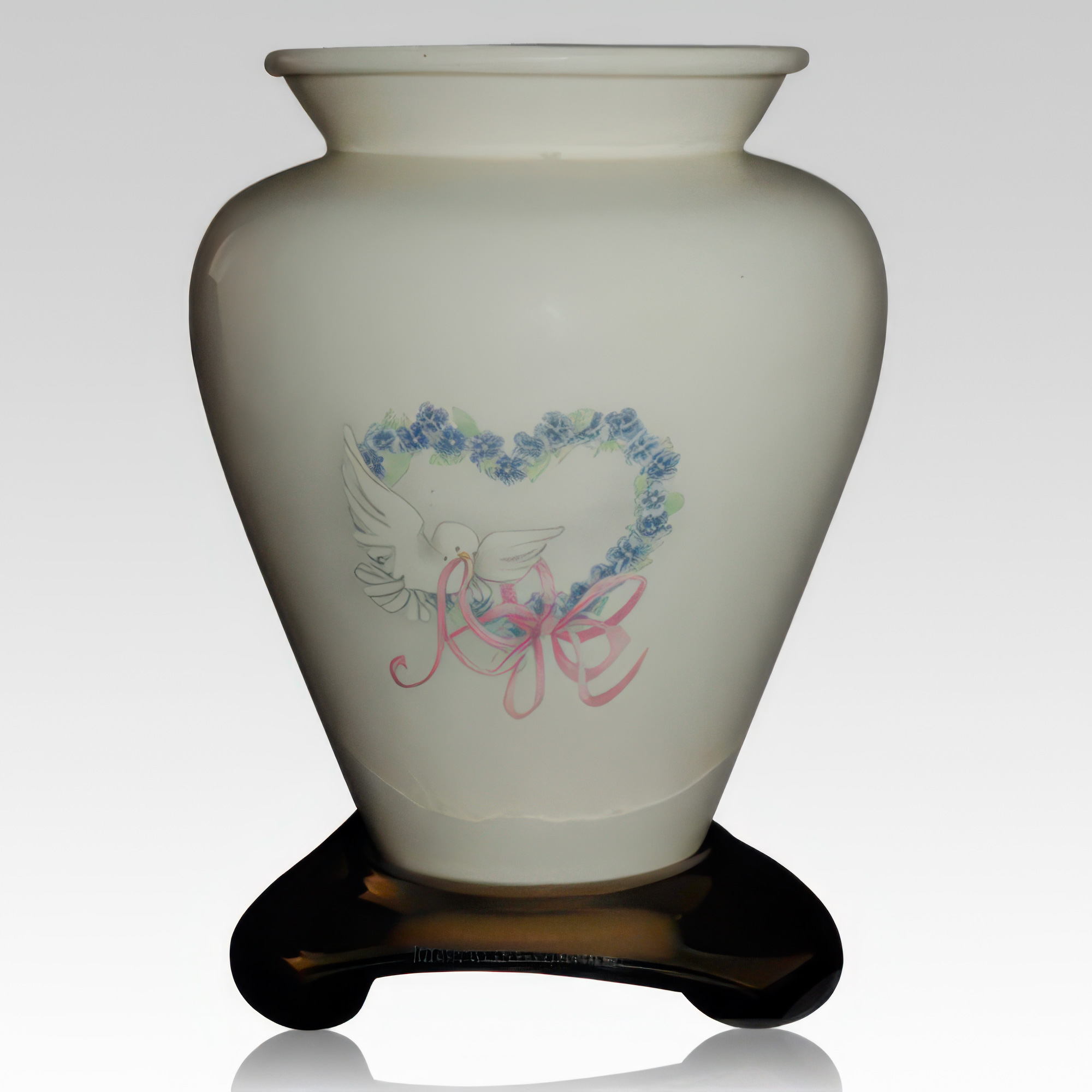
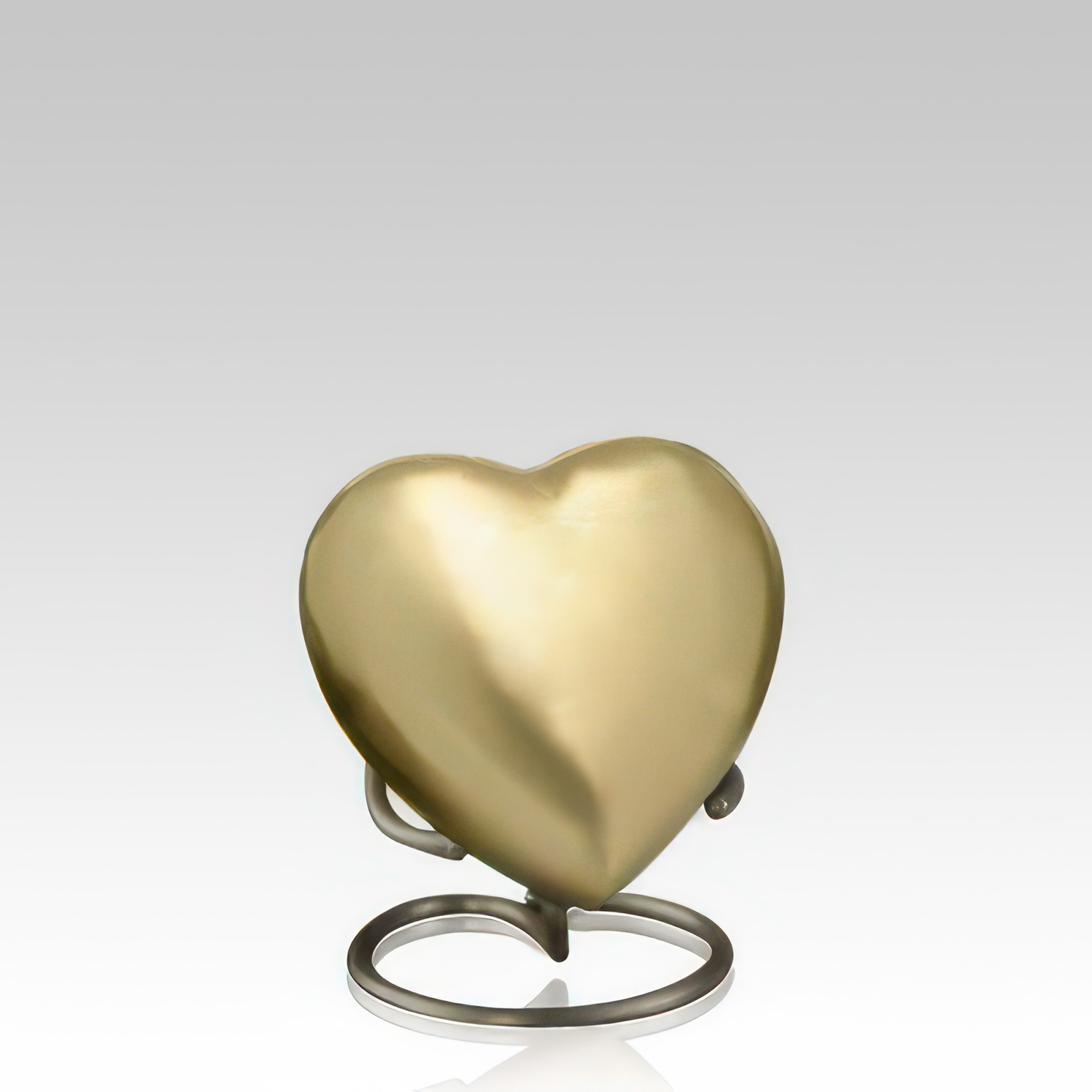
An urn, and the choice is less about the urn than about how much you are keeping. A full-size cremation urn holds everything; a keepsake portion lets the rest be buried, scattered or shared. That decision has to be made early — see below.
Jewelry. A sealed chamber in a pendant or ring holding a pinch of ashes. Cremation jewelry is the most common way people carry someone, and what cremation jewelry is covers how it works.
Cremation art. Ashes fused into hand-blown glass, so the light passes through them. Cremation art is where the ash becomes part of the object rather than sealed inside it, and for many people that is closer to what they wanted.
A flag case, if they served. Flag cases hold a folded burial flag, and it is usually the object a veteran's family puts up first.
A shelf to put it all on.Memorial shelf and home altar ideas covers height, count and arrangement — the difference between a memorial and a surface is almost entirely restraint.
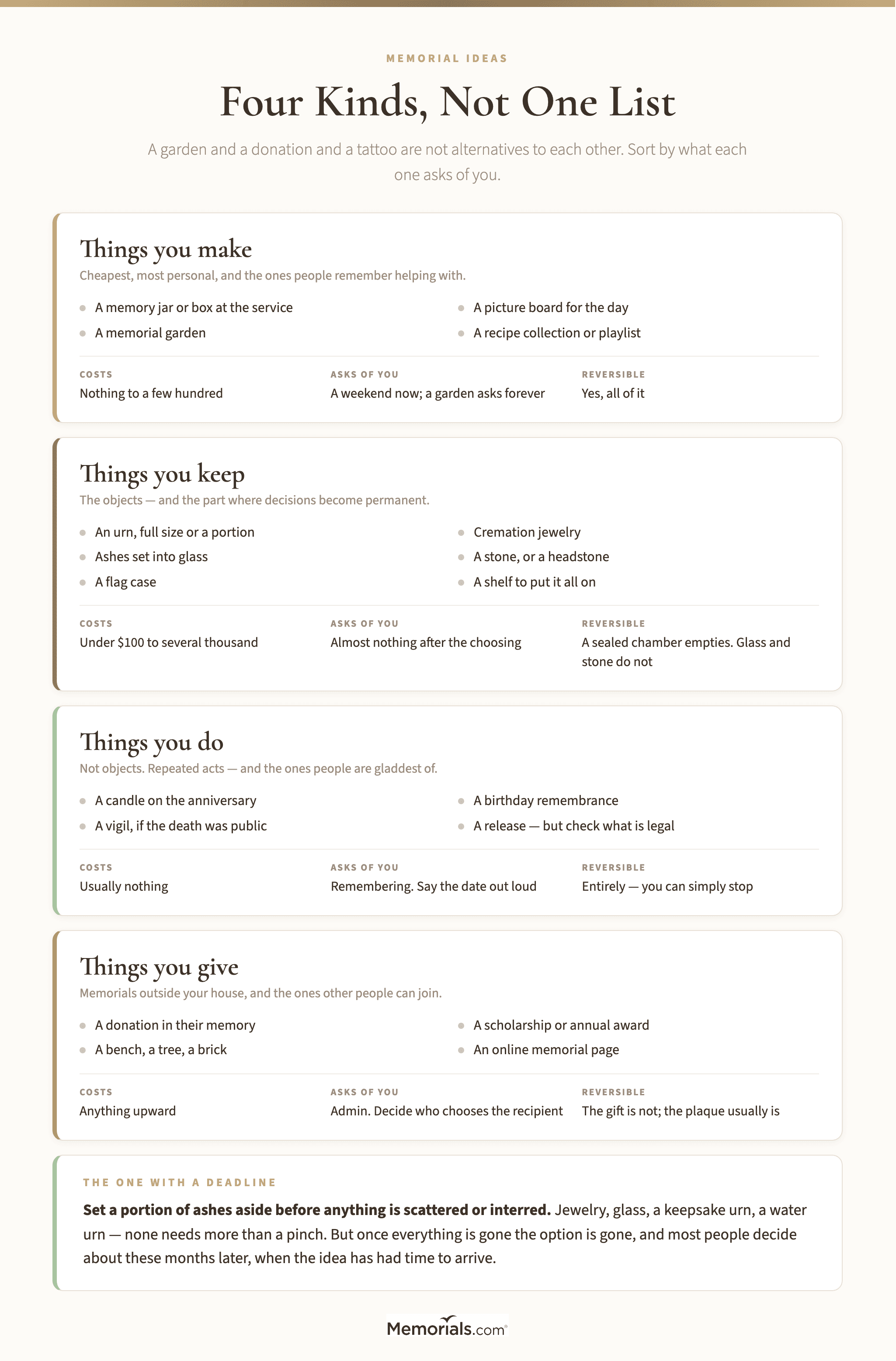
The four kinds, sorted by what they ask of you rather than what they are. The maintenance column is the one that decides which memorials still exist in five years, and it is the column almost every list of ideas leaves out entirely.
Things You Do
Not objects. Repeated acts, and they are what most people say they are glad of years later.
Lighting a candle on the anniversary, the birthday, and the days something happens they should have seen. Memorial candles and candlelight vigils covers the holders, the days families mark, and how to run a vigil when a death was sudden or public.
A release — lanterns, floating lights, seed paper. Worth knowing before you order fifty: sky lanterns are restricted across much of the US and the frames kill livestock where they land. Memorial lanterns covers what is legal and the versions that give you the same moment without the phone call from a farmer.
A birthday remembrance. For many families this is harder than the death anniversary, because it was previously a happy date. What works is something small and fixed — the same meal, the same walk, a candle at the same time — rather than something that has to be organized each year.
Saying the date out loud. Households that mark these days silently tend to stop within two years. The ones where somebody says "this is for Grandad, it's his birthday" keep going, because a ritual nobody names is one nobody remembers to continue.
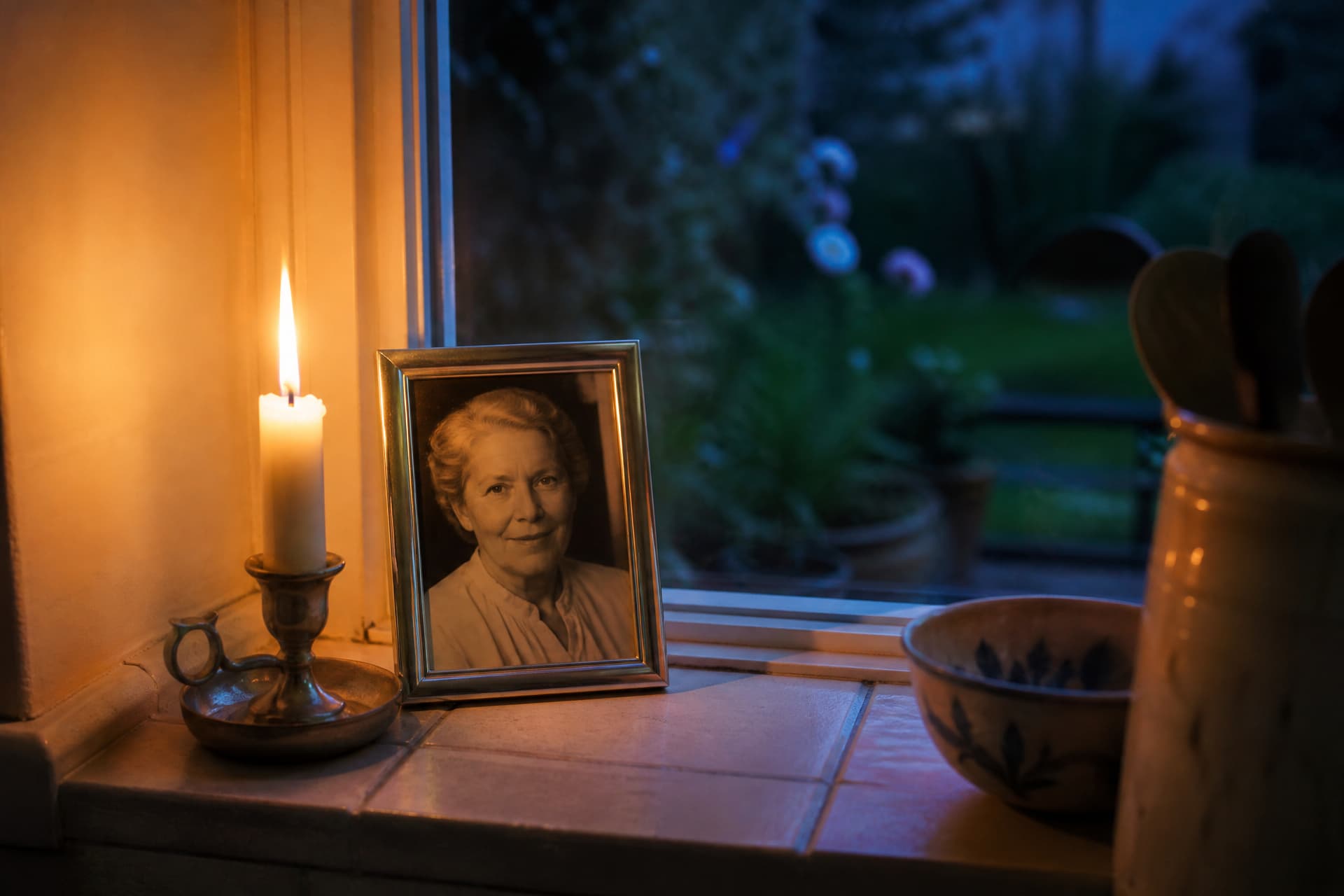
The memorial that survives is usually the smallest one. A candle on a windowsill asks nothing of anybody, costs almost nothing, and is still happening in year ten — which is more than can be said for most of what gets planned in the first month.
Things You Give
Memorials that exist outside your house, and the ones other people can join.
A donation in their memory is the most common and the most immediately useful. In lieu of flowers covers the wording and how the acknowledgments work — and note the phrase: a gift is made in memory of someone who has died, and in honor of someone living. Charities send the card to different people, so choosing wrong sends one to somebody who has died.
A memorial scholarship or fund, which is the most durable option on this page and the one people underestimate the work of. The practical shape: an annual award is far easier to sustain than an endowment, a school or existing community foundation will usually administer it for you, and the first conversation is with them rather than with a lawyer. Decide who chooses the recipient before you raise a dollar — that is the question that stalls most memorial funds.
A bench, a tree, a brick, a stadium seat. Public, read by strangers, and the wording should be in memory of rather than the warmer phrase for exactly that reason.
Naming a star. Worth being straightforward about: star registries are commercial services with no scientific standing, and the name is not recognized by any astronomical body. Plenty of families buy one anyway and are glad of the certificate, which is a fine reason — just buy it knowing what it is rather than what the marketing implies.
An online memorial wall. Free, instant, and it collects from people who could not travel. It also quietly disappears when a platform shuts down, so download whatever people write.
The outdoor version, and the one that asks the most. A garden is the memorial families most often build too large in the first month — a stone, three plants and somewhere to sit is a complete one, and it is the version still being visited in year five.
The Words
Every memorial on this page needs something written on it, and the same three phrases come up.
In Loving Memory is personal — it says you loved them. In Memory Of is neutral and works for anyone, which is why it belongs on donations, benches and anything public. In Memoriam is formal and belongs on programs and printed notices far more than on a headstone.
In loving memory vs in memory of vs in memoriam covers which fits which surface, how to spell memoriam (the single most common carving mistake), and thirty alternatives for when none of the three sounds like the person.
Set a Portion Aside — Before Anything Else
If there was a cremation, this is the one decision on the page with a deadline, and almost nobody is told about it.
Most memorial options need only a pinch of ashes. Jewelry, glass art, a keepsake urn, a water urn, even a tattoo — none of them consumes a meaningful portion. But once everything has been scattered or interred, the option is gone, and most people decide about these things months later, when the idea has had time to arrive.
Setting a small portion aside costs nothing and commits you to nothing. It is the single most practical thing in this guide. Sharing ashes between family members covers doing it fairly when several people want one, and whether it is wrong to separate cremated ashes covers the question properly, including the religious positions.
Ideas by Who Died
Remembrance ideas for deceased family members differ less by relationship than people expect, but a few things reliably do.
A parent or grandparent, especially after a long life, suits something public and something shared — a bench, a tree, a donation — because the circle of people who knew them is wide and most of them want somewhere to put it.
A spouse or partner usually needs something small and near. The objects that get used are the ones within reach: a shelf, something worn, a candle. Public memorials for a spouse are frequently built for other people rather than for the person left.
A sibling or a friend falls into the gap where the family's memorial is not yours. Something you keep — jewelry, a portion, a photograph — matters more here than anything communal, because you may have no standing in the arrangements.
A child changes the calculus entirely and this guide will not pretend otherwise. The things families most often say helped are the ones with no deadline attached: a portion set aside, a tree, a date marked quietly. Nothing needs deciding in the first year.
Someone estranged. Grief that is complicated is still grief, and a private memorial nobody else knows about is a legitimate answer.
A colleague or a community figure. The mistake is scale — a workplace memorial is usually best as one dedication rather than an accumulation of small tributes that becomes a maintenance problem nobody owns.
Ideas by What You Have
No space and no budget. A candle in a holder, a photograph, and a date you mark. That is a complete memorial and it is the one most likely to still be happening in a decade.
A shelf. Three to five objects at eye level, in a room you already walk through.
A yard. A stone set flush into a bed, one plant that flowers on a date that matters, and somewhere to sit.
A grave to visit. The wording is the decision; the stone is the delivery.
Nothing physical at all. A playlist, a recipe you cook on the day, a walk you take. These count, and for people who move often they are the only ones that travel.
Nobody publishes this in one place, and the ranges matter more than the numbers.
Free. A candle you already own, a playlist, a recipe collection, a date you mark, an online memorial page. These are not the budget version — they are the ones most likely to still be happening in ten years.
Under a hundred. An engraved garden stone, a keepsake urn holding a portion, a simple candle holder, a memory jar and cards.
One to five hundred. Most cremation jewelry, a photo urn, a fired ceramic photograph for a headstone, a decent memorial bench contribution.
Five hundred to a few thousand. A full-size urn in stone or bronze, cremation glass art, a garden built rather than assembled, a headstone.
Several thousand and up. A cremation diamond, a large memorial rock, a mausoleum niche, an endowed scholarship.
Two things worth knowing. The engraving is priced by the letter on most products, so a verse can cost more than the stone it is cut into. And a memorial several people contribute to — a bench, a tree, a fund — is usually the way to include a wide circle who all want to do something and have nowhere to put it.
Mistakes That Cost Something
Building it too big. The recurring failure. Scale it to the person you will be in month eight.
Buying before asking the venue. Cemeteries, funeral homes and parks all have rules, and the most common wasted expense in this whole area is something bought before a phone call that would have taken four minutes.
Engraving before the wording is settled. Granite is cut once. Read the proof aloud, letter by letter, at actual size.
Scattering everything. Covered above, and it is the only genuinely irreversible one.
Choosing "in honor of" for someone who has died. Or the reverse. It sends the acknowledgment to the wrong person.
Making it a shrine rather than a memorial. A space that cannot be cleaned, changed or moved has stopped being a memorial and become something else.
Doing it all at once. The best memorials accumulate. One thing now, one on the anniversary, one when you have the energy.
Frequently Asked Questions
What are the best ways to honor a deceased loved one? The ones you will maintain. A candle and a date beats a garden nobody waters, and most families end up with a small kept object, a repeated act, and something with their name on it.
What are some unique memorial ideas? Ashes set into blown glass, a memorial garden planted to flower on an anniversary, a recipe collection, an annual scholarship, or a photograph fired onto porcelain for a headstone.
How much should a memorial cost? Anything from nothing to several thousand. The cost is rarely what makes one succeed — maintenance is.
How soon should I decide? Only one thing is urgent: set a portion of ashes aside before anything is scattered or interred. Everything else is better decided at three to six months.
What do you write on a memorial?In Loving Memory for family, In Memory Of for anything public or given, In Memoriam for printed documents.
Can several people share one person's ashes? Yes, and it is common. Each portion is small, and dividing it early is far easier than revisiting it later.
What is a good memorial for someone with no grave? A shelf at home, a garden, a bench somewhere they liked, or something worn. None of them needs a plot.
Hub Library
This guide is part of the Memorials.com Memorial Tribute Ideas collection. Every page below goes considerably deeper than this overview into one way families mark a life.
Ashes in Tattoo Ink: Is It Safe, and Will an Artist Do It? — Why sterile is not the same as safe, what artists say and why many refuse, how much ash is actually involved, and the options that seal the ashes rather than putting them into you.
In Short
Sort by what it asks of you, not by what it is. Set a portion of ashes aside before anything is scattered. Keep the first memorial smaller than you want to. Then add to it on the anniversaries, in the years when you have the energy — which is how the memorials that last actually get built.