🏬Supersize Online Funeral Retailer🪦1000's of Headstones⚱️Over 10,000 Cremation Urns⚰️Caskets Overnight Delivery🛒Funeral & Memorial Superstore🚚FREE Shipping on ALL Orders👨👩👧👦Helping Families for over 20 Years💰Lowest Price Guarantee🏬Supersize Online Funeral Retailer🪦1000's of Headstones⚱️Over 10,000 Cremation Urns⚰️Caskets Overnight Delivery🛒Funeral & Memorial Superstore🚚FREE Shipping on ALL Orders👨👩👧👦Helping Families for over 20 Years💰Lowest Price Guarantee
🏬Supersize Online Funeral Retailer🪦1000's of Headstones⚱️Over 10,000 Cremation Urns⚰️Caskets Overnight Delivery🛒Funeral & Memorial Superstore🚚FREE Shipping on ALL Orders👨👩👧👦Helping Families for over 20 Years💰Lowest Price Guarantee🏬Supersize Online Funeral Retailer🪦1000's of Headstones⚱️Over 10,000 Cremation Urns⚰️Caskets Overnight Delivery🛒Funeral & Memorial Superstore🚚FREE Shipping on ALL Orders👨👩👧👦Helping Families for over 20 Years💰Lowest Price Guarantee
Choosing an urn often feels like it should be as simple as picking a style you love. Then you see capacities listed in cubic inches, and everything suddenly looks like a math problem.
It is not complicated once you know what those numbers mean and how they connect to the amount of cremated remains you need to place inside. This guide breaks down urn capacity, common size ranges, and a few real world situations that can change what “the right size” looks like.
What “cubic inches” actually means (and why it matters)
Urn capacity is measured by interior volume, almost always shown as cubic inches (in³). Think of one cubic inch as a 1 inch by 1 inch by 1 inch cube. That unit is used because the outside of an urn does not reliably tell you how much room is inside.
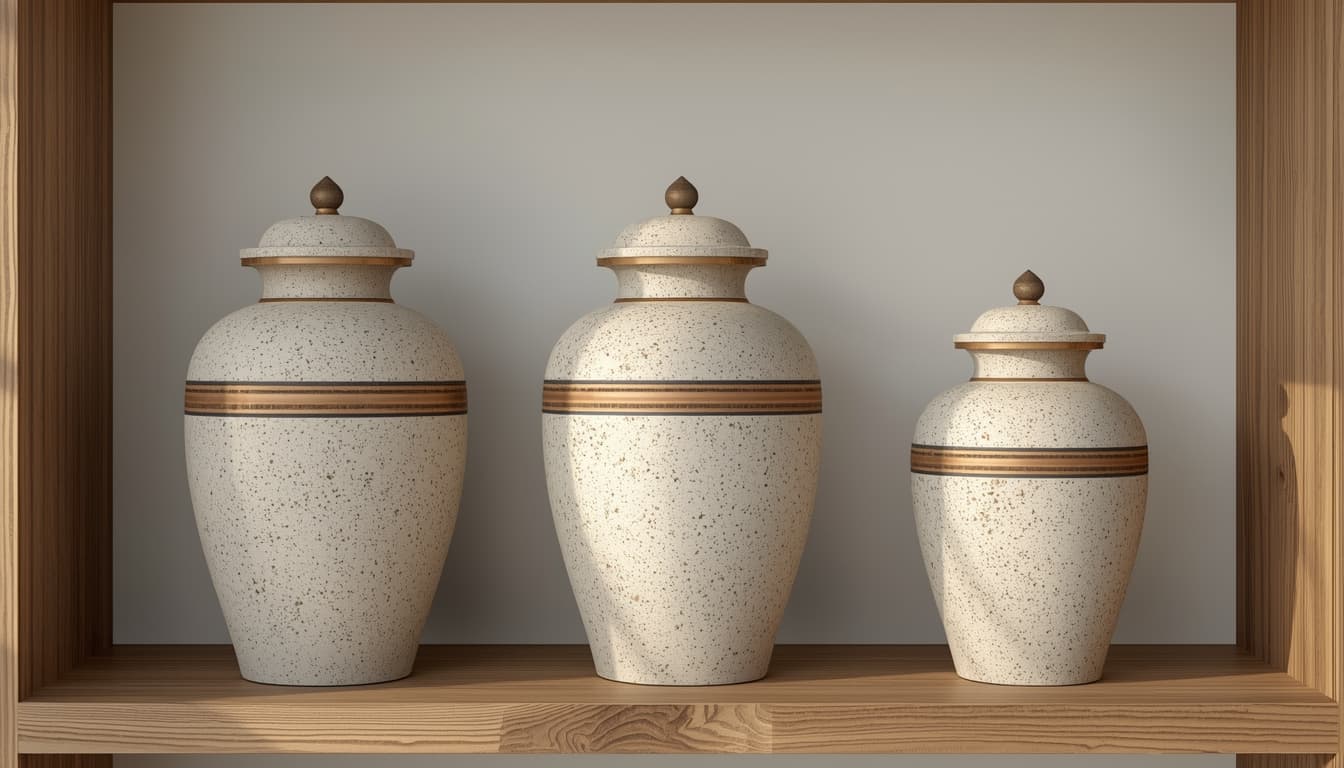
Two urns can look similar on a shelf and still hold different amounts because of:
thick walls (wood, metal, stone, some ceramics)
a tapered interior (narrower toward the base)
decorative bases and pedestals that take away interior space
So when you are comparing urns, focus on the listed capacity in cubic inches, not just height, width, or the product photo.
The simplest sizing rule (with a small cushion)
The most common guideline is:
1 pound of body weight = about 1 cubic inch of urn capacity. For more details on calculating the right size for your needs, see our guide on What Size Urn Do I Need?
People often add a little extra space to make the transfer easier and to avoid compressing the remains. Many families also prefer extra room in case they want to place a small note or other tiny memento inside (only if appropriate for the urn design).
A practical way to think about it is:
Recommended capacity ≈ body weight (lb) + 5% to 10%
After you have a target capacity, you can choose an urn type that fits your plans, whether that is home placement, burial, a niche in a columbarium, or sharing among relatives.
Here are quick rules many families use:
Standard adult: about 200 in³
Companion (two people): about 400 in³
When unsure: round up, not down
Keepsakes: sized for a portion, not the full amount
Common urn sizes at a glance
The categories below are general ranges you will see across many retailers and manufacturers. The exact cutoffs vary by brand, but the pattern stays consistent.
Urn type / use case
Typical capacity range (in³)
Often chosen for
Token or sharing keepsake
1 to 30
A small portion for one person to keep
Keepsake (larger)
30 to 100
Sharing among a few relatives, or holding some remains plus small mementos
Child / juvenile
50 to 120
Infants, children, and some teens depending on size
Standard adult
175 to 225
Most adults
Oversize adult
250 to 400
Larger adults, or when you want extra room
Companion (double)
400+
Two adults together (sometimes with a divider)
That “standard adult” number is why you will see 200 cubic inches mentioned so often. It is a common industry baseline because it suits many adults comfortably.
Estimating the capacity you need by weight
If you know the person’s approximate weight, you can usually get to the right urn size in under a minute. Use the 1 lb to 1 in³ guideline, then add a bit of cushion.
This table gives a simple starting point:
Body weight (lb)
Suggested urn capacity (in³)
Typical category
100
110
Child / small adult urn
150
165
Small adult to standard adult
180
200
Standard adult
200
220
Standard adult (roomier fit)
230
250
Oversize adult
275
300
Oversize adult
350
385 to 400
Oversize adult (near companion size)
If you are close to a category boundary, sizing up is usually the calmer choice. An urn can be bigger than needed without creating a problem. Too small is where the stress shows up.
When exterior dimensions mislead you
It is tempting to look at an urn that is “tall enough” and assume it will hold what you need. Height alone can be a poor clue.
A few common design details reduce interior volume:
If you are shopping online, the safest move is to treat capacity as the deciding metric and use dimensions only to confirm where it will fit in your home or niche.
Special situations that can change the amount of remains
Most families will be fine with the standard guideline, but a few situations deserve extra care.
After a paragraph like this, it helps to keep a short “checklist” in mind:
Aquamation (water cremation): often produces more remains than flame cremation, so extra capacity is wise.
Very tall or heavy adults: an oversize urn can prevent a tight fit.
Very frail or ill adults: sometimes yields less, though it is still safer to avoid going too small.
Unknown weight: measure the temporary container or ask the provider for the volume.
One more note that reassures many people: medical implants typically do not create “extra ashes” you need to plan for. Items like joint replacements do not burn the way bone does and are generally separated out after cremation. Urn sizing is still best based on body weight and the returned cremated remains.
What if you are dividing ashes among family?
Sharing is common. Some families keep a main urn at home and place small amounts into keepsake urns or cremation jewelry for relatives.
The sizing question becomes: do you want one urn to hold everything, or do you want the total divided?
A straightforward approach looks like this:
Pick a primary urn sized for the full amount (often a standard adult size).
Decide how many keepsakes you want to fill.
Leave enough remains in the primary urn to match your plan.
Keepsakes vary widely. Some are designed for a symbolic amount, while others can hold a substantial portion. If you are creating several keepsakes, you may want to choose slightly larger keepsakes than you think you need. It leaves room for a comfortable transfer and reduces the chance of spills.
Companion urns and “double” capacity
A companion urn is made to hold two people’s remains together. Many are around 400 in³, which is basically two standard adult urns combined.
Some companion urns have a divider with two separate compartments. Others use one shared chamber. In either design, it helps to know the approximate capacity you need for each person, not just the combined total.
Here is a practical way to sanity check the numbers:
Person A estimated need: weight (lb) + small cushion
Person B estimated need: weight (lb) + small cushion
Companion urn capacity: should meet or exceed A + B
If one person is much larger than the other, look for an urn that is comfortably above 400 in³ or consider a design that lets each person have an appropriately sized individual urn.
If you do not know the weight, measure what you have
Sometimes the only thing you have is the temporary container from the crematory (often a plastic bag inside a basic box). If weight is unknown, you can still get a good answer by measuring volume.
Options that usually work:
Check paperwork from the crematory or funeral home. They may list the container’s capacity or the decedent’s weight.
Look for markings on the temporary container or box.
Ask the provider directly how much volume is in the bag or what urn capacity they recommend.
If you already purchased an urn and it feels tight, do not force the transfer. A slightly larger urn is often the simplest fix, and many retailers have return policies that help if the urn is unused and in original condition.
Material and style choices that interact with size
Style is personal, but it can affect how easy the process is.
Metal and hardwood urns can be very sturdy, yet thick walls may reduce interior space compared with a thinner ceramic urn of similar outside size. Some artistic urn shapes also have less usable interior volume than a classic vase shape.
Before you buy, match the urn to the plan:
Home display: almost any style works if capacity is right and the footprint fits your shelf.
Columbarium niche: confirm both capacity and exterior dimensions required by the cemetery.
Burial: cemeteries may require an urn vault; confirm size compatibility early.
If you are shopping with Memorials.com, capacity is listed on product pages, and their selection spans standard adult, oversize, companion, and keepsake options, including pet urns. Practical policies, like free ground shipping and a 30 day return window, can make it easier to adjust if you realize you need a different size (always verify current terms before ordering).
Pet urn sizing: similar rule, different scale
Pet urn sizing often follows the same 1 lb to 1 in³ guideline, using the pet’s weight. Because pets range from very small to very large, pet urns also range widely.
Small keepsake pet urns may hold only a token amount. Full size pet urns are meant to hold all remains. If your pet was cremated privately and you received a full set of remains back, choose a capacity that matches the pet’s approximate weight, then add a little extra space the same way you would for a person.
A quick way to choose confidently
You do not need perfect numbers. You need a reasonable estimate and a little margin.
If you want a simple process, use this:
Step 1: Estimate weight in pounds.
Step 2: Choose capacity at weight plus 5% to 10%.
Step 3: Select the urn category that matches your plan (standard, oversize, companion, keepsake).
Step 4: Double check any space constraints (niche dimensions, shelf depth, burial container requirements).
If you are between sizes, sizing up tends to keep the process calmer, especially on a day when you want fewer decisions and fewer surprises.