🏬Largest Funeral Retailer Online📦Over 50,000 products🛒Funeral & Memorial Superstore🚚FREE Shipping on ALL Orders👨👩👧👦Helping Families for over 20 Years💰Lowest Price Guarantee🏬Largest Funeral Retailer Online📦Over 50,000 products🛒Funeral & Memorial Superstore🚚FREE Shipping on ALL Orders👨👩👧👦Helping Families for over 20 Years💰Lowest Price Guarantee
🏬Largest Funeral Retailer Online📦Over 50,000 products🛒Funeral & Memorial Superstore🚚FREE Shipping on ALL Orders👨👩👧👦Helping Families for over 20 Years💰Lowest Price Guarantee🏬Largest Funeral Retailer Online📦Over 50,000 products🛒Funeral & Memorial Superstore🚚FREE Shipping on ALL Orders👨👩👧👦Helping Families for over 20 Years💰Lowest Price Guarantee
Cost of Cremation vs Burial: Full Comparison | Memorials.com Info Center
🏬Largest Funeral Retailer Online📦Over 50,000 products🛒Funeral & Memorial Superstore🚚FREE Shipping on ALL Orders👨👩👧👦Helping Families for over 20 Years💰Lowest Price Guarantee🏬Largest Funeral Retailer Online📦Over 50,000 products🛒Funeral & Memorial Superstore🚚FREE Shipping on ALL Orders👨👩👧👦Helping Families for over 20 Years💰Lowest Price Guarantee
Cremation vs Burial: A Comparison of Each Memorial Service
cremation
Choosing between cremation and burial is one of the most significant decisions a family faces after losing a loved one. Both options carry deep personal, spiritual, and financial weight, and there is no universally right answer.
For many families, the cost of cremation vs burial plays a major role in that decision. Cremation typically costs significantly less than traditional burial, though the final price depends on the type of service, the products selected, and your location. Understanding these costs upfront can reduce stress during an already difficult time and help you plan a meaningful farewell that fits your budget.
This guide breaks down every cost factor, compares service types side by side, and addresses the religious, environmental, and practical considerations that shape this choice. If your family has already decided on cremation and you are ready to explore urn options, our guide to choosing a cremation urn walks you through every factor to consider.
How Much Does Cremation Cost?
Cremation costs vary widely depending on the type of service you choose and where you live. The three most common cremation options are direct cremation, cremation with a memorial service, and full-service cremation with a viewing.
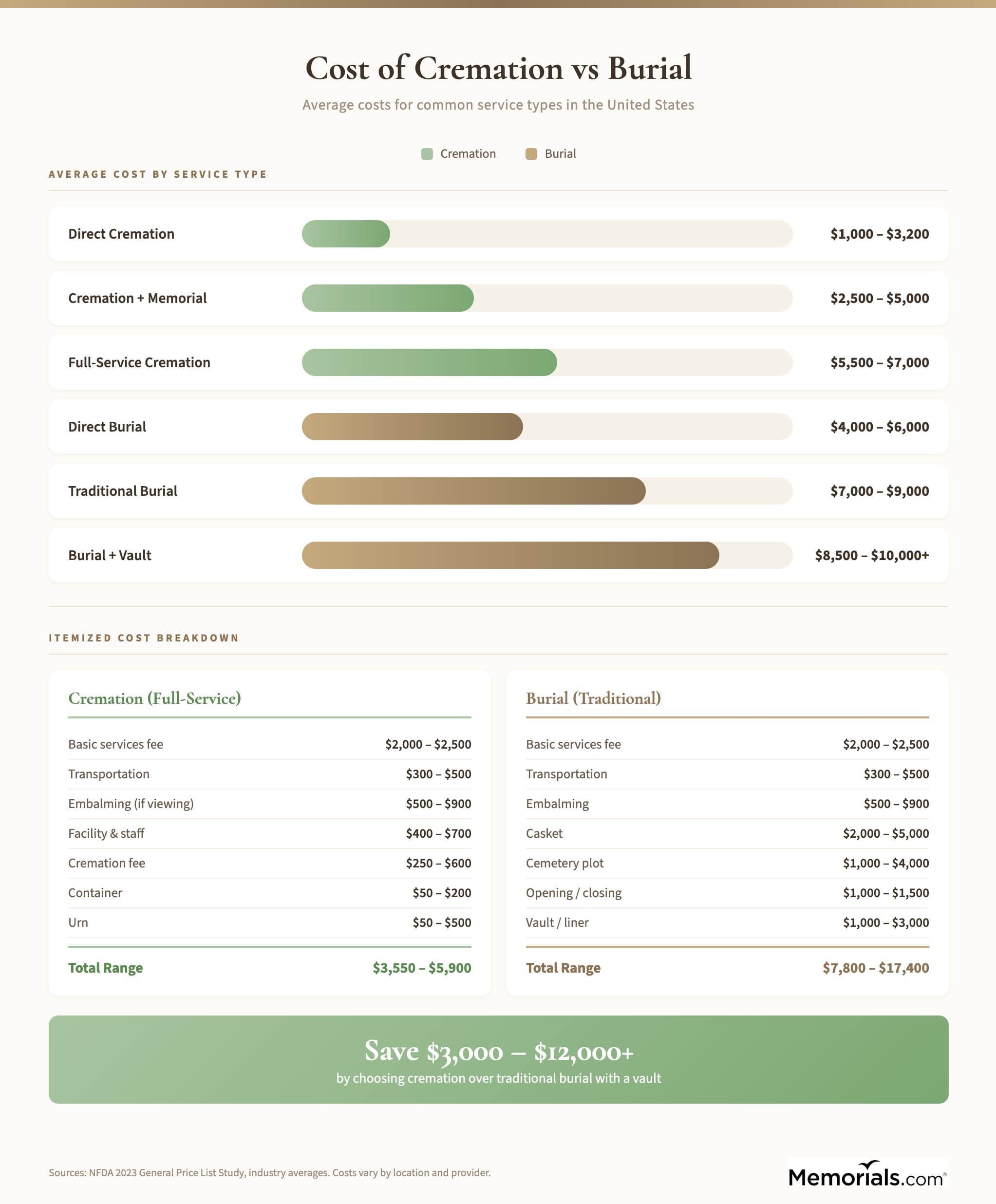
Direct cremation is the most affordable option. The body is transported directly to the crematory and cremated without a viewing or ceremony. According to recent industry data, direct cremation averages between $1,000 and $3,200 nationwide. For a detailed look at how direct cremation works, read our guide to direct cremation.
Cremation with a memorial service includes a gathering held after the cremation. Families receive the cremated remains and can plan a ceremony at a time and location of their choosing. This option typically costs between $2,500 and $5,000.
Full-service cremation with a viewing most closely mirrors a traditional funeral. The body is embalmed and present for a visitation before cremation takes place. The National Funeral Directors Association (NFDA) reports the median cost of a cremation with viewing and ceremony at approximately $6,280.
A standard cremation fee typically covers the following:
Basic services fee — The funeral home's professional services charge for coordinating paperwork, permits, and logistics.
Transportation — Transfer of the body from the place of death to the crematory or funeral home.
Cremation fee — The actual cremation process, charged by the crematory.
Cremation container — A simple combustible container used during cremation (required in most states).
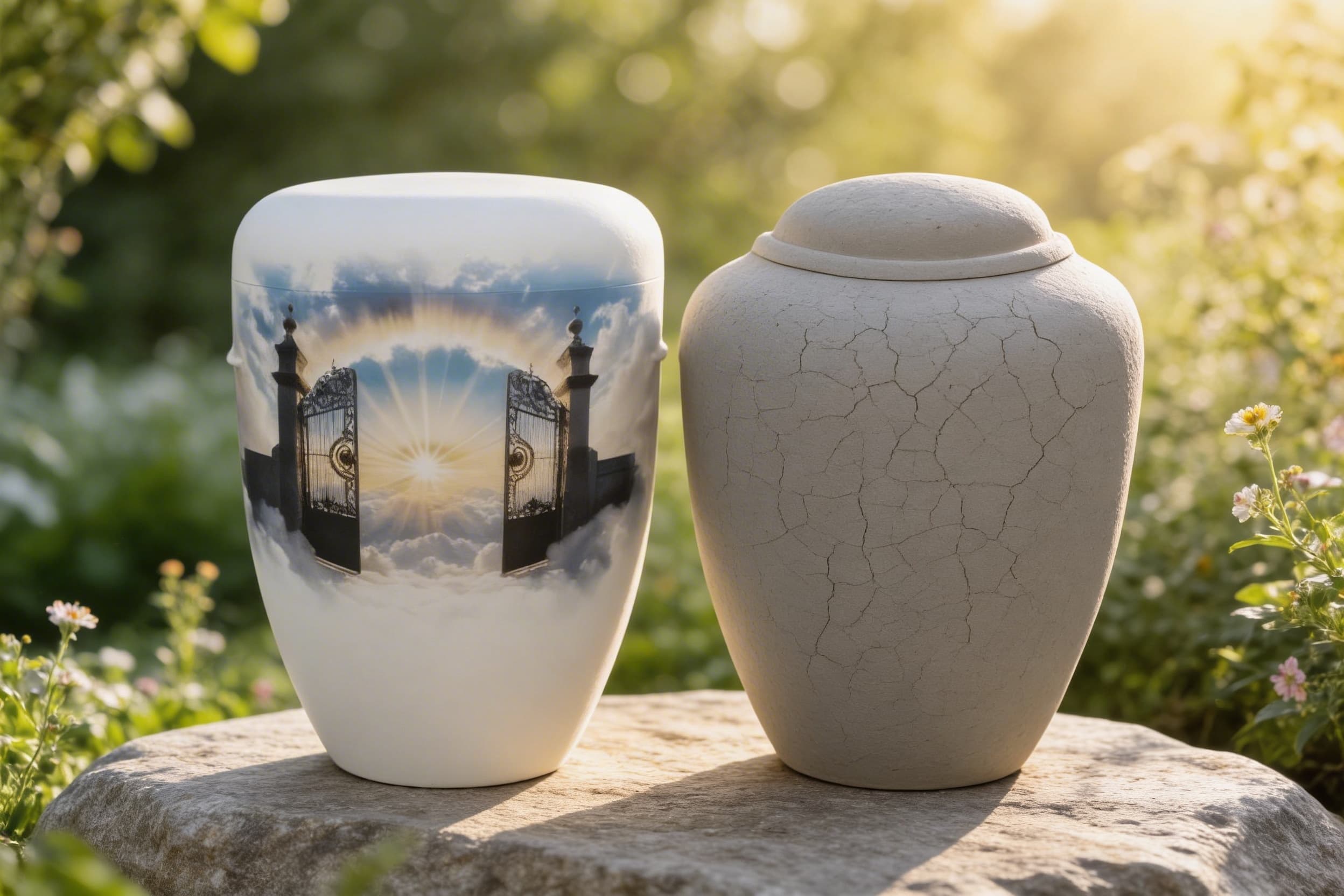
Urn — A permanent container for the cremated remains. Prices range from under $50 for a basic urn to several hundred dollars for handcrafted cremation urns. For a full breakdown by material and style, see our guide on how much does a cremation urn cost.
Optional additions that raise the cost include embalming (if a viewing is held), facility rental for services, a printed memorial package, and a rental casket for the viewing.
How Much Does Burial Cost?
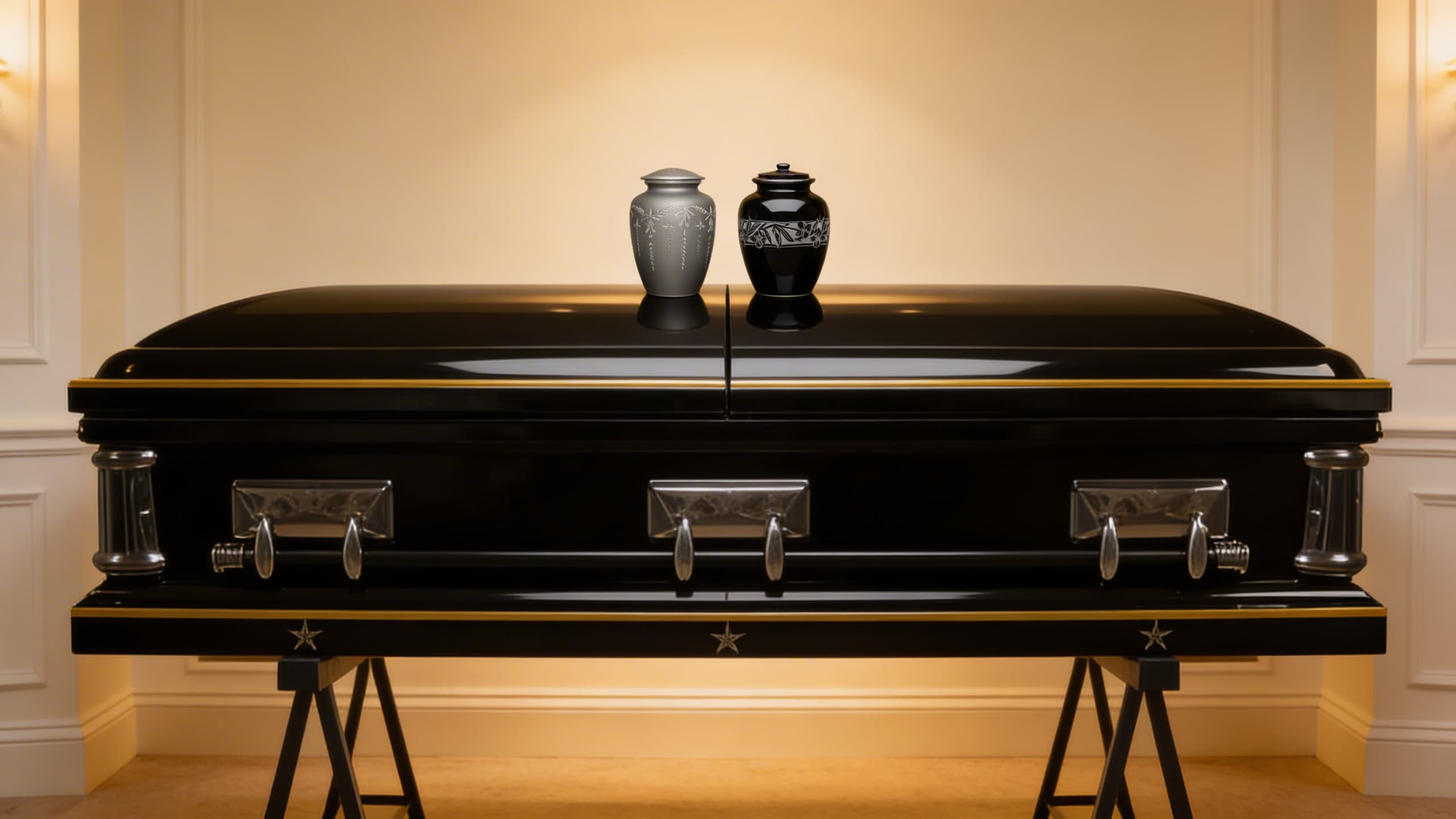
Traditional burial is generally the more expensive option. The NFDA estimates the median cost of a funeral with viewing and burial at approximately $7,848, and that figure climbs to around $9,400 or more when a burial vault is included. These totals do not include cemetery fees, which add another layer of expense.
Burial Cost Breakdown
Here is what a typical burial involves:
Basic services fee — Similar to cremation, this covers the funeral home's administrative and coordination services.
Embalming and body preparation — Required for open-casket viewings, embalming typically costs $500 to $900.
Casket — One of the largest single expenses. A mid-range casket costs between $2,000 and $5,000, though prices range from a few hundred dollars for simple models to $10,000 or more for premium materials. Learn more about your options in our guide to the different types of caskets.
Viewing and funeral ceremony — Facility fees and staffing for the visitation and service.
Hearse and transportation — Transporting the body to the funeral home, ceremony, and cemetery.
Cemetery plot — Varies enormously by location, from $1,000 in rural areas to $4,000 or more in metropolitan cemeteries.
Opening and closing the grave — The physical work of digging and filling the grave, typically $1,000 to $1,500.
Burial vault or grave liner — Most cemeteries require one to prevent the ground from settling. Costs range from $1,000 to $10,000.
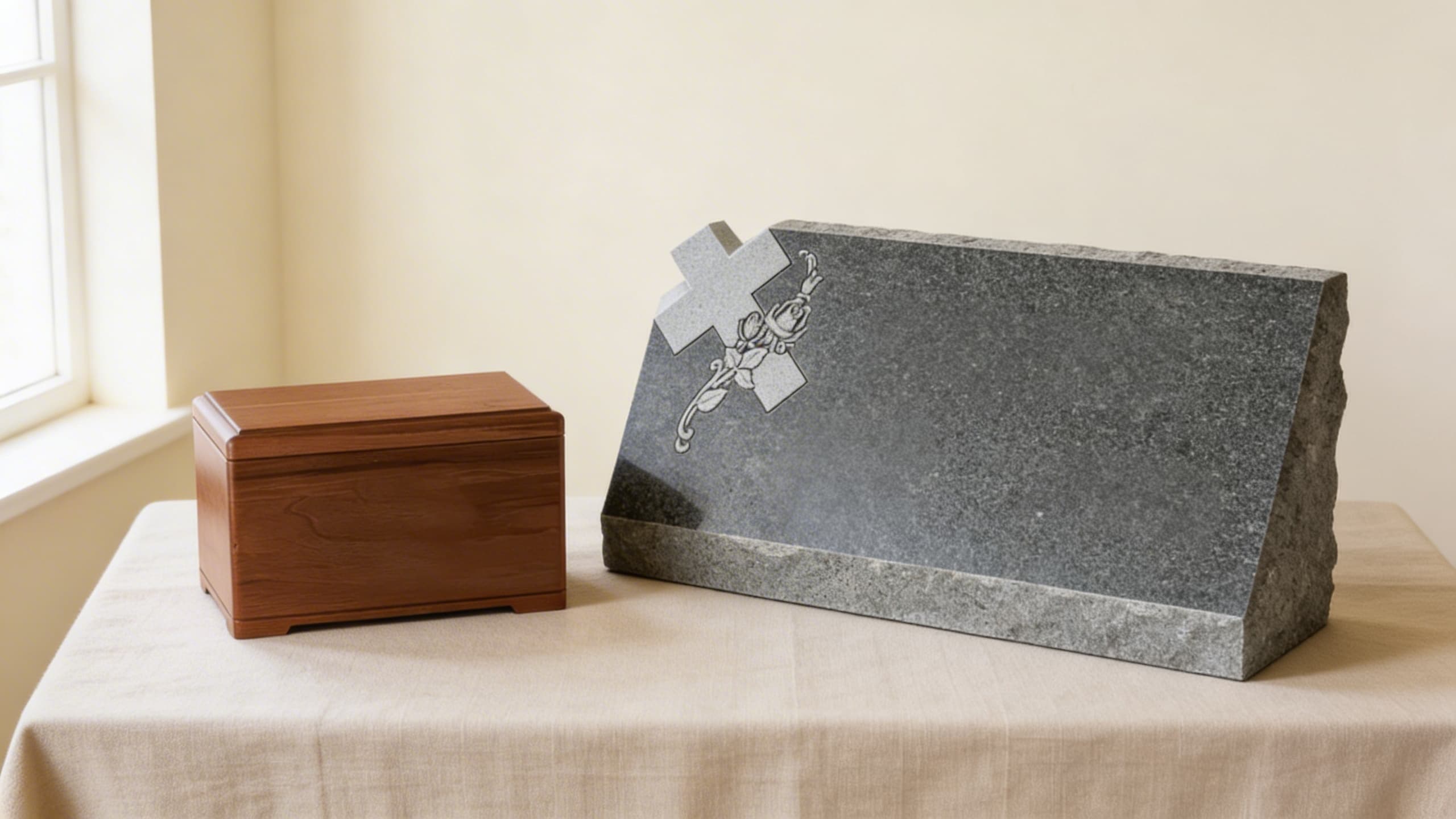
Headstone or grave marker — A lasting memorial at the gravesite. Basic grave markers start around $500, while larger headstones range from $1,000 to $3,000 or more.
For a broader look at all funeral-related expenses, see our complete guide on how much a funeral costs.
Cremation vs Burial Cost: A Side-by-Side Comparison
The following table summarizes average costs for the most common service types. Actual prices vary by provider and region.
Service Type
Average Cost Range
Direct cremation
$1,000 – $3,200
Cremation with memorial service
$2,500 – $5,000
Full-service cremation with viewing
$5,500 – $7,000
Direct burial (no service)
$4,000 – $6,000
Traditional burial with viewing
$7,000 – $9,000
Traditional burial with vault
$8,500 – $10,000+
These ranges do not include optional extras like flowers, obituary notices, or a reception. Cemetery costs for burial (plot, opening/closing, vault) can add $3,000 to $8,000 or more to the burial total.
Why Cremation Costs Less
The cost gap between cremation and burial comes down to the number of required products and services. Burial requires a casket, embalming, a cemetery plot, grave opening and closing, and usually a vault or liner. Cremation eliminates most of these expenses. A direct cremation requires only transportation, the cremation itself, a simple container, and a basic urn.
Even when families choose a full-service cremation with a viewing, the total is typically $2,000 to $3,000 less than a comparable burial because the cemetery-related costs are avoided entirely unless the family chooses to inter the urn.
Hidden Costs to Watch For
Both cremation and burial can include charges that catch families off guard:
Cash advance items — Expenses the funeral home pays on your behalf (death certificates, clergy honoraria, flowers, obituaries) and passes through to you.
Cemetery surcharges — Endowment care fees, weekend or holiday surcharges, and monument installation fees.
Urn niche or columbarium fees — If you choose to place the urn in a columbarium rather than keeping it at home, expect to pay $1,000 to $5,000.
Cremation jewelry — Some families choose cremation jewelry to keep a small portion of remains close. These are typically $50 to $300 per piece.
Under the FTC's Funeral Rule, funeral homes are required to provide an itemized General Price List so you can see every charge before committing. Always request this document and compare quotes from multiple providers.
Cremation vs Burial: Beyond Cost
While cost is a major factor, other considerations shape this decision just as powerfully. Here is how cremation and burial compare across the dimensions that matter most to families.
Flexibility and Memorialization
Cremation offers more flexibility in how, when, and where you memorialize a loved one. Cremated remains can be kept at home in an urn, placed in a columbarium niche, buried in a cemetery using an urn vault, scattered in a meaningful location, or divided among family members using keepsake urns.
There is no time pressure to hold a service immediately. Many families choose to hold a celebration of life weeks or even months after the cremation, giving distant relatives time to plan travel.
Burial creates a permanent, physical resting place that families can visit for decades. For many, the presence of a gravesite marked with a headstone or monument provides deep comfort and a sense of connection. To understand the differences between memorial markers, see our guide on headstone vs grave marker.
Environmental Impact
Neither option is without environmental impact, though the specifics differ.
Traditional burial involves embalming chemicals (typically formaldehyde-based), non-biodegradable caskets, concrete vaults, and ongoing cemetery maintenance. Over time, these materials can affect surrounding soil and groundwater.
Cremation generates carbon emissions and requires significant energy during the two-to-three-hour process. However, its long-term environmental footprint is estimated to be roughly 10% smaller than burial because it eliminates the ongoing land use and maintenance that cemeteries require.
For families prioritizing sustainability, green burials offer an alternative. These use biodegradable materials, skip embalming, and allow the body to return to the earth naturally. Biodegradable urns serve a similar purpose for families who choose cremation followed by earth or water burial.
Alkaline hydrolysis, sometimes called water cremation or flameless cremation, is an emerging option now legal in over 20 states. This process uses water and alkalinity rather than flame, consuming roughly 85% less energy than traditional cremation.
Cremation and Burial Popularity Trends
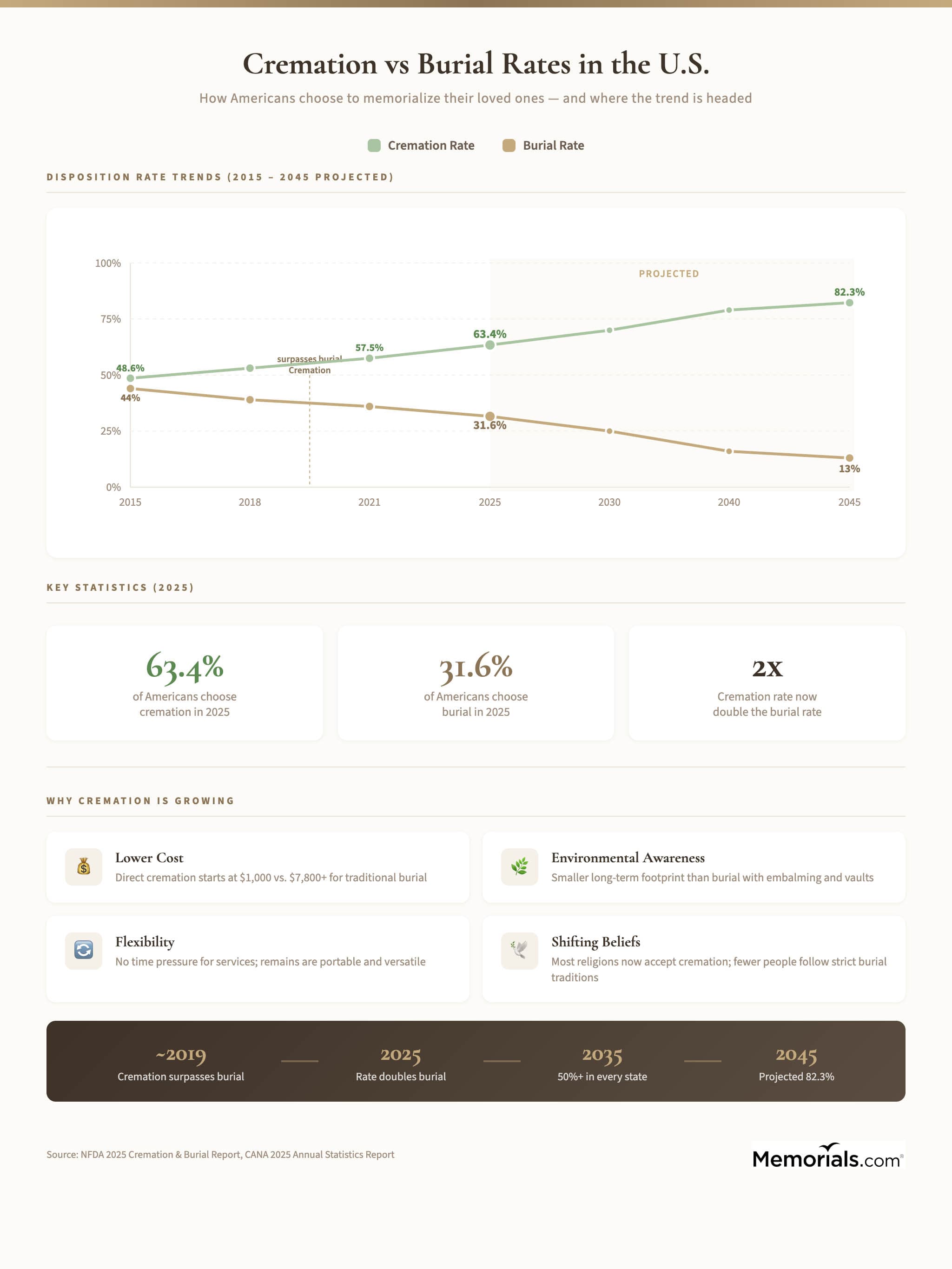
Cremation has become the most common form of final disposition in the United States. According to the NFDA's 2025 Cremation & Burial Report, the projected cremation rate for 2025 is 63.4%, while the burial rate stands at 31.6%. By 2045, the cremation rate is expected to reach 82.3%.
Several factors drive this trend. The rising cost of traditional burial has made cremation more appealing for budget-conscious families. Weakening religious prohibitions, greater geographic mobility (making a fixed burial plot less practical), and growing environmental awareness have all contributed.
Cremation, Burial, and Religious Beliefs
Faith plays an important role in this decision for many families. Religious teachings vary significantly, and consulting with your clergy is always recommended.
Christianity — Most Christian denominations accept cremation, though some express a preference for burial. The Catholic Church permits cremation but requires that cremated remains be kept together and placed in a sacred location rather than scattered or divided. Many Protestant denominations leave the choice to the individual.
Judaism — Orthodox Judaism prohibits cremation and requires burial as soon as possible. Reform and Conservative Judaism have become more open to cremation in recent years, though burial remains preferred.
Islam — Islamic law requires burial and does not permit cremation. Bodies must be washed according to ritual, wrapped in a simple shroud, and buried promptly without a casket.
Hinduism and Buddhism — Both traditions generally favor cremation. In Hinduism, cremation is considered a sacred act that releases the soul. Buddhism also accepts cremation, following the example of the Buddha's own cremation.
Non-religious families — Without religious constraints, the decision often comes down to cost, environmental values, family tradition, and personal preference.
Combining Cremation and Burial
Choosing between cremation and burial does not have to be an either-or decision. Many families choose cremation followed by burial of the urn, giving them the affordability of cremation along with a permanent gravesite for visitation. To understand the full expense involved, read our guide on the cost to bury cremated ashes.
Burying cremated remains requires an urn vault at most cemeteries. These protective outer containers are typically made of concrete, metal, or stone and cost significantly less than full-size burial vaults. For a breakdown of what cemeteries require and what to expect price-wise, see our guide to urn vault requirements.
Other options for cremated remains include:
Columbarium placement — An above-ground structure with niches designed to hold urns. Our cremation niche and columbarium guide explains what to expect in terms of options and pricing.
Scattering — Ashes can be scattered at sea, in a memorial garden, or at a location meaningful to the deceased. Check local regulations, as permit requirements vary. For ocean scattering, learn more about water burial.
Home display — Many families keep the urn in their home, often on a mantle or in a dedicated memorial space.
Cremation jewelry — A small portion of remains can be sealed inside a wearable pendant or keepsake piece.
Memorial art — Ashes can be incorporated into glass art, cremation art, or even planted with a memorial tree.
Regardless of which option you choose, there are practical ways to reduce expenses:
Compare providers. The FTC's Funeral Rule requires funeral homes to give you prices over the phone. Call at least three to five providers in your area before making a decision.
Consider direct cremation or direct burial. Eliminating the viewing and formal ceremony reduces costs by thousands of dollars. You can still hold a memorial gathering separately, at home or in a meaningful location, at little or no additional cost.
Ask about package pricing. Many funeral homes offer bundled packages that cost less than purchasing each service individually.
Look into veteran benefits. Eligible veterans and their spouses may qualify for burial benefits through the Department of Veterans Affairs, including a free burial plot at a national cemetery and a government headstone or marker. Learn more in our guide to VA burial benefits.
Explore burial insurance. A final expense policy can help cover cremation or burial costs and spare your family from financial strain. Read our article on whether burial insurance is worth it.
Pre-plan and prepay. Locking in current prices through a prepaid funeral plan protects against future cost increases and removes the burden of last-minute decision-making from your family.
Frequently Asked Questions
Is cremation or burial cheaper?
Cremation is almost always cheaper than burial. A direct cremation can cost as little as $1,000, while a traditional burial with a vault typically runs $8,500 to $10,000 or more. Even a full-service cremation with a viewing is generally $2,000 to $3,000 less than a comparable burial.
Can you have a funeral service with cremation?
Yes. Cremation does not prevent you from holding a formal funeral service. Many families hold a visitation with the body present before cremation, or they plan a memorial service or celebration of life after receiving the cremated remains. For ideas on planning a post-cremation gathering, see our guide to hosting a memorial for cremation.
What is the cheapest cremation option?
Direct cremation is the most affordable. It skips the viewing, embalming, and formal ceremony entirely. The body is cremated shortly after death, and the remains are returned to the family, usually within a few business days.
Do you need a casket for cremation?
No. Cremation does not require a traditional casket. Most crematories require a rigid, combustible container, but this can be a simple cardboard or fiberboard box. If the family wants a viewing before cremation, a rental casket is available at most funeral homes for a fraction of the purchase price. You can also choose a dedicated cremation casket designed specifically for this purpose.
What happens to the ashes after cremation?
Cremated remains are returned to the family in a basic container or the urn of their choice. From there, families can keep the urn at home, bury it in a cemetery, place it in a columbarium, scatter the ashes, divide them into keepsake urns, or incorporate them into cremation jewelry or memorial art.
Making the Right Choice for Your Family
The decision between cremation and burial is deeply personal. Cost, faith, family tradition, environmental values, and the wishes of the deceased all play a role. There is no wrong answer, and many families find comfort in combining elements of both, such as cremation followed by a graveside urn burial.
Whatever you decide, Memorials.com is here to help. We carry a wide selection of cremation urns, caskets, headstones, and sympathy gifts to honor your loved one's memory. If you need guidance selecting the right urn size, our cremation urn size guide can help you find the perfect fit.