🏬Supersize Online Funeral Retailer🪦1000's of Headstones⚱️Over 10,000 Cremation Urns⚰️Caskets Overnight Delivery🛒Funeral & Memorial Superstore🚚FREE Shipping on ALL Orders👨👩👧👦Helping Families for over 20 Years💰Lowest Price Guarantee🏬Supersize Online Funeral Retailer🪦1000's of Headstones⚱️Over 10,000 Cremation Urns⚰️Caskets Overnight Delivery🛒Funeral & Memorial Superstore🚚FREE Shipping on ALL Orders👨👩👧👦Helping Families for over 20 Years💰Lowest Price Guarantee
🏬Supersize Online Funeral Retailer🪦1000's of Headstones⚱️Over 10,000 Cremation Urns⚰️Caskets Overnight Delivery🛒Funeral & Memorial Superstore🚚FREE Shipping on ALL Orders👨👩👧👦Helping Families for over 20 Years💰Lowest Price Guarantee🏬Supersize Online Funeral Retailer🪦1000's of Headstones⚱️Over 10,000 Cremation Urns⚰️Caskets Overnight Delivery🛒Funeral & Memorial Superstore🚚FREE Shipping on ALL Orders👨👩👧👦Helping Families for over 20 Years💰Lowest Price Guarantee
A generic paw print tattoo stencil is easy to find and almost never what people actually want. What they want is their dog's print — the real shape, the real pad spacing, the real asymmetry — because that is the thing that makes it their dog rather than a clipart paw.
This page is about getting that: how to take a usable print from a living animal, how to take one after death if you did not get the chance, how to turn either into something a tattoo artist can work from, and what artists actually need from you. It sits within our pet memorial guide.
If you have not taken a print yet and your dog is still with you, do it this week. It takes ten minutes and it is the single most common thing people wish they had done.
Three reasons, and the second is the one people do not anticipate.
It is recognizably your dog. Pad proportion, toe spacing, the shape of the metacarpal pad and the gaps between toes vary enormously between individuals. People who know the dog can often tell.
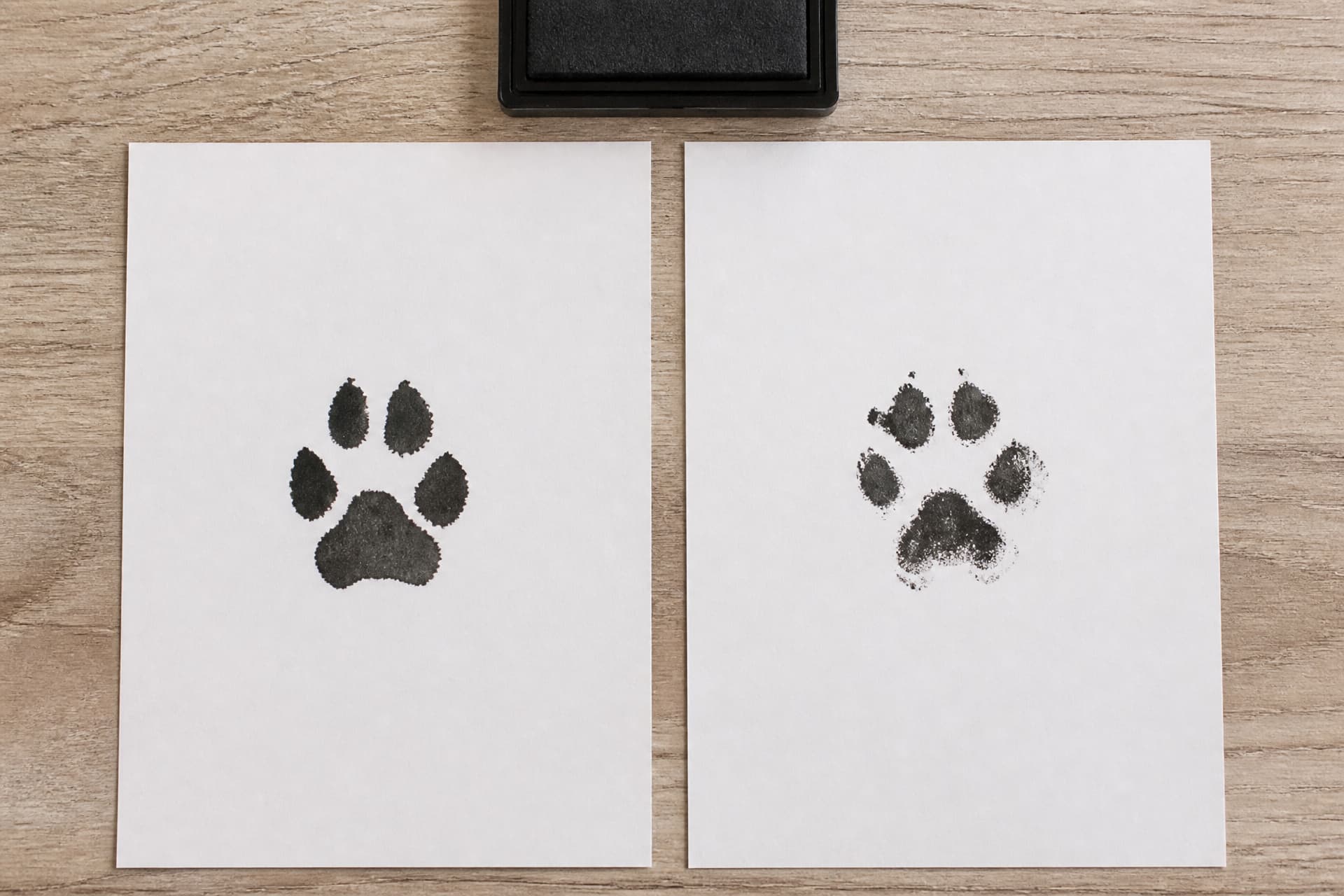
A real print has texture a stencil does not. Skin creases, the grain of the pad, tiny gaps where the ink did not take. A good artist can keep some of that, and it is what makes the tattoo read as an object taken from life rather than a symbol. It is also why over-cleaning a print in software is a mistake.
It scales honestly. A real print tattooed at life size sits on the body at the size the animal actually was, which matters to people more than they expect once it is on them.
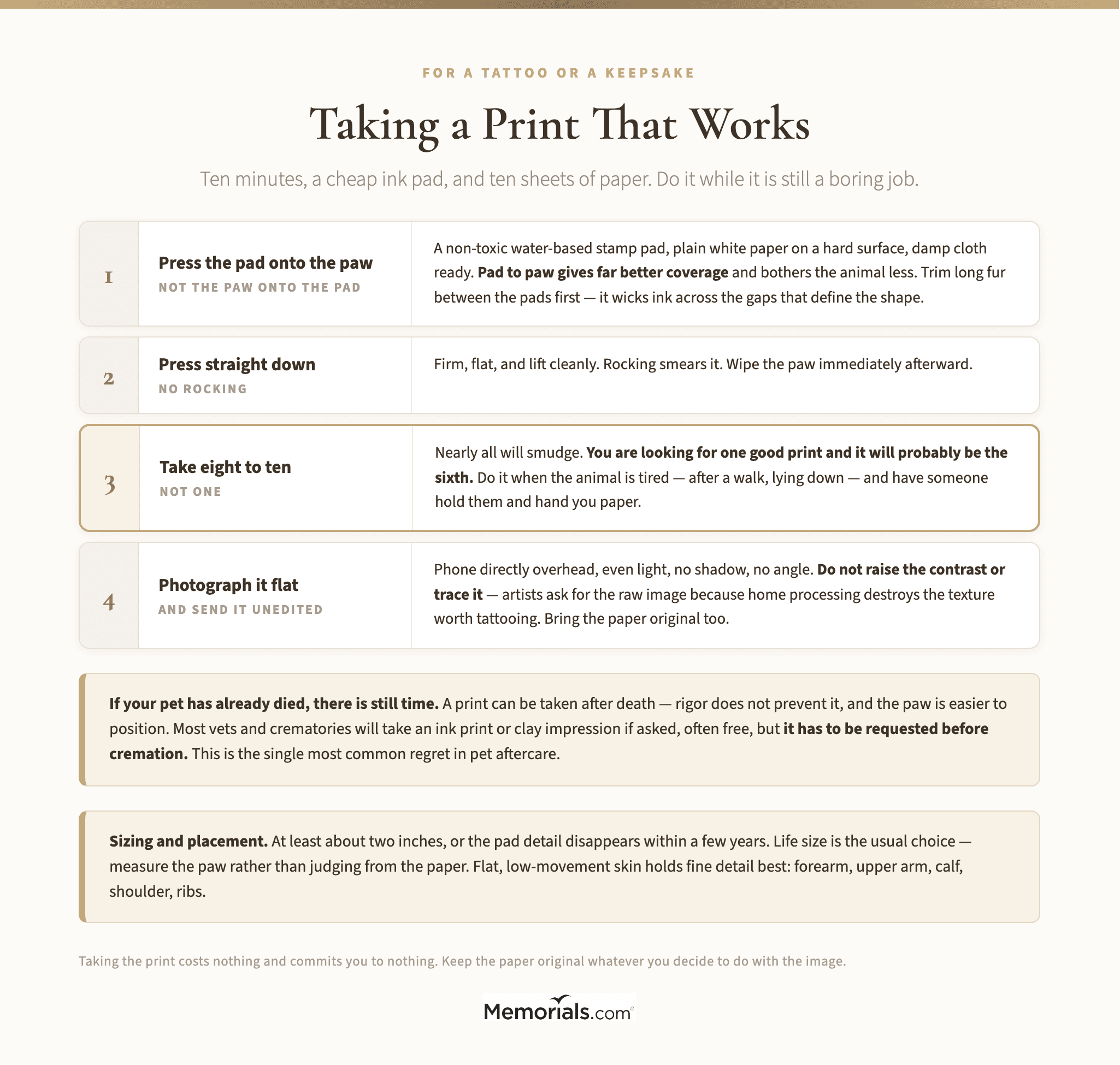
Take eight to ten, not one. Nearly all will smudge, and the one you use will probably be the sixth.
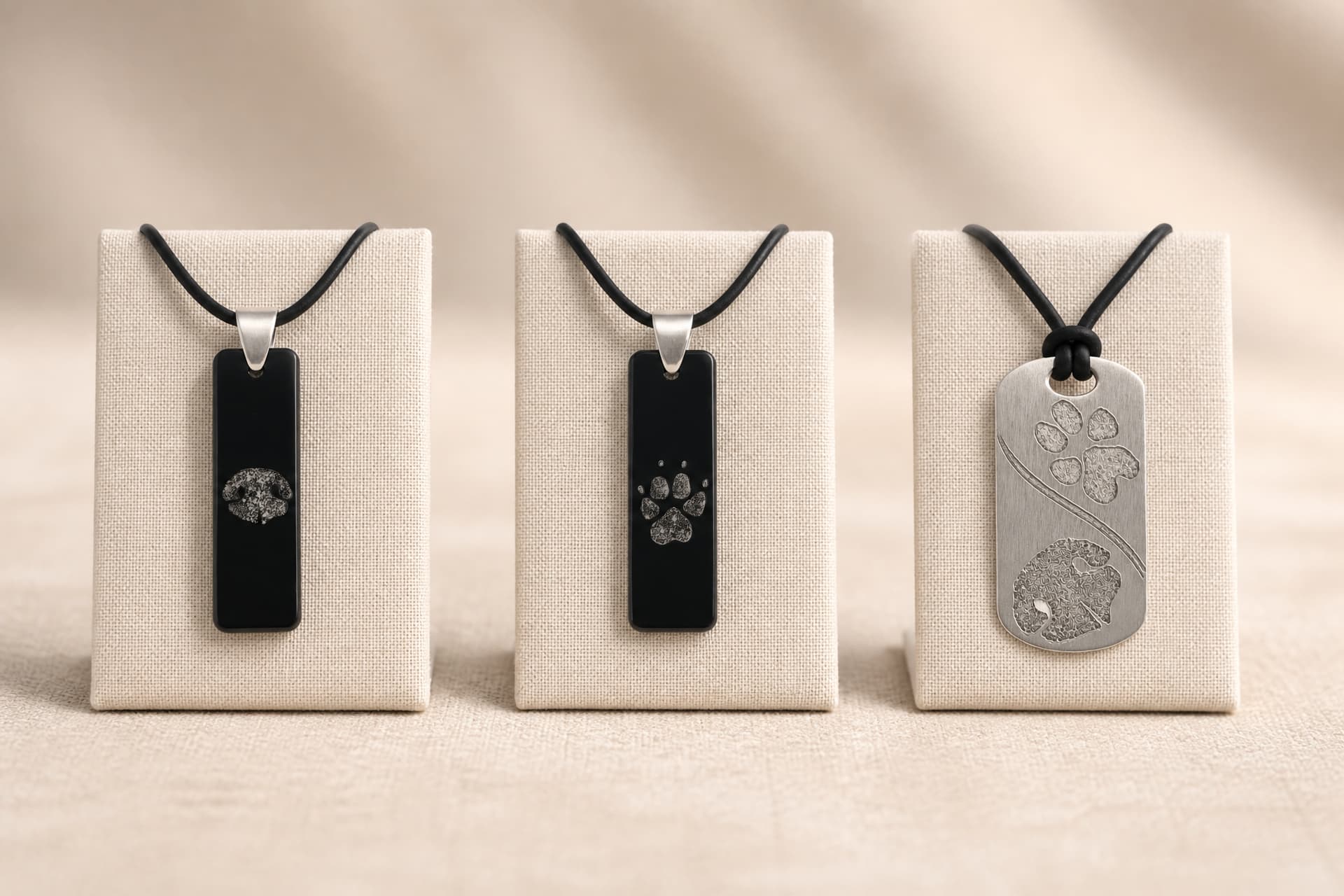
Paw Print Keepsakes
The same print, in something you can wear or place
How to get paw print from dog for tattoo has three methods, in increasing order of faff and quality.
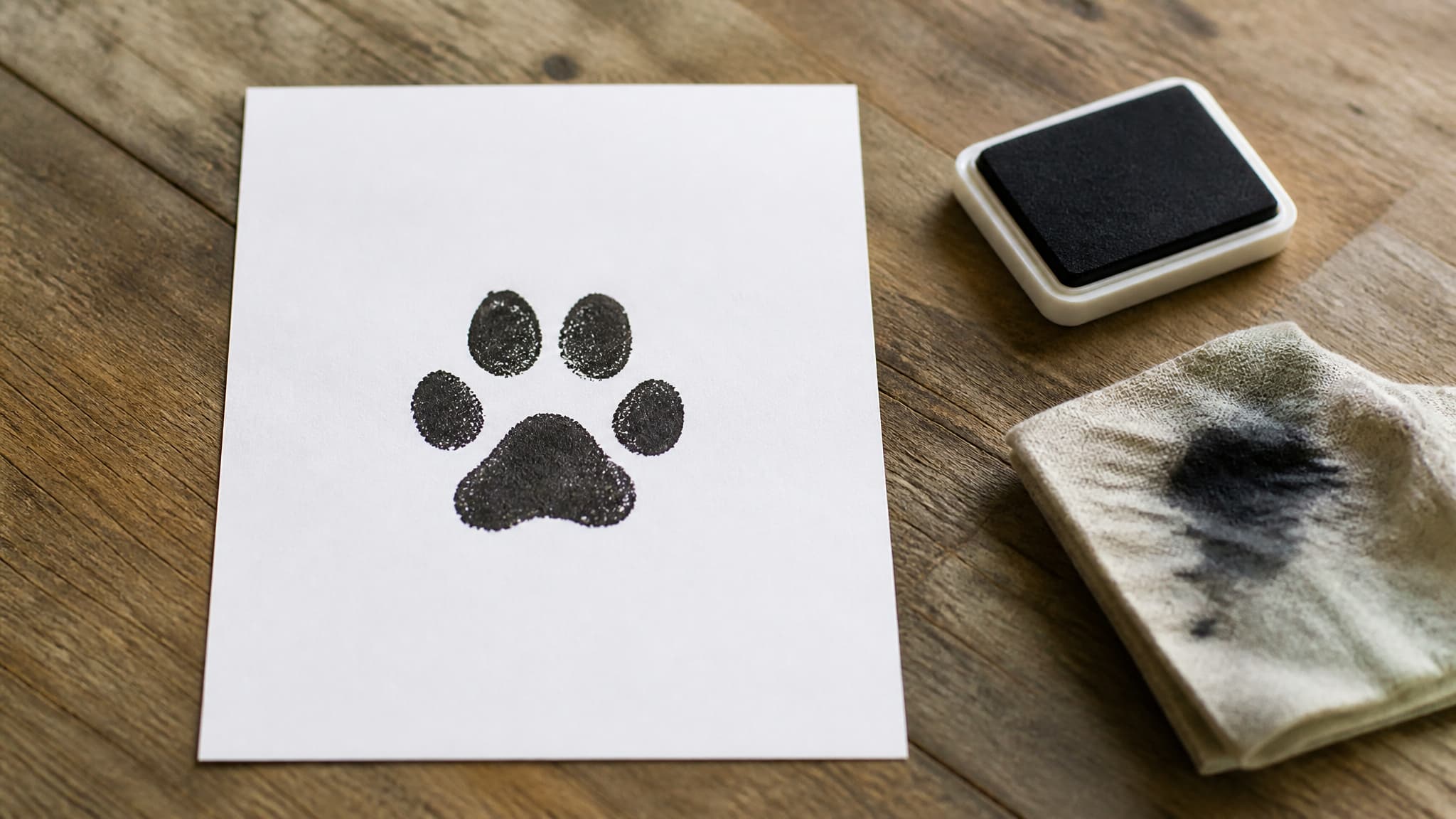
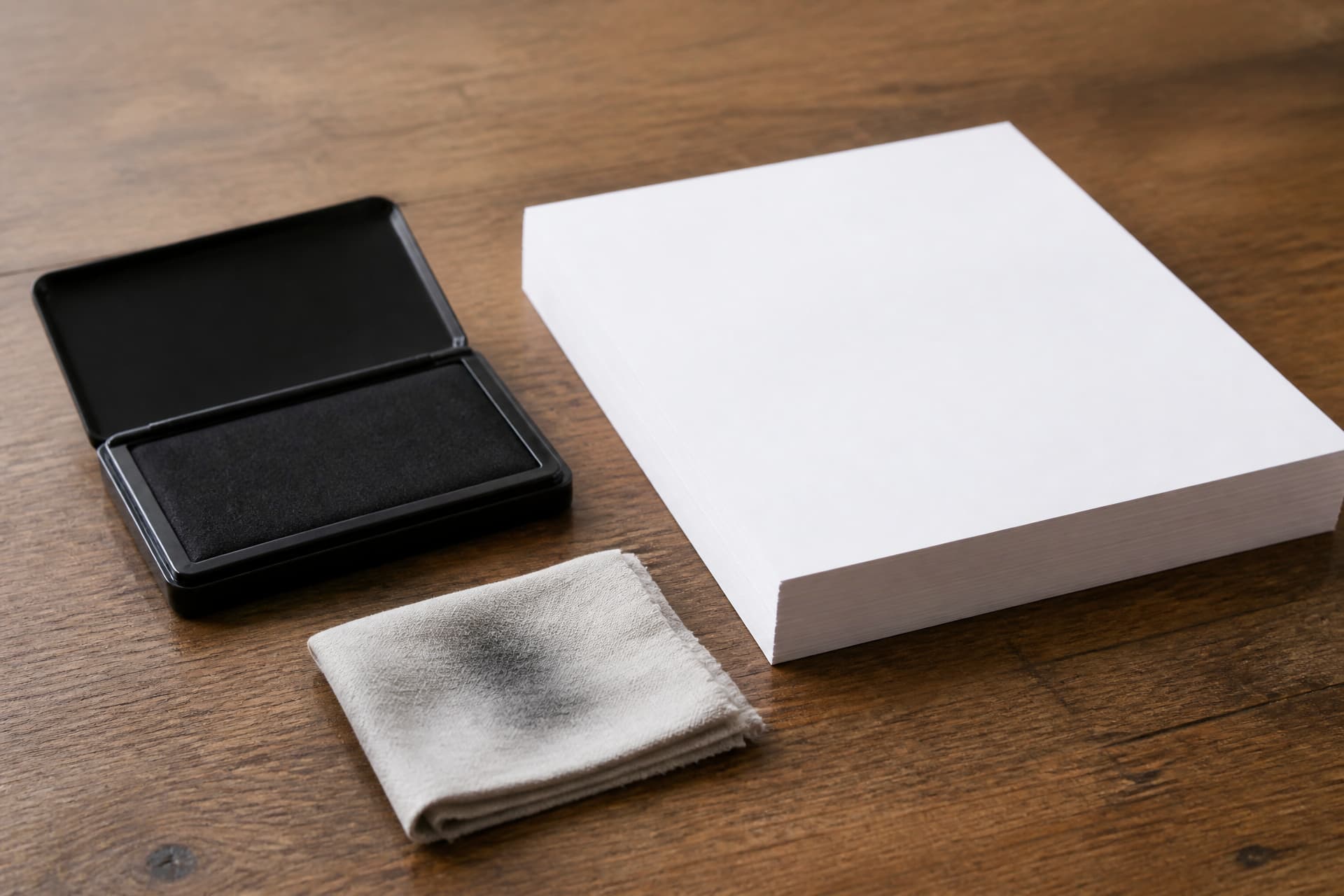
Ink pad and paper. A pet-safe or non-toxic water-based stamp pad, plain white paper on a hard surface, and a damp cloth ready. Press the pad onto the paw rather than the paw onto the pad — you get far better coverage and the dog is less bothered. Then paw onto paper, firm and straight down, no rocking. Wipe immediately.
Washable paint. Child-safe washable poster paint applied thinly with a brush. Messier, but the thicker medium picks up pad texture better than an ink pad does.
Clay or a press mold. An impression kit gives depth rather than a flat image, which is useful for a keepsake and actually harder to use as a tattoo reference. Take one if you want the object; take ink as well if you want the tattoo.
Four things make the difference between a usable print and ten wasted sheets:
Take eight to ten prints, not one. They are nearly all slightly smudged. You are looking for one good one and it will probably be the sixth.
Do it when the dog is tired. After a walk, lying down, half asleep. A standing dog shifts its weight and smears.
Have someone hold the dog and hand you paper. This is a two-person job and attempting it alone is how the paint ends up on the sofa.
Trim the fur between the pads if it is long. Long fur wicks ink across the gaps and fills in the spaces that define the shape.
If your dog hates having its feet handled — and a lot do — do not fight it. Front paws are usually better tolerated than back. A rear paw print is just as good, and one print taken calmly beats four taken over a struggle.
If Your Dog Has Already Died
This section is why many people are here, and there is more time than you would think.
If your pet is still at home or at the clinic, you can take a print yourself. Rigor does not prevent it. The paw is easier to position than a living dog's, and the result is often cleaner than anything you would have managed while they were wriggling. Same method: pad onto paw, paw onto paper.
Ask the vet or the crematory — most will do it, and will not have offered. A clay impression or an ink print is a standard service at a great many practices and crematories, and it is frequently free or a few dollars. It has to be requested before cremation, and this is the single most common regret in pet aftercare: nobody mentioned it and by the time the owner thought of it, the window had closed.
If cremation has already happened, a print is no longer possible. What may still exist: a photograph with a visible paw, a muddy print on a floor you photographed, a clay impression from a puppy vet visit, or a nose print if one was taken. An artist can work from a clear photograph of a paw, though not as well.
If nothing exists, a stencil based on the breed is a reasonable choice and not a failure. A good artist can also work from a photograph of your dog's paw pads from underneath, which many people have without realizing — check photos of your dog lying on its back or sitting with feet up.
Four steps, ten minutes, and the one that has to happen before cremation.
Turning a Print Into a Stencil
How to get dog paw print for tattoo usually ends here, and it is simpler than people fear: most artists would rather do this part themselves.
Photograph or scan the print flat and straight. A phone directly overhead, good even light, no shadow across it, no angle. A scan at 300dpi or more is better if you have access to one.
Send the original photograph, unedited. Do not increase the contrast, do not trace it, do not run it through a filter. Artists routinely ask for the raw image because the processing people do at home destroys exactly the texture that makes it worth tattooing.
Bring the paper original to the consultation if you still have it. Many artists prefer to work from the physical print, and some will trace it directly to size.
Say what size you want it, in inches or centimeters. Life size is the most common request and it is worth measuring the paw rather than guessing — a print on paper can look considerably larger or smaller than the paw felt.
Discuss whether you want it cleaned up. A fully cleaned print reads as a graphic; a print that keeps its gaps and smudges reads as a record. Neither is wrong and artists will have an opinion worth hearing.
One practical note on placement: a paw print holds detail better on flat, low-movement skin — forearm, upper arm, calf, shoulder blade, ribs. Fine texture on a wrist, a foot, or the inside of a finger blurs over the years, and a print is mostly fine texture.
Worth raising because a fair number of people arrive at a tattoo as the only way they can think of to keep the print, and it is not.
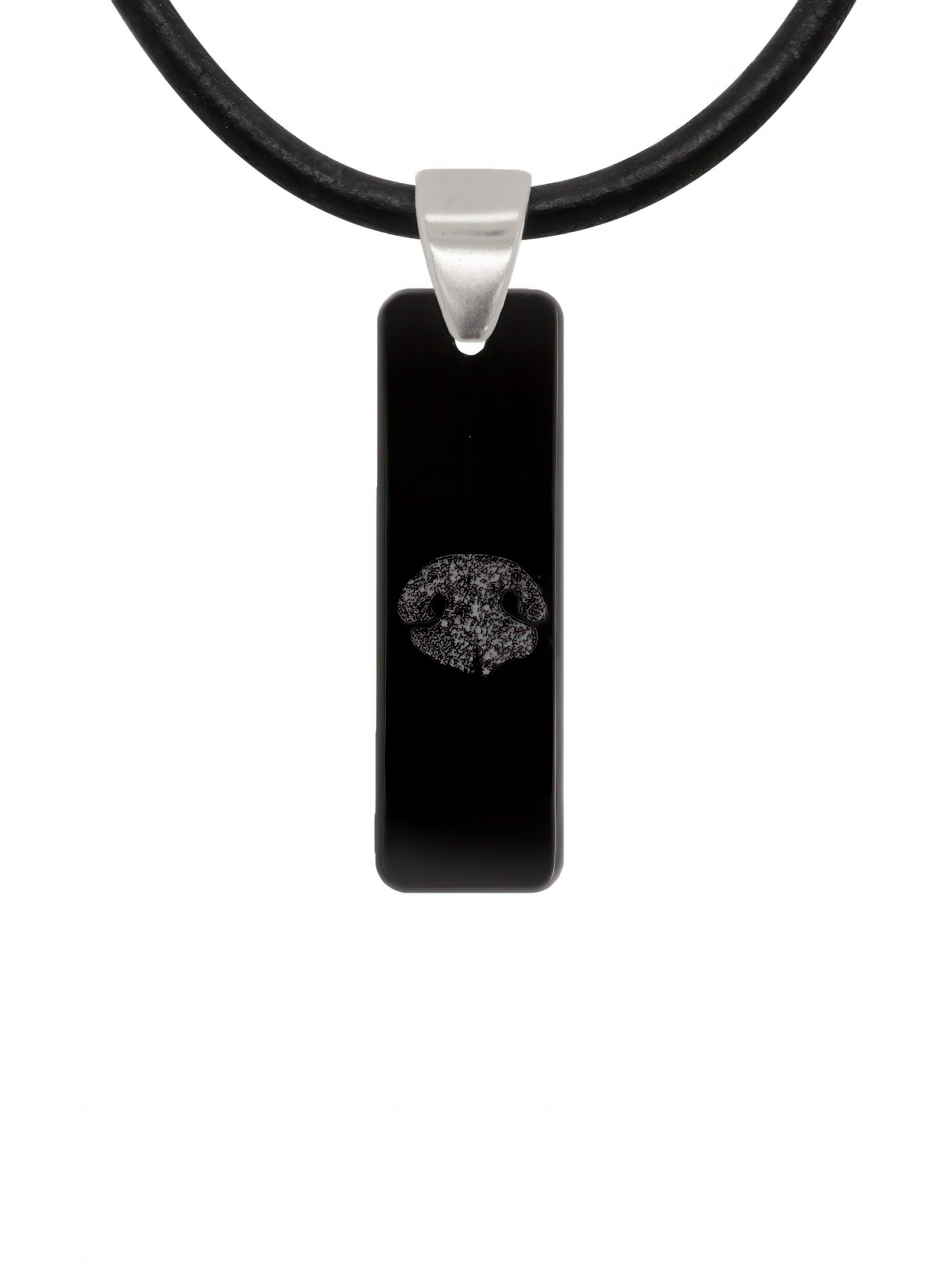
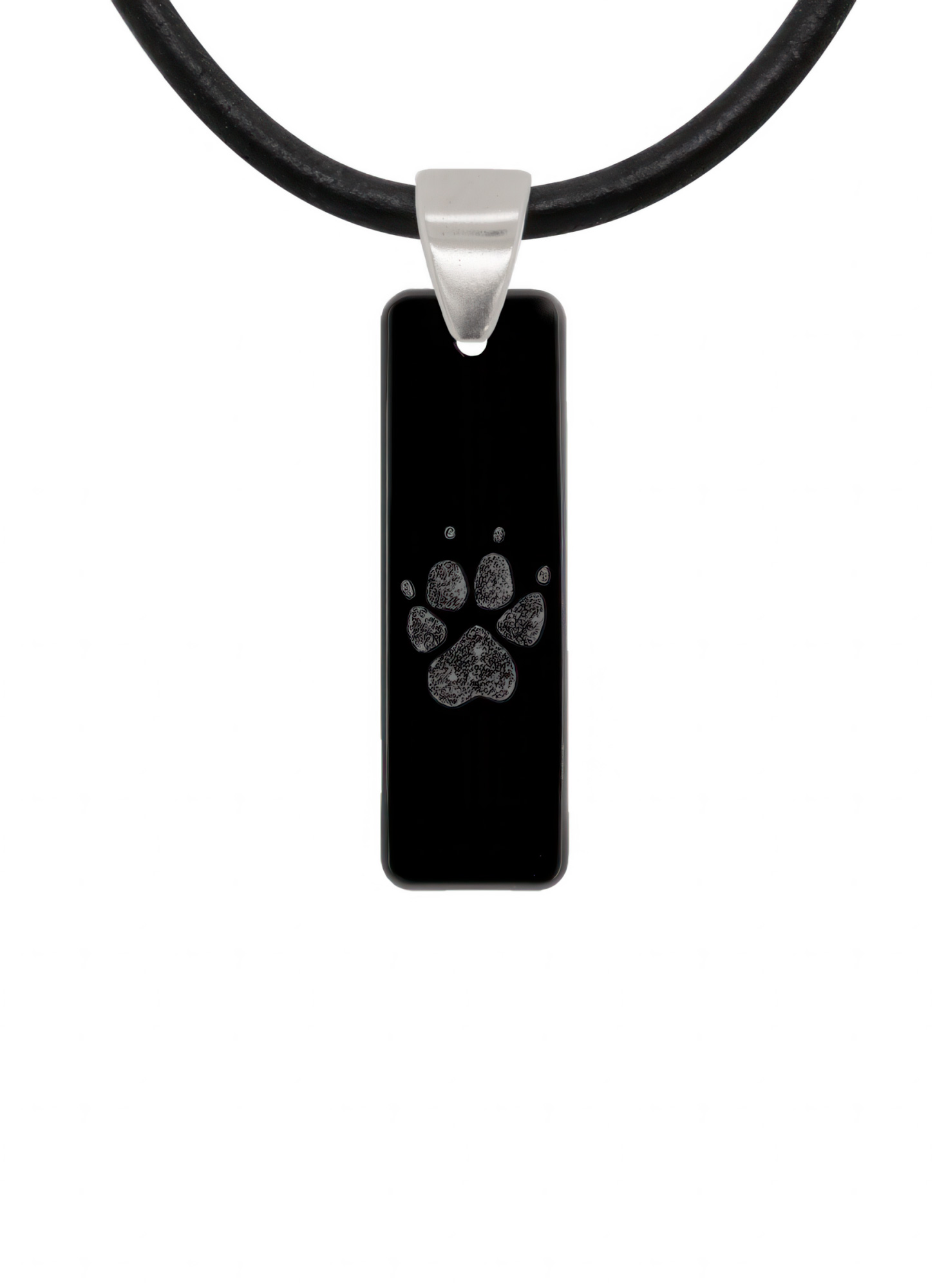
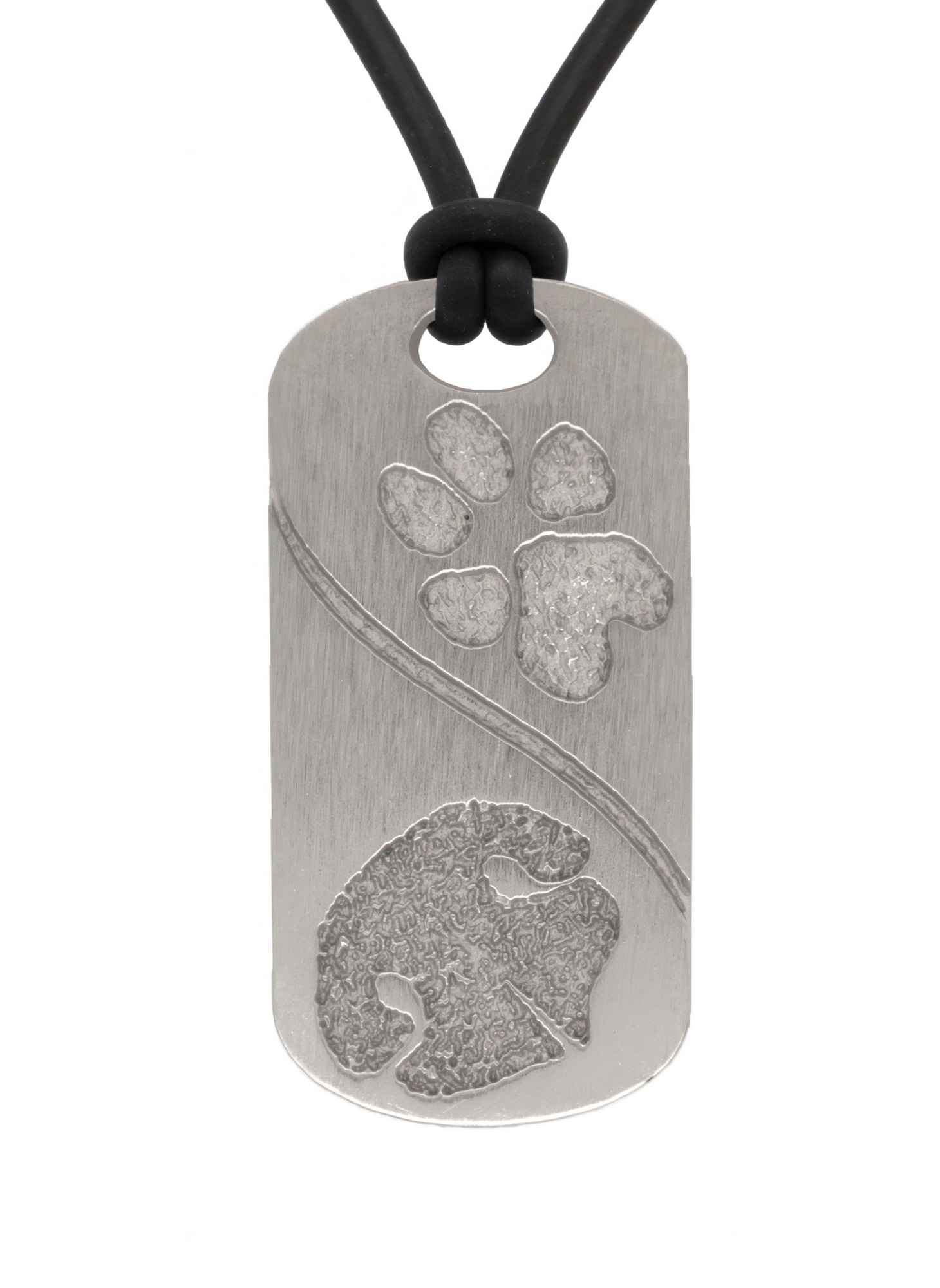
The same image works on anything. A paw print necklace takes the actual impression rather than a generic shape, which is the same appeal as the tattoo without the permanence — and several people who were unsure about a tattoo have ended up with both. A pet urn keychain does the same thing in a form you carry rather than wear.
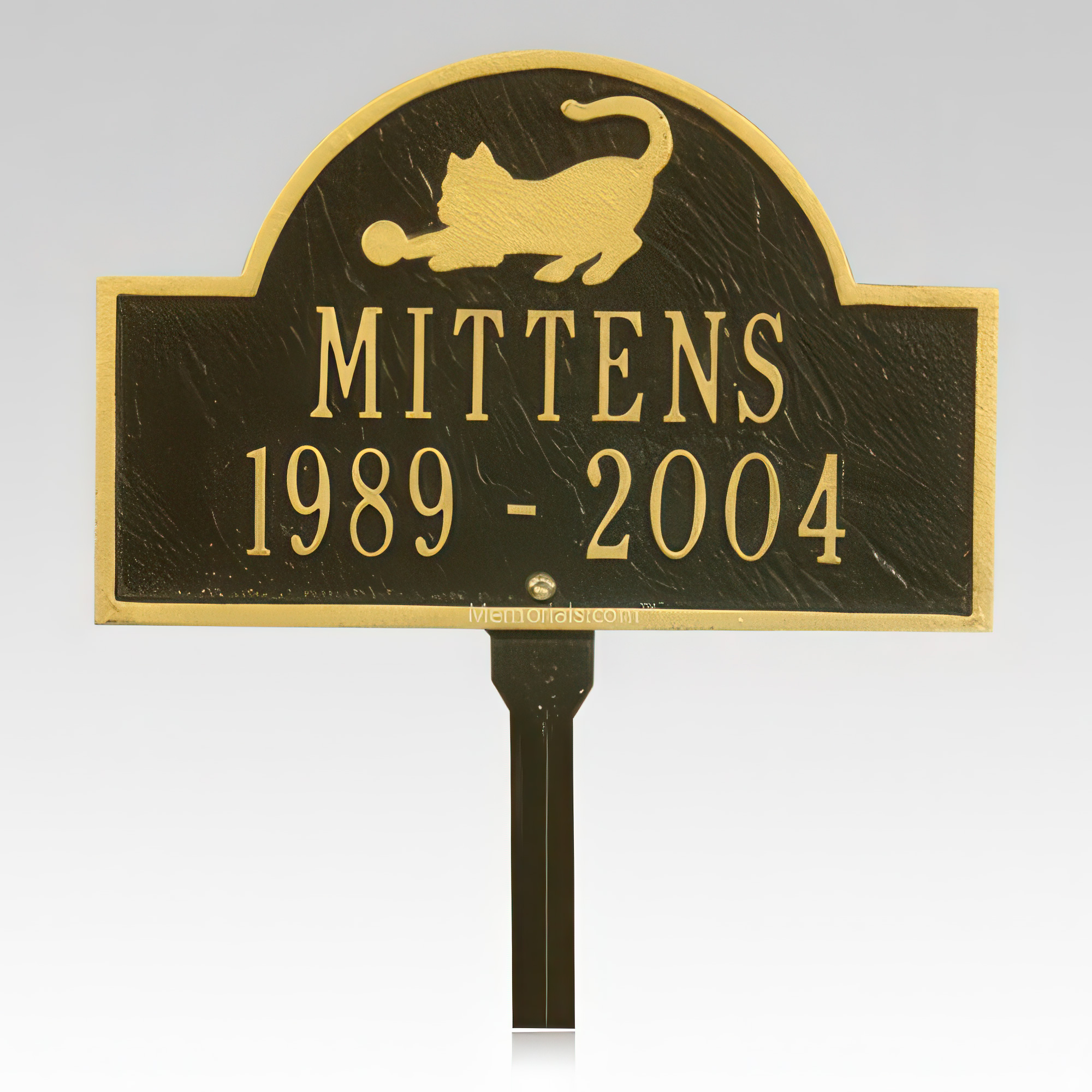
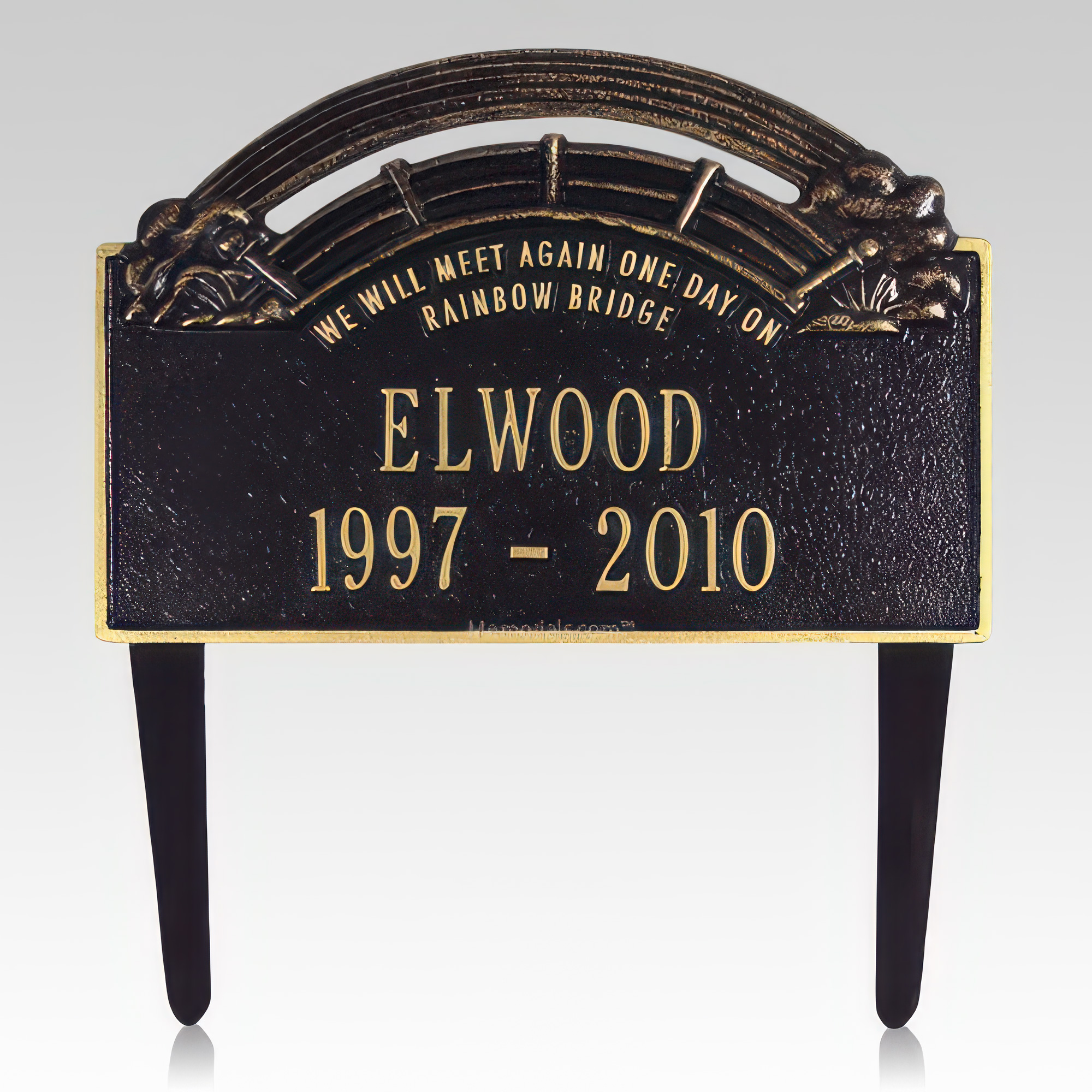
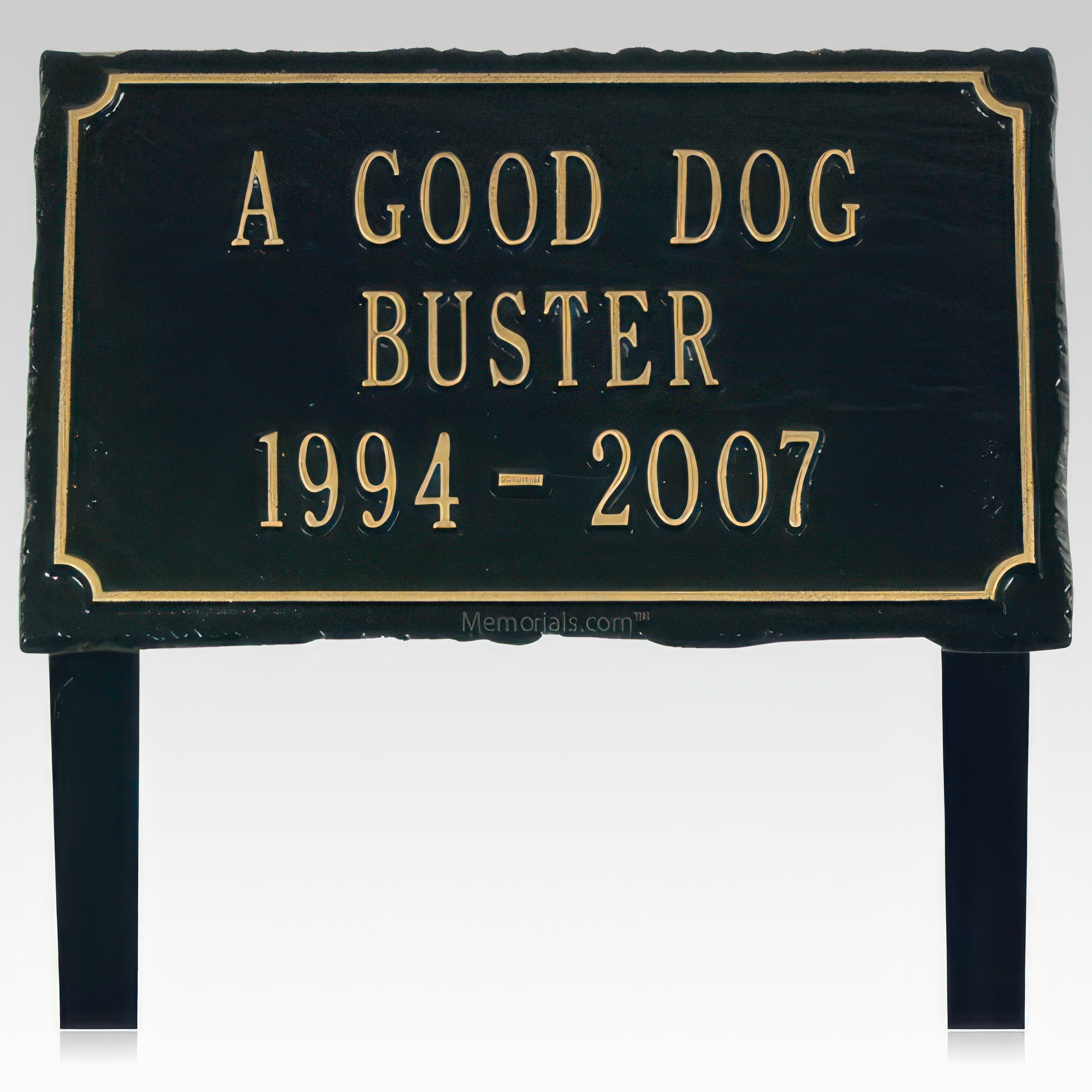
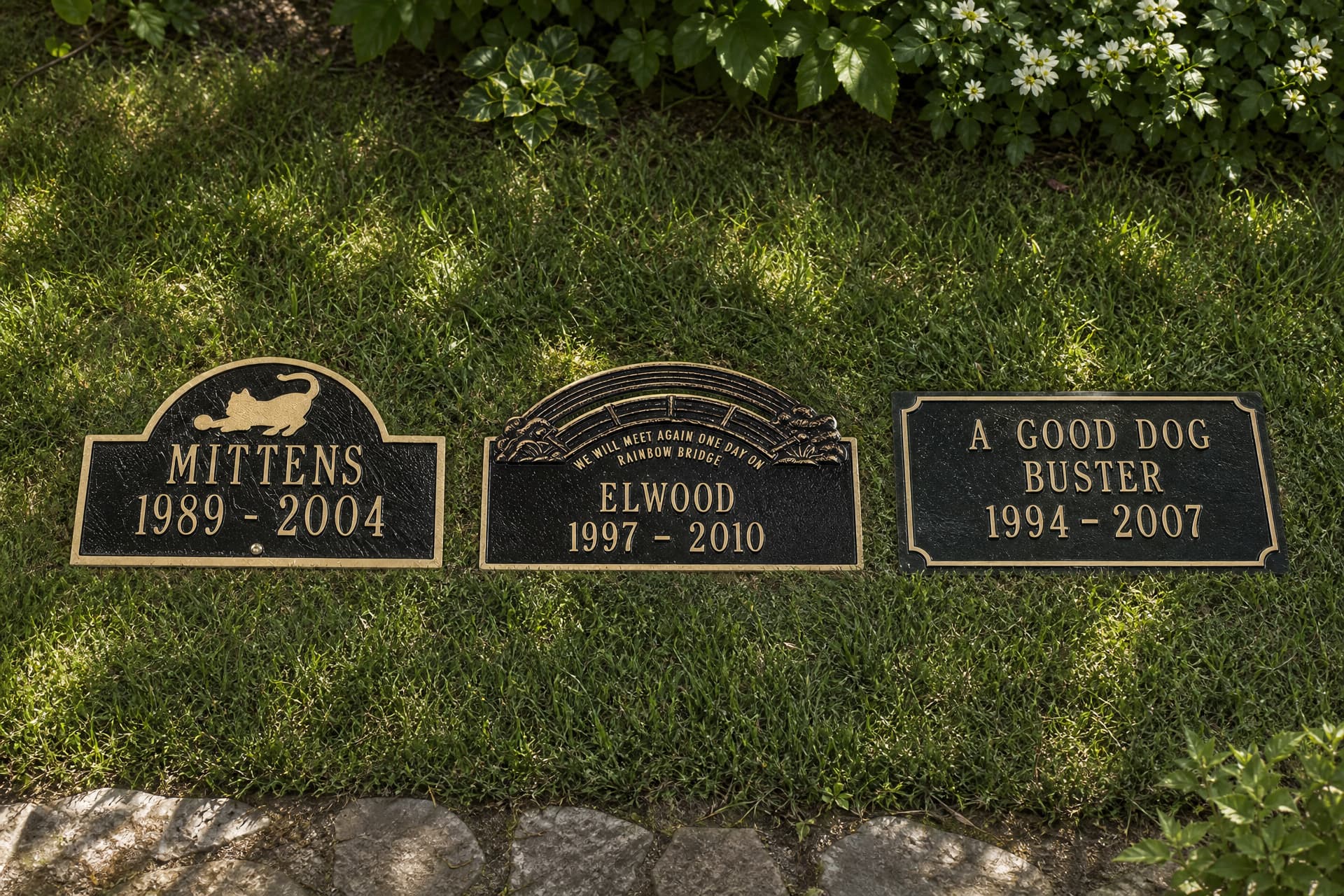
If the print is destined for a grave or a garden rather than a body, it can be engraved: a cross for dog grave or a flat marker will take a traced paw alongside a name.
And the paper original is worth keeping whatever you do with it. Frame it, or put it somewhere safe — people who had a print, used it for a tattoo and then lost the paper tend to mind.
Everything you need. Press the pad onto the paw rather than the paw onto the pad — better coverage, and the animal minds it less.
What Tattoo Artists Wish People Knew
Collected from what artists consistently say about these commissions.
Come with the print, not with a Pinterest board. A reference image of someone else's paw tattoo is useful for style; your dog's actual print is the job. Bring both and be clear which is which.
Do not ask for it smaller than about two inches. Pad detail disappears, and a tiny paw print reads as a smudge within a few years. Bigger holds up.
Expect a single session. Most paw prints are small, single-pass work and are frequently done as a walk-in.
Black holds best. Color paw prints are possible and fade faster, and a print is a shape rather than a palette — most artists steer toward black or very dark gray for a reason.
Ashes in the ink is a separate decision with real risks, not a variant of this one. If someone has suggested it to you, it needs its own conversation with an artist who has done it, and many decline.
Bring a photograph of the dog as well. Not to be tattooed — artists often say it changes how they approach the piece, and several mention that it is the part of these commissions they remember.
Nose Prints, and Other Prints Worth Taking
While you have the ink out, three others are worth two minutes each, because almost nobody thinks of them and they are gone at the same moment the paw print is.
A nose print. A dog's nose has a ridge pattern as individual as a fingerprint, and it makes a strikingly good tattoo — distinctive, abstract to anyone who does not know, and instantly recognizable to anyone who does. Take it with a thin layer of ink on the nose leather and press paper gently against it. Most dogs tolerate this less well than a paw, so one attempt and stop.
A whole-foot print, not just the pad. Press the paw down and roll it very slightly to catch the toe pads and the fur edge. It produces a softer, rounder shape that some people prefer to the hard graphic of a clean pad print.
Both front paws together. Two prints side by side on one sheet, at the spacing the dog actually stands at. It is a composition nobody expects and it works well along a forearm.
And take a photograph of the pads from underneath while you are there. Hold the paw up, photograph it flat with good light. It is a reference an artist can use if every print smudges, and it takes five seconds.
Aftercare, Briefly
Not specific to paw prints, but the question comes up and a blurred memorial tattoo is a particular kind of disappointment.
Keep it clean and out of the sun while it heals, follow whatever the artist tells you over whatever the internet tells you, and do not swim for a couple of weeks. Fine-detail work is less forgiving than bold work, so the difference between good and lazy aftercare shows up sooner on a print than on a heavier design.
Expect it to look slightly softer at six months than it did at six days. That is normal settling rather than fading, and a well-placed print at a sensible size stays legible for decades.
Frequently Asked Questions
How do I get my dog's paw print for a tattoo? A non-toxic water-based ink pad pressed onto the paw, then the paw pressed straight down onto plain paper on a hard surface. Take eight to ten; most will smudge. Do it when the dog is tired and have someone help.
How to get your dog's paw print for a tattoo if they hate their feet touched? Try a rear paw, go when they are half asleep, and stop if it becomes a fight. One calm print beats several taken over a struggle, and a clear photograph of the pads from underneath is a workable fallback.
Can I still get a paw print after my dog has died? Yes, before cremation. You can take one yourself, and most vets and crematories will do an ink print or clay impression if asked — it has to be requested in advance, and it is the thing owners most often wish they had known.
Do tattoo artists need a special stencil? No. Most prefer the original print or a clean straight photograph of it and will make the stencil themselves. Do not edit the image before sending it.
What size should a paw print tattoo be? At least about two inches so the pad detail survives. Life size is the most common choice; measure the paw rather than judging from the paper.
Can a tattoo be done from a clay impression? It can be photographed and used, but a flat ink print is a better tattoo reference. Take both if you are getting an impression made.
Where does a paw print tattoo last best? Flat, low-movement areas — forearm, upper arm, calf, shoulder, ribs. Fine detail blurs on wrists, hands and feet.
The useful thing on this page is the shortest: if your dog is alive, take the print now. Not when you need it, not when something changes — this week, with a cheap ink pad and ten sheets of paper, while it is a boring ten-minute job rather than the hardest thing you will do that year.
Put the good one in a drawer. You may never use it, and the people who have one are uniformly glad.