🏬Supersize Online Funeral Retailer🪦1000's of Headstones⚱️Over 10,000 Cremation Urns⚰️Caskets Overnight Delivery🛒Funeral & Memorial Superstore🚚FREE Shipping on ALL Orders👨👩👧👦Helping Families for over 20 Years💰Lowest Price Guarantee🏬Supersize Online Funeral Retailer🪦1000's of Headstones⚱️Over 10,000 Cremation Urns⚰️Caskets Overnight Delivery🛒Funeral & Memorial Superstore🚚FREE Shipping on ALL Orders👨👩👧👦Helping Families for over 20 Years💰Lowest Price Guarantee
🏬Supersize Online Funeral Retailer🪦1000's of Headstones⚱️Over 10,000 Cremation Urns⚰️Caskets Overnight Delivery🛒Funeral & Memorial Superstore🚚FREE Shipping on ALL Orders👨👩👧👦Helping Families for over 20 Years💰Lowest Price Guarantee🏬Supersize Online Funeral Retailer🪦1000's of Headstones⚱️Over 10,000 Cremation Urns⚰️Caskets Overnight Delivery🛒Funeral & Memorial Superstore🚚FREE Shipping on ALL Orders👨👩👧👦Helping Families for over 20 Years💰Lowest Price Guarantee
How Are Marble Statues Made? | Memorials.com Info Center
🏬Supersize Online Funeral Retailer🪦1000's of Headstones⚱️Over 10,000 Cremation Urns⚰️Caskets Overnight Delivery🛒Funeral & Memorial Superstore🚚FREE Shipping on ALL Orders👨👩👧👦Helping Families for over 20 Years💰Lowest Price Guarantee🏬Supersize Online Funeral Retailer🪦1000's of Headstones⚱️Over 10,000 Cremation Urns⚰️Caskets Overnight Delivery🛒Funeral & Memorial Superstore🚚FREE Shipping on ALL Orders👨👩👧👦Helping Families for over 20 Years💰Lowest Price Guarantee
Renaissance sculptor Michelangelo once said that it was his job to free the human form trapped inside the block of marble. Sculptors of all ages have used marble to make the world’s most beautiful detailed work ever formed from a piece of stone.
In this article, we’ll look at the history of marble sculpture, the techniques and special tools used to carve it, and some of the most famous statues created by the world’s most renowned artists.
What is Marble?
Marble is a metamorphic rock derived from limestone and composed mostly of calcite, a crystalline form of calcium carbonate (CaCO3). As the limestone is transformed by heat and pressure by layers of other materials over long periods, marble is formed. Most of the marble used for sculptures is pure and has very few stains.
Out of all the materials used for sculpting, marble is considered the granddaddy of them all. Marble’s natural translucency and durability make it a perfect stone for creating shapes that seem to make figurative works come alive.
It is no wonder that some of the greatest artists of all time preferred to create marble sculptures over bronze sculptures. The amount of detail and life-like feeling that can be formed from marble far surpass other materials.
At one time, many ancient European marble statues were painted. Artists used paint to make the sculptures vividly colorful. Although many early pieces have lost the layers of paint over time, some artists today continue with painted pieces, while many prefer the unpainted look of this stone.
Greek artists like Phidias, Polykleitos, Myron, and Praxiteles and their successors such as Donatello, Bernini, Michelangelo, Canova, and Rodin were master sculptors. The material’s versatility meant it could be used in several ways, from reliefs to busts and larger pieces. Let’s look at some of the more famous marble sculptures throughout history.
Neolithic Marble Sculpture
Female Figurine (c.4250 BCE)
Cycladic Figurine (c.2600 BCE)
Archaic Greek Marble Sculpture
Kleobis and Biton (610-580 BCE)
Sounion Kouros (600)
Moschophoros or Calf-bearer (c.570)
The Analysis Kouros (525)
“Kritios Boy” (480)
Classical Greek Marble Sculpture
Leda and the Swan (500-450)
The Tyrannicides Harmodius and Aristogeiton (477)
Parthenon Reliefs/statuary (446-430)
Apollo Belvedere (330)
Hellenistic Greek Marble Sculpture
The Barberini Faun (220)
“The Farnese Bull” (2nd Century)
Venus de Milo or Aphrodite de Milos (100)
Borghese Gladiator (100 BCE)
Roman Marble Sculpture
Portrait Bust of Julius Caesar (c.25 BCE)
Ara Pacis Augustae Frieze (13-9 BCE)
Claudius as Jupiter (41-54 CE)
Colossus of Constantine (c.320 CE)
Renaissance Marble Sculpture
Zuccone (1423–35)
Pieta (1497-9)
David (1501-4)
Tomb of Pope Julius II (1505-45)
Mannerist/Baroque Marble Sculpture
Pluto and Proserpina (1621-2)
Apollo and Daphne (1622-5)
Tomb of Pope Leo XI (1634-44)
Milo of Crotona (1671-82)
Neoclassical Marble Sculpture
Apollo (1715)
“The Marly Horse” (1739-45)
Portrait of Voltaire, seated (1781)
Jason with the Golden Fleece (1803-28)
Modern Marble Sculpture
Tarcisius, Christian Martyr or Tarsicius (1868)
The Kiss (1888-9)
Statue of Lincoln (1922)
Female Torso (1953)
The Advantages Of Carving Stone Sculpture Out of Marble
Marble is not only a readily available stone but a preferable stone for carving due to its slightly translucent surface comparable to that of human skin. Any art historian will tell you that using marble (especially Renaissance sculptors) for this reason produced a visual depth beyond the surface that gives each figurative piece a sense of realism and life.
Some types of marble, when first quarried, are amazingly soft and easy to work with, render minute detail, and polish to a smooth texture. As the finished pieces age, the structure of the stone becomes harder and more durable.
Limestone is also used for sculpting but does not contain the same fine properties to add texture and form as marble does. This generally makes limestone a less desirable material to work with for sculpting.
The Disadvantages Of Stone Sculpture In Marble
Working with marble, many sculptors have to be careful, as the stone can absorb skin oils, resulting in yellow or brown stains. Although it is considered one of the most resistant sculpture materials, it might fall under attack by weak acids, making it unsuitable for outdoor installations, such as in a cemetery, that could have an acid rainfall. In this case, granite or bronze is preferred for outdoor sculptures.
Since marble is prone to fracture if used outside, the sculptor must incorporate a support structure to prevent it from collapsing. Unlike bronze, marble is not hollow, and design decisions for the final piece will have to be made. For example, Diana of Versailles required the design of a flowing skirt, tree stump, and stag to support the weight of the entire piece fully.
Steps Before You Start Sculpting
Before a sculptor begins to sculpt a piece in marble, there are a few things they’ll need to do first. Let’s look at some of the preparations necessary to create a full-size or relief sculpture.
Preliminary Clay or Wax Sculpts – These clay and wax sculpts are used as smaller test sculpts before spending countless hours and energy on a large piece of stone.
Pitching – Pitching is knocking off large pieces of unwanted stone. A sculptor striking these big chunks requires a point chisel or a wedge chisel. Considered the “roughing out” stage of the sculpting process.
Refining and Planning – Once the general shape of the statue has been planned, the sculptor will use other tools to refine the figure from the rough chisel further. The sculptor may use calipers to transfer the small clay or wax sculpt to the large statue before continuing with any carving.
Some of The Proper Tools Used in the Carving Process
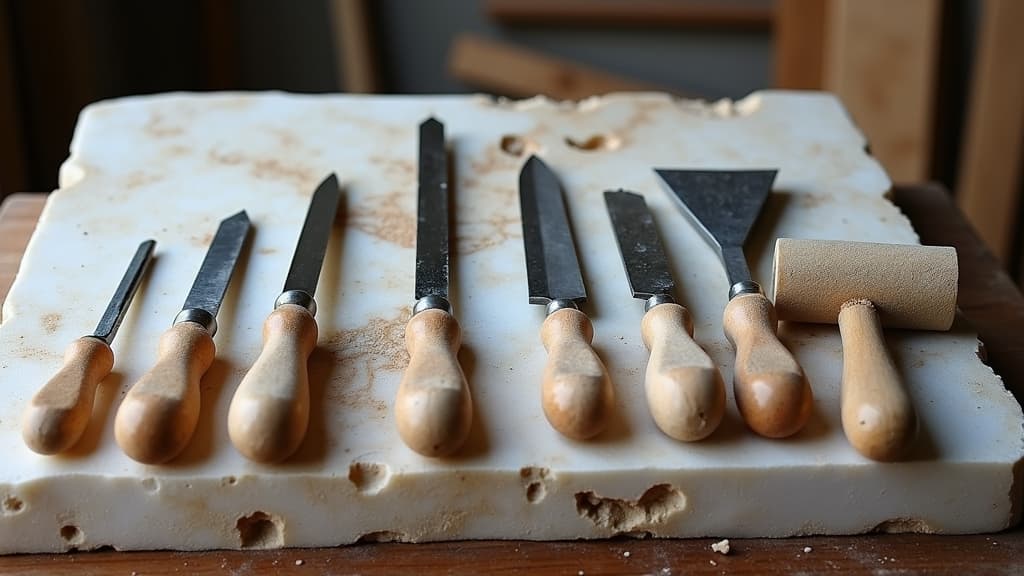
We’ve included a list of the basic carving tools used in sculpting marble. The proper terms below are in Italian, and we’ve included an English translation for each term:
La Mazza – The mallet used to strike the chisel.
Gli Scalpelli – The broad term for “the chisels.”
La Subbia – Meaning “the point,” is a term for a pointed chisel or punch.
L’Unghietto – Translated to “little fingernail,” is the term for round or rondel chisel.
La Gradina – A chisel with multiple teeth making a toothed or claw chisel.
Lo Scalpello – a flat-shaped chisel.
Lo Scapezzatore – Called a “pitcher” or “pitching tool,” this is a hefty chisel with a broad, blunt edge for splitting.
Il Martello Pneumatico – Pneumatic hammer.
Il Flessibile is an angle grinder with an electrolysis-applied diamond studded blade.
Additional Tools
In addition to those hand tools listed above, the general rule is that the artist will use a variety of hammers. The purpose is both for striking the edge tools and the stone.
After using tools like a hammer and chisel, the sculptor will sometimes refine their sculpture further by using fine detail tools, including rasps, files, and abrasive rubbing stones or sandpaper. These are used to smooth the surface contours of the statue.
Tool technique
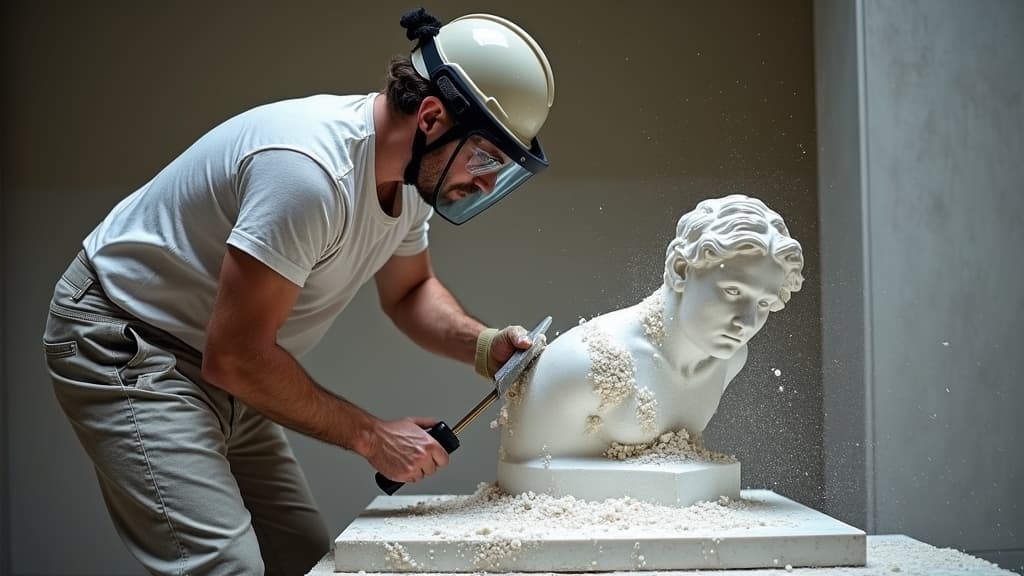
Hammer and point work are common techniques used to create statues since early Roman times and even as far back as ancient Greek sculptors from c. 650 BC. This technique involves holding the chisel against the stone and hitting it with a hammer as hard as possible. As the hammer strikes the chisel, it connects with a piece of the stone, breaking it from the large block.
This method is continued in a line following a specific contour. It sounds like a simple procedure, but it can take months or even years to become proficient in. A skilled stone worker eventually develops a rhythm to their work and, over time, begins to incorporate longer blows (approximately one per second).
The sculptor swings the hammer in a wide arc, lifting the chisel between each blow and flicking out any chips or pieces that may be in the way before repositioning it for the next strike.
With each strike, the tool’s point goes deeper into the stone, removing more material. Some stoneworkers will also spin the tools so that a different part of the point hits the stone each time, keeping the tool sharp and preventing it from breaking.
How To Sculpt In Marble
Today’s sculpting methods are similar to those of famous sculptors like Michelangelo. From the clay sculpt to the final piece, the following is a step-by-step guide on how to create a marble sculpture.
Step 1: The Clay Mould
The first step for an artist is to create their plaster, wax, clay mold, or preliminary sculpture. The reason for the plaster or clay mold is to establish the piece’s final look at a smaller, more malleable scale with material that is easier to refine and correct before tackling the marble.
The clay sculpt is similar to an oil painter making a sketch first before painting. Working in clay is quite forgiving, and the artist can create shapes and adjust the details easier in clay than in stone material. You cannot correct mistakes once they are already carved in stone.
Step 2: Extracting the Material
Once the clay material mold is complete, and the artist is happy with it, they will transfer the shape to the block of stone. Large marble blocks are removed from a quarry and cut down to the desired dimensions necessary for the final piece.
Step 3: Proportions of the Sculpture
Once the block of stone is cut and ready for sculpting, the artist moves it to the studio with the clay or plaster sculpture. The artist will now begin to map out the shapes of the clay sculpted onto the stone using calipers. The calipers provide proportional and accurate measurements from the small clay sculpture to the large stone.
Step 4: Roughing Out and Sculpting
Next is the roughing stage. During this stage, large chunks of material from the marble block are broken free from the block allowing the rough shape of their final sculpture to appear. Careful attention must be considered at this stage so that the sculptor doesn’t accidentally remove too much material from the stone.
Step 5: The Details
Once the rough and general form of the sculpture has been established, the artist carries out detailed work to further refine the shape. The artist must continue using the calipers during each stage to ensure the measurements are still accurate. The tools used to remove material from the stone during this stage are chisels, rifflers, rasps, and sanding blocks.
Step 6: the final step
Once the completed the sculpture is created, it is sometimes finished by rubbing it with oxalic acid to seal it and protect it from possible staining. The oxalic acid will also give it a shiny and transparent finish, adding more visual depth to the sculpture. And that’s it! Your sculpture is complete and ready for display.
The Introduction of Automation and Robotic Carving
Many contemporary sculptors use automation and robotic tools to help them create carved works of art. While most sculptors will only use these high-tech tools in addition to hand carving, some let the robots do all of the work.
The process starts with digital art files created by the artist. Those files are then uploaded to software connected to stone carving machines. The machines use diamond and carbide bits to slowly carve away the form from the stone using the digital art file as its guide. The result is a rough or basic shape that is then sculpted further by hand.
However, this technique is not popular with everyone, and many have criticized the use of robots in making art. At the same time, others praise the technology and see it as an evolutionary step in the art of sculpture.
It has been shown that even the greatest artists, including Michelangelo, would have apprentices do some of the “leg work” of his pieces. Many might argue that modern-day robots are merely the “new apprentices” replacing their human counterparts.
Conclusion
Since the early Neolithic days of sculpting, many sculptors from that period relied mainly on hand tools. Today, some are turning to the modernized use of robotic arms to help them carve out the basic form from the stone. Regardless of which direction sculpting takes, one thing remains certain, marble continues to be a source of inspiration and a way for artists to make their mark in art history.