🏬Supersize Online Funeral Retailer🪦1000's of Headstones⚱️Over 10,000 Cremation Urns⚰️Caskets Overnight Delivery🛒Funeral & Memorial Superstore🚚FREE Shipping on ALL Orders👨👩👧👦Helping Families for over 20 Years💰Lowest Price Guarantee🏬Supersize Online Funeral Retailer🪦1000's of Headstones⚱️Over 10,000 Cremation Urns⚰️Caskets Overnight Delivery🛒Funeral & Memorial Superstore🚚FREE Shipping on ALL Orders👨👩👧👦Helping Families for over 20 Years💰Lowest Price Guarantee
🏬Supersize Online Funeral Retailer🪦1000's of Headstones⚱️Over 10,000 Cremation Urns⚰️Caskets Overnight Delivery🛒Funeral & Memorial Superstore🚚FREE Shipping on ALL Orders👨👩👧👦Helping Families for over 20 Years💰Lowest Price Guarantee🏬Supersize Online Funeral Retailer🪦1000's of Headstones⚱️Over 10,000 Cremation Urns⚰️Caskets Overnight Delivery🛒Funeral & Memorial Superstore🚚FREE Shipping on ALL Orders👨👩👧👦Helping Families for over 20 Years💰Lowest Price Guarantee
Cemetery Planning Guide: How to Choose a Cemetery and Buy a Plot
planning
Choosing a cemetery and purchasing a burial plot is one of the most important decisions a family can make — and one that most people face only once or twice in a lifetime. The process involves weighing location, cost, cemetery rules, burial type, and long-term maintenance, all while navigating an industry that can feel unfamiliar.
This guide walks through every step, from understanding the different types of cemeteries to comparing costs, checking regulations, and making a confident purchase. Whether you are pre-planning your own arrangements or making decisions for a loved one who has recently passed, the sections below cover what you need to know.
If you are also exploring whether cremation or traditional burial is the right fit, our complete cremation planning guide covers that decision in depth.
Types of Cemeteries
Not all cemeteries offer the same services, burial options, or pricing structures. The type you choose shapes nearly every decision that follows — from plot cost to which headstones and markers are permitted. Here is a quick overview of the most common types.
Public cemeteries are independently or corporately owned, for-profit grounds. They are the most common option in the United States and typically offer the widest range of plot types, memorials, and pricing tiers.
Religious cemeteries are owned and operated by a church, synagogue, mosque, or other faith organization. They may restrict burial to members of the congregation or require that interment practices follow specific religious traditions.
Municipal cemeteries are run by a city, town, or county government. They tend to be more affordable than private options, though availability can be limited in older communities where space has filled over decades.
National and state veterans cemeteries provide free burial for eligible veterans and their spouses. There are no charges for the plot, opening and closing the grave, or setting a government-issued marker. Plots cannot be reserved in advance; arrangements are made at the time of need through a funeral home or the Department of Veterans Affairs.
Memorial parks take a uniform landscape approach, often requiring flat bronze or granite markers rather than upright monuments. The grounds tend to feel more open and manicured.
Green or natural burial cemeteries prohibit embalming, vaults, and non-biodegradable containers. The body is typically placed in a shroud or simple biodegradable casket and returned to the earth with minimal environmental impact.
For a deeper look at how these options compare — including hybrid cemeteries that blend traditional and green sections — read our full article on the different types of cemeteries explained, linked in the introduction above.
How to Choose a Cemetery Plot
Once you have narrowed down the type of cemetery, the next step is selecting a specific plot. Several factors influence this choice.
Location and accessibility. Most families choose a cemetery near their current home, their hometown, or a place with family significance. Consider how easy the grounds are to reach for regular visits — a plot at the top of a steep hill or in a remote rural area may discourage family from visiting as often as they would like.
Plot type. Cemeteries generally offer single plots for one casket, companion or double-depth plots for couples (either side-by-side or stacked), family lots that accommodate four or more burials, and smaller sections designated for cremated remains. Some cemeteries also have lawn crypts, which are pre-installed underground concrete containers that protect the casket from the elements.
Availability. Older cemeteries in urban areas may have very limited inventory. Ask the cemetery office which sections are currently available and whether the specific location within a section can be chosen or is assigned.
Atmosphere and aesthetics. Visit the grounds in person before deciding. Walk the sections, notice the landscaping and general upkeep, and pay attention to how well neighboring graves are maintained. A well-funded perpetual care program is a strong indicator that the grounds will remain dignified over time.
Religious or cultural fit. If your family observes specific burial traditions — such as facing a particular direction, avoiding cremation, or requiring rapid interment — confirm that the cemetery can accommodate those needs before committing.
Cemetery Costs: What to Expect
Cemetery expenses often surprise families because the plot price is only one piece of the total. Understanding the full cost structure helps you budget accurately and avoid unexpected charges.
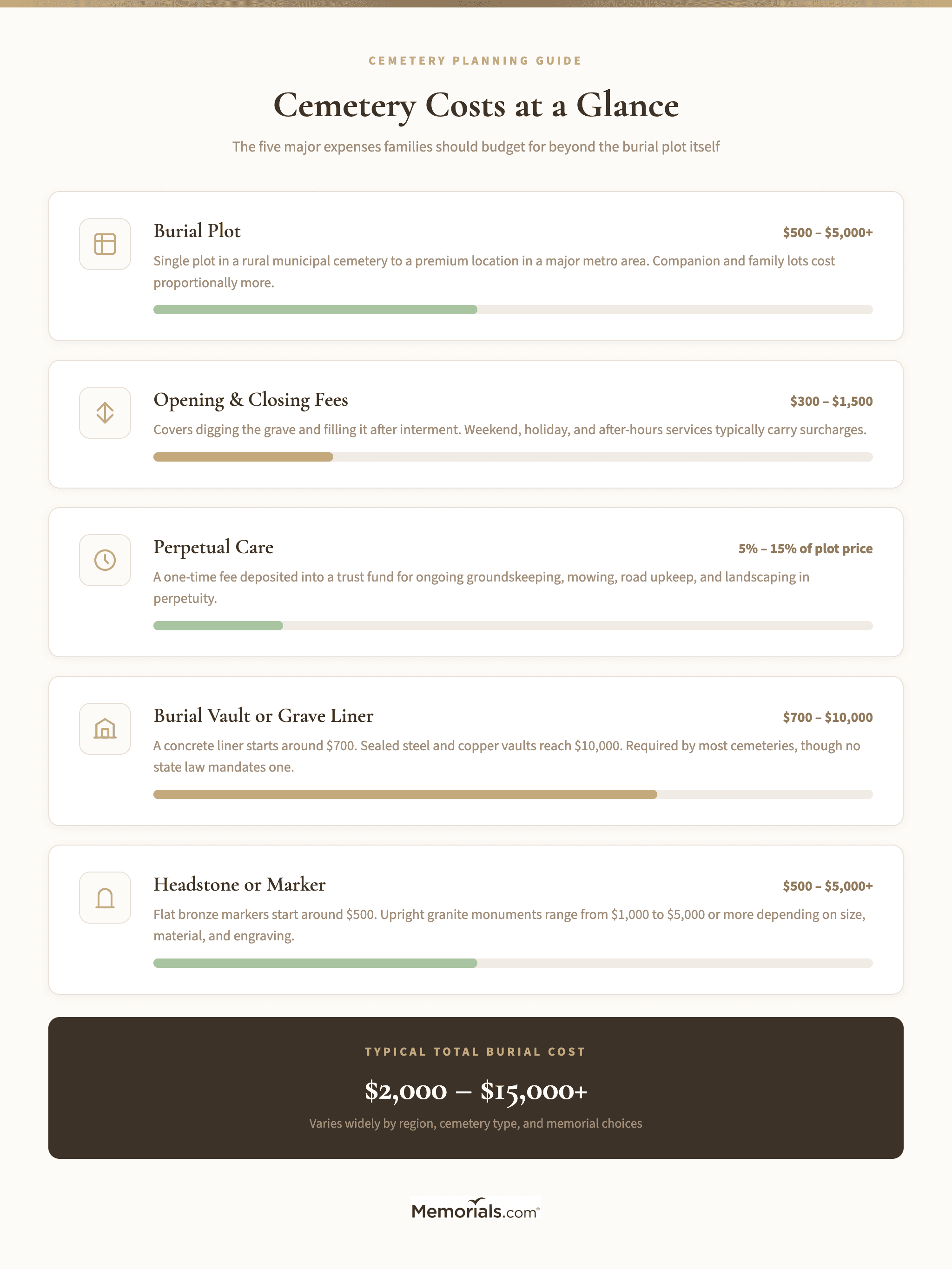
Plot price. A single burial plot in the United States ranges from roughly $500 in a rural municipal cemetery to $5,000 or more in a metropolitan private cemetery. Companion plots and family lots cost proportionally more. Plots in premium locations — near trees, on a hillside, or along a main path — carry higher prices than interior sections. Our detailed cost breakdown covers regional pricing, plot types, and what drives price differences.
Opening and closing fees. This is the charge for digging the grave and filling it back in after interment. Fees typically run $300 to $1,500 depending on the cemetery, time of day, and day of the week. Weekend and holiday burials usually cost more.
Perpetual care or endowment care. Most cemeteries add a maintenance fee — often 5% to 15% of the plot price — that funds a trust for ongoing groundskeeping. This perpetual care fund covers mowing, road maintenance, and general upkeep in perpetuity. Always ask whether this fee is included in the plot price or billed separately.
Burial vault or grave liner. Many cemeteries require an outer burial container to prevent the ground from settling. A concrete grave liner runs $700 to $1,500, while a full burial vault ranges from $1,000 to $10,000 depending on material and construction. Not all states mandate vaults — it is a cemetery policy decision. Our guide to understanding burial vaults explains the differences and when one is required.
Additional fees. These may include recording and transfer fees, a foundation or setting fee for the headstone, charges for tent and chair rental at graveside services, and fees for flower placement and removal. Always request an itemized price list before signing any agreement.
Every cemetery operates under its own set of rules, and these regulations directly affect what you can and cannot do with your plot. Ask for a written copy of the cemetery's rules and bylaws before purchasing.
Memorial restrictions. Some cemeteries only allow flat markers, while others permit upright headstones, benches, or monuments of varying heights. There may be material restrictions (granite only, or bronze on granite) and size limits tied to the plot type. Our guide to cemetery regulations for urns and markers covers the most common rule categories and what to ask.
Decoration policies. Cemeteries typically regulate what decorations are allowed on graves — fresh flowers, artificial flowers, flags, solar lights, and personal items may all be subject to approval or seasonal restrictions. Some grounds clear all items before mowing season, so ask about the schedule.
Vault requirements. As noted above, many cemeteries require an outer burial container. If your chosen cemetery mandates one, ask whether you may purchase it from an outside vendor or must buy through the cemetery. The FTC's Funeral Rule requires funeral homes to allow outside purchases, but this rule does not extend to cemeteries in most states.
Visiting hours and conduct. Most cemeteries have posted hours and expectations around noise, pets, vehicle access, and group gatherings. Our cemetery etiquette guide covers what visitors should know.
Transfer and resale rules. If you later decide to sell a cemetery plot, the cemetery may have right-of-first-refusal clauses or restrictions on private resale. Read the deed or license agreement carefully.
Burial Vaults and Outer Burial Containers
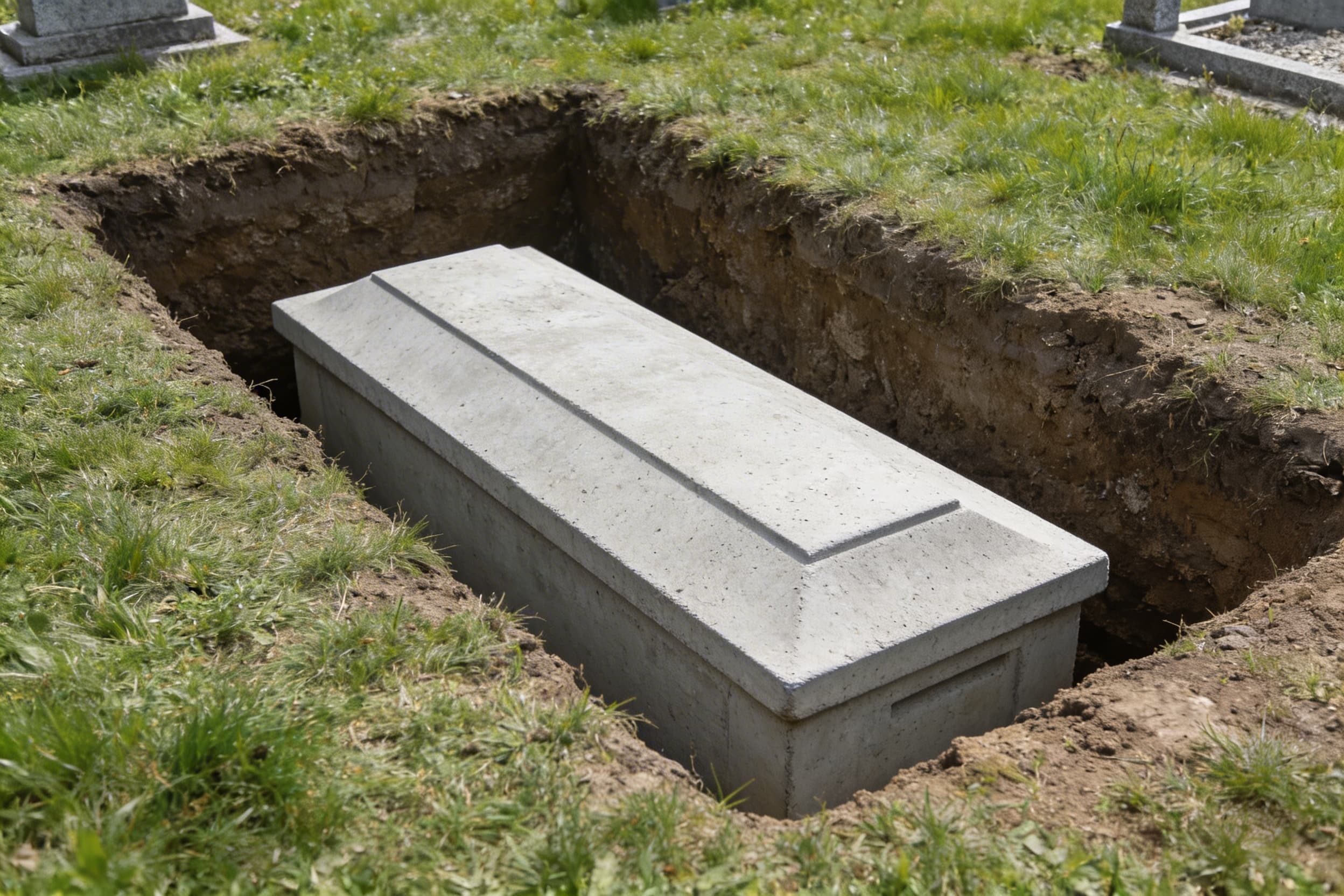
A burial vault is a sealed container that surrounds the casket underground. It prevents the weight of the earth and maintenance equipment from causing the ground to settle or collapse. A grave liner performs a similar function but is open at the bottom and less protective.
While no state law requires a vault, the majority of cemeteries enforce their own vault policy. Families choosing cremation burial face a similar requirement — many cemeteries require an urn vault before interring cremated remains. Our urn vault requirements guide explains sizing, materials, and what specific cemeteries typically ask for.
For a full overview of vault types, materials, and price ranges — including concrete, steel, stainless steel, and copper options — see our cremation vaults guide.
Columbariums and Cremation Niches
Families choosing cremation have several cemetery-based options beyond traditional ground burial. A columbarium is a structure — either freestanding or built into a wall — that houses cremation urns in individual compartments called niches. Each niche is sealed with a plaque bearing the name, dates, and often a short inscription or photograph.
Columbarium niches typically cost less than a full burial plot, ranging from $500 to $5,000 depending on location, niche size, and position within the structure (eye-level niches cost more). They also eliminate the need for a vault, opening and closing fees, and a headstone — making them one of the most affordable cemetery options.
Our cremation niche and columbarium guide covers the full range of placement options, including indoor and outdoor columbariums, urn gardens, and scattering gardens. For families weighing a niche against a traditional burial plot, our columbarium vs. burial plot comparison breaks down cost, space, and long-term considerations.
For guidance on choosing the right urn for any placement — home display, burial, or niche — our urn selection and sizing guide covers materials, sizing charts, and styles.
Grave Decoration and Maintenance
After a burial, many families find comfort in personalizing the gravesite with flowers, lights, seasonal decorations, and landscaping touches. Decorating a loved one's resting place keeps their memory visible and gives visitors a meaningful way to honor them on holidays, anniversaries, and special occasions.
Popular decoration options include fresh and artificial flower arrangements placed in cemetery vases, solar-powered lights for nighttime tributes, seasonal wreaths and garlands, small flags, memorial rocks, and gravestone decorations like bronze butterflies and angels.
For year-round ideas organized by season — from spring planting through winter holiday wreaths — our seasonal cemetery decoration guide offers practical suggestions that comply with most cemetery rules. And our broader cemetery grave decoration ideas article covers creative approaches families have used to personalize gravesites.
Maintaining the plot itself is equally important. Tasks include cleaning the headstone, trimming grass along the marker's edge, replacing flowers, and checking that cemetery lights for graves are functioning. Edging around the plot perimeter keeps the site looking sharp between the cemetery's routine mowing. Our cemetery maintenance and grave care calendar lays out a month-by-month schedule, and our grave edging ideas and installation tips covers materials and techniques.
For families who want to choose the right vase for the headstone or plot, our guide to selecting cemetery vases reviews materials, mounting styles, and weather durability. And if you are adding solar lighting, our solar lights for graves buyer's guide compares features and pricing.
How to Buy a Cemetery Plot: Step by Step
Ready to move forward? Here is a practical walkthrough of the purchasing process.
Step 1: Identify your priorities. Decide on the burial type (full-body casket burial, cremation burial, or niche placement), the geographic area, and your budget range. If the deceased was a veteran, contact the Department of Veterans Affairs at 1-800-827-1000 to check eligibility for a national or state veterans cemetery before exploring private options.
Step 2: Research and visit cemeteries. Contact two or three cemeteries that fit your criteria. Request a written price list and schedule an in-person visit. Walk the available sections, meet the cemetery staff, and take notes on the overall condition of the grounds.
Step 3: Ask the right questions. What plots are currently available, and can you choose a specific location? What are the total fees — plot, opening and closing, vault requirement, perpetual care, and headstone foundation? Are there restrictions on memorial type, size, material, or decoration? Can you use outside vendors for the vault, headstone, or flowers? What are the transfer and resale policies?
Step 4: Compare and decide. Lay out the total cost for each cemetery, including every fee. Factor in the location's convenience for visiting family members, the cemetery's financial stability (ask about the perpetual care fund balance), and whether the rules align with your family's preferences.
Step 5: Complete the purchase. You will sign a license or deed agreement granting you the right to use the plot for interment. This is not a real estate purchase — you are buying burial rights, not the land itself. Keep the deed in a safe location alongside your other important documents, and make sure your family knows where to find it.
Step 6: Plan the memorial. With the plot secured, you can select a headstone or marker, plan the inscription, and arrange for installation. Our headstone design ideas article and memorial engraving guide can help with personalization.
Pre-purchasing a plot. Buying a plot before it is needed — sometimes called pre-planning or pre-need purchasing — can lock in today's prices and relieve your family of a difficult decision under emotional pressure. However, consider whether you may relocate, change your mind about cremation, or find that a different cemetery better serves your family's long-term needs. Selling a plot on the secondary market can be difficult, especially as cremation rates continue to rise. If you are confident in your choice, pre-purchasing is a sound investment. If you are uncertain, wait.
Choosing Cemetery Products
Beyond the plot and headstone, several cemetery products can help you personalize and maintain the gravesite over time. Bronze plaques offer a durable alternative to granite markers. Flower holders and vase attachments keep fresh arrangements secure. Solar-powered lights provide a gentle glow after dark, and decorative accessories like crosses, angel figurines, and photo frames add a personal touch.
If you are looking for meaningful ways to memorialize a loved one beyond the cemetery, our sympathy and grief support guide offers ideas and resources for honoring their memory at home, at work, and during holidays.
For families with pets who want to be laid to rest alongside their animal companion, our pet memorial guide covers options including pet cemeteries, companion burial, and memorial products.
Frequently Asked Questions
How much does a cemetery plot cost on average?
A single burial plot in the United States ranges from about $500 in a small rural cemetery to $5,000 or more in a major metropolitan area. This price covers only the plot itself. Opening and closing fees, a vault or grave liner, perpetual care, and a headstone are separate charges that can double the total cost.
Can you buy a cemetery plot before you need it?
Yes. Pre-purchasing a plot — also called pre-need planning — locks in the current price and spares your family from making this decision during a difficult time. Ask the cemetery about their pre-need pricing, payment plans, and transfer policies in case your plans change.
Do you actually own the land when you buy a cemetery plot?
No. When you purchase a plot, you are buying an easement — the right to use that specific space for burial. The land itself remains the property of the cemetery. Your deed or certificate grants interment rights, which can usually be transferred or resold subject to the cemetery's policies.
What is perpetual care, and is it included?
Perpetual care is an ongoing maintenance fee that funds a trust for groundskeeping — mowing, road upkeep, and general landscaping — in perpetuity. Most cemeteries include this fee in the plot price, but some bill it separately. Ask for clarification before purchasing.
Are burial vaults required by law?
No state law requires a burial vault. However, most cemeteries enforce their own vault policy to prevent the ground from settling. If a vault is required, ask whether you can purchase one from an outside vendor to compare prices.
Cemetery Planning Hub Library
This guide is the starting point for a comprehensive library of cemetery planning resources. Explore the articles below for deeper guidance on each topic.