🏬Supersize Online Funeral Retailer🪦1000's of Headstones⚱️Over 10,000 Cremation Urns⚰️Caskets Overnight Delivery🛒Funeral & Memorial Superstore🚚FREE Shipping on ALL Orders👨👩👧👦Helping Families for over 20 Years💰Lowest Price Guarantee🏬Supersize Online Funeral Retailer🪦1000's of Headstones⚱️Over 10,000 Cremation Urns⚰️Caskets Overnight Delivery🛒Funeral & Memorial Superstore🚚FREE Shipping on ALL Orders👨👩👧👦Helping Families for over 20 Years💰Lowest Price Guarantee
🏬Supersize Online Funeral Retailer🪦1000's of Headstones⚱️Over 10,000 Cremation Urns⚰️Caskets Overnight Delivery🛒Funeral & Memorial Superstore🚚FREE Shipping on ALL Orders👨👩👧👦Helping Families for over 20 Years💰Lowest Price Guarantee🏬Supersize Online Funeral Retailer🪦1000's of Headstones⚱️Over 10,000 Cremation Urns⚰️Caskets Overnight Delivery🛒Funeral & Memorial Superstore🚚FREE Shipping on ALL Orders👨👩👧👦Helping Families for over 20 Years💰Lowest Price Guarantee
Choosing an urn can feel both practical and deeply personal, especially when it's meant to hold the ashes of two people. A companion urn (also called shared urns) is designed for that exact purpose, and it comes with a few decisions that are worth thinking through before you buy.
This guide covers what a companion urn is, how it compares to two separate urns, how sizing works, and what to look for if you're pre-planning. For a broader overview of the entire selection process, see our guide to choosing a cremation urn.
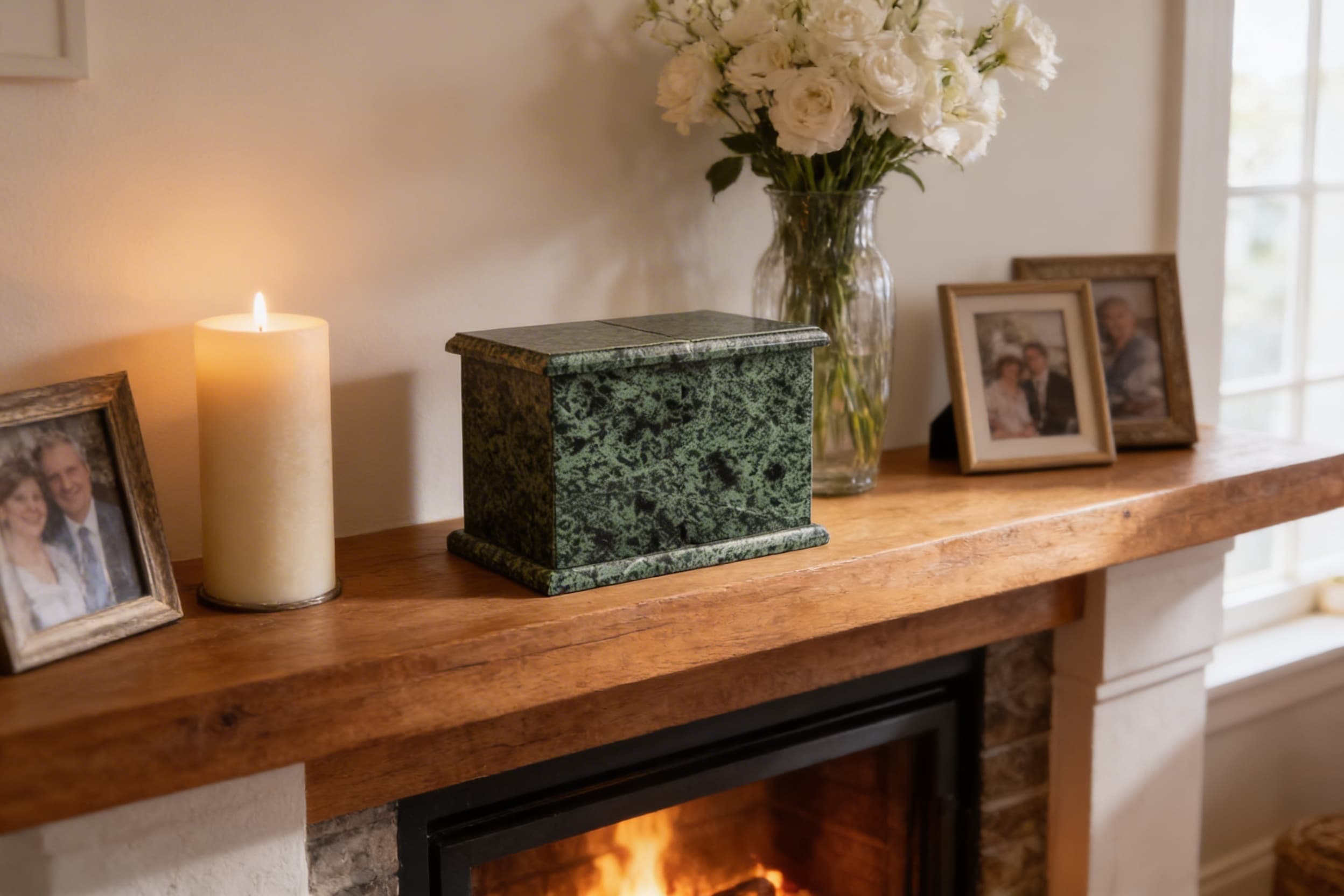
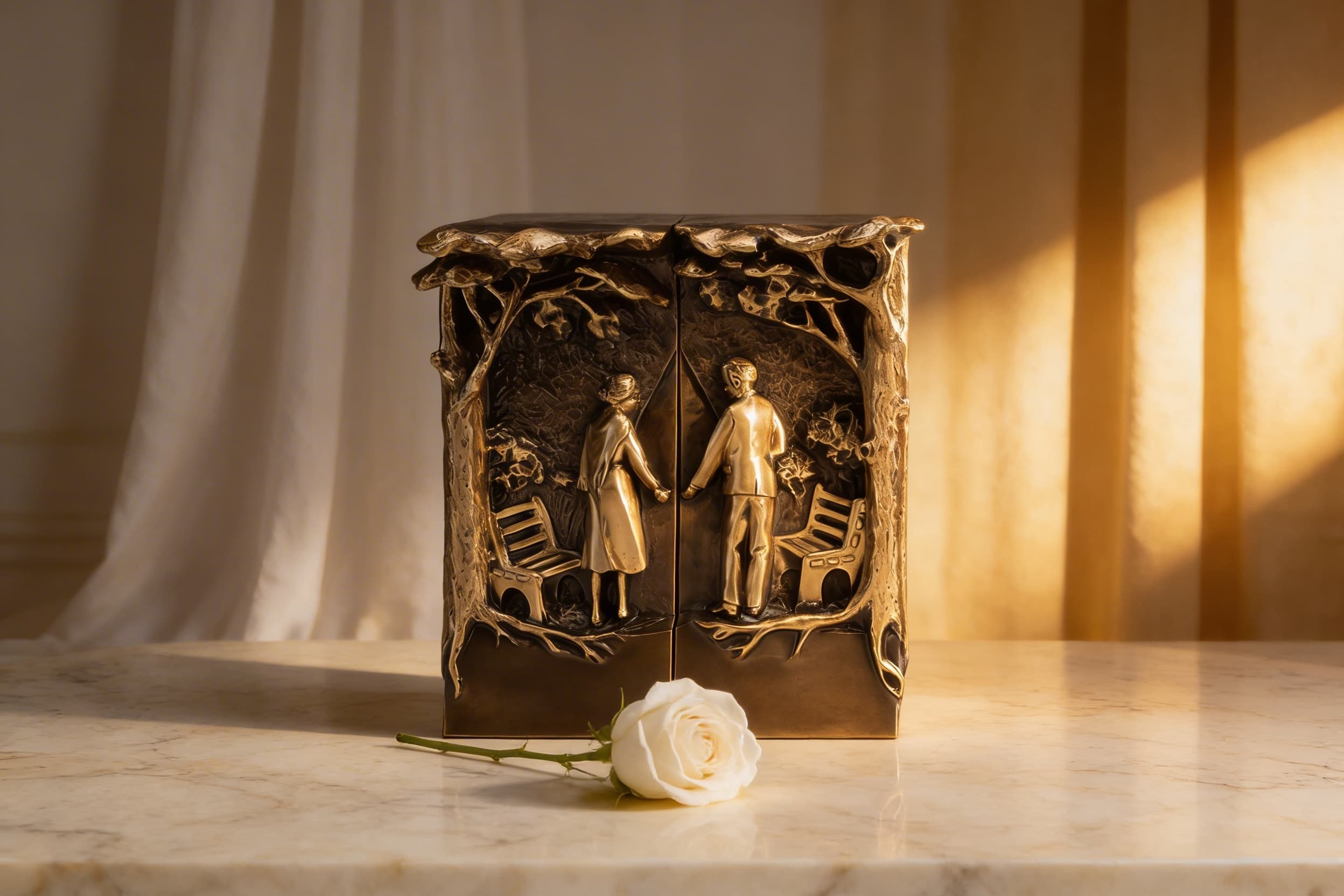
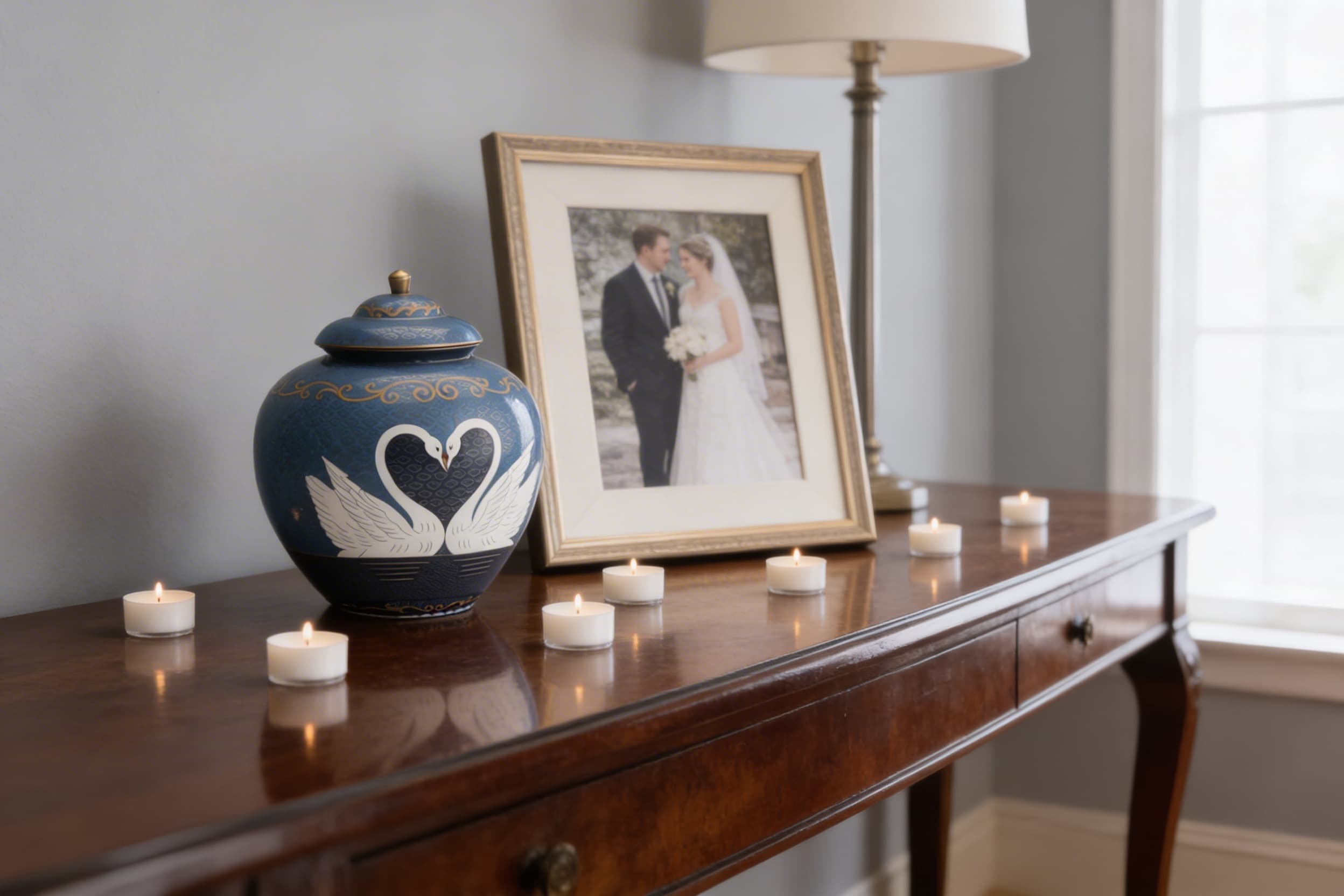
A companion urn is a single urn made to hold the cremated remains of two individuals. It is often selected by spouses or long-term partners, though it can also be used for close family members who want to be memorialized together.
Some companion urns are one large interior space where both sets of remains are placed together (often inside separate bags). Others are built with two distinct chambers to keep the remains separated while still sharing one outer urn.
Sometimes the term "companion urn" is used for an urn set: one larger "main" urn paired with two smaller keepsake urns, or a large urn that includes space for mementos and memory keepsakes. If the goal is truly one vessel for two, check the listed capacity and whether it's single-chamber or divided.
Companion urn vs two separate urns
Many families pause here, because both options are meaningful and both can be "right." The difference usually comes down to how you want the memorial to live in the home or at a cemetery, and whether you want the remains together or simply honored together.
Families comparing cremation options sometimes overlook that the urn decision doesn't have to be permanent — remains can be transferred later if plans change. Some families also wonder about separating cremated ashes between a companion urn and individual keepsakes, which is a perfectly acceptable practice.
A companion urn tends to emphasize unity, shared legacy, and the mutual processing of grief as a tribute to the lives joined together. Two separate cremation urns can offer flexibility if plans may change over time, or if placement preferences differ. Families weighing this choice may also want to compare keepsake urns vs full-size urns to see whether a combination of both meets their needs.
Some common reasons people choose a single shared urn:
One memorial focal point
Easier placement in a niche or on a shelf
A symbol of togetherness
One engraving layout instead of two
Two separate urns may make more sense when the final resting places will be different, when family members want to divide responsibility for memorial items, or when each person had a very distinct style preference.
A practical note: if you are considering cemetery placement, ask the cemetery what sizes are accepted for niches, graveside urn vaults, or columbarium compartments before buying. Dimensions matter as much as capacity.
How big is a companion urn?
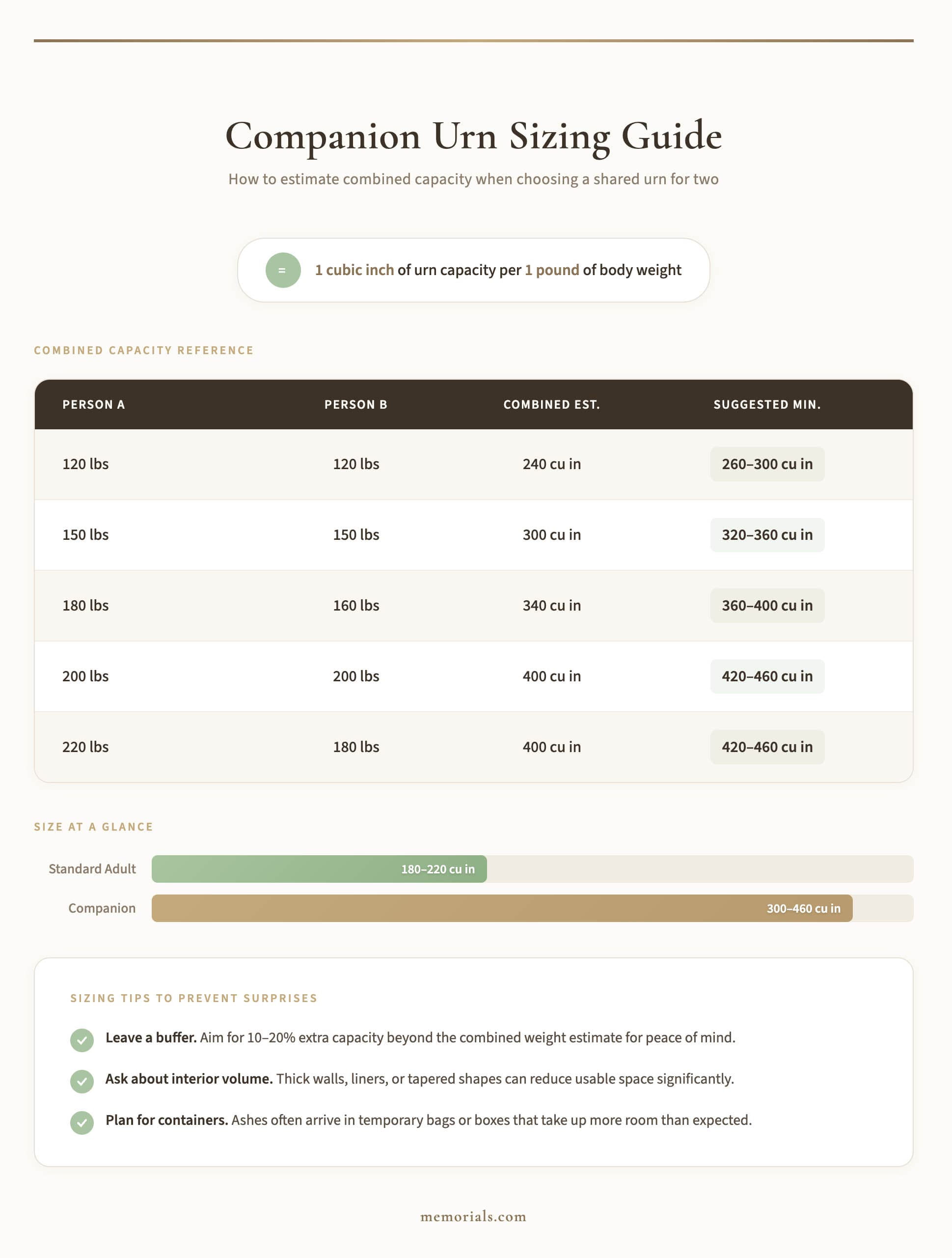
Companion urn size is usually discussed in cubic inches, reflecting the total volume needed for cremated remains. A widely used guideline is:
One cubic inch of urn capacity for each pound of body weight before cremation.
That rule is not perfect, but it is a helpful starting point. For a more detailed breakdown, our guide on what size urn do I need walks through the formula for individual urns, which you can double for companion sizing. For a companion urn, you generally add the two estimated capacities together, then give yourself extra room. Many people prefer to size up slightly for peace of mind.
Here's a simple reference table using the common guideline:
Person A weight (lbs)
Person B weight (lbs)
Estimated combined capacity (cu in)
Suggested minimum companion urn (cu in)
120
120
240
260 to 300
150
150
300
320 to 360
180
160
340
360 to 400
200
200
400
420 to 460
220
180
400
420 to 460
A few sizing tips that prevent last-minute stress:
Leave a buffer: Aim for 10% to 20% extra capacity if you can.
Ask about interior volume: Thick walls, liners, or shapes with narrow bases can reduce usable space.
Plan for containers: Some ashes come in temporary plastic boxes or sturdy bags that take up more room than expected. Many families transfer the ashes into soft urn bags to fit better.
If you already have one person's remains and are buying a companion urn now, you can still plan ahead. You might choose an urn large enough for both and place the first set of remains inside (usually in the crematory-provided bag), leaving space for the second later.
Single chamber vs divided companion urns
This choice is about meaning, not right or wrong.
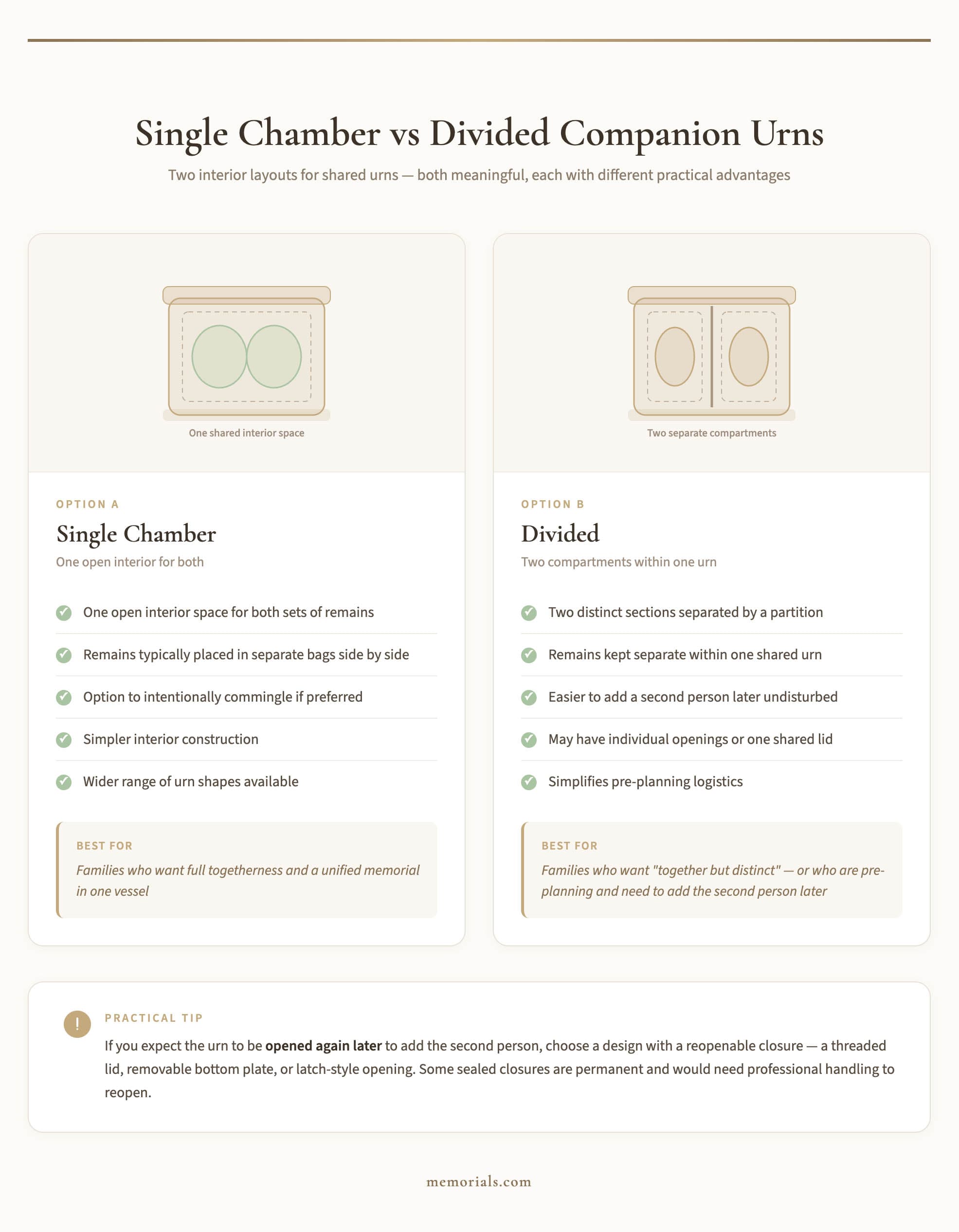
A single-chamber companion urn has one interior space. Both sets of remains can be placed inside, typically in separate bags, or sometimes intentionally commingled if that is the family's preference and aligns with final placement plans.
A divided companion urn has two separate interior compartments. This can be comforting for families who want "together, but distinct." It can also simplify later placement if one person is already in the urn and the other will be added later, since the compartments help preserve space.
A short, practical consideration: if you expect the urn may be opened again in the future to add the second person, pick a design that can be reopened without damaging the closure.
Materials, styles, and where the urn will live
Material often follows location. An urn meant for a living room shelf may prioritize aesthetics and touch. An urn meant for burial may need added protection from moisture and soil pressure. For a deeper look at what's available across every category, our guide to types of cremation urns covers materials, styles, and common uses.
Common companion urn material categories for containing ashes include wood, metal, stone, ceramic, and cultured materials. Each has its own look and feel:
Wood urns can be warm and furniture-like, often chosen for home display. Metal urns can be durable and available in many finishes. Stone or marble urns have a heavier presence and are often chosen for a traditional memorial look. Ceramic urns can feel artistic and handcrafted.
Think about the setting:
Home display: Choose a finish you like seeing daily, and consider whether the opening is on the bottom or back for a cleaner look.
Columbarium niche: Confirm the niche's internal dimensions and any rules about material type.
Burial: Ask about an urn vault. Some cemeteries require one, and it can influence which shapes fit best.
If you are selecting a companion urn for a couple with different tastes, it can help to look for a style with neutral elegance, then personalize through engraving rather than a strong theme.
Companion Urns Guide Checklist: What to Confirm Before You Buy
Decisions can stack up quickly when you are grieving or planning ahead. It helps to separate "must-haves" from "nice-to-haves," and to keep the essentials in view.
Here are key points to confirm before purchasing:
Capacity: Combined cubic inches, plus extra space
Dimensions: Height, width, depth, and niche or shelf limits
Placement plan: Home, niche, burial, or scattering of ashes later
And here are a few two-part questions that make selection clearer:
Preference vs. Practicality: Consider where the urn will be displayed — on a home shelf, in a niche, buried, or placed in a shared family space.
Timeline: Decide when the urn will be sealed — immediately, at a later date, or reopened when the second person is added.
Memorial Style: Choose an engraving approach — one shared message, two separate name areas, or just dates.
Family Plan: Think about future needs — keepsakes for relatives, travel plans, or the possibility of relocation.
Engraving and design layouts for two people
Personalization can be simple and still feel complete. Many companion urns have room for two names and two sets of dates, sometimes with a shared phrase in the center.
A few layout approaches people tend to like:
One unified inscription with both names and dates can feel like a single story. A split layout can give each person equal space while keeping the overall design balanced. A nameplate can also be useful if you are pre-planning and want the option to add the second date later without re-engraving the urn itself.
If the urn includes a photo frame or ceramic picture option, consider whether you want one shared image or two separate photos. Both can work well; it depends on how you want the memorial to "read" at a glance.
A personalized companion urn doesn't require elaborate engraving — two names, two dates, and a short shared phrase can say everything that needs to be said.
Choosing a Companion Urn: Pre-Planning
Pre-planning is not only about logistics. It can reduce uncertainty later, and it can give couples a chance to make choices together without pressure.
When people pre-plan a companion urn, they often decide:
Whether the urn will be kept at home first and later moved to a cemetery
Whether ashes will be placed together or separated by compartments
How engraving will handle dates that are not yet known
It may also help to keep a small note with the urn paperwork that explains the plan. That can be as simple as where the key is stored (if there is one), who should be contacted, and whether the urn is intended to be opened again.
If you're coordinating pre-planning with other arrangements, ask the cremation provider how ashes will be returned (bag, temporary container, box dimensions). That detail can prevent a mismatch between "capacity on paper" and what actually fits comfortably.
If you're working with a funeral home or cremation services provider, ask whether they offer guidance on urn sizing or can hold ashes in a temporary container until a companion urn arrives.
Buying considerations that matter when timing is hard
When you are choosing quickly, a few policies can make the process less stressful. Many families look for clear sizing info, responsive customer support, and a return window in case the urn arrives and the scale feels different in person. If budget is a concern, our guide on how much does a cremation urn cost breaks down typical price ranges by material and size.
Retailers that specialize in memorial products often provide a wide range of companion urn styles, along with personalization, cemetery products, and coordinated keepsakes. Some, including Memorials.com, also offer benefits like free ground shipping and a 30-day return policy, which can be helpful when decisions are happening fast.
If you're ordering an engraved urn on a deadline, confirm production times and double-check spelling, date order, and punctuation. A quick review by a second person can catch small errors before they become permanent.
A gentle note on "together" and what it can mean
A companion urn is one way to honor a shared life, but "together" can take more than one form. For some families, it means one vessel and one placement. For others, it means two separate urns displayed side-by-side, or a companion urn paired with cremation jewelry so children and grandchildren can carry a small portion.
The best choice is the one that fits your plan today while leaving room for whatever tomorrow requires.