🏬Supersize Online Funeral Retailer🪦1000's of Headstones⚱️Over 10,000 Cremation Urns⚰️Caskets Overnight Delivery🛒Funeral & Memorial Superstore🚚FREE Shipping on ALL Orders👨👩👧👦Helping Families for over 20 Years💰Lowest Price Guarantee🏬Supersize Online Funeral Retailer🪦1000's of Headstones⚱️Over 10,000 Cremation Urns⚰️Caskets Overnight Delivery🛒Funeral & Memorial Superstore🚚FREE Shipping on ALL Orders👨👩👧👦Helping Families for over 20 Years💰Lowest Price Guarantee
🏬Supersize Online Funeral Retailer🪦1000's of Headstones⚱️Over 10,000 Cremation Urns⚰️Caskets Overnight Delivery🛒Funeral & Memorial Superstore🚚FREE Shipping on ALL Orders👨👩👧👦Helping Families for over 20 Years💰Lowest Price Guarantee🏬Supersize Online Funeral Retailer🪦1000's of Headstones⚱️Over 10,000 Cremation Urns⚰️Caskets Overnight Delivery🛒Funeral & Memorial Superstore🚚FREE Shipping on ALL Orders👨👩👧👦Helping Families for over 20 Years💰Lowest Price Guarantee
How to Choose a Cremation Urn: The Complete Buying Guide
cremation
Choosing a cremation urn is one of the most personal decisions a family makes after losing someone they love. The urn becomes more than a container — it serves as a lasting tribute, a physical connection to the person who has passed. And yet, most families have never purchased one before.
That unfamiliarity can make the process feel overwhelming, especially during grief. There are hundreds of materials, styles, and sizes to consider. Funeral homes often present a limited selection at marked-up prices, and it can be difficult to know where to begin.
This guide walks through every factor that matters — from sizing and materials to use case, cost, and personalization — so you can make a confident, informed choice that truly honors your loved one.
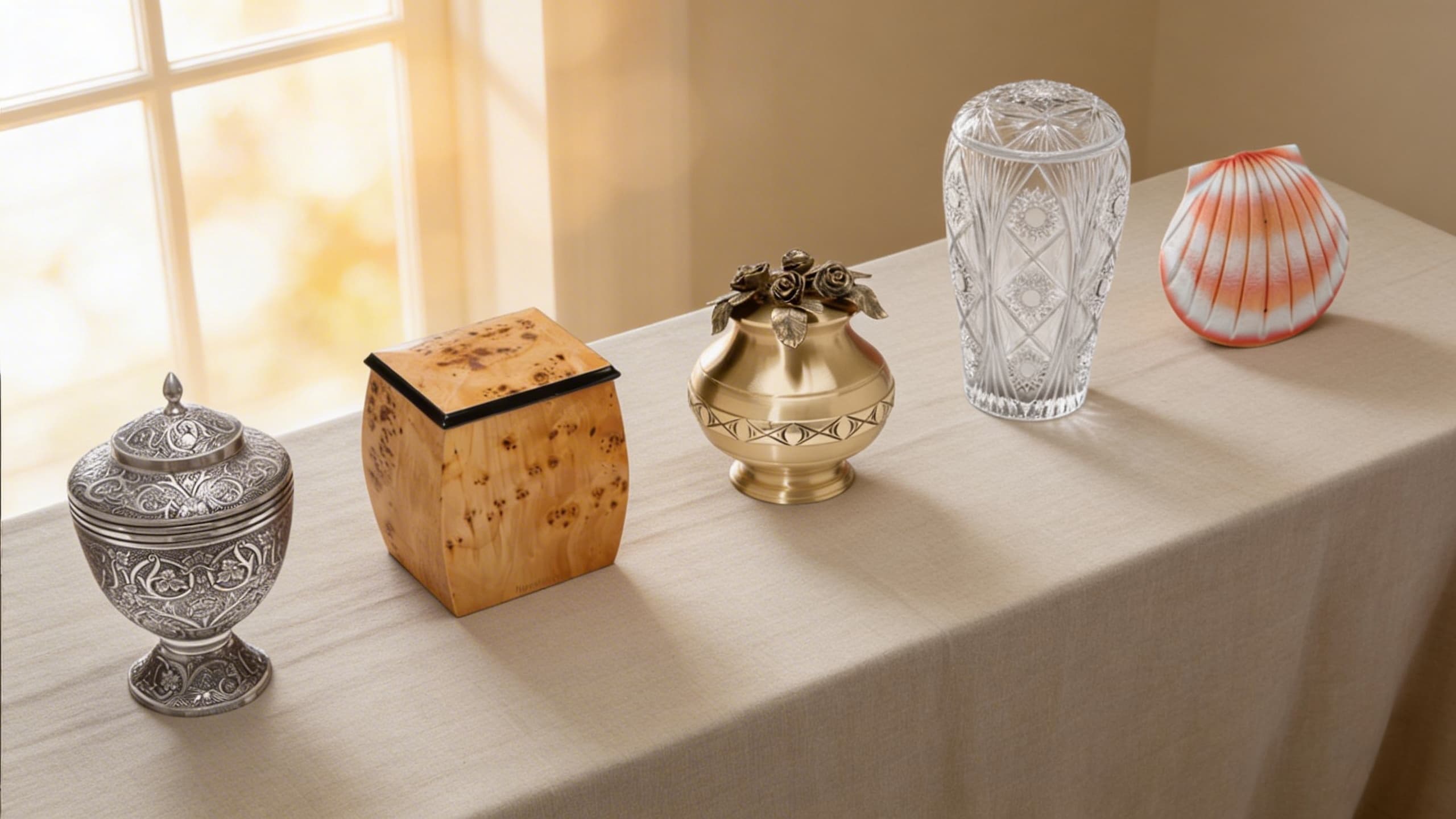
If you're looking for a quick overview of your options, the full range of urn types, materials, and styles is broader than most people expect. Cremation urns today span everything from hand-carved hardwood to hand-blown glass, from military tributes to eco-friendly vessels designed to dissolve in water. The key is matching the urn to what matters most to your family — whether that's permanence, personalization, affordability, or alignment with cultural or environmental values.
This guide is organized as a seven-step framework. Work through each step in order, and by the end you'll have a clear picture of exactly which urn is right for your situation.
What to Expect With Cremated Remains
Before diving into the selection process, it helps to understand what cremated remains actually are and how they're returned to you.
After cremation, the remains — sometimes called cremains — are processed into a fine, pale gray powder with a slightly gritty texture. The volume depends primarily on the person's bone structure and body weight, but for most adults, it amounts to roughly 3 to 9 pounds of material that fills approximately 150 to 220 cubic inches of space.
The crematory typically returns the remains in a sealed plastic bag placed inside a temporary container, which might be a simple cardboard box, a basic plastic container, or a standard-issue temporary urn. This container is perfectly safe for short-term or even long-term storage — there's no urgency to transfer the remains to a permanent urn. Many families take their time selecting the right vessel, and there's no harm in doing so.
For a deeper look at what cremated remains consist of and how they're handled, our article on everything you need to know about human ashes covers the topic thoroughly. If you're wondering about the timeline between passing and receiving the remains, our guide on how long the cremation process takes walks through each stage from the initial arrangements through the return of cremated remains, typically a span of several days to two weeks depending on local requirements.
Step 1: Decide How the Urn Will Be Used
The single most important question to answer before looking at any specific urn is this: what will happen with the cremated remains?
The intended use determines which materials, sizes, and styles are appropriate. An urn destined for ground burial has different requirements than one that will sit on a mantelpiece for decades. Here are the most common use cases and what each one demands.
Display at Home
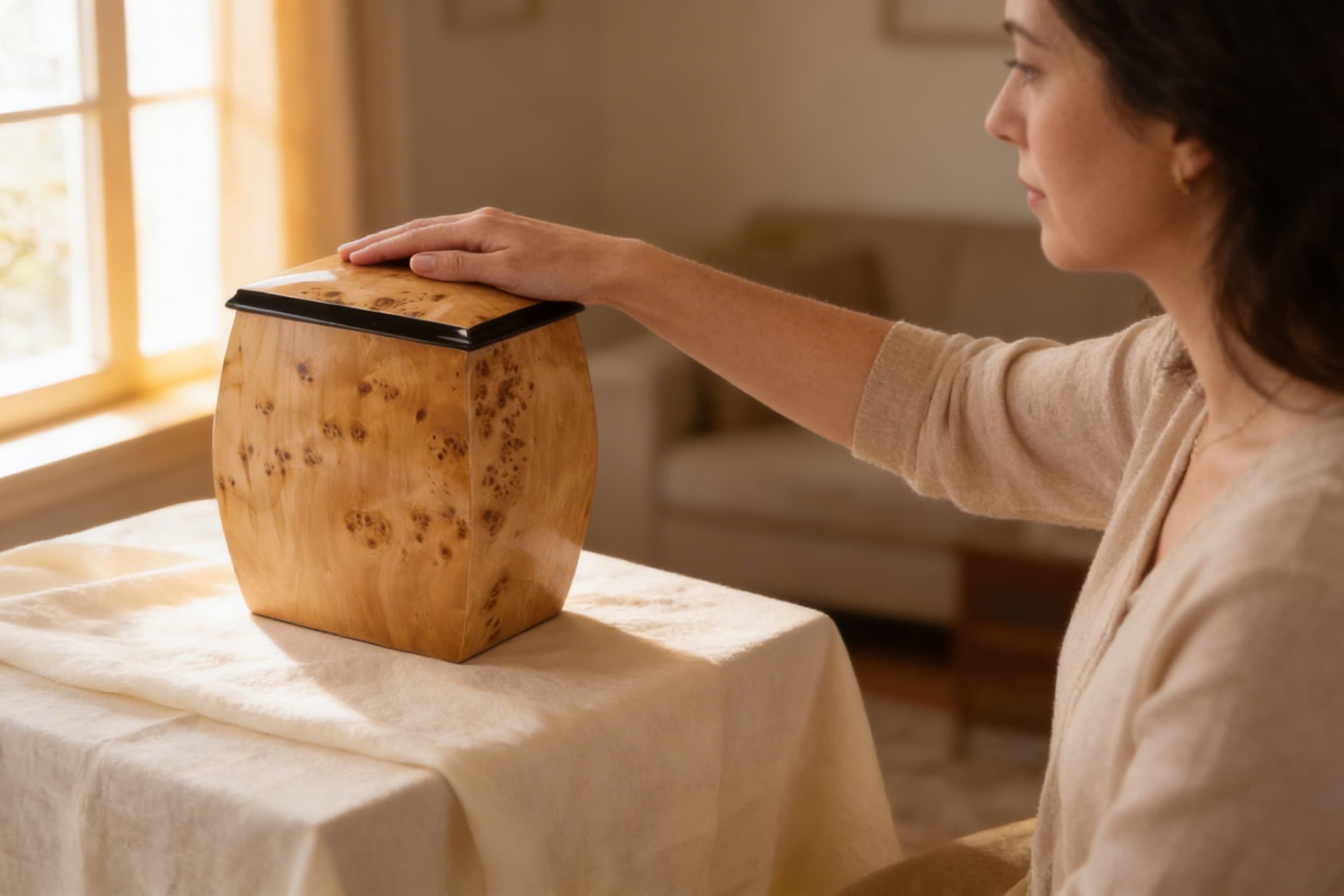
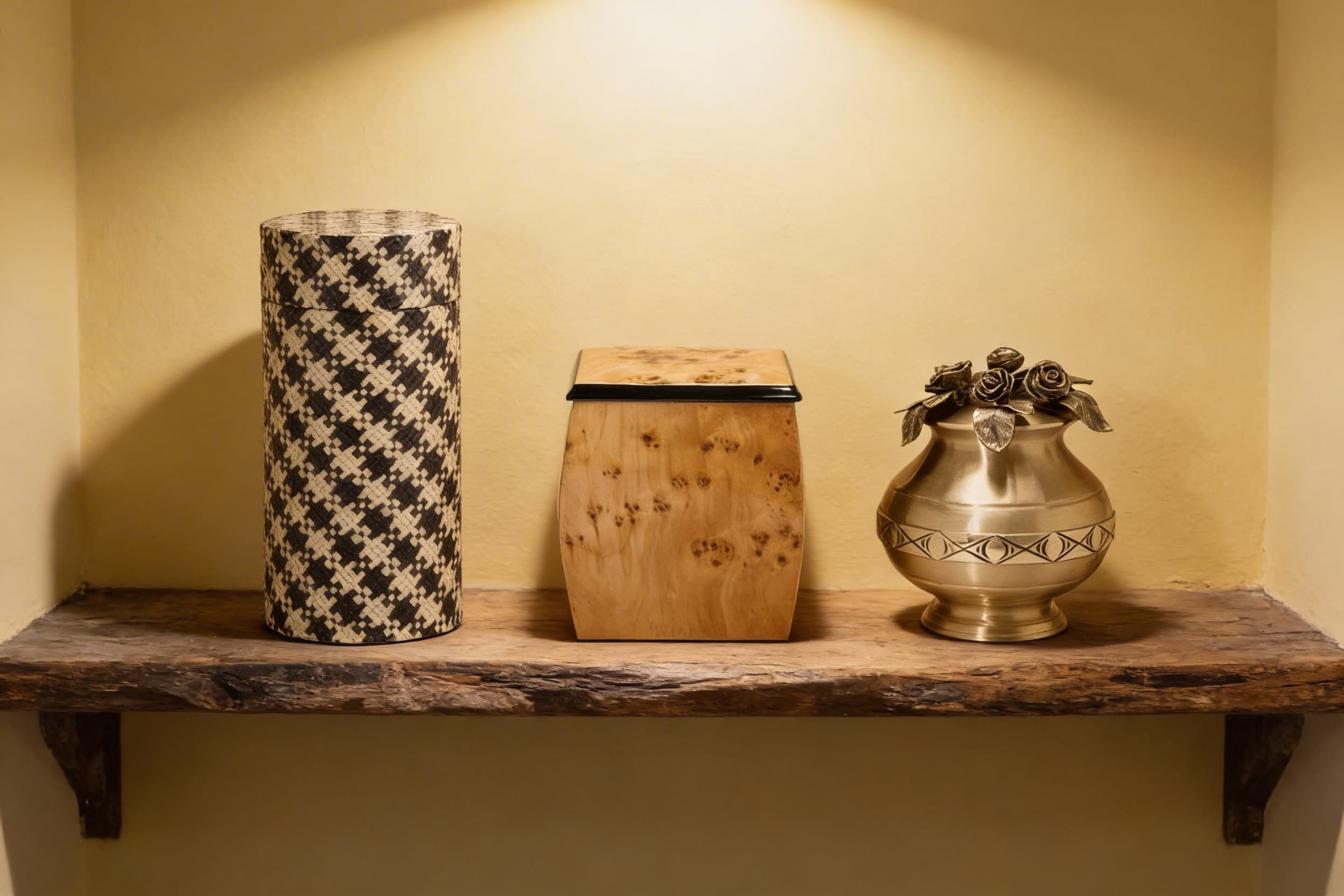
Many families choose to keep their loved one's cremated remains at home in a prominent place — a mantel, bookshelf, or dedicated memorial space. If this is your plan, focus on an urn that fits the room's aesthetic and is made from a durable material that holds up over time. Wood urns, ceramic urns, and hand-blown glass are popular choices for home display because they combine visual warmth with lasting quality. For detailed guidance on creating a meaningful space in your home, read our guide on how to display a cremation urn at home.
Some families feel uncertain about keeping cremated remains in their home. If that resonates with you, our article on whether it's bad luck to keep ashes in the house addresses common concerns and cultural perspectives. A related question many families ask is whether it's acceptable to open an urn — for example, to divide ashes among keepsake urns or to add personal mementos alongside the remains. Our article on whether it's bad luck to open an urn separates the myths from the facts and explains when and how it's perfectly appropriate.
Columbarium Niche
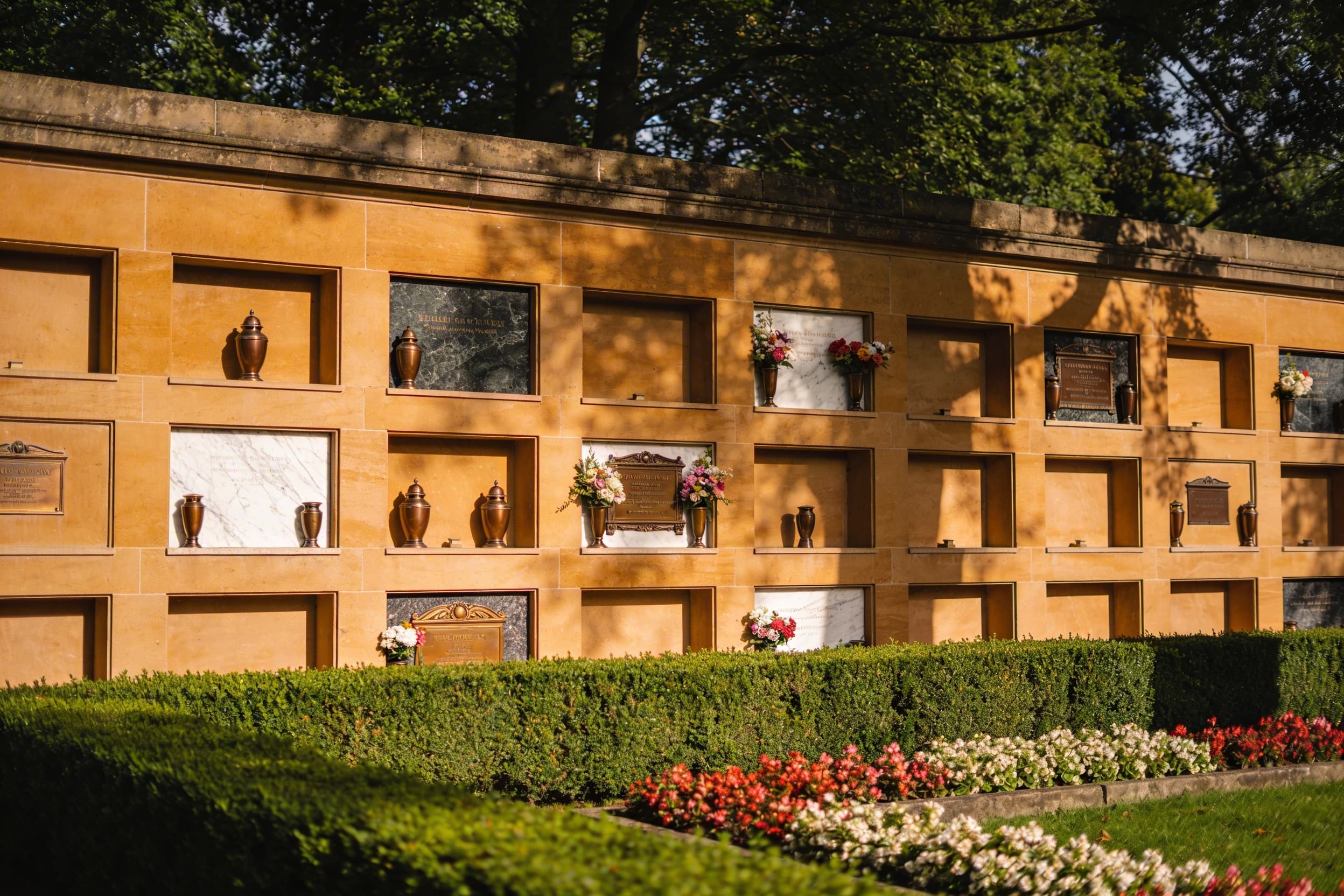
A columbarium is a structure — often at a cemetery, church, or memorial park — with individual compartments called niches designed to hold urns. If you're choosing this route, the niche dimensions become your primary constraint. Always get the exact measurements (height, width, and depth) from the facility before purchasing an urn. Some columbariums also restrict which materials they allow, so confirm their guidelines early in the process. Our cremation niche and columbarium guide covers sizing, costs, and what to expect.
Ground Burial
Any urn can technically be buried, but most cemeteries require the urn to be placed inside a protective outer container called an urn vault. The vault prevents the ground from settling over time and protects the urn from soil pressure and moisture. Urn vaults come in several materials — polymer and high-density plastic are the most affordable, while concrete and steel provide maximum protection. Some vault designs are self-sealing and permanently protect the urn from water intrusion.
Cultured marble urns are a notable exception — many cemeteries allow them to be buried directly without a vault because of their structural strength and water resistance. This can save $100 to $500 on vault costs, making cultured marble a practical choice for families planning ground burial.
Before purchasing, check with your cemetery about their specific vault requirements. Ask about material restrictions, vault specifications, and whether certain urn types qualify for direct burial. Our urn vault requirements guide breaks down the rules, costs, and options, and our article on cremation urns for burial covers material suitability in detail. If you're weighing the full cost of urn burial against other options, our article on how much it costs to bury cremated ashes provides a complete price breakdown.
Scattering Ashes
If the plan is to scatter cremated remains, you'll want an urn designed for that purpose — lightweight, with an easy-to-open lid that allows controlled release. Standard urns with threaded lids can make scattering difficult, especially in windy conditions. Purpose-built scattering urns and scattering tubes give you much better control over the process.
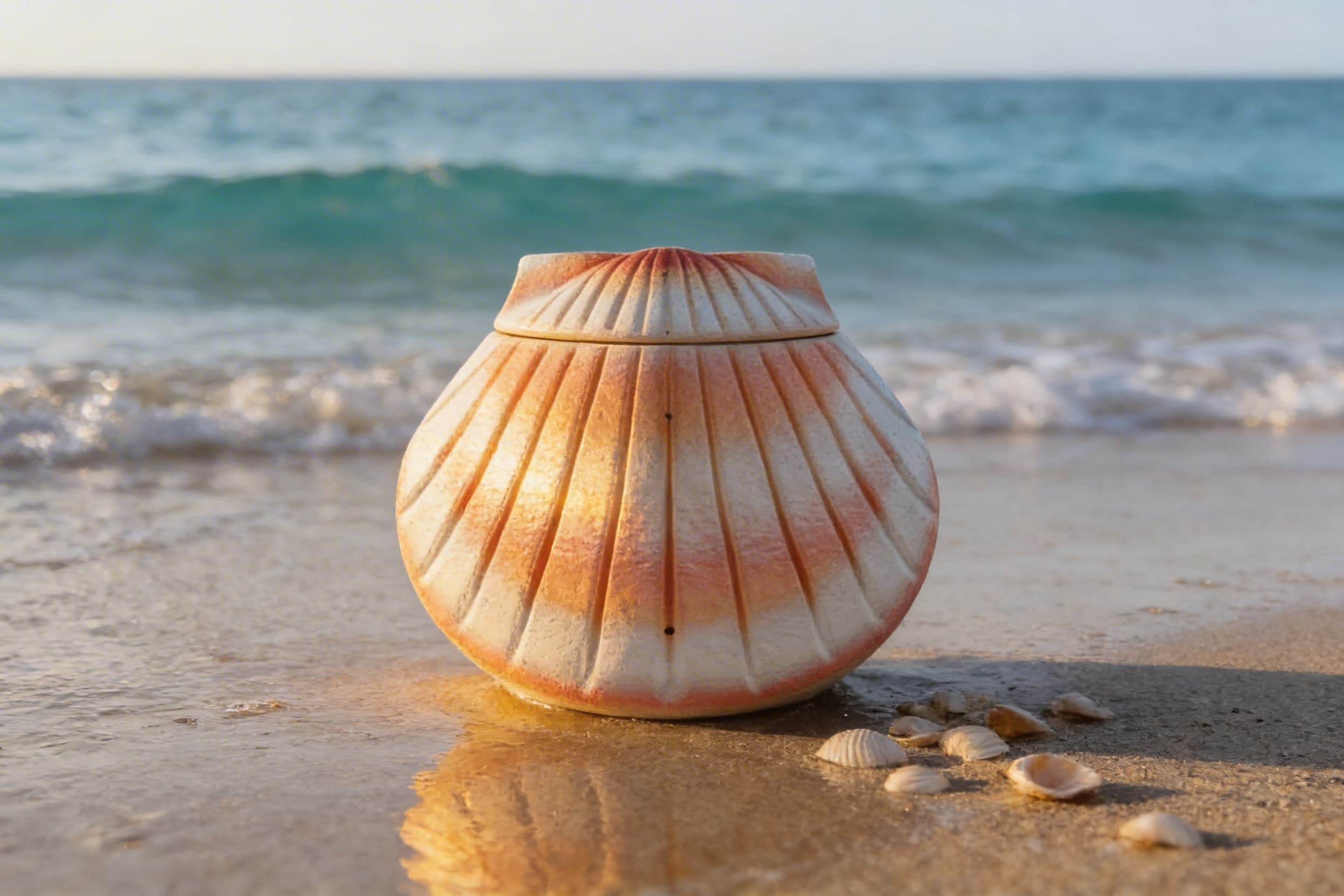
Biodegradable urns made from materials like sand, salt, or plant fiber are ideal for water scattering ceremonies, as they float briefly before dissolving naturally. This creates a meaningful visual moment during the ceremony without any environmental impact. For land-based scattering, a simple scattering tube with a removable end cap lets you control the flow of ashes directionally.
Keep in mind that scattering laws vary by state and locality. National parks, bodies of water, and private land each have different rules. Our scattering ashes guide walks through methods for land, water, and aerial scattering, including etiquette and legal considerations.
Sharing Remains Among Family Members
Rather than entrusting one person with all of the cremated remains, many families choose to divide them among multiple keepsake urns — smaller vessels designed to hold a portion of the ashes. This allows siblings, grandchildren, or close friends to each keep a personal memorial. Cremation jewelry is another option for carrying a small amount of remains close at all times. To understand the considerations involved in dividing ashes, read Is It Wrong to Separate Cremated Ashes? and our comparison of keepsake urns vs. full-size urns.
Traveling With Cremated Remains
If you need to transport an urn by air, the Transportation Security Administration (TSA) requires that the urn pass through X-ray screening. Metal and stone urns often can't be scanned clearly, which may cause issues at security checkpoints. Fabric-covered urns and certain wood urns are better choices for air travel because they're fully X-ray scannable. Some families purchase a temporary urn for travel and then transfer the remains to a permanent vessel once they've reached their destination.
For international travel, rules vary by country. Some nations require a death certificate, cremation certificate, and a permit from the local consulate before cremated remains can cross the border. It's also worth noting that most airlines allow cremated remains in carry-on luggage but not in checked baggage — keeping the urn with you gives you more control and avoids the risk of loss. If you're traveling by car, simply place the urn in a secure spot where it won't shift or fall during the drive.
Step 2: Get the Right Size
Urn sizing follows a straightforward rule: one cubic inch of urn capacity for every pound of pre-cremation body weight. A person who weighed 175 pounds will need an urn with at least 175 cubic inches of capacity.
Most standard adult urns hold 200 to 220 cubic inches, which accommodates the majority of adults. If your loved one weighed more than 200 pounds, look for an oversized or extra-large urn. If you're not sure about the exact weight, your cremation provider can give you an estimate of the volume of cremated remains you'll receive.
A few additional sizing considerations:
Companion urns are designed to hold the remains of two people and typically range from 350 to 400 cubic inches in capacity. Our companion urns guide covers how to choose the right one.
Keepsake urns hold anywhere from 3 to 100 cubic inches, depending on the style. They're used when dividing remains among family members or when most ashes have been scattered and a small portion is kept.
If you'd like a more detailed breakdown with visual size charts, our article What Size Urn Do I Need? is a complete reference.
Tip: When in doubt, size up. It's always better to have a slightly larger urn than one that's too small to hold all of the cremated remains comfortably.
Step 3: Choose a Material
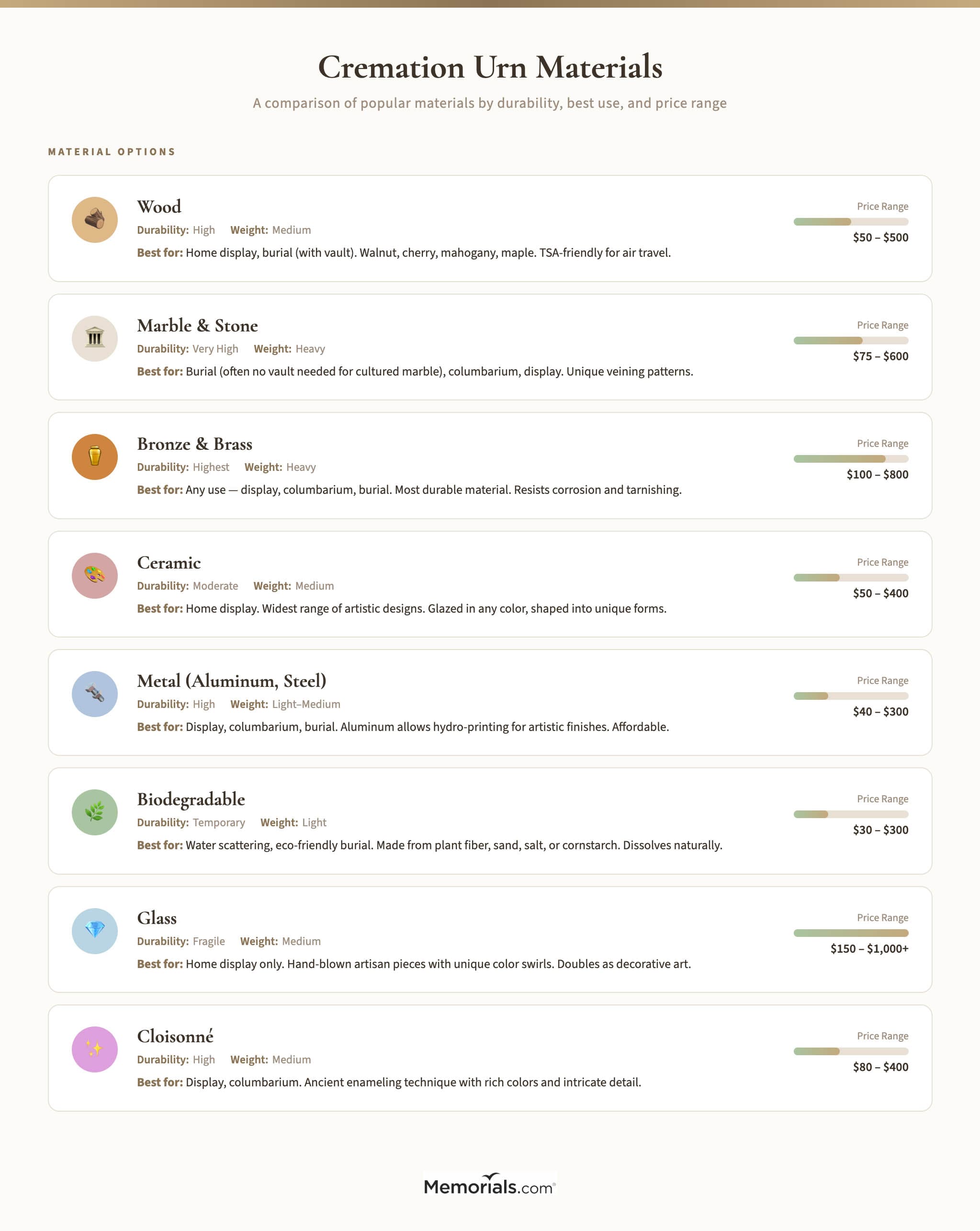
The material of a cremation urn affects its appearance, durability, suitability for different uses, and price. Here's an overview of the most common options. For a deeper comparison, see our full guide to types of cremation urns.
Wood
Wood urns are among the most popular choices, valued for their warmth, natural beauty, and wide range of finishes. Hardwoods like walnut, cherry, mahogany, and maple each have distinct grain patterns and color tones, making every urn subtly unique. Oak provides a more rustic, sturdy character, while rosewood and teak offer exotic richness. Many wood urns feature dovetail or hand-joined construction that reflects fine craftsmanship.
Wood is suitable for home display and ground burial (though a vault is typically required for burial). Wood urns are also among the better options for air travel, as they pass through TSA X-ray scanners without issue — just avoid designs with metal appliqués or hardware if you plan to fly. Prices generally range from $50 to $500 depending on the wood species, construction quality, and level of hand-finishing.
Marble and Stone
Marble urns carry an unmistakable sense of permanence. Natural marble features unique veining that means no two urns are identical. Cultured marble — an engineered composite — offers similar aesthetics at a lower price point and can often be engraved directly, which natural marble typically cannot. Both varieties are heavy, durable, and suitable for display, columbarium placement, or ground burial. Many cemeteries allow cultured marble urns to be buried without a separate vault due to their structural integrity. Prices range from $75 to $600.
Bronze and Brass
Bronze urns are the most durable option available. Bronze and brass resist corrosion, denting, and tarnishing, making them suitable for virtually any use — home display, columbarium, or burial. They're available in a range of finishes from classic patina to polished gold. The weight and heft of metal urns convey a sense of solidity and permanence. Prices typically range from $100 to $800, with hand-cast bronze pieces at the higher end.
Ceramic
Ceramic urns offer the widest range of artistic expression. They can be glazed in virtually any color, shaped into unique forms, and painted with intricate designs. This makes them a strong choice for families who want something truly one-of-a-kind. Ceramic is best suited for indoor display, as it's more fragile than wood or metal. Prices generally range from $50 to $400.
Metal (Aluminum, Stainless Steel)
Metal urns beyond bronze and brass include aluminum and stainless steel options. Aluminum is lightweight, making it practical for transport, and can be finished with hydro-printing techniques that create detailed nature scenes or artistic patterns. Stainless steel is highly resistant to damage and corrosion. Metal urns work well for display, columbarium placement, and burial. Prices range from $40 to $300.
Biodegradable
Biodegradable urns are crafted from plant fiber, sand, salt, cornstarch, paper, or other natural materials designed to break down over time. They're the go-to choice for water scattering ceremonies, eco-friendly ground burial, or families who want the remains to return to the earth naturally. Some biodegradable urns are designed to float on water for a period before dissolving, creating a meaningful ceremony moment. Our biodegradable cremation urns guide covers the options in depth. Prices range from $30 to $300.
Glass
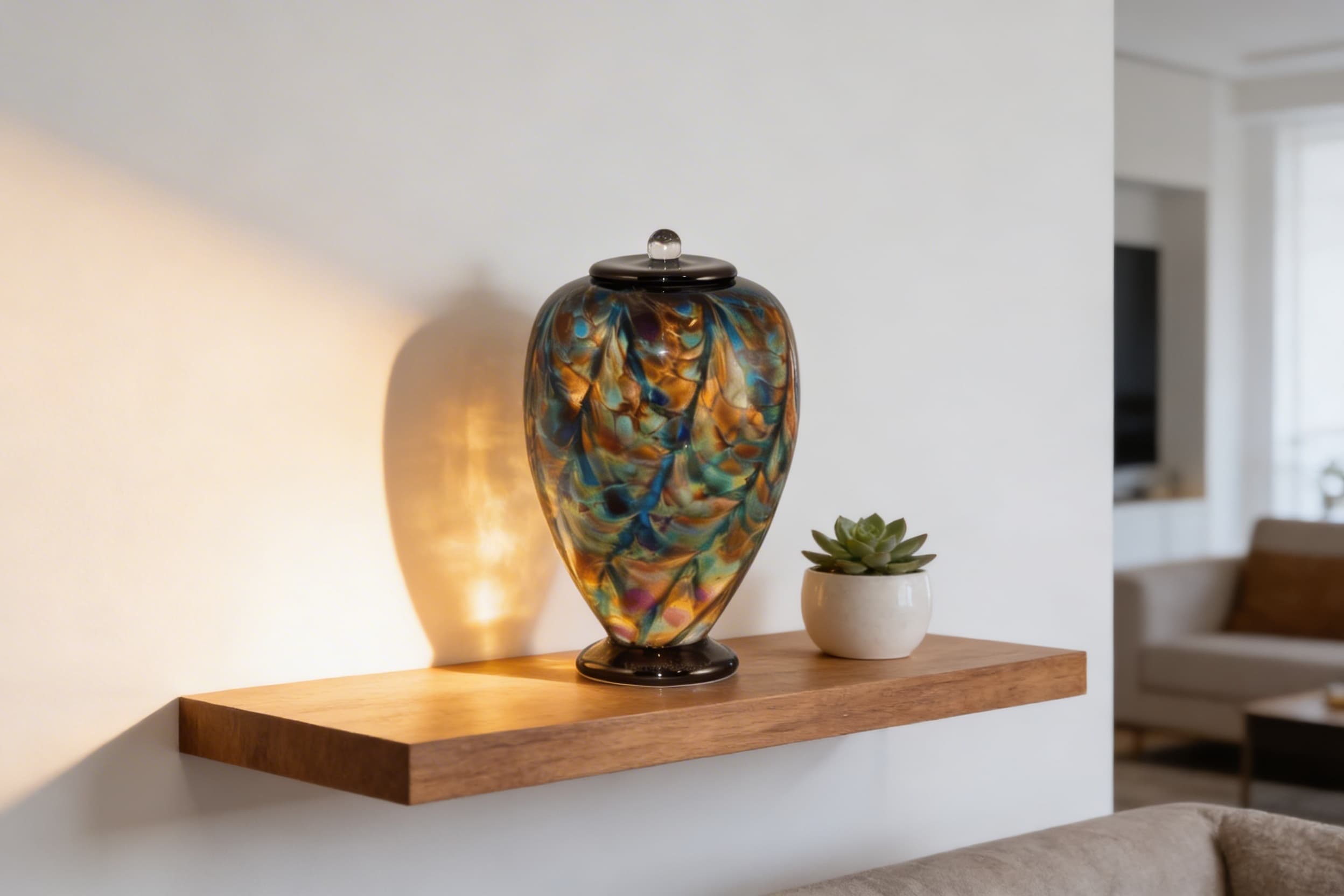
Hand-blown glass urns are distinctive artistic pieces, often featuring swirls of color trapped within the glass. They're best suited for prominent display in the home and serve as both a memorial and a work of art. Because of their fragility, they're not recommended for burial or travel. Prices typically start around $150 and can exceed $1,000 for custom artisan pieces.
Cloisonné
Cloisonné urns feature an ancient enameling technique where thin metal wires create compartments that are then filled with brightly colored enamel and fired at high temperatures. The result is a richly decorated, highly detailed surface. These urns are durable and suitable for display or columbarium placement. Prices generally range from $80 to $400.
A Note on Decorative Vases vs. Cremation Urns
If you've been searching online, you may have noticed that some decorative vases look remarkably similar to cremation urns — and you might be wondering whether a vase could serve the same purpose. While there's no law preventing you from using a vase, purpose-built cremation urns are specifically engineered for this role. They include secure closures to prevent accidental spills, openings designed for transferring cremated remains, and capacities rated in cubic inches so you can match the urn to the volume of ashes. Decorative vases typically lack these features. Our article on urn vase vs. cremation urn explains the practical differences in detail and helps you decide whether a standard urn or a repurposed vessel is the right choice for your situation.
Step 4: Consider the Budget
Cremation urn prices span a wide range — from under $30 for a simple biodegradable vessel to over $1,000 for custom artisan work. Most families spend between $75 and $350.
A few things that influence cost:
Material is the primary driver. Bronze and natural marble sit at the higher end. Wood, ceramic, and metal urns occupy the middle range. Biodegradable and basic metal urns are the most affordable.
Size matters too. Companion urns that hold the remains of two people cost more than standard individual urns, and keepsake urns cost less because they're smaller.
Personalization adds to the base price. Engraving, photo embedding, and custom finishes typically add $25 to $150 depending on the complexity.
Where you buy makes a significant difference. Funeral homes often carry a limited selection at premium prices — markups of 100% to 300% over wholesale are not uncommon. Online retailers like Memorials.com generally offer a wider range of options at lower prices because they don't carry the overhead costs of a physical facility. You are never required to purchase an urn from a funeral home — this is a legal right under the FTC's Funeral Rule, which states that funeral homes must accept any urn supplied by the family without penalty.
Timing also plays a role. If you need the urn immediately for a service, expedited shipping from an online retailer can typically deliver within 1 to 3 business days. If the urn will be personalized with engraving, allow an additional 2 to 5 business days for that work. In the interim, cremated remains are perfectly safe in the temporary container provided by the crematory — there is no urgency to transfer them immediately. Some families take weeks or even months to select the right permanent urn, and that's completely normal.
Pre-planning is another option worth considering. Purchasing an urn in advance as part of end-of-life planning removes the decision from the period of acute grief and often results in a more thoughtful choice. It also allows more time to compare options and find the best value.
For a full cost breakdown by material, size, and style, our cremation urn cost guide covers everything in detail.
Step 5: Personalize the Urn
Personalization transforms a cremation urn from a standard vessel into a unique memorial that reflects your loved one's identity. There are several ways to add a personal touch.
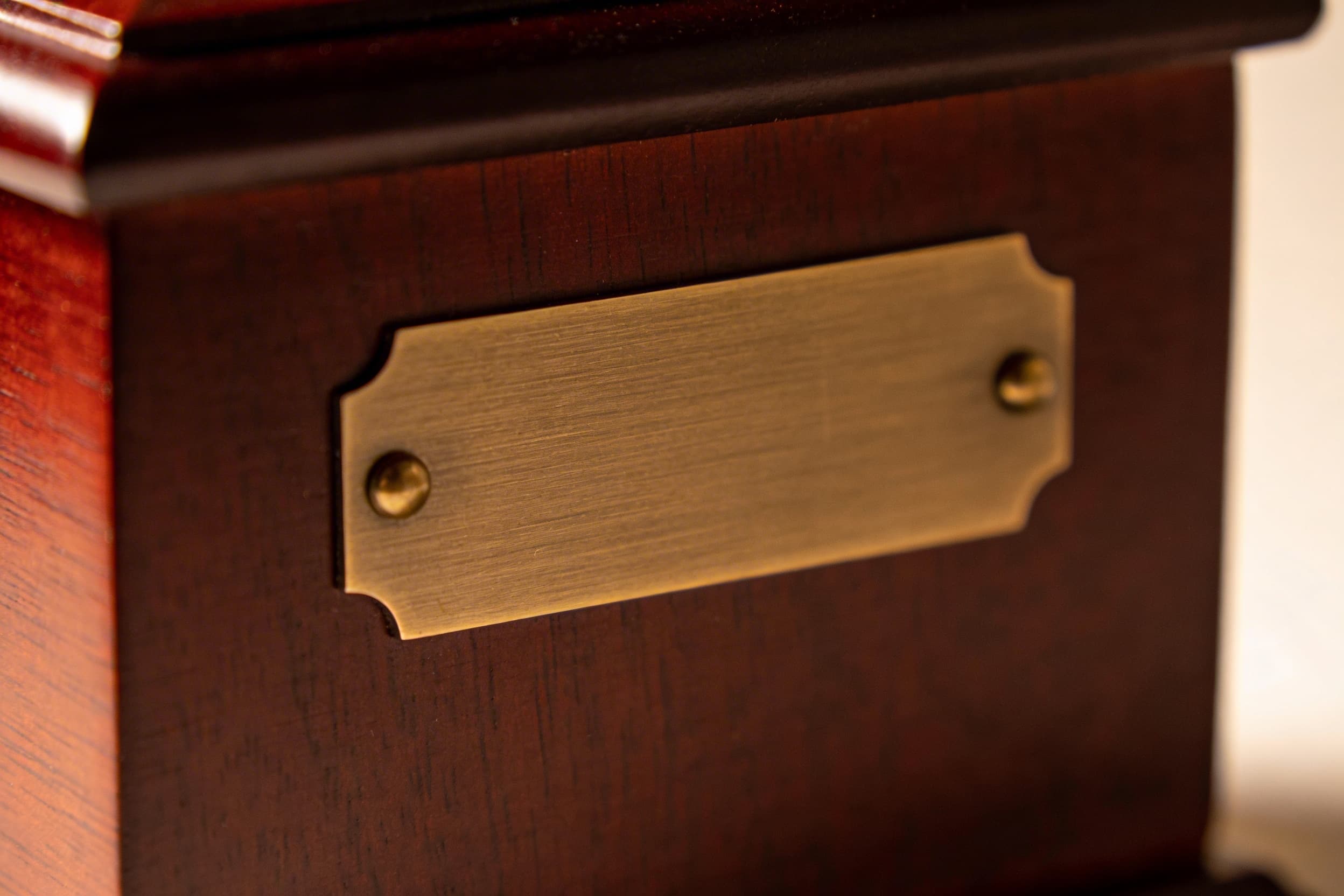
Engraving is the most common form of personalization. Names, dates, short quotes, religious verses, or meaningful phrases can be inscribed directly onto many materials — especially cultured marble, metal, and wood. Popular engraving choices include the person's full name and birth-death dates, a brief epitaph like "Forever in Our Hearts," a line from a favorite poem or scripture, or a simple symbol that held meaning. Laser engraving produces crisp, precise text and can even reproduce photographs on certain surfaces. Hand engraving offers a more traditional, artisan feel. Engraved urn nameplates offer an alternative for urns whose surfaces can't be directly engraved; the nameplate attaches to the urn and can feature text, images, or both.
Themed and hobby urns reflect the passions and personality of the person who has passed. Urns featuring fishing, hunting, sports, motorcycles, nature scenes, and other motifs are widely available. Our guide to hobby and themed urns explores these options. For families of veterans, military and veteran urns feature patriotic emblems, service branch insignias, and flag motifs — our military veteran urn guide covers VA benefits and selection considerations.
Photo urns incorporate a photograph of your loved one directly into the urn's design, creating an immediately personal memorial. Color choices can also reflect a favorite hue or match the decor of the space where the urn will be displayed.
For a complete overview of personalization possibilities, including what to engrave and how the process works, see our urn engraving and personalization guide.
Step 6: Understand Cemetery and Burial Requirements
If you plan to bury the urn or place it in a columbarium, there are rules you'll need to follow. These vary from cemetery to cemetery, so always confirm requirements with the facility before purchasing.
Urn vaults are the most common requirement for ground burial. An urn vault is a protective outer container — typically made of polymer, concrete, or steel — that houses the urn underground. Its purpose is to prevent the soil from settling and to protect the urn from moisture and pressure. Vault costs typically range from $50 to $500. Some vault designs double as an urn and burial container in one, which can save money. Cultured marble urns may be exempt from the vault requirement at certain cemeteries because of their structural density.
Columbarium niches have specific dimension limits. Measure the niche (height × width × depth) and compare against the urn's exterior dimensions before buying. Some facilities restrict materials as well.
National cemeteries operated by the VA have their own specific requirements for veteran burials. If your loved one served in the military, our military veteran urn guide details the VA burial allowance, urn specifications, and how to arrange interment at a national cemetery.
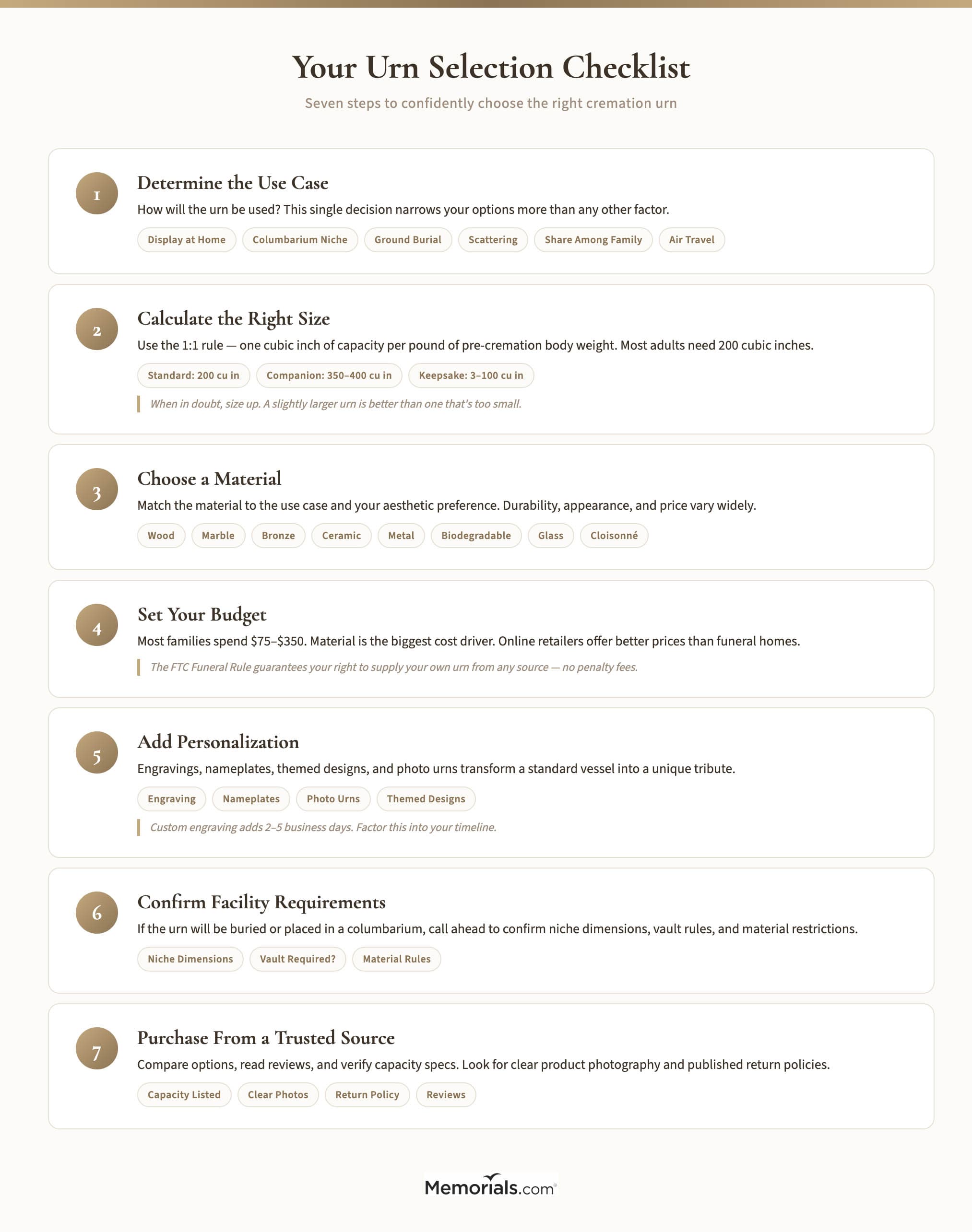
To bring all of these factors together, here is a step-by-step checklist you can use to narrow your search and arrive at the right urn with confidence.
1. Determine the use case. Will the urn be displayed at home, placed in a columbarium niche, buried in a cemetery, used for scattering, or divided among family members? This narrows the field immediately.
2. Calculate the size you need. Use the one-cubic-inch-per-pound rule. For a standard adult, a 200-cubic-inch urn covers most situations. For two people, look at companion urns in the 350-to-400-cubic-inch range.
3. Choose a material. Match the material to your use case: durable metals and stone for burial and outdoor placement, decorative wood or ceramic for home display, biodegradable materials for scattering or eco-friendly burial.
4. Set a budget. Know what you're comfortable spending before you start browsing. Most families find a meaningful urn between $75 and $350.
5. Decide on personalization. Consider whether you'd like engraving, a nameplate, a themed design, or a photo embedded in the urn. Factor this into your budget and timeline, as custom engraving typically adds a few business days.
6. Confirm cemetery or facility requirements. If the urn is being buried or placed in a columbarium, call the facility to get niche dimensions, vault requirements, and material restrictions before you purchase.
7. Purchase from a trusted source. Compare options from online retailers and funeral homes. Look for clear product photos, capacity specifications, material details, return policies, and customer reviews.
This seven-step process covers the vast majority of situations, but every family is different. The sections below address several special cases — companion urns, religious traditions, infant or child urns, and what to do after scattering — that may apply to your circumstances.
Special Considerations
Companion Urns for Couples
Companion urns hold the cremated remains of two people and are a meaningful choice for couples or close family members who wish to rest together. They're available in single-chamber and dual-chamber configurations — dual-chamber models keep the remains separate while housed in the same vessel, while single-chamber designs combine the remains together.
Companion urns typically hold 350 to 400 cubic inches, roughly double the capacity of a standard adult urn. They come in the full range of materials — wood, marble, bronze, ceramic — and many can be personalized with both names and dates.
These urns are also a practical choice for pre-planning, as one person's remains can be placed first and the second added later. The surviving spouse keeps the urn displayed at home or at another location, with space reserved for their own remains when the time comes. Our companion urns guide explores sizing, styles, and emotional considerations for choosing an urn for two.
Religious and Cultural Traditions
Religious beliefs and cultural practices can influence what type of urn is appropriate. Catholic guidelines, for example, specify that cremated remains should be kept together and interred in a sacred place rather than scattered or divided. Other faith traditions have their own perspectives on cremation and memorialization. Our religious and cultural cremation urn guide covers Catholic, Protestant, Jewish, Hindu, Buddhist, and Islamic perspectives. Religious urns featuring crosses, the Star of David, and other faith-based imagery are available for families who want the urn to reflect their spiritual values.
Choosing an Urn for a Child or Infant
Selecting an urn for a child is an extraordinarily difficult decision. Baby and child urns are specifically designed with smaller capacities and often feature gentler designs — soft colors, angels, teddy bears, or nature motifs. Sizing differs significantly from adult urns, so it's important to work with your cremation provider to understand the volume of remains. Our guide to choosing an urn for a child or infant provides compassionate, detailed guidance for this sensitive situation.
What Happens to an Urn After Scattering
If you scatter most of the ashes but keep a portion, a keepsake urn is a practical way to preserve a small amount of cremated remains. Some families repurpose the original urn as a memorial vessel — filling it with photographs, letters, or small mementos instead of ashes. Others choose to place the empty urn alongside the keepsake in a memorial display, creating a dedicated remembrance space in their home.
One often-overlooked option is donating the urn. If it's in good condition and the family no longer needs it, some funeral homes and nonprofit organizations accept gently used urns to help families who cannot afford one. Our article on what to do with an urn after scattering ashes covers creative and meaningful options for giving the urn a second purpose.
Frequently Asked Questions
How many cubic inches does a standard cremation urn hold?
Most standard adult cremation urns hold 200 to 220 cubic inches of capacity. This accommodates the cremated remains of adults who weighed up to approximately 200 pounds. For individuals who weighed more, oversized urns are available in capacities ranging from 250 to 300+ cubic inches. For a detailed size chart, see our article What Size Urn Do I Need? in the Urn Selection Info Center.
Do I have to buy an urn from the funeral home?
No. Under the Federal Trade Commission's Funeral Rule, funeral homes must accept any urn purchased from an outside source and cannot charge a fee for doing so. Many families find a wider selection and more competitive pricing by shopping online.
What is the difference between an urn and an urn vault?
An urn holds the cremated remains. An urn vault is a separate protective outer container that goes around the urn during ground burial to prevent soil settling and protect the urn from the elements. Some cemeteries require a vault for urn burial; others do not. Some products combine both functions into one — acting as both the urn and the burial container.
Can I bury any cremation urn?
Any urn can be placed in the ground, but most cemeteries require it to be inside a vault. Cultured marble and certain stone urns are sometimes approved for direct burial without a vault. Always check with the cemetery before purchasing.
How do I transfer ashes into a new urn?
Cremated remains are returned from the crematory in a sealed plastic bag inside a temporary container. To transfer them, simply lift the bag and place it into the new urn. Your funeral director can also handle this for you. There's no special process required, and you don't need to open the bag. If the bag is too large for the new urn's opening, the remains can be carefully poured from the bag into the urn over a clean surface, though most families find the bag fits without issue.
What is the best material for a cremation urn?
There is no single "best" material — the right choice depends on how the urn will be used. For home display, wood, ceramic, and glass offer warmth and visual appeal. For ground burial, bronze, marble, and cultured stone provide the durability to withstand time underground. For scattering ceremonies, biodegradable urns are purpose-built for the occasion. For a complete comparison, see our types of cremation urns guide.
Can I bring a cremation urn on an airplane?
Yes, but the urn must be able to pass through the TSA's X-ray scanner. Dense materials like metal, stone, and thick ceramic may prevent the scanner from producing a clear image, which could lead to your urn being denied at the security checkpoint. TSA agents are not permitted to open an urn for manual inspection. Wood urns, fabric urns, and lightweight composites are the safest options for air travel. Always check with your airline in advance, as some carriers have additional requirements.
How long can cremated remains stay in a temporary container?
Indefinitely. The temporary container provided by the crematory — typically a plastic box or cardboard container — safely holds the remains for as long as needed. The plastic bag inside creates a sealed environment. There is no degradation or safety concern with leaving remains in a temporary container while you take time to select a permanent urn. Many families wait weeks or months before making a final decision, and that is perfectly acceptable. Some families use the temporary container for years before choosing a permanent urn, and there is no harm in doing so.
Finding the Right Urn for Your Family
Choosing a cremation urn is a deeply personal process, but it doesn't have to be an overwhelming one. By working through the decisions in order — use case, size, material, budget, personalization, and facility requirements — you'll arrive at a choice that feels right.
If you're still in the early stages and weighing your options between cremation and traditional burial, our in-depth comparison of cremation vs. burial covers the practical, emotional, and financial factors that shape that decision. For families who have already chosen cremation, the urn selection process is the next meaningful step.
Remember that there is no single "correct" choice. The best urn is the one that reflects your loved one's personality, meets the practical requirements of its intended use, and brings comfort to the people who will see it and remember. Some families find their urn in minutes; others take weeks to decide. Both approaches are completely normal, and there is no timeline you need to follow.
If you're ready to start browsing, explore our complete collection of cremation urns to find the perfect tribute. Every urn ships with care, and our team is available to answer questions and help you find the right fit for your family's needs.