🏬Supersize Online Funeral Retailer🪦1000's of Headstones⚱️Over 10,000 Cremation Urns⚰️Caskets Overnight Delivery🛒Funeral & Memorial Superstore🚚FREE Shipping on ALL Orders👨👩👧👦Helping Families for over 20 Years💰Lowest Price Guarantee🏬Supersize Online Funeral Retailer🪦1000's of Headstones⚱️Over 10,000 Cremation Urns⚰️Caskets Overnight Delivery🛒Funeral & Memorial Superstore🚚FREE Shipping on ALL Orders👨👩👧👦Helping Families for over 20 Years💰Lowest Price Guarantee
🏬Supersize Online Funeral Retailer🪦1000's of Headstones⚱️Over 10,000 Cremation Urns⚰️Caskets Overnight Delivery🛒Funeral & Memorial Superstore🚚FREE Shipping on ALL Orders👨👩👧👦Helping Families for over 20 Years💰Lowest Price Guarantee🏬Supersize Online Funeral Retailer🪦1000's of Headstones⚱️Over 10,000 Cremation Urns⚰️Caskets Overnight Delivery🛒Funeral & Memorial Superstore🚚FREE Shipping on ALL Orders👨👩👧👦Helping Families for over 20 Years💰Lowest Price Guarantee
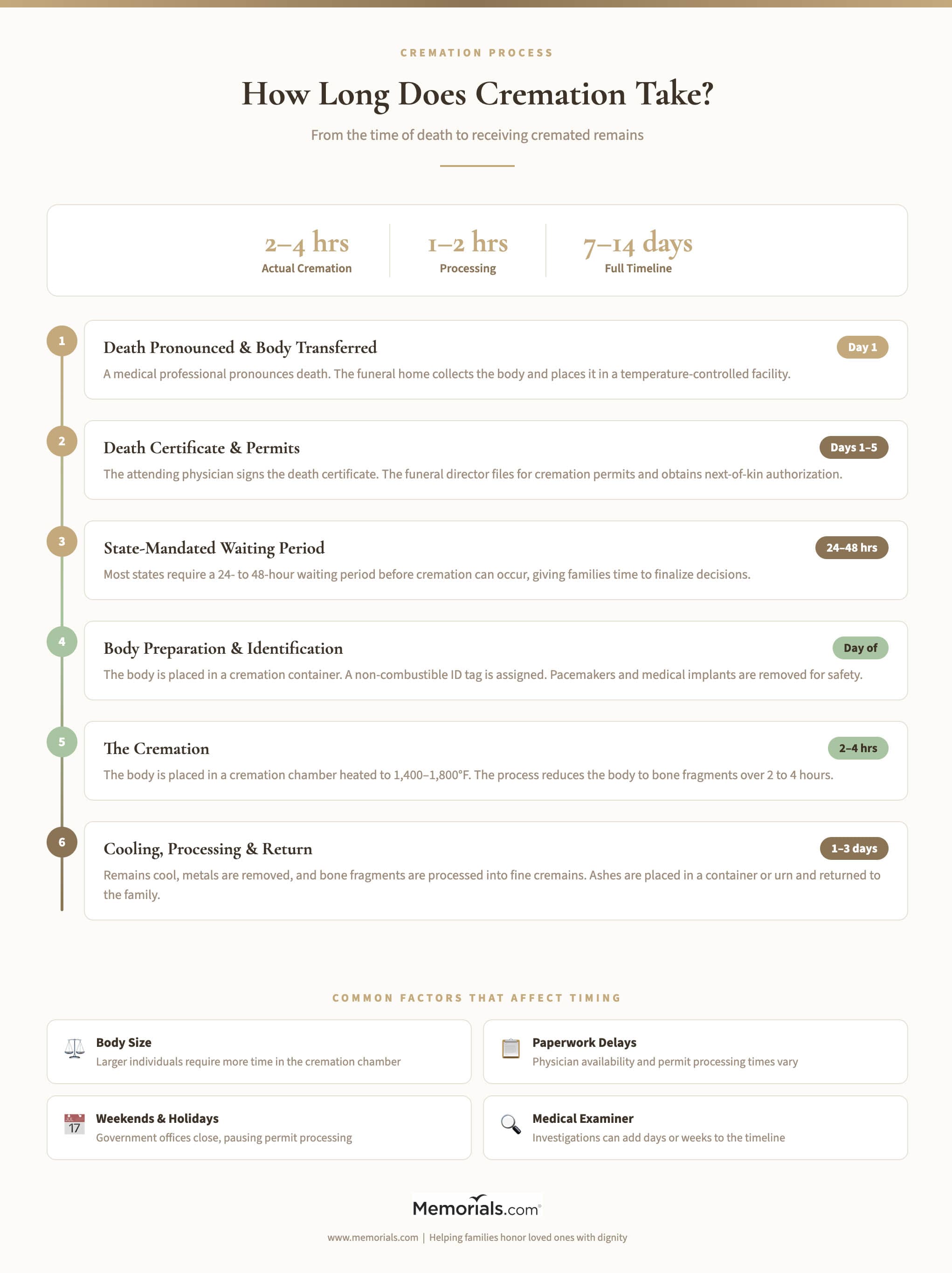
How long does the cremation process take? The short answer: the actual cremation lasts about 2 to 4 hours. The longer and more accurate answer: the entire process — from the moment of death through the return of cremated remains to your family — typically spans 7 to 14 business days.
That gap between the cremation itself and the full timeline surprises many families. Understanding what happens during each stage can help set realistic expectations and ease some of the uncertainty during an already difficult time. This is one of many practical questions families face when choosing a cremation urn and planning what comes next.
What Happens During the Cremation Process
The cremation process follows a regulated sequence of steps, each designed to ensure legal compliance, proper identification, and respect for the deceased. Here is a step-by-step look at what happens.
After a loved one passes, a medical professional — whether a hospice nurse, hospital physician, or medical examiner — must officially pronounce the death. Once the pronouncement is made, the funeral home arranges to collect the body and bring it to a temperature-controlled facility.
This initial step usually happens within a few hours of the death, though timing can vary depending on the location and time of day.
Step 2: Death Certificate and Legal Authorization
Before cremation can be scheduled, two critical pieces of paperwork must be completed.
The death certificate. The attending physician or medical examiner must sign the death certificate, which records the cause and manner of death. In many states, the death certificate must also be filed electronically with the local health department. Delays at this stage are common — if the physician is unavailable or the cause of death requires additional review, the process can stall for several days.
Cremation authorization. The legal next of kin must sign a cremation authorization form granting permission for the cremation to proceed. The specific rules about who qualifies as next of kin vary by state, but it is generally the surviving spouse first, then adult children. If multiple adult children share this authority, all must typically agree and sign.
The funeral director also files for a cremation permit from the local or state government. These administrative steps account for the largest portion of the overall cremation timeline, often taking 2 to 5 business days.
Step 3: Mandatory Waiting Period
Most states require a waiting period — usually 24 to 48 hours after death — before cremation can legally take place. This window allows families time to finalize their decision and ensures all legal and medical reviews are complete.
Some states have longer or shorter waiting periods, so it is worth asking your funeral director about local regulations. During this time, the body is kept in refrigerated storage at the funeral home or crematory.
Step 4: Body Preparation and Identification
On the day of cremation, the deceased is placed into a cremation container — a rigid, combustible enclosure made of pressed wood or heavy cardboard designed specifically for this purpose. No casket is required for cremation, though families may choose to use one if a viewing was held beforehand.
A non-combustible identification tag with a unique number is assigned to the deceased. This metal tag stays with the remains throughout the entire cremation process, from the chamber through to the final container, ensuring proper identification at every stage.
If the deceased had a pacemaker, defibrillator, or other battery-powered medical implant, these devices must be removed before cremation. The batteries inside these devices can explode under extreme heat, posing a serious safety risk to crematory staff and equipment.
Step 5: The Cremation Itself
The body is placed inside a cremation chamber — also called a retort — and exposed to intense heat between 1,400°F and 1,800°F. At these temperatures, all organic matter is reduced through combustion.
The process occurs in two stages. During primary combustion, the soft tissue, organs, and container materials burn off as gases. These gases pass into a secondary chamber where they undergo additional combustion before being vented through the crematory's exhaust system.
How long does the actual cremation take? Most cremations are completed in 2 to 4 hours, though the time varies based on several factors (discussed below). What remains after the chamber cools are bone fragments and any non-combustible materials like surgical implants or dental work.
Step 6: Processing the Cremated Remains
After the cremation cycle is complete, the remains need time to cool — typically 30 to 60 minutes. Once cooled, the crematory staff carefully collects the bone fragments and uses a magnet to remove any remaining metal pieces from joint replacements, screws, or other implants.
The bone fragments are then placed into a machine called a cremulator, which grinds them into the fine, uniform powder most people recognize as "ashes" or cremains. This processing step takes an additional 1 to 2 hours.
The final cremated remains typically weigh between 3 and 7 pounds, depending on the individual's bone structure (not their body weight at the time of death). The cremains are placed into a temporary container provided by the crematory or into a cremation urn the family has already selected. Knowing what size urn you'll need in advance can help you have the right container ready when the ashes are returned.
Factors That Affect How Long Cremation Takes
Several variables can shorten or extend the timeline.
Body size and composition. A person with a larger body requires more time in the cremation chamber. While an average-sized adult may take about 2 to 3 hours, a larger individual may need 3 to 4 hours or more.
The cremation container. Heavier or more substantial containers (like a wooden casket used after a viewing) take longer to combust than a standard cardboard cremation container.
Crematory equipment. Modern cremation chambers with updated technology tend to complete the process faster than older units. Facility schedules also play a role — high-demand periods or equipment maintenance can push the cremation date back by a day or two.
Paperwork and permit processing. This is by far the most common source of delay. Physician availability, state processing times for death certificates, and government office hours all influence the timeline. A death that occurs on a Friday evening, for example, may not see any permit paperwork processed until the following Tuesday.
Medical examiner involvement. If the death requires investigation by a medical examiner or coroner — as is common with unexpected or unattended deaths — cremation cannot proceed until the examiner provides clearance. This can add several days or, in some cases, weeks to the overall timeline.
State laws and regulations. Every state has its own rules governing waiting periods, permit requirements, and documentation standards. Some states allow cremation within 24 hours of obtaining permits, while others impose longer waiting periods. Families weighing their options may find our cremation vs burial comparison helpful for understanding how timelines and costs differ between the two.
How Long Does It Take to Get Ashes Back?
Most families receive cremated remains within 7 to 10 business days after making initial arrangements, though the total timeframe can extend to 14 days depending on the factors described above.
Once the cremation and processing are complete, the ashes are ready for pickup within 1 to 3 days. Some crematory facilities offer same-day return if the family has already selected an urn and the cremation was completed early in the day.
If you have chosen direct cremation — meaning no viewing, visitation, or funeral service before the cremation — the timeline tends to be on the shorter end, since there is no need to coordinate service scheduling, embalming, or casket selection.
For families who need the remains shipped, the United States Postal Service allows cremated remains to be sent through Priority Mail Express in a sealed, rigid container along with copies of the death certificate and cremation permit.
What Happens After Cremation
Receiving your loved one's cremated remains opens the next chapter of memorialization. There is no rush — families can take as much time as they need to decide how they wish to honor their loved one. For a full overview of your options, see our guide on what to do with ashes after cremation.
Dividing the ashes among family members.Keepsake urns allow multiple family members to each hold a small portion of the cremated remains. Cremation jewelry offers another way to carry a tiny amount of ashes in a pendant, ring, or bracelet.
Burial or placement in a columbarium. Cremated remains can be buried in a cemetery plot, often inside an urn vault for added protection. Columbarium niches provide an above-ground alternative.
Scattering the ashes. Families may choose to scatter ashes in a location meaningful to their loved one, whether at sea, in a garden, or at a favorite outdoor spot. Biodegradable urns are designed specifically for water or earth scattering.
Holding a memorial service. Whether or not there was a funeral before the cremation, families can plan a memorial service at any time — days, weeks, or even months later — with or without the ashes present.
If you are still deciding what to do with cremated remains, our guide on everything you need to know about human ashes covers the topic in depth.
FAQ
How long does the actual cremation take?
The physical cremation process takes approximately 2 to 4 hours, depending on the size of the body and the type of cremation container used. After the cremation itself, an additional 1 to 2 hours is required for cooling and processing the bone fragments into cremains.
How long after death does cremation happen?
Cremation typically occurs 3 to 7 days after death. This period accounts for the time needed to obtain the signed death certificate, secure a cremation permit, receive next-of-kin authorization, and observe any state-mandated waiting period.
Can you watch a cremation?
Many crematory facilities allow family members to witness the cremation if they wish. This is often referred to as a "witnessed cremation" and may involve a brief ceremony as the body is placed into the chamber. Ask your funeral director whether this option is available and whether any additional fees apply.
Do you get all the ashes back after cremation?
Crematories make every effort to recover all of the cremated remains. However, a very small amount of calcium residue may remain in the chamber from the process. The vast majority of your loved one's remains — typically weighing 3 to 7 pounds — will be returned to your family.
What is the difference between cremation and direct cremation?
Standard cremation may include a full funeral service, viewing, or visitation before the body is cremated. Direct cremation skips all of these steps — the body is cremated shortly after death with no formal ceremony beforehand, making it the most affordable cremation option. Families who choose direct cremation can still hold a memorial service at a later date.
How to Reduce Delays in the Cremation Process
While you cannot eliminate the legal and administrative steps required for cremation, there are several things you can do to help the process move as smoothly as possible.
Pre-plan if possible. Pre-arranging cremation services allows you to complete many authorization documents in advance, which can shave 2 to 3 days off the total timeline. It also spares your family from navigating complicated paperwork while grieving.
Keep important documents accessible. Having a healthcare power of attorney, a list of next-of-kin contacts, and any pre-arrangement paperwork organized and easy to find prevents scrambling during the first critical hours after a death.
Communicate your wishes. If you or a loved one prefers cremation, make sure family members know and agree. Disputes among next of kin about whether to proceed with cremation are one of the more common — and avoidable — sources of delay.
Ask about turnaround times upfront. When selecting a cremation provider, ask how long their typical process takes from start to finish. Providers with on-site crematories generally offer faster turnaround than those who contract with third-party facilities.
Choosing an Urn for Your Loved One
Once you receive the cremated remains, selecting a meaningful urn becomes one of the most personal decisions in the memorialization process. Whether you prefer handcrafted artistry, timeless elegance, or understated simplicity, the right urn serves as a lasting tribute.
Browse our complete collection to find an urn that honors your loved one's memory and personality. For families wishing to share the remains, explore our selection of keepsake pieces and memorial pendants.