🏬Supersize Online Funeral Retailer🪦1000's of Headstones⚱️Over 10,000 Cremation Urns⚰️Caskets Overnight Delivery🛒Funeral & Memorial Superstore🚚FREE Shipping on ALL Orders👨👩👧👦Helping Families for over 20 Years💰Lowest Price Guarantee🏬Supersize Online Funeral Retailer🪦1000's of Headstones⚱️Over 10,000 Cremation Urns⚰️Caskets Overnight Delivery🛒Funeral & Memorial Superstore🚚FREE Shipping on ALL Orders👨👩👧👦Helping Families for over 20 Years💰Lowest Price Guarantee
🏬Supersize Online Funeral Retailer🪦1000's of Headstones⚱️Over 10,000 Cremation Urns⚰️Caskets Overnight Delivery🛒Funeral & Memorial Superstore🚚FREE Shipping on ALL Orders👨👩👧👦Helping Families for over 20 Years💰Lowest Price Guarantee🏬Supersize Online Funeral Retailer🪦1000's of Headstones⚱️Over 10,000 Cremation Urns⚰️Caskets Overnight Delivery🛒Funeral & Memorial Superstore🚚FREE Shipping on ALL Orders👨👩👧👦Helping Families for over 20 Years💰Lowest Price Guarantee
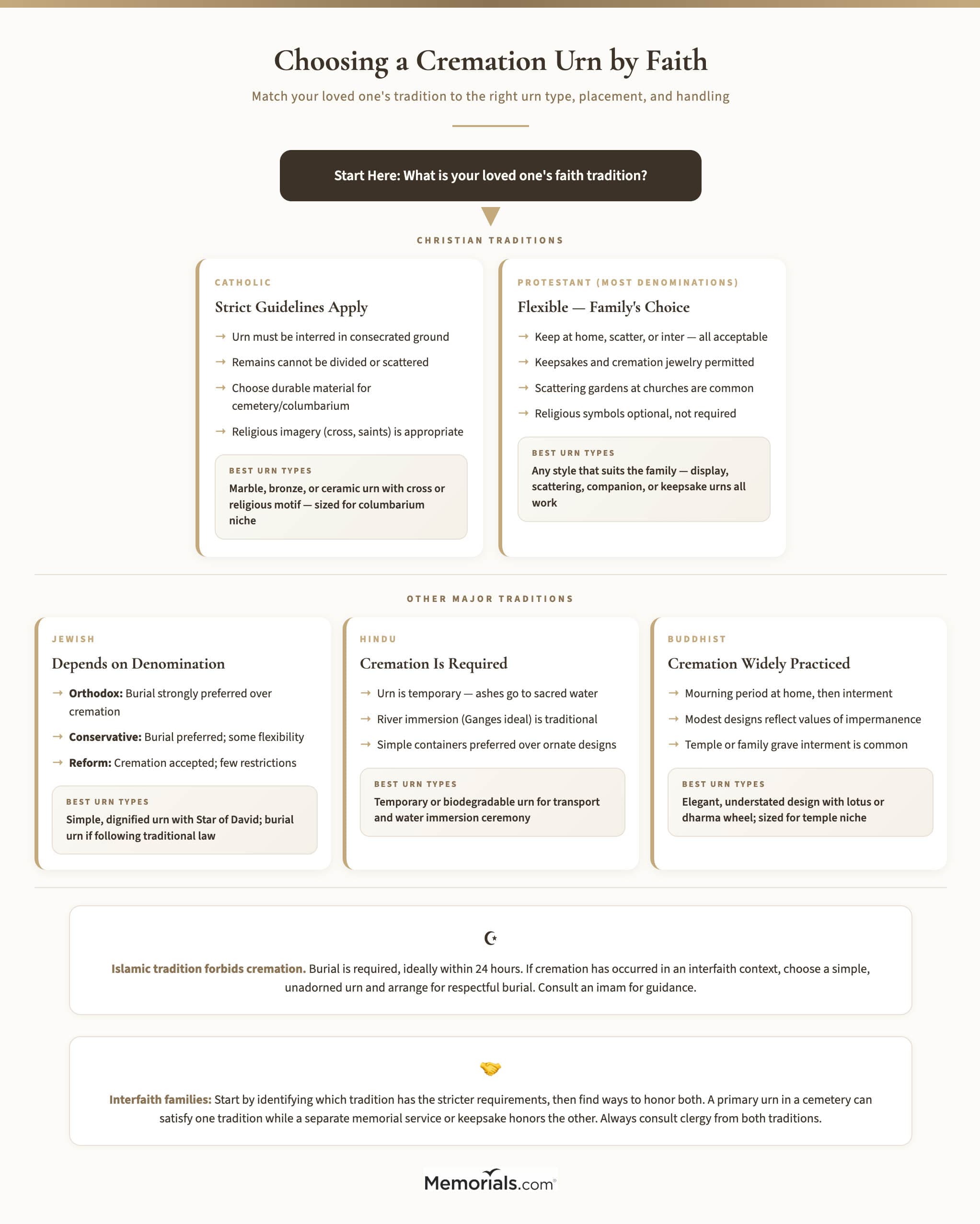
Cremation rates in the United States now exceed 60 percent, and families across every religious tradition are navigating a question that previous generations rarely faced: how do I choose a cremation urn that respects my loved one's faith?
The answer depends on your specific tradition. Some religions embrace cremation wholeheartedly and place few restrictions on how ashes are stored. Others permit cremation under strict conditions that directly affect the type of urn you select, where you place it, and how long you keep it. A few traditions prohibit cremation entirely — yet families within those communities sometimes still need guidance when circumstances lead them down this path.
This guide walks through six major religious traditions and their practical implications for urn selection. Whether you are just beginning the process of or narrowing your options based on faith, understanding your tradition's expectations will help you make an informed decision. The goal here is not to settle theological debate — for deeper exploration of scripture and doctrine, see our article on — but to help you make a respectful choice when you are ready to shop for an urn.
The Catholic Church has permitted cremation since 1963, and the Vatican's 2016 instruction Ad resurrectionem cum Christo clarified the Church's expectations for handling cremated remains. These guidelines carry real weight when you are choosing an urn.
What the Church Requires
Catholic teaching holds that cremated remains must be treated with the same reverence as an intact body. Three rules matter most for urn selection:
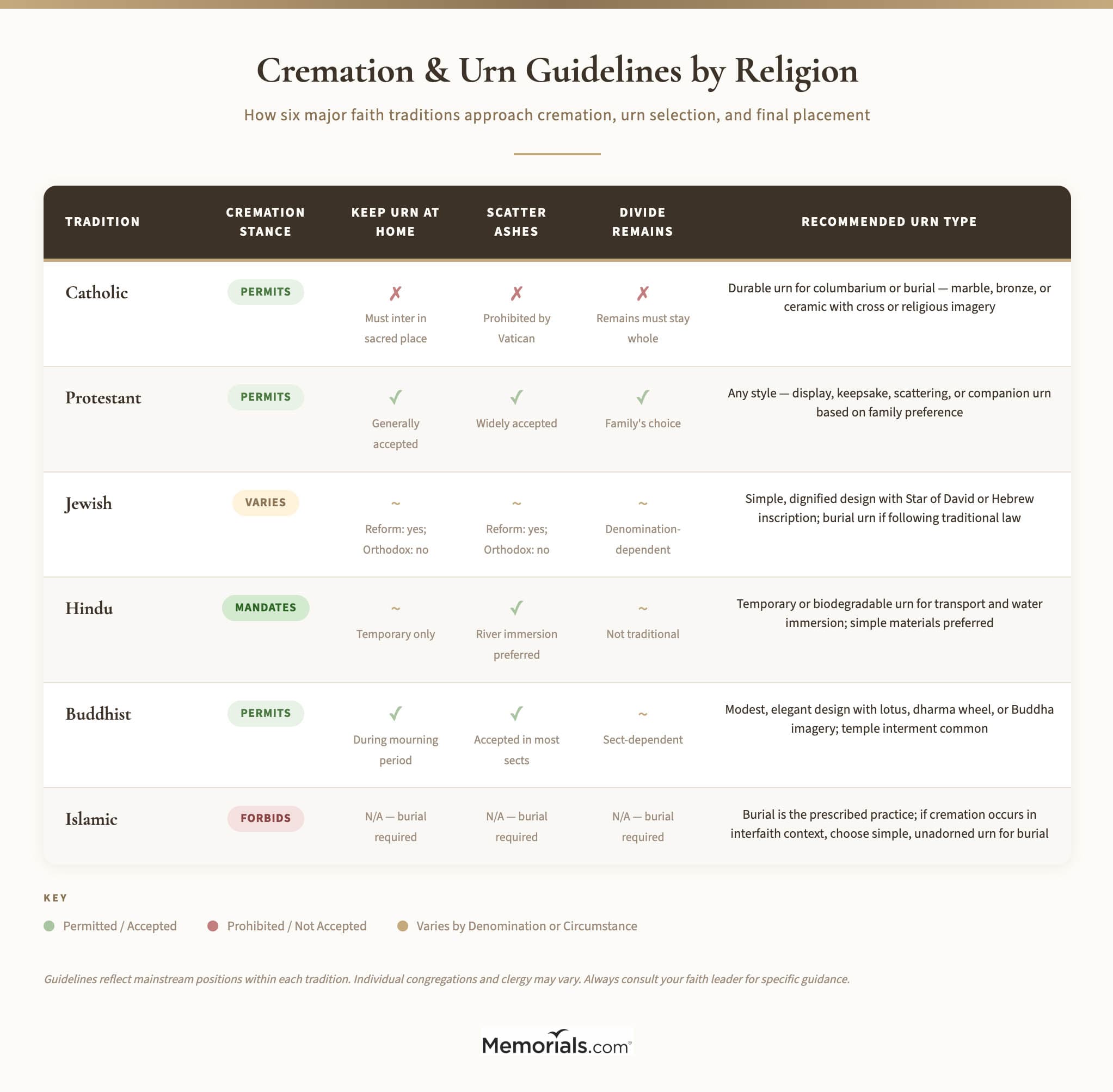
Remains must stay together. Dividing ashes among family members, placing portions into cremation jewelry, or separating remains into multiple keepsake urns conflicts with Catholic guidelines. The Church expects all cremated remains to be kept in a single, worthy vessel.
The urn must be placed in a sacred location. The Vatican requires interment in consecrated ground — a Catholic cemetery, columbarium, or mausoleum. Keeping an urn at home on a mantel or shelf is not considered reverent disposition under Catholic teaching, though some diocesan bishops may grant exceptions in extraordinary circumstances.
Scattering is not permitted. Ashes may not be scattered over water, from the air, or on the ground. This means scattering urns and biodegradable urns designed to dissolve in water are not appropriate for Catholic families who wish to follow Church guidelines strictly.
Choosing a Catholic-Appropriate Urn
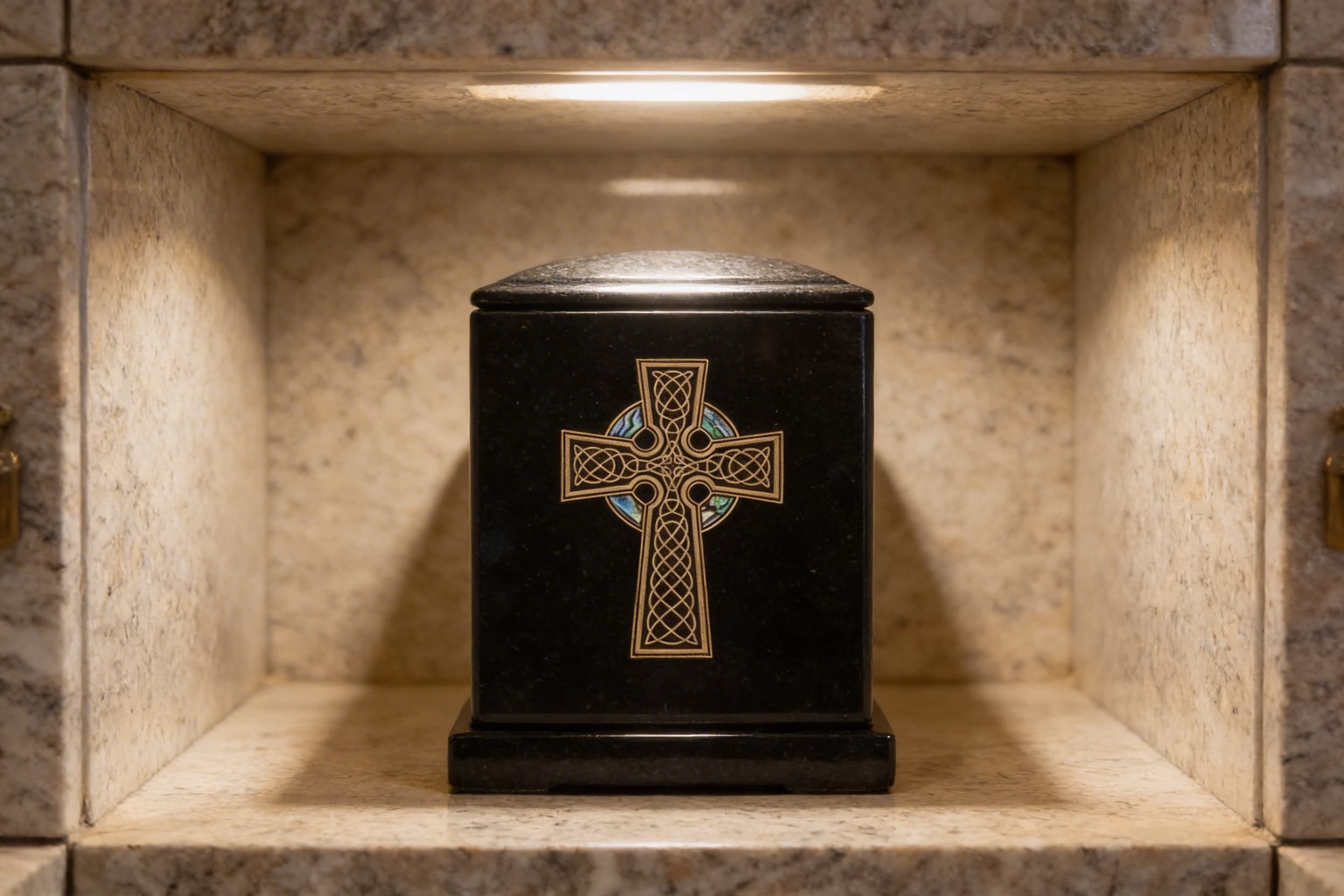
Since the urn will likely be placed in a columbarium niche or buried in a cemetery plot, consider these practical factors. Our cremation niche and columbarium guide covers niche dimensions and placement requirements in detail.
Size matters. A standard adult urn (200 cubic inches) holds the cremated remains of most adults. If the urn will be placed in a columbarium niche, confirm the niche dimensions before purchasing — some niches accommodate only compact or rectangular urns.
Material durability is important. Marble urns, bronze urns, and ceramic urns hold up well in both columbarium and burial settings. Wood urns are beautiful but may degrade faster if buried without a vault. For families planning interment, our guide to cremation urns for burial explains vault requirements and material considerations.
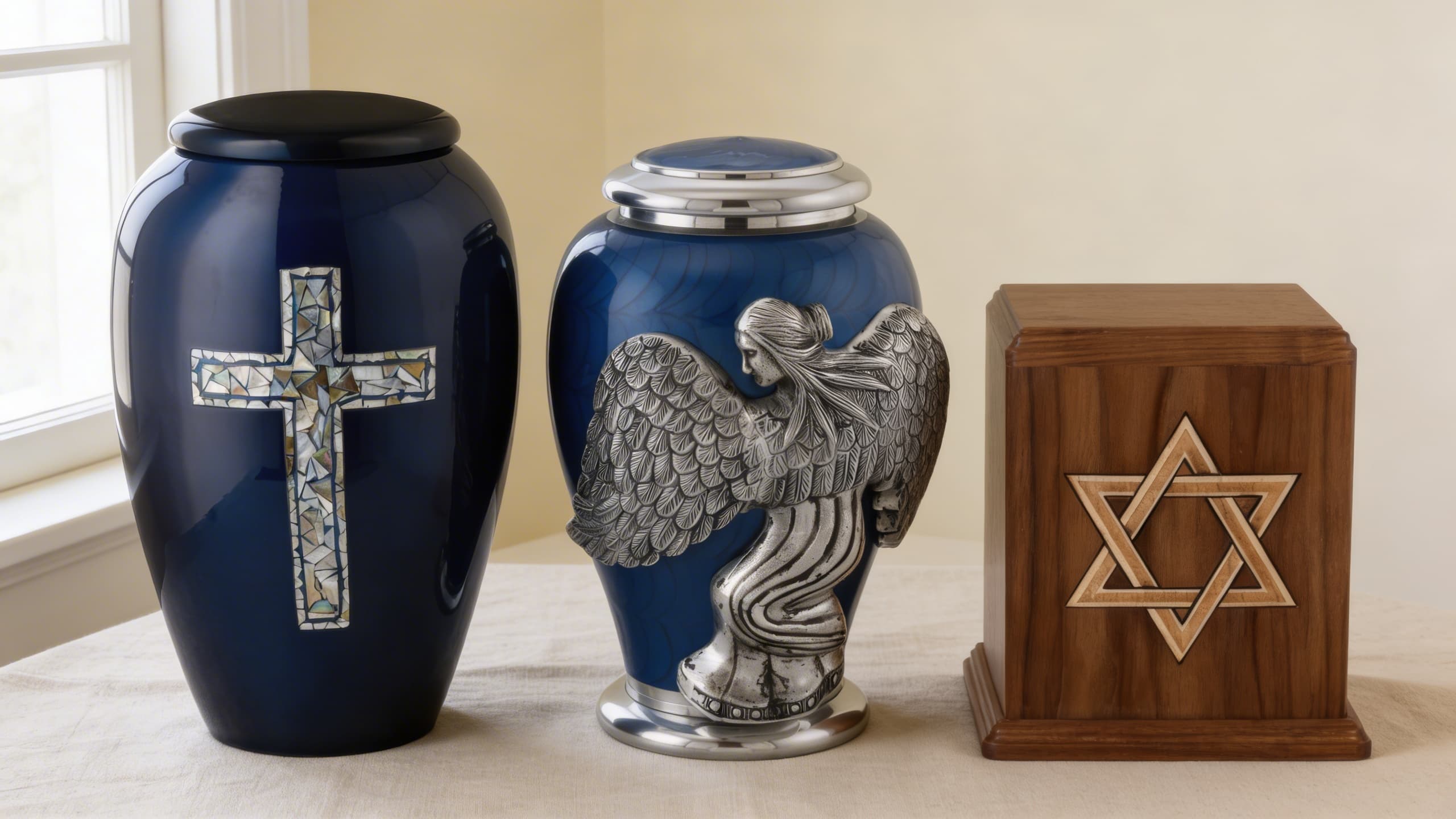
Symbols reinforce faith. Cross urns, urns featuring praying hands, depictions of the Virgin Mary, or scenes from Psalm 23 reflect Catholic devotion. Browse religious urns to find designs that feature these symbols.
Catholic Urn Selection at a Glance
The Church describes the urn as a "worthy vessel," which means it should be made of respectful, durable material. Cardboard or temporary containers from the crematorium meet minimum requirements, but most families choose something more permanent — particularly since the urn becomes a lasting memorial in a cemetery or columbarium.
Protestant Perspectives on Cremation Urns
Protestant denominations represent a wide range of views, but the majority leave cremation decisions to individual families. This gives Protestant families more flexibility in urn selection than Catholic guidelines typically allow.
Denomination-by-Denomination Overview
Most mainline Protestant churches — including Methodist, Presbyterian, Lutheran, and Baptist congregations — neither condemn nor mandate cremation. The emphasis tends to fall on celebrating the life of the deceased rather than prescribing specific disposition methods.
A few Protestant traditions take firmer positions. The Eastern Orthodox Church generally opposes cremation and considers it a desecration of the body. Greek Orthodox parishes in particular maintain strong objections. If your loved one belonged to an Orthodox tradition, consult with the parish priest before proceeding with cremation.
Urn Selection Flexibility
Because most Protestant traditions impose few restrictions on handling cremated remains, families have broad latitude. Some families wonder about superstitions around keeping ashes in the house, but most Protestant clergy affirm that home display is a perfectly acceptable choice:
Ashes may be kept at home, buried, placed in a columbarium, or scattered. This means any urn style works — from a display urn for the mantel to a scattering urn for a meaningful location. Companion urns are a popular choice for couples who want their remains united.
Scattering gardens at Protestant churches are increasingly common. Many congregations maintain dedicated outdoor spaces where families can scatter ashes and place a small marker.
Keepsake urns and cremation jewelry are widely accepted. Families who want to share a small portion of ashes among relatives can do so without doctrinal concern in most Protestant settings.
Religious symbols like the cross, praying hands, or the ichthys (fish symbol) are popular decorative choices but are not required.
Jewish Traditions and Cremation Urns
Jewish views on cremation vary significantly by denomination, and this directly affects urn decisions.
Orthodox and Conservative Judaism
Traditional Jewish law (halacha) strongly favors burial in the ground and discourages cremation. Orthodox rabbis generally will not officiate at services involving cremated remains, and Orthodox cemeteries may refuse to inter an urn.
Conservative Judaism also prefers traditional burial, though individual rabbis may exercise discretion. Some Conservative congregations permit funeral services for cremated individuals while encouraging families to choose burial when possible.
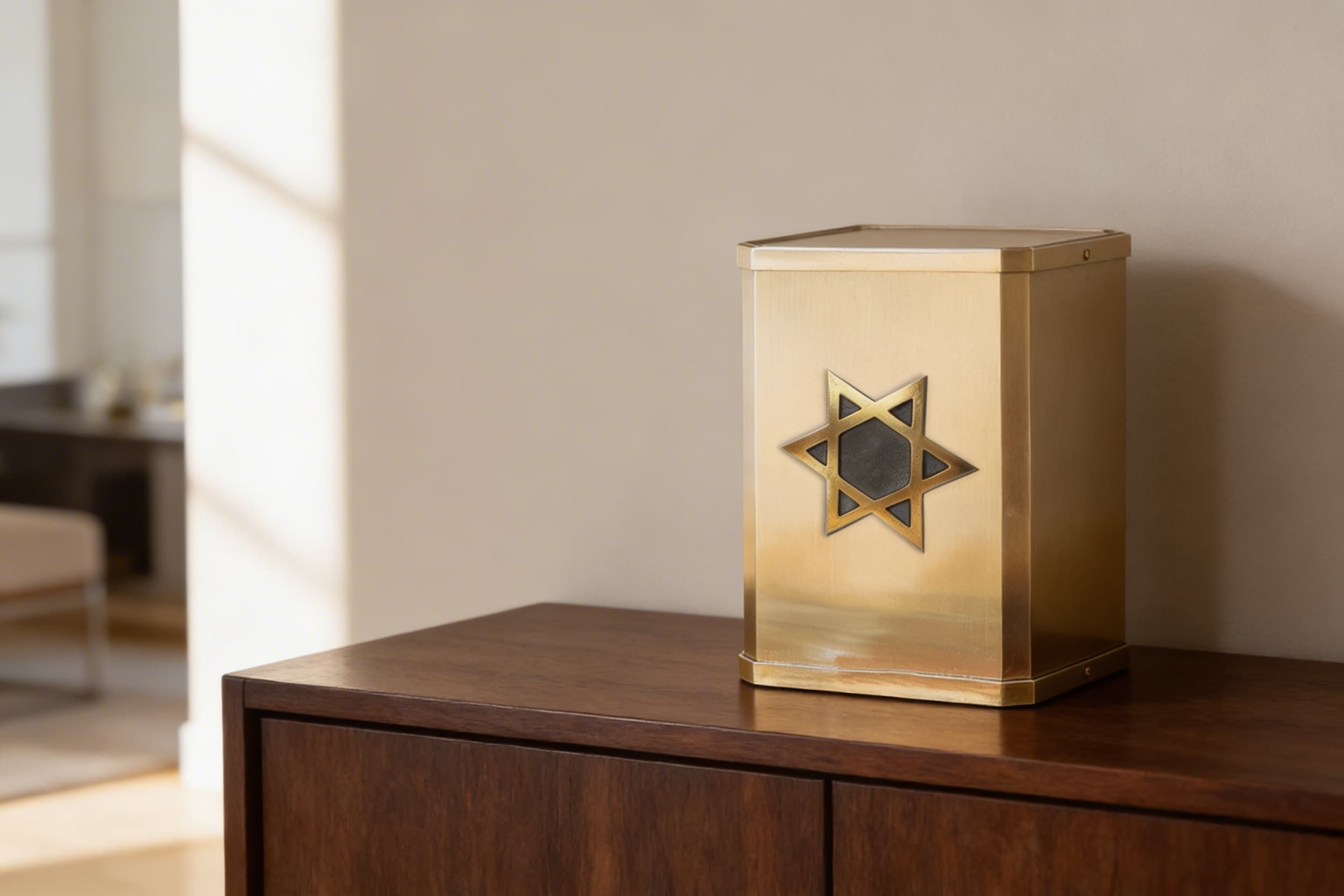
For families within these traditions who do choose cremation despite the preference for burial, selecting a simple, dignified urn and arranging for burial in a Jewish cemetery that accepts cremated remains is the most respectful path. Urns featuring the Star of David or a menorah honor the faith while acknowledging the reality of the family's decision.
Reform Judaism
Reform Judaism is generally open to cremation and places fewer restrictions on what families do with cremated remains. Reform rabbis commonly officiate at memorial services involving cremated remains, and the movement does not prohibit scattering or keeping ashes at home.
Reform Jewish families may choose any urn style that feels appropriate. Urns featuring Jewish symbols — the Star of David, the Tree of Life, the menorah, or Hebrew inscriptions — provide a meaningful connection to heritage.
Hindu Cremation Traditions and Urn Considerations
Hinduism not only permits cremation — it mandates it for most adherents. The Hindu funeral rites known as antim sanskar (last rites) hold deep spiritual significance, and cremation is understood as an offering to Agni, the god of fire, that frees the soul from the physical body and advances it toward moksha (liberation from the cycle of rebirth).
How Hindu Tradition Affects Urn Choice
In traditional Hindu practice, the role of an urn is temporary. After cremation, ashes are customarily immersed in a sacred river — ideally the Ganges — within a few days or weeks. Hindu families living outside India may arrange to ship remains to India for immersion, or they may choose a local river or body of water that holds personal significance. Our guide on how to scatter ashes covers legal considerations and ceremony planning for water-based disposition.
Because the urn serves a transitional purpose, Hindu families often select:
Simple, understated urns that hold the remains respectfully during the interval between cremation and immersion. Ornate or expensive urns are generally unnecessary since the urn will not serve as a long-term memorial.
Biodegradable urns for families who plan a water immersion ceremony in a local setting. These urns dissolve naturally in water, aligning with both Hindu tradition and environmental regulations.
Metal urns or temporary containers when remains will be shipped to India. Many families use a sturdy but simple vessel for safe transport, then transfer the ashes for the immersion ceremony.
Exceptions to the Cremation Rule
Hindu tradition exempts certain individuals from cremation. Children under the age of three, saints, and holy men may be buried rather than cremated. Families navigating these exceptions should consult with a Hindu priest or community elder for guidance.
Buddhist Views on Cremation and Urn Selection
Buddhism broadly supports cremation, following the example of the Buddha himself. However, practices vary considerably across Buddhist traditions and geographic regions.
Regional Variations
In Theravada Buddhist communities (common in Thailand, Sri Lanka, and Myanmar), cremation typically follows an extended vigil and is preceded by chanting and prayers led by monks. The cremation ceremony itself is a spiritually significant event.
In Japan, where Buddhist funeral traditions are deeply embedded in culture, a practice called kotsuage, or the bone picking ceremony, follows cremation. Family members use chopsticks to place bone fragments into an urn, beginning at the feet and working upward to the head. The urn is kept at home for 35 to 49 days — the Buddhist 49-day mourning period, which some families conclude at the fifth weekly rite — before being interred at a family grave or temple.
Tibetan Buddhist traditions may favor sky burial or cremation depending on the region and the wishes of the deceased.
Urn Selection for Buddhist Families
Buddhist families generally have flexibility in urn choice since the tradition imposes few restrictions on how cremated remains are stored:
Display urns are appropriate for families who keep the remains at home during a mourning period before interment. Urns featuring the lotus flower, the dharma wheel, or depictions of the Buddha reflect Buddhist devotion.
Simple, elegant designs align with Buddhist values of modesty and detachment from material excess. Ornate or lavish urns may feel inconsistent with the tradition's emphasis on impermanence.
Burial or temple interment is common after the mourning period. Families who plan to inter the urn should choose materials that withstand the intended setting.
Islamic Perspective: When Cremation Is Not Traditional
Islamic law classifies cremation as haram (forbidden). Muslims believe the body is a sacred trust from Allah and must be returned to the earth through burial, ideally within 24 hours of death. The body is washed, wrapped in a simple white shroud, and buried facing Mecca without a casket or elaborate container.
Why This Section Matters
While a guide to cremation urns may seem irrelevant for Muslim families, there are circumstances where this information becomes necessary:
Interfaith families where one spouse was Muslim and the other follows a tradition that practices cremation may need to navigate competing expectations.
Families of Muslim individuals who chose cremation against traditional practice may still want to honor Islamic heritage in their memorial choices. In such cases, selecting an urn with minimal ornamentation and arranging for burial in a respectful setting aligns more closely with Islamic values of simplicity and dignity.
Non-Muslim family members caring for a Muslim loved one benefit from understanding why cremation creates theological tension, so they can approach the situation with sensitivity and seek guidance from an imam.
Practical Guidance for Interfaith and Multi-Cultural Families
Many modern families include members from different religious backgrounds, and funeral decisions can become a source of tension when traditions conflict. A few principles help navigate these situations:
Start the conversation early. End-of-life preferences discussed before a death occurs reduce conflict and guesswork. Ask your loved ones directly about their wishes — both for cremation versus burial and for how they want their remains handled.
Consult clergy from the relevant tradition. A Catholic priest, rabbi, imam, or Hindu pandit can clarify what their tradition requires and where flexibility exists. Many clergy are experienced in helping interfaith families find respectful compromises.
Consider a "both/and" approach. Some families place the primary cremation urns in a cemetery or columbarium to satisfy one tradition while sharing small keepsake portions with family members from a tradition that permits it. This requires sensitivity — Catholic and Orthodox Jewish guidelines, for example, prohibit dividing remains.
Focus on shared values. Most religious traditions agree on the core principles of treating the deceased with dignity, providing a permanent place for remembrance, and supporting the grieving family. When specific practices conflict, these shared values offer common ground.
Selecting an Urn That Reflects Faith: Symbols and Materials
Regardless of tradition, many families want an urn that visually reflects their loved one's faith. Here is a quick reference for common religious symbols found on cremation urns:
Christian symbols: Cross (Latin, Celtic, or Orthodox), praying hands, ichthys fish, dove, Bible scenes, angels, depictions of Jesus or the Virgin Mary.
Jewish symbols: Star of David, menorah, Tree of Life, Hebrew inscriptions, chai symbol. Many families add personalized Hebrew text or scripture references — our urn engraving and personalization guide covers inscription options and what to expect.
Hindu symbols: Om, lotus flower, Ganesha, images of other deities.
Buddhist symbols: Lotus flower, dharma wheel, bodhi tree, Buddha figure, enso circle.
General spiritual symbols: Doves, trees of life, eternal flames, and natural scenes that convey peace and transcendence without tying to a specific tradition.
Materials also carry cultural significance. Marble and stone suggest permanence and are associated with traditional Western memorials. Wood connects to natural cycles and is favored in many Eastern traditions. Brass and bronze evoke warmth and are widely used across South Asian cultures.
Frequently Asked Questions
Can Catholics keep a cremation urn at home?
Catholic guidelines state that cremated remains should be interred in a sacred place — a Catholic cemetery, columbarium, or mausoleum. Keeping an urn at home is not considered reverent disposition under standard Church teaching, though diocesan bishops may grant rare exceptions in extraordinary circumstances.
Does Judaism allow cremation?
It depends on the denomination. Orthodox Judaism strongly discourages cremation and favors traditional ground burial. Conservative Judaism also prefers burial but may show some flexibility. Reform Judaism generally accepts cremation and places fewer restrictions on how families handle cremated remains.
What kind of urn is appropriate for Hindu families?
Hindu families typically need the urn only temporarily, since ashes are traditionally immersed in a sacred river. A simple, understated urn — or a biodegradable urn for water immersion — is usually the most practical and culturally appropriate choice.
Are there cremation urns with Buddhist symbols?
Yes. Urns featuring the lotus flower, dharma wheel, bodhi tree, or Buddha figures are available. Buddhist tradition emphasizes modesty, so many families choose simple, elegant designs rather than highly ornate options.
What should interfaith families do when traditions conflict?
Start with open conversation and consult clergy from each relevant tradition. Many families find compromise by choosing a primary memorial that respects the stricter tradition's requirements while finding smaller ways — a separate memorial service, a keepsake, a dedicated prayer space — to honor the other tradition.
Honoring Faith Through Thoughtful Urn Selection
Choosing an urn is one of many decisions families face after a loss, and faith adds a layer of meaning — and sometimes complexity — to that choice. The right urn respects your loved one's beliefs, meets the practical requirements of their tradition, and gives your family a sense of peace.
If your loved one held deep religious convictions, take the time to understand what their tradition asks of you before selecting an urn. Browse our collection of religious urns to find designs that honor Christian, Jewish, and other faith traditions, or explore our full cremation urns catalog to find the style and material that feels right for your family.