🏬Supersize Online Funeral Retailer🪦1000's of Headstones⚱️Over 10,000 Cremation Urns⚰️Caskets Overnight Delivery🛒Funeral & Memorial Superstore🚚FREE Shipping on ALL Orders👨👩👧👦Helping Families for over 20 Years💰Lowest Price Guarantee🏬Supersize Online Funeral Retailer🪦1000's of Headstones⚱️Over 10,000 Cremation Urns⚰️Caskets Overnight Delivery🛒Funeral & Memorial Superstore🚚FREE Shipping on ALL Orders👨👩👧👦Helping Families for over 20 Years💰Lowest Price Guarantee
🏬Supersize Online Funeral Retailer🪦1000's of Headstones⚱️Over 10,000 Cremation Urns⚰️Caskets Overnight Delivery🛒Funeral & Memorial Superstore🚚FREE Shipping on ALL Orders👨👩👧👦Helping Families for over 20 Years💰Lowest Price Guarantee🏬Supersize Online Funeral Retailer🪦1000's of Headstones⚱️Over 10,000 Cremation Urns⚰️Caskets Overnight Delivery🛒Funeral & Memorial Superstore🚚FREE Shipping on ALL Orders👨👩👧👦Helping Families for over 20 Years💰Lowest Price Guarantee
Cremation burial might seem straightforward: select an urn, schedule the interment, and lay the remains to rest. However, families are often caught off guard when the cemetery office mentions, "You'll need an urn vault," along with specific urn specifications and requirements.
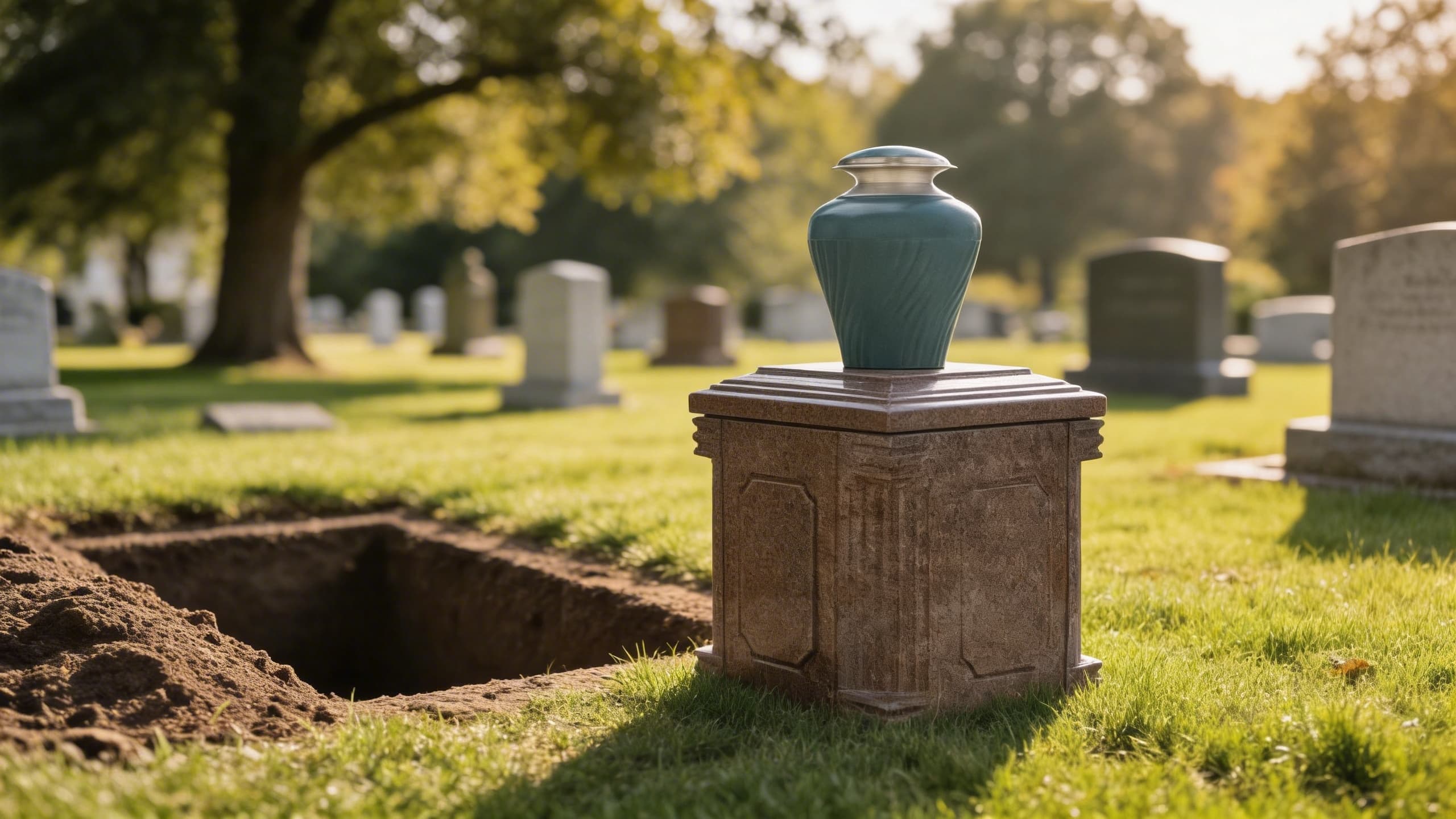
But, why do you need an urn vault? While the need for an urn vault depends on the cemetery's regulations, its main purpose is to protect the urn from environmental damage. An urn vault adds structural integrity, shielding the urn from ground pressure and moisture, and helps ensure the lasting preservation of your loved one's remains. Understanding vault rules is just one part of the bigger picture when learning that meets both personal and practical needs.
An urn vault is not the same thing as an urn, and the "requirements" are rarely one-size-fits-all. They depend on the cemetery's rules, local ordinances in some areas, the type of burial space you own, and even the equipment the cemetery uses to maintain the grounds.
What an urn vault is (and what it is not)
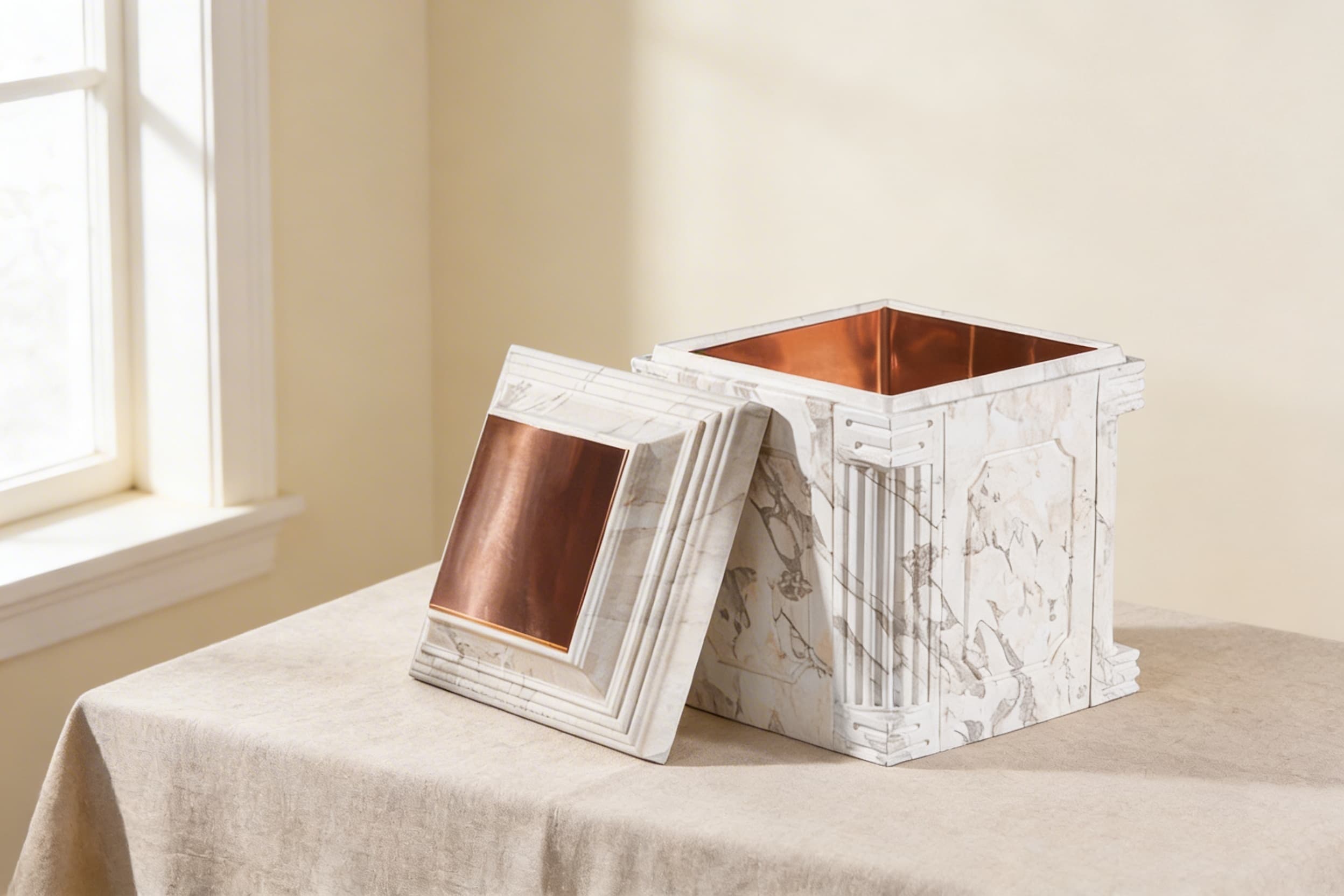
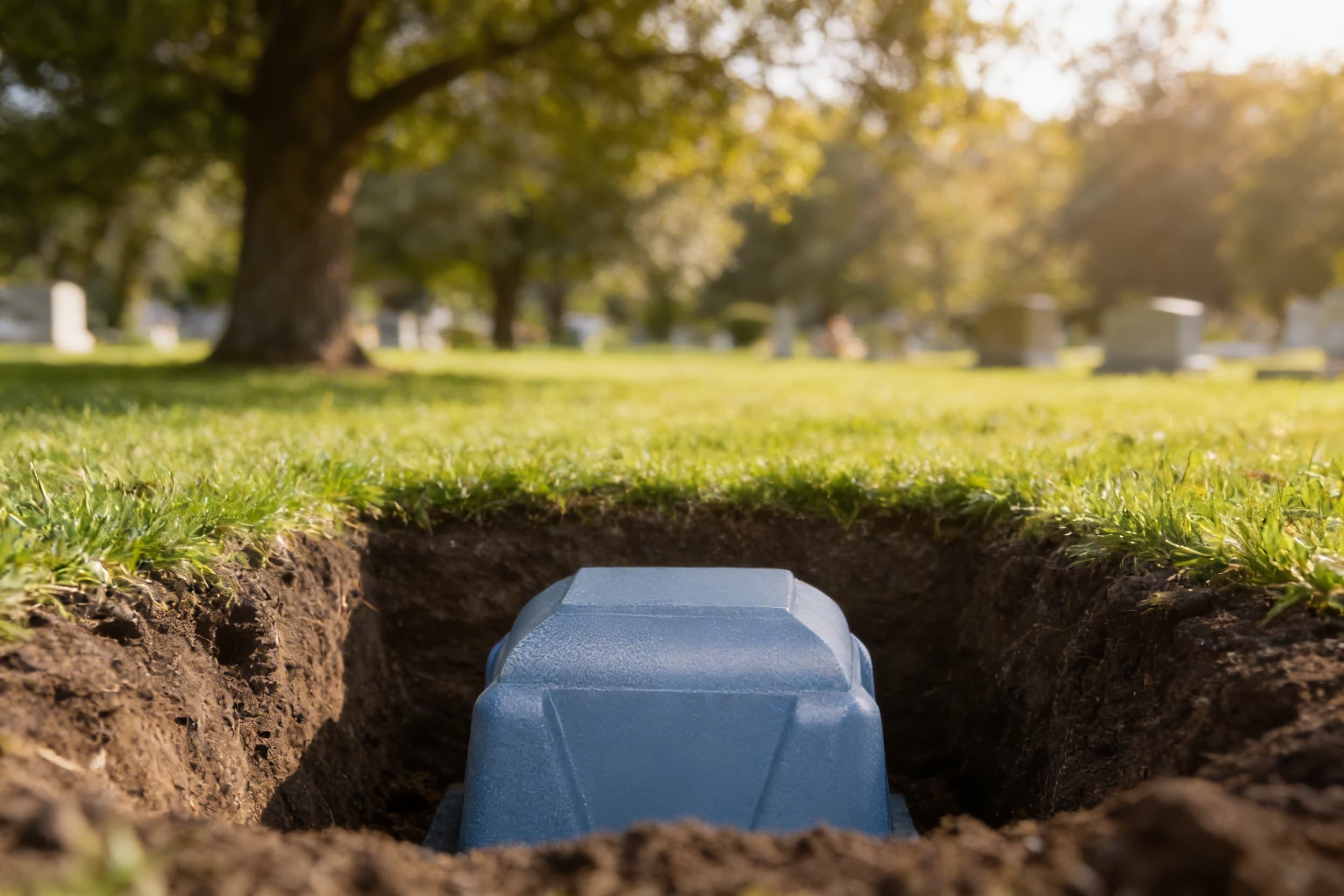
An urn vault is an outer receptacle designed to go into the ground and hold the urn inside it. Think of it as structural protection and moisture protection for the urn.
It is not the decorative urn you display at home, and it is not the same as a full-size burial vault used for caskets. For a deeper look at what full-size burial vaults are and when cemeteries require them, see our guide on what a burial vault is and why it matters. Most urn vaults are compact, but they still need to meet practical expectations: fit, strength, and resistance to water and soil conditions.
A cemetery may also use the term urn liner. In many places, "liner" and "vault" get used interchangeably, though "vault" often implies a more sealed design.
Who sets urn vault requirements: law, cemetery policy, and your contract
In the United States, state law generally does not require outer burial containers for cremation burials. Consumer guidance around the FTC Funeral Rule often summarizes it this way: outer burial containers are not required by state law, but cemeteries can require them as a condition of burial in their property.
So the requirement you will deal with most often is a cemetery rule, not a federal rule. Our overview of cemetery regulations for burials explains the most common rules families encounter for urns, vaults, and markers — and vault requirements are just one piece of the broader planning process covered in our complete guide to cemetery planning.
Local government codes can still matter. Some municipalities publish cemetery ordinances that specify acceptable materials (concrete, metal, fiberglass, reinforced polymers) and may even cap dimensions. That is why the same urn vault that works in one town can be rejected in another.
Size and fit: the most common requirement that trips people up
The vault has to fit the urn, and the vault has to fit the cemetery's allowed footprint.
Many single-urn vaults have interior dimensions around 12 inches by 12 inches, with depth commonly in the 12 to 15 inch range. Exterior dimensions are larger because of wall thickness and lid design. Some local rules set maximums around 12 inches by 12 inches by 12 inches for the vault, which can be stricter than what manufacturers commonly sell.
This is where families can lose time: buying an urn first, then learning the vault the cemetery requires cannot accommodate that urn's shape, handles, or outer diameter.
A quick way to prevent this is to measure the urn the way a vault "sees" it: the widest point (including decorative bands and handles) and the full height (including the lid and any finial).
After you have those numbers, it helps to confirm these basics with the cemetery before purchasing anything:
Maximum outside dimensions allowed
Whether they allow a "family" or "companion" urn vault (two or more urns)
Whether the urn itself must meet material rules (many cemeteries restrict wood or cardboard for in-ground burial)
Materials that are commonly accepted (and commonly rejected)
Cemeteries are usually focused on durability and long-term maintenance. Their goal is to reduce settling and keep the grounds safe and level for visitors and mowing equipment.
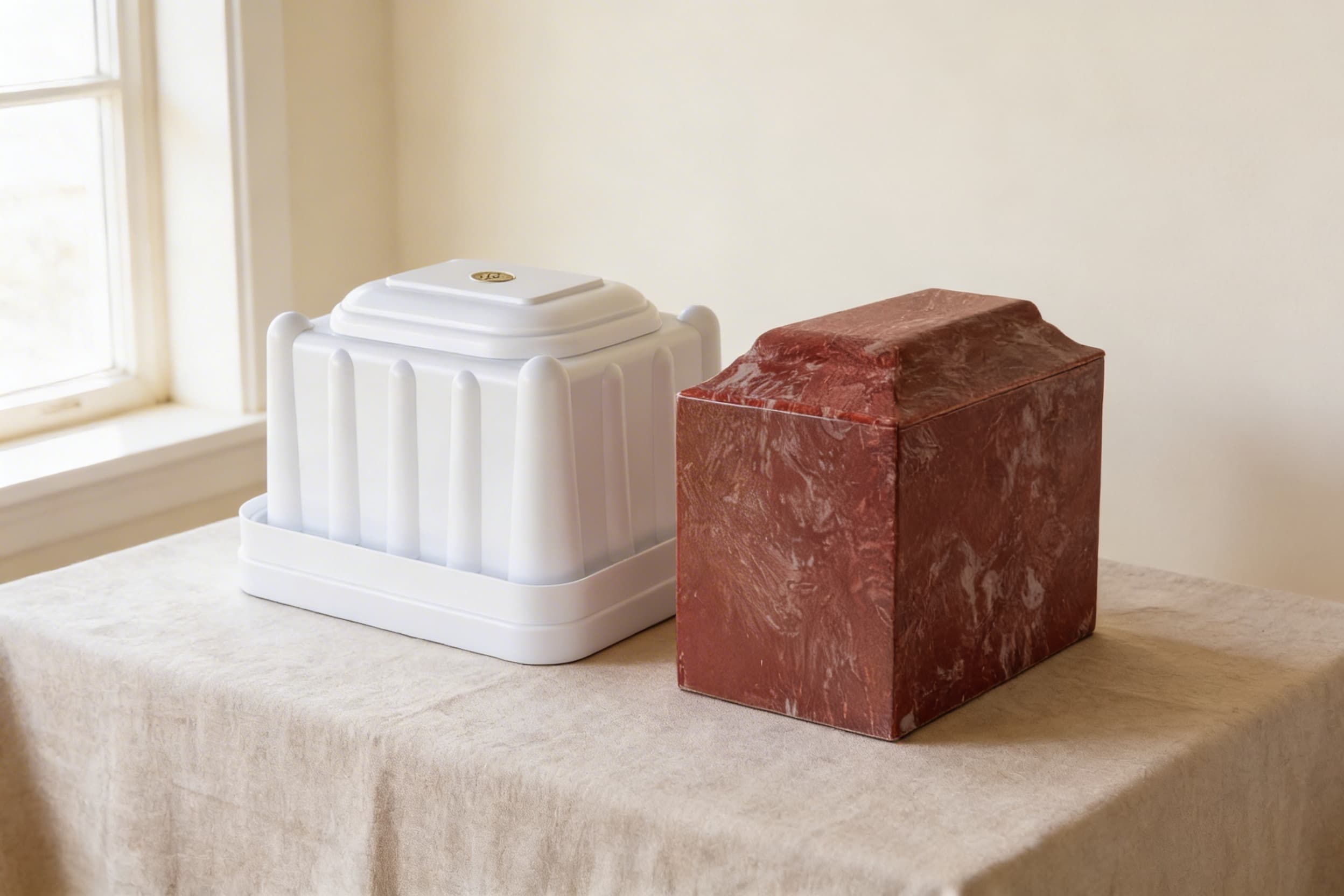
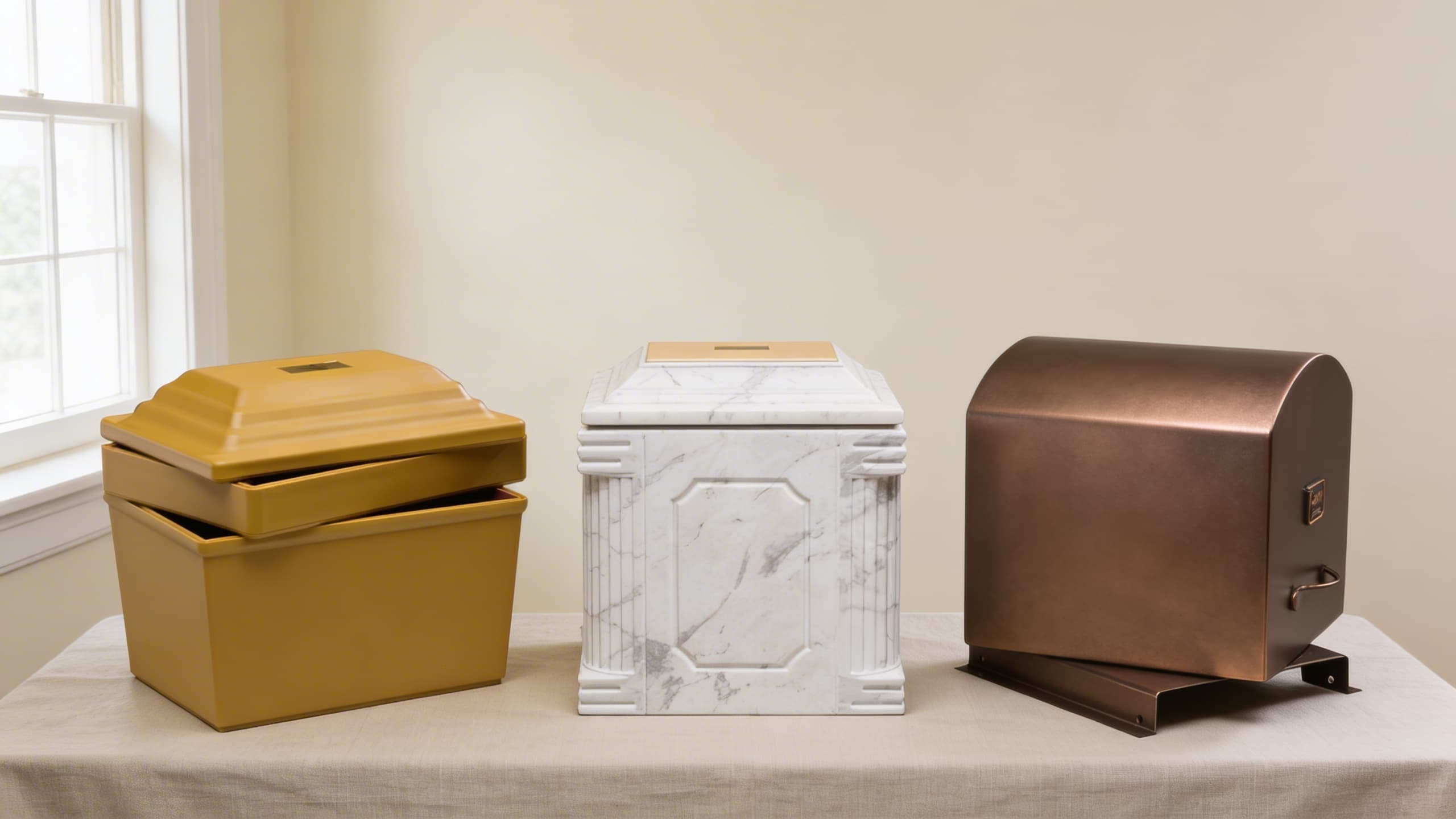
In practice, that means most cemeteries accept urn vaults made from concrete, metal, fiberglass, plastic, marble, or reinforced polymers for reliable storage. Our guide to cremation-specific vault options compares types, sizes, and costs side by side. Some cemeteries explicitly reject wood vaults and may also restrict urns made of wood, paper, or other biodegradable materials in traditional sections.
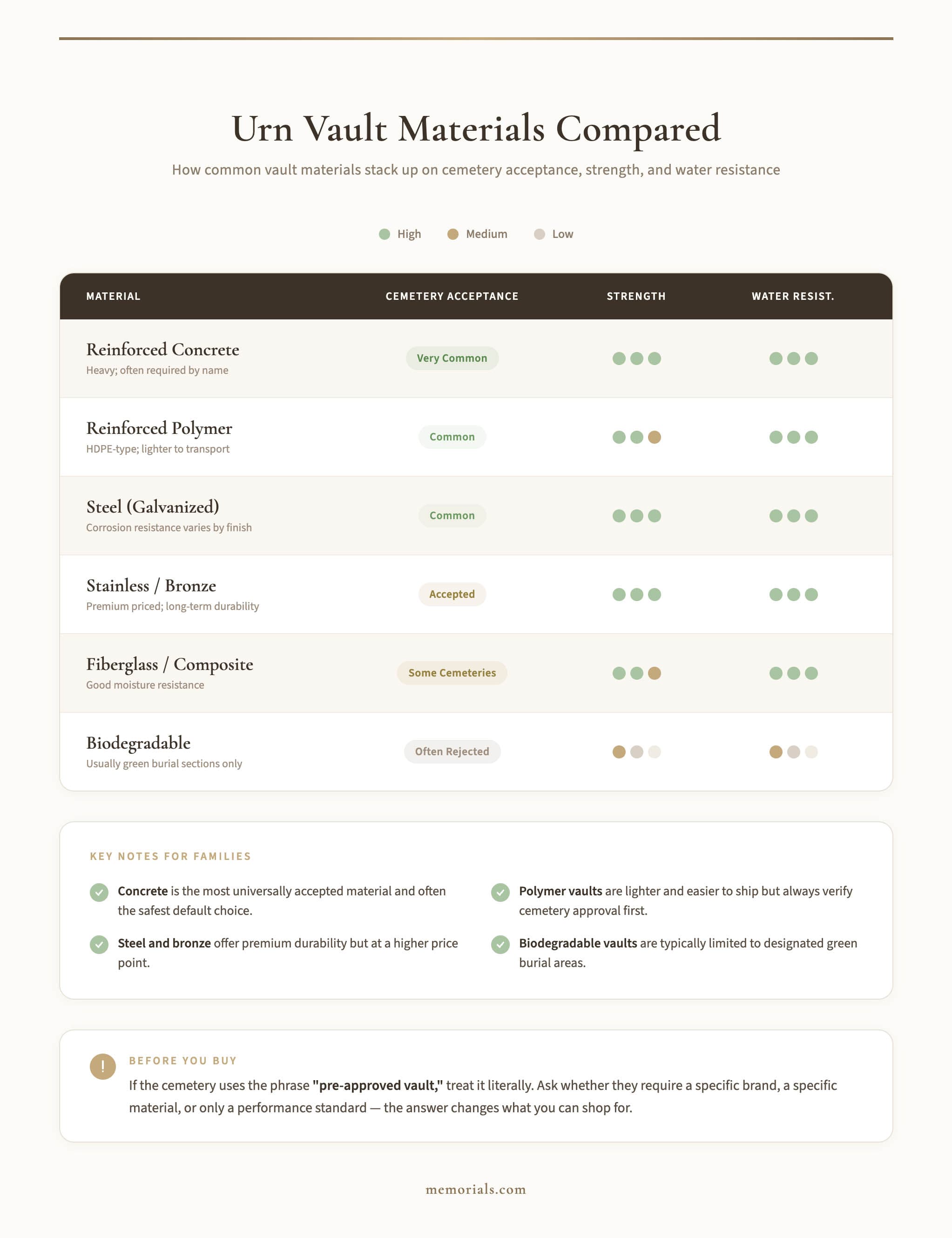
Below is a practical comparison that matches how cemeteries tend to think about "requirements," not just what a product description says.
Material
Typical cemetery acceptance
Strength under soil and equipment
Water resistance
Notes families should know
Reinforced concrete
Very common
High
High when sealed
Heavy to handle; often chosen when rules say "concrete required"
Reinforced polymer (HDPE-type)
Common
Medium to high (depends on design)
High
Lighter and easier to transport; check that it is approved by the cemetery
Steel (galvanized)
Common in many areas
High
High when gasketed
Sealed lid design matters; corrosion resistance varies by finish
Stainless steel, bronze, copper
Accepted where offered
High
High
Often premium priced; sometimes selected for long-term durability
Fiberglass/composite
Accepted in some cemeteries
Medium to high
High
Good moisture resistance; acceptance depends on local policy
Biodegradable vaults
Often not accepted in traditional sections
Low to medium
Low to medium
May be limited to green burial areas with different rules
If you are working with a cemetery that uses the words "pre-approved vault," treat that literally. Ask what they approve, and whether they require a specific brand, a specific material, or only a performance standard.
Sealed versus vented: what "airtight" usually means in modern urn vaults
Older burial practices sometimes included venting concepts, but modern urn vaults are generally designed as sealed enclosures. They commonly use tongue-and-groove lids, gaskets, or air-seal style closures intended to keep moisture out.
That focus on sealing is not about preserving cremains (cremated remains are largely mineral). It is about protecting the urn itself, keeping the interior from filling with water and soil, and maintaining the stability of the grave surface over time.
A good way to translate "sealed" into a requirement you can verify is to ask how the lid mates to the base: gasket, sealant channel, air-seal design, or mechanical fasteners with a sealing strip.
Load and environmental expectations: what the vault has to withstand
Even a small vault is asked to do a big job. Soil exerts steady pressure, and cemeteries often drive maintenance equipment over burial sections. In colder climates, freeze-thaw cycles can shift soil and stress joints.
That is why many rules focus on "strength to the sexton's satisfaction" or similar language. Concrete vaults often rely on high-strength mixes and reinforcement; polymer vaults rely on molded ribs and wall thickness; metal vaults rely on gauge, seam design, and the lid's locking system.
One sentence that captures the real-world requirement is this: the vault should prevent collapse that can lead to settling and a sunken grave.
Burial depth, placement, and how multiple urns are handled
Some cemeteries specify how deep the urn vault must be placed, sometimes requiring the top of the vault to be at least about 12 inches below grade. Others leave depth to the cemetery staff while still requiring the vault itself.
If multiple urns will be interred in the same grave, the cemetery may have spacing rules, stacking rules, or a maximum number allowed per gravesite. Some local codes even spell out a cap on how many urn vaults may go into one plot.
If you are planning a companion placement, a family grouping, or future interments, ask early whether the cemetery prefers:
Separate single-urn vaults placed side-by-side
A multi-urn vault built to hold two or more urns
Stacking, when space is limited (not all cemeteries allow it)
Those choices affect cost, timing, and the size limitations you need to follow. For families who prefer above-ground placement instead of in-ground burial, a cremation niche and columbarium guide can help explain that alternative path. For a complete overview of every option — niches, garden plots, memorial walls, and more — see our article on where urns are placed at a cemetery.
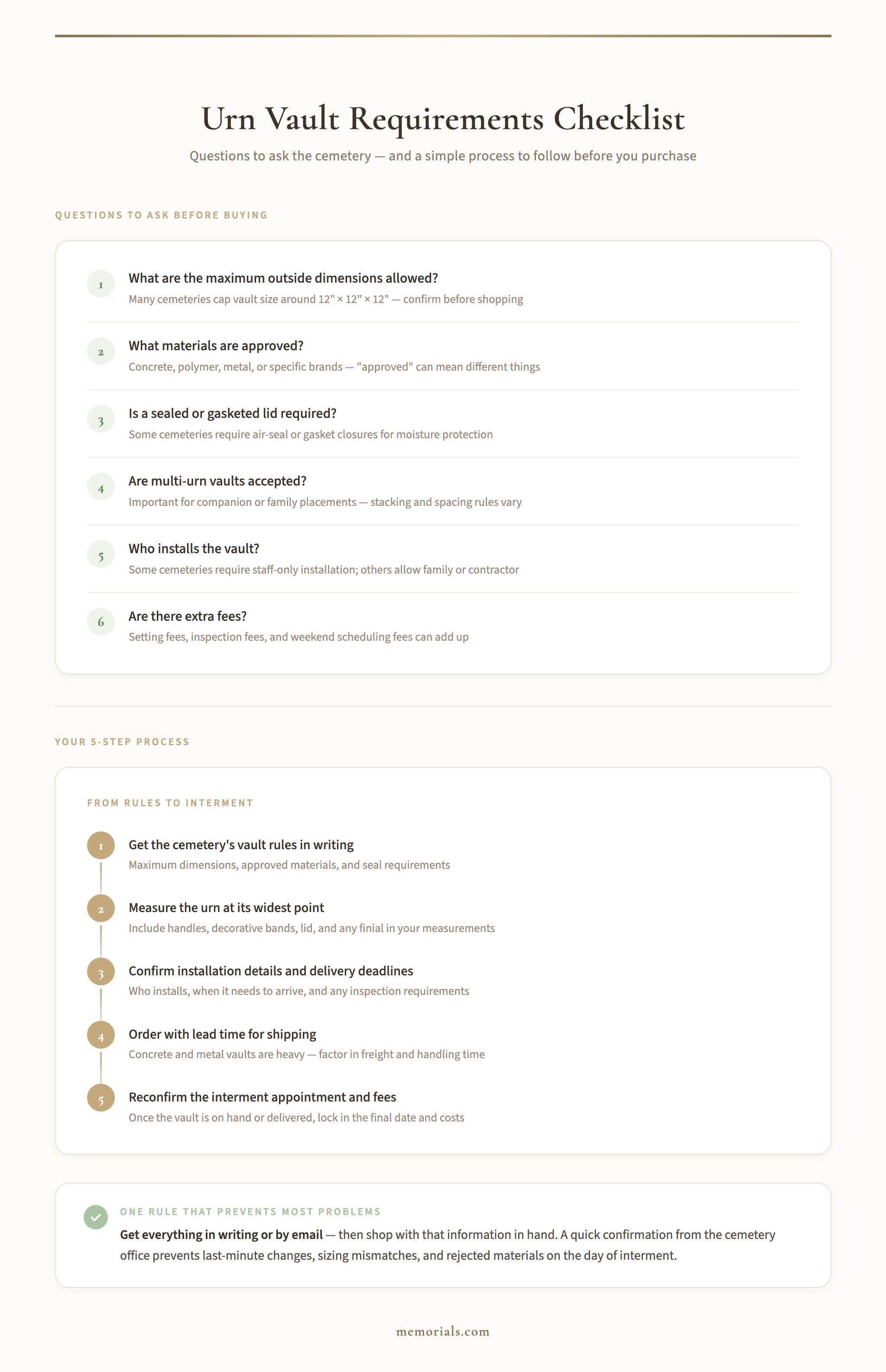
Questions to ask the cemetery before you purchase
Cemetery rules can be clear, or they can be a short line on a price sheet. A few direct questions usually bring the real requirements into view.
After you ask what they require, it helps to clarify the details in writing or by email, then shop with that information in hand:
Maximum outside dimensions
Approved materials
"Sealed" requirement (gasketed lid, air-seal, or other)
Single urn versus multi-urn allowed
Who installs it (cemetery staff only, or family/contractor allowed)
Any extra fees (setting fee, inspection fee, weekend scheduling fee)
If you are also purchasing a grave marker, ask whether the cemetery requires a specific marker base or setting material, since that may interact with how the urn plot is prepared.
Choosing the urn and the vault together (instead of making them fight each other)
Many people choose an urn based on personality, hobbies, or a design that feels right. That is a good instinct. The practical step is making sure the vault can accommodate the urn's widest point and that the urn material is allowed for in-ground burial. Our guide to cremation urns for burial covers which materials and designs hold up best underground.
This is also where shopping selection helps. A store with a broad catalog of urn sizes and styles can make it easier to match the urn to the vault rules without settling for something that feels generic. Memorials.com, for example, carries a large range of cremation urns and cemetery products, including urn vault options, plus pet urns and pet memorials for families doing a similar planning process after the loss of a pet.
When you are trying to match "meaningful" with "meets requirements," these checkpoints tend to keep decisions simple:
Urn measurements: confirm width at handles and overall height
Vault interior clearance: leave breathing room for angled shoulders, not just straight walls
Cemetery rule language: "approved," "sealed," and "no wood" are all different requirements
Future plans: leave space if more than one urn may be placed in the same plot
Cost and timing: what changes when a vault is required
An urn vault adds an item cost, and it can add scheduling friction if the cemetery requires delivery by a certain date or requires staff installation only. To get a fuller picture of the total expense, our breakdown of the cost to bury cremated ashes covers vault fees, opening-and-closing charges, and other common line items.
Shipping weight is part of it. Concrete and many metal vaults are heavy, which can affect freight and handling. Polymer options can be easier to ship and carry, though acceptance still depends on the cemetery.
It also helps to ask about returns before you order. Policies like a 30-day return window and free ground shipping, when offered, can make it less stressful to correct a sizing mismatch, though you still want to confirm the seller's terms for heavy cemetery products. Families weighing all their options may also find it helpful to review a cremation vs burial comparison that puts these costs in broader context.
A simple paperwork and timing plan you can follow
It is easy to get stuck waiting on one small detail, especially when multiple family members are involved.
A short plan keeps the process moving without rushing decisions:
Get the cemetery's urn vault rules in writing, including max dimensions and approved materials.
Measure the urn you want to use, or select the urn after you confirm the vault interior size.
Confirm who installs the vault and whether the cemetery needs delivery by a certain date.
Place the order with enough lead time for shipping and any required inspection.
Reconfirm the interment appointment and fees once the vault is on hand or delivered.
This approach keeps the "requirements" from turning into last-minute changes, while still leaving room to choose a memorial that feels personal.