🏬Supersize Online Funeral Retailer🪦1000's of Headstones⚱️Over 10,000 Cremation Urns⚰️Caskets Overnight Delivery🛒Funeral & Memorial Superstore🚚FREE Shipping on ALL Orders👨👩👧👦Helping Families for over 20 Years💰Lowest Price Guarantee🏬Supersize Online Funeral Retailer🪦1000's of Headstones⚱️Over 10,000 Cremation Urns⚰️Caskets Overnight Delivery🛒Funeral & Memorial Superstore🚚FREE Shipping on ALL Orders👨👩👧👦Helping Families for over 20 Years💰Lowest Price Guarantee
🏬Supersize Online Funeral Retailer🪦1000's of Headstones⚱️Over 10,000 Cremation Urns⚰️Caskets Overnight Delivery🛒Funeral & Memorial Superstore🚚FREE Shipping on ALL Orders👨👩👧👦Helping Families for over 20 Years💰Lowest Price Guarantee🏬Supersize Online Funeral Retailer🪦1000's of Headstones⚱️Over 10,000 Cremation Urns⚰️Caskets Overnight Delivery🛒Funeral & Memorial Superstore🚚FREE Shipping on ALL Orders👨👩👧👦Helping Families for over 20 Years💰Lowest Price Guarantee
Choosing the right urn starts with one practical question: how much space do you actually need? The answer depends on your loved one's body weight before cremation, where you plan to place the urn, and whether you want to keep all of the ashes together or share them among family members.
This guide walks you through the sizing formula, provides complete reference charts by urn category and body weight, and covers the specific dimensions you should look for based on your situation. It is part of our larger resource on how to choose a cremation urn, and sizing is one of the most important steps in that process. Whether you are shopping before or after cremation, the information here will help you select an urn that fits comfortably and gives you confidence that you have made the right choice.
How Urn Sizing Works: The Weight-to-Cubic-Inch Rule
Urn capacity is measured in cubic inches (in³) — the interior volume available to hold cremated remains. One cubic inch equals a space of 1" × 1" × 1". This is the universal unit used across the memorial industry, and it is the single most important number to check on any product page when comparing urns.
The industry-standard formula, established by the Cremation Association of North America (CANA), is straightforward:
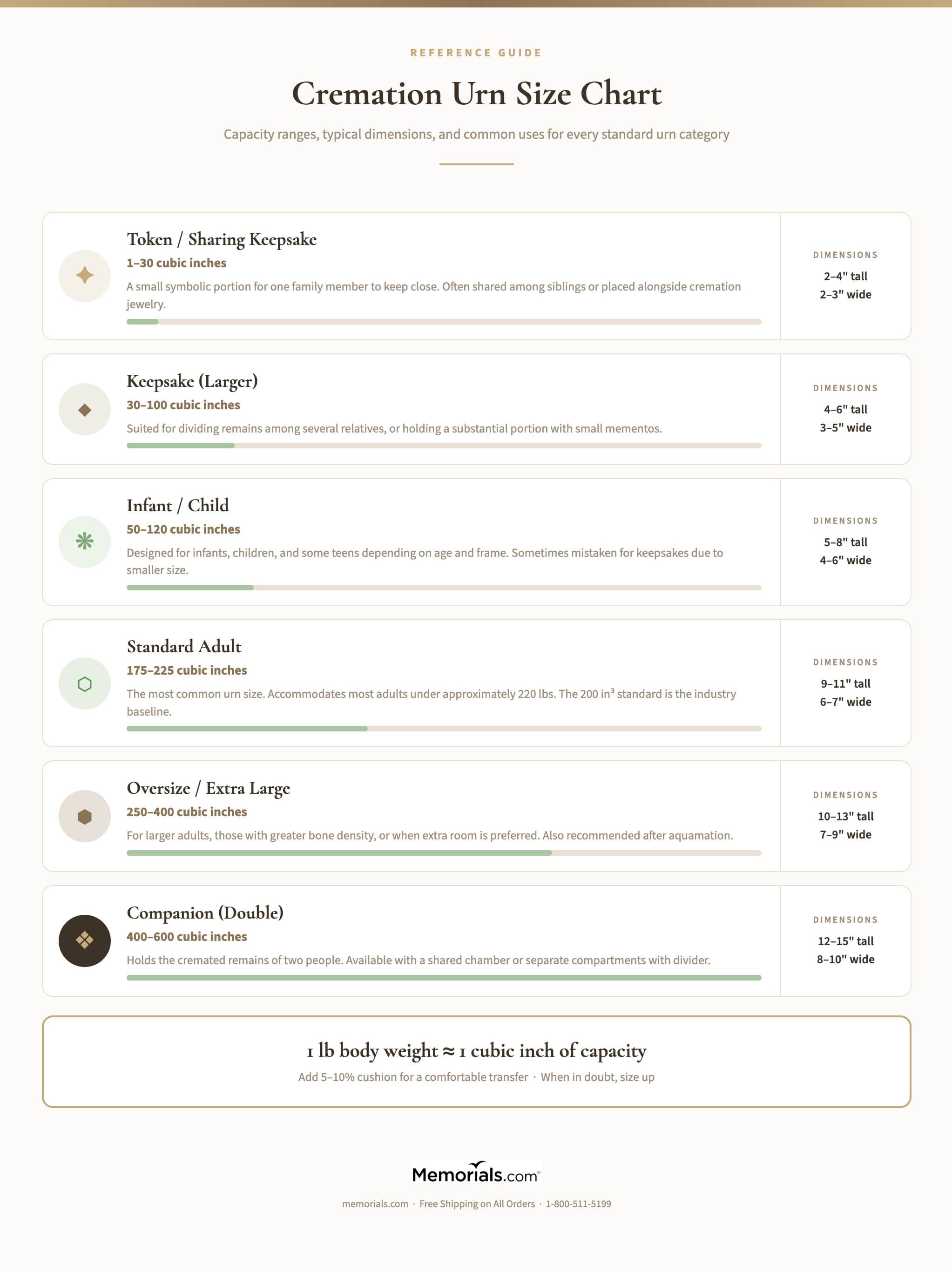
1 pound of body weight ≈ 1 cubic inch of urn capacity
A person who weighed 170 pounds before cremation will need an urn that holds at least 170 cubic inches. A person who weighed 200 pounds will need approximately 200 cubic inches.
This ratio is not an exact science — bone density, height, and the cremation process itself can all affect the final volume of cremation ashes — but it works reliably for the vast majority of cases. The practical advice is to round up slightly. Choosing an urn with 10–20 extra cubic inches gives you a comfortable cushion and avoids the stress of an urn that turns out to be just barely too small.
Two urns that look the same height on a shelf can hold very different amounts of ashes because thick walls, tapered interiors, decorative bases, and double-walled construction all reduce usable space. This is why capacity — not height, width, or weight of the urn itself — is the number that matters.
Here is a breakdown of common urn sizes, their capacity in cubic inches, and when each size applies:
Urn Category
Capacity Range (in³)
Typical Use
Approximate Exterior
Keepsake
1–50
Small symbolic portion for sharing among family
2–5 in tall, 2–4 in wide
Small
50–100
Infants, small children, or dividing ashes among 2–3 family members
5–7 in tall, 4–5 in wide
Medium
100–150
Children, teenagers, smaller adults, or scattering a portion and keeping the rest
7–9 in tall, 5–6 in wide
Standard Adult
175–225
Most adults under approximately 220 lb. The 200 in³ standard is the CANA industry benchmark.
Vase: 9–11 in tall, 6–7 in dia. Box: 9–11 × 7–8 × 7–10 in
Oversize / Extra Large
225–400
Adults who were larger in stature or had greater bone density
10–13 in tall, 7–9 in wide
Companion (Double)
400–600
Two adults together, with or without a divider
12–15 in tall, 8–10 in wide
The 200 cubic inch standard adult urn is the most commonly purchased size because it comfortably accommodates the cremated remains of the majority of adults.
Weight-to-Capacity Reference Chart
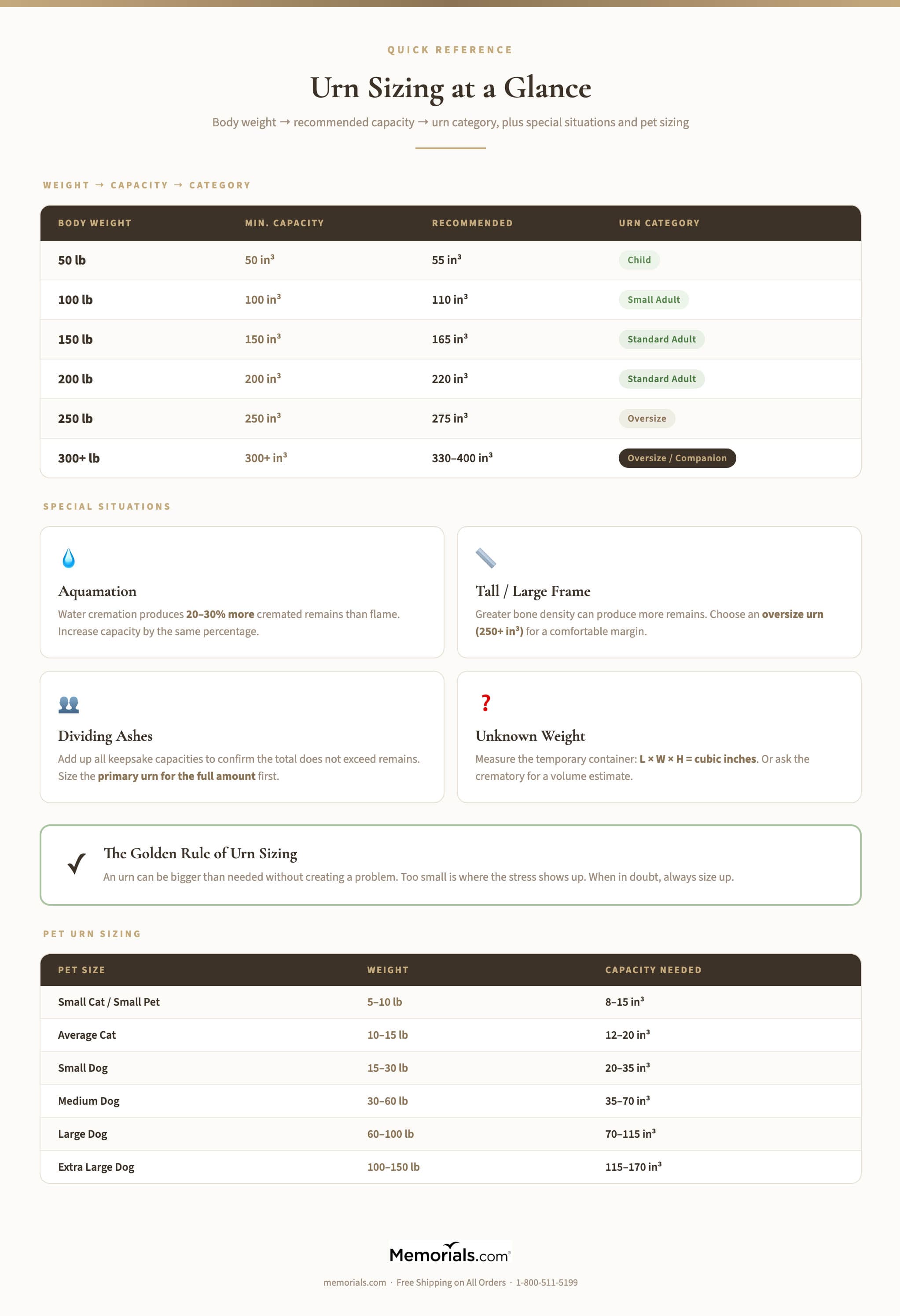
If you know the approximate body weight before cremation, this chart provides a starting capacity that includes a small cushion for a comfortable fit.
Body Weight (lb)
Minimum Capacity (in³)
Recommended Capacity (in³)
Urn Category
50
50
55
Child
100
100
110
Small Adult
150
150
165
Standard Adult
200
200
220
Standard Adult
250
250
275
Oversize
300+
300+
330–400
Oversize / Companion
When you fall near a boundary between categories, sizing up is the safer choice. An urn with extra space creates no problems. One that is too small creates real stress during an already difficult moment.
Standard Urn Dimensions in Inches
Cubic inch capacity tells you how much an urn holds inside, but exterior dimensions tell you whether it will fit on a shelf, inside a columbarium niche, or within an urn vault. Both numbers matter.
Here are typical exterior measurements for common urn shapes at the standard 200 cubic inch adult capacity:
Vase-shaped urns: approximately 9–10 inches tall and 6–7 inches in diameter.
Box-shaped urns: approximately 9–11 inches long, 7–8 inches wide, and 7–10 inches tall.
Cylinder urns: approximately 10–12 inches tall and 5–6 inches in diameter.
Always check the product page for the exact exterior dimensions before purchasing — especially if the urn must fit inside a niche, vault, or specific display space. Two urns with identical capacity can have very different outside measurements depending on material thickness and shape.
Dimension Ranges by Category
These are approximate exterior dimensions for the most common urn shapes. Use these to confirm fit for a niche, shelf, or vault.
Urn Category
Height Range
Width/Diameter Range
Depth Range (Box Styles)
Keepsake
2–5 in
2–4 in
2–4 in
Standard Adult (Vase)
9–11 in
6–7 in
—
Standard Adult (Box)
7–9 in
9–11 in
7–8 in
Oversize Adult
10–13 in
7–9 in
—
Companion (Vase)
12–15 in
8–10 in
—
Companion (Box)
7–10 in
14–16 in
9–12 in
Columbarium niches typically accept urns up to about 11 inches tall, 11 inches wide, and 13 inches deep — but every facility is different. If you plan to place an urn in a niche, confirm the exact interior niche dimensions with the cemetery before purchasing. Our guide to cemetery regulations for urns and markers covers what to ask.
How Material Affects Interior Capacity
Material choice directly affects the gap between exterior size and interior capacity. A thick-walled marble urn will have a smaller capacity relative to its exterior size than a thin-walled metal urn. Our overview of types of cremation urns explains how each material influences not just sizing but also durability, appearance, and suitability for different placements.
As a general rule: if two urns share the same exterior height, the one with thinner walls holds more cremated remains. Always confirm interior capacity in cubic inches rather than relying on exterior measurements alone.
Choosing the Right Urn for Your Situation
The size you need also depends on what you plan to do with the ashes. Ask yourself these questions before selecting an urn:
Will you keep all of the cremated remains together? Choose a standard adult urn (200 cubic inches) or larger based on your loved one's weight.
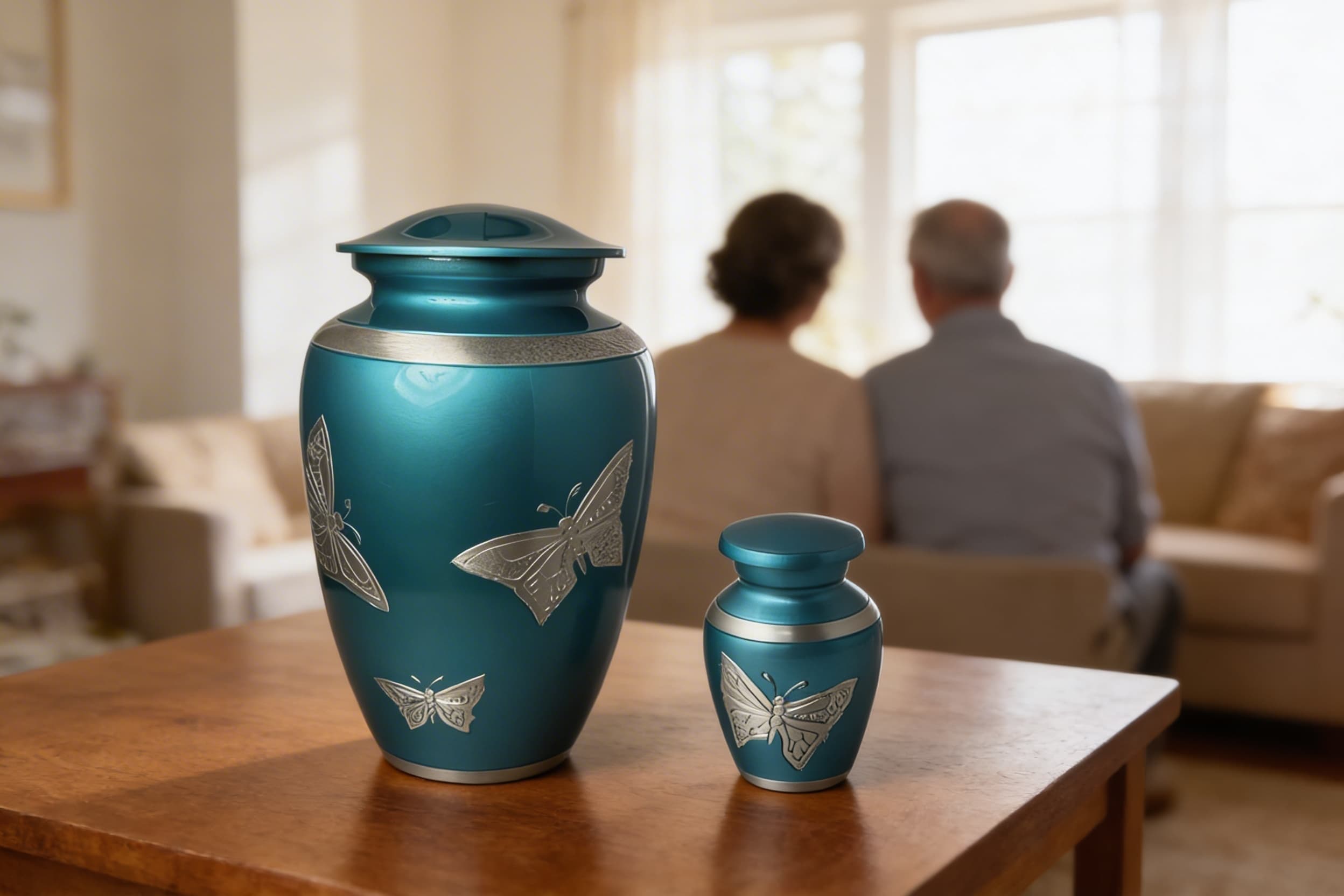
Will family members share the ashes? You may need one primary urn plus several keepsake urns. Keepsake urns range from 1 to 50 cubic inches and allow each family member to keep a meaningful portion.
Are you placing the urn in a columbarium niche? Contact the columbarium for their specific niche dimensions before ordering. Even if the capacity is right, an urn that is one inch too tall will not fit.
Will you bury the urn? Burial typically requires an urn vault, and the urn must fit inside the vault's interior. Measure the vault's inside dimensions and compare them against the urn's exterior dimensions.
Do you want to scatter the ashes?Scattering urns are designed for temporary holding and easy release. Since they do not store remains permanently, precise sizing is less critical — but the urn still needs to hold the full volume of ashes until the ceremony.
Do two people want to share a single urn? Add both body weights together to estimate the total cubic inches needed, then select a companion urn that meets or exceeds that number.
Will you keep a small portion in cremation jewelry? A cremation pendant holds roughly a pinch of ashes — far less than one cubic inch. You will still need a primary urn for the remaining cremated remains.
Companion Urns: Sizing for Two
A companion urn holds the cremated remains of two people. Most models offer approximately 400 cubic inches of total capacity — essentially two standard adult urns combined into one vessel.
Some companion urns feature a divider that creates two separate compartments. Others use a single shared chamber. Either way, the sizing math is straightforward:
Person A: body weight (lb) + 5–10% cushion
Person B: body weight (lb) + 5–10% cushion
Total needed: Person A + Person B
Urn capacity: should meet or exceed the total
If one person was significantly larger than average, look for companion urns above the standard 400 in³ mark — many are available up to 500–600 in³. Our guide to choosing a shared urn for two covers divider options, material choices, and other factors specific to companion selections.
Keepsake and Sharing Urns
Many families choose to divide cremated remains among several keepsake urns or pieces of cremation jewelry so that multiple relatives can each keep a personal memorial. If you are weighing this option, our comparison of keepsake versus full-size urns explains how the two categories differ and when each makes sense.
If you plan to create several keepsakes from one set of remains, add up the total capacity of all the keepsake vessels to make sure it does not exceed what is available from the primary urn or the total cremated remains. Size the primary urn for the full amount first, then fill keepsakes from it.
Infant and Child Urn Sizes
Baby and child urns follow the same 1 pound to 1 cubic inch guideline, scaled down to smaller body weights.
Age Range
Approximate Weight (lb)
Recommended Capacity (in³)
Newborn / Infant
5–15
10–20
Toddler (1–3 years)
20–35
25–40
Child (4–8 years)
35–60
40–70
Older Child / Young Teen
60–120
70–135
Child urns are sometimes mislabeled or confused with keepsakes because of their smaller size. Always confirm the listed capacity before purchasing.
Pet Urn Sizing
The same 1 pound = 1 cubic inch formula applies to pets. Because pets range from a few pounds to well over 100 pounds, pet urns come in a much wider range of sizes than human urns.
Pet Size
Approximate Weight (lb)
Recommended Capacity (in³)
Small cat / small pet
5–10
8–15
Average cat
10–15
12–20
Small dog
15–30
20–35
Medium dog
30–60
35–70
Large dog
60–100
70–115
Extra large dog
100–150
115–170
If your pet was cremated privately and you received all remains back, choose a capacity that matches the pet's approximate weight plus a small cushion. For more on costs and the cremation process, see our guide to pet cremation.
How to Measure Cremation Ashes if You Already Have Them
If cremation has already taken place and you need to determine how much space the ashes require, you do not need to rely on the weight formula. You can measure the remains directly.
The crematory will return the ashes in a temporary container — usually a plastic bag inside a basic box or plastic urn. To measure:
Place the bag of ashes into a box with flat, straight sides (a cardboard box works well).
Measure the length, width, and height of the ashes in inches.
Multiply length × width × height to get the total volume in cubic inches.
Example: The ashes fill a space measuring 8" × 6" × 3.75" → 8 × 6 × 3.75 = 180 cubic inches. A standard 200 cubic inch urn will hold these ashes comfortably.
If you are unsure, ask the funeral home or crematory for the capacity of the temporary container they provided, or simply ask them to recommend a size. They handle this question frequently.
Situations That Change How Much Capacity You Need
The standard sizing guideline works for most families, but a few circumstances call for extra caution.
Aquamation (water cremation) produces roughly 20–30% more cremated remains than traditional flame cremation. If your loved one chose aquamation, increase the recommended capacity accordingly. A 200 lb individual may need 240–260 cubic inches after aquamation rather than the standard 220.
Very tall or large-framed adults may have greater bone density, which can produce more remains than the weight-based estimate suggests. Choosing an oversize urn (250+ in³) provides a comfortable margin.
Unknown weight is common when families do not have recent medical records. In this case, ask the crematory or funeral home — they can often provide the volume of remains in the temporary container or recommend a specific capacity. You can also measure the remains directly using the method described above.
Medical implants like joint replacements and pacemakers do not increase the amount of ashes. These items are separated out after cremation and do not affect urn sizing.
How Placement Affects Your Size Choice
Where you plan to keep the urn can add a secondary size constraint on top of capacity:
Home display — Capacity is the only real limit. Choose the style and footprint that suits your space.
Columbarium niche — Both interior capacity and exterior dimensions matter. Confirm the niche measurements with the cemetery first, then find an urn that fits within those dimensions while still meeting your capacity needs.
Burial — Many cemeteries require the urn to be placed inside an urn vault. Confirm vault interior dimensions to make sure your urn fits. See our article on cemetery regulations for urns and markers for detail on what different cemeteries require.
Scattering — If you plan to scatter all remains, a biodegradable or scattering urn is designed for that purpose. Capacity still matters so the remains fit during transport.
Dividing among family — Choose a primary urn for the full amount, then fill keepsakes from it. The primary urn should be sized for the total remains, not a reduced portion.
What to Do if the Urn You Bought Is Too Small
This is more common than you might expect, and it does not mean anything went wrong with the cremation. It usually happens because the urn was marketed as "adult" but had a capacity of only 120–150 cubic inches — lower than the standard 200 cubic inches.
Check the urn's listed capacity in cubic inches. If it is significantly below your loved one's body weight, you have a few options: exchange the urn for a larger size, divide the ashes between the original urn and one or more keepsake urns, or contact the retailer about their return policy. Many retailers, including Memorials.com, offer returns on unused urns in original condition.
Never force ashes into an urn that does not have enough room. A slightly larger urn is always the better choice.
Frequently Asked Questions
What size urn do I need for a 200 pound person?
A 200 pound person typically requires an urn with at least 200 cubic inches of capacity. This is the standard adult urn size and the most commonly available option. Adding 10–20 extra cubic inches provides a comfortable margin, so an urn in the 200–220 cubic inch range is ideal.
How many cubic inches is a standard cremation urn?
A standard adult cremation urn holds approximately 200 cubic inches. The Cremation Association of North America (CANA) established this as the industry benchmark. Most urns labeled "adult" or "standard" fall within the 175–220 cubic inch range.
Can an urn be too big?
An urn cannot be too big in terms of function — extra space inside will not cause any issues. Many families choose an urn slightly larger than needed for an easier transfer and to leave room for a small memento like a handwritten note or a lock of hair. The only concern is visual scale or physical fit if placing the urn in a columbarium niche or urn vault.
How do I measure cremation ashes for an urn?
Place the bag of cremated remains into a box with flat sides. Measure the length, width, and height of the ashes in inches. Multiply all three numbers together to get the total volume in cubic inches. This measurement tells you the minimum urn capacity you need.
Does aquamation require a larger urn?
Yes. Aquamation, also called water cremation, typically produces 20–30% more cremated remains than flame cremation. Increase the standard recommendation by that same 20–30% to ensure a comfortable fit.
What is the difference between urn capacity and urn dimensions?
Capacity refers to the interior volume in cubic inches — how much the urn can hold. Dimensions refer to the exterior height, width, and depth of the urn in inches. Two urns with the same capacity can have very different exterior dimensions depending on wall thickness, shape, and material. Always check both numbers before purchasing, especially if the urn needs to fit in a specific space.
Choosing an Urn That Honors Your Loved One
Getting the size right is the practical foundation of selecting a cremation urn. Once you know the capacity you need — and our guide to how much a cremation urn costs can help you budget by material and size — you can focus on the details that make the urn meaningful — the material, the design, the engraving, and the way it reflects the person you are remembering.
Memorials.com carries cremation urns in every size from small keepsakes to oversized companion urns, with capacity clearly listed on every product page. All orders include free ground shipping, and a 30-day return window gives you flexibility if you need to adjust your selection. Browse the full collection or call 1-800-511-5199 for personal guidance.