🏬Supersize Online Funeral Retailer🪦1000's of Headstones⚱️Over 10,000 Cremation Urns⚰️Caskets Overnight Delivery🛒Funeral & Memorial Superstore🚚FREE Shipping on ALL Orders👨👩👧👦Helping Families for over 20 Years💰Lowest Price Guarantee🏬Supersize Online Funeral Retailer🪦1000's of Headstones⚱️Over 10,000 Cremation Urns⚰️Caskets Overnight Delivery🛒Funeral & Memorial Superstore🚚FREE Shipping on ALL Orders👨👩👧👦Helping Families for over 20 Years💰Lowest Price Guarantee
🏬Supersize Online Funeral Retailer🪦1000's of Headstones⚱️Over 10,000 Cremation Urns⚰️Caskets Overnight Delivery🛒Funeral & Memorial Superstore🚚FREE Shipping on ALL Orders👨👩👧👦Helping Families for over 20 Years💰Lowest Price Guarantee🏬Supersize Online Funeral Retailer🪦1000's of Headstones⚱️Over 10,000 Cremation Urns⚰️Caskets Overnight Delivery🛒Funeral & Memorial Superstore🚚FREE Shipping on ALL Orders👨👩👧👦Helping Families for over 20 Years💰Lowest Price Guarantee
Celtic symbols have been carved into stone, inked on skin, woven into manuscripts, and worn close to the body for more than two thousand years. They were chosen not for decoration but for meaning – to mark relationships, honor ancestors, and acknowledge that life, death, and what lies beyond are bound together in a single unbroken thread.
For families choosing cremation jewelry, Celtic and nature-inspired designs carry that same depth today. A small pendant engraved with a Trinity knot or shaped like a dragonfly does more than hold a pinch of cremated remains. It holds a story – about a person's heritage, their love of the natural world, or a belief in the continuity of the soul. For families unfamiliar with this keepsake format, understanding how cremation jewelry works is a helpful first step.
This guide explains what the most common Celtic and nature symbols mean in a memorial context, how different styles translate into pendant and necklace designs, and what to consider when choosing a piece that truly reflects who your loved one was. If you're still exploring your options, our complete guide to cremation jewelry covers every style and format available.
Why Celtic and Nature Symbols Resonate in Memorial Jewelry
Celtic culture, rooted in the Iron Age and early Christian periods of Ireland, Scotland, and broader northwestern Europe, produced a symbolic vocabulary that was always intertwined with the natural world. The Celts did not draw a sharp line between the spiritual and the physical. Oak trees, rivers, the moon, and the turning of seasons were all charged with meaning. Symbols like the spiral, the knot, and the cross were ways of encoding that worldview into objects people could carry with them.
That philosophy maps naturally onto the purpose of celtic cremation jewelry. A piece you wear daily – one that holds a trace of someone you loved – asks exactly the same questions the Celts were asking: What connects us to those who came before? What survives death? How do we carry the people we've lost?
Nature symbols work similarly. Dragonflies, butterflies, oak leaves, and forget-me-nots each carry centuries of accumulated meaning around transformation, endurance, and remembrance. These aren't arbitrary choices. For many families, they're the most honest visual language available. Each of those symbols has a history longer than the jewellery it is set into; the butterfly’s is the best documented, and we have traced what the butterfly has meant across cultures.
The Seven Most Meaningful Celtic Symbols in Memorial Jewelry
1. The Celtic Knot (Triquetra / Trinity Knot)
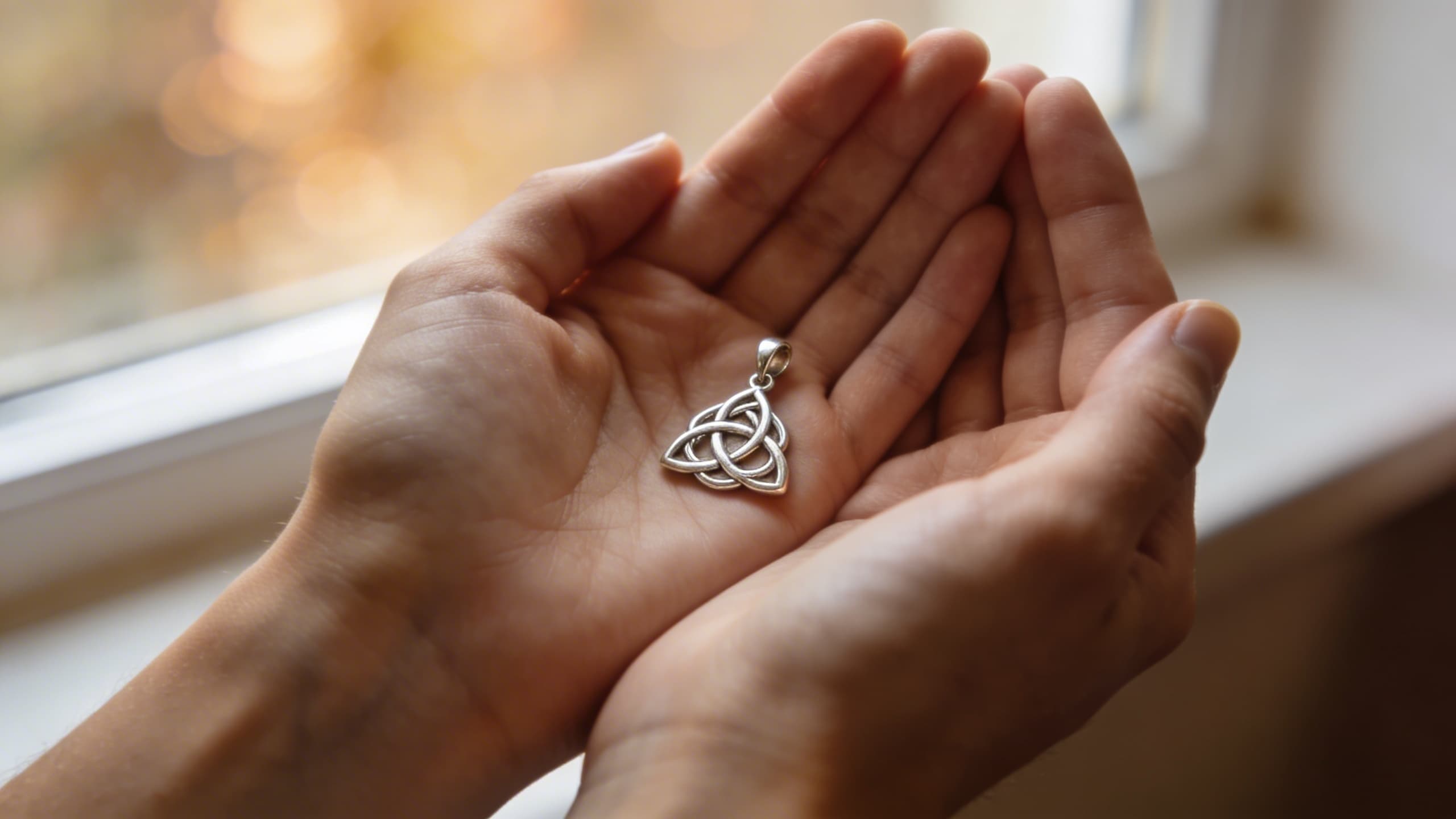
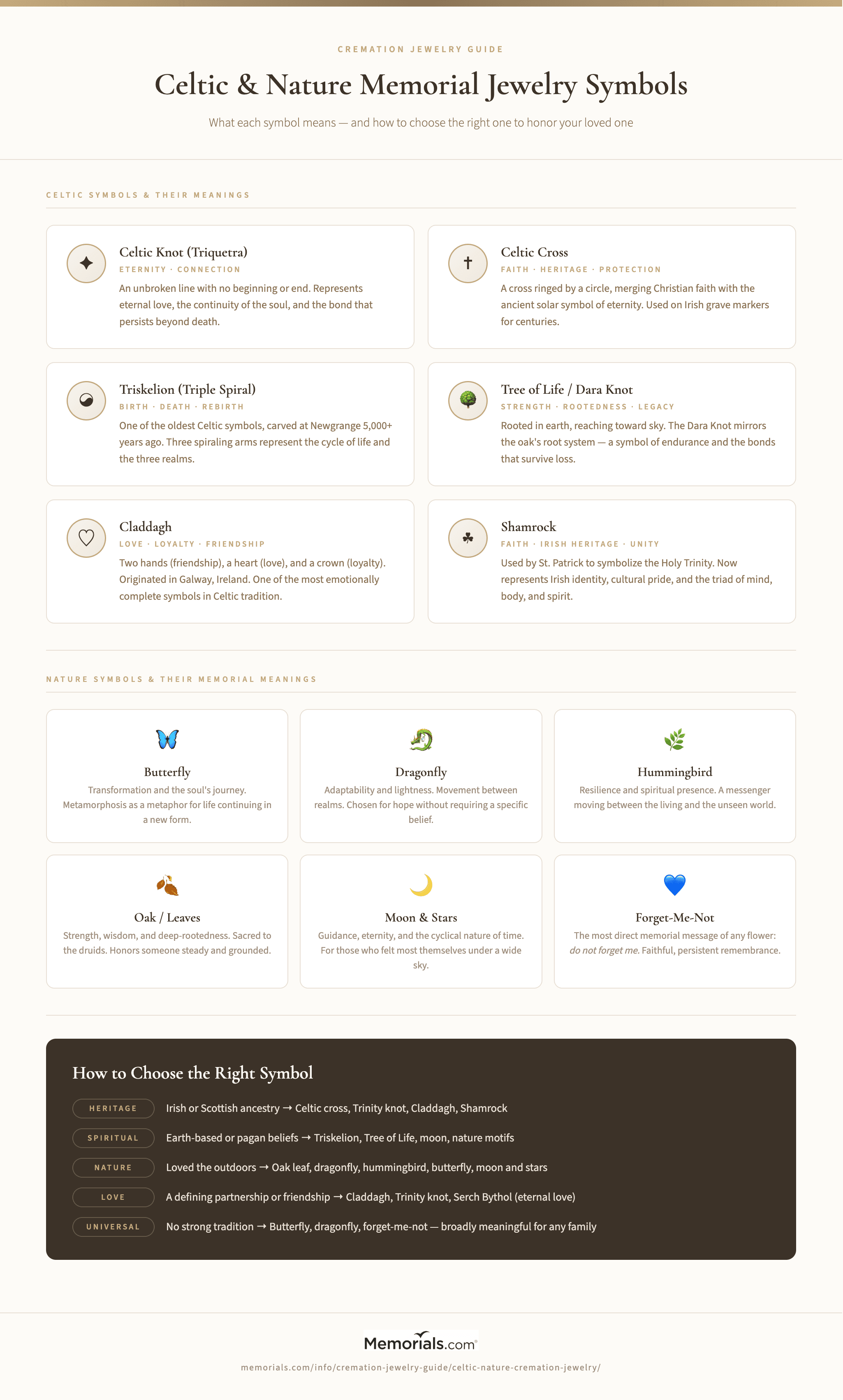
The Celtic knot is the design most people recognize first – a continuous interlacing pattern with no visible start or finish. That feature is also its core meaning. An unbroken line suggests eternity, the continuous cycle of life and death, and a bond that cannot be severed.
The Triquetra, or Trinity Knot, is one of the most common knot forms used in memorial jewelry. Its three interlocked arcs can represent the Christian Holy Trinity (Father, Son, Holy Spirit), or the pre-Christian triple cycle of birth, death, and rebirth. Some wearers connect it to the triad of past, present, and future. Others simply read it as a symbol of love that has no end.
When a Triquetra is encircled – a ring surrounding the three-pointed knot – the circle amplifies the meaning. It adds unity and divine protection to the existing symbolism of eternity and interconnection.
For families with Irish or Scottish heritage, a Trinity knot pendant that also functions as a cremation necklace is one of the most culturally resonant choices available.
2. The Celtic Cross
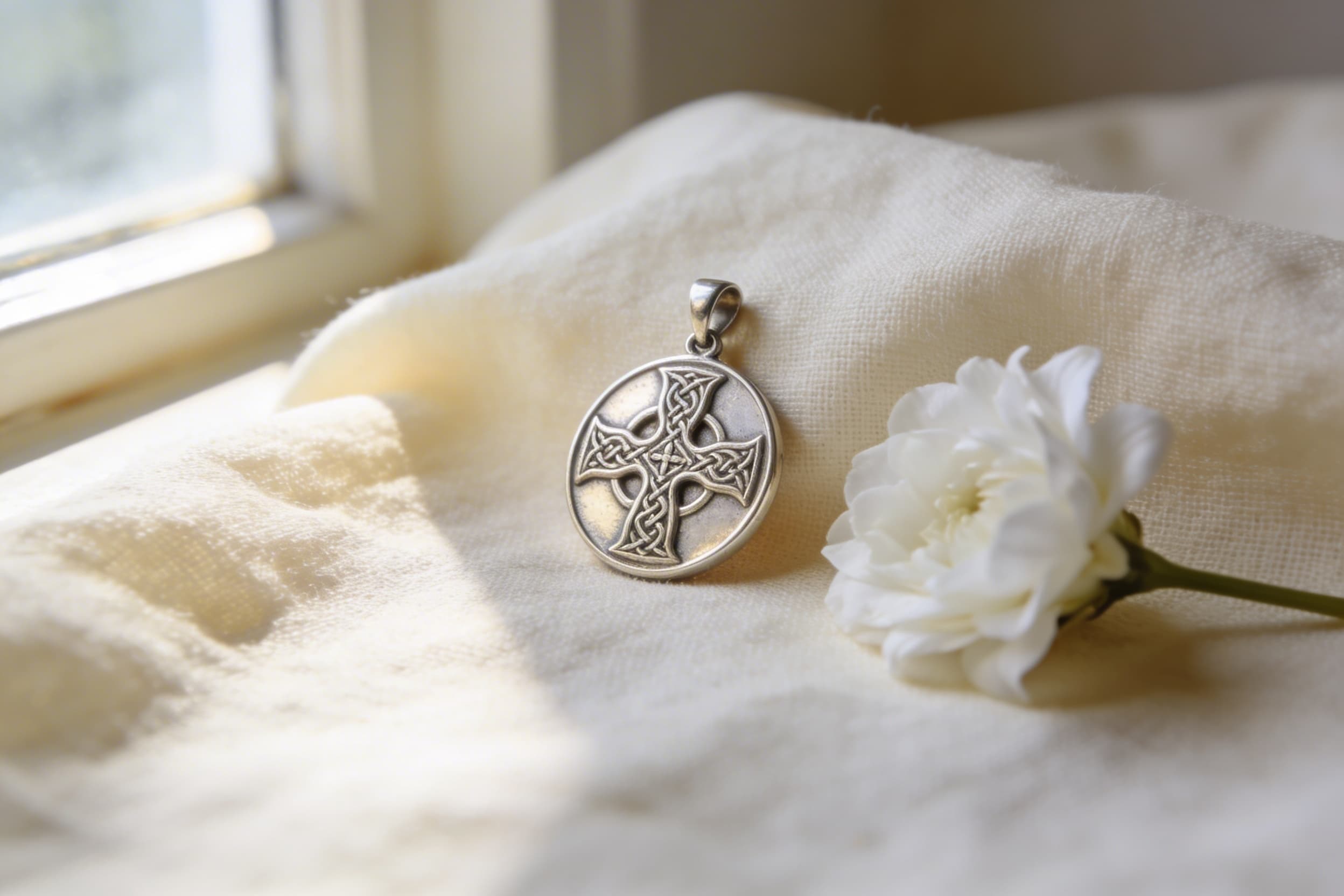
The Celtic cross combines the familiar Latin cross with a ringed circle at its center. Historically, it began as an Irish Christian symbol, closely associated with St. Patrick and the early spread of Christianity across Ireland. The circle – originally a pagan solar motif representing eternity – was absorbed into the Christian form, creating a design that bridges two spiritual traditions.
In memorial contexts, the Celtic cross has been used on grave markers and funerary monuments for centuries. It appears carved into ancient stone at monastic sites across Ireland and Scotland, and it carries layered meaning: faith, heritage, protection, and the belief that death is a passage rather than an ending.
A Celtic cross pendant holding a small portion of cremated remains is particularly meaningful for families with Catholic Irish ancestry, though the symbol has broad resonance for anyone drawn to its visual and cultural history.
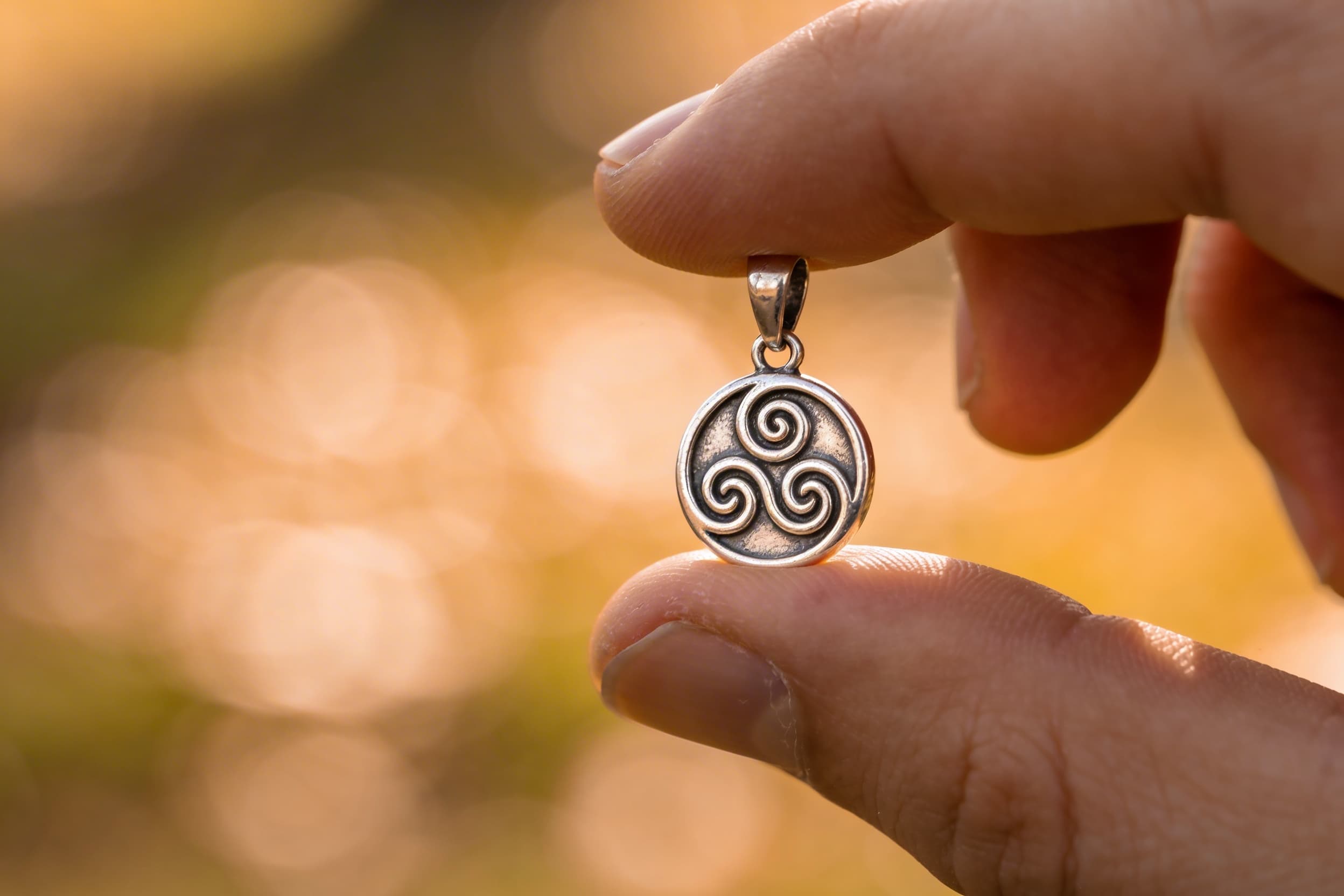
3. The Triskelion (Triple Spiral)
The Triskelion – three spiraling arms radiating outward from a central point – is one of the oldest Celtic symbols in existence. Its most famous appearance is carved into the entrance stone at Newgrange, a Neolithic passage tomb in Ireland estimated to be over 5,000 years old. The structure predates the Egyptian pyramids.
The triple spiral conveys motion and cycle. In pagan spirituality, the three arms often represent birth, death, and rebirth, or the three realms of earth, sea, and sky. In Christian interpretation, it can stand for the Holy Trinity. In either reading, the symbol communicates that existence is not linear – it spirals, returns, and continues.
For a family honoring someone who felt deeply connected to ancient history, Celtic heritage, or the cycles of the natural world, a Triskelion pendant is a particularly powerful choice.
4. The Tree of Life
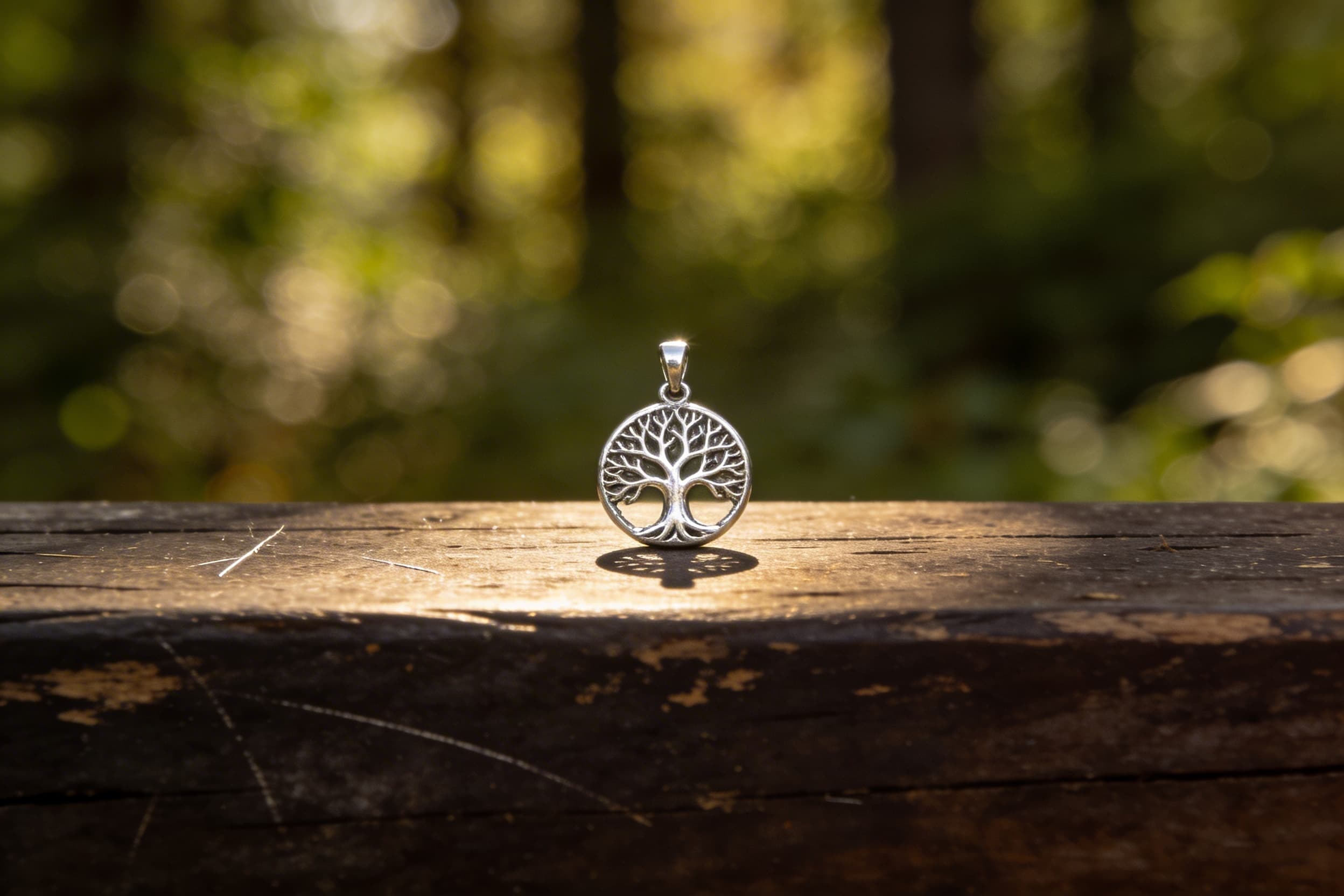
The Tree of Life appears across many cultures but carries a specific meaning in Celtic tradition. Rooted deeply in the earth and reaching upward into the sky, the tree represents the connection between the underworld, the living world, and the heavens. In Celtic belief, specific trees were sacred – the oak above all, but also the ash, the birch, and the yew, which was planted in Irish churchyards for centuries as a symbol of immortality.
The Dara Knot, a related Celtic symbol derived from the Irish word "doire" (oak), encodes this meaning in knotwork form. Its complex interwoven design mirrors the root system of an oak tree, symbolizing inner strength, groundedness, and the ability to endure loss.
In memorial jewelry, a Tree of Life pendant often features delicate branching metalwork in the upper half and root forms in the lower half, sometimes inlaid with abalone, stone, or stained glass. It speaks to the idea that the person who has died remains connected – through family, through memory, through the roots that persist even when the branches are gone.
5. The Claddagh
The Claddagh originated in the Claddagh fishing village in Galway, Ireland, and depicts two hands holding a crowned heart. Each element carries its own meaning: the hands represent friendship, the heart symbolizes love, and the crown stands for loyalty. Together, they make the Claddagh one of the most emotionally complete symbols in Celtic tradition.
While the Claddagh is best known as a ring design, it translates beautifully into cremation pendant form. For a family honoring a marriage of many decades, a partnership of deep loyalty, or a friendship that was the defining relationship of a life, a Claddagh design can say what is difficult to put into words.
6. The Shamrock
The Shamrock is Ireland's most recognized emblem. Saint Patrick famously used its three leaves to explain the concept of the Holy Trinity. Over centuries, the Shamrock came to represent not only Christian faith but Irish national pride and the simple endurance of a people who maintained their identity across centuries of difficulty.
In memorial jewelry, a Shamrock pendant works particularly well for honoring someone who was proud of their Irish roots, who loved the celebration and story of St. Patrick's Day, or whose family identity was shaped by Irish immigration and the keeping of tradition across generations.
7. Ogham Script
Ogham is the oldest known Irish writing system, consisting of horizontal or diagonal lines carved across a central stem. In ancient times, Ogham inscriptions on standing stones marked territories and commemorated individuals – their names, their lineage, their significance to the community.
An Ogham inscription on a cremation pendant functions as a direct continuation of that tradition. A loved one's name or initials, a meaningful word, or a short phrase rendered in Ogham script creates a piece that connects the wearer to an ancestral form of remembrance while holding something genuinely personal.
Nature Symbols in Memorial Jewelry
Celtic and pagan memorial jewelry is not limited to knotwork and crosses. A wide range of nature-inspired motifs carry deep symbolic weight in memorial contexts – particularly for those who held a spiritual connection to the natural world, or whose families did not follow a formal religious tradition.
Dragonfly. Associated with transformation and adaptability, the dragonfly is among the most frequently chosen nature symbols in memorial jewelry. Its shimmering wings and ability to move across air and water make it a natural emblem of the soul's movement between states of being. Families often choose dragonfly designs when they want something hopeful that doesn't require any particular belief system.
Butterfly. The butterfly is perhaps the most universal symbol of transformation and the soul's continuation. Its metamorphosis from caterpillar to cocoon to winged form is an almost exact metaphor for the belief that death is not an ending but a change in state. In Celtic and broader pagan tradition, butterflies were sometimes seen as departed souls returning to visit those they loved.
Hummingbird. A hummingbird represents resilience, joy, and spiritual presence. These tiny birds travel vast distances despite their size, and in many Indigenous and Celtic-adjacent belief systems they are understood as spiritual messengers – creatures that move between the living world and the unseen one. A hummingbird pendant carries a quiet intimacy: this person was small but traveled far, brought sweetness, and is still here in some form.
Oak and Forest Motifs. The oak was sacred to the druids and carries meaning around strength, wisdom, endurance, and deep-rootedness. A pendant featuring oak leaves, an acorn, or forest imagery speaks to someone who found peace outdoors, who lived with stability and groundedness, or whose family planted and tended things for future generations.
Stars and Moon. Celestial symbols have been used in memorial art across cultures for millennia. A crescent moon suggests mystery, the feminine, and the turning of time. A star can represent guidance, the way certain people seem to light things from a distance even after they are gone. Both translate well into pendant designs for those whose loved one felt most themselves at night, under a wide sky, or who had a deep interest in astronomy or the cosmic.
Forget-Me-Not. This small blue flower carries one of the clearest memorial meanings of any plant: do not forget me. It appears in Victorian mourning jewelry, in poetry, and in the names given to remembrance organizations across Europe. A forget-me-not pendant is a simple, direct tribute – an acknowledgment that being remembered is itself a form of love.
Pagan Memorial Jewelry: What It Means and Who It's For
The term "pagan memorial jewelry" is sometimes used interchangeably with Celtic or nature-based designs, but it carries a specific meaning worth clarifying. Pagan, in the context of memorial and spiritual jewelry, generally refers to pre-Christian or earth-based belief systems – druidic traditions, Wicca, polytheistic nature religions, and related practices that center the natural world and its cycles rather than a single deity.
For families honoring someone who identified with these traditions, pagan memorial jewelry typically emphasizes:
Symbols of cyclical time (spirals, moons, wheels of the year)
Nature motifs (oak, mistletoe, animals, stars)
The Triskelion or Triquetra read in a non-Christian context
(birth/death/rebirth; earth/sea/sky)
Pentagrams (earth, water, fire, air, spirit)
Celtic revival or reconstructionist symbols
There is meaningful overlap between Celtic Christian jewelry and pagan memorial jewelry. The Tree of Life, the Triple Spiral, and many knot forms predate Christianity and carry both pre-Christian and Christian interpretations. A family with mixed beliefs, or one that simply finds these symbols personally resonant regardless of doctrine, can choose them freely.
Choosing the Right Symbol for Your Loved One
The best approach is to start with what you know about the person.
Start with heritage. If your loved one was proud of Irish, Scottish, or Welsh ancestry, or if Celtic tradition was part of how your family understood itself, begin there. Celtic crosses, Trinity knots, and Claddagh designs carry cultural meaning that goes beyond aesthetics.
Consider their spiritual beliefs. Someone who followed a formal faith may be best honored with symbols that align with that tradition – a Celtic cross for a Catholic, a Tree of Life for someone drawn to broadly spiritual or earthy values, a Triquetra for someone whose faith was personal and hard to categorize.
Think about their relationship with nature. A person who spent their weekends hiking, gardening, or simply watching birds from a window has already told you something. A pendant shaped like an oak leaf, a hummingbird, or a moon may carry more meaning than a knot they never mentioned.
Look at the jewelry they wore. People who chose Celtic knotwork in their lifetime are telling you something. People who always wore small, simple pieces may be best honored with a clean, minimalist nature symbol rather than an elaborate knotwork design. For additional style guidance by audience, our guide to cremation jewelry for women covers the pendant styles and sizes most commonly chosen.
For nature cremation jewelry and celtic memorial jewelry, most pieces are made from sterling silver or stainless steel with optional gold plating. They hold a small pinch of cremated remains – typically less than a teaspoon – in a concealed threaded compartment. The piece is sealed after filling and worn or displayed as a permanent keepsake.
Materials, Styles, and What to Expect
Most Celtic and nature cremation pendants are made from sterling silver or stainless steel, with some pieces available in 14K gold. Sterling silver offers traditional warmth and a softer finish. Stainless steel is more affordable and highly resistant to tarnish, which matters for a piece worn daily. Gold is chosen when the memorial piece is also meant to function as heirloom jewelry passed down within a family. For a full breakdown of how each metal performs over years of daily wear, see our cremation jewelry materials guide.
Sizes vary considerably. Standard pendants are roughly three-quarters of an inch to one and a half inches in diameter or height – small enough to be worn discreetly under clothing. Larger statement pendants exist for those who prefer something more visible.
The ash compartment is accessed via a small threaded opening, typically on the back or base of the piece. A jeweler or funeral home can assist with filling if the family prefers not to handle the remains directly. Once sealed, the compartment is not visible and the pendant looks indistinguishable from conventional jewelry.
Many pieces are engravable. A name, date, or short phrase added to the back of a Celtic pendant deepens its personal meaning considerably. Ogham script, as noted above, is a particularly distinctive engraving choice for pieces with Irish heritage significance.
Frequently Asked Questions
What is the meaning of Celtic cremation jewelry?
Celtic cremation jewelry combines the symbolism of ancient Celtic designs – knots, crosses, spirals, and tree motifs – with the function of a memorial keepsake that holds a small amount of cremated remains. The symbols carry meanings around eternity, heritage, love, protection, and the continuity of the soul. For families with Irish, Scottish, or Celtic ancestry, these designs also serve as a direct connection to cultural identity.
What does the Celtic knot mean on a cremation pendant?
The Celtic knot, in its various forms, represents eternity and the unbroken bond between people and generations. Because the knot has no clear beginning or end, it became a natural symbol for things that persist – love, spirit, and memory. On a cremation pendant, it carries the idea that the connection to the person who died continues, even as its form changes.
What is the difference between Celtic and nature cremation jewelry?
Celtic cremation jewelry uses specific symbols from Irish, Scottish, and broader Celtic tradition – knots, crosses, spirals, Claddagh, and Ogham. Nature cremation jewelry uses imagery from the natural world – dragonflies, butterflies, trees, flowers, and celestial motifs. These categories overlap significantly, since Celtic symbolism is itself deeply rooted in nature. A Tree of Life pendant, for example, belongs comfortably in either category.
Can non-Irish families wear Celtic cremation jewelry?
Yes. While Celtic designs carry cultural meaning, they are not restricted to families with Irish or Scottish heritage. Many people choose these symbols for their aesthetic, their spiritual resonance, or simply because the imagery feels like an honest representation of the person they are honoring. The Triquetra, Tree of Life, and Triskelion in particular have broad appeal beyond heritage-specific uses.
How is ash placed in a cremation pendant?
A very small amount of cremated remains – typically a pinch, less than a teaspoon – is placed through a threaded opening in the pendant, usually located on the back. The opening is then sealed with the provided tool or a small amount of jeweler's adhesive. Many families ask a funeral director or jeweler to assist with this step. Once sealed, the ash is fully enclosed and the pendant is worn like any other piece of jewelry.
A Final Note
Celtic and nature symbols found their way into jewelry long before cremation jewelry existed as a category. People have always wanted to carry something meaningful – a mark of where they came from, what they believed, and who they loved.
A pendant engraved with a Trinity knot, shaped like a dragonfly, or bearing the interwoven roots of a Tree of Life is not simply a container for ashes. It is a continuation of the oldest human instinct: to find the right symbol for what cannot be said in plain words, and to wear it close.
Explore our full collection of celtic cremation jewelry to find the design that speaks to your family's story.