🏬Supersize Online Funeral Retailer🪦1000's of Headstones⚱️Over 10,000 Cremation Urns⚰️Caskets Overnight Delivery🛒Funeral & Memorial Superstore🚚FREE Shipping on ALL Orders👨👩👧👦Helping Families for over 20 Years💰Lowest Price Guarantee🏬Supersize Online Funeral Retailer🪦1000's of Headstones⚱️Over 10,000 Cremation Urns⚰️Caskets Overnight Delivery🛒Funeral & Memorial Superstore🚚FREE Shipping on ALL Orders👨👩👧👦Helping Families for over 20 Years💰Lowest Price Guarantee
🏬Supersize Online Funeral Retailer🪦1000's of Headstones⚱️Over 10,000 Cremation Urns⚰️Caskets Overnight Delivery🛒Funeral & Memorial Superstore🚚FREE Shipping on ALL Orders👨👩👧👦Helping Families for over 20 Years💰Lowest Price Guarantee🏬Supersize Online Funeral Retailer🪦1000's of Headstones⚱️Over 10,000 Cremation Urns⚰️Caskets Overnight Delivery🛒Funeral & Memorial Superstore🚚FREE Shipping on ALL Orders👨👩👧👦Helping Families for over 20 Years💰Lowest Price Guarantee
A fingerprint is the only thing in the world that has ever belonged to exactly one person. No two are alike – not even between identical twins. That biological uniqueness is what makes fingerprint jewelry unlike any other form of memorial keepsake. Every pendant, ring, or charm captures something that cannot be duplicated, replicated, or replaced.
This guide covers everything families need to know about fingerprint jewelry: what it is, how it's made, which types of pieces are available, what metals to choose, and how to go through the ordering process – including what to do if your loved one has already passed.
What Is Fingerprint Jewelry?
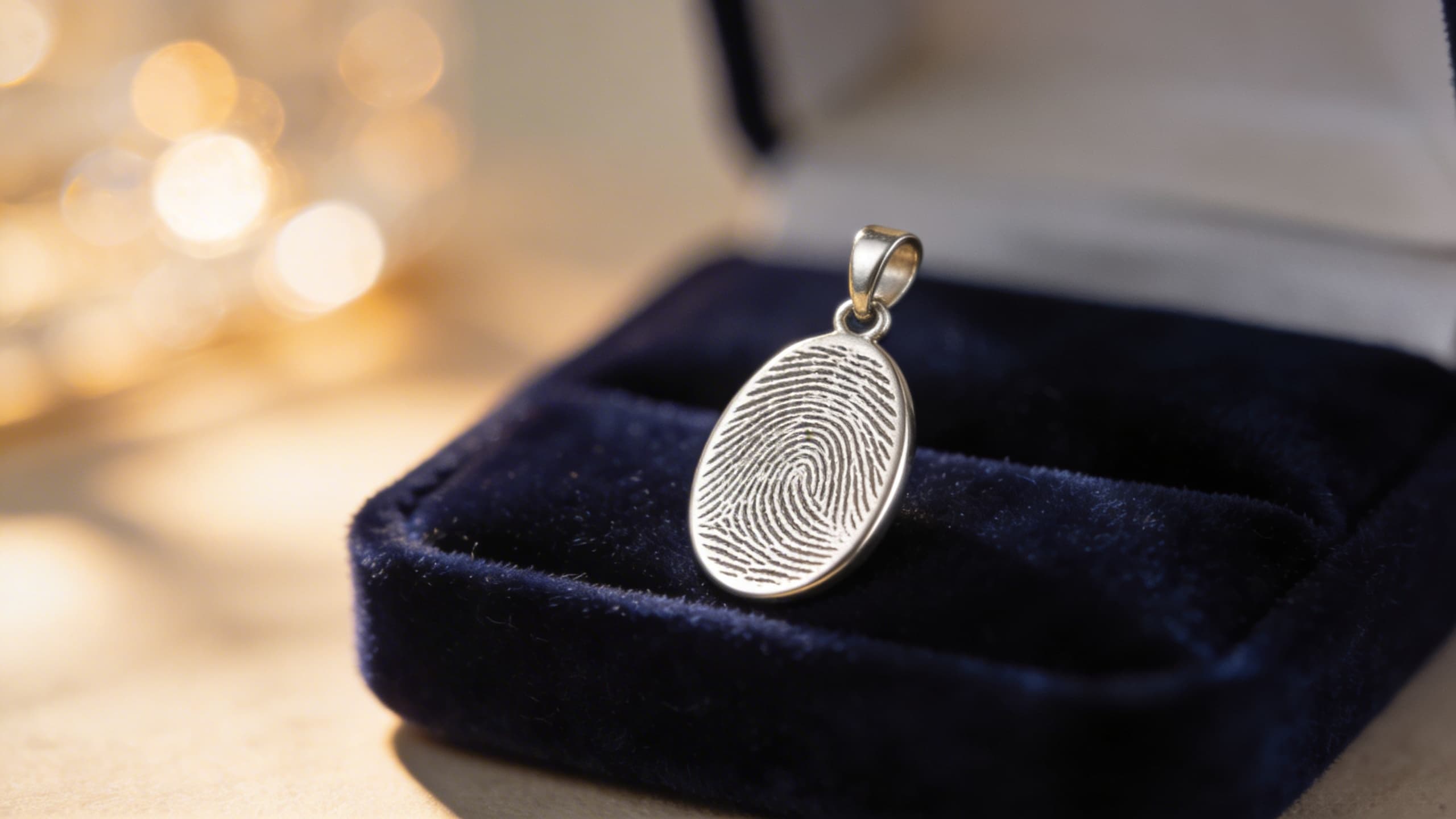
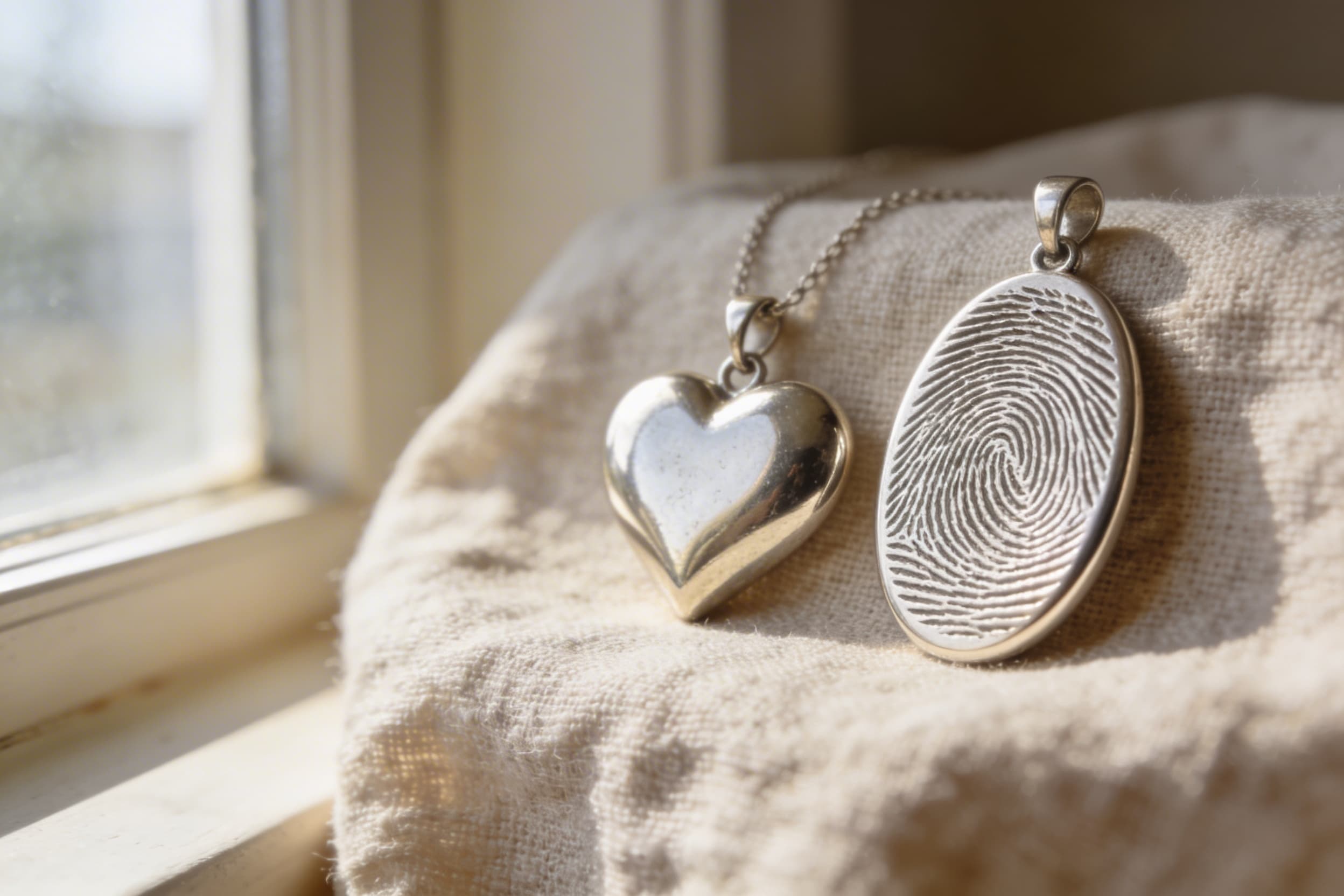
Fingerprint jewelry is custom created from an actual fingerprint – typically a thumbprint – of someone you love. The print is captured either through an ink impression or a digital photograph and is then permanently rendered into metal in the form of a pendant, ring, bracelet, keychain, or other wearable piece.
The result is jewelry that is entirely one-of-a-kind. Because no two people share the same fingerprint, every single piece produced is a true original. Wearing it means carrying something that existed only on that one person – a physical expression of their singular presence in the world.
While fingerprint jewelry has long been associated with memorial use, it is now common for people to order pieces as birth keepsakes for newborns, anniversary gifts, or wedding bands where each partner's print appears on the other's ring. That said, its deepest meaning tends to come after loss – when families reach for something tangible, something real, to hold onto.
What Are Thumbies?
Thumbies® is one of the most recognized brand names in fingerprint keepsake jewelry. Founded in 1998 after a man received fingerprint charms of his daughters and was profoundly moved by the experience, Thumbies grew into a dedicated manufacturer of print-based memorial keepsakes.
Thumbies pieces are created using the lost wax casting method (explained in detail in the next section) and can be produced in sterling silver, 14k gold, and white gold. The brand offers classic pendants, rings, bracelets, keychains, dog tags, and specialty shapes including hearts, stars, crosses, and sports motifs.
When people search for "thumbies fingerprint jewelry," they are often looking for this specific brand, or using the name generically to describe the style of fingerprint charm jewelry. Both uses are common. Thumbies has become something of an industry standard – widely distributed through funeral homes and memorial retailers.
How Fingerprint Jewelry Is Made
Understanding how fingerprint jewelry is made helps families evaluate quality and make better buying decisions. There are several production methods in use today, and they are not equivalent.
Lost Wax Casting (3D Fingerprint Jewelry)
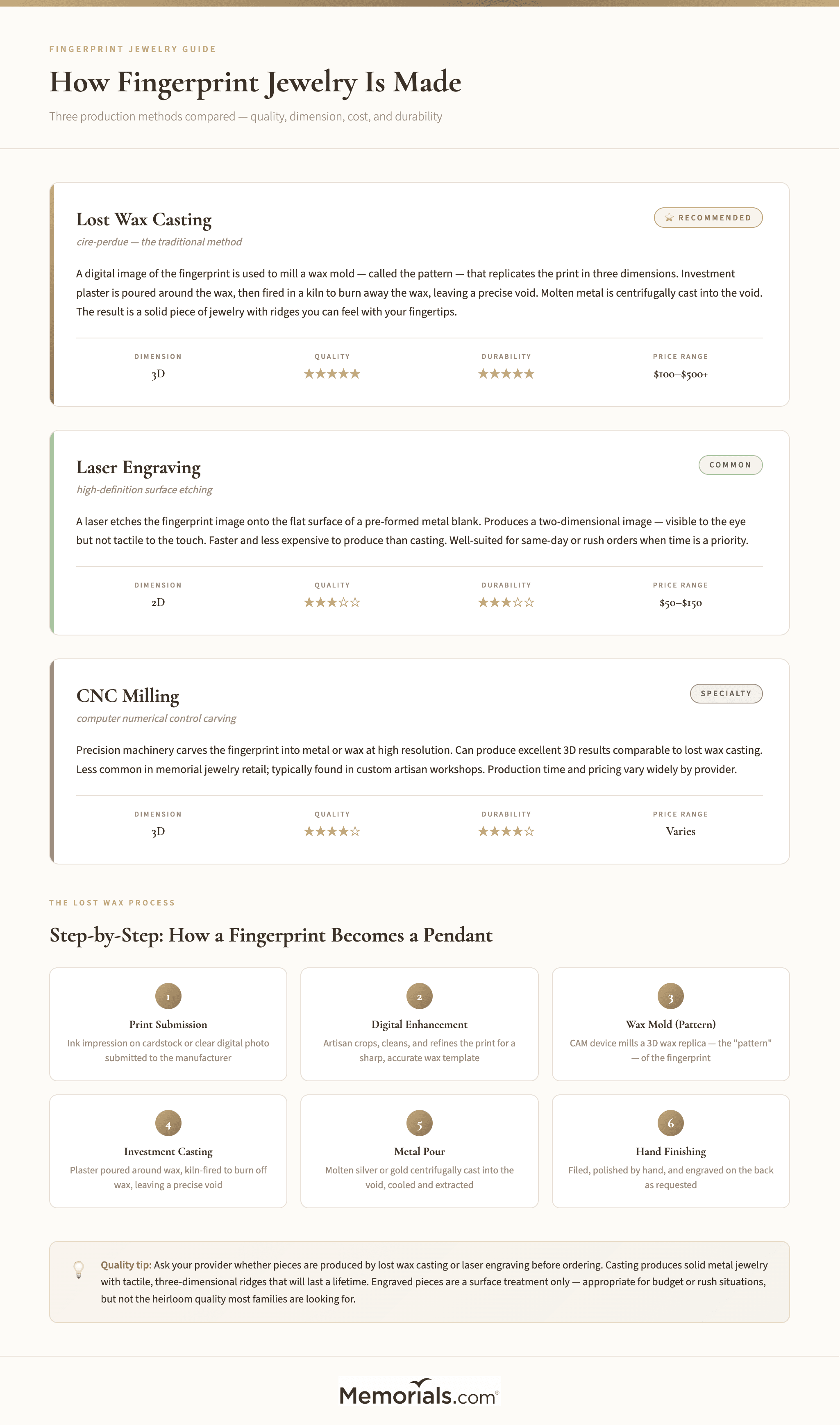
Lost wax casting – also called cire-perdue – is the oldest and most respected method for creating fingerprint jewelry. It produces a true three-dimensional impression where the ridge lines of the fingerprint are raised or recessed into the metal surface, giving the piece a tactile quality you can feel with your fingertips.
The process works as follows:
A clear image of the fingerprint is submitted (either as an ink impression on cardstock or a digital photograph).
An artisan digitally enhances the print, cropping to the most detailed portion and cleaning the edges for a sharp, accurate template.
A computer-assisted manufacturing device uses the digital image to mill a wax mold – called the pattern – that is a three-dimensional replica of the fingerprint.
Investment plaster is poured around the wax pattern and allowed to cure.
The flask goes into a kiln, burning off the wax entirely and leaving a hollow void in the exact shape of the fingerprint.
Molten metal – sterling silver, 14k gold, or another alloy – is forced into the void using centrifugal casting.
Once cooled, the metal piece is removed, filed, and hand-polished to its final finish.
The result is a piece of solid metal jewelry – not plated, not coated – with the fingerprint permanently embedded into its structure. This makes lost wax cast pieces more durable and more faithful to the original print than any surface-treatment method.
Laser Engraving (2D Fingerprint Jewelry)
Laser engraving etches the fingerprint image onto the flat surface of a pre-formed metal piece. This produces a two-dimensional image rather than a raised or recessed impression. Laser-engraved pieces are generally faster to produce and less expensive, but they lack the dimensional quality of cast pieces and the image cannot be felt by touch.
CNC Milling
Computer Numerical Control (CNC) milling uses precision machinery to carve the fingerprint into metal or wax at high resolution. It can produce excellent 3D results but is less common in the fingerprint jewelry market than lost wax casting.
For families evaluating quality, lost wax casting remains the gold standard. The impression has depth, texture, and structural integrity that laser-etched pieces cannot replicate. Some families also choose pieces that combine a fingerprint cast with a small ash chamber – for those interested in that option, our guide on how ashes are incorporated into cremation jewelry walks through the filling and sealing process in detail.
Types of Fingerprint Jewelry
Fingerprint Pendants
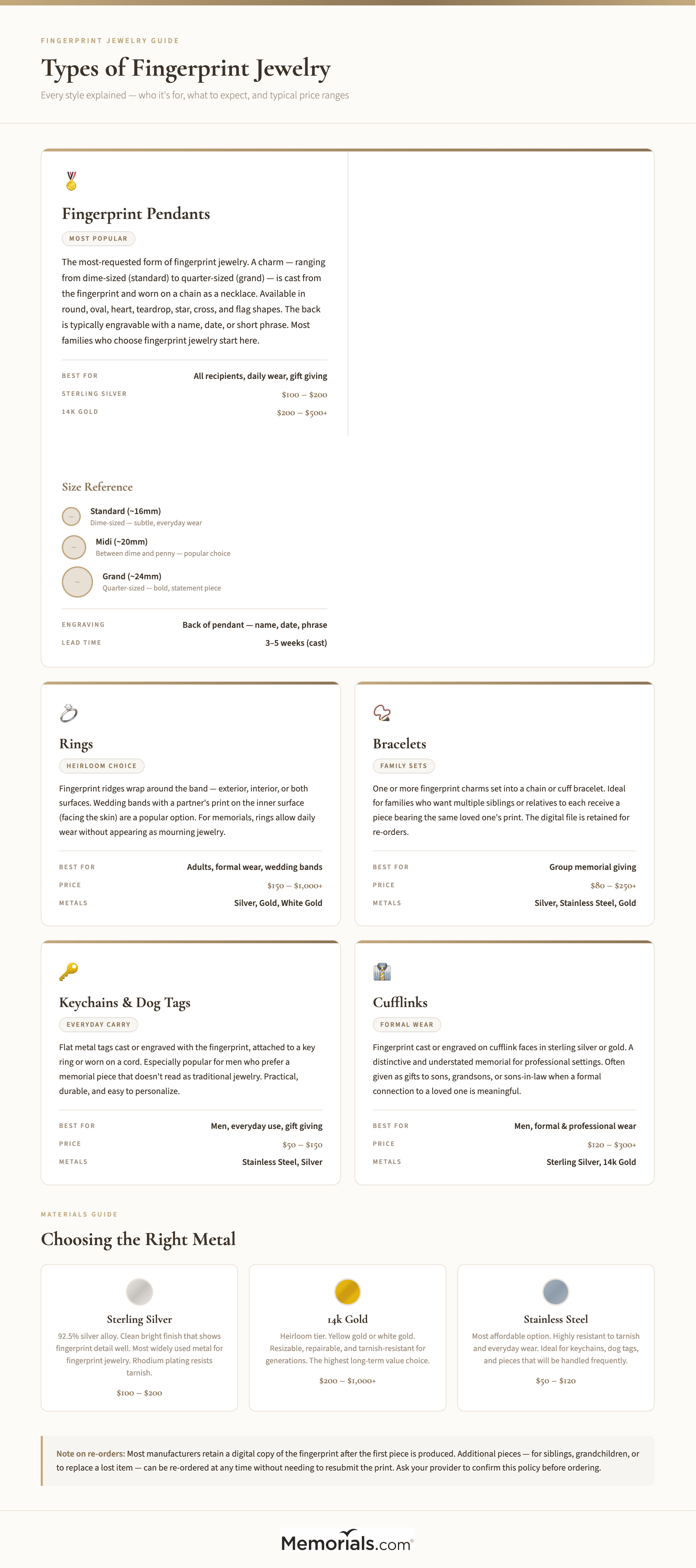
The pendant is the most common form of fingerprint keepsake jewelry. A small charm – typically the size of a dime or quarter depending on the size option chosen – is produced from the fingerprint and attached to a chain for wear as a necklace.
Pendants come in a wide variety of shapes: round, oval, heart, teardrop, cross, star, flag, and more. Size options typically range from a standard (roughly dime-sized) to a midi to a grand format. The back of the pendant is usually available for engraving – a name, date, or short phrase in capital letters or script font.
For those interested in exploring the full range of available styles, fingerprint jewelry at Memorials.com includes pendants across multiple shapes and metals.
Fingerprint Rings
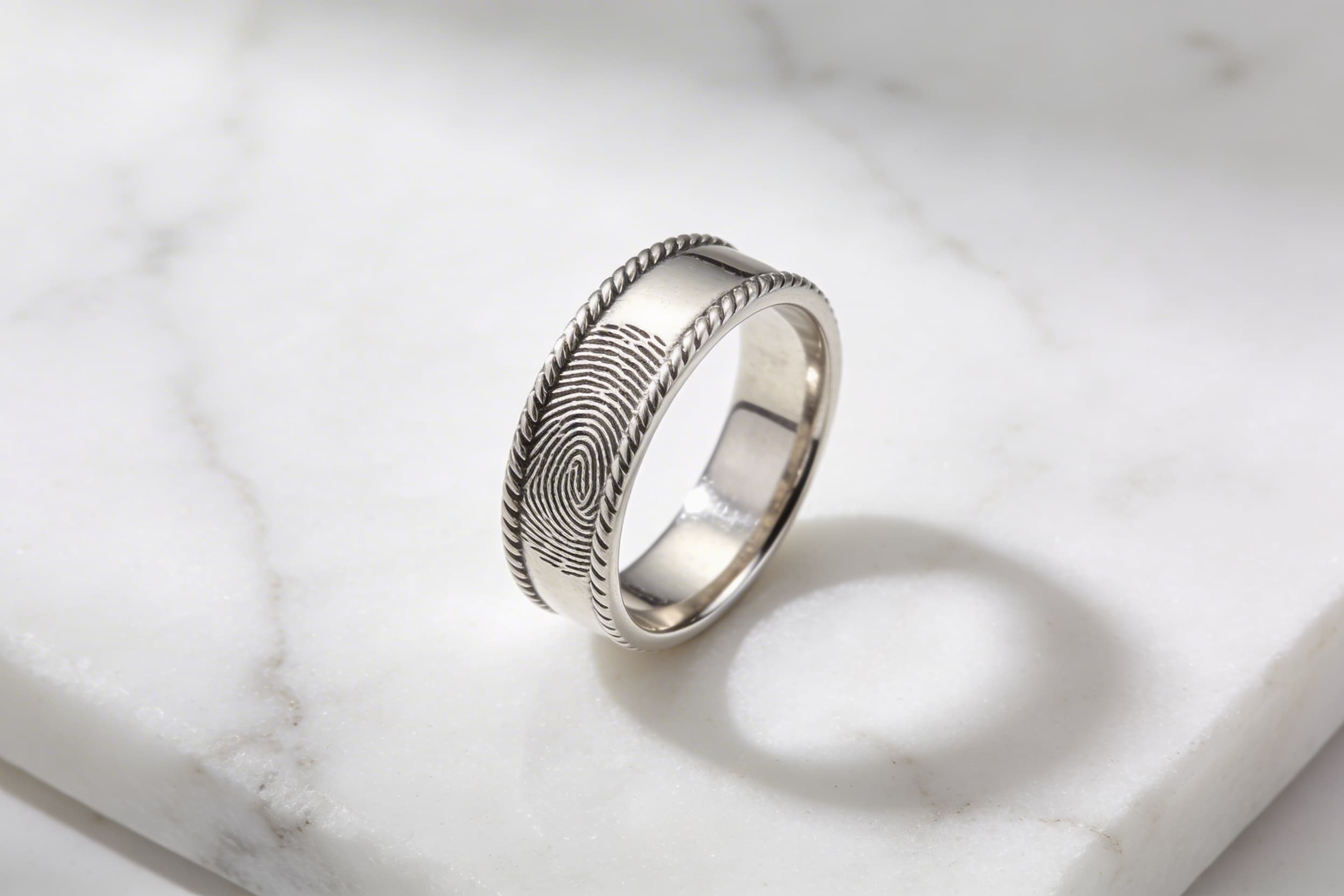
Fingerprint rings wrap the print impression around a band, placing the ridges on the outer surface of the ring, the inner surface, or both. Wedding bands with one partner's print on the inside surface – facing the wearer's skin – carry an intensely personal meaning that traditional engraving cannot match.
For memorial use, fingerprint rings allow families to wear a loved one's print in a format that feels more formal or everyday-wearable than a pendant. Rings are available in sterling silver, 14k yellow gold, white gold, and stainless steel. You can browse cremation rings for ring styles that pair fingerprint customization with memorial intent.
Fingerprint Bracelets
Fingerprint bracelets typically feature one or more fingerprint charms set into a chain or cuff bracelet. They make a meaningful gift option for family members who want to share the same loved one's print across multiple pieces. Cremation bracelets can incorporate fingerprint charms alongside other memorial elements.
Fingerprint Keychains and Dog Tags
For those who prefer a wearable piece that doesn't carry jewelry connotations – particularly popular for men – fingerprint keychains and dog tags offer a practical daily-carry option. The print is cast or engraved on a flat metal tag that attaches to a key ring or wears on a chain or cord. For additional styles tailored to men's preferences, our guide to cremation jewelry for men covers the full range of options, from understated pendants to statement pieces.
Fingerprint Cufflinks
Fingerprint cufflinks carry the print on the face of each cufflink and are crafted in sterling silver or gold. They are a particularly meaningful option for professional or formal wear, and one of the most distinctive forms of men's fingerprint memorial jewelry. Cremation earrings and cufflinks covers this category.
Materials and Metals
Sterling Silver
Sterling silver (92.5% silver, 7.5% copper alloy) is the most widely used metal for fingerprint jewelry. It offers a clean, bright surface that shows fingerprint ridge detail well and is accessible in price. Better manufacturers apply rhodium plating to their sterling silver pieces – a surface treatment that resists tarnishing and scratching, extending the life of the piece significantly.
Stainless Steel
Stainless steel is the most affordable option and is highly resistant to tarnish, corrosion, and everyday wear. It is a common choice for keychains, dog tags, and pieces intended for more frequent handling. The trade-off is that stainless steel cannot be resized or worked as easily as precious metals.
14k Gold and White Gold
Gold pieces represent the heirloom tier of fingerprint jewelry. A 14k yellow gold or white gold pendant or ring is more expensive – often significantly so – but will last generations without tarnishing and can be resized, repaired, and passed down. These pieces tend to hold the most sentimental and monetary value over time.
Fingerprint Memorial Ideas Beyond the Pendant
Fingerprint jewelry is not limited to traditional necklace pendants. Families have found meaningful ways to incorporate a loved one's print across a range of memorial contexts.
Multiple-piece family sets. Many families order the same print in multiple pieces – one pendant each for several siblings, or a matching ring and pendant for a couple. Most manufacturers retain the digital fingerprint file after production, so re-orders can be placed at any time without needing to re-submit the print.
Handprints and footprints. When the subject is an infant or young child, standard fingerprinting is often not feasible – babies don't develop fully distinct fingerprints until around 6-18 months. Hand impressions or foot impressions are excellent alternatives, producing a larger, more legible cast. For adults with faint or worn fingerprints (common in elderly individuals or those who worked with their hands for decades), a palm-edge print or handprint section often yields better results.
Paw prints and pet memorials. Fingerprint jewelry techniques extend naturally to pet memorials. Paw prints and nose prints can be captured and cast using the same lost wax process, producing pendants, charms, and rings for those grieving the loss of a companion animal. See pet cremation jewelry for memorial pieces designed specifically for pet loss.
Keepsake gift giving. Fingerprint pieces are frequently given as thoughtful gifts to grieving family members. A pendant bearing a parent's thumbprint, given to adult children, creates a shared memorial object that connects multiple family members to the same loved one. These gifts are often described by recipients as the most meaningful item they own. For additional gift ideas in this space, memorial jewelry offers a broad selection.
How to Submit a Fingerprint
Ink Print Kits
Most fingerprint jewelry companies offer a free ink print kit that includes an ink strip or ink pad, cardstock, and a pre-addressed return envelope. The kit is mailed to you, you capture the print at home, and you return the physical card.
Tips for a clean ink print:
Clean and completely dry the finger before inking
Roll the finger from one side to the other in a single smooth motion rather than pressing flat
Use medium pressure – too light and the ridges won't register; too heavy and the ridges will fill in
The thumb is almost always the best choice because of its size and the complexity of its ridge pattern
Take several prints on separate cards and choose the clearest one to submit
Digital Photo Submissions
Many manufacturers now accept a clear, in-focus digital photograph of the fingerprint in lieu of an ink impression. The finger should be pressed lightly against a glass surface or photographed under good lighting with a macro-capable camera. The manufacturer's team will assess whether the image has sufficient detail for production.
When a Loved One Has Already Passed
Families often worry that they've missed the window for fingerprint jewelry if their loved one has already passed. In most cases, this is not true.
Funeral homes routinely capture fingerprints as part of the preparation process, and many offer ink impression kits or digital scanning services. If the funeral home has already taken prints, they can typically provide a copy for jewelry purposes. It is worth asking the funeral director directly – many have relationships with fingerprint jewelry providers and handle the submission process on the family's behalf.
Existing fingerprints may also be available from sources families haven't considered: past arrest records, employment records that required prints, military service files, or even high-quality photographs of someone's hands taken during their lifetime.
What to Expect: Turnaround Time and Cost
Turnaround Time
Because each piece is made to order – cast, finished, and engraved individually – fingerprint jewelry takes time to produce. Standard turnaround for lost wax cast pieces is typically 3-5 weeks from the date the manufacturer confirms an acceptable print. Rush services may be available for an additional fee.
Some manufacturers offer laser-engraved pieces with same-day or next-day production for families facing urgent timelines, such as a memorial service or burial.
Cost
Quality fingerprint jewelry ranges in price depending on the production method, metal, and piece type:
Stainless steel or sterling silver pendants (laser engraved): $50-$120
For a complete overview of what affects memorial jewelry pricing across all types and methods, our cremation jewelry cost guide breaks down every factor in detail. For families considering cremation jewelry more broadly, fingerprint pieces represent one tier of a wide range of memorial jewelry options – from simple necklaces for ashes to glass art pendants and birthstone pieces.
FAQ
Can fingerprint jewelry be made after someone has died? Yes. Funeral homes frequently capture fingerprints during the preparation process, and many work directly with memorial jewelry companies. Families should ask the funeral director about print capture services before or immediately after arrangements are made. Existing sources – such as employment records, military files, or government identification records – may also hold prints.
What's the difference between Thumbies and other fingerprint jewelry brands? Thumbies® is a specific brand that has been producing print-based keepsakes since 1998 and is widely distributed through funeral homes and memorial retailers. The name is sometimes used generically to describe fingerprint charm jewelry as a category. Other reputable manufacturers use the same lost wax casting method and offer comparable quality. The key differentiators between brands are metal options, shape variety, engraving capabilities, and turnaround time.
Is lost wax cast fingerprint jewelry worth the higher price? For most families, yes. Lost wax cast pieces produce a three-dimensional impression that can be felt by touch, are made from solid metal (not plated), and will not wear off or degrade over time the way surface-etched pieces can. The additional cost reflects hand-finishing by skilled artisans and materials that are structurally superior to laser-engraved alternatives.
Can I order multiple pieces from the same fingerprint? Yes. Most manufacturers retain a digital copy of the fingerprint file after the first order, allowing additional pieces to be produced at any time without re-submitting the print. This makes it practical for siblings, grandchildren, or multiple family members to each receive a piece bearing the same loved one's print.
What if my loved one has faint fingerprints? Elderly individuals, people who worked extensively with their hands, and some medical conditions can all result in worn or faint ridge patterns. In these cases, manufacturers recommend trying a different finger, using a palm-edge or side-of-thumb area that may have better definition, or shifting to a handprint or footprint as an alternative. Good manufacturers will work with families to identify the best approach given the print quality available.
Finding the Right Fingerprint Keepsake
A fingerprint memorial piece is a deeply personal decision. The right choice depends on how the recipient prefers to wear jewelry, the budget available, and whether the piece is meant to be a quiet daily companion or a statement heirloom.
For families beginning their search, the fingerprint jewelry collection at Memorials.com offers a range of pendant styles, metals, and sizes. For those exploring the full landscape of cremation jewelry, The Complete Guide to Cremation Jewelry covers every jewelry type from ash-filled pendants to glass art pieces, with guidance on choosing the right memorial for each family's circumstances.