🏬Supersize Online Funeral Retailer🪦1000's of Headstones⚱️Over 10,000 Cremation Urns⚰️Caskets Overnight Delivery🛒Funeral & Memorial Superstore🚚FREE Shipping on ALL Orders👨👩👧👦Helping Families for over 20 Years💰Lowest Price Guarantee🏬Supersize Online Funeral Retailer🪦1000's of Headstones⚱️Over 10,000 Cremation Urns⚰️Caskets Overnight Delivery🛒Funeral & Memorial Superstore🚚FREE Shipping on ALL Orders👨👩👧👦Helping Families for over 20 Years💰Lowest Price Guarantee
🏬Supersize Online Funeral Retailer🪦1000's of Headstones⚱️Over 10,000 Cremation Urns⚰️Caskets Overnight Delivery🛒Funeral & Memorial Superstore🚚FREE Shipping on ALL Orders👨👩👧👦Helping Families for over 20 Years💰Lowest Price Guarantee🏬Supersize Online Funeral Retailer🪦1000's of Headstones⚱️Over 10,000 Cremation Urns⚰️Caskets Overnight Delivery🛒Funeral & Memorial Superstore🚚FREE Shipping on ALL Orders👨👩👧👦Helping Families for over 20 Years💰Lowest Price Guarantee
Mourning jewelry has carried grief in wearable form for centuries. Before there were cremation pendants, fingerprint keepsakes, or birthstone rings memorializing the people we loved, there were jet-black lockets, braided hair brooches, and rings engraved with names and dates of the dead. These pieces weren't decorative accessories – they were expressions of love that outlasted life itself.
The practice of creating jewelry specifically to commemorate the deceased spans from ancient Egypt through medieval Europe, peaks spectacularly during the Victorian era, and evolves into the modern memorial jewelry families choose today. Understanding this history can offer comfort: the desire to carry someone with you, to hold something tangible against grief, is not new. It is one of the oldest human impulses we know. If you are currently choosing a piece for your family, our walks through every contemporary option – from ash pendants to fingerprint rings – and can help you find the right fit.
Mourning jewelry is any piece of personal adornment created to commemorate the deceased, worn as an expression of grief and ongoing remembrance. It is distinct from ordinary jewelry in that it is made, commissioned, or worn explicitly in connection with a person who has died.
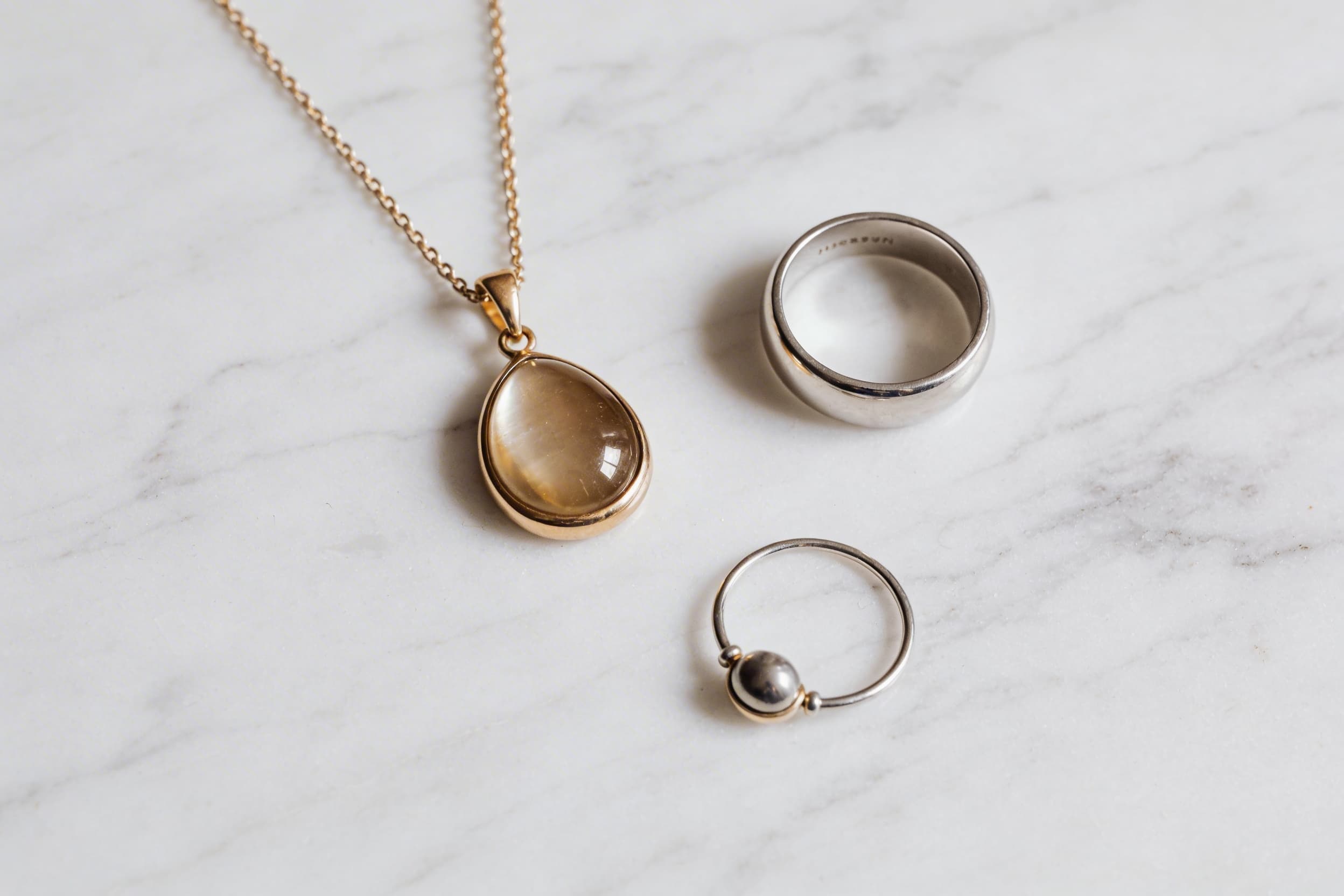
Throughout history, mourning jewelry has taken many forms: rings engraved with the name and death date of a loved one; lockets containing a miniature painted portrait; brooches and bracelets woven from the deceased's hair; pendants set with dark stones such as jet, onyx, and black enamel; and more recently, cremation pendants designed to hold a small portion of ashes close to the body.
What connects all of these across time is not the material or the form – it is the intention. Mourning jewelry is worn because grief needs somewhere to go, and love needs somewhere to stay.
Ancient Origins: Remembrance Jewelry Before the Victorian Era
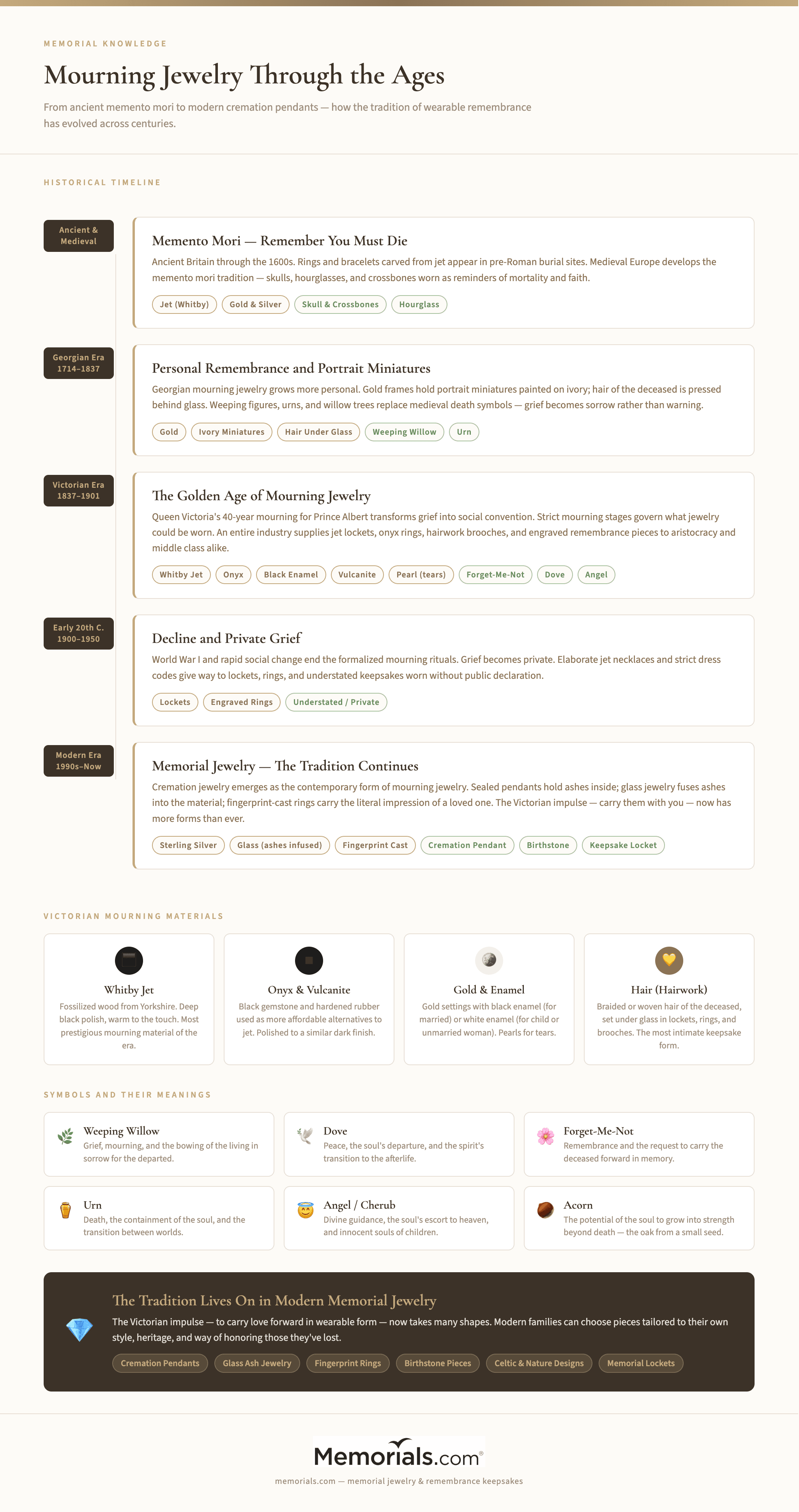
The history of mourning jewelry does not begin with Queen Victoria, though she dominates its popular story. Archaeological evidence from pre-Roman Britain shows rings and bracelets carved from jet – a fossilized wood prized for its deep black polish – appearing in burial sites from the Neolithic and early Bronze Age. Romans brought their own mourning customs into Britain, and jet worked into personal ornaments has been found alongside Roman-era remains.
The medieval European tradition gave mourning jewelry its most lasting visual vocabulary: the skulls, hourglasses, and crossbones of memento mori – a Latin phrase meaning "remember that you must die." These were not meant to be macabre for shock value. They were reminders that life was brief and faith in the afterlife should govern how one lived. A memento mori pendant from around 1540 found in England carries this dual message: the skull on one face, a Christian inscription of resurrection on the other.
The seventeenth and eighteenth centuries in England saw mourning jewelry grow increasingly personal. The Georgian era (1714-1837) produced some of the most refined and technically demanding examples of the form. Georgian pieces were typically cast in gold, occasionally in silver, and characterized by their restrained elegance. Portrait miniatures painted on ivory – tiny likenesses of the deceased, sealed behind glass in gold frames – were particularly prized. Hair from the deceased was pressed and arranged behind the same glass, and willow trees, urns, and weeping figures rendered in paint or enamel became standard iconography.
The symbolic vocabulary of Georgian mourning jewelry reflects a philosophical shift from the medieval era: death was no longer a terrifying judge but a sorrowful passage. God had become, as one period source describes it, "a father watching his children at play" – and grief was no longer penance but love.
Victorian Mourning Jewelry: The Peak of the Tradition
The history of mourning jewelry reaches its fullest, most elaborate expression during the Victorian era (1837-1901), and one person is largely responsible for that: Queen Victoria herself.
When Prince Albert died in December 1861, Victoria entered a mourning that lasted for the remaining forty years of her life. She wore black crepe dresses daily. She had Albert's clothes laid out each morning as though he would walk in at any moment. She slept with a cast of his hand beside her. And she wore mourning jewelry – exclusively, conspicuously, for decades – as both a private expression of her grief and a public statement about the seriousness of loss.
Because Victoria was the most admired public figure of her age, her choices became social conventions. Aristocrats and the middle class followed her example. Wearing mourning jewelry became not merely acceptable but expected, and an entire industry grew up to supply it.
The Strict Stages of Mourning
Victorian mourning was formalized into stages, each with its own dress codes and jewelry conventions:
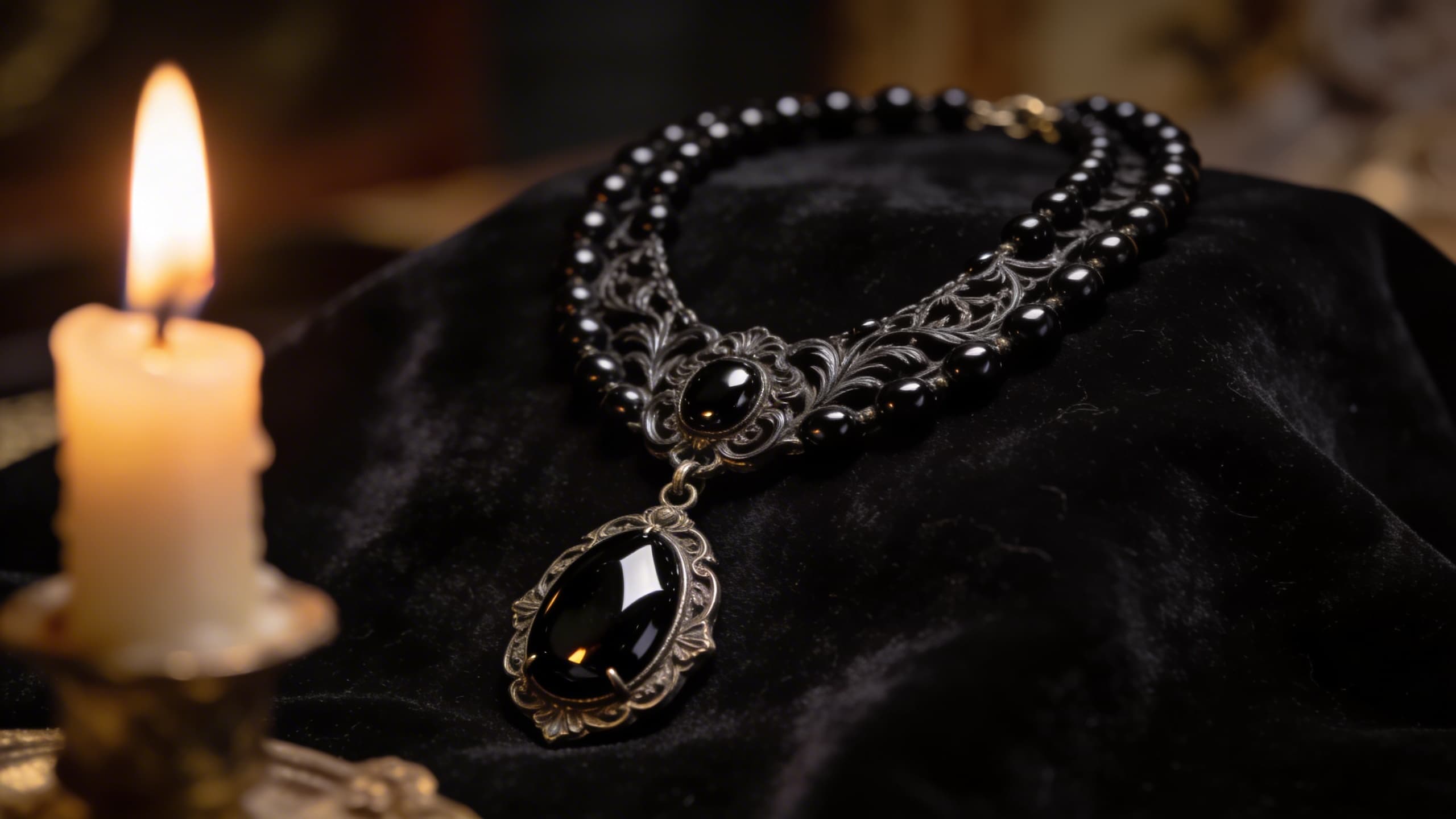
Full Mourning lasted approximately one to two years for a widow. Dress was head-to-toe black crepe, and jewelry was limited to jet – a fossilized wood found primarily in Whitby, North Yorkshire, known for its deep, light-absorbing black polish. No bright stones, no gold accents, nothing that could be called decorative rather than somber.
Half Mourning followed, typically lasting six months to a year. Black gradually gave way to gray, mauve, and purple, and jewelry materials expanded to include onyx, amethyst, dark garnets, and jet pieces with gold trim.
Ordinary Mourning permitted pearls – whose teardrop shape made them almost too perfectly symbolic – and lighter colors.
The strictness of these conventions applied most heavily to women, particularly widows, and varied by class. Working-class families observed what they could afford; wealthier families commissioned elaborate custom pieces that functioned almost as wearable monuments.
Materials and Symbols of Victorian Mourning Jewelry
The materials of Victorian mourning jewelry were chosen with care and meaning.
Jet was the most prestigious material, particularly Whitby jet, which was soft enough to carve into intricate designs – flowers, crosses, serpents eating their own tails (symbols of eternity) – and polished to a depth that seemed to absorb light entirely. Its popularity in the 1860s and 1870s created such demand that the Whitby jet trade employed hundreds of craftsmen. As supply struggled to keep up, manufacturers introduced vulcanite (hardened rubber) and bog oak as cheaper alternatives, though purists distinguished between them.
Onyx served the same visual function as jet – deep black, capable of being polished smooth – and was more widely available for setting in standard gold and silver settings.
Black enamel coated rings, lockets, and brooches, often surrounding a gemstone or framing an inscription. By convention, black enamel was worn for a married person, while white enamel marked the mourning piece of a child or unmarried young woman.
Pearls carried the symbolism of tears and purity. They were particularly used in pieces commemorating children and young women.
Gold remained the setting of choice for more affluent pieces, though with deliberate restraint – ornate goldwork would have seemed disrespectful to the solemnity of the occasion.
Symbolic imagery engraved, painted, or enameled onto Victorian mourning jewelry had its own grammar: weeping willows signified grief; urns signified death and the soul's transition; doves signified peace and the spirit's departure; forget-me-nots asked the wearer to carry memory forward; and angels guided the departed toward heaven. Acorns represented the potential of the soul in the afterlife, growing into strength from small seeds.
Hair Jewelry: The Most Personal Form of Mourning Keepsake
Of all the forms Victorian mourning jewelry took, none is more intimate – or more foreign to modern sensibility – than hairwork.
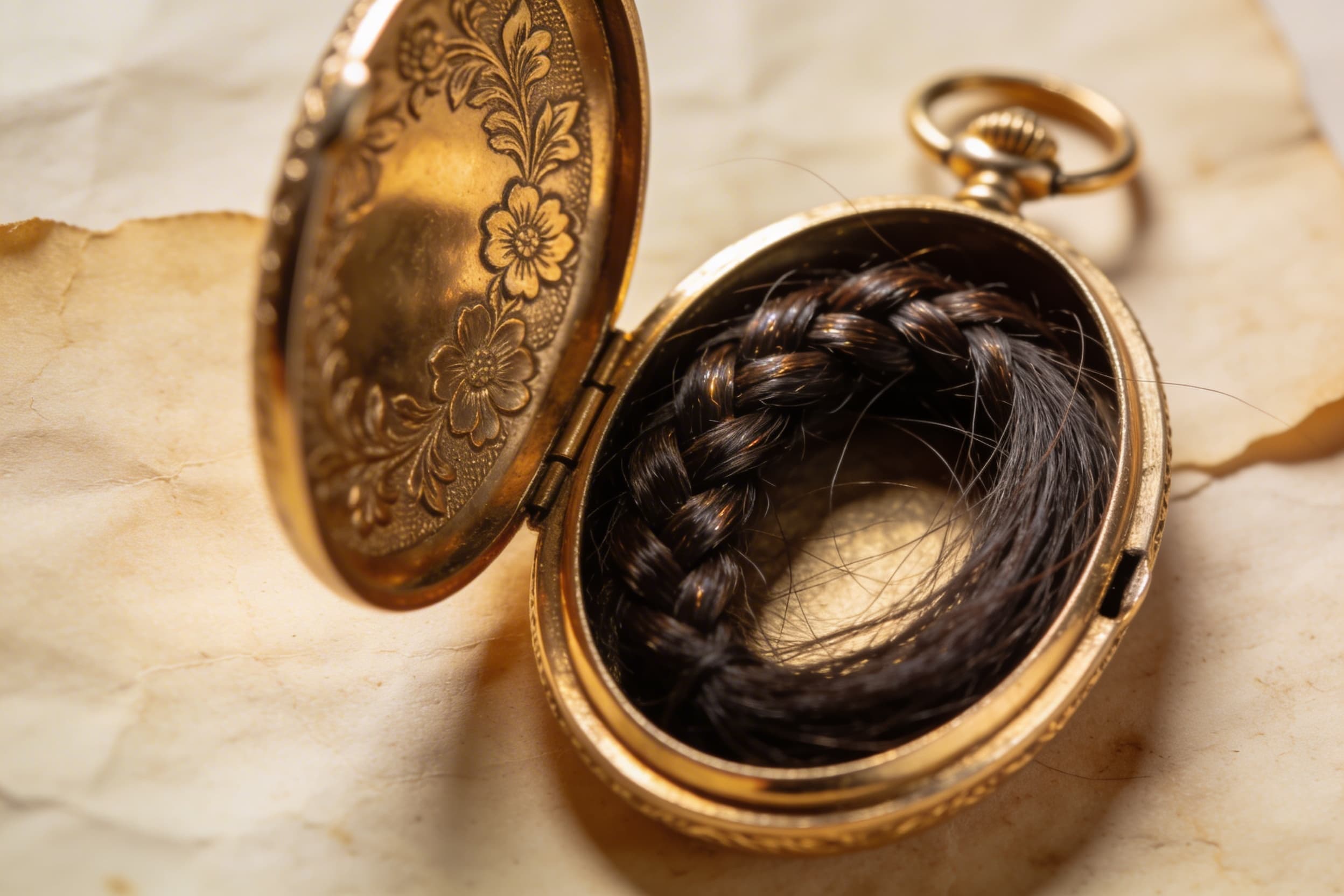
Hair from a deceased loved one was treated as a precious material, cut and preserved before burial and entrusted to jewelers who specialized in the intricate art of hairwork. Strands were boiled in baking soda, sorted by length, divided into fine bundles, and then braided, woven, or coiled into remarkably complex structures: flowers, serpentine curves, geometric grids. This hair was set under glass in lockets, woven into rings and bracelets, and sometimes mounted as brooches or earrings.
The result was a keepsake that carried a literal trace of the person – not a symbol or a representation, but something that had physically been part of them. For families navigating a culture without photographs and without the preservation technologies we take for granted today, hairwork was one of the few ways to hold something irreducibly real.
Hairwork also occupied an ambiguous cultural space. Not all hair jewelry was mourning jewelry. Lockets of hair were exchanged between living friends and lovers; mothers kept locks from their children's first haircuts. The same material that marked grief also marked affection, and this dual meaning is part of why the tradition feels surprisingly close to modern sensibility – we still keep baby curls, save a pet's fur, press flowers. The Victorians simply made these impulses wearable. If you are drawn to this tradition, our guide to lock of hair keepsake ideas covers the modern options for preserving a loved one's hair in jewelry and keepsakes.
Remembrance Jewelry Traditions Beyond England
The history of mourning jewelry is often told as an English or British story, anchored in Queen Victoria and the Whitby jet trade. But remembrance jewelry traditions appear across cultures throughout human history.
In ancient Egypt, amulets and jewelry were placed in tombs to accompany the deceased, but also worn by the living as protective reminders of the dead. In pre-Columbian Mesoamerica, jade and gold ornaments were associated with the dead and with spiritual transition. In Japan, small lacquered memorial tablets called ihai served as focal points for ancestral remembrance – a parallel function to the personal keepsakes of European mourning culture.
Across West African traditions, beaded ornaments carried genealogical memory, linking the living to lineages of ancestors. In Jewish tradition, mourning garments and specific ritual periods like shiva create a structured container for grief, though personal jewelry plays a smaller role than in Protestant European cultures.
The convergence of these traditions in modern memorial jewelry design is visible in pieces that draw on Celtic knotwork, nature motifs, religious symbols, and regional iconography – a globalized vocabulary of remembrance that modern families can choose among according to their own heritage and values.
From Victorian Mourning Jewelry to Modern Memorial Jewelry
The elaborate customs of Victorian mourning – the stages, the strict dress codes, the formal commissioning of jet pieces – declined sharply in the early twentieth century. World War I accelerated the change: with so many dead, so suddenly, the formal rituals of prolonged mourning became practically impossible to maintain. The somber conventions gave way to more restrained, private expressions of grief.
But the underlying need – to carry someone with you, to have an object that anchors memory – never went away. It simply changed form. For a full overview of modern cremation jewelry – how it works, how it is made, and what is available – our dedicated guide covers every category in detail.
Modern memorial jewelry builds directly on the tradition mourning jewelry established. Where Victorian families kept a lock of hair behind glass, modern families may choose a pendant that holds a small portion of ashes sealed permanently inside. Where a Georgian widow wore a ring engraved with her husband's name and death date, a modern widower might choose a fingerprint jewelry piece cast from an actual fingerprint impression.
The connection is more than aesthetic. It is functional: these pieces exist to keep a person present. To make grief wearable. To create something that can be held and touched on the days when nothing else helps.
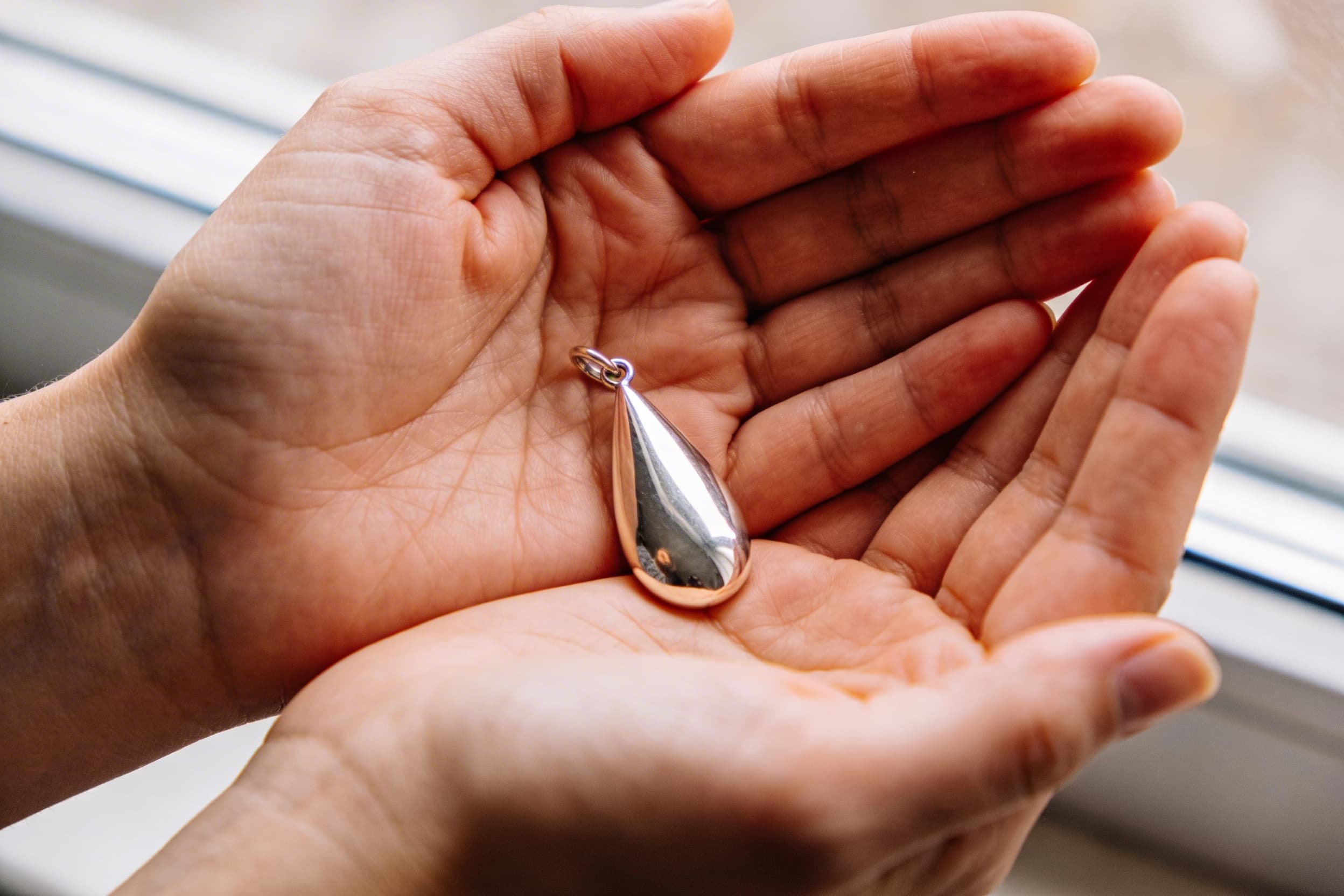
Cremation jewelry in particular has grown into a sophisticated category that ranges from simple sterling silver pendants to hand-blown glass pieces with ashes infused inside during the glassblowing process. Glass cremation jewelry represents one of the more striking modern translations of the Victorian impulse to make grief beautiful – the ashes become part of the material itself, swirled into color and light.
Choosing Modern Remembrance Jewelry
Families today have far more options than their Victorian counterparts, which can make choosing meaningful. A few questions can help narrow the field.
What do you want it to hold? Some families want a piece that contains ashes; others prefer something made from a fingerprint impression, a lock of hair, or a birthstone representing the month of the loved one's death or birth. Each creates a different kind of physical connection.
Who will wear it, and when? Some memorial jewelry is designed for everyday wear – subtle pendants, understated rings, bracelets that read as ordinary jewelry to most observers. Others are more explicitly commemorative and better suited to special occasions. Consider how the person who will wear it lives their daily life.
What is your aesthetic and heritage?Nature & Celtic cremation jewelry connects Irish and Celtic heritage to memorial tradition through knotwork and organic motifs. Cremation jewelry crosses serve families for whom faith is central to how they hold grief. Heart cremation jewelry offers a universal symbol of love in various metals and styles.
How many family members need a piece? One of the most meaningful shifts modern cremation jewelry for ashes enables is the possibility of multiple family members each carrying a small portion of remains – something Victorian mourning jewelry, which required hair that could only be divided so many ways, could not so easily accomplish. A family of four siblings can each choose their own piece, each honoring the same person in a way that fits their own life.
Choosing a piece for someone else is also a meaningful way to offer support in grief. If you are considering cremation jewelry as a gift, our gift guide covers what to look for and how to select something that will resonate with the person receiving it.
FAQ: Mourning Jewelry History and Modern Memorial Pieces
What is mourning jewelry? Mourning jewelry is any personal ornament created and worn to commemorate a deceased loved one. The tradition spans ancient history, reaches its most elaborate form during the Victorian era (1837-1901), and continues today in modern forms such as cremation pendants, fingerprint rings, and hair memorial lockets.
Why did Victorians wear mourning jewelry? Victorian mourning jewelry served several purposes simultaneously: it expressed grief publicly and respectfully, it kept the memory of the deceased physically present, and it followed a formalized social code that governed what was appropriate during each stage of mourning. Queen Victoria's decades-long public mourning for Prince Albert made mourning jewelry socially essential across classes.
What materials were used in Victorian mourning jewelry? The most common materials were jet (a fossilized wood prized for its deep black polish), onyx, black enamel, vulcanite, and bog oak. Pearls were associated with tears and were used for pieces mourning children or unmarried women. Hairwork – intricate pieces incorporating the deceased's hair – was among the most intimate forms.
Is mourning jewelry still made today? Yes. Modern memorial jewelry carries the same intention as historical mourning jewelry – keeping a loved one close – using contemporary materials and methods. Cremation jewelry that holds ashes inside a sealed pendant, glass jewelry with ashes fused into the material, and fingerprint-cast rings are among the most popular forms today.
What is the difference between mourning jewelry and memorial jewelry? The terms are often used interchangeably, but historically "mourning jewelry" referred specifically to pieces worn during formal mourning periods following a death. "Memorial jewelry" is the broader, more modern term covering any piece created to honor and remember the deceased, whether worn during bereavement or carried forward as a permanent keepsake.
The impulse that drove a Victorian widow to commission a jet locket and a modern parent to choose a small cremation pendant is the same: the need to carry love forward, to have something that belongs to the person who is gone. Browse Memorials.com's full collection of memorial jewelry to find a piece that honors your loved one in a form that fits your life and your heart.