🏬Supersize Online Funeral Retailer🪦1000's of Headstones⚱️Over 15,000 Cremation Urns⚰️Caskets Overnight Delivery🛒Funeral & Memorial Superstore🚚FREE Shipping on ALL Orders👨👩👧👦Helping Families for over 20 Years💰Lowest Price Guarantee🏬Supersize Online Funeral Retailer🪦1000's of Headstones⚱️Over 15,000 Cremation Urns⚰️Caskets Overnight Delivery🛒Funeral & Memorial Superstore🚚FREE Shipping on ALL Orders👨👩👧👦Helping Families for over 20 Years💰Lowest Price Guarantee
🏬Supersize Online Funeral Retailer🪦1000's of Headstones⚱️Over 15,000 Cremation Urns⚰️Caskets Overnight Delivery🛒Funeral & Memorial Superstore🚚FREE Shipping on ALL Orders👨👩👧👦Helping Families for over 20 Years💰Lowest Price Guarantee🏬Supersize Online Funeral Retailer🪦1000's of Headstones⚱️Over 15,000 Cremation Urns⚰️Caskets Overnight Delivery🛒Funeral & Memorial Superstore🚚FREE Shipping on ALL Orders👨👩👧👦Helping Families for over 20 Years💰Lowest Price Guarantee
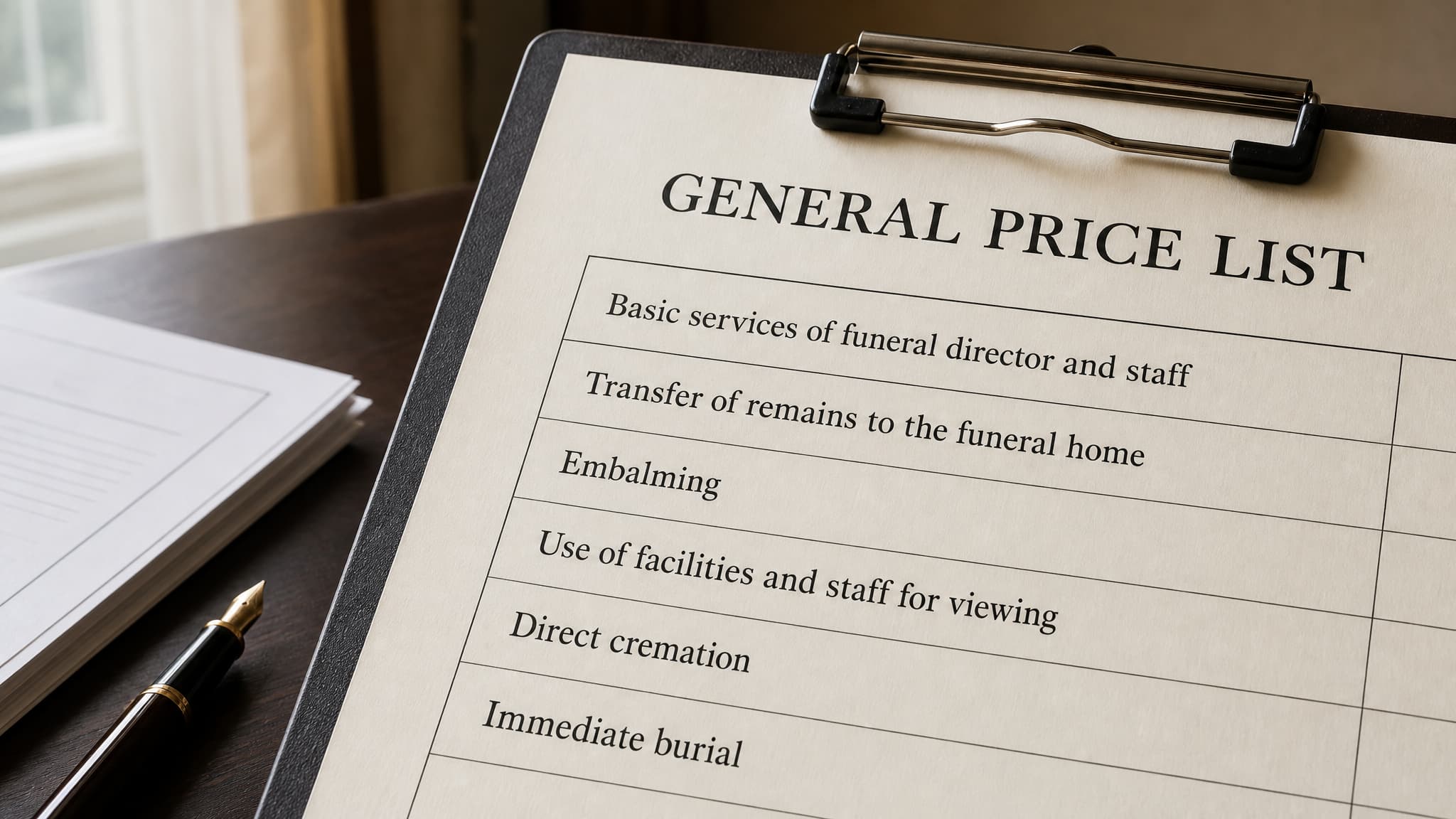
Every funeral home in the United States is required to hand you a funeral general price list — in print, item by item, before anyone discusses what you want. You do not have to buy anything to get it, you do not have to give your name, and they may not make you wait for it.
Most families never see one.
That is not because funeral directors are hiding it, exactly. It is because a family arriving to arrange a funeral is not thinking about paperwork, and a price list handed over at that moment goes into a folder unread. The document is powerful and it is boring, which is a bad combination.
This page explains what is on it, what the law behind it actually guarantees, and how to use it — including the parts most people are surprised to learn they are entitled to. It sits inside our funeral planning guide, which covers the rest of the decisions around it.
The general price list exists because of the FTC Funeral Rule, a federal regulation the Federal Trade Commission put in place in 1984 after an investigation into funeral industry sales practices. It applies to every funeral provider in the country.
The Rule is short and it is mostly about information. Its central idea is that a family should be able to find out what things cost, and buy only the things they want, at the moment when they are least equipped to argue.
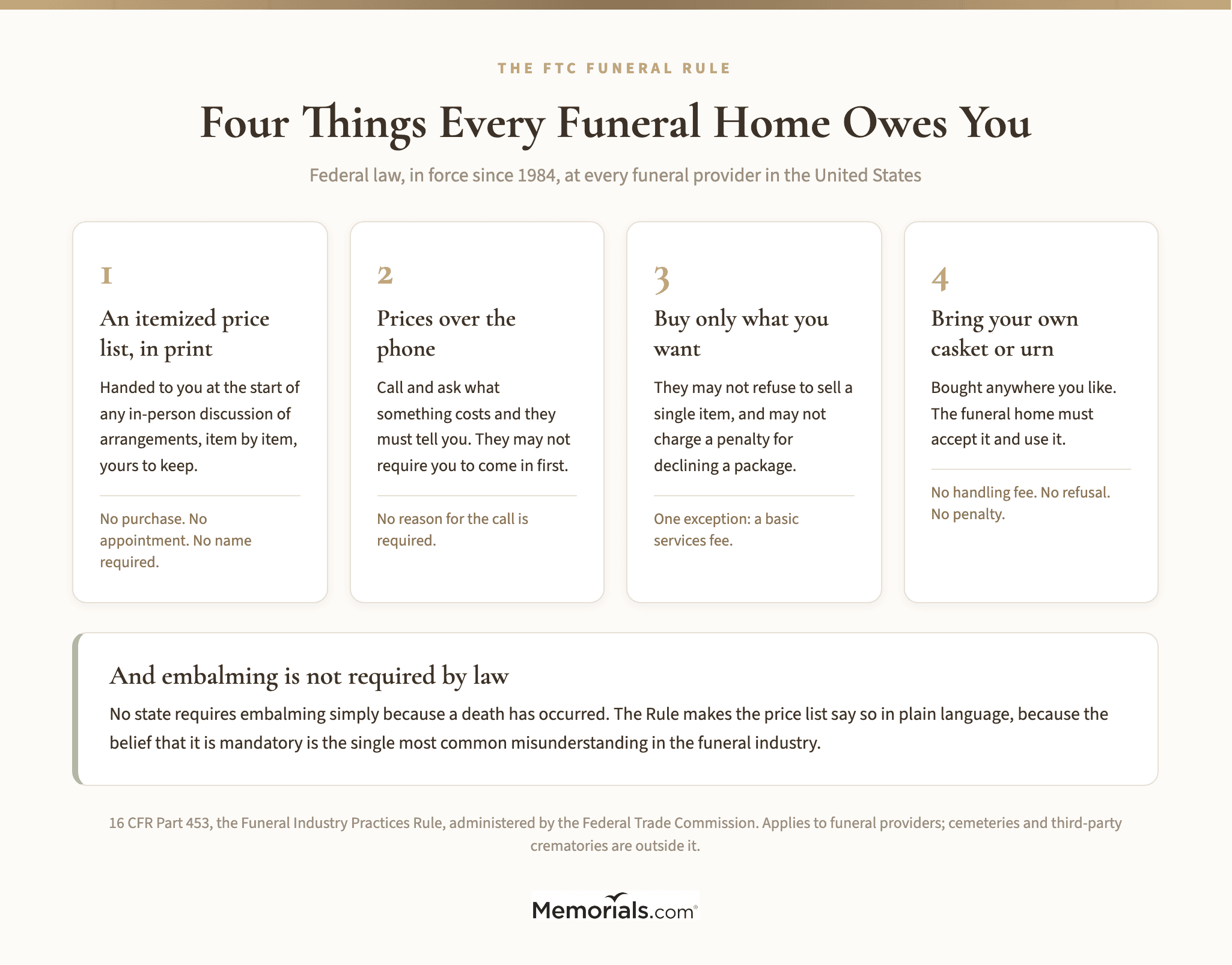
Four of its provisions matter most to an ordinary family.
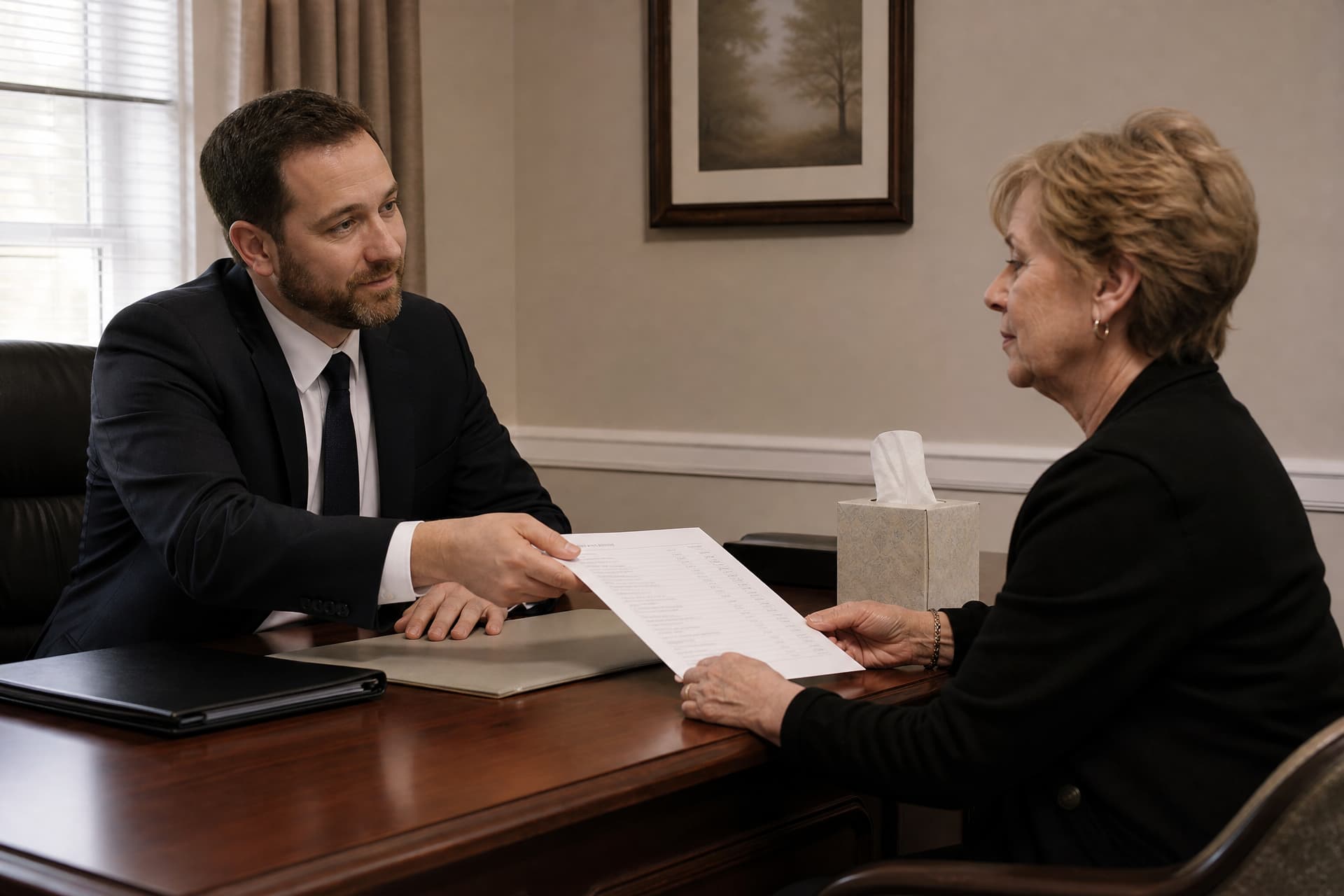
You get an itemized price list, in writing, before the discussion. Not a package brochure and not a verbal summary — a printed list you may keep, handed over at the start of any in-person conversation about arrangements. You do not need an appointment and you are not required to buy anything.
You get prices over the phone. If you call and ask what something costs, they must tell you. They may not require you to come in.
You may buy only what you want. A funeral home may not refuse to sell you a single item, and may not charge a fee for declining a package. There is one legitimate exception: a "basic services" fee that applies to every arrangement.
You may supply your own casket or urn, and they may not charge you for it. No handling fee, no refusal, no penalty. This is the provision most people do not know exists.
The law requires the price list to be handed over at the start of an in-person discussion about arrangements — before anyone asks what kind of service you want, and whether or not you intend to buy anything.
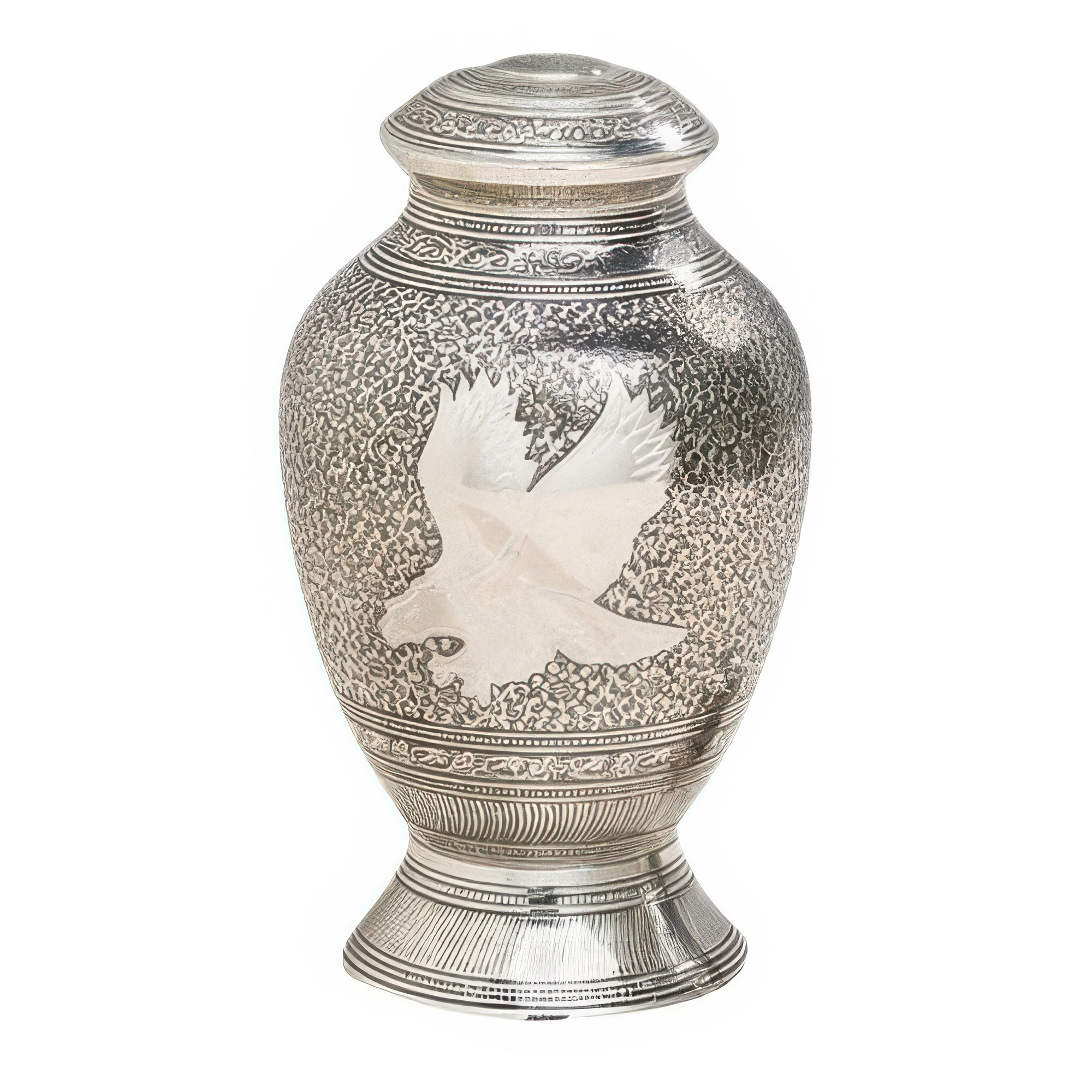
Urns You Can Bring to Any Funeral Home
Federal law says they must accept it, without a handling fee
A general price list is not a menu of packages. It is a list of individual charges, and the Rule specifies most of the lines. Reading one is easier once you know that the order is roughly fixed.
Basic services of the funeral director and staff. This is the one charge you cannot decline, and on most price lists it is the largest single line. It covers the arrangement conference, planning, permits and filings, sheltering the remains, and the firm's overhead. It is charged on every arrangement, including a direct cremation.
Transfer of remains to the funeral home. Collecting the deceased from a home, hospital or care facility. Usually includes a set mileage radius, with a per-mile charge beyond it.
Embalming. And here the list must carry a sentence in plain language, because this is the most misunderstood charge in the industry: embalming is not required by law in ordinary circumstances. It is required for certain kinds of transport and by some cemeteries and providers for a public viewing with an open casket, but no state requires it simply because someone has died. If you are choosing direct cremation or immediate burial, you should not be paying for it at all.
Other preparation of the body. Dressing, cosmetics, restorative work — separate from embalming and separately priced.
Use of facilities and staff. Broken into pieces: viewing, funeral ceremony, memorial service, graveside service. Each priced on its own, which is what lets a family take one and decline the others.
Transportation. The hearse, and usually a separate line for a service vehicle or family car.
Direct cremation and immediate burial. Each of these must be offered as a standalone item, at a stated price, with the container options spelled out. These are the two lines that let a family opt out of the traditional arrangement entirely.
Forwarding or receiving remains. For a death away from home.
The document has no standard title page, which is part of why it goes unread — ask for the general price list funeral home staff are required to provide and you may be handed something headed "Price List", "GPL" or nothing at all. The contents are what the regulation fixes, not the cover.
Two more documents sit alongside it and are just as required: a casket price list and an outer burial container price list, each itemized, each shown before you are taken to look at the merchandise. If you are shown a selection room before you are shown those lists, that is the wrong order.
The four provisions that matter most to an ordinary family. All four apply to every funeral provider in the United States, and none of them require you to buy anything or give your name.
The Provisions Families Are Most Surprised By
You can buy a casket anywhere. Online, from a warehouse club, from a builder. The funeral home must accept it, must not charge you a handling fee, and must not require you to be present when it is delivered. Caskets carry some of the highest markups in the trade, and this provision is the reason a family is allowed to go around them. If a casket is what you want, cremation caskets and cheap urns for ashes are both things you may bring to any funeral home in the country.
Any of these may be bought anywhere and brought to any funeral home in the country, which must accept it without a handling fee. Urns and caskets carry some of the highest markups in the trade, and this provision is the reason a family is allowed to go around them. Products from left to right: Flying Eagle Cremation Urn, Red Rose Cremation Urn, Eternity Cremation Urn and Grecian Bronze Cremation Urn.
Embalming is a choice, not a requirement. See above. The Rule specifically requires the price list to say so, because the assumption that it is mandatory is so widespread.
A casket is not required for cremation. The provider must offer an unfinished alternative container — cardboard or pressed wood — and may not tell you otherwise. Our cremation cost by state research found direct-cremation price ranges spanning fifteen thousand dollars at a single funeral home, and the whole of that span was the container.
You may decline a package. Packages are legal and often genuinely cheaper. But a funeral home may not require one, and must let you assemble the arrangement item by item at the listed prices.
A "cash advance" item must be disclosed if it is marked up. Flowers, obituary notices, clergy honoraria, death certificates — things the funeral home buys on your behalf. If they add a service charge to any of them, the Rule requires them to tell you.
How to Read One Without a Funeral Director in the Room
The Rule's most useful feature is that it works before there is a death. Anyone may walk into any funeral home and ask for the price list, or call and ask for prices, without explanation.
The second right on the list, and the least used. A funeral home must answer price questions over the phone — no appointment, no reason given, no obligation. Three calls on an ordinary afternoon is the whole exercise.
Get three. Prices for identical services vary more between two firms in one town than between two states. Our research across 996 published price lists found the gap between the cheapest and most expensive provider inside a single state runs to 4.0x at the median.
Compare the same line, not the packages. Package names are marketing and no two firms use the same ones. "Basic services of the funeral director and staff" is defined by regulation, appears on every list, and is comparable across firms.
Add the four that hide outside the headline. Permits and filing fees, the medical examiner or coroner fee where the state charges one, certified copies of the death certificate, and transport beyond the included radius. A cheaper headline with these on top is often the more expensive arrangement — which is exactly the arithmetic a grieving family will not do at the table.
Do it years early if you possibly can. The single most effective thing anyone can do to keep their own family from overpaying is to compare price lists calmly, in their own time, with nobody grieving in the room.
The comparison the Rule was written to make possible. Three lists, the same line on each — and it is a far easier task on an ordinary weekday than in the first forty-eight hours after a death.
When a Funeral Home Does Not Follow It
Most do. The Funeral Rule has been in force for four decades and compliance is generally good, particularly at established firms.
Where it breaks down is usually not refusal but omission: the list is not offered until asked for, the alternative container is never mentioned, or a family is walked into a casket selection room before they have seen a casket price list. None of those are aggressive acts. They are what happens when a script is written to sell rather than to inform.
If a provider will not give you a price list, will not quote over the phone, or tells you that embalming is required when it is not, you can report it to the Federal Trade Commission. You can also simply leave. There is no obligation created by walking in, and a firm that will not show you its prices has told you something useful about itself.
What This Does Not Cover
The Funeral Rule applies to funeral providers. It does not cover cemeteries or crematories that sell directly to the public without a funeral home attached, which is a genuine gap — a cemetery's price list is not federally mandated in the same way, and cemetery charges are a large share of a burial's cost.
It also does not regulate what things may cost. It requires disclosure, not restraint. A funeral home may charge whatever it likes for a casket, provided it tells you the price and lets you buy elsewhere.
And it does not override state law, which governs waiting periods, who may authorize a cremation, permits, and whether a family may act without a funeral director at all. Those rules differ substantially state to state.
Frequently Asked Questions
Do I have to give my name to get a funeral general price list? No. Anyone may ask for one, and the funeral home may not require identification, an appointment or any intention to buy. You may take it with you.
Can they charge me for the price list? No. It is provided free.
Is embalming required by law? Not in ordinary circumstances, and no state requires it simply because a death has occurred. Some states require it or refrigeration after a set number of hours if the body is not cremated or buried promptly, and some providers require it for a public viewing with an open casket. Those are conditions, not a general rule. The Funeral Rule requires the price list to carry a statement saying so, because the misconception is so common. Our guide to the embalming process covers what it actually involves.
Does the funeral home price list have to be given over the phone? They must answer price questions over the phone. They are not required to read the entire document aloud, but they must tell you what things cost, and most will email or post one on request.
Do funeral laws by state override the Funeral Rule? No — the federal Rule sets a floor and state law sits on top of it. A state may require more disclosure, and several do. What varies most by state is not disclosure but process: waiting periods, permits, who may authorize a cremation, and whether a family may act without a licensed director.
What if the funeral home will not accept a casket I bought elsewhere? They must, and they may not charge you a fee for it. If they refuse, that is a direct violation of the Rule and worth reporting.
Does the FTC funeral rule apply to cremation providers? Yes, where the provider is a funeral provider — which includes almost every firm arranging cremations for families. A crematory that only accepts business from funeral homes and never deals with the public is a different case.
In Short
The funeral general price list is the most useful document in the funeral industry and the least read. It is free, it is itemized, you are entitled to it before any discussion of what you want, and you may take it home and compare it against two more.
The rights it comes with are broader than most families realize: buy the casket anywhere, decline embalming, decline the package, take the direct cremation and nothing else. None of that requires an argument. It requires knowing the list exists.