🏬Supersize Online Funeral Retailer🪦1000's of Headstones⚱️Over 10,000 Cremation Urns⚰️Caskets Overnight Delivery🛒Funeral & Memorial Superstore🚚FREE Shipping on ALL Orders👨👩👧👦Helping Families for over 20 Years💰Lowest Price Guarantee🏬Supersize Online Funeral Retailer🪦1000's of Headstones⚱️Over 10,000 Cremation Urns⚰️Caskets Overnight Delivery🛒Funeral & Memorial Superstore🚚FREE Shipping on ALL Orders👨👩👧👦Helping Families for over 20 Years💰Lowest Price Guarantee
🏬Supersize Online Funeral Retailer🪦1000's of Headstones⚱️Over 10,000 Cremation Urns⚰️Caskets Overnight Delivery🛒Funeral & Memorial Superstore🚚FREE Shipping on ALL Orders👨👩👧👦Helping Families for over 20 Years💰Lowest Price Guarantee🏬Supersize Online Funeral Retailer🪦1000's of Headstones⚱️Over 10,000 Cremation Urns⚰️Caskets Overnight Delivery🛒Funeral & Memorial Superstore🚚FREE Shipping on ALL Orders👨👩👧👦Helping Families for over 20 Years💰Lowest Price Guarantee
Cremation Cost by State in 2026: Prices and How to Compare Them
cremation
Ask what a cremation costs and you get one national number, usually near $2,000. It is not wrong, but it describes nobody in particular. In Mississippi, the published direct-cremation prices we read run from $495 to $3,865 — and the firms at those two ends are not selling the same thing. Cremation cost is a local number, which is why this guide is the state-by-state version of the answer.
What a family actually wants to know is narrower than a national average: what cremation costs where they live, from someone they could call this afternoon, and how to tell whether the first quote is a fair one.
So every figure on this page comes from 881 published price lists in 2026, across all fifty states — General Price Lists, the itemized disclosure the federal Funeral Rule requires every funeral provider to hand you — rather than from an average of averages. How we collected them is at the foot of the page.
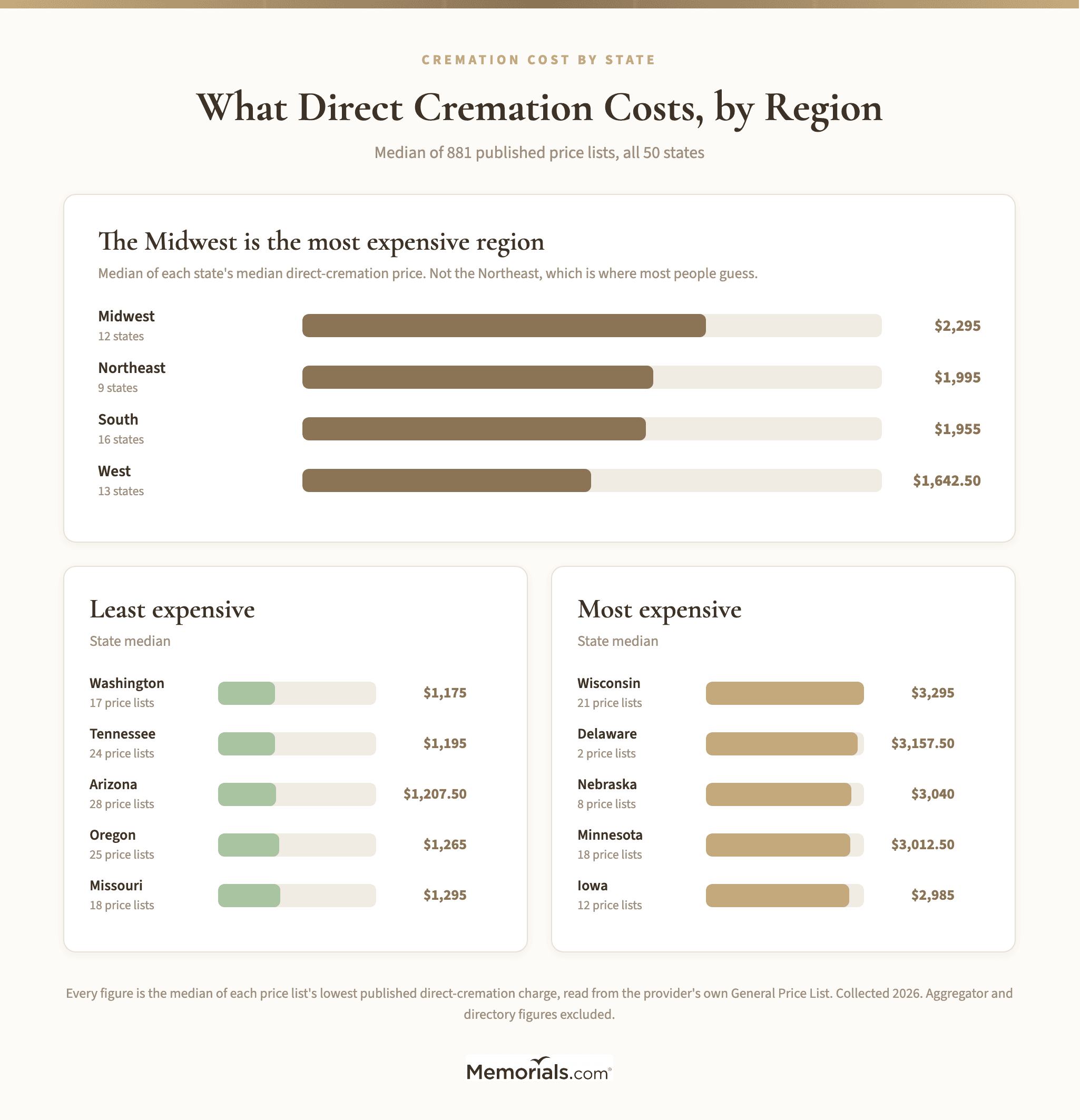
Direct cremation runs from a median of $1,175 in Washington to $3,295 in Wisconsin. But the more useful finding sits inside each state: at the median, the gap between the cheapest and most expensive provider in one state is wider than the gap between the cheapest and most expensive state. Families who called around last year to find out how much cremation cost in their own town already knew that. A national figure cannot show it.
Each figure is the median of the lowest published direct-cremation price in that state. Most funeral homes in America do not post prices at all — federal law requires them to hand you a price list and to read prices over the phone, but not to publish one — so a small number in the last column means few were published, not that few firms exist. Where the count is small, read the state as a sample of what is visible rather than a survey.
Every state name links to that state's full guide, with the published price lists, local laws and what the price covers.
Figures read from each provider's own published price list in September 2026. These are the prices published when we read them; a price list carries an effective date and changes. Confirm with the provider before you commit.
Read the median, not the range — and notice how wide the ranges are. Across the states where we found five or more price lists, the gap between the cheapest and most expensive provider inside a single state runs to 4.3x at the median. The gap between the cheapest state and the most expensive is 2.8x. Where you live matters less than which provider you call, and that is the single most useful thing on this page.
Indiana is the extreme case: $495 to $4,600 across twenty-four price lists, a ninefold spread inside one state. Mississippi, Michigan, New Jersey, Maine and Florida all run better than six to one.
The split is not random, and it follows the kind of business far more closely than it follows the map. Firms that lead with cremation post a median of $1,275; firms that call themselves funeral homes, mortuaries or chapels post $2,370. We sorted those two groups by what each firm calls itself, so the line between them is rough at the edges — but the gap is about a thousand dollars, and the next section is what that buys.
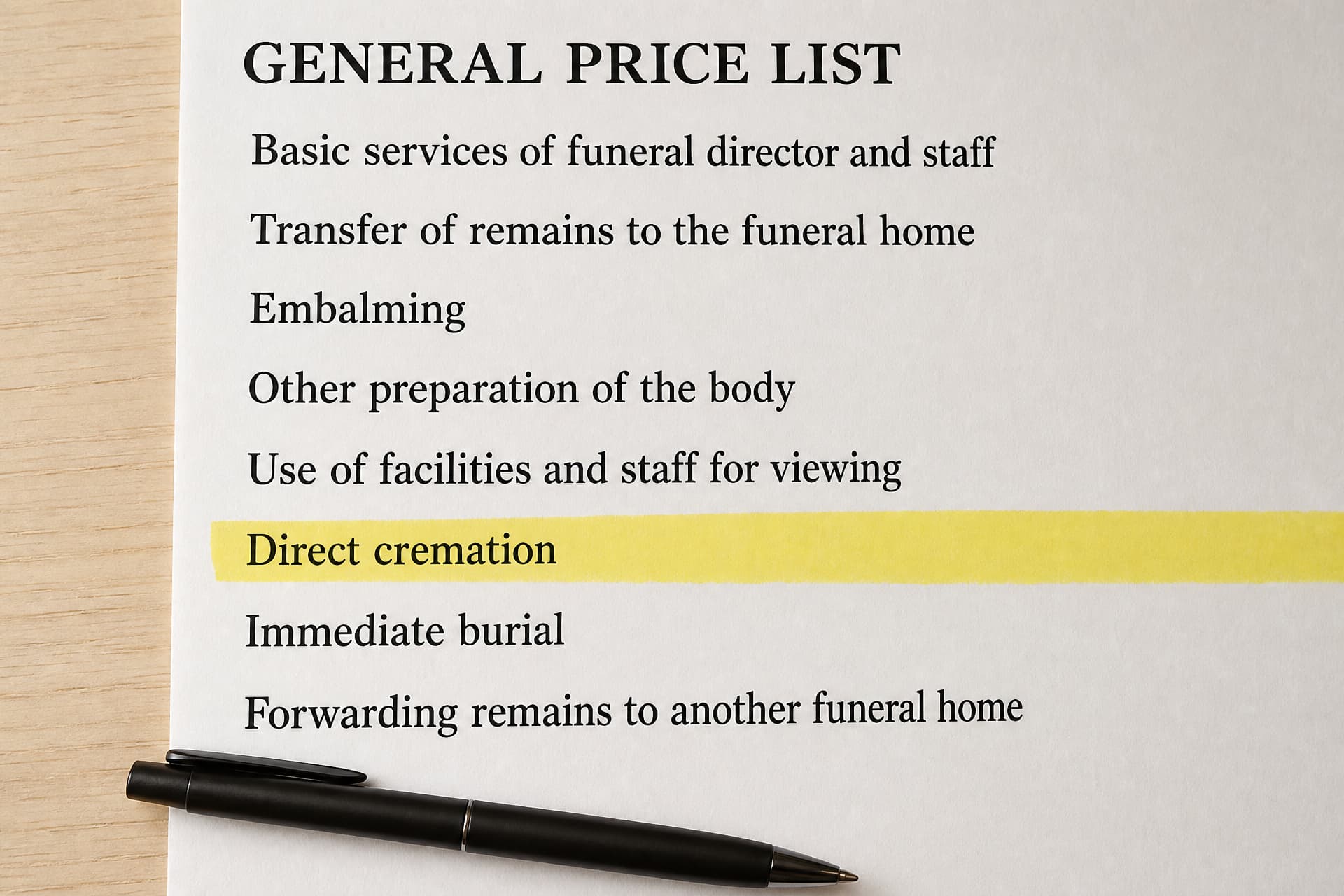
The General Price List is the document these figures come from. Federal law requires every funeral provider to give you one, itemized, before you discuss arrangements — and to hand it over on the phone if you ask.
Median direct-cremation price, from 881 published price lists. The Midwest is the most expensive region in the country at $2,295 and the West the least at $1,642.50 — the opposite of what most people expect. The price-list count beside each state is how much evidence sits behind it.
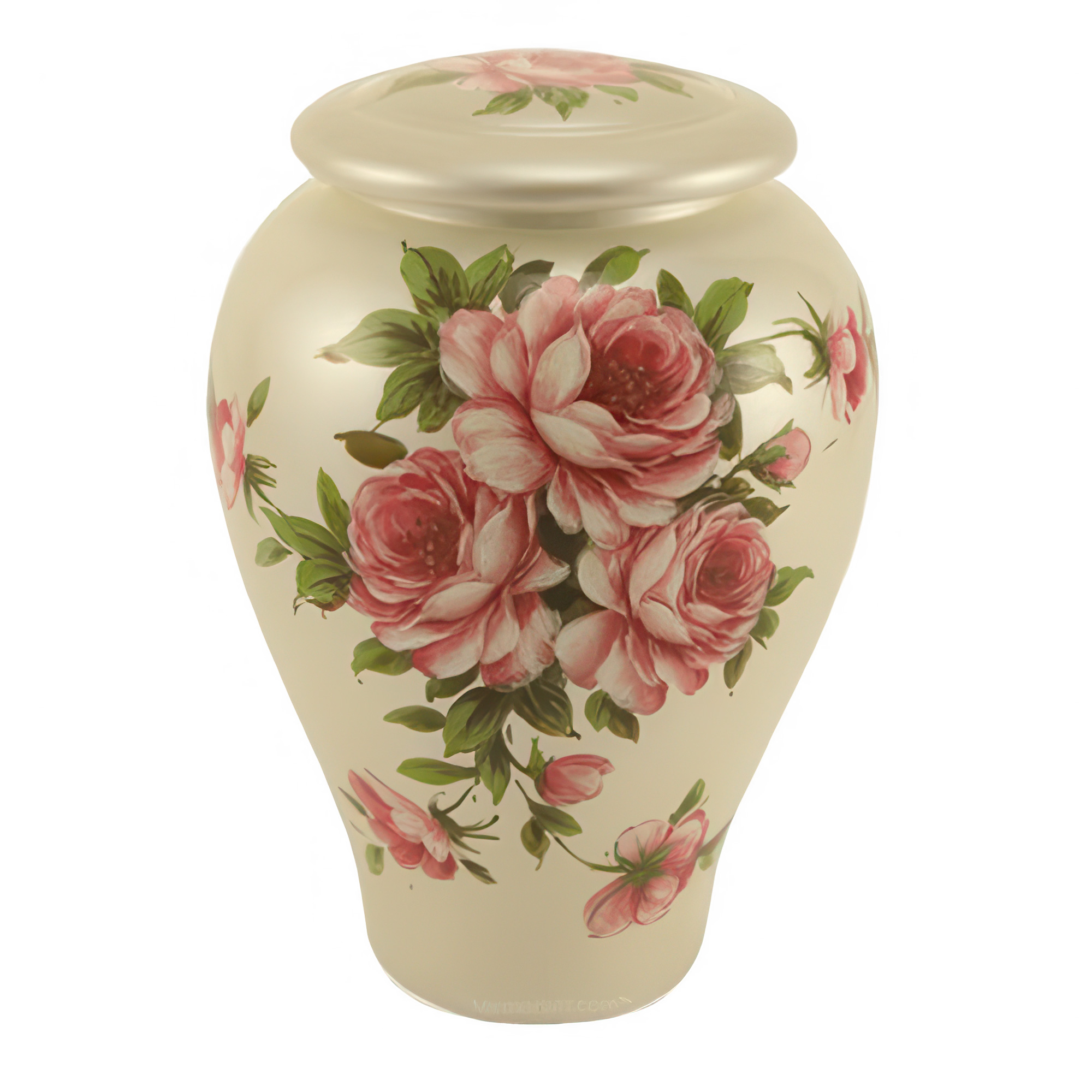
Urns for After a Direct Cremation
The permanent vessel is almost never included in the cremation price
The Midwest Is the Most Expensive Region, Not the Northeast
Ask most people which part of the country charges most for a funeral and they will say the Northeast. The price lists say otherwise. Taking the median of each state's median, the Midwest is the most expensive region in the country at $2,295 across its 12 states — ahead of the Northeast at $1,995 across 9, the South at $1,955 across 16, and the West, the cheapest region in the country, at $1,642.50 across 13.
The Midwest's lead over the Northeast is real but narrow — $300 at the median — and the useful part is not the gap but how little the region explains. Wisconsin, Minnesota and Iowa all sit above $2,800, while Ohio, in the same region, is the ninth cheapest state in the country. Massachusetts, New York, New Jersey and Pennsylvania all sit below $2,300.
So do not plan around a region. There is a pattern that explains far more of the variation than geography does, and it is the next section.
Two Different Businesses, Both Selling "Direct Cremation"
This is the thing that explains most of the spread on this page, in every state, and it is rarely spelled out anywhere a family would look. Two very different kinds of company print the same three words on their price list, and the difference between them is worth more to you than any state median on this page.
A cremation-only provider sells cremation and very little else. It either owns a retort — the cremation chamber itself — or contracts with a crematory that does. It takes arrangements by telephone or online, keeps no chapel and usually no viewing room, and sometimes has no premises a family would ever visit. In many states it holds a different license from a funeral home altogether: Florida licenses this kind of firm as a direct disposal establishment and states the limit plainly — it "may only provide cremation services." These are the firms that set the floor of a state's range, and their median across the country is $1,275.
A full funeral home sells a building and the hours inside it. A chapel, arrangement and viewing rooms, refrigeration, a telephone answered at three in the morning, frequently a crematory on the premises — and direct cremation as one line on a price list with dozens of others. Their median is $2,370, and they occupy the middle and the top of every state's range.
The cheaper firm is not undercutting the other one. It is selling less. A chapel that sits empty on a Tuesday, a licensed director on call overnight, a viewing room and a parking lot are real costs, and they are carried by the services that firm actually sells. So when you put a $995 quote beside a $2,400 quote, you are usually not looking at two prices for one thing but at two businesses, one of which can do considerably more than the other.
Cremation-only provider
Full funeral home
Direct cremation
yes
yes
Viewing or visitation with your loved one
no
yes
A funeral or memorial service they arrange
no
yes
Burial, if the family changes its mind
no
yes
Premises to visit
often none
yes
Typical position in a state's range
the floor
the middle and top
What the cheaper option cannot do for you is the part worth reading twice. A cremation-only provider generally does not host a viewing or a visitation with your loved one present, does not arrange a funeral service, and cannot move you to a burial if the family changes its mind. Usually that is a practical limit rather than a legal one — no chapel, no viewing rooms, nothing to hold a service in. In some states it is a legal one: Florida and New Mexico, for instance, license a "direct disposer" that is barred from selling a viewing or a service at all, and a New Mexico firm has to tell you so in writing before you sign. So decide first whether anyone will want time with your loved one beforehand, because the firms at the bottom of your state's range mostly cannot offer it — and changing your mind later means starting again with another firm, at that firm's prices.
What the higher price is holding open is a building, staffed hours and equipment kept available whether or not you use them. In exchange you get the option to change your mind, one organization handling everything if plans grow, and frequently an in-house crematory — which means no third-party crematory fee, and your loved one stays in one firm's care from start to finish.
So the decision to make before you compare a single price is which of the two you want. Settle that first and the prices become comparable. If you are certain about direct cremation and nothing else, the top of your state's range is capacity you will pay for and not use. If you are not certain, the bottom of the range may not be available to you at all.
That is also why state medians move the way they do: where dedicated cremation firms are thick on the ground a state's median falls, and where the market is mostly traditional funeral homes it rises.
What You Are Actually Buying
Direct cremation is the least expensive way to be cremated because it is the least expensive arrangement, not because the cremation is cheaper. There is no viewing, no ceremony with your loved one present, and no embalming. What you are paying for is a short list of things, and it is worth knowing what is on it before anyone quotes you a number.
A quoted price is a bundle, and the bundles are not standard. No two price lists describe their coverage quite the same way, which is exactly why the itemized list is the thing to ask for. It is also why "what does it cost" is a weaker question than "what is in that number".
So go down this list with whoever is quoting you, and get a yes or a no on each item:
Basic services of the director and staff — the professional fee, and usually the largest single component.
Transfer of your loved one into their care — from the place of death, and within what radius.
The cremation itself — see the paragraph below; this one is not a formality.
Filing the death certificate and the cremation permit — the filing, and separately the government fee.
Refrigeration or shelter while waiting — often free for a set number of days, then billed daily.
The container your loved one is cremated in — the alternative container, or a casket if you want one.
Transport to the crematory — a separate movement from the first transfer, if the crematory is not theirs.
A temporary container for the ashes — the box the ashes come home in, before any urn.
Ask specifically whether the cremation itself is inside the quoted price. It sounds like a strange question and it is the most useful one on the list. Providers handle the crematory charge in different ways — some hold it inside the headline price, some show it further down the page as a separate line of a few hundred dollars, and some do not price it on the document at all. All of that is legal and disclosed, and none of it is a trick. It is simply why two headline numbers are not comparable until you have both itemized lists in front of you. Ask where the crematory charge sits, and ask every provider the same way.
What is almost never included: a permanent urn, certified copies of the death certificate, transport beyond a set radius, an obituary, and any kind of service. If you want a gathering you can still have one — a memorial service held afterward is unaffected by this choice, which is why direct cremation and a real funeral are not alternatives to each other.
So call three or four providers, and do it before you need to. The bundles differ and the fees sit in different places, so the only way to compare two quotes is to make both providers answer the same question. Half an hour of phone calls is worth several hundred dollars and often more.
And the best version of that half hour happens years early. Someone who arranges their own cremation in advance — comparing providers calmly, with nobody grieving in the room — spares their family the one conversation nobody is equipped to have well. Grief is the worst possible state in which to compare prices. Pre-arranging is not morbid; it is the single most effective thing anyone can do to keep their own family from paying more than they meant to in the hardest week of their lives.
And the fee that is not the funeral home's
Twenty-eight states charge a government fee on a cremation, separate from anything the provider earns, and it is very often outside the price you were quoted.
Most are modest. Filing fees of $25 to $30 are typical, several states set a medical examiner's fee at around $75 in statute, and the highest we found are Connecticut at $150 for the medical examiner's cremation certificate and Oklahoma at $235 for the permit. Treat those as the shape of it rather than a national schedule, and ask the funeral home for the figure in the county where the death occurred.
Against a $1,500 cremation these are small sums. But they are real, they are usually billed on top of the provider's own charges, and they rarely appear in a quoted price. The useful question to a provider is not "what does it cost" but "what will appear on the bill that isn't in that number?" Permits, the medical examiner fee, certified copies of the death certificate, and transport beyond a set radius are the four that catch people.
If you are weighing the whole decision rather than only the cremation, cost of cremation vs burial sets the two side by side, and how much a funeral costs covers the full-service figure direct cremation is being compared against. For the process rather than the price, direct cremation explains what actually happens and in what order.
Why the Same Service Is Quoted at $899 and $19,415
This is the single most confusing line on a funeral home's price list, and it is rarely explained.
Open a General Price List and you may find direct cremation printed not as a price but as a range, its top end many times its bottom. It does not mean the cremation is sometimes worth five figures.
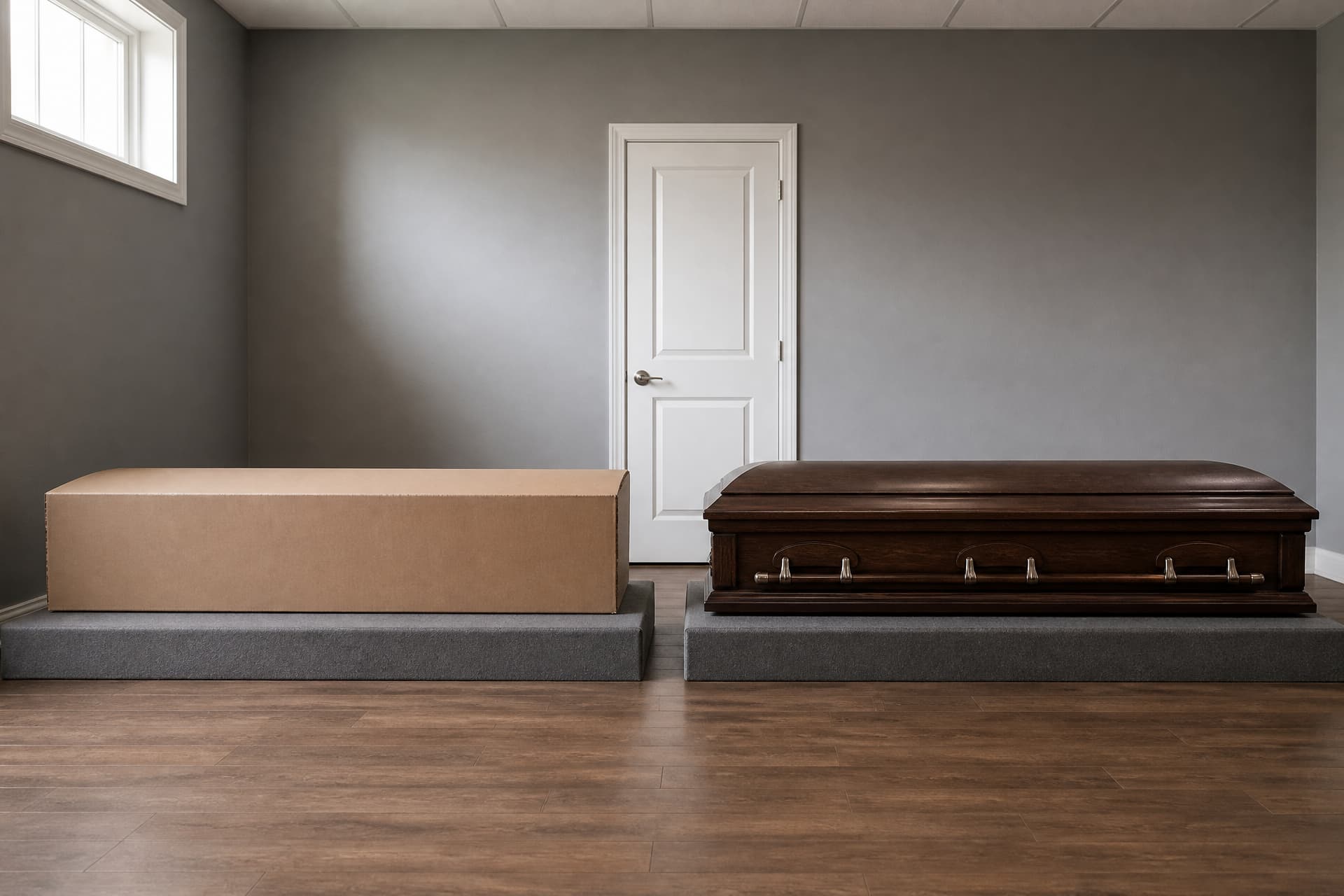
The difference is the container your loved one is cremated in — and that container is cremated too.
Every cremation needs something to hold your loved one as they go into the chamber. At the low end that is an alternative container: a plain, unfinished box of cardboard or pressed wood, no handles, no lining. At the high end it is a combustible casket — wood or pressed board, never metal — and some families do choose one. What almost nobody does is buy an expensive casket in order to burn it: a family who wants a viewing first and the cremation afterwards normally rents one for the service instead. The five-figure ceilings you see printed are the provider's whole casket list added on top of the cremation, which is why the top of the range is a box rather than a price anyone pays. Whichever container is used it goes into the retort, and none of them is what the ashes come back in — those arrive in a separate temporary container about the size of a shoebox, which is why an urn is a purchase of its own.
The casket has to be combustible, and that rules out metal. A cremation chamber runs somewhere around 1,400 to 1,800°F — hot enough to consume wood, not hot enough to destroy steel or bronze, which melt higher. So crematories take wood, pressed board and cardboard, and a price list may carry a disposal charge if a metal casket arrives, because it cannot be cremated and has to be emptied and disposed of instead. The rental works because the two parts come apart: a rental casket has a removable inner container that goes into the chamber while the shell stays behind and is used again.
The Funeral Rule requires a provider's direct-cremation line to cover every container option they stock, cheapest to most expensive — so one printed range can run from a cardboard box to a hardwood casket while the cremation itself never changes. What moves that number is the box, and the box is optional. A provider may not require a casket for direct cremation, and may not charge a handling fee for a container bought elsewhere.
Quoted as a national cost, a range like that reads as "direct cremation costs $899 to $19,415" — technically sourced, and practically meaningless. Every figure on this page is a floor: the price with the basic container, which is what the overwhelming majority of direct-cremation families actually buy. When you read a price list yourself, find the low number and then find what the high number is buying. It is almost always a casket.
Both are containers a loved one can be cremated in, and both are consumed in the chamber — neither is what the ashes come back in. The casket has to be combustible, which is why crematories take wood and not metal. A provider's direct-cremation price has to span every container they stock, which is how one service ends up printed as a range running into five figures.
The Laws That Change What You Pay, and When
Cremation law is state law, and it changes both the bill and the calendar. A few examples of how much states differ:
Waiting periods are not universal, and most states have none. Alabama does — a genuine 24-hour statutory wait under Ala. Code § 34-13-121(a)(1). Illinois has one too (410 ILCS 18/35(a)), and Massachusetts requires 48 hours (M.G.L. c. 114, § 44). Most states have nothing of the kind, and what actually governs how fast a cremation can happen is the paperwork: the death certificate has to be filed, and a permit has to be issued.
Florida's famous "48-hour rule" is widely misreported. Fla. Stat. § 497.607(1) says a cremation must be performed within 48 hours of an agreed time — a deadline for the crematory to act, not a delay before it may. Pages that describe it as a mandatory wait have it backwards.
Some states put every cremation in front of a medical examiner, not just the suspicious deaths. Arizona, Florida, Connecticut, Massachusetts and Michigan all do, in different forms. That is a signature to obtain and, in several states, a fee to pay.
Who may authorize a cremation is a statutory list, and the order is not the same everywhere. California, unusually, puts a health-care power-of-attorney agent ahead of the surviving spouse (Health & Safety Code § 7100). Georgia runs the opposite of a waiting period: under O.C.G.A. § 31-21-7 the person with the right of disposition forfeits it if they do not act within two days of being notified.
Each state guide below sets out that state's own rules, with the statute named.
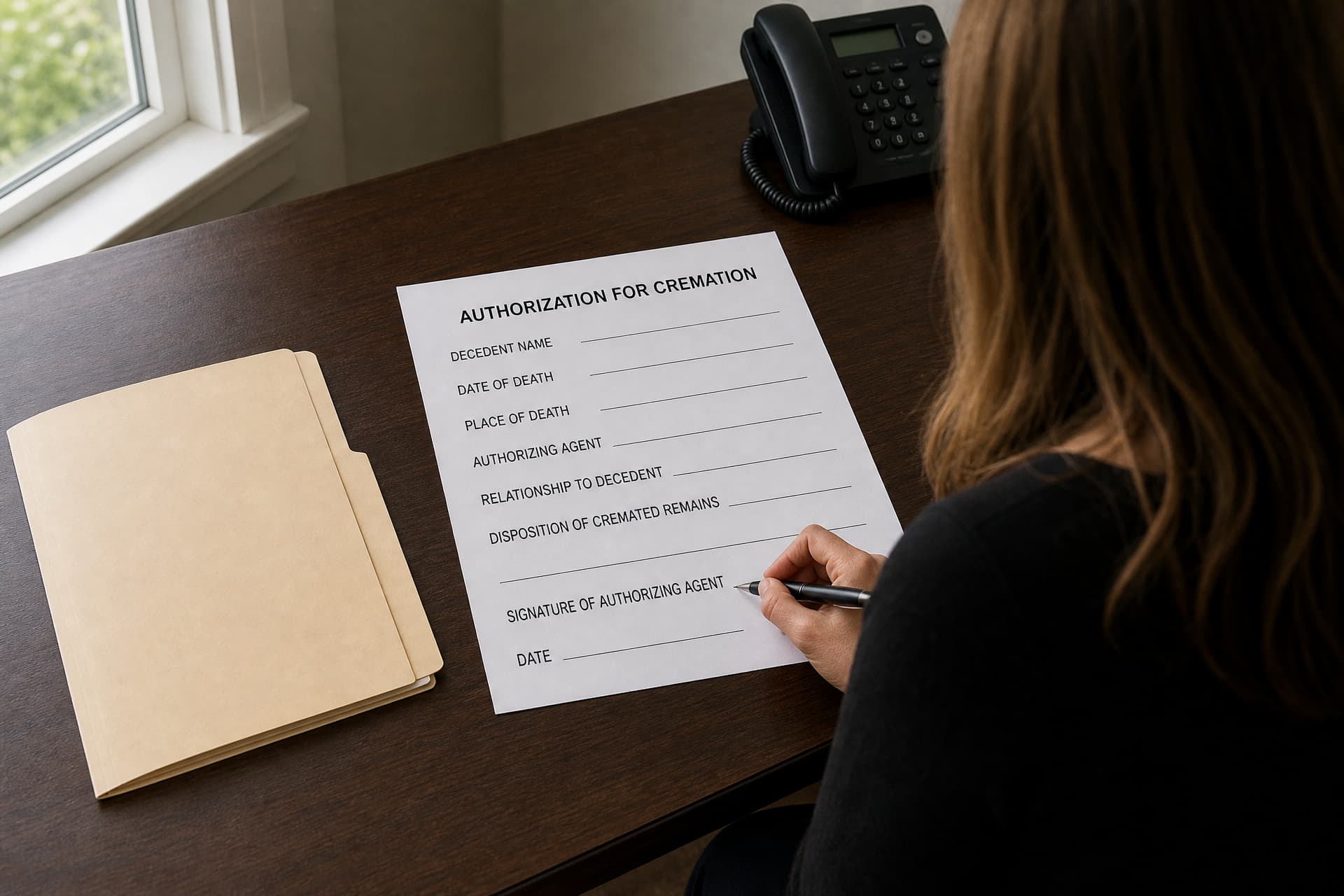
The authorization form, the death certificate and the permit are the three documents that decide how quickly a cremation happens. In most states there is no waiting period at all — the paperwork is the wait.
Searching "Cremation Near Me" — What That Actually Finds
When people search cremation costs near me, Google mostly returns a map of funeral homes within a few miles. That is useful for a phone number and almost useless for a price, because the map listing does not carry one and most funeral homes do not publish theirs. Two things are worth knowing before you start calling.
The nearest provider is rarely the cheapest, and distance is a billable line. Most direct-cremation prices include transfer of your loved one within a set radius — often 25 or 50 miles — and charge per mile beyond it. What did that cremation near me cost, against one an hour away? The map cannot answer it: a provider forty miles out at $995 can genuinely beat one down the road at $1,395, or the mileage can wipe the saving out entirely. Ask for the radius, then ask what the per-mile charge is past it.
Ask three providers, and ask each the same question. Not "what does cremation cost", but "what is the total for direct cremation, including permits, the medical examiner fee, transfer from where the death occurred, and one certified copy of the death certificate". Worded identically three times, quotes for basic cremation cost near me can be compared. Worded loosely, they cannot.
No page can tell you what direct cremation costs near me or near you specifically — only what the published range is across your state, which is what the table above gives you. If nothing in your state's guide is within reach, the state median is still the number to hold in your head when the first quote arrives.
Choosing an Urn, and What It Adds
Almost no direct-cremation price includes a permanent urn. The provider supplies a temporary container — usually a plastic or cardboard box — and the family chooses the actual vessel separately, which is why urn prices are not in the table above.
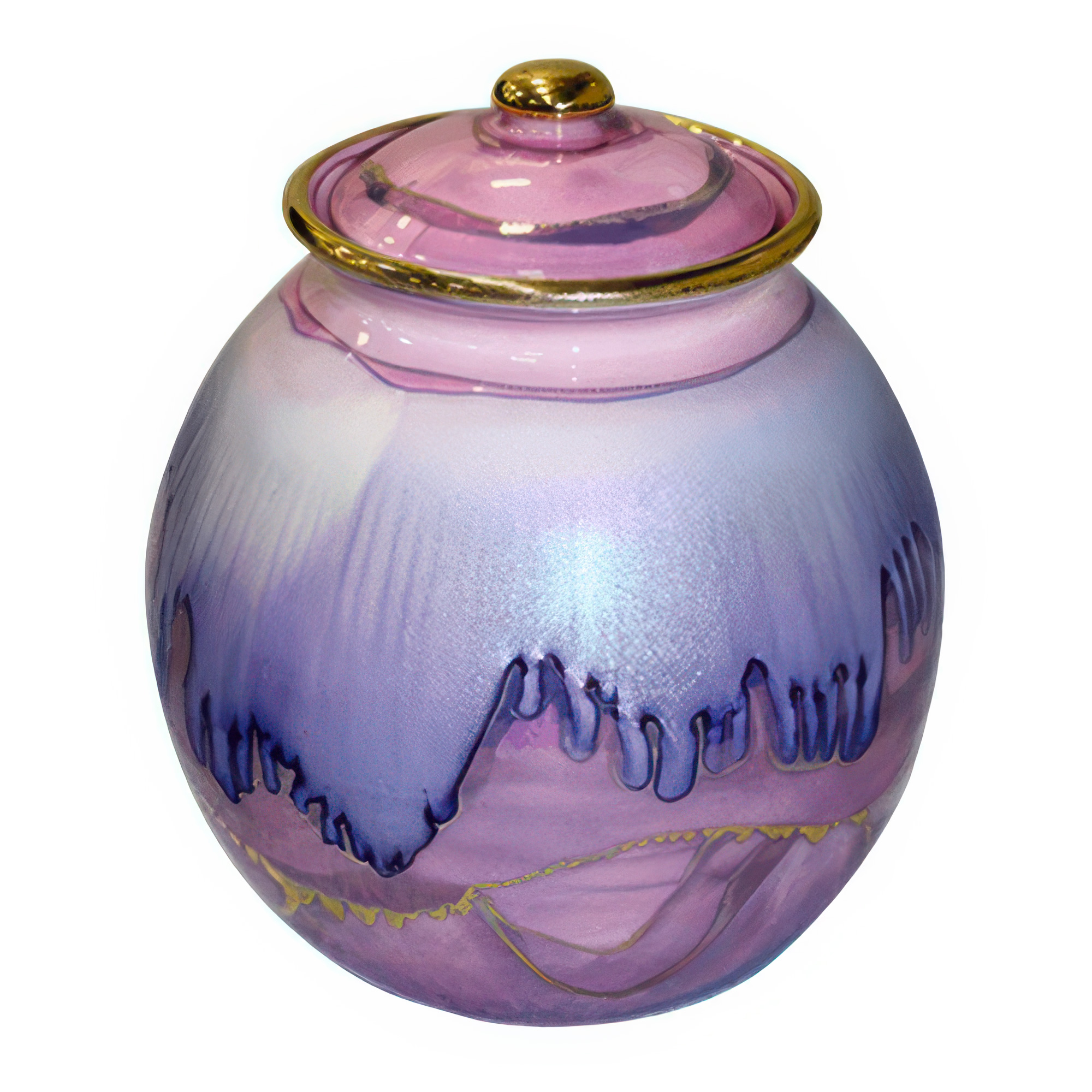
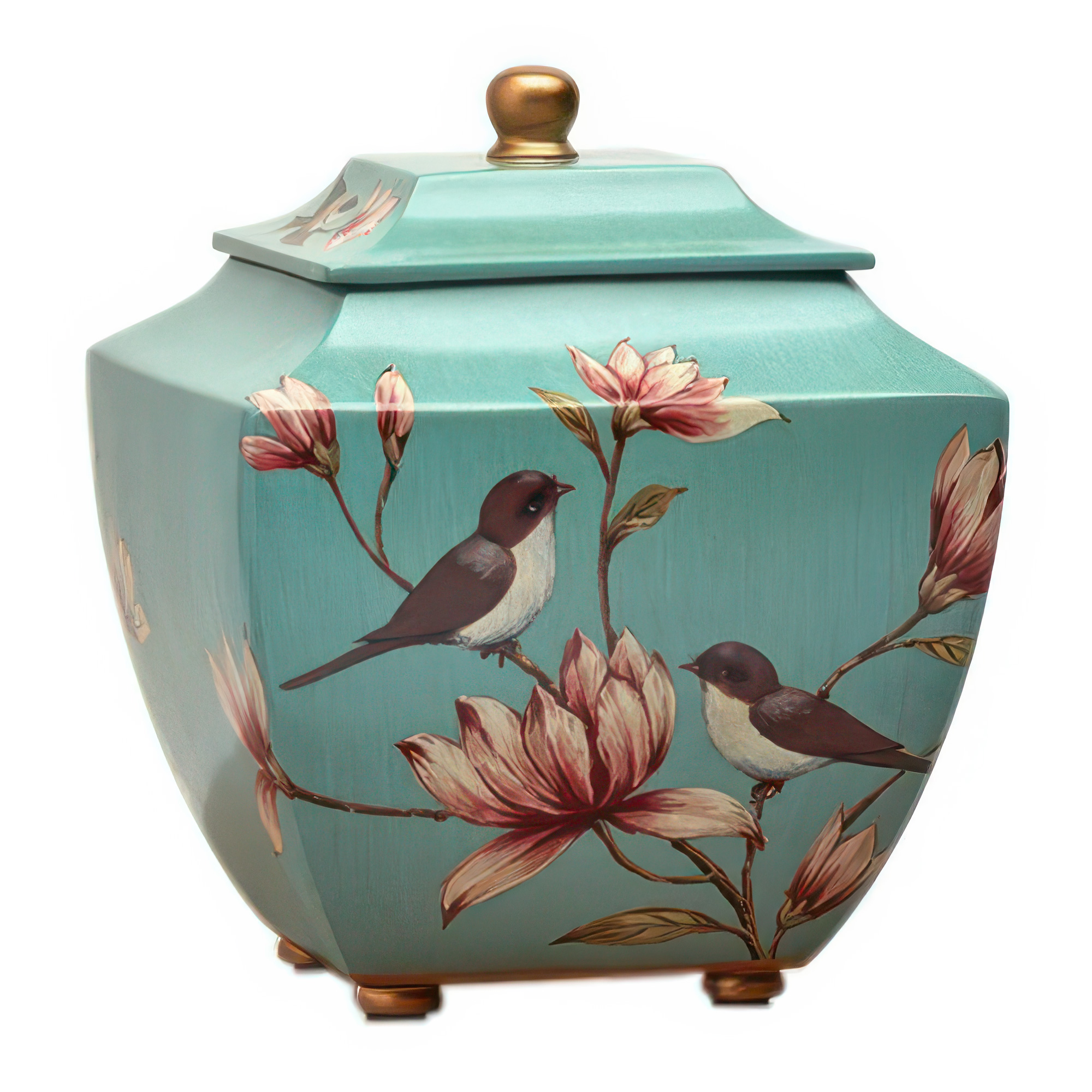
The range is wide and starts lower than most people expect. Cheap cremation urns for adults covers full-size urns at the affordable end, and they are full-size: a standard adult urn holds around 200 cubic inches, and that is a capacity question rather than a quality one. Ceramic cremation urns sit in the middle of the market and are the most common choice for a home or a niche.
If the ashes are going into the ground or into a columbarium, check the cemetery's rules before buying — many niches have fixed interior dimensions, and some require a specific outer container. How much a cremation urn costs goes into what drives the price.
Direct cremation is already the least expensive option most providers offer, but there are two others worth knowing about.
Water cremation — alkaline hydrolysis, sold as aquamation — is legal in a growing number of states and typically prices close to flame cremation, sometimes slightly above it. Hydro cremation covers how it works and where it is available.
Donation to a medical school or a body-donation program can reduce the cost to near zero, with the ashes returned to the family afterward. It is not available to everyone and it is not fast.
And the least-discussed option: several states have an indigent or low-income burial assistance program, administered at state or county level. If cost is the binding constraint, ask the funeral director directly — they will know the local program and are usually willing to help with the application.
Where Your State Sits
The table at the top of this page links all fifty state guides, alphabetically, with each state's median beside it. The cheapest states have very little in common except a dense market of dedicated direct-cremation providers, and the most expensive have markets weighted toward full funeral homes.
Wherever you land in the table, the provider you call matters more than the state you call from. A median is a starting point for judging the first quote you are given, not a price anyone charges.
How We Got These Numbers, and What They Cannot Tell You
We think the method matters as much as the figures, so here it is plainly.
The source is the General Price List — the itemized document the federal Funeral Rule requires every funeral provider to give you, in person before arrangements are discussed and over the phone if you ask for prices. Every figure on this page comes from one, read on the provider's own website rather than from a funeral directory — one of the comparison sites that come up when you search for a price near you, publishing figures for funeral homes they do not run. Where we could set a directory listing beside the provider's own document, the two often did not agree, and how they disagreed matters more than how often: a directory naming a service the provider does not sell, quoting a single line out of a package that costs twice as much, or still serving a figure from a price list years out of date.
We count price lists, not firms. Two locations often share one document and a single firm sometimes publishes several, so the count beside each state is the number of documents we read rather than a headcount of businesses.
We publish the median rather than the average, because one very high list pulls an average away from what a family in that state would actually be quoted. Each state's figure is the median of the lowest direct-cremation price on each list we read, and what each price includes was recorded as the list words it — normalizing that is most of the work.
There is no national average on this page, and that is deliberate. The sample is uneven — 48 price lists in Florida, one in Alaska — and an average across it would describe our research rather than the country. That is the statistic this page exists to replace, not to reissue.
Four states are too thin to state a range. We found one published price list in Alaska, two in Delaware, and four each in Hawaii and South Dakota. Anyone arranging a cremation in those states should expect to make phone calls. And where we say we found no published price, that is a statement about our search and never a claim that a firm fails to publish one.
These prices were collected in 2026 and they will move. A price list is true on the day it is posted, and plenty of the ones we read were two and three years old and still sitting live. Every price list carries an effective date, so confirm before you commit to anything.
Frequently Asked Questions
How much does a cremation cost in the United States? It depends far more on your state and on which provider you call than on anything else. Across the 881 price lists we read, the state medians run from $1,175 to $3,295. How much cremation costs in your own state is in the table above.
How much is the cremation cost once the extras are added, and what is the average cost cremation providers publish? Across the price lists we read this year, most states sit between $1,200 and $3,300 for direct cremation. How much is the average cremation nationally is a question we decline to answer with one number: our sample runs from 48 published price lists in Florida to one in Alaska, and an average across it would describe our research rather than the country. The state medians in the table above are the honest version.
How much do cremations cost compared with a burial? Direct cremation is usually the least expensive option a funeral provider offers, and a full burial the most. The price of cremation without a service is a small fraction of a traditional funeral bill, which is why the two are so often compared.
How much are cremations when you add a viewing? More, and sometimes substantially. A cremation with viewing cost includes the things direct cremation removes — embalming or refrigeration, a viewing room, staff time, and often a rental casket. If your family wants time with your loved one first, that is a real and reasonable choice; it is simply not what the prices on this page describe.
What are the cremation requirements in my state? They differ, and each state guide sets out its own with the statute named — who may authorize, what permit is needed, whether a medical examiner must sign, and whether any waiting period applies.
Why is direct cremation so much cheaper than a regular funeral? Because it removes the parts that cost money: no viewing, no embalming, no ceremony, no casket beyond a basic container. You can still hold a memorial service afterward, and many families do.
Is the cheapest provider in my state the right choice? Not automatically. The low end of every state's range is typically an online-only operator with no chapel and a set service radius, and for many families that is exactly right. But check the radius, check whether the crematory is theirs or subcontracted, and check what the price excludes. A $795 cremation with $400 of add-ons is not cheaper than a $1,095 cremation that includes them.
Does cremation cost more if I choose it at the last minute? The cremation itself, no. What can cost more is the delay: several states require refrigeration after a set number of hours, and that is billed daily. If a family needs time to gather, ask about the refrigeration charge before assuming waiting is free.
Why would anyone pay for a casket that is going to be burned? Usually because the casket was not bought for the cremation but for the funeral: a family who wants a viewing, or a service with their loved one present, needs a casket for that, and the cremation happens afterward with the same one. If that is the shape of what you want, ask about a rental casket by name — you get the appearance for the service without buying something that will be cremated. And if it is not, remember that a provider must tell you an alternative container is available and may not require a casket.
Do I have to buy the urn from the funeral home? No. The Funeral Rule gives you the right to buy an urn anywhere you like, and it bars the funeral home from refusing to use it or charging a handling fee for one you bring.
That matters, because the urn is usually presented at the worst possible moment — during arrangements, from a display case, with no way to compare. There is no rush: the ashes come home in a temporary container that is perfectly secure, and families often take weeks to choose. You can browse cremation urns at your own pace, and if the ashes are going into a niche or a grave, check the required dimensions first.
How long does it take to get the ashes back? Usually one to three weeks, and the variable is paperwork rather than the cremation. In states that require a medical examiner's sign-off on every death, that step sets the pace.
In Short
Direct cremation in the United States costs between roughly $1,200 and $3,300 depending on the state, and within any state the gap between the cheapest and most expensive provider is usually wider than the gap between states.
The figure you should act on is your own state's, and the number to ask a provider for is not the headline price but the total: permit, medical examiner fee, death certificates, transport, and whether a permanent urn is included. Your state's guide, linked above, has the local version of all of it.