🏬Supersize Online Funeral Retailer🪦1000's of Headstones⚱️Over 10,000 Cremation Urns⚰️Caskets Overnight Delivery🛒Funeral & Memorial Superstore🚚FREE Shipping on ALL Orders👨👩👧👦Helping Families for over 20 Years💰Lowest Price Guarantee🏬Supersize Online Funeral Retailer🪦1000's of Headstones⚱️Over 10,000 Cremation Urns⚰️Caskets Overnight Delivery🛒Funeral & Memorial Superstore🚚FREE Shipping on ALL Orders👨👩👧👦Helping Families for over 20 Years💰Lowest Price Guarantee
🏬Supersize Online Funeral Retailer🪦1000's of Headstones⚱️Over 10,000 Cremation Urns⚰️Caskets Overnight Delivery🛒Funeral & Memorial Superstore🚚FREE Shipping on ALL Orders👨👩👧👦Helping Families for over 20 Years💰Lowest Price Guarantee🏬Supersize Online Funeral Retailer🪦1000's of Headstones⚱️Over 10,000 Cremation Urns⚰️Caskets Overnight Delivery🛒Funeral & Memorial Superstore🚚FREE Shipping on ALL Orders👨👩👧👦Helping Families for over 20 Years💰Lowest Price Guarantee
There is a moment, usually the morning after, when somebody has to tell everyone. Not the newspaper — the people. The cousin in Arizona, the friends from the running club, the workplace, the neighbor who will notice the cars. What you need at that moment is a funeral announcement template: the words already arranged, so you only have to fill in the ones that are yours.
That message is a funeral announcement, and it is not the same thing as a death notice. A death notice is published, costs money by the line, and is written for strangers scanning a page. An announcement is sent, costs nothing, and goes to people who already knew and loved them. This page is a funeral announcement template for the second kind — by text, by email, on Facebook, and on a printed card — with wording for each and a note on when to send it.
If you need the published version instead, how to write an obituary covers the death notice and the obituary in full. For where this sits in the rest of the service, see the .
Send something within a day. People find out anyway, and finding out sideways is worse than finding out plainly.
Two messages, not one. The first says they died. The second, days later, says when the service is.
Give the facts and stop. Name, when, where, and what to do next. Nothing else is required of you.
Different channel, different length — a text is two sentences, a card is four.
You may say "private". It is a complete answer and needs no explanation.
Announcement, Death Notice, Obituary
Three words for three different things, and families get asked for all three in the same week.
What it is
Where it goes
Length
Funeral announcement
A message telling people what is happening and when
Text, email, social, printed card
2–5 sentences
Death notice
A paid factual notice
Newspaper, funeral home website
40–60 words
Obituary
A tribute — the life, not just the death
Newspaper, funeral home website
150–500+ words
The death notice and the obituary are covered in full on our obituary guide, including what each costs and where to file it. Everything below is the announcement.
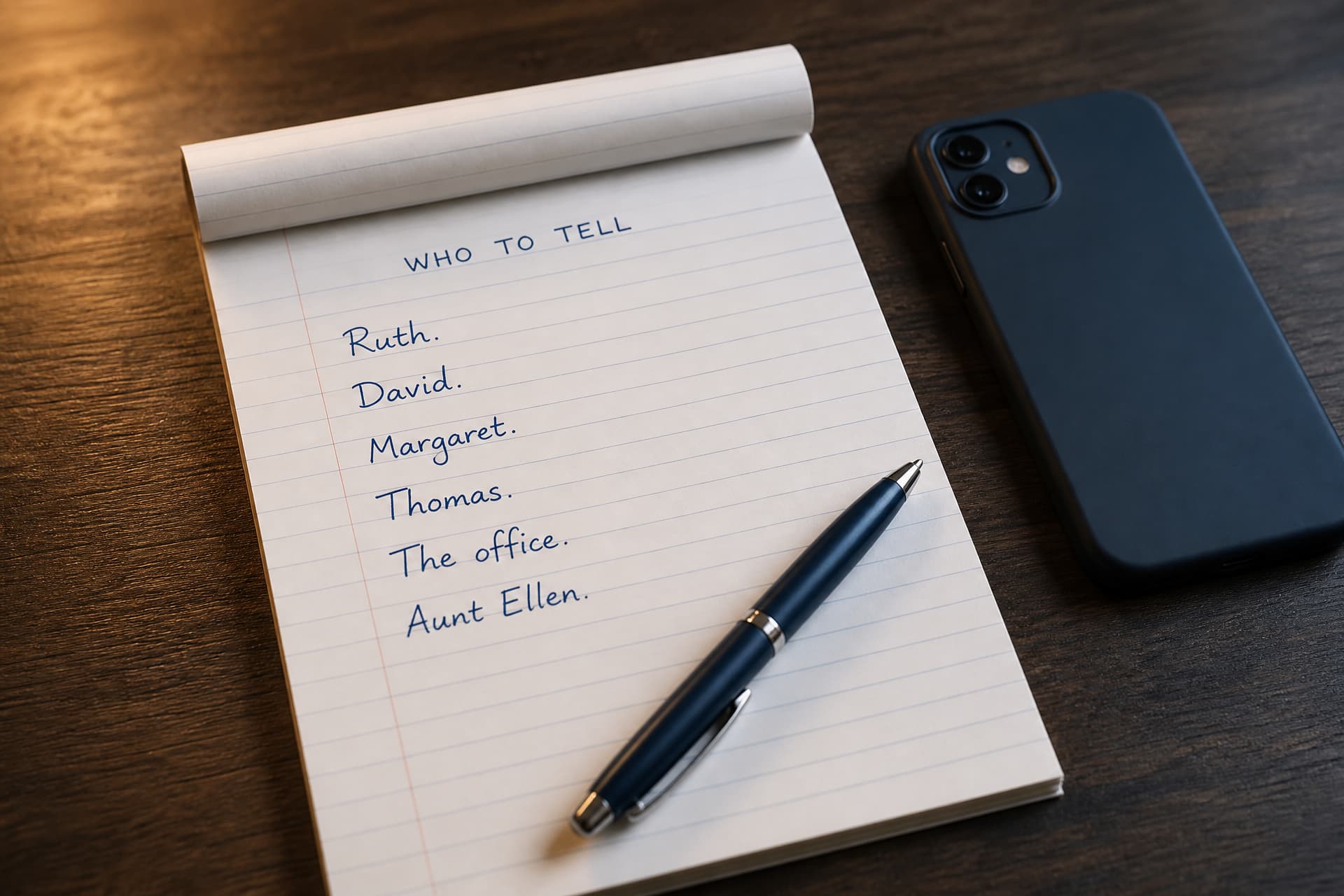
Write the list before you write the message. Most families send in three waves — immediate family first by phone, then close friends and colleagues by text, then everyone else — and knowing which wave somebody is in decides what you send them.
The Core Funeral Announcement Template
Every funeral announcement sample below is this, expanded or trimmed:
Part
Fill in
1
[Full name], [age], of [city], died on [date].
2
[Relationship to you, if the reader might not know: "my father", "our colleague"]
3
[The service: what, where, when] — or [Details to follow] — or [The family has asked for a private service]
4
[What you want from them: "all are welcome", "please share with anyone I have missed", "no flowers, please"]
Parts 1 and 3 are the message. Parts 2 and 4 are what make it readable by someone holding a phone in a supermarket queue.
By Text Message
The most common way this news now travels, and the one people most worry about getting wrong. The funeral announcement examples below are two or three sentences each. No greeting, no sign-off — a text does not need either, and adding them makes it read like a form letter.
"I'm so sorry to send this by text. Dad died last night. The funeral is Saturday the 14th at 11 at St Mary's — I'd love you to be there."
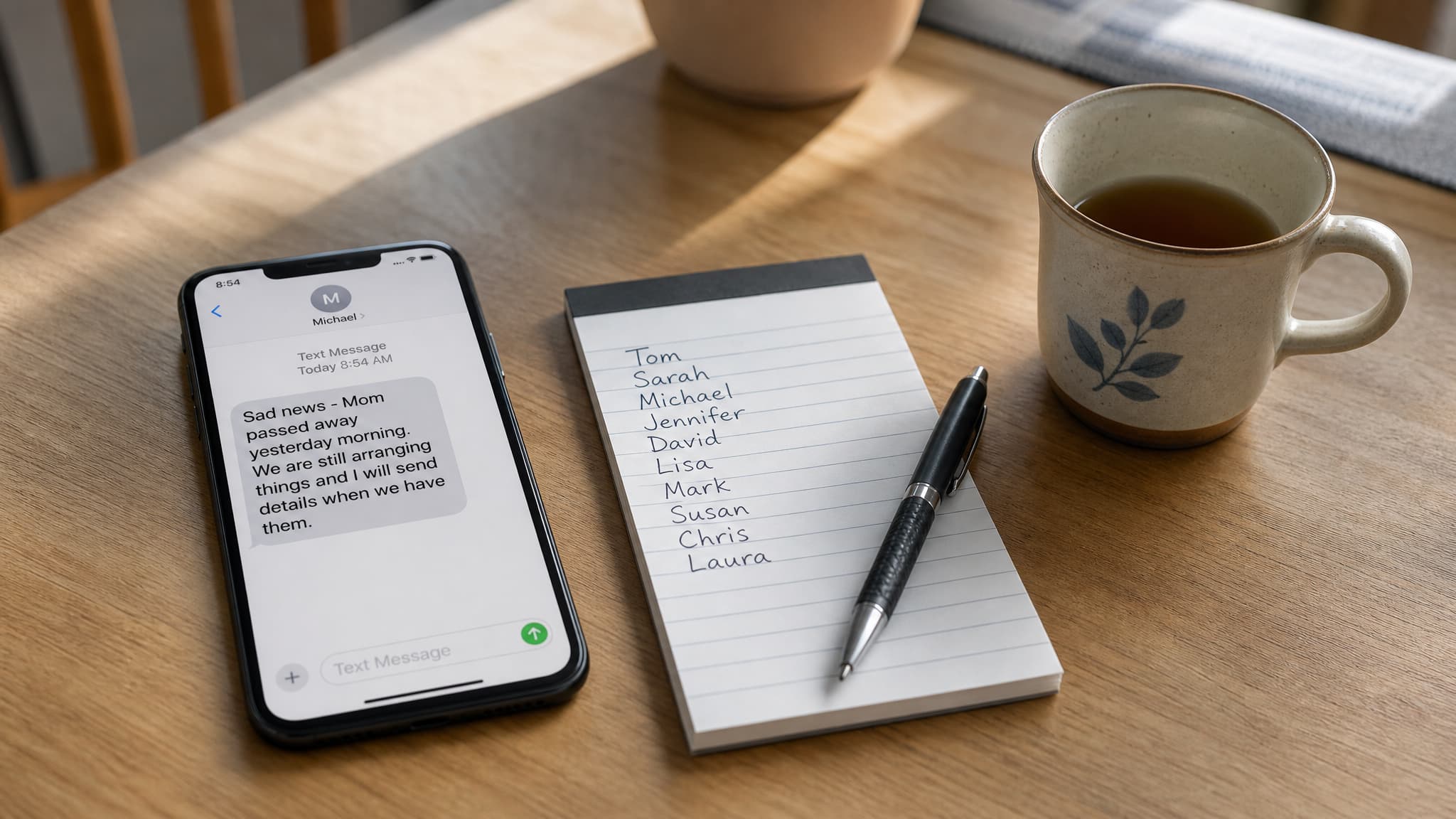
"Sad news — Mom passed away yesterday morning. We're still arranging things and I'll send details when we have them."
"Letting you know that Tom died on Tuesday. Service is next Friday at 2, Riverside Chapel. Please pass this on to anyone from the shop."
Two things worth knowing. Send it to one person at a time rather than as a group message — a group thread turns into everyone's condolences arriving at once on your phone. And it is completely acceptable to apologize for the medium and then use it anyway; the alternative is that they hear it from somebody else.
By Email
The right channel for a workplace, a club, a congregation or a large extended family. Longer than a text, and it carries a subject line, which is the part people stall on.
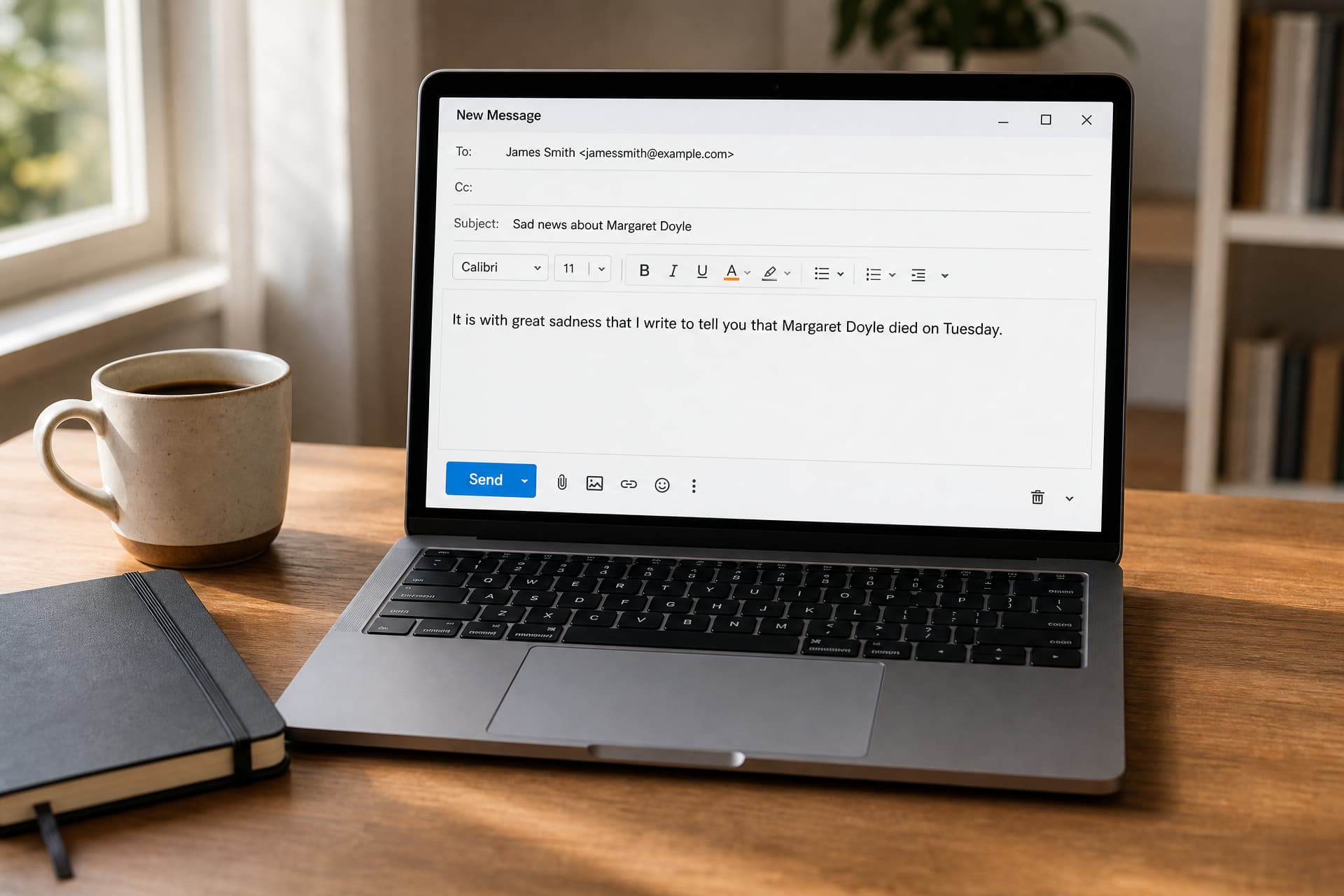
Subject:Sad news about [full name] — or, for a workplace, [Full name], [Department]
Part
Wording
Opening
It is with great sadness that I write to tell you that [full name] died on [date].
Context
[He / She / They] [worked here for [number] years / was a member of this congregation since [year]].
Service
The funeral will be held at [place] on [date] at [time]. [All are welcome. / The family has asked that the service be private.]
Practical
[In lieu of flowers, the family has asked for donations to [charity].] [Cards can be sent to [address].]
Close
[Sender name and role]
The subject line is where people stall. Put the name in it, as here — a vague subject on a workplace email gets opened late, and this is the one message that should not be opened late.
A workplace email should say plainly whether colleagues are welcome at the service. People will not ask, and they will assume they are intruding unless told otherwise.
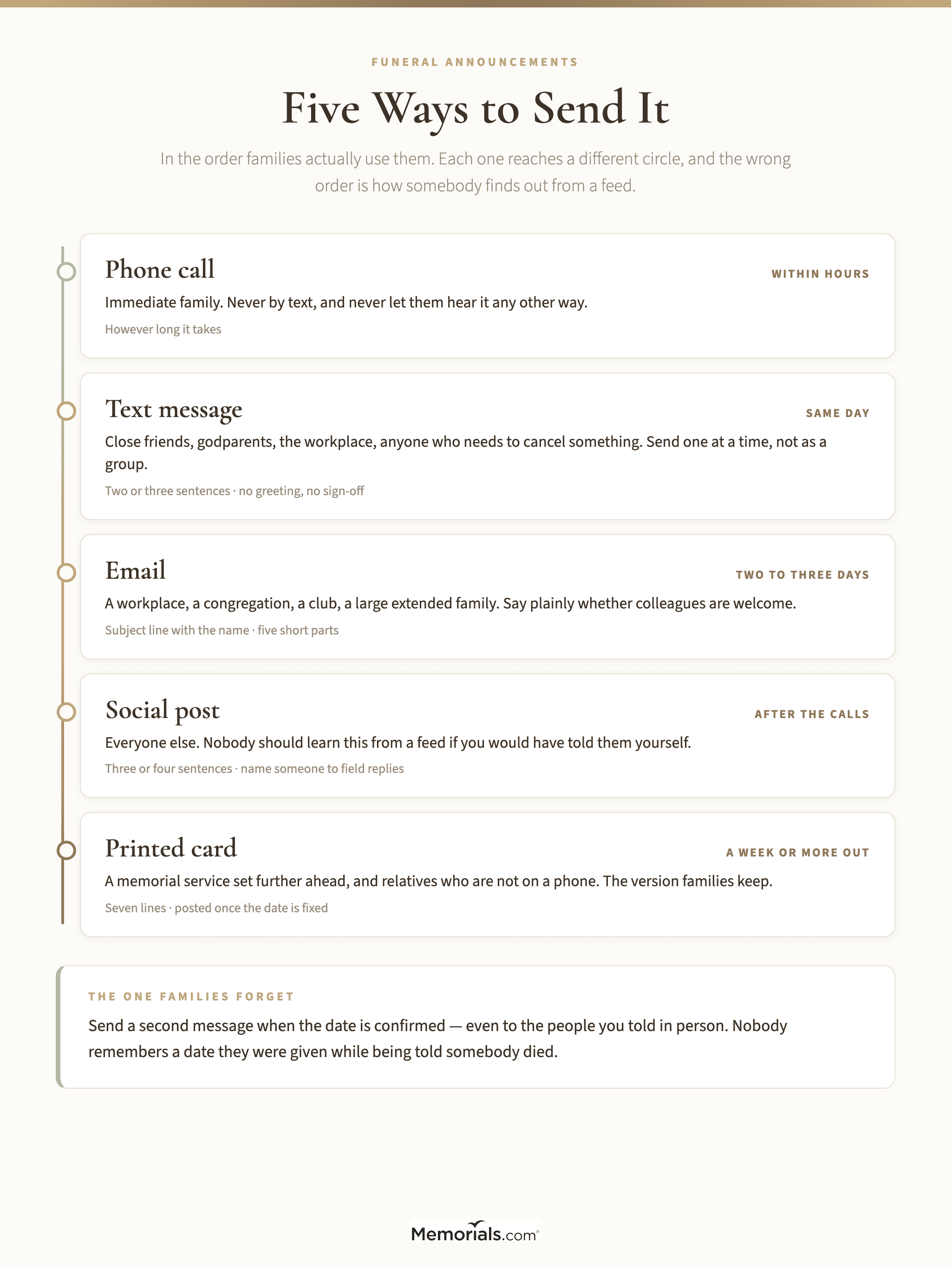
Five channels, in the order most families use them. A phone call for immediate family within hours; texts to close friends and colleagues the same day; email for a workplace or congregation once the facts are settled; a social post only after the people who should hear personally already have; and a printed card last, once the date is fixed.
On Facebook and Social Media
A facebook death announcement has one rule above all others, and it is about timing rather than wording: nobody should learn this from a feed if you would have told them yourself. Post it after the calls and texts, not before — an hour is usually enough, a day is safer.
"It is with a heavy heart that we share that [full name] passed away on [date]. Funeral details to follow. Thank you for the love you have already shown our family."
"[Full name], [dates]. Service at [place] on [date] at [time]. All who knew and loved him are welcome."
"Our mother died peacefully on Sunday. We are not ready to say much more yet. We will share details of the service here when we have them."
Three practical notes. Turn off comment notifications before you post, or your phone will not stop for two days. Say if the service is private, because otherwise people will ask in the comments and you will answer the same question forty times. And name a person to contact if you want help — "messages to my sister Ruth, who is fielding these for us" is a kindness to yourself.
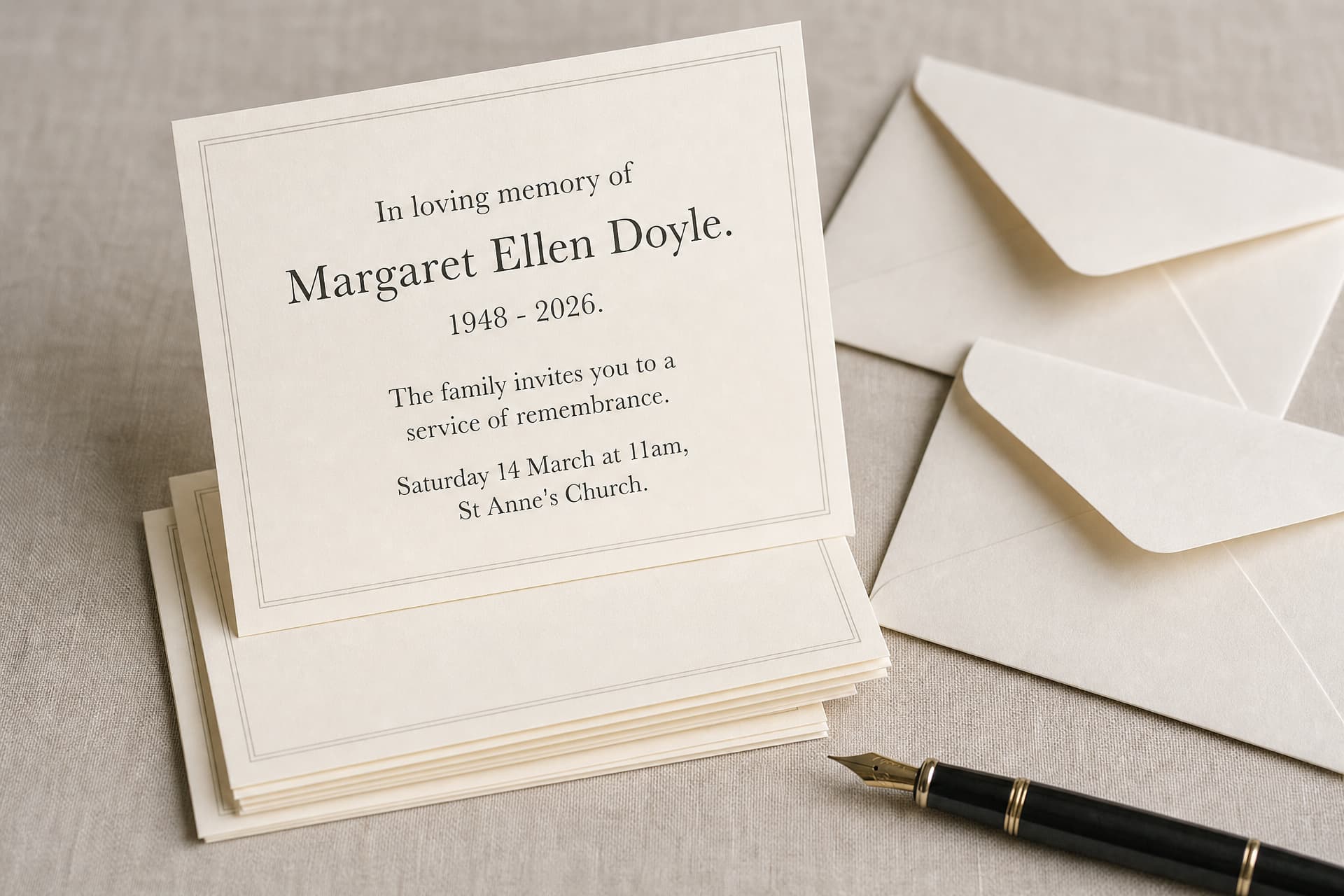
By Printed Card
Slower, and the version families keep. A printed announcement is usually sent for a memorial service held weeks after the death, or to older relatives who are not on a phone.
Line
Wording
1
In loving memory of
2
[Full name]
3
[Date of birth] — [Date of death]
4
[The family invites you to a service of remembrance]
5
[Day, date] at [time] · [Venue, address]
6
[Reception to follow at [place].]
7
[RSVP to [name] on [number], or simply come.]
Printed cards are for the service that is weeks away, not the news that broke this morning. They arrive after everyone already knows, which is exactly their job — this is the version people put on the mantelpiece and use to plan a journey.
Cards are also what most families print for the service itself, and the two jobs are usually served by the same stationery. Our memorial cards cover both — announcement cards to send, and prayer cards and guest books for the day.
When to Send What
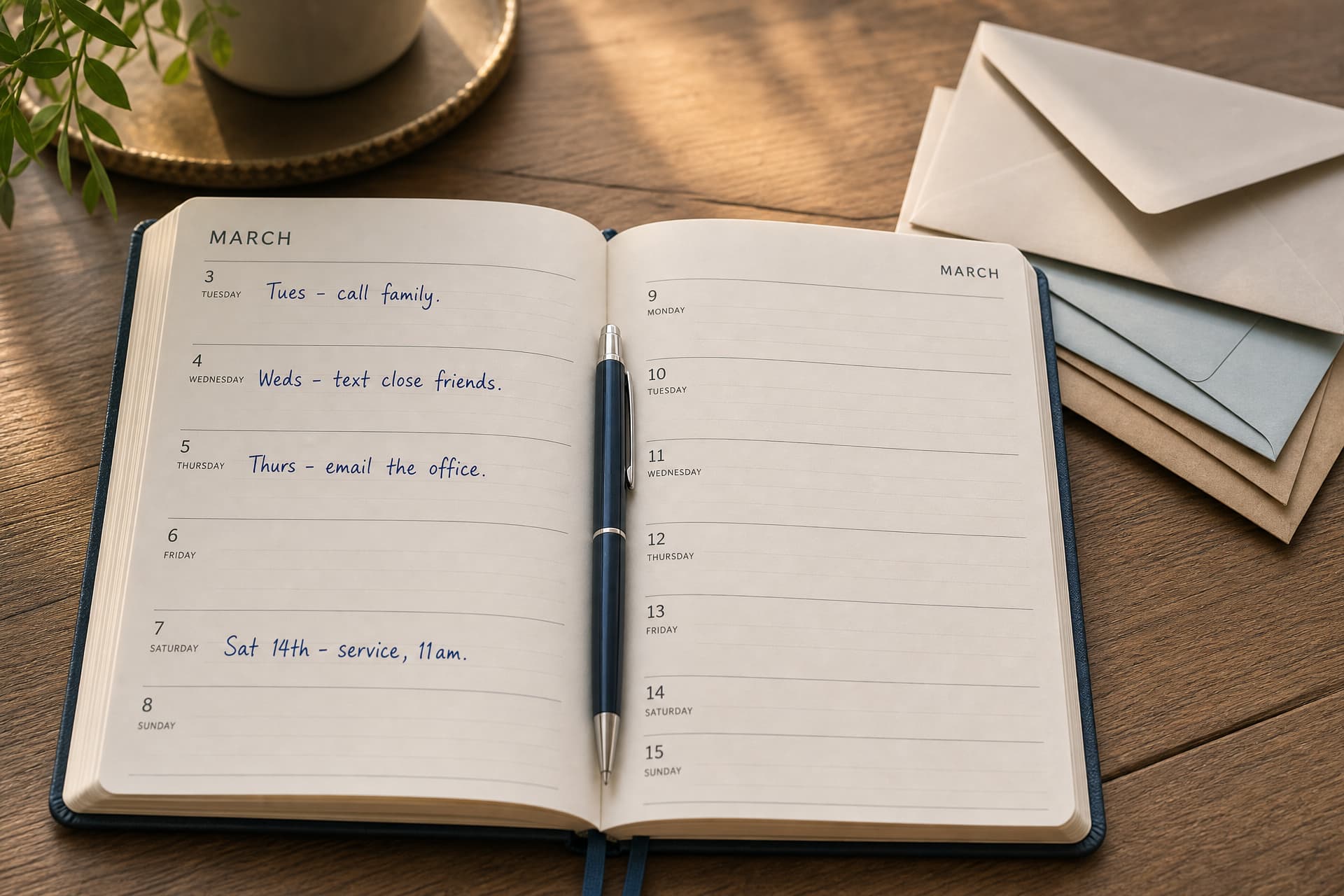
The timing matters more than the wording, and the sequence is the same in almost every family.
Within hours — immediate family, by phone. Never by text, and never let them find out any other way.
The same day — close friends, godparents, the workplace, the person who needs to cancel the milk. Text or a call.
Within two or three days — the wider circle, by email or a group message, usually still without a date.
Once the date is fixed — a second message with the service details. This is the one people actually need, and it is the one families most often forget to send because they assume everyone already knows.
A week or more out — printed cards, if you are sending them, for a memorial service set further ahead.
The second message is the one families forget. The first tells people somebody died; the second tells them when to be somewhere, and it is usually days later once the funeral home has confirmed a date.
Send the second message even to people you told in person. Nobody remembers a date they were given while being told somebody died.
Whose Job Is This?
Nobody assigns it, and in most families it lands on whoever is holding a phone when the decision gets made. That is worth interrupting, because the person who most wants to send it is often the person least able to.
Hand it to someone one step out. A sibling, a cousin, a close friend, an adult grandchild — somebody who loved them but is not the one making funeral arrangements at the same time. They will write a clearer message, and more importantly they can absorb the replies. Forty condolences arriving on the phone of the person planning the funeral is a real and avoidable harm.
Name that person inside the message."Replies to my sister Ruth, who is helping us with this" does two jobs at once: it tells people where to send their sympathy, and it quietly tells them not to send it to you.
Split the list rather than the task. One person can take the family, another the workplace, a third the church or the club. Each of them knows their own group's names, and the whole thing is done in an hour rather than a day.
The one part not to delegate is the first wave. Immediate family should hear it from immediate family, by voice, however hard that is.
Wording for the Difficult Ones
A private service."The family has asked for a private service." That is the whole sentence. You do not owe an explanation and adding one invites negotiation.
No service at all."There will be no funeral, at Dad's request." Follow it with something people can do instead — a charity, a date to raise a glass — because otherwise they are left holding sympathy with nowhere to put it.
A delayed service."We will hold a memorial in the spring so that everyone can travel. Details to follow." Say the season even if you cannot say the date.
A sudden death."[Name] died unexpectedly on [date]." Nothing more. Do not write anything you would not want repeated.
A long estrangement. Send the plain facts to the person concerned, without commentary, and let them decide what to do with it.
You do not want to say the cause. Then do not. "Died peacefully at home" is complete, and no reasonable person will ask.
What Not to Put In
Everything on this list has caused a family a problem, and none of it is obvious in the moment.
The home address, on a public post. Funerals are published events and empty houses during them are a known target. Put the venue in the announcement and the family's address nowhere near it.
Anything the immediate family has not agreed. The cause of death, an estrangement, a second marriage, who is and is not invited — none of that belongs in a message somebody forwards. If you are unsure whether a detail is yours to share, it is not.
A photograph you have not been asked about. People feel strongly about which picture goes public, and by the time you find out you are wrong it has been shared forty times.
Times you are not certain of. A corrected time is far more disruptive than a late one. "Details to follow" costs nothing; a wrong time costs somebody a wasted journey.
Anything you would not say aloud to the person's face. Announcements get screenshotted, printed and kept, and they are read by people you did not have in mind when you wrote them.
A Homegoing Service Announcement
In many Black churches the service is a homegoing — a celebration of the person's arrival home rather than a mourning of their departure — and the announcement is written to match. The tone is warmer, scripture is common, and the language of the invitation is celebratory rather than somber.
Part
Wording
1
[Full name] was called home on [date].
2
[Scripture, if the family uses one.]
3
The homegoing celebration for [name] will be held at [church] on [date] at [time].
4
[Viewing from [time]. Repast to follow in the fellowship hall.]
5
[The family of [name] thanks you for your prayers.]
Two conventions worth knowing if you are writing one for a family and are not from the tradition: "celebration" rather than "funeral" through the whole announcement, and the repast is named — it is part of the day, not an afterthought.
In Spanish
A short bilingual version is useful where part of the family reads Spanish. This wording is standard and formal:
Con profundo pesar, la familia [apellido] comunica el fallecimiento de [nombre completo], ocurrido el [fecha].
El servicio se celebrará el [fecha] a las [hora] en [lugar].
Agradecemos sus oraciones y su compañía.
Send both languages in the same message rather than two messages; families read whichever they read and pass on the whole thing.
Frequently Asked Questions
What should a funeral announcement say? Who died, when, and what is happening next. Everything else is optional.
Is a funeral announcement the same as a death notice? No. A death notice is a paid published notice; an announcement is a message you send. Our obituary guide, linked above, covers the published kind.
Is it rude to announce a death by text? No, and it is now the most common way. Reserve calls for immediate family and use text for everyone else.
Should I post it on Facebook? Yes, if it helps — but after the people who should hear personally already have.
What if we have not arranged the funeral yet? Send the first message anyway and say "details to follow." Waiting until everything is settled means people find out from someone else.
How do I announce a memorial service held months later? The same template with the date, sent as a memorial service announcement once the venue is booked. A printed card suits this better than a text, because people need to make travel plans.
Do I have to say how they died? No. Never.
In Short
Send something within a day, and send it again when you have a date. Give the facts, name what you want from people, and stop. A text is two sentences, an email carries a subject line and a clear answer on whether colleagues are welcome, and a social post waits until the calls are done.
If the service is private, say so plainly. That is a complete sentence and it needs nothing after it.