🏬Supersize Online Funeral Retailer🪦1000's of Headstones⚱️Over 10,000 Cremation Urns⚰️Caskets Overnight Delivery🛒Funeral & Memorial Superstore🚚FREE Shipping on ALL Orders👨👩👧👦Helping Families for over 20 Years💰Lowest Price Guarantee🏬Supersize Online Funeral Retailer🪦1000's of Headstones⚱️Over 10,000 Cremation Urns⚰️Caskets Overnight Delivery🛒Funeral & Memorial Superstore🚚FREE Shipping on ALL Orders👨👩👧👦Helping Families for over 20 Years💰Lowest Price Guarantee
🏬Supersize Online Funeral Retailer🪦1000's of Headstones⚱️Over 10,000 Cremation Urns⚰️Caskets Overnight Delivery🛒Funeral & Memorial Superstore🚚FREE Shipping on ALL Orders👨👩👧👦Helping Families for over 20 Years💰Lowest Price Guarantee🏬Supersize Online Funeral Retailer🪦1000's of Headstones⚱️Over 10,000 Cremation Urns⚰️Caskets Overnight Delivery🛒Funeral & Memorial Superstore🚚FREE Shipping on ALL Orders👨👩👧👦Helping Families for over 20 Years💰Lowest Price Guarantee
Funeral Programs: Examples, Wording, and Order of Service
funeral
A funeral program is the folded sheet handed to people as they arrive. It tells them what is going to happen, names everyone taking part, and carries a photograph of the person who died. It is the smallest document produced for a funeral and it is the one people still have in a drawer twenty years later.
It goes by several names and they all mean the same thing: a funeral service program, a memorial service program, an order of service, or simply the program. Nothing changes but the wording on the cover.
This page covers what goes in one panel by panel, wording you can adapt, a full order of service, how many to print, and what it costs. Everything on it applies equally to a burial, a cremation service or a celebration of life.
The Short Answer
Four panels, on one folded sheet. Cover, order of service, the life, and thanks.
Print 25% more than you expect. People take two, and families want spares afterwards.
The names are the part to get right. Everything else can be plain; a misspelled name cannot be fixed.
One photograph on the cover. More inside if you have a booklet.
It has to be final before it prints, which is usually the day before the service.
The standard is a single sheet folded once, giving four panels. Read in this order:
Panel
What goes on it
1 — Front cover
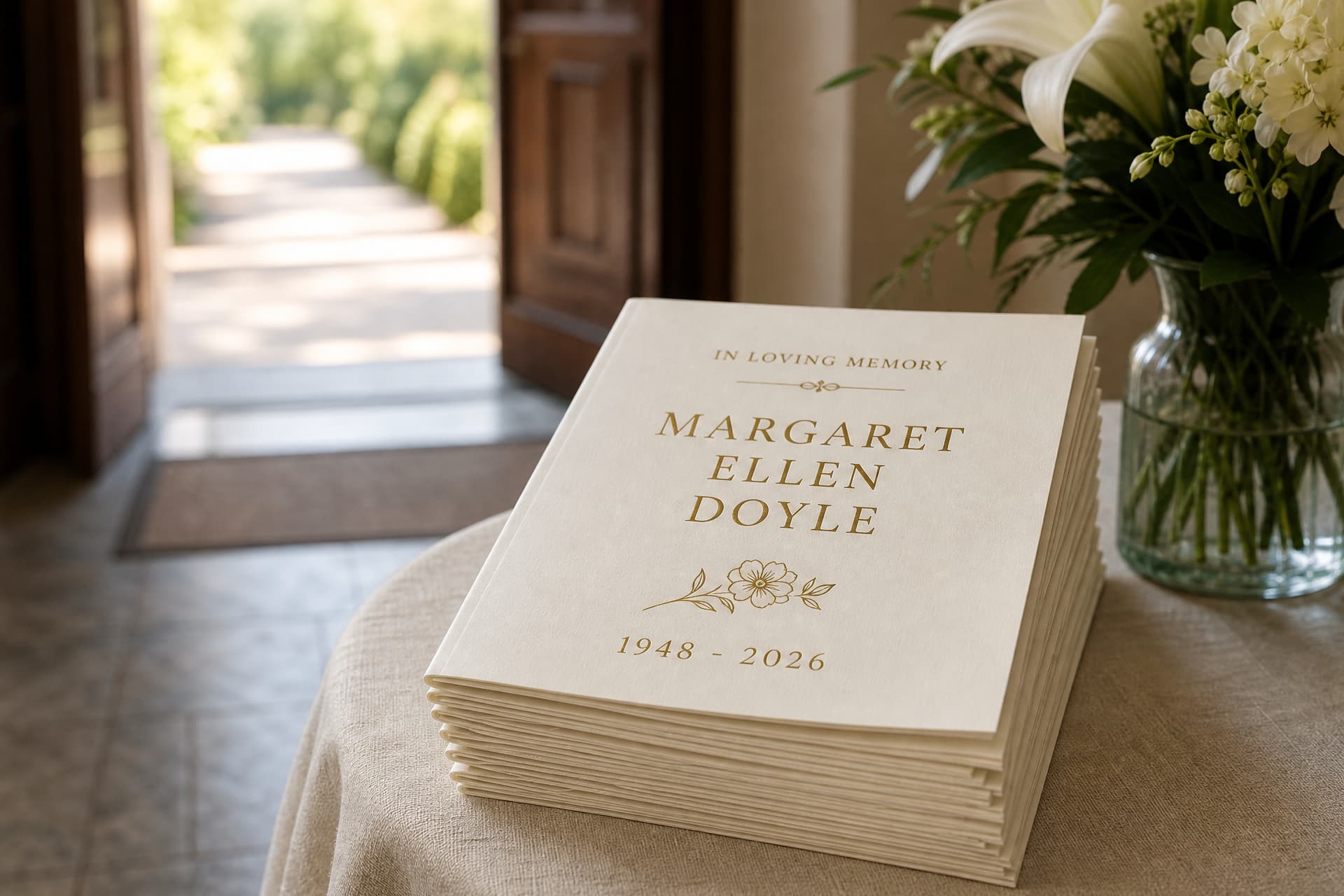
Photograph, full name, dates of birth and death, and a line such as In Loving Memory or Celebrating the Life of
2 — Inside left
The order of service: every part, in sequence, with who is doing it
3 — Inside right
The obituary or life summary, and the family — survived by, preceded by
4 — Back cover
The thank-you from the family, a poem or scripture, and the reception details
Panel 4 is the one families skip and guests most need. The reception address belongs there, because it is what people are looking for when the service ends and it is the only piece of paper they are holding.
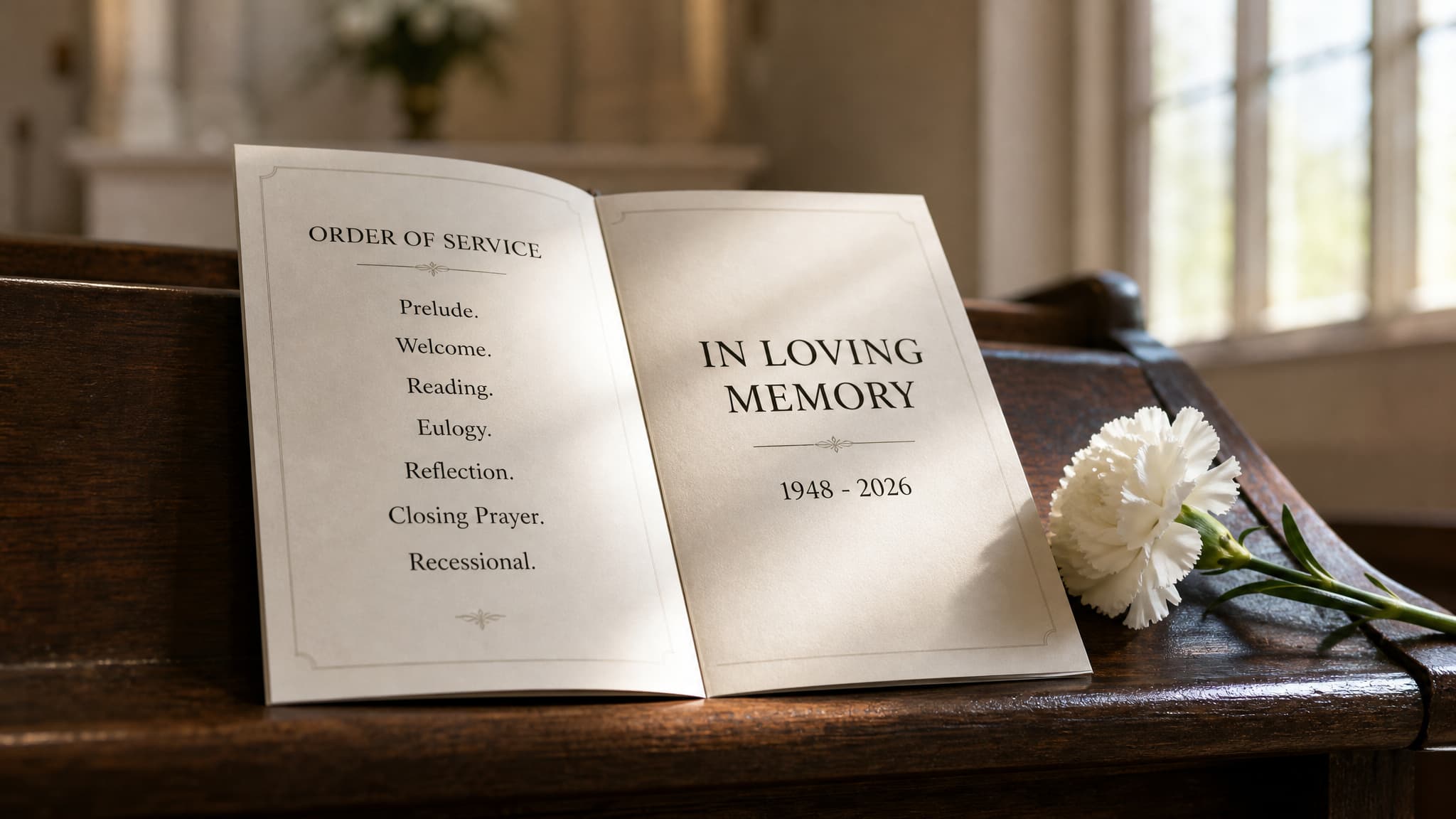
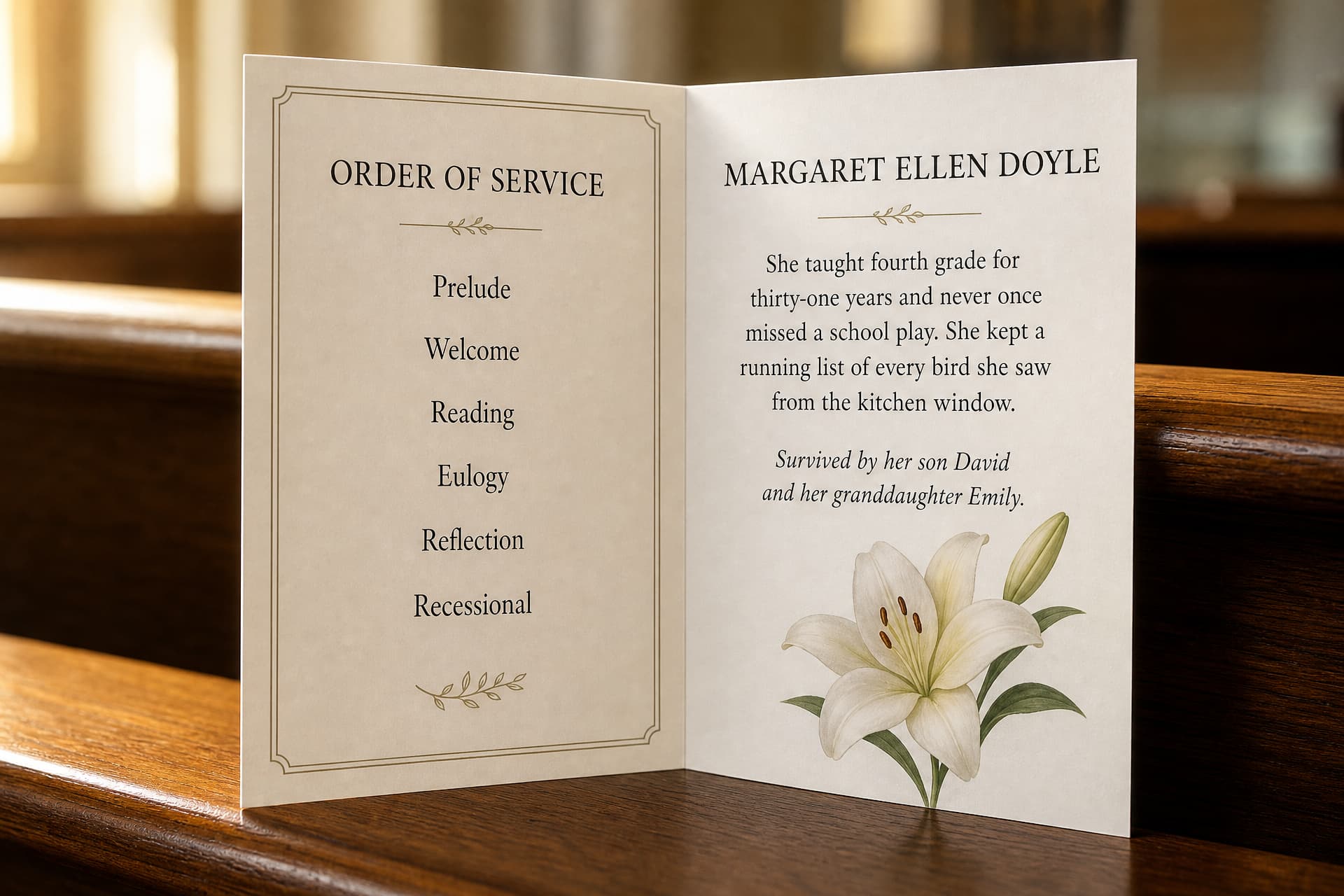
The single-fold program open at its two inside panels — the order of service on the left, the life and the family on the right. This is the format the overwhelming majority of funerals use, and it fits on one sheet of letter or A4 card folded once.
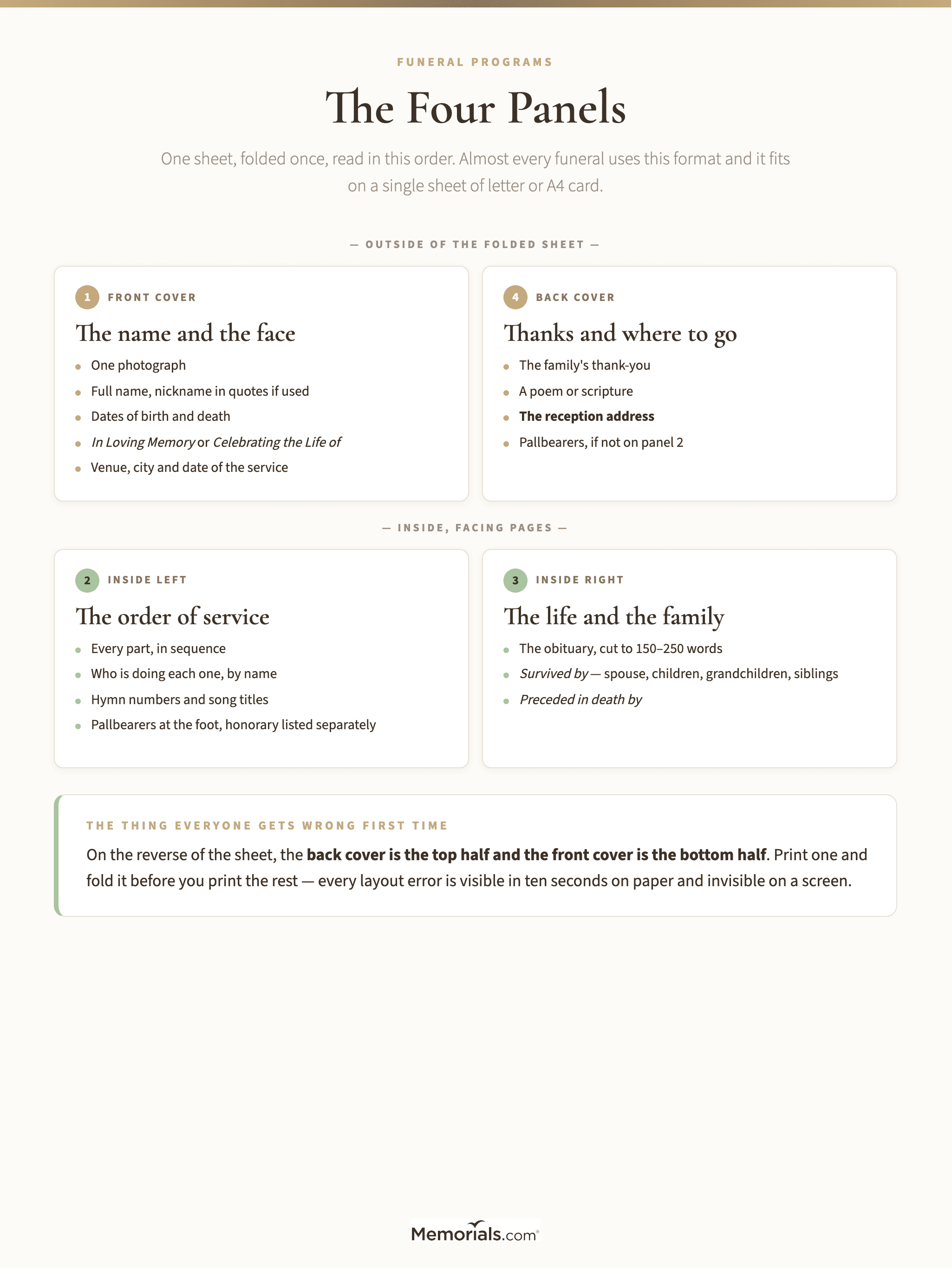
The four panels in reading order. The front cover and back cover are the outside of the folded sheet; the two facing panels are the inside. If you are laying this out yourself, the back cover is the top half of the reverse side and the front cover is the bottom half — which is the single thing most people get wrong on the first attempt.
Funeral Program Examples: Cover Wording
Most funeral program examples differ only here — the cover carries five things and no more, and crowding it is the commonest design mistake.
Line
Options
Heading
In Loving Memory of · Celebrating the Life of · In Memoriam · A Service of Thanksgiving for the Life of
Name
Full name, with a nickname in quotation marks if the family uses one
Dates
March 4, 1948 — August 12, 2026 · or 1948 – 2026
Service line
Funeral Service · Memorial Service · Celebration of Life
Place and date
Venue name, city, and the date of the service
A homegoing celebration uses its own wording throughout, beginning on the cover: Homegoing Celebration for the Life of is standard, and the word funeral usually does not appear anywhere in the program.
The Order of Service
The funeral order of service is the inside-left panel and the part guests actually read during the service. Search for an order of service for funeral wording and you will find the same sequence everywhere; what varies is which parts a family uses. Print it as a plain list with the names of whoever is doing each part.
Part
Printed as
Prelude
Prelude — [musician or recording]
Welcome
Welcome — [officiant name]
Opening prayer or words
Opening Prayer — [name]
First reading
Reading — "[title]" — read by [name]
Musical selection
[Song title] — [performer]
Eulogy
Eulogy — [name], [relationship]
Second reading or tribute
Tribute — [name]
Reflection
Reflection — [officiant name]
Closing prayer
Closing Prayer — [name]
Recessional
Recessional — [song title]
Name everybody. A reader who sees their own name printed takes the role more seriously, and guests genuinely want to know who is speaking. It also becomes the record: in ten years this sheet is the only place that says who read at the funeral.
Print the pallbearers. They go at the bottom of this panel or on the back, in two columns, with honorary pallbearers listed separately beneath — honorary pallbearers are named in the program precisely because being named is the role.
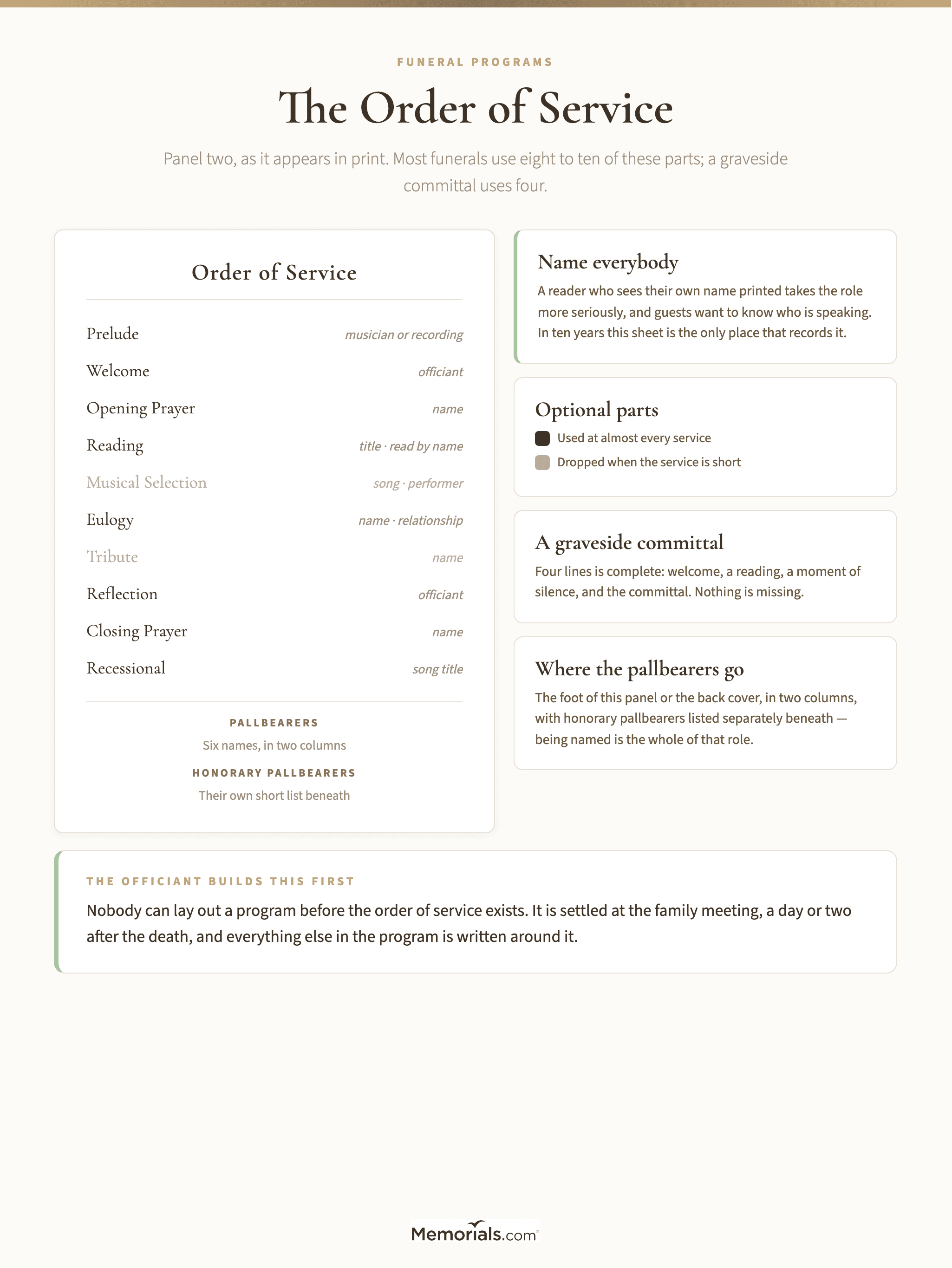
The order of service as it appears on the panel, with the optional parts marked. Most funerals use eight to ten of these; a graveside committal uses four. The pallbearer list sits at the foot of this panel or on the back cover, with honorary pallbearers in their own short list beneath the carrying ones.
The Life Panel
The inside-right panel carries a condensed version of the obituary — usually 150 to 250 words, because that is what fits.
Do not reprint the newspaper obituary in full. Cut it to the announcement, the biography, one personal detail and the family, and let the full version live where it was published. Obituary templates has fill-in formats at three lengths, and the 150-word standard form fits a program panel almost exactly.
The family section runs beneath it in the conventional order:
Survived by — spouse, then children with their spouses, then grandchildren, then siblings.
Preceded in death by — those who died first.
Great-grandchildren are often given as a count rather than a list. Ask the family first, because some want every name.
This is where errors do lasting damage. A missing stepchild or an unmarried partner left off the survived-by list is the thing families remember years later, and unlike a newspaper it cannot be corrected.
How Many to Print
More than you think, and the arithmetic is not what people expect.
Expected attendance
Print
50
65
100
125
150
190
200
250
Funeral program templates and pre-scored paper both come in packs of 25 or 50, which is worth knowing before you count. Add 25%. Couples take two rather than sharing one, latecomers take one on the way out, and the family will want ten or fifteen spares to send to people who could not come. Running out is far worse than over-printing, because the people without one are the ones who arrived last and are already feeling on the edge of things.
If the service is being livestreamed, send the program to remote guests as a PDF with the link. Following along matters more when you cannot see the room.
Printing Options and What They Cost
Four routes, and most families take the first.
The funeral home. Almost all of them print programs, often as part of the package. Simplest, and they will not miss the deadline.
A local print shop. Better paper and more design freedom, usually 24 to 48 hours, and typically $1 to $3 a copy depending on paper and color.
Print at home. Entirely viable on pre-scored memorial paper, and the cheapest by a wide margin. A color laser gives better results than inkjet on heavy stock.
Online printers. Cheapest per copy at volume, but shipping time is the risk — a two-day funeral timeline and a five-day delivery do not meet.
Whichever route, the deadline is the same: the program has to be final the day before. Names, spellings and the running order all have to be settled by then, which is why the officiant builds the order of service first and hands it to whoever is printing.
Our memorial cards category carries the printed stationery families order alongside the program — prayer cards, memorial parchment for home printing, and the guest book that stands at the door.
Most families use whatever the funeral home offers, and the ones who lay it out themselves are usually doing it because they want a specific photograph or a specific feel. The design decisions that matter are few.
Paper. Use card rather than paper — 65lb cover stock or heavier. A funeral program printed on ordinary printer paper goes limp in a warm chapel and creases in a pocket, and this is a document people keep. Pre-scored memorial paper from a stationer folds cleanly without a bone folder; a sheet folded by hand cracks along the spine unless you score it first.
Fonts. Two, at most. A serif for the name and headings, a plain sans-serif or the same serif for the body. Set the name large — larger than feels comfortable — because it is what people look for when they pick the sheet up. Everything else can be 10 or 11 point, and the order of service can go smaller still.
Color. Almost every program is printed in black on cream or white, with a single color photograph. That is not a failure of imagination; it prints reliably on every machine and it never looks wrong. Where families use color, one accent drawn from the photograph is enough — a border, a rule under the name, nothing more.
Margins. Half an inch minimum, and more at the fold. Home printers cannot print to the edge, and a design that assumes they can comes back with a white strip down one side.
Print one and fold it before you print the rest. Every layout problem — a panel upside down, the back cover on the wrong half, text running into the fold — is visible in ten seconds on a single proof and invisible on a screen.
When a Booklet Makes More Sense
A single fold is right for a funeral held within a week. A booklet — eight or twelve pages, stapled or stitched at the spine — is right when there is more time and more to say.
Families choose one for a memorial service held weeks after a cremation, for a long life with a lot of photographs, or where several people are speaking and each deserves naming. The extra pages usually carry a photo spread across the middle, a poem or scripture on its own page, and a longer life story than a single panel allows.
Two practical differences. A booklet has to be paginated in multiples of four, because each folded sheet makes four pages — so eight or twelve, never ten. And it costs meaningfully more to print, typically three to five times a single fold, which is worth knowing before the design is finished rather than after.
If the service is soon, do not attempt a booklet. The single fold is not a compromise; it is what almost every funeral uses and nobody has ever remarked on it.
Programs by Service Type
The four panels stay the same. What changes is the wording.
A religious funeral prints the liturgy in the order of service — hymn numbers, responses, the parts where the congregation speaks. Ask the officiant for the exact text rather than transcribing it.
A celebration of life usually drops funeral entirely, uses a color photograph, and often replaces the order of service with a looser running order. The tone of the cover sets the tone of the day.
A military funeral adds rank and branch beneath the name, and the order of service includes the flag presentation and Taps.
A cremation memorial held weeks later often becomes a booklet rather than a single fold, because there is time to make one and more photographs to include.
A graveside-only service needs a single card rather than a folded program — name, dates, four lines of order of service, and the reception address.
The Photograph on the Cover
More families agonize over this than over anything else in the program, and the criteria are simpler than the agonizing suggests.
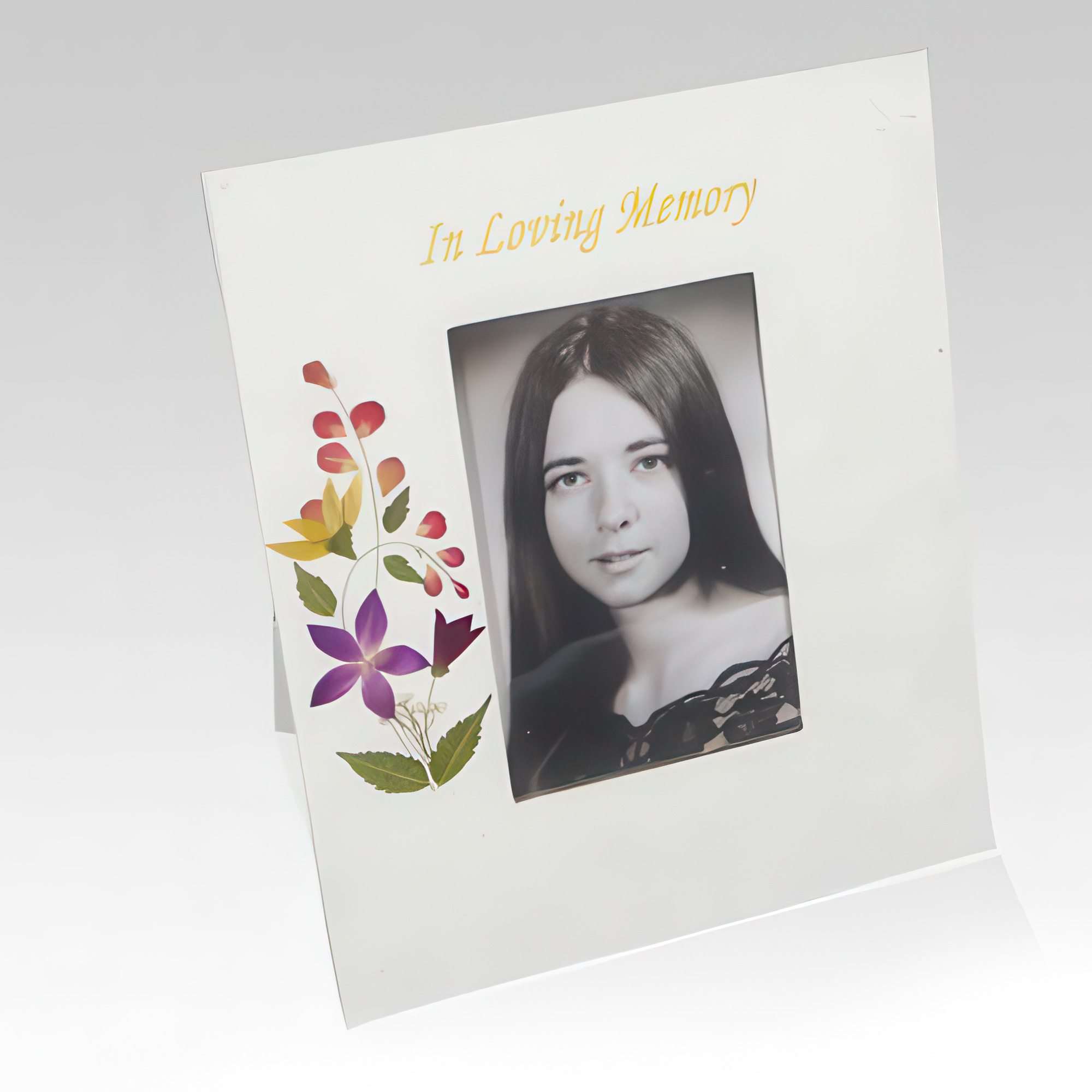
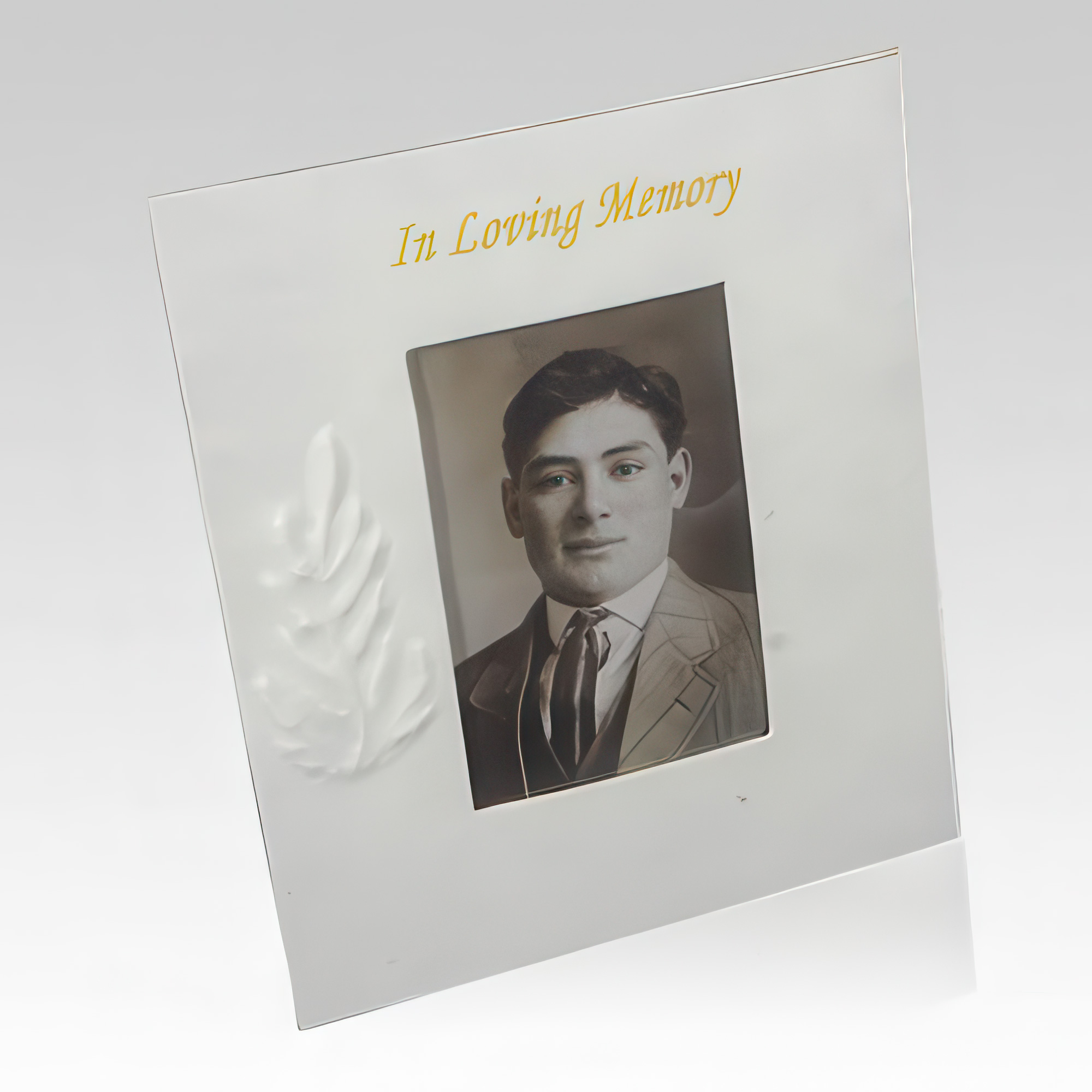
Pick the one where they look like themselves. Not the most recent, not the most formal, and not necessarily the best photograph. The face at the age people knew them best is the one the room recognizes, and a slightly imperfect snapshot of somebody laughing beats a stiff studio portrait from twenty years earlier.
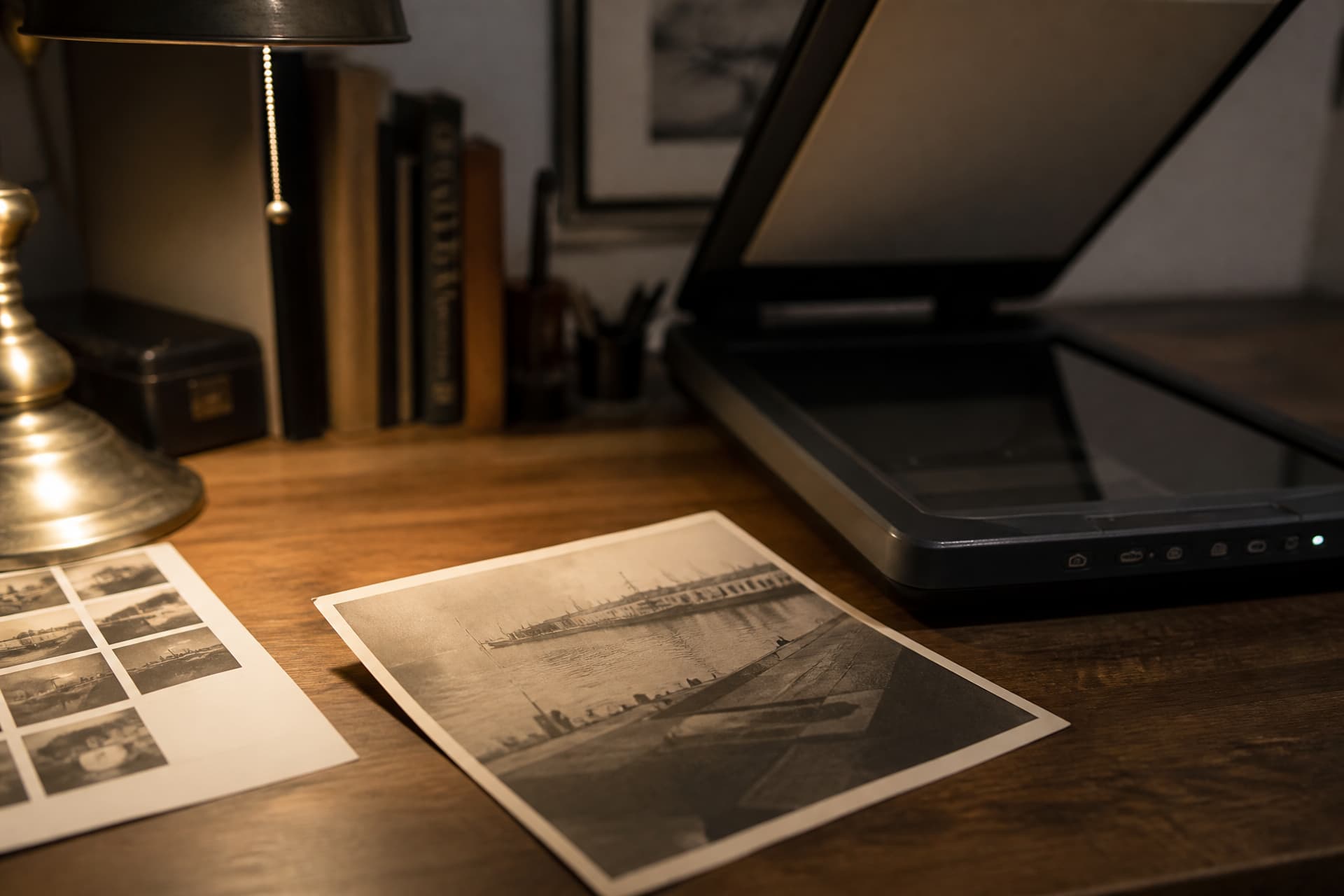
Check the resolution before you fall in love with it. A program prints small and on coated stock, which is unforgiving. If the only copy is a print, scan it rather than photographing it — a phone picture of a photograph loses more than people expect, and the loss only becomes visible once it is printed and there is no time to change it.
Crop close. A full-length photograph of somebody at a wedding reduces the face to the size of a fingernail on a program cover. Crop to head and shoulders even if it means losing a much-loved background.
Ask before you crop somebody out. A picture with a spouse, a sibling or a friend removed is a decision somebody will notice, and it upsets people far more than you would expect. It takes one message to ask.
Black and white is always safe. A color photograph on a cream cover can clash with whatever the printer does with the ink; converting to grayscale removes the problem entirely and never looks like a compromise. Most funeral homes will do this by default.
If there is genuinely no good photograph — which happens more often than people admit — a program with no picture at all and the name set large is dignified and complete. It is a better answer than a bad photograph enlarged.
Common Mistakes
Every one of these is routine and every one is avoidable.
A misspelled name. The single most damaging error and the easiest to prevent. Have somebody outside the immediate family read the names aloud against a written list.
The reception address left off. Guests are holding this sheet and nothing else.
A low-resolution photograph. A picture taken off a phone screen or lifted from Facebook prints soft and gray. Scan an original if one exists.
Too much on the cover. Five lines, one photograph. A poem on the cover pushes the name down and it is the name people are looking for.
Printing before the running order is final. Then a speaker changes and the programs are wrong. Confirm with the officiant, then print.
Forgetting the honorary pallbearers. They are named in the program and nowhere else — leaving them off removes the entire substance of the title.
Scan the original rather than photographing a print or pulling it from social media. A funeral program is small and printed on coated stock, which is unforgiving of a soft source — and the cover photograph is the part of this document people look at longest.
What Happens to Them Afterwards
Programs outlast the day by a long way, and a small amount of planning at the time saves a lot of hunting later.
Keep more than you think. Ten to fifteen spares, put somewhere deliberate rather than in the pile of things carried home from the funeral home. Families ask for them years afterwards — a grandchild doing a school project, a cousin who could not come, somebody assembling a family history.
Print 25 percent more than you expect. Couples take two rather than sharing, latecomers take one on the way out, and the family will want ten or fifteen spares — running out is far worse than over-printing, because the people left without one arrived last and already feel on the edge of things.
Send one to everybody who could not attend. It is the single most appreciated thing a family can post in the weeks afterwards, and it costs a stamp. People who were too far away or too unwell to come genuinely treasure it, because it is the only thing that tells them what happened and who spoke.
Photograph or scan one. A flat scan of all four panels takes five minutes and it is what survives when the paper does not. Email it to the family, put it wherever the family photographs live, and it will still exist when the drawer has been cleared.
One goes in the guest book. Tucked inside the front cover, the two documents together are the complete record of the day: who came, and what happened. Families who do this are always glad of it.
A funeral program is a small piece of print produced under pressure in about a day, and it becomes the most durable object from the whole event. Treating it as a keepsake while you are making it — good paper, the right photograph, the names checked — takes very little extra effort and is the whole difference in twenty years.
Frequently Asked Questions
What is a funeral program? The folded sheet handed to guests, carrying the order of service, a photograph, the life summary and the family's thanks.
What is the difference between a funeral program and an order of service? None in practice. The order of service is one panel of the program, and the two names are used interchangeably.
How many pages should a funeral program be? One sheet folded once — four panels — covers almost every service. A booklet is for a memorial held later with more photographs.
Who writes the funeral program? Usually the family, with the order of service supplied by the officiant. The funeral home will lay it out if they are printing it.
How much do funeral programs cost? Often included by the funeral home. A print shop is typically $1 to $3 a copy; printing at home on memorial paper is the cheapest.
What photograph should go on the front? One where they look like themselves, at the age people knew them best. Scan the original for resolution.
Do you print the pallbearers in the program? Yes — carrying pallbearers and honorary pallbearers in separate lists.
What do you write on the back of a funeral program? The family's thank-you, a poem or scripture, and the reception details.
Who Does What, and When
A funeral program is assembled by three or four people who are rarely in the same room, and it is the handoffs that miss.
The officiant builds the order of service. They settle who is reading, who is speaking and in what sequence, usually at the family meeting a day or two after the death. Nobody can lay out a program before that exists — see the funeral officiant's role for what that meeting covers.
The family supplies the names. Survivors, predeceased, pallbearers, readers, and the spelling of every one of them. This is the part that arrives late and matters most, and it is worth writing out longhand rather than dictating it over the phone.
Somebody writes the life panel. Usually whoever wrote the obituary, cut to fit. If the obituary is not finished, the panel gets written from the same material.
The funeral director or a print shop lays it out, and needs everything above plus the photograph, as a file rather than a print.
The sequence has one hard deadline in it: the printer needs it the day before. Working backwards, the running order has to be settled two days out and the names the same day. Families who miss the program deadline almost always miss it on the names, and it is the one thing nobody can guess.
Ask the funeral director what time they need it and treat that as fixed. They will have told you, once, on a day when nobody was writing anything down.
Hub Library
This guide is part of the Memorials.com Funeral Programs collection. Every page below goes considerably deeper than this overview into one part of the service — what gets written, who does what, and what happens on the day.
What Gets Written
The documents produced for a funeral, each with fill-in formats you can copy.
Four panels on one folded sheet: cover, order of service, the life and the family, and the thanks. Name everybody who takes part, put the reception address on the back, add 25% to the print run, and check the spellings against something written down.
Get it final the day before. It is the one document from the funeral that people still have decades later, and the only errors that matter are the names.