🏬Supersize Online Funeral Retailer🪦1000's of Headstones⚱️Over 10,000 Cremation Urns⚰️Caskets Overnight Delivery🛒Funeral & Memorial Superstore🚚FREE Shipping on ALL Orders👨👩👧👦Helping Families for over 20 Years💰Lowest Price Guarantee🏬Supersize Online Funeral Retailer🪦1000's of Headstones⚱️Over 10,000 Cremation Urns⚰️Caskets Overnight Delivery🛒Funeral & Memorial Superstore🚚FREE Shipping on ALL Orders👨👩👧👦Helping Families for over 20 Years💰Lowest Price Guarantee
🏬Supersize Online Funeral Retailer🪦1000's of Headstones⚱️Over 10,000 Cremation Urns⚰️Caskets Overnight Delivery🛒Funeral & Memorial Superstore🚚FREE Shipping on ALL Orders👨👩👧👦Helping Families for over 20 Years💰Lowest Price Guarantee🏬Supersize Online Funeral Retailer🪦1000's of Headstones⚱️Over 10,000 Cremation Urns⚰️Caskets Overnight Delivery🛒Funeral & Memorial Superstore🚚FREE Shipping on ALL Orders👨👩👧👦Helping Families for over 20 Years💰Lowest Price Guarantee
Writing an obituary for a loved one is one of the most meaningful things you can do during a difficult time. An obituary is more than a death announcement — it is a tribute that shares who someone was, the life they lived, and the people they loved. It also serves a practical purpose, informing the community about funeral or memorial service arrangements.
Whether you are writing an obituary for a parent, spouse, grandparent, or friend, this guide walks you through every step of the process. From gathering essential details to choosing where to publish, you will have everything you need to craft a heartfelt, accurate tribute. Writing the obituary is one task on a larger list — our funeral planning guide covers the full range of decisions families face.
An obituary is a written notice that informs others about a person's death while celebrating their life. It typically includes biographical information, a list of surviving family members, and details about upcoming services.
Obituaries serve several purposes at once. They announce the death publicly, preserve a record of the person's life for future generations, and give friends and community members the information they need to pay their respects.
Obituary vs. Death Notice
People often confuse an obituary with a death notice, but the two serve different purposes. A death notice is a brief factual announcement — name, age, date of death, and service details. An obituary is longer and more personal, weaving in biographical details, personality, accomplishments, and family connections. Think of a death notice as the facts and an obituary as the story.
Obituary vs. Eulogy
An obituary is also distinct from a eulogy. A eulogy is a speech delivered at the funeral or memorial service, often by a close family member or friend. It tends to be more personal and emotional than an obituary, which is written for a broader public audience. Many families prepare both — the obituary to share publicly before or around the time of the service, and the eulogy for the service itself. If you are also preparing remarks for the service, our guide on what to say at a funeral offers helpful direction.
What to Include in an Obituary
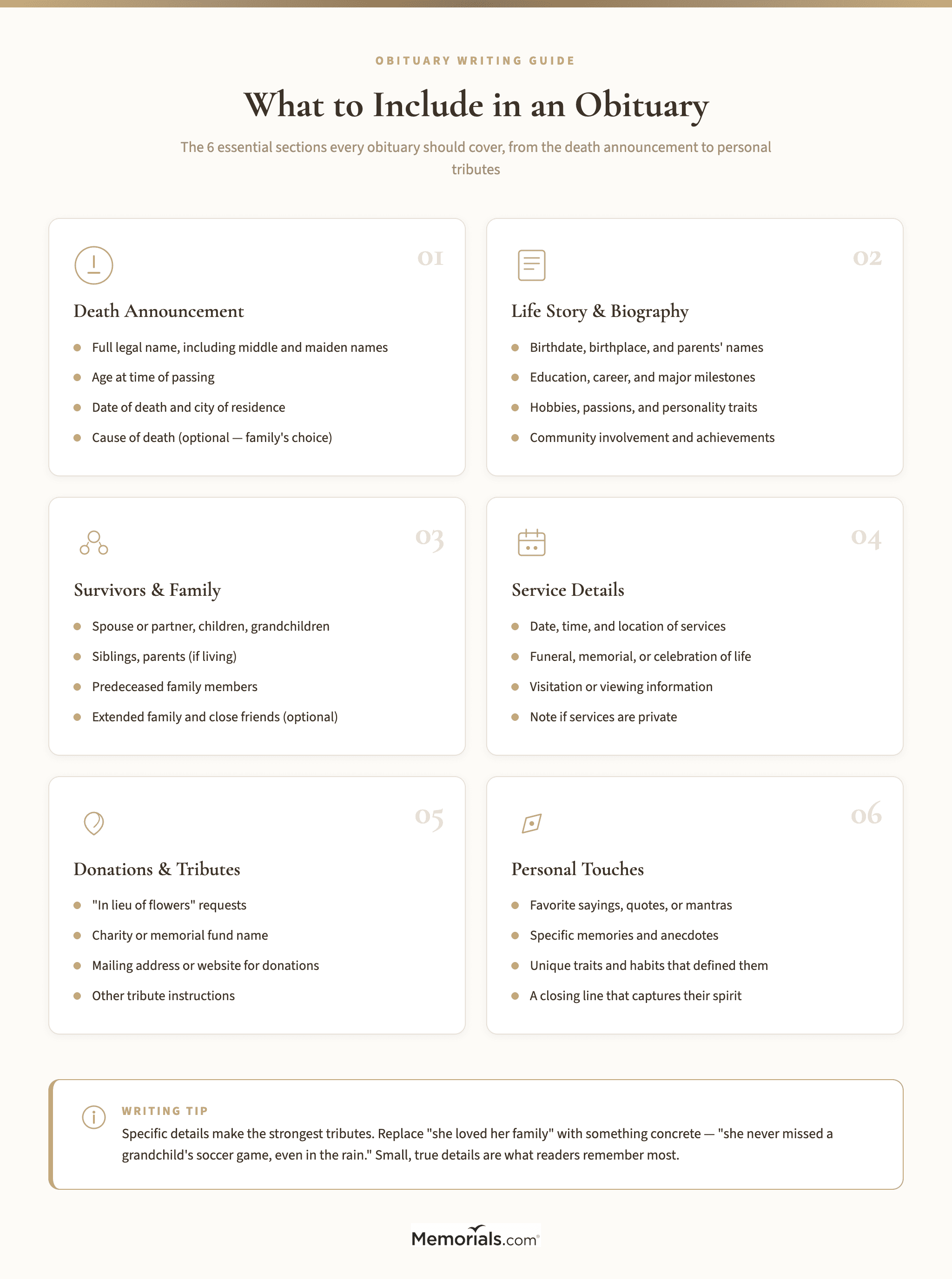
Every obituary should cover a set of core details. Here is what to include, roughly in order.
The Death Announcement
Open with the person's full legal name, including any middle names, maiden names, or suffixes like Jr. or Sr. If the person was widely known by a nickname, include that as well. Follow with their age, city of residence, and the date of death. Some families choose to include the location or circumstances of the death, while others prefer to keep those details private. Both approaches are appropriate.
The language of the announcement is a personal choice. "Died," "passed away," "left this world," and "went to be with the Lord" are all common phrasings. Choose the words that feel authentic to the person and the family.
Biographical Information
The biographical section is the heart of the obituary. It tells the story of the person's life, moving through the key chapters: where they were born, where they grew up, where they went to school, and what they did for work. Include significant milestones like marriage dates, military service, career achievements, and community involvement.
Beyond the chronological facts, this is where personality comes through. Mention hobbies, passions, favorite pastimes, and the small details that made them who they were — a love of gardening, a talent for storytelling, a habit of collecting something unexpected. These personal touches are what transform an obituary from a factual record into a genuine tribute.
Survivors and Predeceased Family
List the person's surviving family members, typically starting with a spouse or partner, then children (and their spouses), grandchildren, siblings, and parents if still living. Extended family members, close friends, and beloved pets can also be included.
If any close family members died before the person, note that they were "preceded in death by" those individuals. The standard phrasing is: "She is survived by her husband, John; her children, Sarah and Michael; and her four grandchildren. She was preceded in death by her parents, Robert and Helen."
You are not required to list every family member by name. Many families use a phrase like "and many loving nieces, nephews, and friends" to acknowledge extended family without listing everyone individually.
Funeral and Memorial Service Details
Include the date, time, and location of any public services — whether a funeral, memorial service, visitation, or celebration of life. If the service is private, say so clearly: "A private family service will be held." If no service is planned immediately, you might write: "A celebration of life will be announced at a later date."
Charitable Donations and Memorial Tributes
Many families request donations to a charity, memorial fund, or organization that was meaningful to the deceased, often in lieu of flowers. Include the full name of the organization and, if possible, a mailing address or website link. The standard phrasing is: "In lieu of flowers, memorial donations may be made to [Organization Name]."
How to Write an Obituary Step by Step
Knowing what to include is half the work. The other half is actually sitting down and writing it. Here is a practical process that works whether you are writing the obituary yourself or helping someone else.
Step 1: Gather the Facts
Before you write a single sentence, collect all the essential information: full name, dates, places, family names, and service arrangements. Having everything in front of you prevents errors and reduces the stress of trying to remember details while writing.
Step 2: Talk to Family and Friends
Some of the best obituary details come from conversations. Ask siblings, children, cousins, and close friends for stories, memories, and personal details you might not know or have forgotten. These conversations often surface the specific details — a signature phrase, a Sunday morning tradition, a running joke — that make an obituary feel alive.
Step 3: Choose a Tone
An obituary can be warm, formal, lighthearted, reverent, or any combination. The tone should match the personality of the person being honored. Some of the most memorable obituaries use humor, while others are quietly dignified. There is no wrong approach as long as it feels true to the person.
Step 4: Write the First Draft
Start with the death announcement, move through the biographical section, list family members, and end with service details and donation information. Do not worry about perfection on the first pass — get the information down and refine the language afterward.
A helpful framework is to think of yourself as a storyteller. You are not writing a legal document. You are sharing the story of a life with people who cared about that person.
Step 5: Add Personal Touches
Go back through your draft and look for places to add warmth and personality. Replace generic descriptions with specific ones. Instead of "she loved her family," try something like "she never missed a grandchild's soccer game, even in the rain." Specific details are what readers remember.
Step 6: Proofread Carefully
Obituaries are read by many people and preserved permanently online. Check all names, dates, and facts for accuracy. Read the text aloud to catch awkward phrasing. Print a copy if it helps you spot errors you might miss on screen. Ask at least one other person — ideally someone who knew the deceased well — to review the draft before publishing.
Short Obituary Examples
Not every obituary needs to be long. Newspaper obituaries are often limited by word count or cost, and some families simply prefer a concise announcement. A short obituary can be just as meaningful as a long one if it captures the essential facts and a true personal detail.
Here are three structural formats for short obituaries, using fictional names, that you can adapt to your own situation.
Brief Death Notice (40–60 words)
Margaret Anne Collins, 78, of Austin, Texas, passed away on March 14, 2026. She retired after 30 years of teaching third grade and was known for her generous spirit and love of bluebonnets. She is survived by her daughter, Lisa, and three grandchildren. A memorial service will be held at First Presbyterian Church on March 20 at 2:00 p.m.
Standard Short Obituary (100–150 words)
James Robert Whitfield, 65, of Denver, Colorado, died peacefully at home on February 8, 2026, surrounded by his family. Born on July 12, 1960, in Omaha, Nebraska, James graduated from the University of Colorado and spent his career as a civil engineer. He was a devoted father, an avid fly fisherman, and the kind of neighbor who would shovel your driveway before you woke up. James was preceded in death by his parents, Robert and Eileen. He is survived by his wife of 38 years, Karen; his children, David and Rachel; and his granddaughter, Emma. A celebration of life will be held on February 15 at Riverside Community Center at 11:00 a.m. In lieu of flowers, donations may be made to Trout Unlimited.
Narrative Short Obituary (150–200 words)
Catherine Marie Torres, 82, left this world on January 22, 2026, the same way she lived in it — quietly, gracefully, and on her own terms. Born in San Antonio to Manuel and Rosa Delgado, Catherine grew up in a household where the kitchen door was always open and the coffee was always on. She married Eduardo Torres in 1964, and together they raised four children in the home they built with their own hands. Catherine worked as a bookkeeper for 25 years, sang in the church choir every Sunday, and made tamales every December for anyone who walked through her door. She is survived by her children — Maria, Luis, Ana, and Carlos — along with nine grandchildren and two great-grandchildren. She was preceded in death by her husband, Eduardo, and her sister, Rosa Elena. The family will receive visitors on January 26 at Sacred Heart Catholic Church from 4:00 to 7:00 p.m., followed by a funeral mass on January 27 at 10:00 a.m.
These examples follow the standard obituary format — announcement, biography, survivors, service details — but the third shows how a narrative approach can bring a short obituary to life with just a few specific details.
How Long Should an Obituary Be?
Obituary length depends on where you plan to publish it and how much you want to share. Here are general guidelines.
A death notice is typically 40 to 60 words — just the essential facts.
A newspaper obituary usually runs 150 to 300 words. Most newspapers charge by the word or line, so brevity has a practical cost advantage.
An online obituary has no strict word limit. Digital platforms like funeral home websites and memorial sites allow longer, more detailed tributes — some running 500 to 1,000 words or more.
If you are unsure, aim for 200 to 400 words. That is enough space to cover all the essential sections while including the personal details that make an obituary feel like a genuine tribute rather than a form.
Where to Publish an Obituary
Families today have more options than ever for publishing an obituary. Most choose more than one.
Local newspapers remain the traditional choice, especially for reaching older community members who still read print editions. Most newspapers offer both print and online listings. Pricing varies by publication and word count — a print obituary typically costs anywhere from $50 to $500, depending on length and whether a photo is included.
Funeral home websites are one of the most common places to post an obituary. Many funeral homes will publish the obituary on their website as part of their services, and these listings are often the first result that appears when someone searches for the deceased by name.
Online memorial platforms like Legacy.com, Tributes.com, and other memorial websites allow families to create permanent digital obituaries with photos, guestbooks, and condolence sections.
Social media is increasingly used to share the news of a death, though most families use it to supplement — not replace — a formal obituary.
Whichever platform you choose, keep a copy of the final obituary for your family's records. It becomes a lasting document.
Obituary Writing Tips for Specific Situations
Writing an Obituary for a Parent
When writing an obituary for a family member, especially a parent, the challenge is balancing your personal knowledge with what readers need to know. Focus on the details that defined them as a person, not just their relationship to you. What were they known for? What would a neighbor or coworker remember about them?
Writing Your Own Obituary in Advance
Some people choose to write their own obituary ahead of time. This spares loved ones from the task during an already emotional period and ensures the obituary reflects the tone and details the person preferred. If you go this route, designate someone to update dates and service details when the time comes.
Religious Obituaries
Religious and cultural traditions shape how obituaries are written. Catholic obituaries often reference the faith journey, parish membership, and devotions like the rosary. Jewish death notices tend to be brief, with burial happening quickly. Certain Catholic funeral traditions carry specific expectations about obituary language and service announcements.
When the Death Is Sudden or Tragic
If the death was unexpected — an accident, a sudden medical event, or another traumatic circumstance — families often struggle with how much to disclose. There is no obligation to include the cause of death. A simple phrase like "died unexpectedly" or "passed away suddenly" acknowledges the circumstances without sharing details the family may not be ready to make public.
Complementary Memorial Keepsakes
Many families create printed keepsakes alongside the obituary. Memorial cards — also called prayer cards or remembrance cards — are small printed cards distributed at the funeral that feature the person's photo, dates, and a meaningful quote or prayer. They serve as a lasting physical memento that attendees can keep.
If you are planning a celebration of life rather than a traditional funeral, celebration of life cards offer a more contemporary option for printed tributes.
Frequently Asked Questions
How long should an obituary be?
Most obituaries run between 200 and 400 words, though length depends on where you plan to publish. Newspaper obituaries tend to be shorter due to word-count pricing, while online obituaries can be as long as needed. A death notice — the shortest format — is typically 40 to 60 words.
What should you not include in an obituary?
Avoid including private home addresses, personal phone numbers, or financial details. If there are sensitive family dynamics — estrangements, complicated relationships, or minors whose names you prefer to keep private — you can choose what to include. You are also not required to disclose the cause of death.
Do you have to pay for an obituary?
It depends on where you publish. Funeral home websites and online memorial platforms often include obituary posting at no additional cost. Newspaper obituaries typically do carry a fee, ranging from $50 to $500 or more depending on the publication, word count, and whether a photograph is included.
Who writes the obituary?
A close family member usually writes the obituary — often a spouse, adult child, or sibling. Friends can also write obituaries, and some families hire the funeral home or a professional obituary writer to help. Some people write their own obituary in advance.
What is the difference between an obituary and a death notice?
A death notice is a brief factual announcement — name, age, date of death, and service details. An obituary is longer and more personal, including biographical information, personality details, family listings, and often a narrative about the person's life.
Writing the Obituary Is Part of a Bigger Process
The obituary is one piece of a much larger set of arrangements. If you are managing funeral planning alongside writing the tribute, a funeral planning checklist can help you track every task — from selecting a casket to notifying organizations — so nothing falls through the cracks during an overwhelming time.
An obituary is more than a notice. It is the last story you tell on someone's behalf, and it deserves the same care and honesty you would bring to any conversation about someone you love.