🏬Supersize Online Funeral Retailer🪦1000's of Headstones⚱️Over 10,000 Cremation Urns⚰️Caskets Overnight Delivery🛒Funeral & Memorial Superstore🚚FREE Shipping on ALL Orders👨👩👧👦Helping Families for over 20 Years💰Lowest Price Guarantee🏬Supersize Online Funeral Retailer🪦1000's of Headstones⚱️Over 10,000 Cremation Urns⚰️Caskets Overnight Delivery🛒Funeral & Memorial Superstore🚚FREE Shipping on ALL Orders👨👩👧👦Helping Families for over 20 Years💰Lowest Price Guarantee
🏬Supersize Online Funeral Retailer🪦1000's of Headstones⚱️Over 10,000 Cremation Urns⚰️Caskets Overnight Delivery🛒Funeral & Memorial Superstore🚚FREE Shipping on ALL Orders👨👩👧👦Helping Families for over 20 Years💰Lowest Price Guarantee🏬Supersize Online Funeral Retailer🪦1000's of Headstones⚱️Over 10,000 Cremation Urns⚰️Caskets Overnight Delivery🛒Funeral & Memorial Superstore🚚FREE Shipping on ALL Orders👨👩👧👦Helping Families for over 20 Years💰Lowest Price Guarantee
A funeral receiving line is the few minutes at the end of a visitation or a service when the immediate family stands together and everyone else files past to speak to them. It is brief, it is formal, and it is the part of a funeral that guests spend the most time worrying about.
The worry is almost always the same one: what do I say? The answer is shorter than people expect. One sentence, eight seconds, and then move. Anything longer holds up a line of forty people behind you, and the family will not remember the words — they will remember that you came.
This page covers who stands in the line and in what order, what to say when you reach them, how the front rows are usually seated, and what to do when there is no line at all. For funeral etiquette more broadly, see funeral etiquette; for where this sits in the running order, the .
Say one sentence."I'm so sorry" is complete. Add your name if they might not place you.
Eight to ten seconds each. There are people behind you.
Do not ask questions. The family has answered "how did it happen" forty times already.
A handshake or a brief hug — follow their lead, not your instinct.
If you knew the person and not the family, say how you knew them. That is the most useful thing you can offer.
Who Stands in the Line, and in What Order
A receiving line funeral follows a conventional order, and no rule enforces it. Most families line up closest-relationship-first, so that guests meet the person they most came for while they are still composed.
Position
Who
1
The spouse or partner
2
The children, oldest to youngest
3
Children's spouses, beside their partner
4
The parents of the person who died, if living
5
Siblings
6
Grandchildren, if they are old enough to want to
Three things worth knowing. Nobody is obliged to stand in it — a family member who cannot face it may sit, and no guest will think anything of it. Grandchildren often stand at the end so they can slip away when they have had enough. And a chair belongs in the line, for anyone elderly or unwell; standing for ninety minutes is a real physical demand that nobody warns families about.
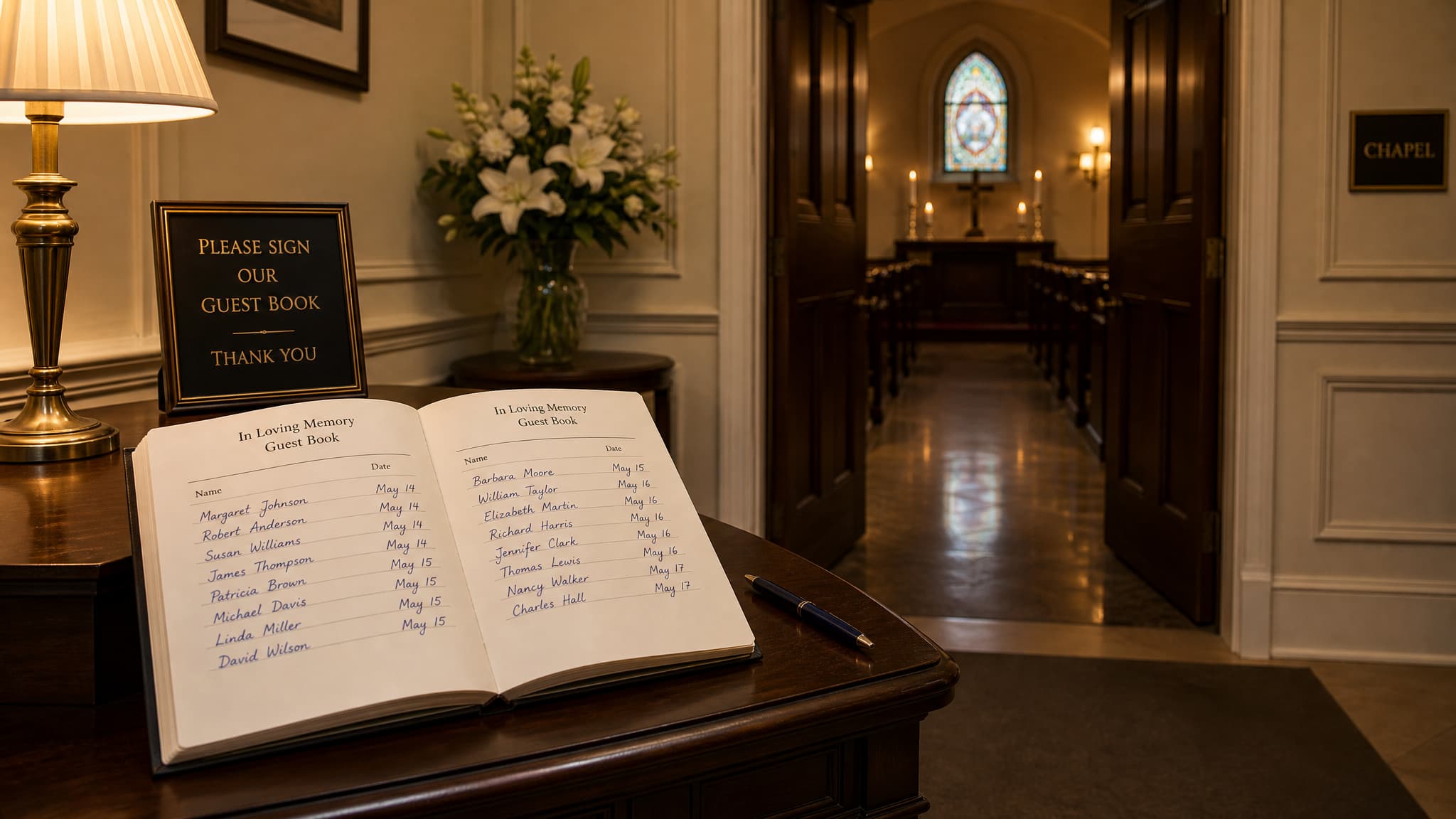
The line usually forms in the foyer rather than the chapel, and the guest book sits at the start of it. Signing the book before you join the line is the practical order — it gives you something to do while you wait and it means you are not writing while the family stands waiting for you.
What to Say at a Receiving Line
What to say at a wake receiving line is the question guests actually arrive with, and the whole script is one sentence, optionally two. These all work:
"I'm so sorry for your loss."
"I'm Anna — I worked with your dad. He talked about you constantly."
"There's nothing to say, is there. I'm just so sorry."
"He was very kind to me when I was new. I won't forget it."
"I loved her. I'm so glad I got to know her."
If you knew the person and not the family, say how."I was in his running club" gives them something real, and families genuinely collect these — half of what people learn about a parent's working life they learn in a receiving line.
What not to say, and every one of these is common and well-meant:
"How did it happen?" — they have answered it forty times today.
"At least he had a good innings" or "at least she isn't suffering." Any sentence starting at least is an argument that the loss is smaller than it is.
"Let me know if you need anything." It puts the task on them. "I'll call you next week" is the same sentiment with the work in the right place.
"I know exactly how you feel." You do not, and the family are not in a position to say so.
Anything about yourself that lasts more than a sentence.
Silence is also fine. Taking somebody's hand and saying nothing is a complete contribution and people remember it.
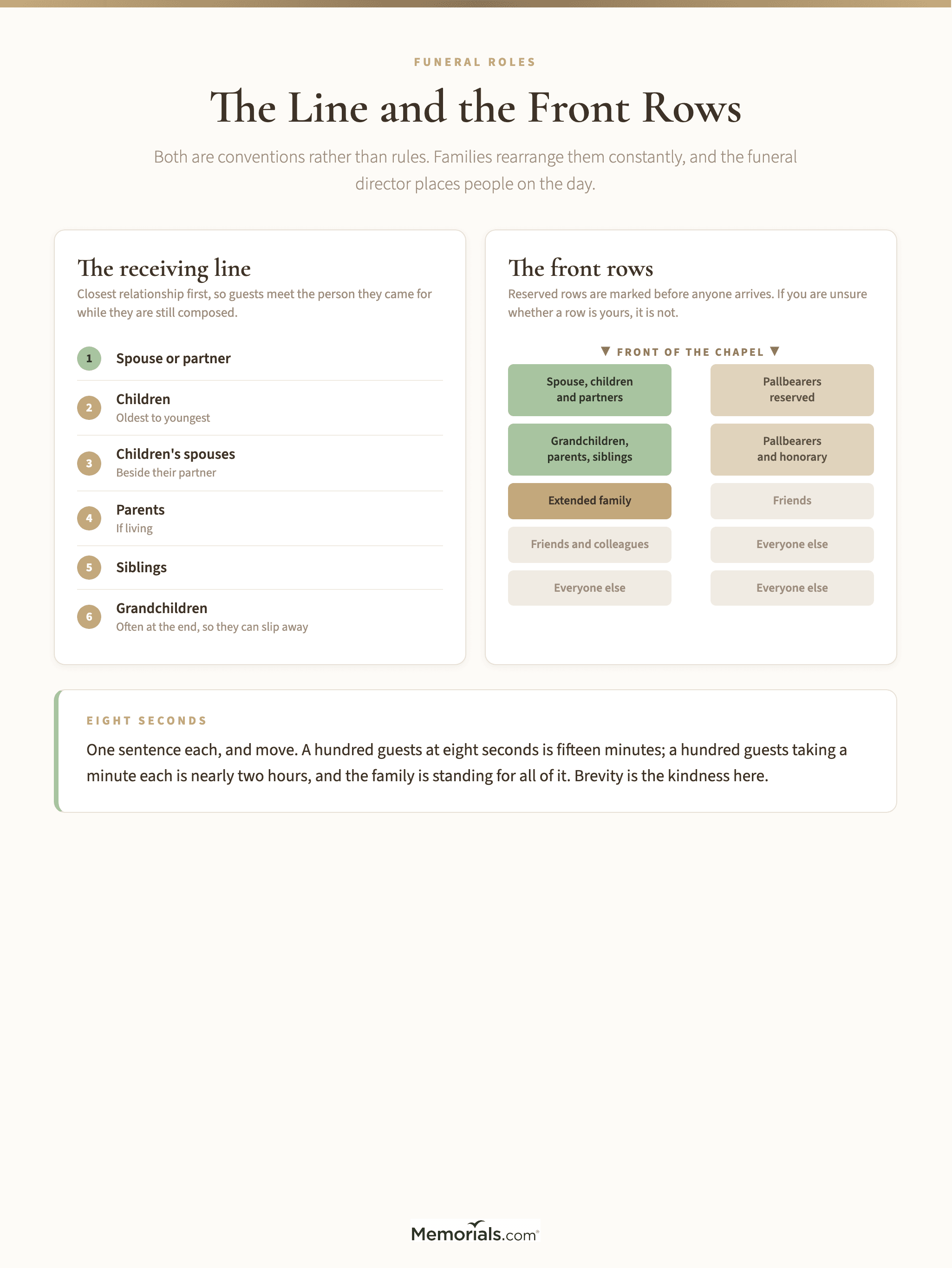
The conventional line order and the front rows, side by side. Both are conventions rather than rules — families rearrange them constantly, and the funeral director will place people on the day. The right-hand side shows the pattern most chapels use: immediate family in the first row on the left, pallbearers reserved on the right.
How Long to Take
Eight to ten seconds with each person. It feels abrupt from the inside and it is exactly right from the outside.
A visitation with a hundred guests and six people in the line takes over an hour at that pace, and the family is standing for all of it. Guests who take a minute each — which feels like the respectful thing to do — turn that into three hours. The kindest thing a guest can do in a receiving line is be brief.
If you genuinely need to talk to somebody, say so and step out: "Can I call you next week?" takes four seconds and gets you the conversation without the line behind you.
Funeral Seating: Where the Family Sits
The receiving line disperses into the seating, and the family seating order at a funeral follows the same logic — closest first, and near the front.
Row
Usually
Front left
Spouse, children, and their partners
Second left
Grandchildren, parents, siblings
Third left
Extended family — aunts, uncles, cousins
Front right
Pallbearers, often reserved with a ribbon
Behind
Friends, colleagues, and everyone else
Funeral seating is a convention rather than a rule, and left and right in particular are reversed by some chapels. The funeral director will have marked the reserved rows before anyone arrives, and if you are not sure whether a row is yours, it is not — sit further back and nobody will move you.
Two situations families ask about. Divorced or separated parents are usually seated in the same row with somebody between them, which is a decision worth making before the day rather than in the doorway. And a partner who was never married in belongs in the front row; if that is contested in your family, the funeral director has handled it before and will place people so that nobody has to argue in public.
Our funeral etiquette guide, linked at the top, covers where guests sit and what to do if you arrive late.
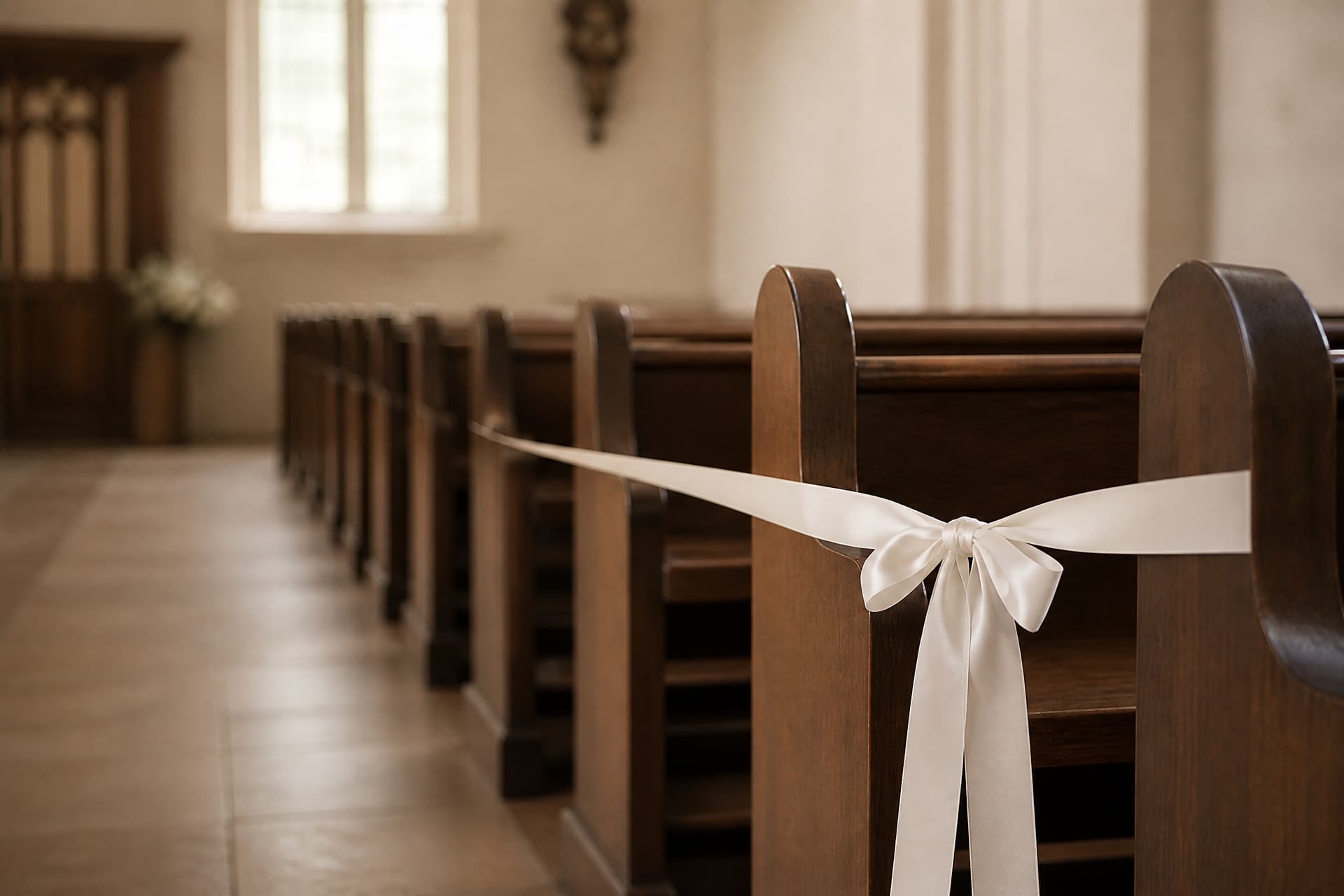
A ribbon across the aisle end is how reserved rows are marked in most chapels. If you are unsure whether a row is meant for you, it is not — the reserved seating is always signposted, and sitting further back is never the wrong choice.
If You Are the Family
Almost everything written about receiving lines is addressed to guests. The family's side has its own set of problems and nobody prepares them for it.
Decide in advance whether to have one. It is entirely your choice and there is no default. A hundred guests at eight seconds each is fifteen minutes; a hundred guests who each take a minute is nearly two hours of standing. If the numbers are large or anybody in the family is frail, saying no is the right answer and the funeral director will simply direct people to their seats instead.
Put a chair in the line. For a parent, a grandparent, or anybody unwell. Sitting in a receiving line is completely unremarkable and standing for an hour is genuinely hard.
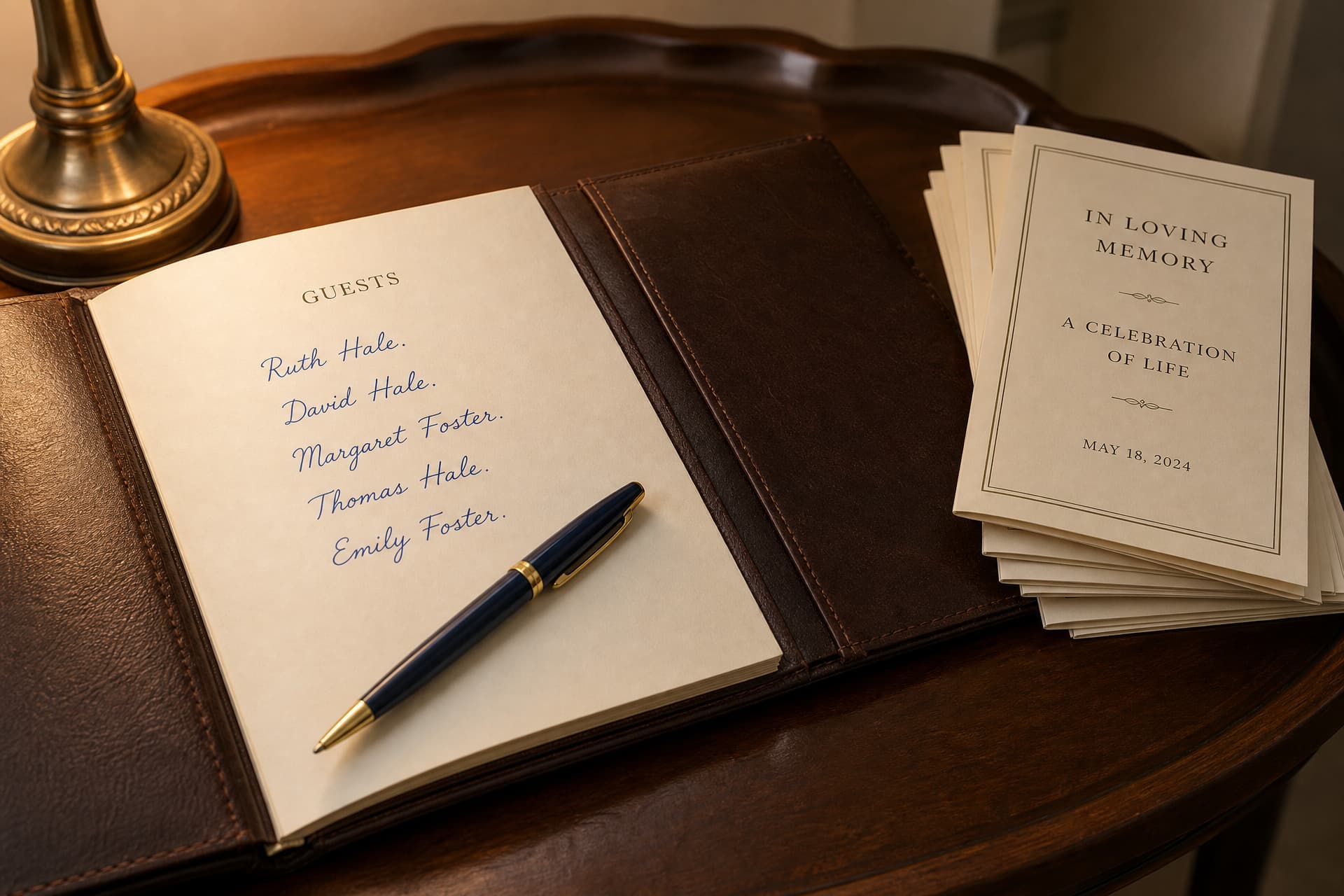
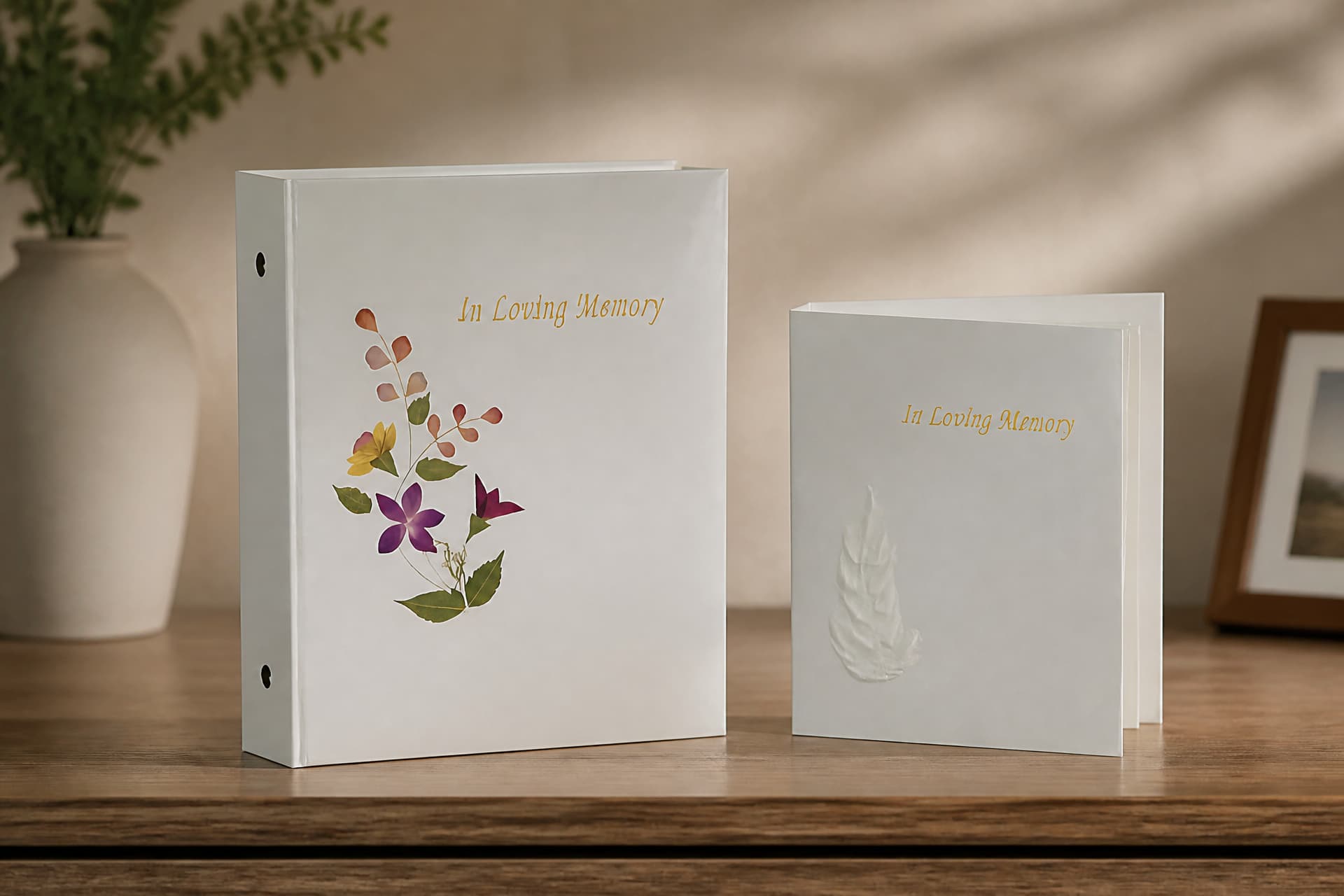
The guest book is the record of who came, and families rely on it more than they expect — most of the line is gone from memory within a week. Left to right: Bouquet Photo Album and Verne Memorial Guest Book.
Give somebody the job of moving the line along. A cousin or a friend standing at the end who says "thank you so much for coming, the chapel's just through there" keeps it flowing without anybody in the family having to end a conversation. This is the single most useful role at a visitation and almost nobody assigns it.
Expect not to remember it. Families are consistently surprised by how much of the line they cannot recall afterwards — who came, what was said, whole conversations gone. That is ordinary and it is exactly what the guest book is for. Somebody should also quietly note who sent flowers, because the cards get separated from the arrangements almost immediately.
Eat something first. Advice that sounds trivial and is not. A receiving line is an hour of concentrated emotional work, standing, usually before a service, usually on a day nobody has managed breakfast.
You may stop. If it becomes too much, step out. The line will re-form around you and every single person in it will understand.
When There Is No Receiving Line
Increasingly common, and entirely proper.
At a celebration of life, the family usually circulates rather than standing in a line, and you speak to them when you find them.
After a graveside committal, people tend to approach the family in ones and twos at the car. The same one sentence applies.
At a large funeral, some families decide against a line specifically because two hundred guests would take three hours. They are right to.
If the family has asked for no line, respect it completely and write instead. A card that arrives the following week is worth more than a handshake at a bad moment.
What does not change is the sentence. Whether you say it in a line, in a parking lot or in a card, it is the same eight seconds of work.
Bringing Children Through
Parents ask about this more than anything else on this page, and the honest answer is that children handle receiving lines better than the adults bringing them do.
Tell them what will happen first. Not about death — about the mechanics. "We're going to stand in a line, and when we get to Grandma you can say hello, and then we'll go and sit down." Children cope well with a known sequence and badly with an unexplained one.
Give them one thing to say and let them say it."I'm sorry Grandpa died" is enough from a six-year-old and will land better than anything an adult manages that day. If they would rather say nothing, a hand held out is a complete contribution.
Let them leave the line. A child who has had enough should be taken out, and every family in the room will silently approve. Somebody should be nominated to do exactly that so it does not fall to whoever is closest to the front.
Do not make them touch or kiss anybody — the person who died, or a relative they barely know. A child pressed into a physical thing they did not want is the memory that lasts.
Bring something for afterwards. A visitation is long, quiet and boring for anyone under about ten, and a book or a quiet toy for the sitting-down part is not disrespectful. It is planning.
Older children and teenagers often want a role — signing people in, handing out programs, standing at the end of the line thanking people. Giving them one is usually kinder than leaving them to stand about feeling useless.
The New Orleans Second Line
A different thing entirely, and worth naming because the words look similar. In New Orleans, a second line is the procession that follows a jazz funeral — the brass band and the main mourners are the first line, and the crowd that joins them dancing behind is the second. It is a celebration, it is public, and anyone may join it.
If you have arrived here looking for that, it has nothing to do with a receiving line at a funeral home. It is one of the genuinely joyful funeral traditions in the country and it deserves the distinction.
What Happens Straight Afterwards
The line ends and the room changes shape, and there is a short awkward gap that catches people out.
If the receiving line was at a visitation, the family usually goes to sit down and guests are left to find their own seats or leave. You are allowed to leave. A visitation is a come-and-go event by design, and staying to the end is not a measure of anything.
If it was after the service, the line typically ends at the door and flows straight into the parking lot, where everyone stands about waiting to see whether they should follow the hearse. Ask somebody rather than guessing — the funeral director or an usher will tell you plainly whether the graveside is family-only, and it very often is.
The reception afterwards is a genuinely different event with different rules. It is louder, people eat, and it is where the actual conversations happen — the ones the receiving line had no room for. If you wanted to talk to somebody properly and only got eight seconds, this is where you get the rest of it.
The reception is where the conversations the receiving line had no room for actually happen. If you wanted to say something properly and only got eight seconds, this is where you get the rest of it — and it is a genuinely different event, louder and easier than anything before it.
One last thing families consistently say afterwards: the people who turned up mattered far more than anything anybody said. Nobody has ever been criticized for a clumsy sentence in a receiving line. Plenty of people quietly regret not going at all.
Frequently Asked Questions
What do you say in a receiving line at a funeral? One sentence. "I'm so sorry for your loss" is complete. Add your name and how you knew them if the family might not place you.
How long should you spend with each person? Eight to ten seconds. Brevity is the kindness here.
Do you shake hands or hug? Follow their lead. Offer a hand; if they pull you in, that is the answer.
Do I have to go through the line? No. If you are overwhelmed or in a hurry, sign the guest book and leave. Nobody is counting.
Who stands in a funeral receiving line? Immediate family, closest relationship first. Nobody is obliged to.
Where does the family sit at a funeral? Front rows, usually on the left, with pallbearers often reserved on the right.
What if I cry? Then you cry. You are at a funeral, and you will not be the first one that hour.
In Short
One sentence, eight seconds, no questions. Say how you knew them if the family might not know you. Sign the guest book before you join the line rather than after, and if you need a real conversation, ask for one next week instead.
If there is no receiving line, nothing about that changes except where you are standing.