🏬Supersize Online Funeral Retailer🪦1000's of Headstones⚱️Over 10,000 Cremation Urns⚰️Caskets Overnight Delivery🛒Funeral & Memorial Superstore🚚FREE Shipping on ALL Orders👨👩👧👦Helping Families for over 20 Years💰Lowest Price Guarantee🏬Supersize Online Funeral Retailer🪦1000's of Headstones⚱️Over 10,000 Cremation Urns⚰️Caskets Overnight Delivery🛒Funeral & Memorial Superstore🚚FREE Shipping on ALL Orders👨👩👧👦Helping Families for over 20 Years💰Lowest Price Guarantee
🏬Supersize Online Funeral Retailer🪦1000's of Headstones⚱️Over 10,000 Cremation Urns⚰️Caskets Overnight Delivery🛒Funeral & Memorial Superstore🚚FREE Shipping on ALL Orders👨👩👧👦Helping Families for over 20 Years💰Lowest Price Guarantee🏬Supersize Online Funeral Retailer🪦1000's of Headstones⚱️Over 10,000 Cremation Urns⚰️Caskets Overnight Delivery🛒Funeral & Memorial Superstore🚚FREE Shipping on ALL Orders👨👩👧👦Helping Families for over 20 Years💰Lowest Price Guarantee
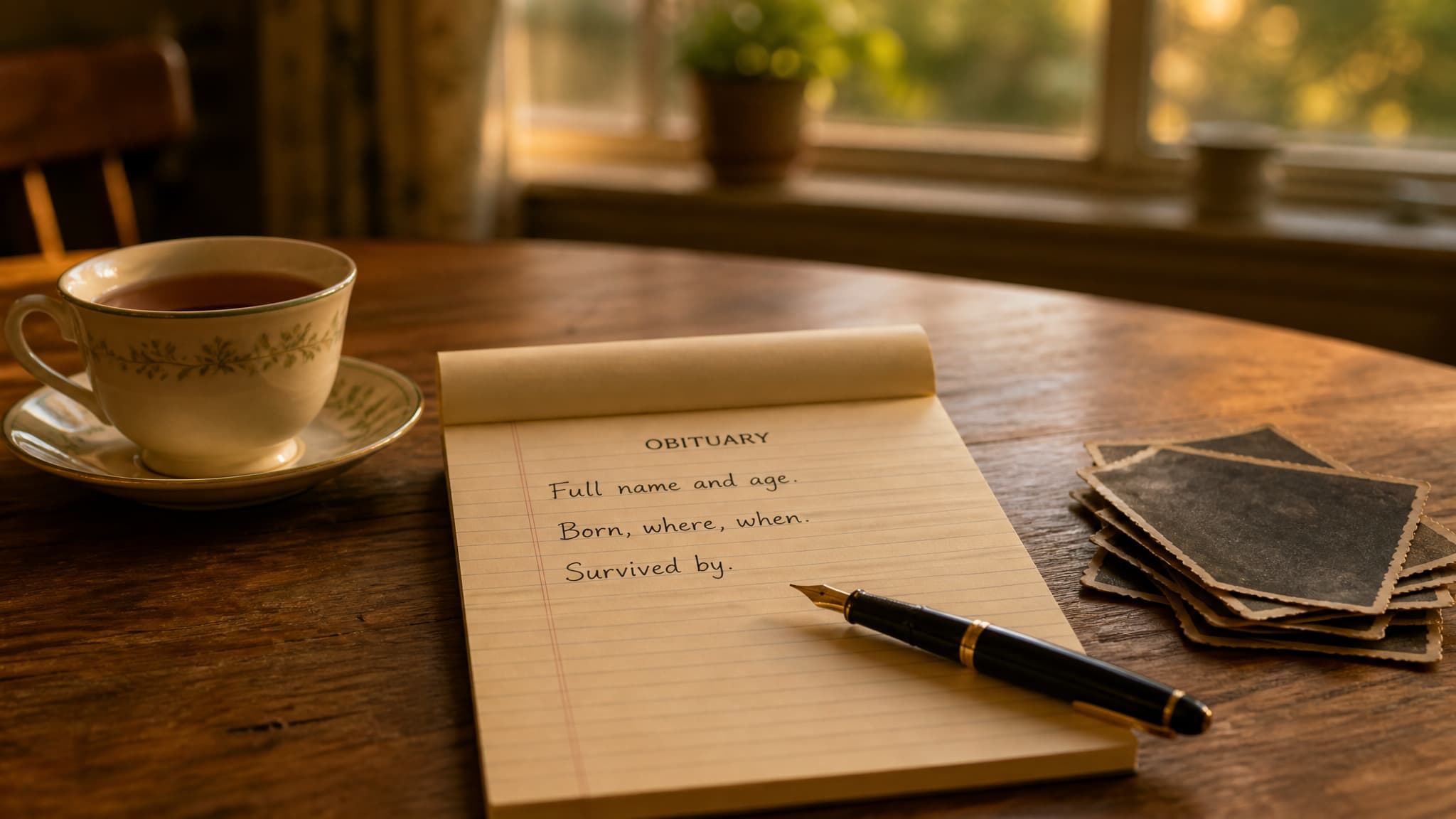
Most obituary advice tells you what to include. That is useful once you have started, and useless at the moment you are sitting in front of a blank page at eleven at night with a deadline from the funeral home in the morning. Obituary templates exist for that moment.
This page is the other thing: a form. Three of them, at roughly 60, 150 and 300 words, with every line written out and the parts you supply marked in brackets. Fill the slots in order and you have an obituary, without having to decide what shape it should be first.
If you want the guidance rather than the form — what to include, how to gather the facts, how long it should be, where to publish it — how to write an obituary covers all of that and this page deliberately does not repeat it. For where the obituary sits in the rest of the service, see the .
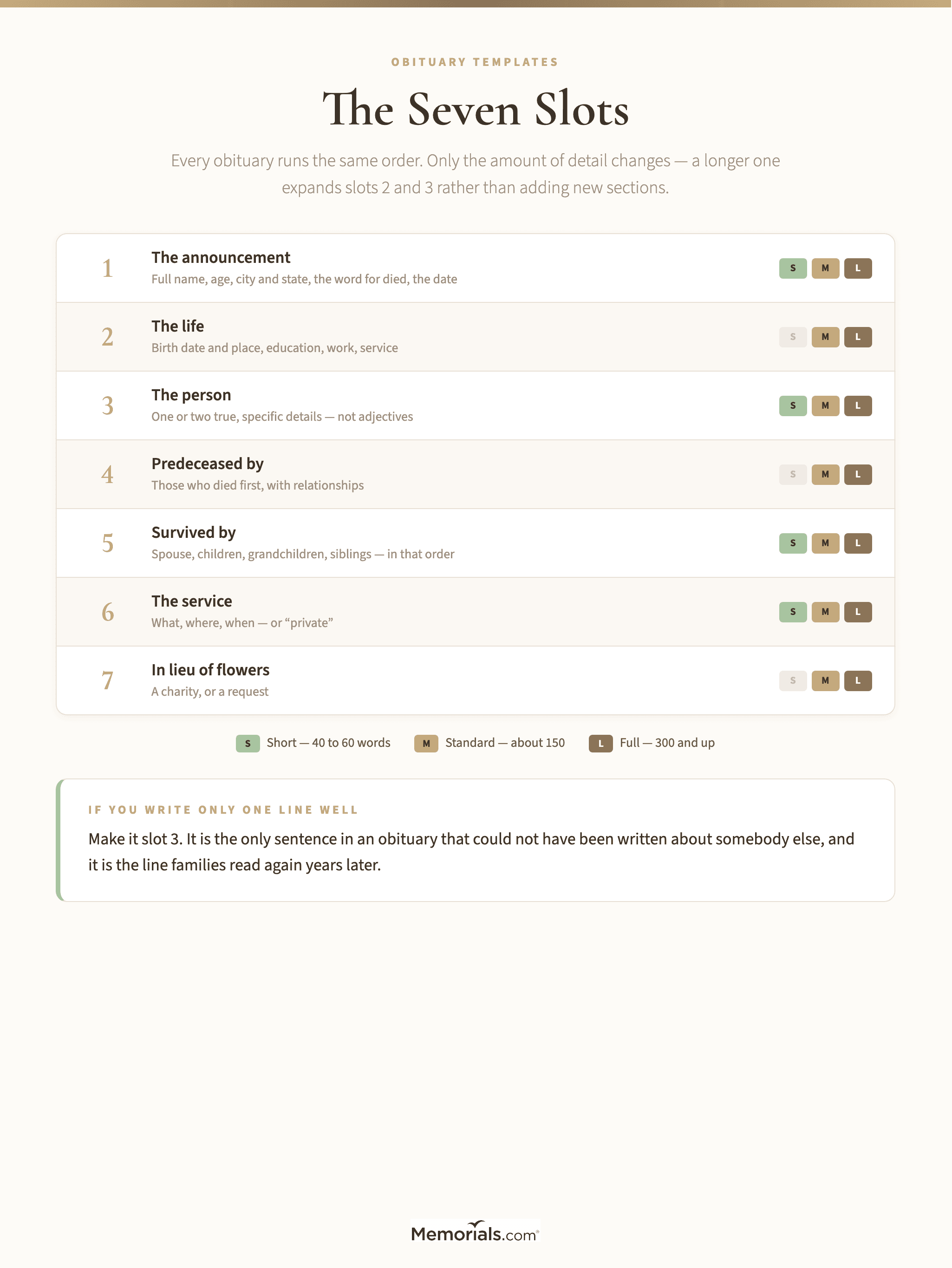
Every obituary template on this page — and very nearly every obituary in print — runs through the same seven slots in the same order. The obituary format below is the skeleton; the three templates that follow are that skeleton at different lengths.
#
Slot
What goes in it
1
The announcement
Full name, age, city and state, the word for died, the date
2
The life
Birth date and place, education, work, service
3
The person
One or two true, specific details — not adjectives
4
Predeceased by
Those who died first, with relationships
5
Survived by
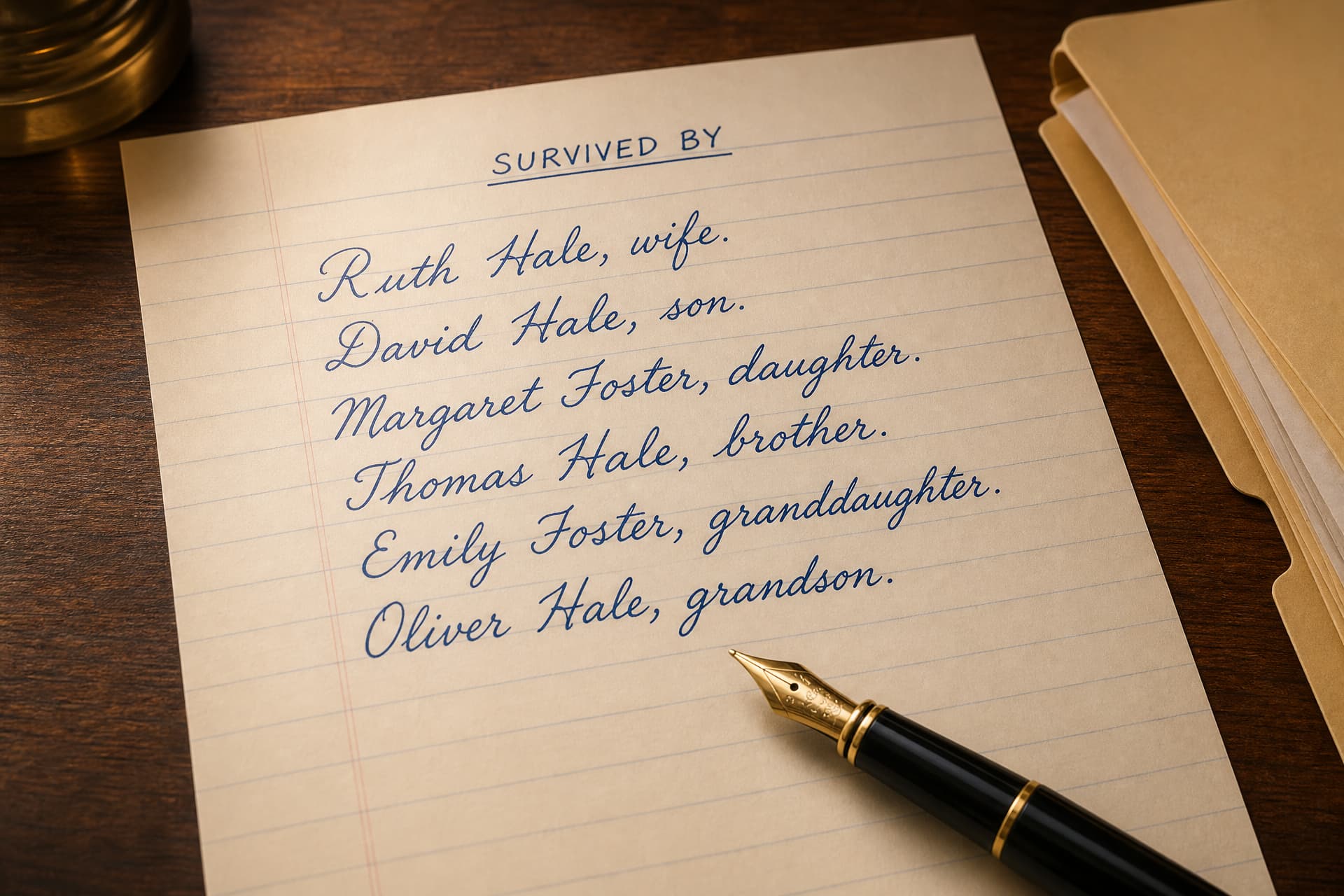
The living, closest first, with relationships
6
The service
What, where, when — or "private"
7
In lieu of flowers
A charity, or a request
Two notes before you start. Slot 3 is the one people skip and the one everyone remembers — "she kept a running list of every bird she saw from the kitchen window" does more than three sentences of devoted, loving and kind. And slot 5 has an order: spouse, then children and their spouses, then grandchildren, then siblings, then parents if living.
Gather the facts before you open the template. Names spelled as the family spells them, dates confirmed against a document rather than a memory, and the survivor list written out in full — this is where the time actually goes.
Template 1 — The Short Form
Around 40 to 60 words. This is the paid death notice most newspapers charge by the line for, and it is also the right length when the family wants something plain.
Line
Fill in
1
[Full name], [age], of [city, state], [died / passed away] on [date].
2
[He / She / They] [worked as / retired from / was known for] [one detail].
3
[He / She / They] is survived by [name and relationship], and [name and relationship].
4
[A service will be held at [place] on [date] at [time]. / Services will be private.]
Filled in, simple obituary examples at this length read like this — the fictional names are there so you can see the joins:
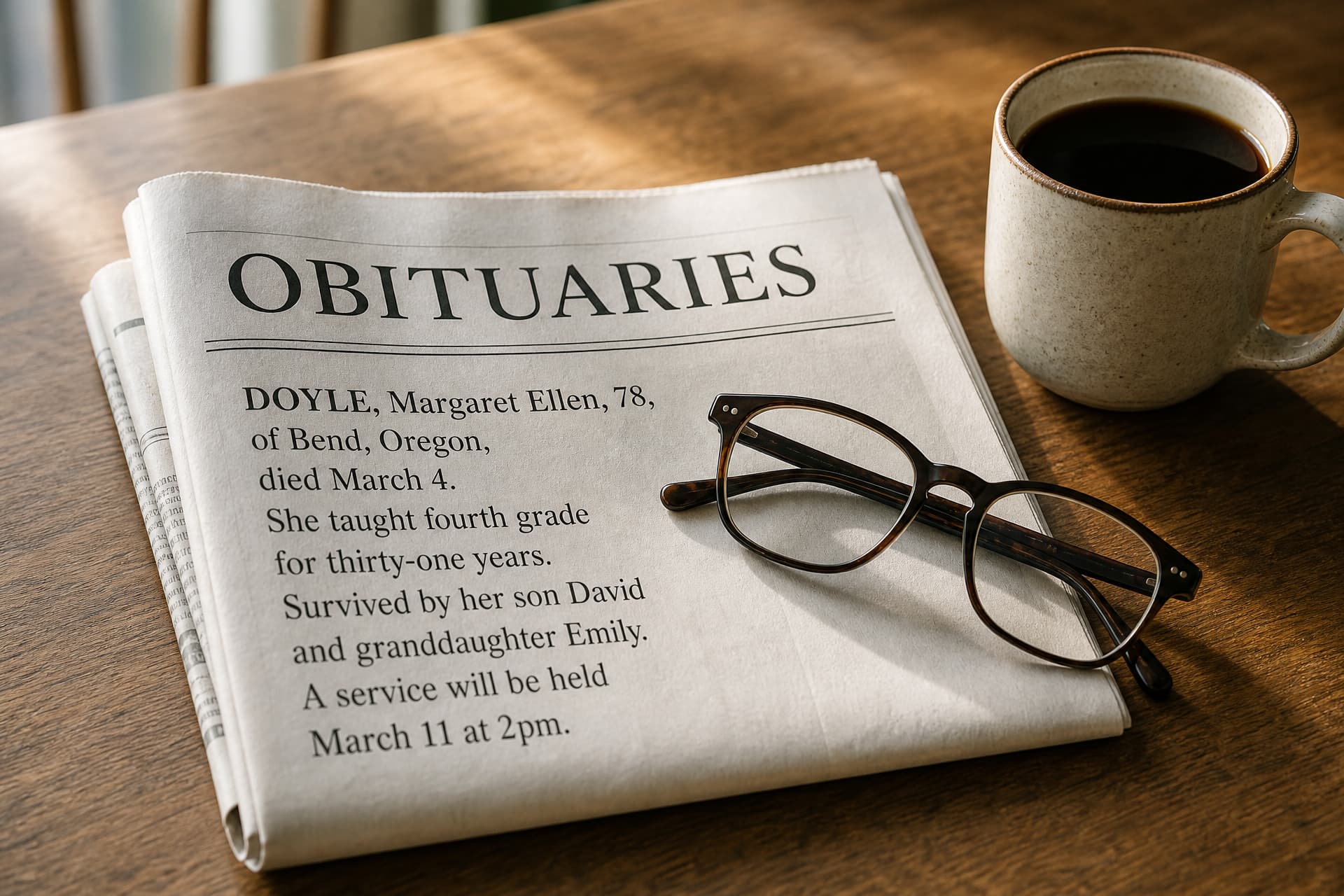
Margaret Ellen Doyle, 81, of Bend, Oregon, died on March 4, 2026.
She taught fourth grade for thirty-one years and never once missed a school play.
She is survived by her son, Peter, and her granddaughter, Wren.
A service will be held at St. Anne's on March 11 at 2:00 p.m.
Sixty-one words, and the second line is doing all the work.
Template 2 — The Standard Form
Around 150 words, and the one most families use. This fill in the blank obituary template adds the biography and the predeceased line, and it is the version most people mean when they search for how to write an obituary template.
Line
Fill in
1
[Full name], [age], of [city, state], [died / passed away peacefully / died unexpectedly] on [date] [at home / at [facility] / surrounded by family].
2
Born [date] in [city, state], to [parent] and [parent], [first name] [graduated from [school] / grew up in [place]].
3
[He / She / They] [worked as [role] at [employer] for [number] years / served in the [branch] / raised [number] children in [place]].
4
[First name] [was happiest / could always be found / was known for] [one specific, true detail].
5
[He / She / They] was preceded in death by [name and relationship], and [name and relationship].
6
Survivors include [spouse]; [children and their spouses]; [grandchildren]; and [siblings].
7
[A funeral / A memorial service / A celebration of life] will be held at [place] on [date] at [time].
8
In lieu of flowers, the family asks that donations be made to [organization].
Leave out any line that does not apply rather than inventing something for it. An obituary with six lines that are true reads better than one with eight where two are padding.
The same seven slots at every length — only the amount of detail changes. Short runs 40 to 60 words and uses slots 1, 3, 5 and 6; standard runs about 150 and adds the biography and the predeceased line; the full version expands slot 2 and slot 3 rather than adding new ones.
Template 3 — The Full Form
Around 300 words and up, for a newspaper that charges by the inch rather than the line, for a funeral home website, or for a printed program. It is the standard form with slots 2 and 3 opened out — it does not add new sections.
Line
Fill in
1
[Full name] ([nickname]), [age], of [city, state], [died] on [date] [circumstance].
2
[First name] was born on [date] in [city, state], the [first / second / youngest] of [number] children born to [parent] and [parent].
3
[He / She / They] attended [school] and [graduated from [college] in [year] with a degree in [subject]].
4
On [date], [first name] married [spouse] at [place]; they were married for [number] years.
5
[First name] [worked at [employer] as [role] from [year] to [year] / served in the [branch] from [year] to [year], including [posting]].
6
[He / She / They] [was a member of / volunteered with / spent [number] years at] [organization].
7
[Two or three sentences of specific detail: what they made, grew, collected, fixed, argued about, cooked, or drove.]
8
[First name] was preceded in death by [names and relationships].
9
[He / She / They] is survived by [spouse]; [children and their spouses]; [grandchildren]; [great-grandchildren]; [siblings]; and [others].
10
[Service details, including visitation, funeral and interment, each with place, date and time.]
11
[In lieu of flowers, donations may be made to [organization], or [alternative request].]
12
[A closing line the family chooses: a phrase they used, a line of scripture, or nothing at all.]
Line 7 is where a full-length obituary earns its space. If you write nothing else at length, write that.
Newspapers usually charge by the line or the column inch and count everything — including the words in brackets if you leave them in. Print the finished text, read it once on paper, and check the dates against a document before it is filed.
Slot 3 Is the Whole Obituary
If you take one thing from this page and ignore the rest of the form, take this. The third slot — the personal detail — is the only line in an obituary that could not have been written about somebody else, and it is the line families read again years later.
The instinct is to reach for adjectives, because adjectives feel respectful and they are easy to produce under pressure. She was a devoted mother, a loving grandmother, and a kind friend to all who knew her. Nobody who reads that sentence learns anything, and every obituary on the page beside it says the same thing in the same order.
What works instead is small, concrete and slightly odd. He rebuilt the same motorcycle four times and never rode it further than the end of the street. She kept a running list of every bird she saw from the kitchen window and made visitors add to it. He answered the phone by announcing the weather. She could not be persuaded that a recipe needed measuring.
The test is simple: could this sentence be true of anyone else at this funeral? If it could, it is an adjective wearing a disguise, and it should be replaced with the thing the person actually did. You are not writing a character reference. You are writing the one paragraph that will make somebody who knew them say yes, that was him.
Ask the family for this line specifically rather than waiting for it to arrive. "What did she always do that drove you mad?" produces better material in thirty seconds than an hour of respectful conversation, and it produces it from the people who are otherwise sitting quietly in the room with nothing to contribute.
Two Mistakes Worth Avoiding
Padding to reach a length. If the newspaper wants 200 words and you have 140 true ones, file 140. Padding always shows, because the only material available to pad with is adjectives, and a reader can feel the moment a sentence stops carrying information. An obituary is not judged by its length by anyone except the person paying for the column inches.
Getting the survivor list wrong. This is the single thing families are most upset by afterwards, and it is almost always an accident. The conventional order is spouse, then children with their spouses in brackets, then grandchildren, then great-grandchildren, then siblings, then parents if living, then anyone else who belongs. Within each group, oldest first.
Two traps live in that list. A stepchild or a partner who was never married in is the omission people notice most, and the safest approach is to name them in the same sentence as everyone else rather than in a separate one. A large number of grandchildren is usually given as a count rather than a list — "and eleven grandchildren" — but ask first, because some families want every name and will count them when the paper arrives.
Write the survivor list out in full before you touch the template, get somebody else in the family to read it, and check every spelling against something written down. It is the only part of an obituary where being wrong is a lasting injury rather than an error.
Variations by Situation
The slots do not change; what fills them does. These are the adjustments families ask about most.
A long illness."after a long illness" or "following a long battle with [condition]" both appear widely. Naming the condition is entirely the family's choice and many prefer "died peacefully at home" with no cause at all.
A sudden death."died unexpectedly" is the standard phrasing and needs no elaboration.
A young person. Shorten slot 2 rather than stretching it, and give slot 3 more room. Schools, teams and friends belong in the survivor line alongside family.
No surviving close family. Replace slot 5 with the people who were actually there: "He is survived by his neighbors of thirty years, the Kowalski family, and by his colleagues at…"
A second marriage. Name both, in order: "preceded in death by his first wife, Anne" and "survived by his wife, Ruth."
Writing your own in advance. Fill every slot except the announcement and leave that one blank. Families who receive one say it is the single most useful thing they were left.
A religious obituary. Slot 12 is where scripture or a liturgical phrase goes, not slot 1.
How to Fill One In When You Do Not Have the Facts
Half the difficulty with any template for obituary writing is not the wording. It is that three of the slots need information nobody in the room is certain about, and the deadline does not move while you find it.
The birth date and place are the usual holdup. A birth certificate settles it, and so does a passport, a marriage certificate or an old military record; a driver's license and a memory both get it wrong often enough that it is worth checking one against the other. If nothing can be found in time, the year alone is acceptable and nobody will remark on it — "born in 1943 in Toledo" has appeared in print thousands of times.
Work history is the second. Families reliably know where somebody worked and reliably disagree about when, and the fix is to stop giving years: "spent his working life at the paper mill" is true, complete and impossible to get wrong. Give the dates only where somebody can produce them.
The third is the survivor list, and it is the one that genuinely cannot be guessed. Write it out longhand, read it to two people in the family separately, and expect at least one addition from each of them. Doing that once costs twenty minutes. Getting it wrong is the thing families still mention a decade later.
When a slot cannot be filled at all, delete the line rather than softening it. An obituary that says nothing about somebody's education reads as an obituary about a person who did other things. An obituary that says "little is known about her early years" reads as an obituary written by a stranger.
What to Do With It Once It Is Written
An obituary usually gets used three or four times over, and it is worth knowing that before you write, because the length you choose has to survive all of them.
The newspaper or the funeral home website, which is what most people mean by publishing it.
The printed program at the service. The standard form fits a program panel almost exactly; the full form usually does not.
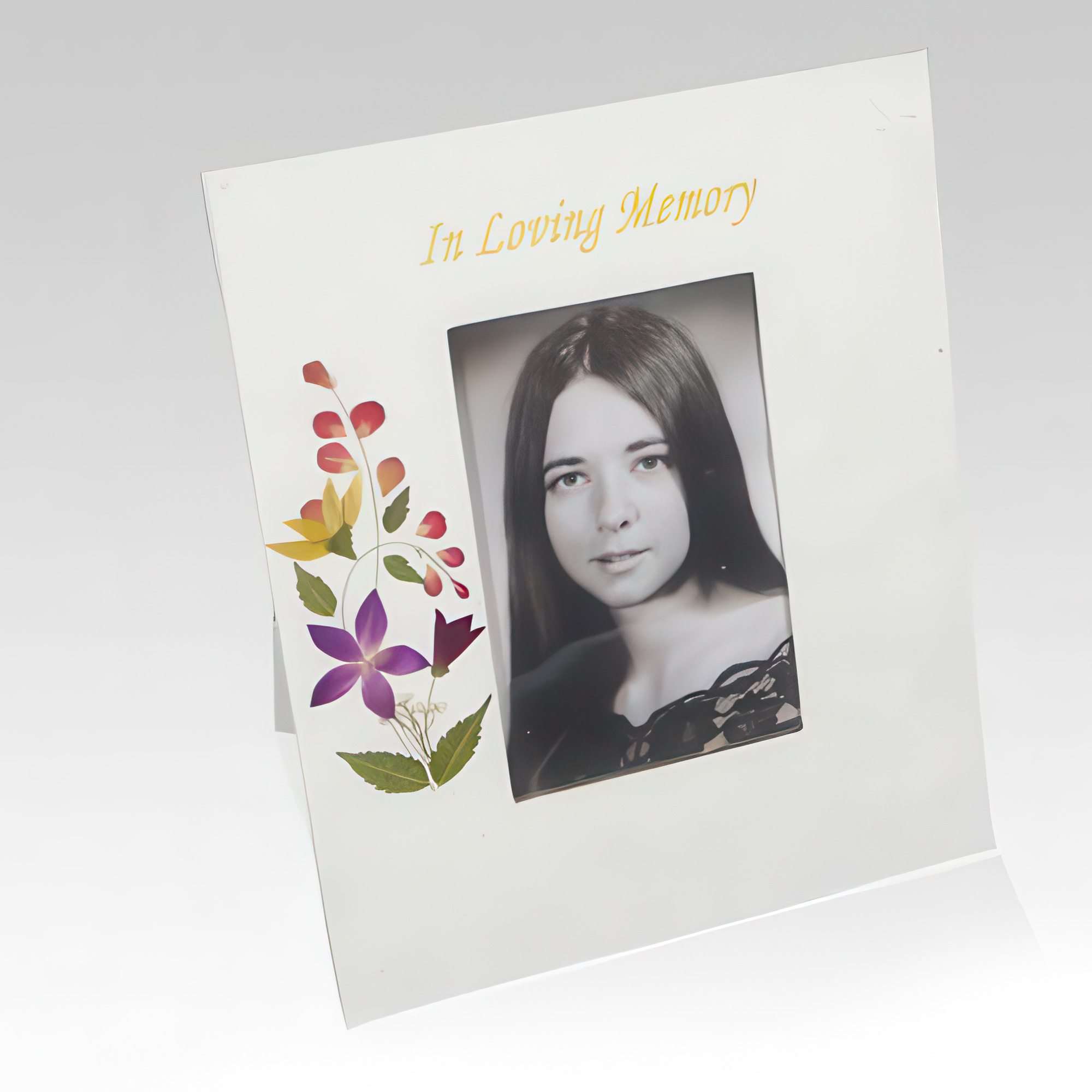
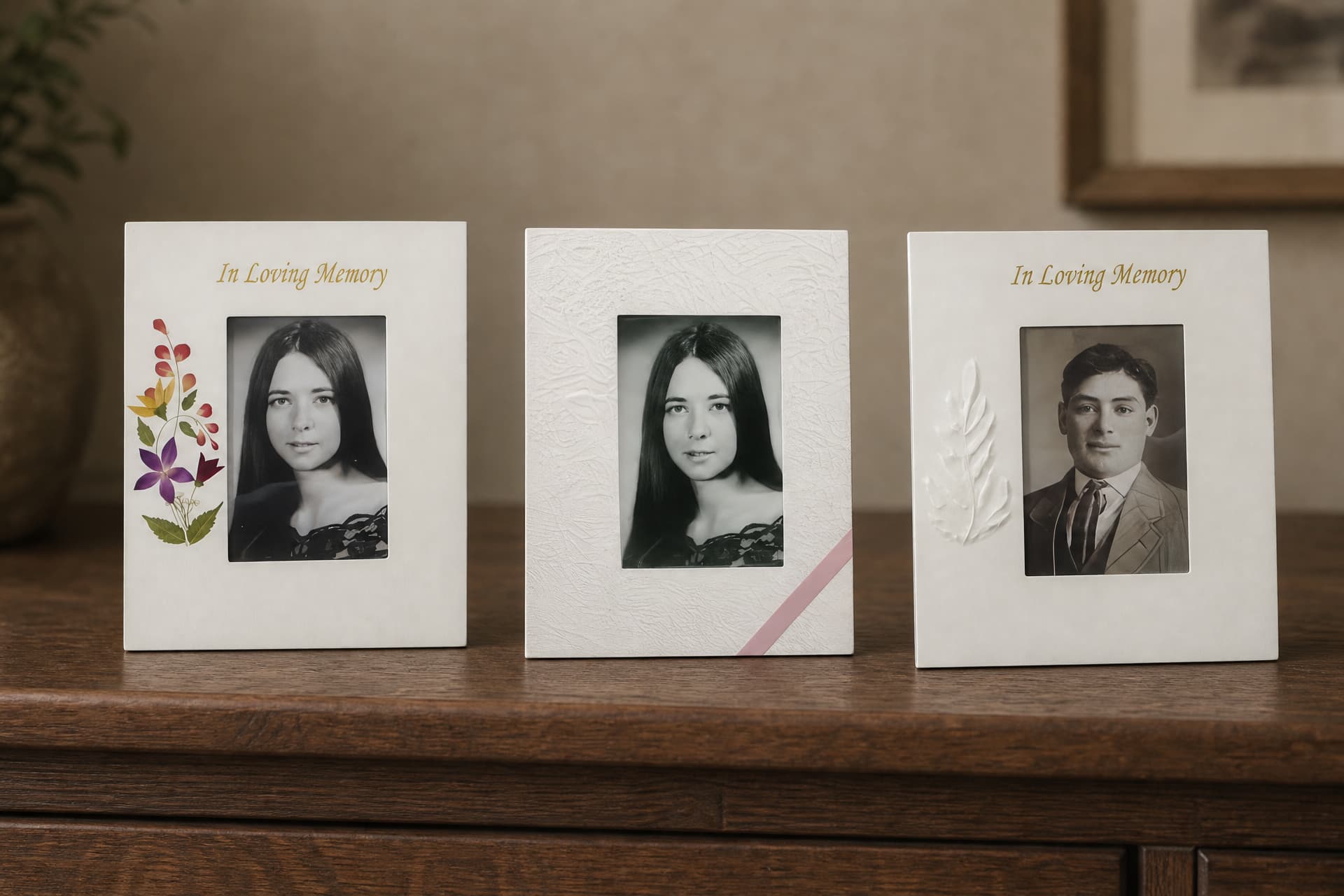
Memorial cards handed to guests, which carry a short version — often just slot 1 and slot 3, with a photograph. This is what people are looking for when they search for obituary card examples, and it is a different, shorter piece of writing than the one the newspaper prints.
The guest book, where the short form is sometimes printed inside the front cover.
Write the standard form first even if you need the short one. Cutting down is much easier than expanding, and you will need both before the week is out.
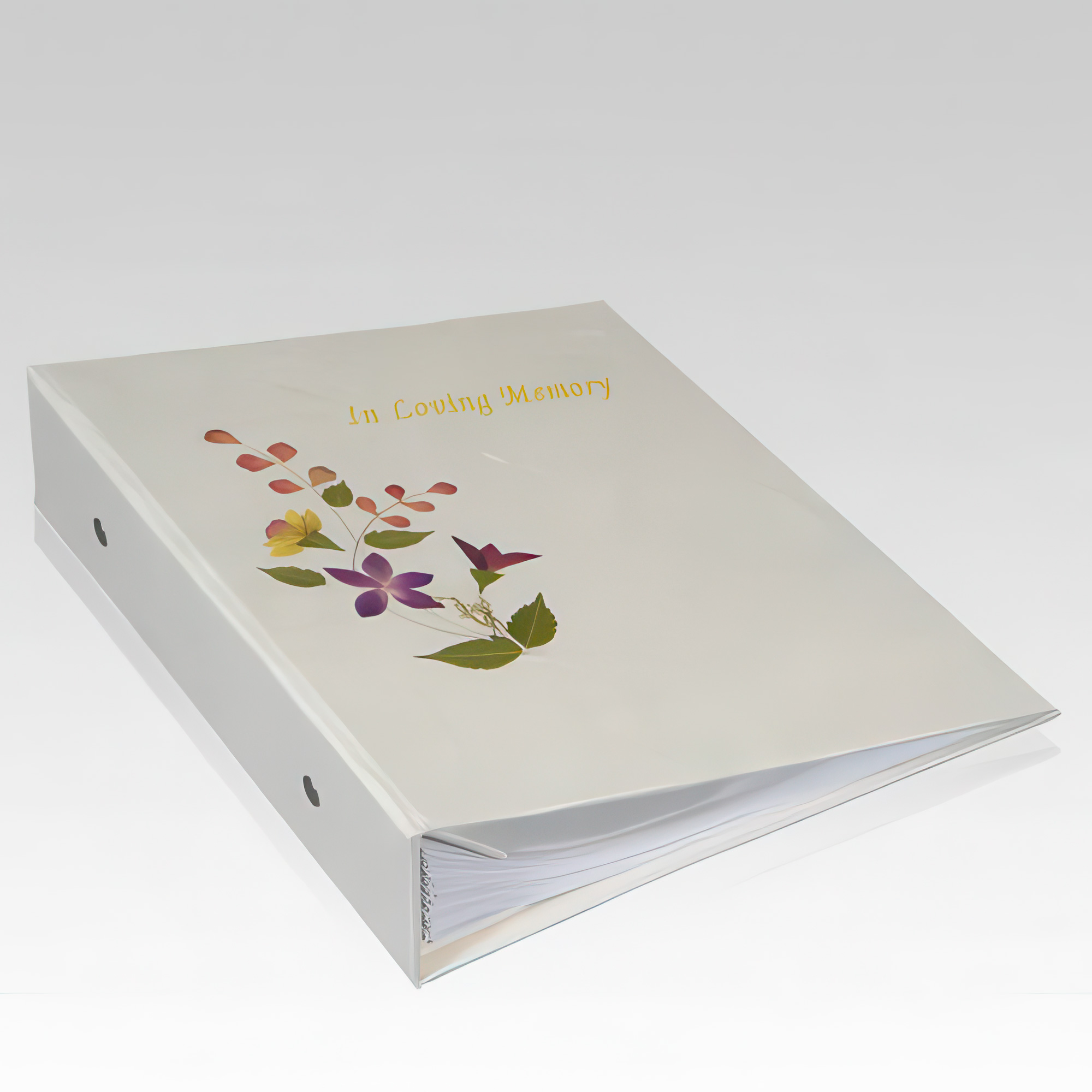
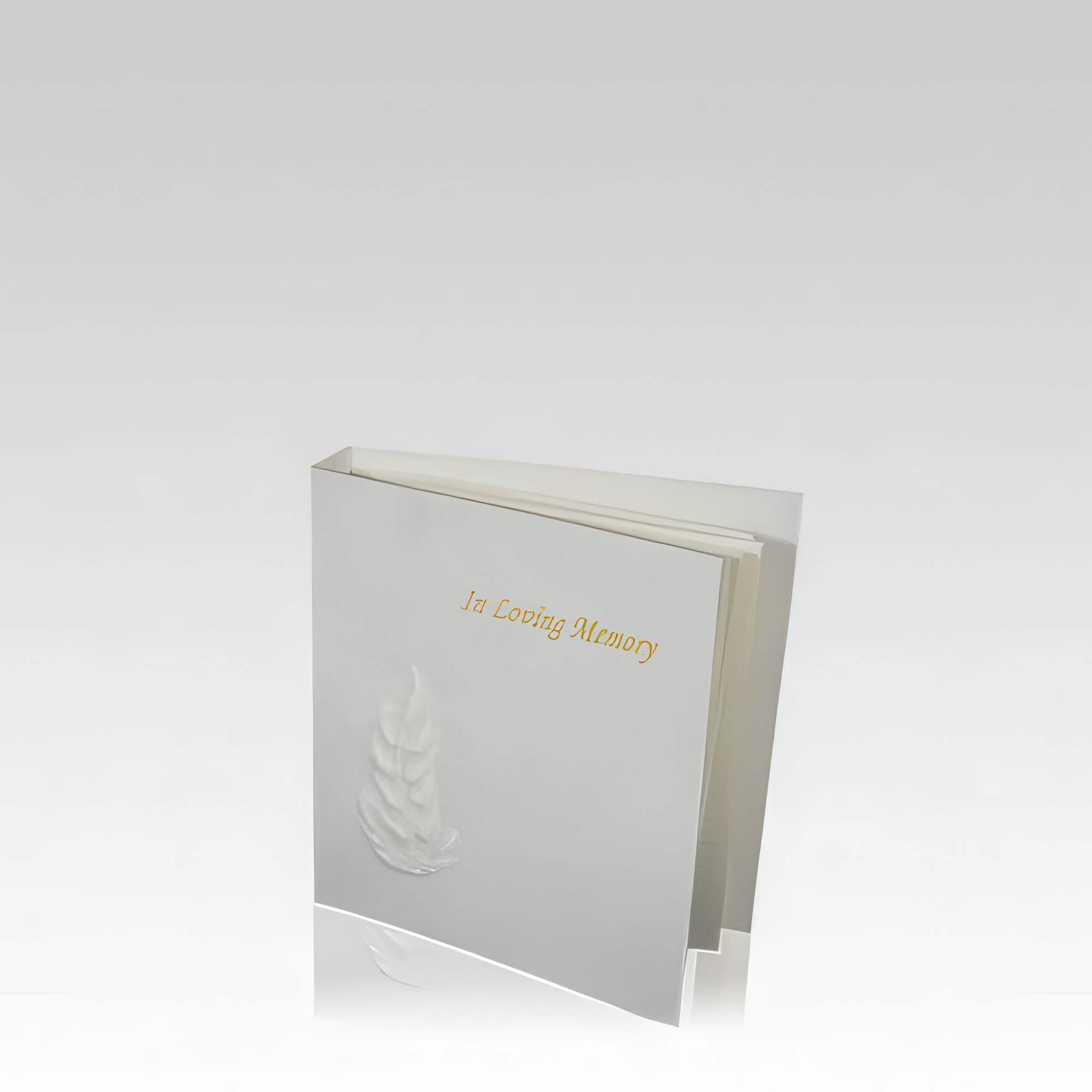
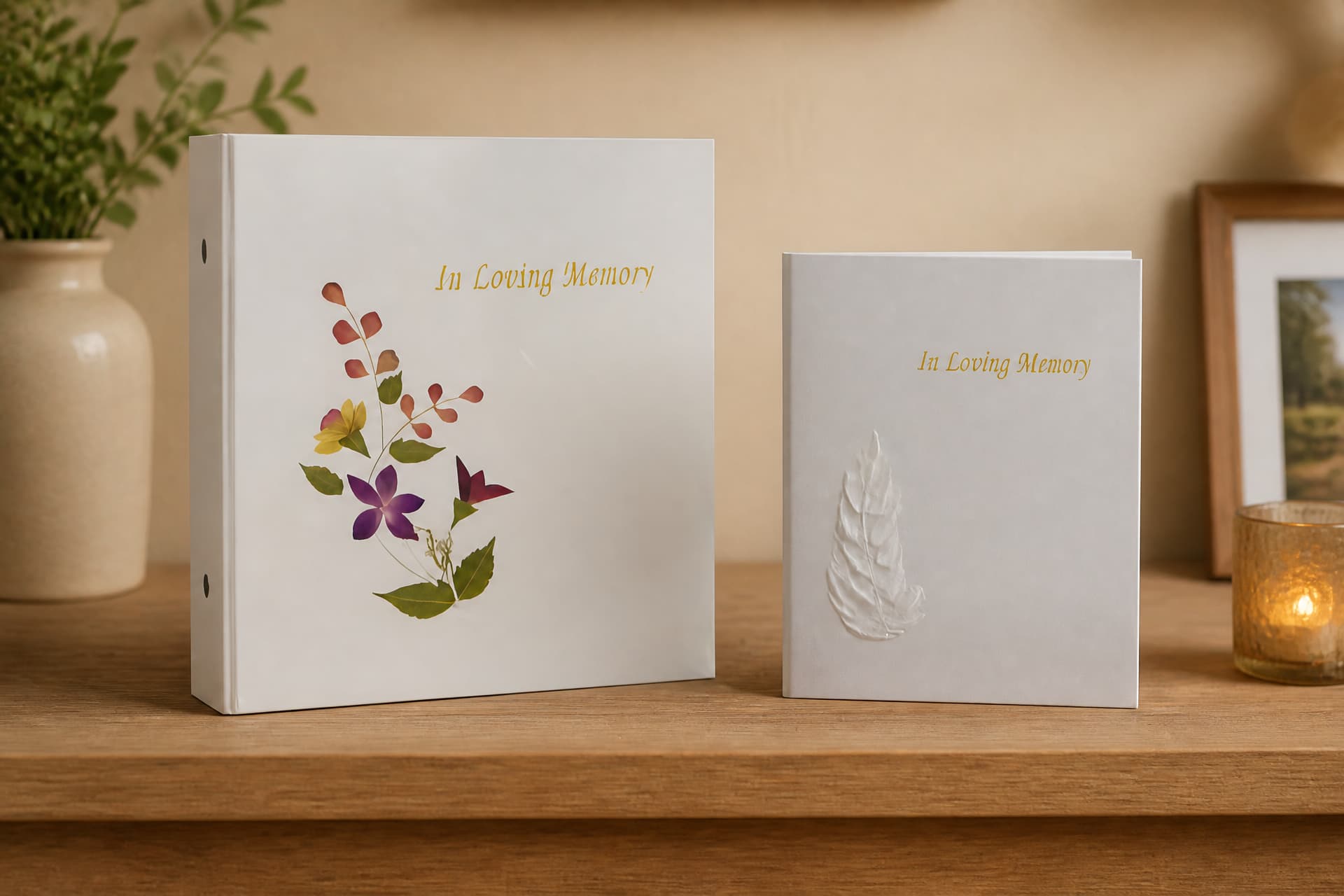
The short version usually ends up in one of these — printed inside the front cover of the guest book, or facing the first page of the album. Left to right: Bouquet Photo Album and Verne Memorial Guest Book.
The Photograph
Almost every obituary runs with a photograph, and families reliably leave the choice until last, when the only images to hand are the ones on somebody's phone from the last two years.
Pick it at the same time as you write slot 3, because the two answer the same question. The photograph that works is rarely the most recent or the most formal one — it is the one where the person looks like themselves. A face at the age people knew them best, looking at the camera, in reasonable light. Newspapers reproduce small and in poor contrast, so a close crop of the face survives printing and a full-length shot of somebody at a wedding does not.
Two practical points. Get the highest-resolution copy you can find — a photograph of a photograph will look fine on a screen and disappear in newsprint, so scan the original if one exists. And check with the family before using a picture that includes somebody else cropped out, which is a small thing that upsets people more than you would expect.
Is there a standard template for obituary writing? There is a standard order — the seven slots above — but no standard wording. Every newspaper and funeral home accepts the same structure.
How long should each version be? Roughly 40 to 60 words for a death notice, 150 for a standard obituary, 300 or more for a full one. Our full guide to writing one goes into what drives that choice.
Do I have to include the cause of death? No. It is never required, and "died peacefully" or simply the date is complete on its own.
What if I get a name or a date wrong? Newspapers will usually print a correction, and funeral home websites can be edited. Check the spellings against a document rather than a memory before it is filed, because the printed program cannot be corrected.
Can I write an obituary for someone who died years ago? Yes. Memorial and anniversary notices use the same format with the past tense adjusted.
Are these templates free to use? Yes. Copy any of them, fill in the brackets, and change any wording that does not sound like your family.
In Short
Seven slots, in the same order, at whichever of three lengths you need. Fill the brackets, delete the lines that do not apply, cut nothing from slot 3, and read the whole thing aloud once before you send it.
If you want the reasoning behind the form rather than the form itself, the writing guide linked at the top of this page is its companion.