🏬Supersize Online Funeral Retailer🪦1000's of Headstones⚱️Over 10,000 Cremation Urns⚰️Caskets Overnight Delivery🛒Funeral & Memorial Superstore🚚FREE Shipping on ALL Orders👨👩👧👦Helping Families for over 20 Years💰Lowest Price Guarantee🏬Supersize Online Funeral Retailer🪦1000's of Headstones⚱️Over 10,000 Cremation Urns⚰️Caskets Overnight Delivery🛒Funeral & Memorial Superstore🚚FREE Shipping on ALL Orders👨👩👧👦Helping Families for over 20 Years💰Lowest Price Guarantee
🏬Supersize Online Funeral Retailer🪦1000's of Headstones⚱️Over 10,000 Cremation Urns⚰️Caskets Overnight Delivery🛒Funeral & Memorial Superstore🚚FREE Shipping on ALL Orders👨👩👧👦Helping Families for over 20 Years💰Lowest Price Guarantee🏬Supersize Online Funeral Retailer🪦1000's of Headstones⚱️Over 10,000 Cremation Urns⚰️Caskets Overnight Delivery🛒Funeral & Memorial Superstore🚚FREE Shipping on ALL Orders👨👩👧👦Helping Families for over 20 Years💰Lowest Price Guarantee
A Zoom funeral is an ordinary funeral that a camera is pointed at. The service happens in the chapel exactly as it always would; what changes is that some of the people attending are watching from a kitchen in another state.
Most funeral homes now offer zoom funeral services and many include them in the standard package. The families who most need it are the ones who cannot travel — a sibling recovering from surgery, grandchildren overseas, anyone for whom a two-day journey on four days' notice is simply not possible.
This page covers how a virtual funeral actually works, what funeral homes charge, how to run one yourself if yours does not offer it, how to invite people, and the etiquette of attending one. For where this sits in the rest of the arrangements, see the funeral program guide.
Ask the funeral home first. Most already do this and many charge nothing extra.
Expect $100 to $400 where it is a paid add-on, usually including a recording.
Sound matters far more than picture. A shaky image is forgivable; inaudible is worthless.
Send the link twice — once when you send the service details, and again an hour before.
Someone in the room should be watching the stream, not the service. Give that job to a specific person.
What a Virtual Funeral Actually Is
Three different things get called the same thing, and they cost and behave differently.
What it is
Who can join
Usually costs
Livestream
A one-way broadcast from the chapel, often on the funeral home's own page
Anyone with the link
Often included
Zoom funeral service
A two-way meeting — remote guests can be seen and heard if unmuted
Whoever is invited
Free to $100
Recording only
Filmed and sent afterwards, nothing live
Anyone, later
$50 to $200
A zoom funeral service in the strict sense — a two-way meeting — is the one families reach for by name and the one they usually should not choose. A livestream is the safer default. Two-way means somebody's dog, doorbell or unmuted television can land in the middle of a eulogy, and a family already carrying a funeral should not also be moderating a call. Choose Zoom only where remote guests need to participate — a reading from abroad, a grandchild saying something.
Where a remote guest is speaking, do it as a hybrid: livestream for the room, and one Zoom window on a laptop by the lectern with a speaker pointed at the congregation. It is less elegant and far more reliable.
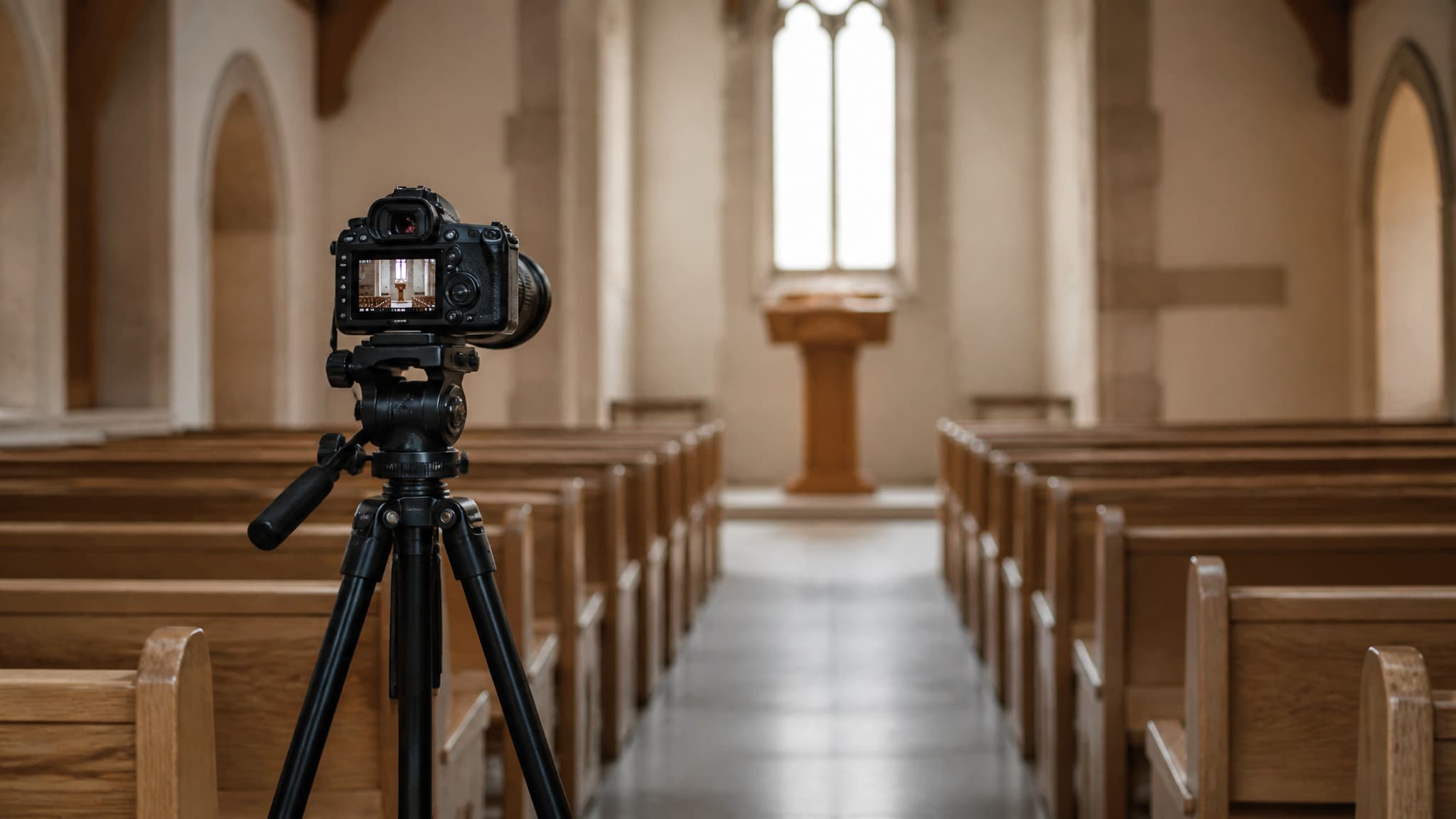
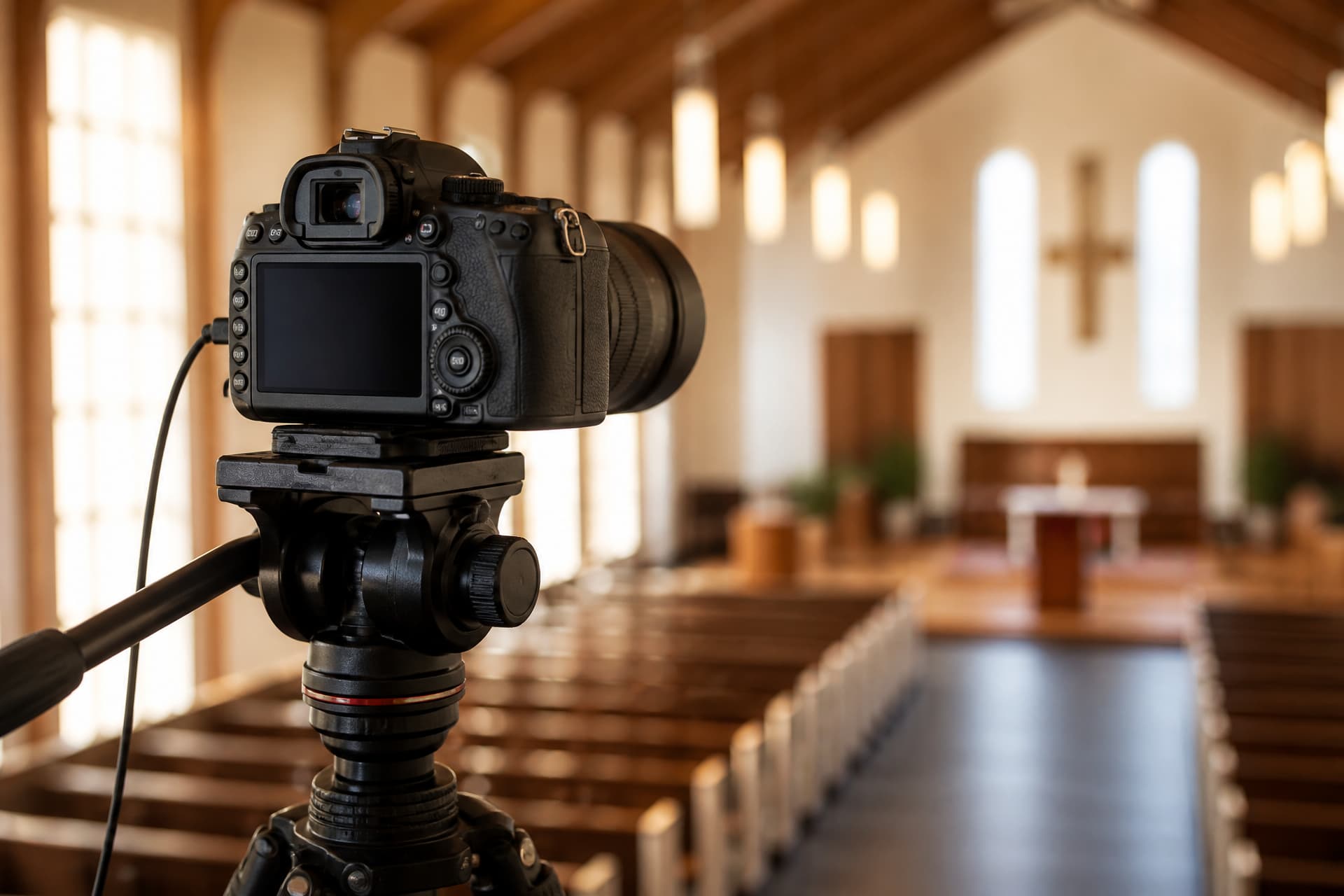
The camera goes at the back on a tripod, above head height so a standing congregation does not block it. What it must never do is point at the family — a livestream shows the service, not the people grieving through it, and every funeral home understands this without being asked.
What a Zoom Funeral Costs
Zoom funeral services cost less than families expect, and the price varies by funeral home and region. This is one of the easier things to negotiate, because the marginal cost to them is small.
Included at no charge — increasingly common, particularly at larger funeral homes with a camera already installed in the chapel.
$100 to $400 as a paid add-on, typically covering the stream, the technician, and a recording afterwards.
$50 to $200 for a recording without a live broadcast.
Nothing at all if you run it yourself from a phone, which is entirely allowed and covered below.
Two things to ask before you agree. Does the price include the recording, and for how long is it available — some hosted links expire after 30 or 90 days, which families discover a year later when they go looking. And is there a technician, or does the funeral director start it and then walk away to run the service.
Running It Yourself
Completely reasonable, and most families do it from a phone. The failure modes are predictable and all of them are preventable.
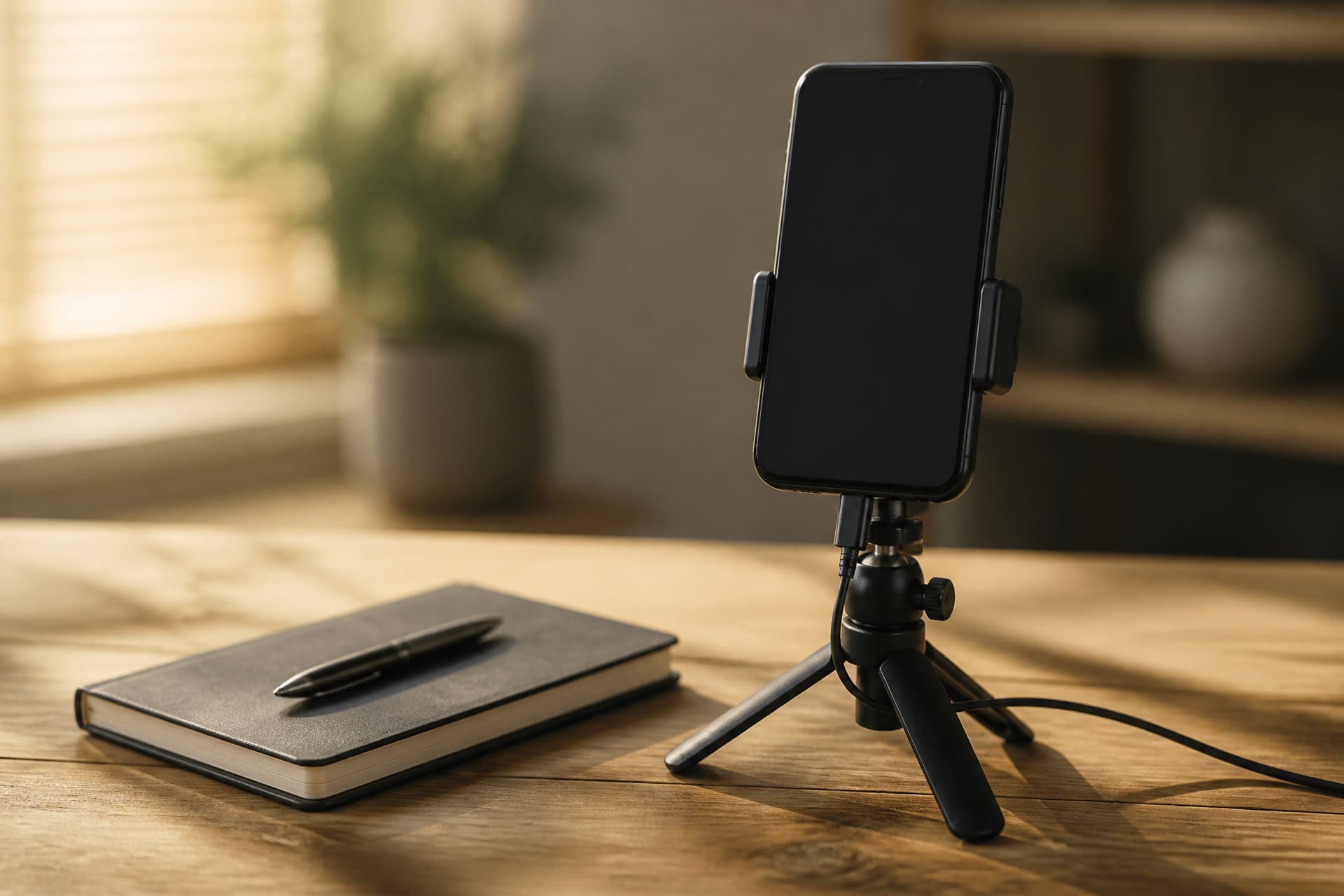
Use a tripod. A handheld phone for forty minutes is unwatchable and the person holding it cannot attend the funeral. A cheap tripod is the single best thing you can spend money on here.
Sit it at the back, above head height. Not the aisle, not the front.
Test the sound from where the camera will be, not from the front. Chapels are built to carry a voice forward; a phone at the back may pick up nothing but the air conditioning.
Plug it in. Forty minutes of video on a phone that started at 60% will not make it, and a battery warning mid-eulogy is its own small disaster.
Use the venue's wifi if there is any, and test it in the actual room. Cell signal inside a stone chapel is frequently nil.
Mute everyone on arrival and leave them muted.
Give one person the job, and make sure that person is not immediate family. Somebody who is going to be steady is worth more here than somebody who is technical.
Ask the funeral director for permission first. Almost all will say yes. A few venues — some churches, some crematoria — have their own rules, and finding that out on the day is avoidable with one phone call.
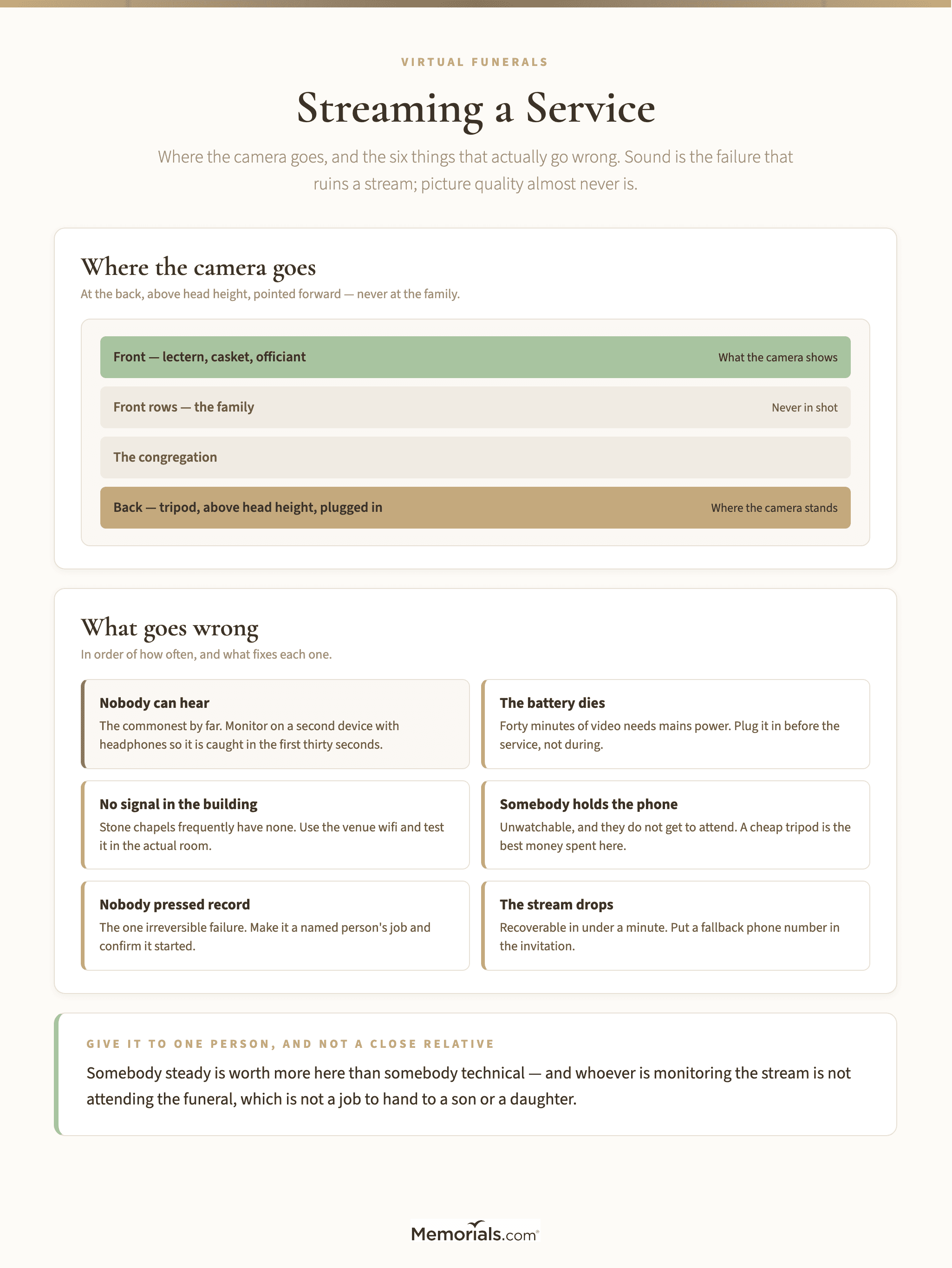
Where the camera goes and what most often goes wrong. Sound is the failure that ruins a stream and picture quality almost never is — a slightly dark, slightly wobbly image with clear audio is a service somebody can attend, and a beautiful silent one is not.
Inviting People
The link is an announcement, and it works the same way as any other. Funeral announcements and death notices covers the wording; the parts specific to a stream are these:
Send it twice. Once with the service details, and again about an hour before. The second one is the one people actually use.
Say the time zone. Every time. "11am Eastern" prevents the single most common miss.
Say whether it is one-way. People who expect to be seen prepare differently from people who are watching.
Include a fallback. A phone number for somebody who is not in the immediate family, in case the link does not work.
Say if it is being recorded and how to get it, so guests who cannot make the time know there is another option.
If you are sharing the link publicly, be aware that a fully open livestream is exactly that — public. Funeral homes usually offer a password or an unlisted link, and it is worth asking.
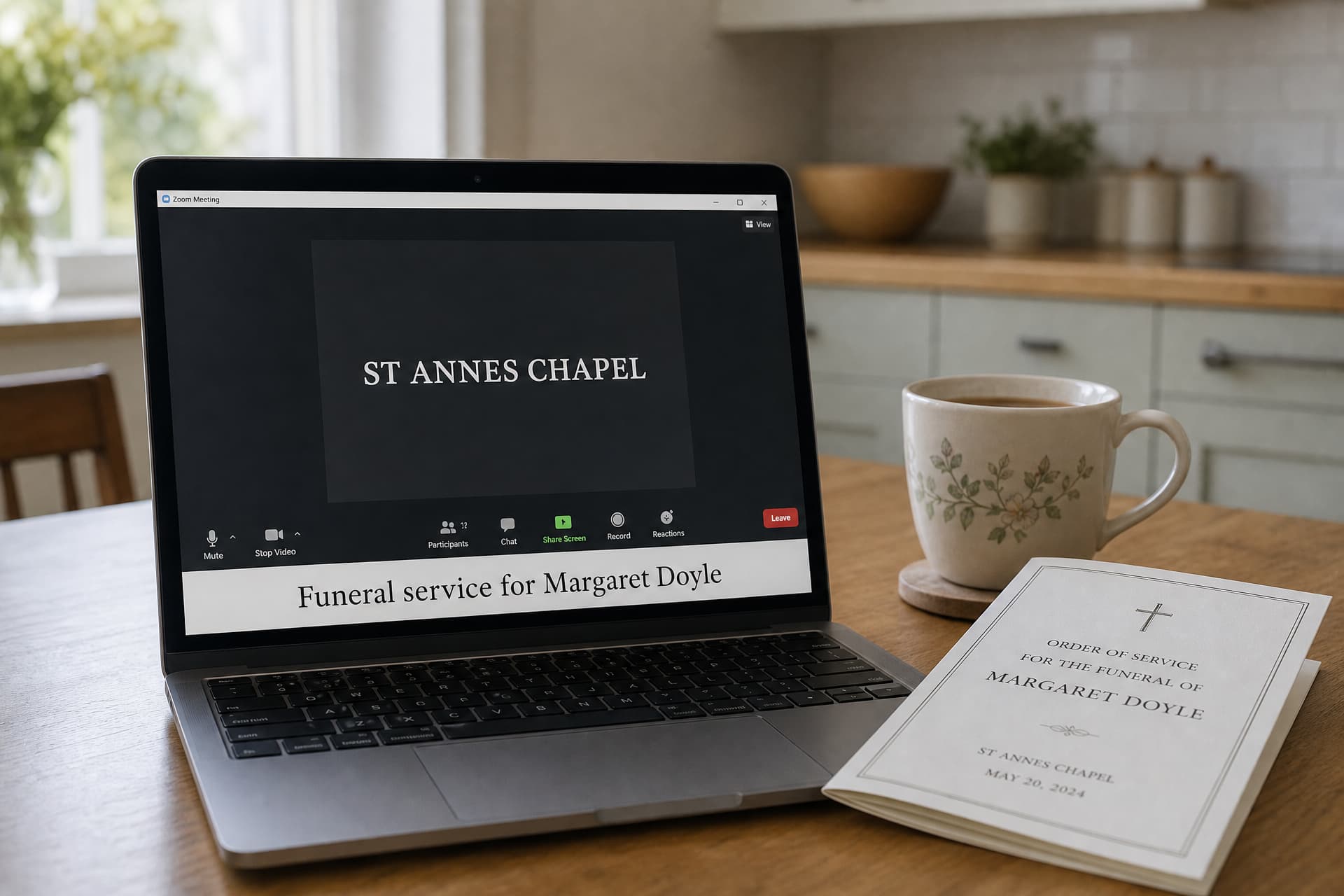
This is where most remote mourners actually are. Print the order of service and send it as a PDF with the link — following along matters more when you cannot see the room, and it gives people something to hold.
Attending a Funeral Online
The etiquette is not obvious, because there is no room to take cues from.
Dress as you would in person. It matters more than it sounds like it does, mostly to you.
Join five minutes early and stay muted.
Do not eat, walk around, or take calls. You are at a funeral.
Camera on or off is your choice on a two-way call — but if it is on, sit still and treat it as a pew.
Do not comment in the chat during the service unless the family has invited it. Some families genuinely want it; most find it distracting to whoever is monitoring.
Send something afterwards. This is the important one. Attending remotely is invisible to the family unless you tell them you were there — a message that evening saying "I watched, and I'm so sorry" is what converts your attendance into something they know about.
When It Goes Wrong
Because it sometimes does, and none of it is a catastrophe.
The stream drops. Someone should have the fallback number. Most funeral homes can restart it in under a minute and the recording usually captures the whole thing regardless.
Nobody can hear. The commonest failure by far. Whoever is monitoring should be watching the stream on a second device with headphones, so this is caught in the first thirty seconds rather than at the end.
The link does not work for older relatives. Call them and hold the phone up. It is not elegant and it works.
Somebody joins unmuted. Mute them and say nothing. The room will barely notice.
The recording never arrives. Ask for it in writing before the day, and ask when it expires.
The one genuinely irreversible failure is nobody pressing record. If the recording matters to your family, make it somebody's specific job and confirm it started.
A phone on a cheap tripod, plugged in, is a completely acceptable way to stream a funeral. What is not acceptable is somebody holding it — forty minutes handheld is unwatchable, and the person holding it does not get to attend.
Hybrid Services, and Why They Are Worth the Trouble
The version families are happiest with afterwards is rarely the pure livestream. It is the one where remote people were given something to do.
A reading delivered from another country, over a laptop propped on the lectern with a speaker facing the pews, is a genuinely moving thing and it is not technically difficult. It requires one person watching a second screen, a wired speaker rather than a laptop's own, and a short rehearsal the day before with the person who will be reading. That is the whole cost of it.
The same applies to a grandchild too young to travel, a colleague who worked alongside them for thirty years, a sibling in hospital. Any of them can be given ninety seconds, and the room hears from someone it otherwise would not have.
Two things make this work rather than fail. Rehearse the join, so the remote reader is already connected and muted before the service starts rather than dialling in during the hymn. And have a printed copy of whatever they are reading in the room, so that if the connection drops somebody can simply stand up and read it. The second one is what turns a risky idea into a safe one.
Should You Record It?
Families are split on this and both answers are right.
In favour: people who could not attend can watch later, in their own time, which is often easier than watching live. Children too young to understand sometimes want it years afterwards. And there is usually a eulogy in it that nobody wrote down.
Against: some families never watch it and find its existence uncomfortable. A recording of the worst day of your life sitting in a folder is not a neutral object.
The middle answer most families land on: record it, do not watch it, and keep it. The decision to have it is easy to make now and impossible to make later.
If you do keep it, get it off the funeral home's hosting and onto your own storage within the first month. Hosted links expire, companies change providers, and the file is not truly yours until it is somewhere you control.
For the Person Who Cannot Be There
Almost everything written about virtual funerals is addressed to the family arranging one. The harder side is being the person watching, and it deserves saying plainly: attending a funeral on a screen is not the same, and pretending otherwise does not help.
What is missing is not the service. It is everything around it — the standing about beforehand, the person who catches your eye across the chapel, the hand on your arm, the reception where the actual grieving gets done. You get the forty minutes and none of the six hours, and that is why it can feel strangely unfinished.
Three things help, and they are all about rebuilding some of what the screen removes.
Watch it with somebody, even somebody who did not know them. Grief in an empty room with headphones on is a particular kind of hard.
Do something to mark it in your own place. Light a candle, put a photograph out, wear the thing you would have worn. It sounds small and it is the difference between attending and observing.
Do something in your own place to mark it — a candle, a photograph out, the clothes you would have worn. It sounds small, and it is the difference between attending a funeral remotely and watching one.
Make a plan for afterwards. A call with a sibling that evening, a visit in a month, flowers sent to the house rather than the funeral home. The instinct is to feel that you have missed your chance to participate; you have not, the participation is just shifted later.
And say something to the family that day. Not because they need managing, but because a remote mourner is genuinely invisible otherwise — the room saw who came, and nobody saw you.
If you are on the family's side and somebody could not be there, the reverse also holds: tell them what they missed. Who spoke, what was said, who came from where. It takes ten minutes and it closes something that would otherwise stay open for years.
Frequently Asked Questions
How does a Zoom funeral work? A camera at the back of the chapel broadcasts the service. Remote guests join by link and watch; on a true Zoom call they can also be seen and heard if unmuted.
How much does a virtual funeral cost? Often nothing. Where it is charged, $100 to $400 including a recording is typical.
Can I stream a funeral myself? Yes, with the funeral director's permission, which is almost always given. Use a tripod and plug the phone in.
What do you wear to a virtual funeral? The same as an in-person one.
Is it disrespectful to attend a funeral online? No. Attending remotely is attending. Send a message afterwards so the family knows you were there.
Should the camera show the family? No. It shows the service — the lectern, the casket, the officiant. Never the front rows.
How long do funeral livestream recordings last? Ask, because it varies from 30 days to indefinitely. Download it and keep your own copy.
In Short
Ask the funeral home first, choose a one-way livestream unless somebody remote is speaking, and spend your attention on sound rather than picture. Send the link twice with the time zone in it, give one steady person the job of monitoring, and plug the phone in.
If you are watching from somewhere else — dress for it, stay muted, and message the family that evening. They will not know you were there unless you tell them.