🏬Supersize Online Funeral Retailer🪦1000's of Headstones⚱️Over 10,000 Cremation Urns⚰️Caskets Overnight Delivery🛒Funeral & Memorial Superstore🚚FREE Shipping on ALL Orders👨👩👧👦Helping Families for over 20 Years💰Lowest Price Guarantee🏬Supersize Online Funeral Retailer🪦1000's of Headstones⚱️Over 10,000 Cremation Urns⚰️Caskets Overnight Delivery🛒Funeral & Memorial Superstore🚚FREE Shipping on ALL Orders👨👩👧👦Helping Families for over 20 Years💰Lowest Price Guarantee
🏬Supersize Online Funeral Retailer🪦1000's of Headstones⚱️Over 10,000 Cremation Urns⚰️Caskets Overnight Delivery🛒Funeral & Memorial Superstore🚚FREE Shipping on ALL Orders👨👩👧👦Helping Families for over 20 Years💰Lowest Price Guarantee🏬Supersize Online Funeral Retailer🪦1000's of Headstones⚱️Over 10,000 Cremation Urns⚰️Caskets Overnight Delivery🛒Funeral & Memorial Superstore🚚FREE Shipping on ALL Orders👨👩👧👦Helping Families for over 20 Years💰Lowest Price Guarantee
Communal cremation means your pet is cremated at the same time as other pets, in the same chamber, and the ashes are not separated afterward. Nothing comes back to you.
That last sentence is the whole subject, and it is the part people most often learn too late. A good number of the families who search this term are not choosing between options — they are trying to find out what they already agreed to at the vet's office on the worst day of the year, and whether their pet's ashes are coming home. If that is you: they are not, and this page explains what did happen instead, where the ashes go, and what you can still do.
If you are deciding, the honest summary is that communal cremation is a legitimate, dignified and much cheaper option, chosen by a lot of people for sound reasons, and the only thing that disqualifies it is wanting the ashes. Everything below is the detail.
For how cremation itself works end to end, our pet cremation process guide covers the chamber, the chain of custody and the timeline. This page is about the communal option specifically. Both sit within our pet memorial guide.
What Communal Cremation Means
Several pets are placed in the cremation chamber together and cremated in one cycle. In a communal cremation the dog or cat shares that chamber with other animals for the whole of it. Afterward the remains cannot be told apart, because they are physically mixed — there is no process that separates them later, and no provider who offers to.
So communal cremation meaning, stated as plainly as it can be: a shared cremation with no individual ashes returned. You may also see it called group cremation or mass cremation. Those are the same service. Some providers prefer "communal" precisely because the alternatives sound worse, which is worth knowing when you are reading a price list.
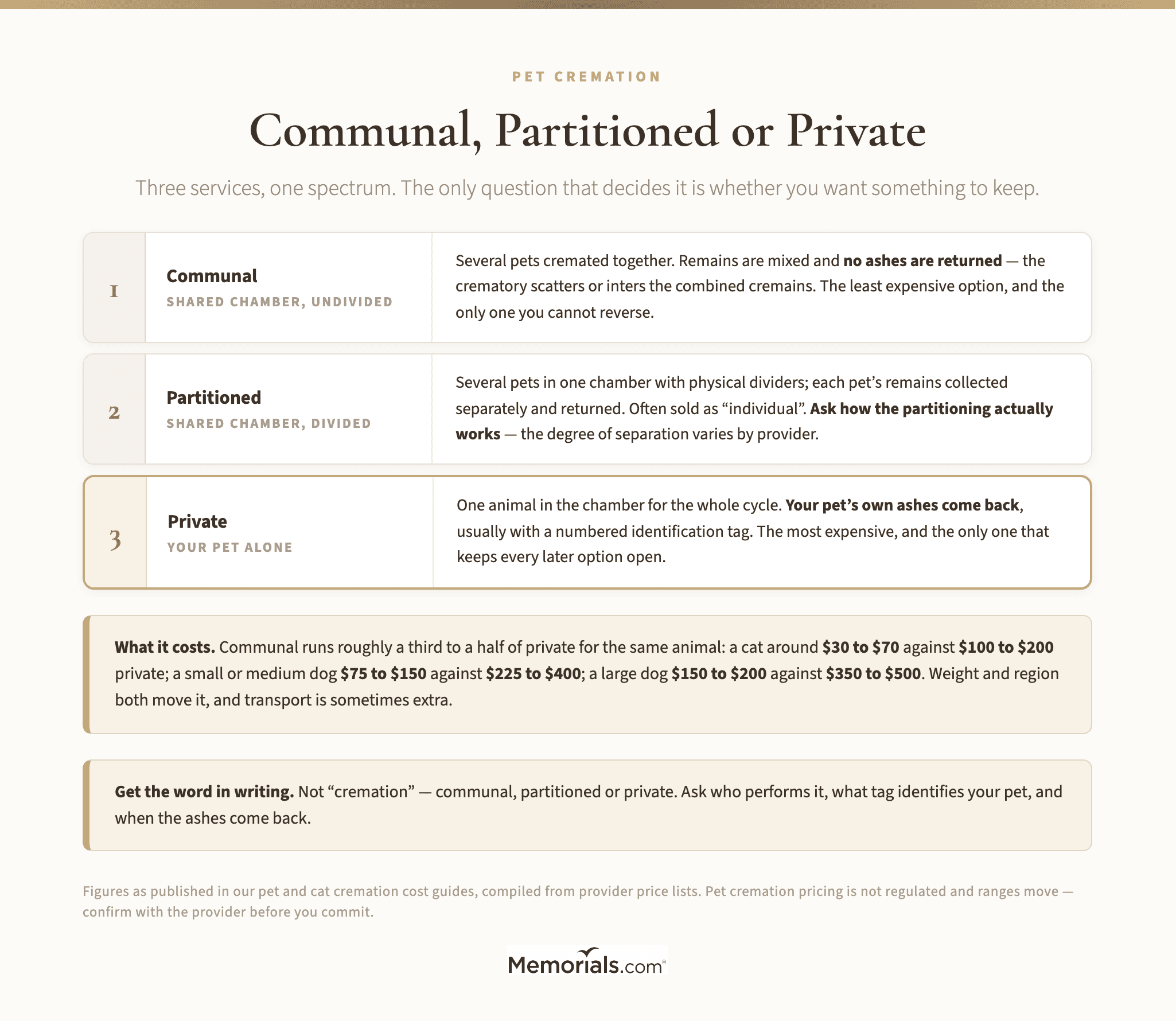
It helps to see the three options as one spectrum rather than three products:
In the chamber
Ashes returned
Private
your pet alone
yes, your pet's own
Partitioned or individual
several pets, physically divided
yes, kept separate during the cycle
Communal
several pets, undivided
no
The middle row is where the care is needed. "Individual" sounds like "private" and often is not — it usually means partitioned, and how real the partitions are varies by provider. Ask which of these three you are buying using those words, and ask what separates the animals.
Where the combined cremains usually go. Many crematories keep a dedicated area like this; some allow families to visit it and some do not, which is worth asking before you sign rather than after.
Pet Memorials and Markers
For families who chose communal cremation and want somewhere to go
No ashes, no urn, and usually no paw print or fur clipping either, because those are taken as part of a private package rather than at the chamber.
What you may still be offered, depending on the provider, is a certificate recording that the cremation took place and the date. It is not a legal document and it does not identify remains. Some families find it worth having and some find it worse than nothing; there is no right answer there.
This is the one decision in pet aftercare you cannot reverse. Everything else can be changed later. You can move ashes between urns, bury them years afterward, divide them among family, scatter some and keep some. None of that is available once a communal cremation has happened, which is the only reason this page presses the point.
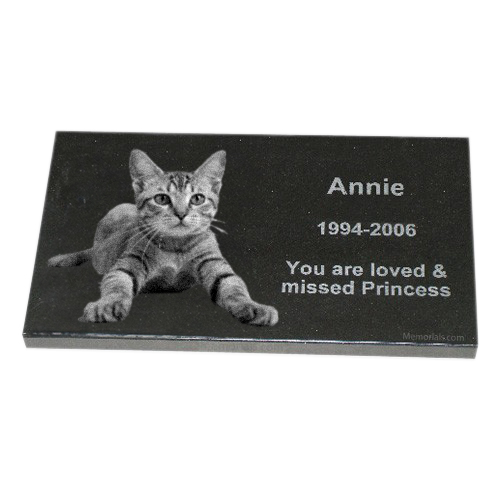
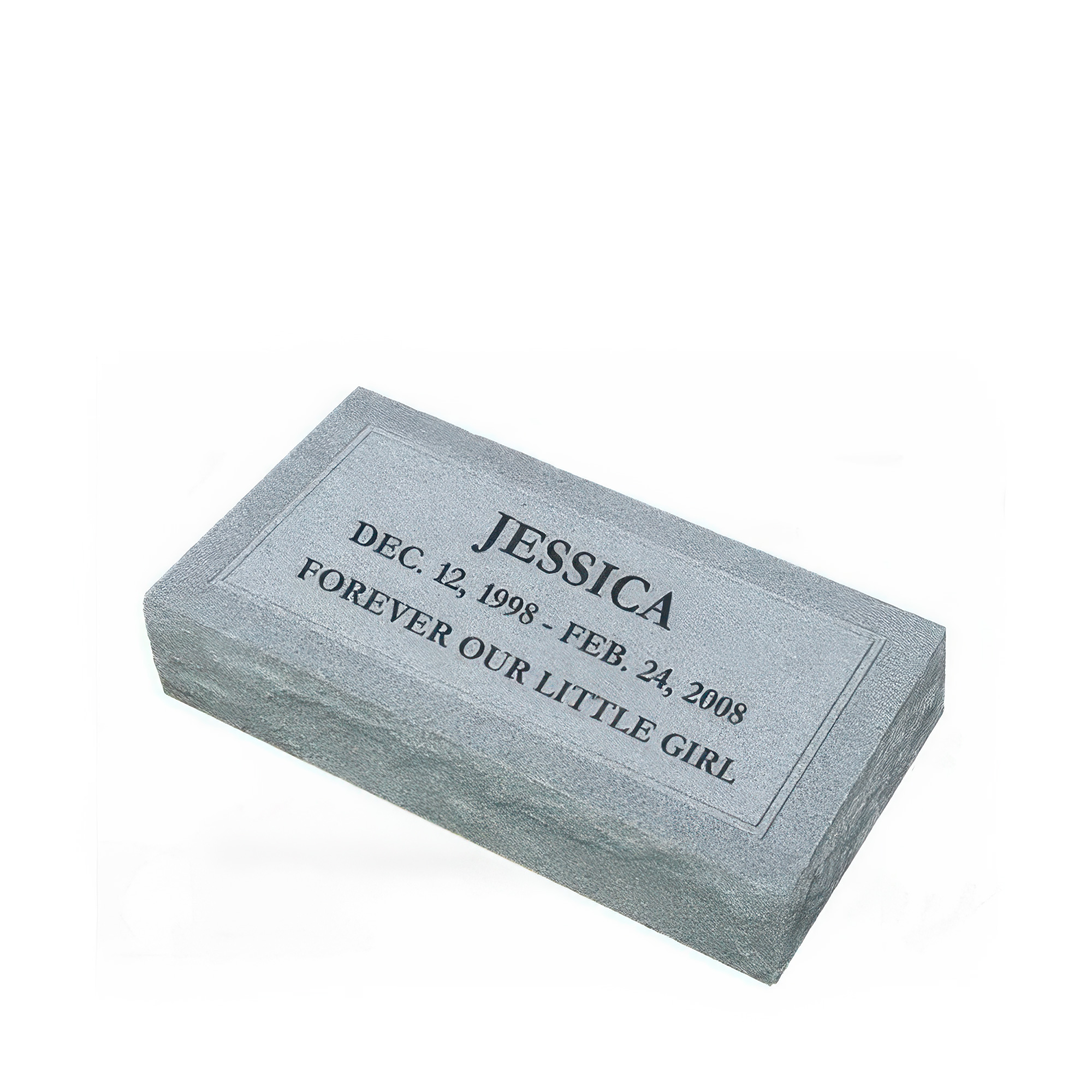
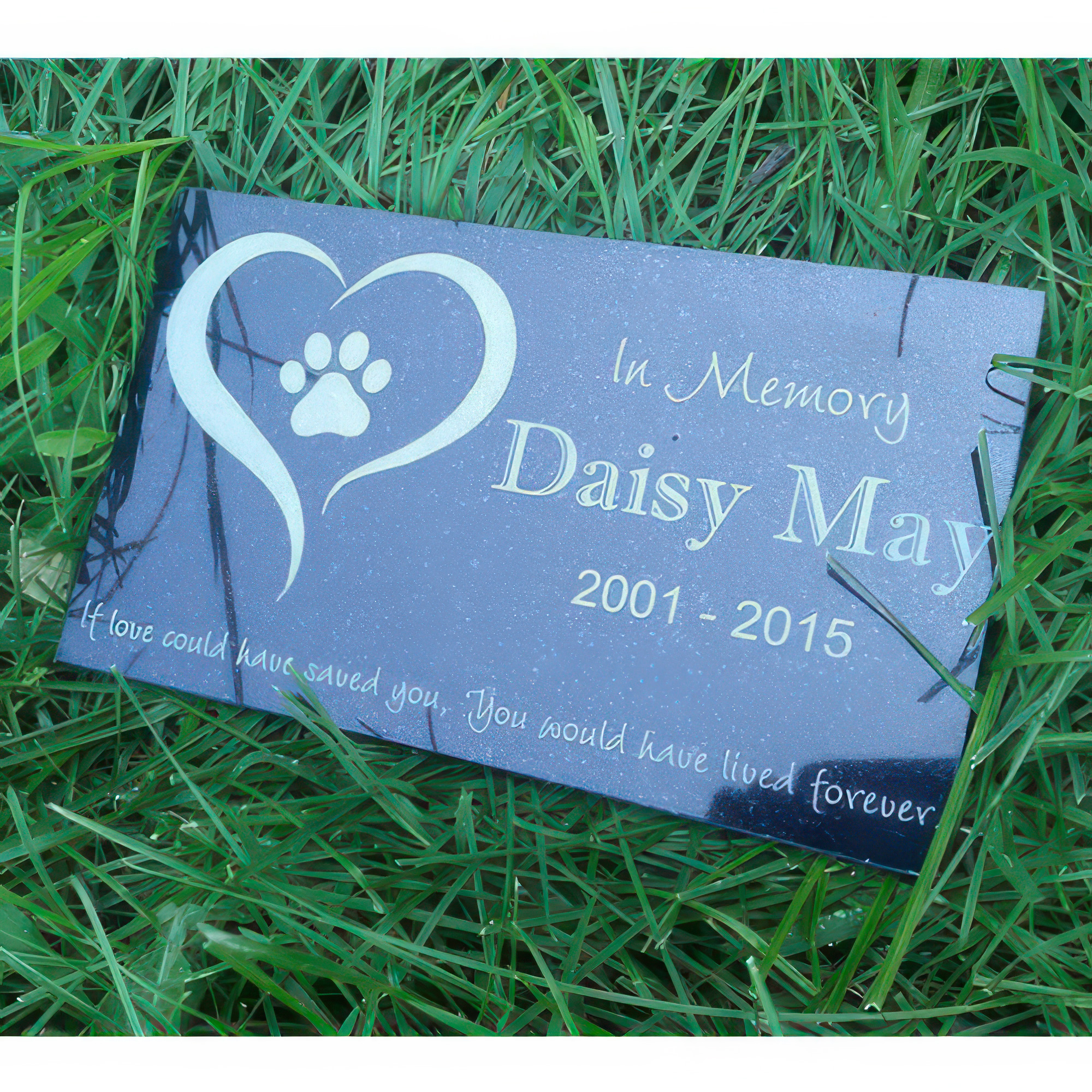
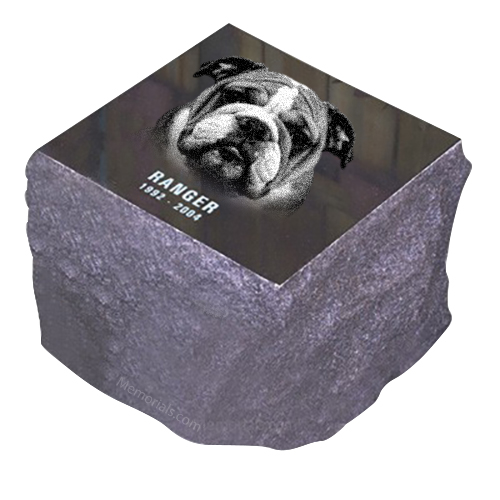
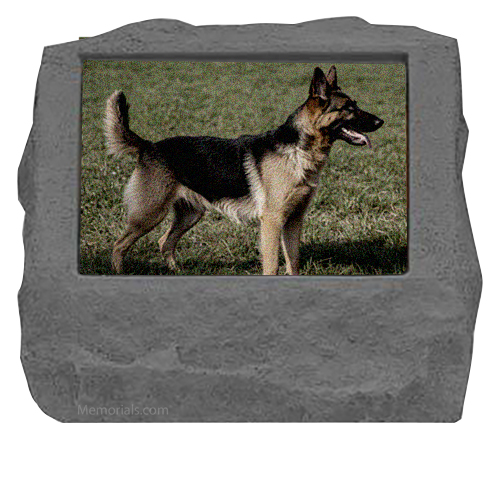
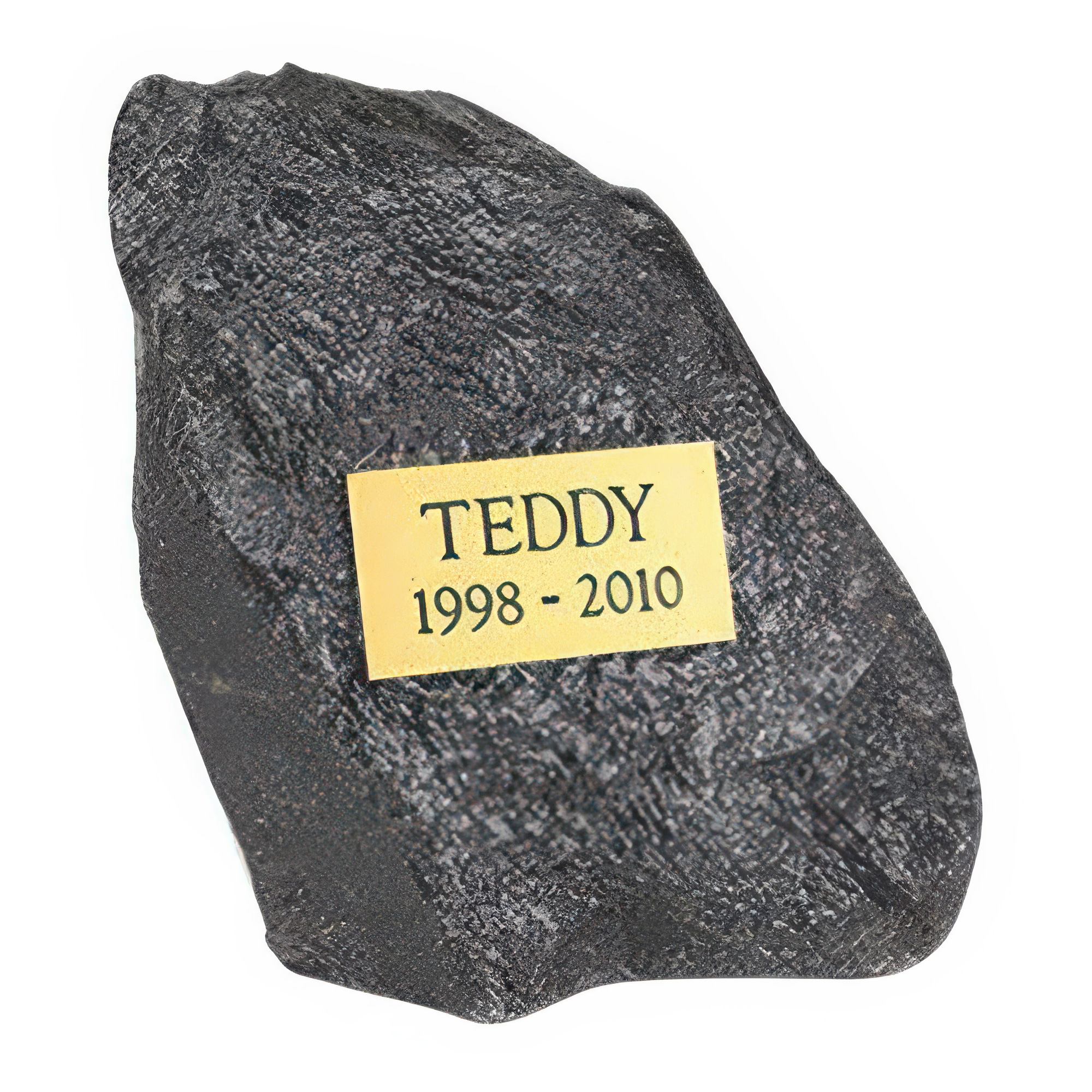
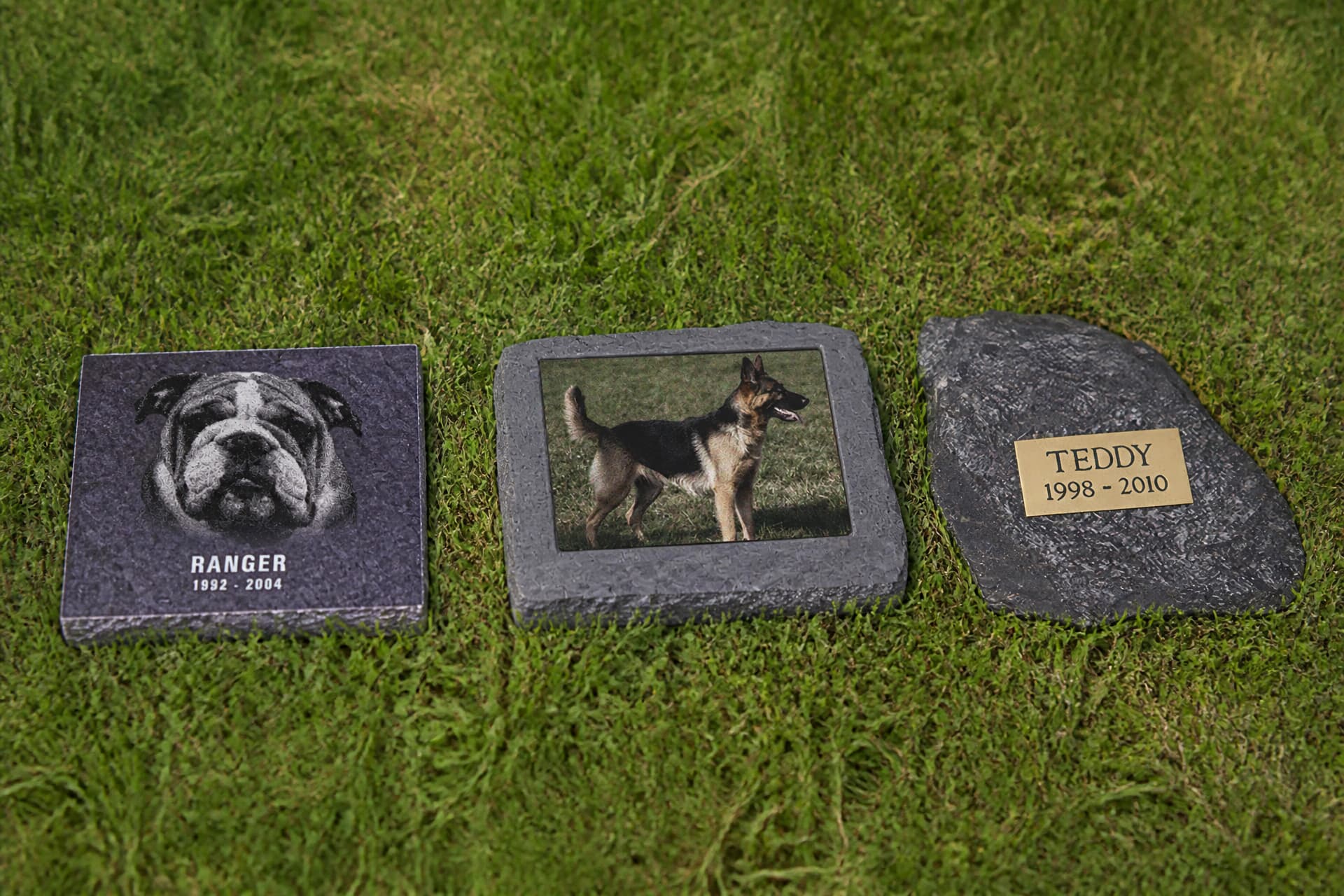
It also changes what there is to do afterward, and that is the part most pages stop short of. After a communal cremation a pet owner has nothing to place anywhere, where a family who kept ashes has an object and somewhere to put it. Families who chose communal do not, and a surprising number go looking for something to stand in for it — which is why a marker rather than a container is usually the right answer here. A pet memorial rocks marker in the garden, engraved with a name, gives the same fixed place to go without pretending to hold anything. A pet cremation memorial does the same indoors.
If you have not yet decided, and you think you might want the ashes, choose private and buy the container later. An urn is a decision you can take in a month, when you are thinking more clearly, and a large pet urn will still be there. The cremation is the decision you have to take now.
Where the Ashes Actually Go
The combined remains of the cycle are handled by the crematory rather than returned, and in practice that means one of three things.
Scattered on the crematory's own grounds. Many operators keep a memorial garden or a dedicated area for exactly this, and this is the most common arrangement. Some allow families to visit it; some do not, because it is on working premises rather than a cemetery.
Scattered elsewhere under the operator's own policy — woodland, a field, occasionally at sea where local rules permit it. The location is the provider's choice, not yours.
Interred in a common plot at a pet cemetery the crematory works with, which is less common and usually costs a little more.
Ask which one, and ask whether you can visit. It is a reasonable question, the answer is not standard, and it is the difference between having somewhere to go and not. If having a place matters to you, ask before you sign rather than afterward — a provider who scatters on their own grounds and allows visits is offering something materially different from one who does not.
Cost is the main reason families choose it, and it is a real difference rather than a marginal one: a communal pet cremation typically runs somewhere between a third and a half of the private price for the same animal.
Two things drive the figure. Weight, because cremation is priced by the time and fuel a body takes, which is why a large dog costs multiples of a cat. And region, because the same service in a major metro can run twice a rural price.
These are the figures our own cost guides publish, read from provider price lists:
Communal
Private
Cat
$30 to $70
$100 to $200
Small or medium dog
$75 to $150
$225 to $400
Large dog
$150 to $200
$350 to $500
Figures as published in our pet and cat cremation cost guides, compiled from provider price lists. Pet cremation pricing is not regulated the way human funeral pricing is, there is no required disclosure, and ranges move. Treat these as the shape of the market and confirm the actual number with the provider before you commit.
A caution about the shape of those ranges, because we would rather say it than have you discover it: published communal ranges vary more between sources than private ranges do, including between our own two cost guides. That is not sloppiness in the data so much as a real feature of the service — communal is often bundled, sometimes folded into a euthanasia fee, and occasionally offered at no separate charge at all, so there is less of a standard price to report. The private figure is the more reliable one, and the ratio between them is more useful than either number alone.
Ask what the number includes. Transport from the vet, the certificate, and any paw print are the three that are sometimes extra and sometimes not. A communal quote that covers collection can be better value than a lower one that does not.
What each service puts in the chamber, and what comes back from it.
Communal or Private: How to Actually Decide
The difference between private and communal cremation comes down to one question, and it is not really a question about cremation.
Do you want something to keep?
If yes, private, and nothing else will do. Partitioned returns ashes but shares a chamber, so if the reason you want them is that they are specifically your pet's, ask hard about how the partitioning works before accepting it as equivalent.
If no — and plenty of people mean no, for reasons that are theirs — communal is the better choice, not merely the cheaper one. Families who know they will not keep an urn, who do not want an object in the house, who are moving, who are elderly and do not want to leave someone else deciding what to do with it, who find the idea of their pet among others genuinely comforting rather than troubling: that is a sound decision and it does not need defending.
What makes it a bad decision is choosing it under pressure, on a day when you cannot think, because it was the cheapest line on a form. If you are in that moment now and cannot answer the question, there is usually more time than it feels like — a body can be held refrigerated for a period while you decide, and how long can a dead pet be kept in a freezer is a question with a practical answer rather than a panicked one. Ask the clinic to hold your pet overnight and decide tomorrow. Almost nobody regrets having taken a day.
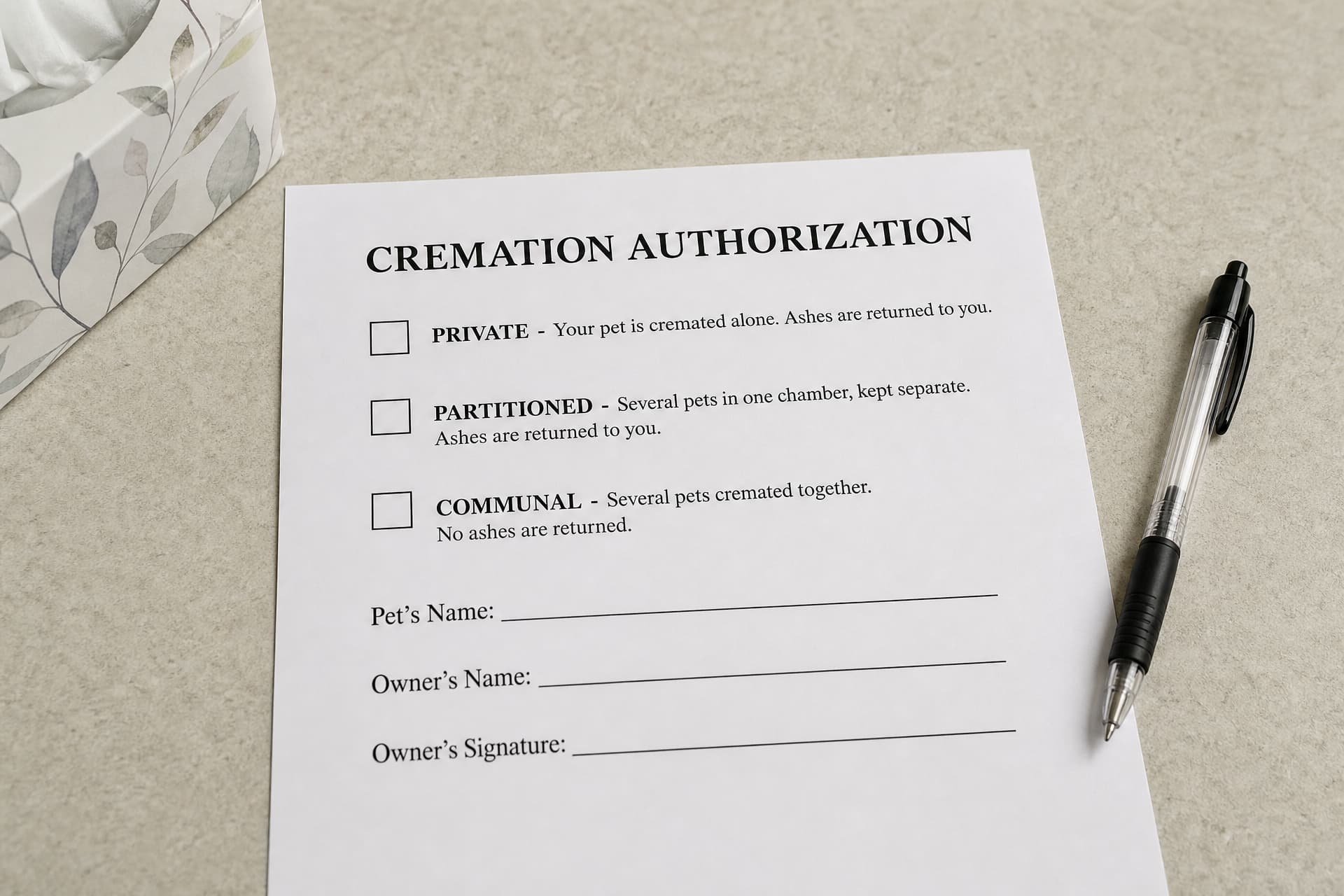
Ask for the word in writing. Not “cremation” — private, partitioned or communal. If the form has one box, write the word beside it and keep a copy.
How to Check Which Service You Are Actually Getting
This section exists because the failure mode is real and almost nothing covers it: families who believe they paid for private cremation and received communal.
It is rarely anybody acting in bad faith. It is usually vocabulary. "Individual" gets used for partitioned, partitioned gets described as private, a form has one checkbox for "cremation", or the arrangement is made verbally at the clinic and the clinic is not the crematory.
Four things make it checkable rather than a matter of trust.
Get it in writing, with the word on it. Not "cremation" — "private", "partitioned" or "communal". If the form has one box, write the word next to it and keep a copy.
Ask who actually performs it. Most vet clinics do not own a crematory; they use a contractor. Ask which one, and you can then ask that operator your questions directly rather than through a third party.
Ask what identifies your pet through the process. Private operators generally use a numbered tag or disc that stays with the body and is returned with the ashes. That is the chain of custody, and a provider who cannot describe theirs is telling you something.
Ask the return time before you leave. Private is usually days to a couple of weeks. If you are told ashes will come back and given no timescale, follow it up — a vague answer is worth one phone call now rather than six weeks of waiting.
If you are already past this point and worried: ask the clinic for the crematory's name and ask the crematory directly what service was performed on what date. They keep records of cycles. You are entitled to ask, and most will tell you.
Cats and Communal Cremation
The service is identical; what differs is the arithmetic. A cat's communal cremation is often $30 to $70 against $100 to $200 private, so the gap in absolute money is small enough that it rarely decides anything on its own.
Which means for cats the question is almost purely about whether you want the ashes, uncomplicated by cost. That is worth naming, because owners of large dogs face a genuinely different decision — a $200 difference and a $350 difference are not the same trade-off, and nobody should feel they made a lesser choice because the number was larger.
Some of the people reading this are here for that reason, so it should be said rather than left out.
The cremation cannot be undone and the ashes cannot be recovered. There is no version of this page that softens that.
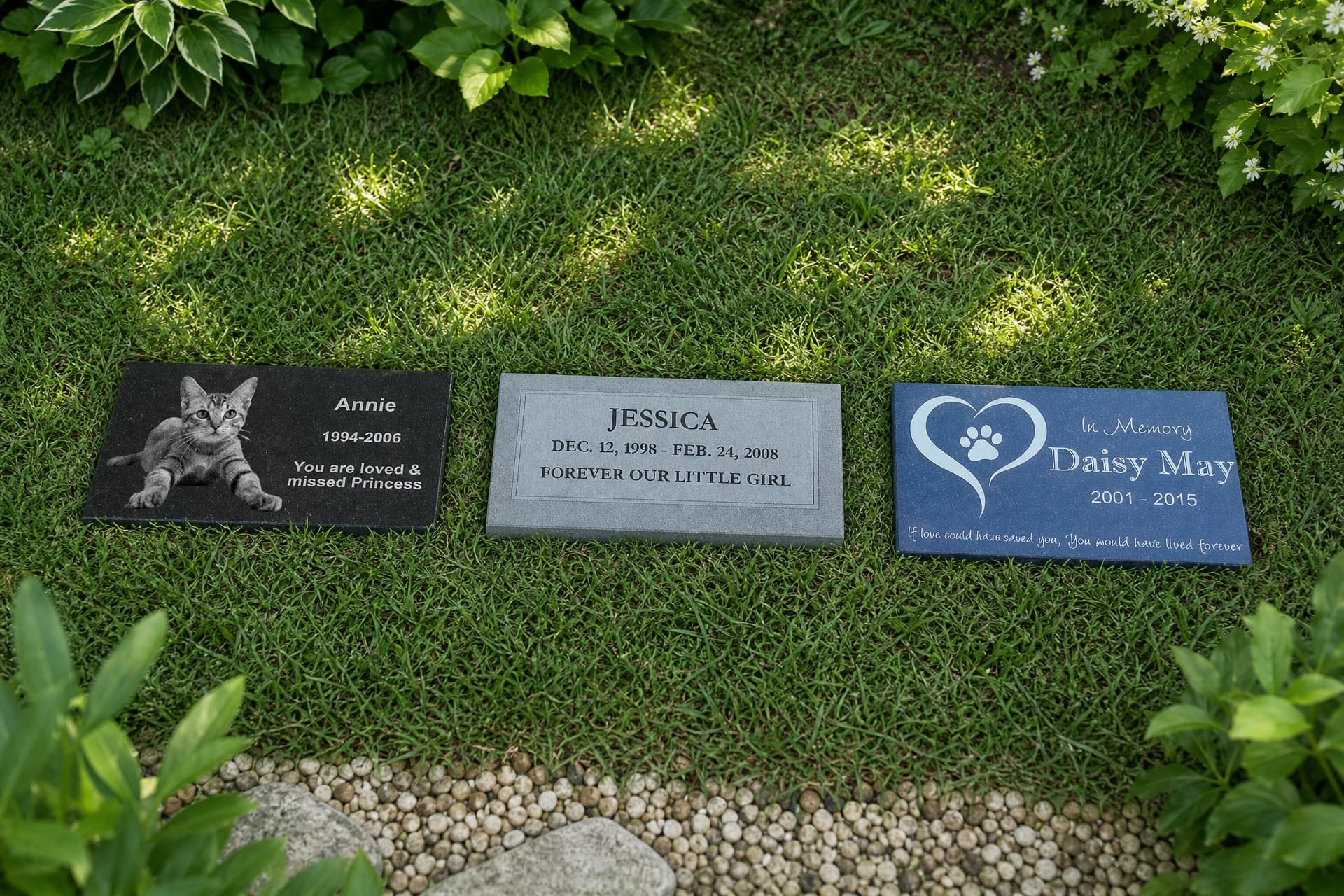
What is available is a place. The reason a marker works where an urn does not is that it is not pretending to hold anything — it marks that the animal existed and that this is where you come to think about them. A stone in the garden, a plaque by the window, a bench. Families who chose communal and later put a marker somewhere often describe it as having closed something that was left open, and it is worth knowing that the option exists, because nobody at the clinic will mention it.
It is also worth being fair to yourself about the decision. Communal cremation is the most common choice in the industry by volume. It was the normal option, you were asked on the worst day, and you took the one in front of you. That is not a failure of love.
Frequently Asked Questions
What is a communal cremation? Several pets cremated together in one chamber, with the remains mixed and no individual ashes returned. It is the least expensive option and is also called group or mass cremation. What is communal cremation in practice, then, is a shared cycle with nothing to collect afterward.
Do you get ashes back from a communal cremation? No. The remains cannot be separated afterward. If ashes were returned to you, the service was private or partitioned, whatever the paperwork called it.
What is communal cremation for pets versus individual? "Individual" usually means partitioned — several pets in one chamber with physical dividers, and ashes returned separately. It sits between communal and private, and the real separation varies by provider, so ask how the partitioning works.
How much is a communal dog cremation? Roughly $75 to $150 for a small or medium dog and $150 to $200 for a large one, against $225 to $500 for private. Weight and region both move it, and transport is sometimes extra.
Where do the ashes go after a communal cremation? Usually scattered on the crematory's own memorial grounds, sometimes elsewhere under the operator's policy, occasionally interred in a common plot. Ask which, and ask whether you can visit.
Is communal cremation disrespectful? No. The animals are handled with the same care and the same equipment; the only difference is that the remains are not separated. It is the most commonly chosen option in the industry.
Can I change my mind after choosing communal cremation? Only before it happens. Call the clinic or crematory immediately and ask them to hold your pet — if the cycle has not run, it can usually still be changed to private.
A Final Thought
The thing worth carrying away is the question, not the price: do you want something to keep? Answer that honestly and the rest decides itself, including the money.
And if you are reading this having already found out that nothing is coming back, the useful part of this page is the last section rather than the first. The ashes are not recoverable. A place to go is, and it is a smaller thing to arrange than it sounds.