🏬Supersize Online Funeral Retailer🪦1000's of Headstones⚱️Over 10,000 Cremation Urns⚰️Caskets Overnight Delivery🛒Funeral & Memorial Superstore🚚FREE Shipping on ALL Orders👨👩👧👦Helping Families for over 20 Years💰Lowest Price Guarantee🏬Supersize Online Funeral Retailer🪦1000's of Headstones⚱️Over 10,000 Cremation Urns⚰️Caskets Overnight Delivery🛒Funeral & Memorial Superstore🚚FREE Shipping on ALL Orders👨👩👧👦Helping Families for over 20 Years💰Lowest Price Guarantee
🏬Supersize Online Funeral Retailer🪦1000's of Headstones⚱️Over 10,000 Cremation Urns⚰️Caskets Overnight Delivery🛒Funeral & Memorial Superstore🚚FREE Shipping on ALL Orders👨👩👧👦Helping Families for over 20 Years💰Lowest Price Guarantee🏬Supersize Online Funeral Retailer🪦1000's of Headstones⚱️Over 10,000 Cremation Urns⚰️Caskets Overnight Delivery🛒Funeral & Memorial Superstore🚚FREE Shipping on ALL Orders👨👩👧👦Helping Families for over 20 Years💰Lowest Price Guarantee
Understanding the pet cremation process can bring real comfort during one of the most difficult moments a family faces. When a beloved dog, cat, or other companion animal passes away, knowing what happens next — and what choices are available — helps you make decisions that feel right without the added weight of uncertainty.
This guide walks through each stage of the pet cremation process, from the initial arrangements through receiving your pet's cremated remains. If you are navigating the broader experience of losing a pet and want a full overview of memorialization options, our complete guide to pet memorials covers everything from burial to keepsakes and beyond.
We focus here on the process itself — how cremation works, the types of cremation offered, how long it takes, and what you can expect to receive afterward. For detailed pricing information, see our separate guide on .
Pet cremation uses controlled, high-temperature heat to reduce a pet's body to its basic mineral components. The process takes place in a specialized facility — a pet crematory or crematorium — using equipment specifically designed for animal aftercare. Here is what happens at each stage.
Arrangement and Transport
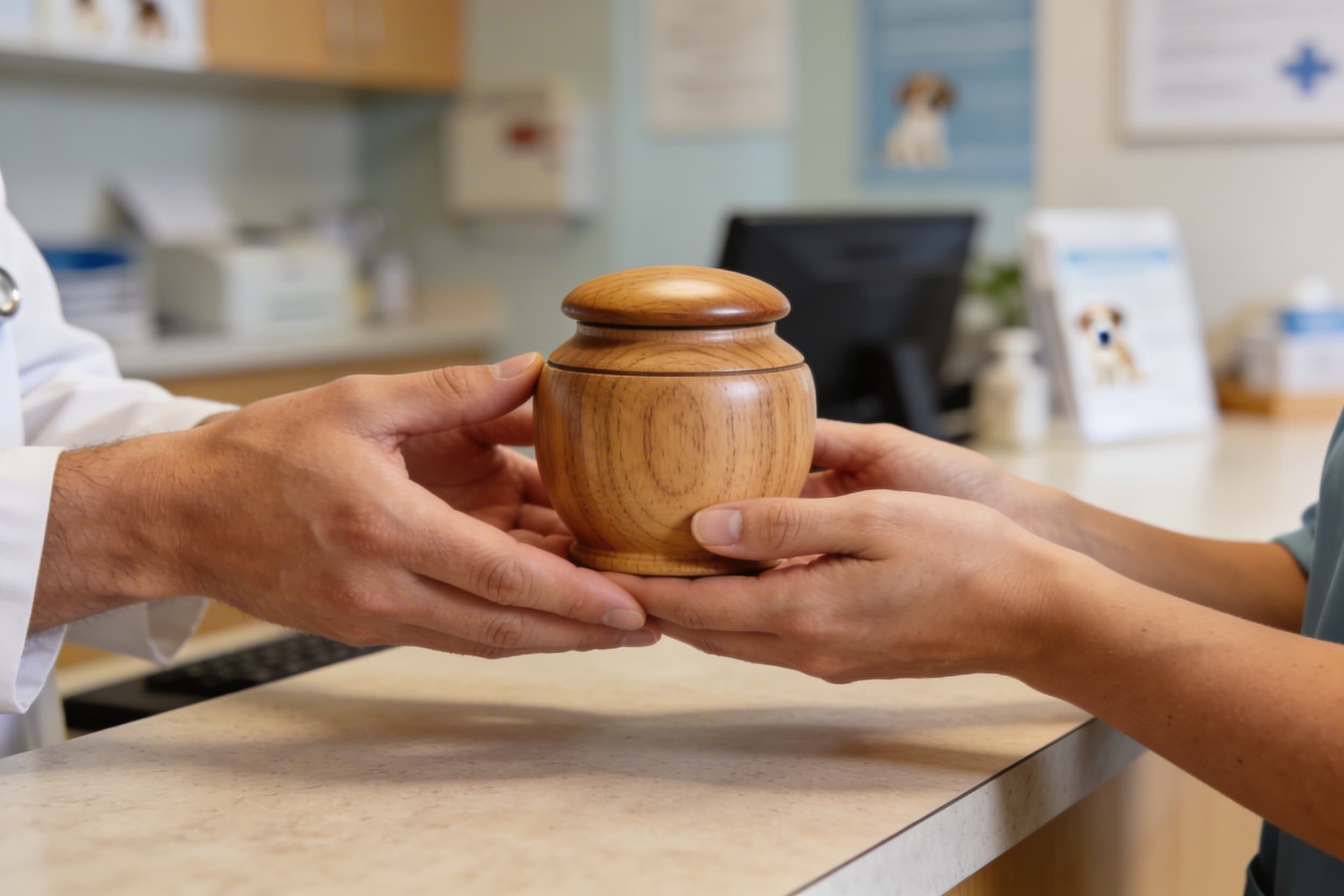
The pet cremation process typically begins at your veterinarian's office. After a pet passes away naturally or is humanely euthanized, the veterinary staff will help coordinate transport to a pet crematory. Some cremation providers also offer home pickup for pets who pass at home.
During the arrangement step, you will choose the type of cremation you prefer (private, communal, or partitioned — more on each below) and discuss any memorial keepsakes you would like, such as a clay paw print or fur clipping. It is important to request these mementos before the cremation takes place, since they cannot be collected afterward.
Identification and Chain of Custody
Reputable pet crematories use a strict identification system to ensure the remains you receive belong to your pet. Most facilities assign a unique tracking tag — typically a small stainless steel disc with a number — that stays with your pet from intake through the entire cremation process and return. This chain of custody may also include intake paperwork, digital logging, and photo checkpoints at each stage.
If this level of documentation matters to you, ask the cremation provider about their specific tracking procedures before making your decision. A trustworthy facility will welcome these questions.
The Cremation Chamber
Your pet's body is gently placed into a cremation chamber (sometimes called a retort). The chamber is heated to extremely high temperatures, typically between 1,400 and 1,800 degrees Fahrenheit. At this intensity, the heat reduces all organic matter — soft tissue, fur, and muscle — through a combination of evaporation and combustion.
What remains after the cremation cycle are calcified bone fragments. These are not powdery ash in the traditional sense, though the term "ashes" is commonly used. The fragments are off-white to light gray in appearance.
Processing the Remains
After the chamber cools, a crematory technician carefully removes any non-organic materials such as surgical pins, identification microchips (which usually do not survive the heat), collar hardware, or orthopedic implants. The remaining bone fragments are then placed into a specialized processor called a cremulator, which reduces them to a fine, sand-like consistency.
These processed remains — formally called cremains or cremated remains — are what families receive. The texture is coarse and granular, similar to fine sand, and the color ranges from pale gray to off-white depending on the pet's size and the minerals present in their bones.
What You Receive Back
If you chose private or partitioned cremation, the cremated remains are placed into a sealed bag inside a temporary container or an urn of your choosing. The amount of cremains returned varies based on your pet's body weight. As a general guideline, you can expect approximately one cubic inch of cremated remains per pound of body weight — so a 50-pound dog would yield roughly 50 cubic inches of cremains.
Many families choose to place the remains in a pet urn designed for long-term display or burial. Others divide a small portion into pet cremation jewelry or pet keepsake urns so multiple family members can carry a physical connection to their pet. For ideas on memorialization after cremation, see our guide on what to do with pet ashes.
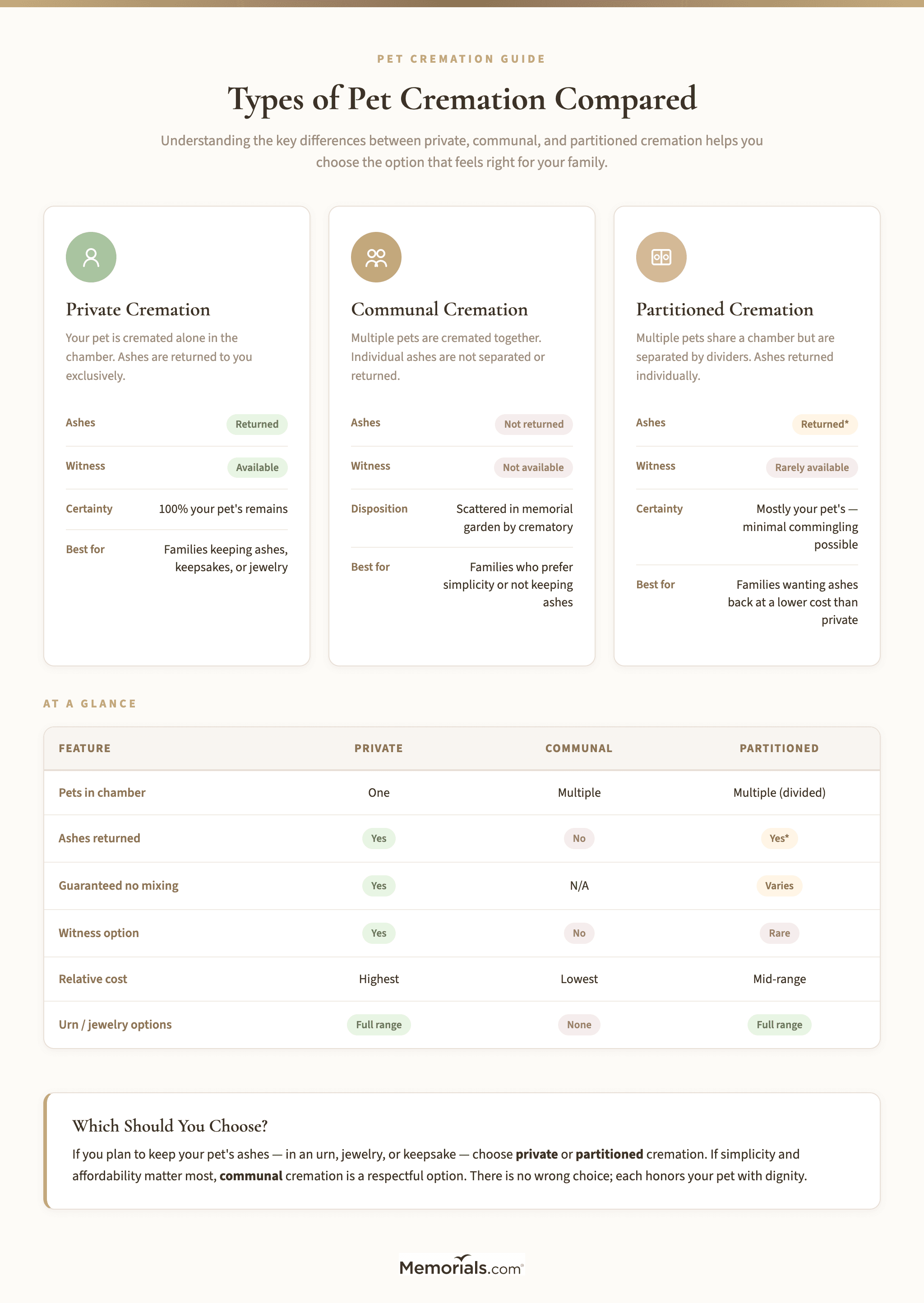
Types of Pet Cremation: Private, Communal, and Partitioned
The single most important decision you will make about pet cremation is the type of service. This determines whether you receive your pet's ashes back, the level of personalization available, and the overall experience.
Private Cremation
In a private cremation, your pet is the only animal in the cremation chamber during the entire cycle. This guarantees that the cremains returned to you belong solely to your pet, with no possibility of commingling with another animal's remains.
Private cremation is the preferred choice for families who plan to keep the ashes at home in a pet memorial, scatter them in a meaningful location, or divide them into keepsake jewelry. Some facilities also offer witnessed cremation as an add-on to private service, allowing you to be present when the cremation begins. Witnessed cremation can provide an important sense of closure for families who want to accompany their pet through every step.
Communal Cremation
Communal cremation involves multiple pets being cremated together in the same chamber at the same time. Because the remains are mixed, individual ashes are not separated and are not returned to families. Instead, the crematory typically scatters the combined cremains in a memorial garden or other designated area.
Communal cremation is a respectful option for families who do not wish to keep their pet's ashes or who prefer a simpler arrangement. It is also generally the most affordable type of pet cremation. There is no wrong choice here — some families find genuine comfort in the idea that their pet is not alone in their final moments.
Partitioned (Semi-Private) Cremation
Partitioned cremation — sometimes called individual or semi-private cremation — sits between private and communal. Multiple pets are placed in the same cremation chamber, but physical dividers separate each animal during the process. After cremation, each pet's remains are collected separately and returned to their family.
This option offers a balance between cost and personalization. However, the degree of separation varies by provider, so it is worth asking specifically how partitions work at the facility you are considering and whether they can guarantee no commingling of remains.
How Long Does Pet Cremation Take?
The pet cremation timeline depends on several factors, including the type of cremation chosen, your pet's size, and the crematory's schedule. Here is a general breakdown of what to expect.
The Cremation Itself
The actual cremation cycle typically takes between 30 minutes and two hours. Smaller animals like cats, rabbits, and small dogs are on the shorter end, while large-breed dogs may take closer to two hours. Very large animals such as horses require specialized equipment and significantly longer processing time.
From Passing to Receiving Ashes
The total timeline from your pet's passing to receiving their cremated remains usually spans one to two weeks. Here is why the process takes longer than the cremation itself:
Transport scheduling adds one to three days in most cases, as crematories coordinate pickups from multiple veterinary clinics on set routes. The cremation and processing adds one to two days, including cooldown time and the processing of bone fragments into cremains. If you ordered an urn or memorial keepsake through the crematory, preparation of those items may add additional time. Finally, return delivery — either back to the veterinary clinic for pickup or directly to your home — adds another one to three days depending on the provider.
Some cremation services offer expedited or same-day private cremation for an additional fee. If timing is important to you, ask about rush options when making your arrangements.
Communal Cremation Timeline
Because communal cremation does not involve returning individual ashes, the timeline is generally shorter from the provider's perspective. However, families may not receive notification of when the cremation took place unless they specifically request it.
How Long Can You Wait Before Cremation?
Most families have more time than they fear. If your pet has died at home, you generally have 12 to 24 hours to make arrangements, provided the body is kept somewhere cool — a room below 65°F (18°C), resting on a hard surface such as tile or concrete rather than on bedding. Wrapping your pet in a blanket with ice packs alongside the abdomen extends that window to roughly 48 hours.
If your veterinarian is handling the arrangements, you have longer. Most clinics keep refrigerated storage and can hold your pet for several days, which is enough time to choose between private and communal cremation, select an urn, or wait for a family member to travel home and say goodbye. There is no obligation to decide the same day, and a good crematory will not rush you.
Heat is what shortens the window. In summer, or in a warm climate without air conditioning, decomposition begins within hours rather than a day, so aim to reach your veterinarian or the crematory within 24 hours. The same limit applies if you are planning a home burial instead of cremation.
If you want time with your pet before they go, take it. Many providers will accommodate a private goodbye at the clinic or the crematory, and some offer expedited or same-day cremation for an additional fee if timing matters to you. For the practical steps in the first few hours, our guide on what to do when your dog dies walks through caring for the body, contacting your vet, and what to expect next.
Cremation for Dogs vs. Cats: Are There Differences?
The cremation process itself is essentially the same for dogs and cats. The chamber, temperatures, and techniques do not change based on species. The primary differences are practical ones related to size.
Cats and small dogs produce less cremains than large dogs, simply because they have less bone mass. A typical house cat weighing 8 to 10 pounds will yield roughly 8 to 10 cubic inches of cremated remains — enough to fit in a small keepsake urn. A 70-pound Labrador Retriever, by comparison, yields considerably more and requires a standard full-size pet urn.
The cremation cycle is also shorter for smaller animals. A cat cremation may take 30 to 45 minutes, while a large dog may require 90 minutes to two hours. For specific pricing differences between dog and cat cremation, see our guide on cat cremation cost.
Other companion animals — rabbits, birds, guinea pigs, reptiles, and hamsters — can also be cremated. Most standard pet crematories accommodate these species, though you should confirm with the facility in advance. Horses and livestock require specialized large-animal cremation services that are less widely available.
Aquamation: A Water-Based Alternative
A growing number of pet aftercare providers now offer aquamation, also known as water cremation or alkaline hydrolysis. This process uses a combination of warm water, gentle agitation, and an alkaline solution to break down organic tissue over a longer period — typically 18 to 20 hours, compared to one to two hours for flame cremation.
The end result is similar: processed bone fragments that are returned to the family as cremated remains. Many families find that aquamation cremains are slightly finer and lighter in color than flame cremation cremains.
Aquamation appeals to environmentally conscious families because it uses roughly 90 percent less energy than traditional flame cremation and produces no direct carbon emissions. Availability varies by region, so check with local providers to see if this option exists in your area.
What to Ask Your Veterinarian or Cremation Provider
Making decisions about pet cremation is easier when you have clear answers. Here are the most important questions to ask when arranging cremation services:
About the cremation type: Will my pet be cremated alone (private), or will other animals be present? If partitioned, how are the animals separated? Can I witness the cremation if I choose private service?
About identification: What tracking system do you use to ensure I receive my pet's remains? Is there a unique identification tag that stays with my pet throughout the process?
About the timeline: How long will it take from pickup to receiving my pet's cremains? Do you offer expedited services?
About what is returned: What type of container will the cremains come in? Can I provide my own urn? How much cremains should I expect based on my pet's weight?
About keepsakes: Can you take a paw print or fur clipping before cremation? Do you offer any memorial items such as nose prints or ink impressions?
If choosing a pet urn in advance, knowing the expected volume of cremains will help you select the right size. The one-cubic-inch-per-pound guideline applies to most dogs and cats.
Making the Decision: Is Cremation Right for Your Pet?
For many families, cremation offers flexibility that burial does not — the ability to keep a physical memorial at home, to scatter ashes in a place that held meaning for your pet, or to divide remains among family members who each want a keepsake. It is also more widely available than pet cemetery burial, particularly in urban and suburban areas.
If you are still weighing your options, our article on whether to cremate or bury a pet explores both paths side by side.
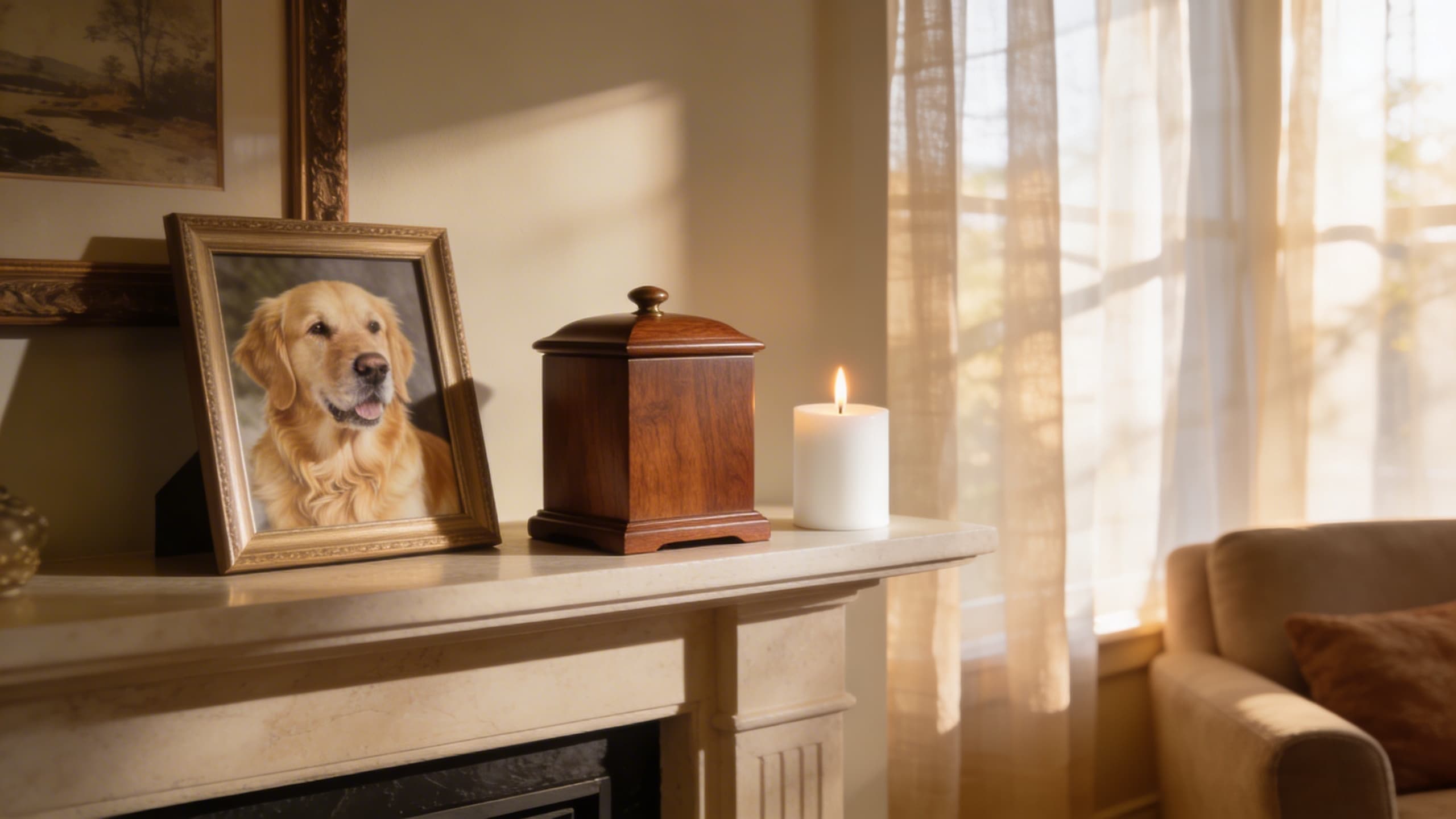
Whatever you choose, the goal is the same: honoring the bond you shared in a way that brings comfort. Some families find peace in a pet cremation jewelry guide that helps them choose the right piece worn close to the heart. Others place their pet's urn on a shelf beside a favorite photo. There is no single right answer — only the one that feels right for your family.
Memorials.com offers a wide selection of pet urns, pet cremation jewelry, and keepsake urns to help you create a lasting tribute to the companion who meant so much.
Frequently Asked Questions
How long does it take to cremate a pet?
The cremation itself typically takes 30 minutes to two hours depending on your pet's size. However, the total time from your pet's passing to receiving cremated remains is usually one to two weeks, accounting for transport, scheduling, processing, and return delivery.
Do you get your pet's actual ashes back?
With private cremation, yes — you receive only your pet's cremated remains. With partitioned cremation, ashes are returned but there is a small possibility of minimal commingling depending on the facility. With communal cremation, individual ashes are not returned.
What do pet cremated remains look like?
Pet cremains have a coarse, sand-like texture and range in color from pale gray to off-white. They are processed bone fragments, not fine ash. The amount you receive depends on your pet's body weight — approximately one cubic inch per pound.
Is aquamation better than traditional cremation?
Neither method is inherently better — it depends on your priorities. Aquamation uses significantly less energy and produces no direct emissions, making it appealing for environmentally conscious families. Traditional flame cremation is more widely available and typically faster. Both methods produce cremated remains that are returned to the family.
Can I be present during my pet's cremation?
Some crematories offer witnessed cremation, allowing you to be present when the cremation process begins. This is usually available only with private cremation and may carry an additional fee. Ask your cremation provider about witnessed options if this is important to you.