🏬Supersize Online Funeral Retailer🪦1000's of Headstones⚱️Over 10,000 Cremation Urns⚰️Caskets Overnight Delivery🛒Funeral & Memorial Superstore🚚FREE Shipping on ALL Orders👨👩👧👦Helping Families for over 20 Years💰Lowest Price Guarantee🏬Supersize Online Funeral Retailer🪦1000's of Headstones⚱️Over 10,000 Cremation Urns⚰️Caskets Overnight Delivery🛒Funeral & Memorial Superstore🚚FREE Shipping on ALL Orders👨👩👧👦Helping Families for over 20 Years💰Lowest Price Guarantee
🏬Supersize Online Funeral Retailer🪦1000's of Headstones⚱️Over 10,000 Cremation Urns⚰️Caskets Overnight Delivery🛒Funeral & Memorial Superstore🚚FREE Shipping on ALL Orders👨👩👧👦Helping Families for over 20 Years💰Lowest Price Guarantee🏬Supersize Online Funeral Retailer🪦1000's of Headstones⚱️Over 10,000 Cremation Urns⚰️Caskets Overnight Delivery🛒Funeral & Memorial Superstore🚚FREE Shipping on ALL Orders👨👩👧👦Helping Families for over 20 Years💰Lowest Price Guarantee
The question comes up often, and it makes complete sense to ask it. You've chosen a deeply personal piece of jewelry, one that holds a small portion of your loved one's cremated remains – and you want to know whether it's actually safe to wear every day.
The answer is yes, with some practical nuance. Cremation jewelry is safe for daily wear. The ashes sealed inside pose no health risk, and quality pieces are made from materials that are comfortable against skin. That said, "safe to wear" and "safe to wear in every situation" are different things – and knowing the difference protects both the piece and the memorial inside it. If you'd like more context on what is cremation jewelry before diving into safety specifics, that guide covers the basics of how these pieces are made and filled.
This guide covers everything you need to know: the science behind ash safety, how different materials behave with daily wear, when to take your piece off, and how to keep it in good condition for years. For a complete overview of all memorial jewelry types and how to choose, see our complete cremation jewelry guide.
Are Cremated Ashes Safe to Be Near Your Skin?
The most fundamental concern people have is whether cremated remains – sometimes called cremains – are harmful to be near. Scientifically, the answer is straightforwardly reassuring.
Cremation occurs at temperatures exceeding 1,400°F (760°C). At those temperatures, all organic pathogens are destroyed. What remains is a mineral substance composed primarily of calcium phosphates and trace minerals – similar in composition to bone meal. Health authorities, including the CDC, consider properly processed cremated remains to be sterile.
Wearing ashes in jewelry safe? Yes. The ashes inside a pendant or ring chamber are not in contact with your skin – they're enclosed within a sealed metal or glass chamber. Even in the unlikely event of a tiny amount of ash making brief contact with your skin, the material is inert and non-toxic. It's fine particulate matter, and as long as you're not inhaling a significant quantity during the filling process, there's no health risk.
One practical note: when you first fill your piece, work on a stable surface and avoid creating airborne dust. The ashes themselves are harmless, but fine mineral dust of any kind is better kept out of your lungs. Once sealed, that concern is gone entirely.
Cremation Jewelry Health Risks: What's Real vs. What Isn't
When people search for cremation jewelry health risks, they usually have one of two concerns: the ashes themselves, or the jewelry materials. We've covered the first. Here's the second.
Skin Irritation and Allergies
The most common real-world health issue with any jewelry – including cremation jewelry – is skin sensitivity to metals. This has nothing to do with the memorial contents and everything to do with material choice.
Stainless steel (specifically grades 316L and 304) is among the most skin-tolerant options for daily wear. It's durable, tarnish-resistant, and releases nickel below European safety thresholds in most quality pieces. Stainless steel cremation jewelry tends to be the easiest choice for people who want to put a piece on and not think about it.
Sterling silver is beautiful and traditional, but it tarnishes with exposure to air, sweat, and moisture. It doesn't typically cause skin reactions unless you have a known silver sensitivity, but it does require more maintenance than stainless steel.
Gold (higher-karat yellow gold, specifically) is one of the lowest-risk options for sensitive skin. White gold may contain other alloys, so if you've had reactions to jewelry in the past, ask about the alloy composition. Gold-plated pieces look identical to solid gold early on, but the plating wears down with daily contact, especially on areas that rub against skin or clothing.
Titanium is worth considering if you have significant skin sensitivity. It's lightweight, hypoallergenic, and essentially inert against skin – the same material used in surgical implants. It doesn't tarnish and holds up well over time.
Glass cremation jewelry is stunning but more fragile. Glass pendants don't cause skin reactions, but they're more vulnerable to impact and should be worn with some care in physically active settings.
If you've experienced skin reactions to jewelry in the past, the safest route is to choose titanium or high-karat yellow gold and request clear material disclosure from the seller before purchasing. Vague terms like "alloy" or "metal" are red flags.
Is There Any Risk From the Seal Failing?
The honest answer is: the main risk of daily wear isn't health-related – it's the integrity of the memorial contents. A seal that loosens from water, impact, or wear could allow a small amount of ash to escape. That's not a health concern, but it is a meaningful loss.
This is why understanding how your piece closes – screw-top, hinged locket, soldered seal – matters before you wear it daily.
Can You Wear Cremation Jewelry Every Day? A Practical Guide
You can wear cremation jewelry every day. Many people do, and it provides genuine comfort during the grief process and beyond. The question of whether you should wear it in every specific situation is where practical guidance becomes useful.
Situations Where You Should Remove Your Piece
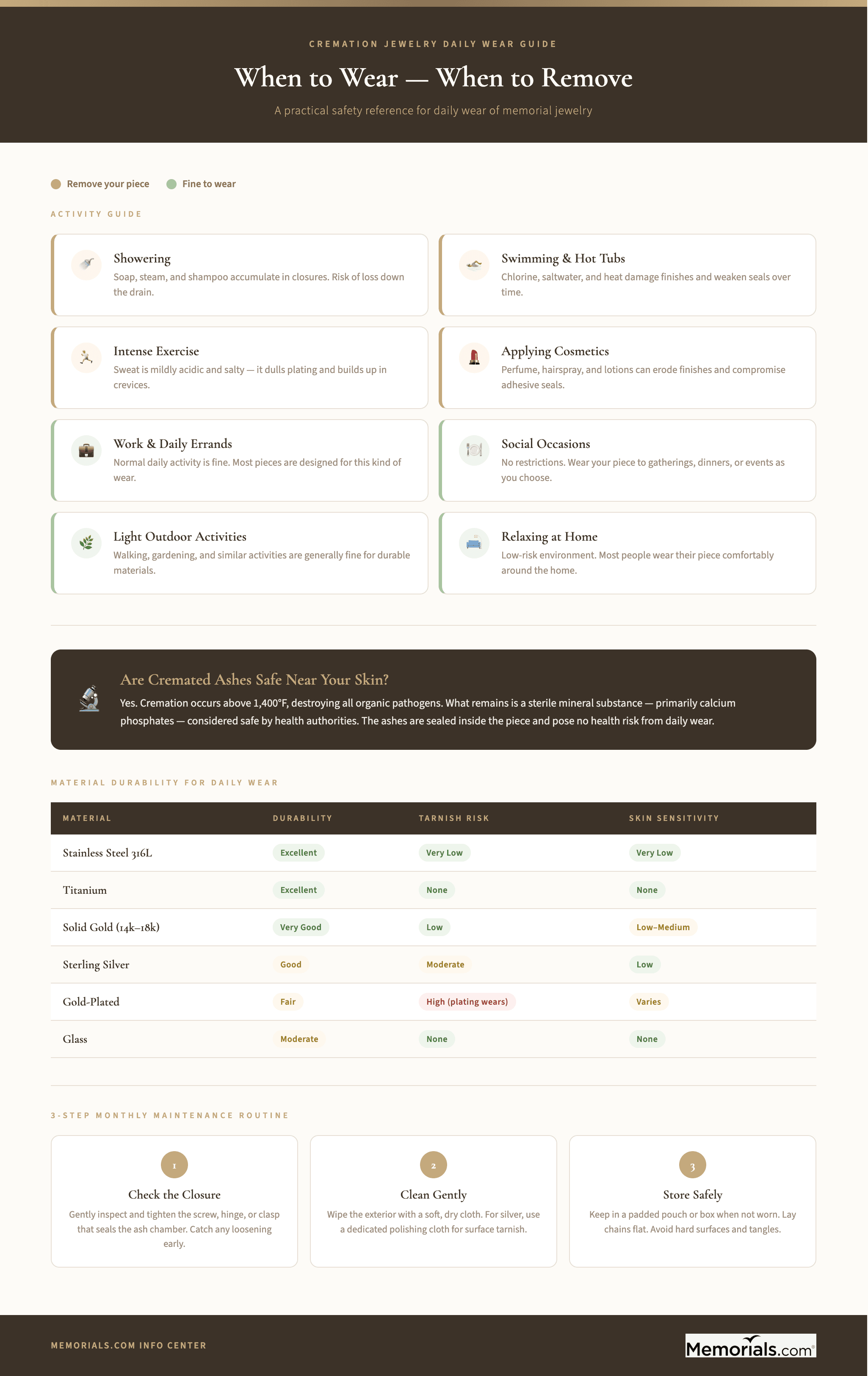
Showering. Water itself may not damage a stainless steel piece, but soap, shampoo, and conditioner can accumulate in threads, crevices, and closures over time. Steam loosens some adhesive seals. More importantly, showering presents a real risk of the piece going down the drain or sustaining impact in a wet environment. Remove it before getting in the shower.
Swimming – pools, oceans, hot tubs. Chlorine is corrosive to most metals, especially sterling silver and plated finishes. Saltwater accelerates tarnish and works into crevices. Hot tubs combine heat, chemicals, and longer soak time – a triple risk to both finish and seal. Even if the ashes stay protected, repeated immersion will shorten the lifespan of any piece.
Exercise and high-sweat activities. Sweat is salty and mildly acidic. It lingers on metal surfaces in a way that water doesn't, dulling plating, accelerating tarnish on silver, and building up in closures. Physically intense activity also increases the chance of impact or catching the piece on equipment.
Applying cosmetics, perfume, or lotion. Spray perfume, hairspray, and lotions all contain compounds that can erode finishes and compromise adhesive seals. Put your piece on after your routine, not before.
Sleeping. This is personal preference, but many jewelers recommend removing chains and pendants before sleep. Repeated tension from moving while asleep can stress clasps and chains over time. It also puts the piece at risk of impact if you move suddenly.
Situations Where Daily Wear Is Fine
Beyond those scenarios, you can wear cremation jewelry exactly as you would any fine jewelry. Wearing it to work, while running errands, at home, at gatherings – there's no reason to take it off. Many people wear theirs for months or years continuously, especially in the earlier stages of grief, and find that the constant physical connection brings real comfort.
If wearing the piece every single day eventually starts to feel heavy, it's worth knowing that many people naturally transition to wearing it on specific days, occasions, or when they feel the need for connection. That shift doesn't diminish the piece or the memory – it often reflects a quiet sign that grief is evolving.
Material Durability for Daily Wear: A Quick Reference
For a deeper look at how each material is constructed and what to prioritize when choosing, our cremation jewelry materials guide covers each option in detail.
Keeping Your Piece in Good Condition: Maintenance Basics
Daily wear is sustainable with a small amount of routine care – and our guide on how to care for cremation jewelry walks through the full routine if you want more depth. The essentials are below.
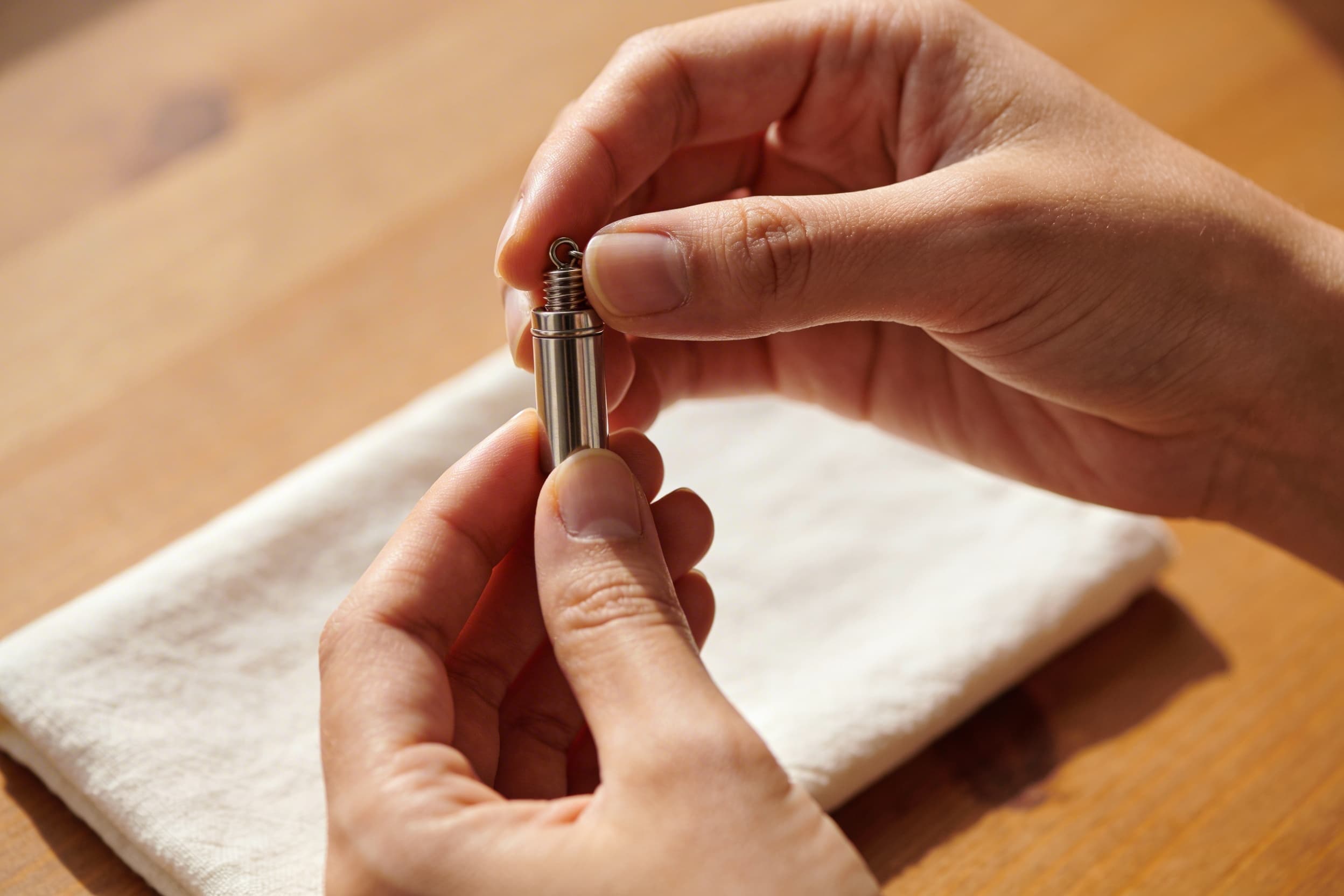
Monthly closure check. Once a month, check the screw, hinge, or clasp that seals the ash chamber. Gently tighten any screw-top pendants by hand. Inspect hinged lockets to confirm they close firmly. If anything feels loose, don't wait – tighten or have it professionally inspected before further wear.
Gentle cleaning. Wipe the exterior with a soft, dry or barely damp cloth after days where the piece was exposed to sweat. Avoid abrasive cloths, chemical jewelry dips, or ultrasonic cleaners unless the manufacturer specifically recommends them for your material. For sterling silver, a dedicated silver polishing cloth works well for surface tarnish.
Storage when not worn. Keep the piece in a padded pouch or jewelry box when you take it off. Avoid leaving it on hard surfaces where it could roll, fall, or sustain impact. Chains tangle and weaken when thrown into a drawer with other items – lay them flat or hang them if possible.
Replacing chains. Over time, chains do wear and clasps weaken, especially with daily use. Replacing a chain is far easier than replacing the pendant itself. Replacement chains and upgrades are available for most standard pendant sizes.
What If the Seal on My Piece Has Loosened?
It happens. Screw-top pendants can work loose with daily movement. Hinged lockets can develop play in the hinge over time. If you notice your seal has loosened or you can see any gap around the chamber:
Remove the piece and place it gently on a flat surface.
Do not turn it upside down or shake it.
If the screw-top style, gently tighten by hand.
If the gap is larger, or you're unsure whether ashes have shifted, contact the jewelry maker for guidance before wearing again.
Some families choose to add a small drop of adhesive after filling as an extra precaution – if this wasn't done at the time of filling and you'd like to add it now, a jeweler can help.
The emotional weight of noticing a loosened seal can be significant. Take a breath. In most cases, the ashes remain largely in place, and the fix is straightforward. This is why monthly inspections matter – catching it early keeps the situation simple.
Frequently Asked Questions
Is it safe to wear cremation jewelry around other people? Completely. There's no health risk to others from being near cremation jewelry. The cremated remains are sealed inside the piece, inert, and sterile. Many people wear their pieces without anyone knowing what the jewelry contains.
Can cremation jewelry cause a skin rash? A skin reaction is possible with any metal jewelry – it's caused by the material of the piece, not by the ashes inside. Nickel sensitivity is the most common cause. If you're prone to jewelry-related skin irritation, choose stainless steel 316L, titanium, or high-karat gold and request full material disclosure from the seller. Switching to a higher-quality material typically resolves the issue entirely.
Can you shower with cremation jewelry on? Most jewelers recommend removing your piece before showering. While a brief splash of water rarely causes immediate damage to stainless steel, the combination of soap, steam, and shower environment creates cumulative risk to seals and finishes over time. It's a simple habit that meaningfully extends the life of the piece.
Is it weird or morbid to wear ashes in jewelry every day? Many families find deep comfort in it, and cremation jewelry has been part of memorial culture in various forms since at least the 17th century. Grief is personal, and there's no right or wrong timeline or manner of keeping a loved one close. If wearing the piece brings you comfort and connection, that's reason enough.
What happens if a small amount of ash escapes the seal? Cremated remains are non-toxic and sterile – there is no health risk from brief skin contact with a small quantity of ash. The primary concern is the emotional significance of the memorial contents. If you notice your seal has compromised, tighten or repair it promptly. Most situations are easily resolved.
Choosing Jewelry That Holds Up to Daily Life
If you're still choosing a piece, the daily-wear question should inform your material selection. Cremation jewelry spans a wide range of styles and materials – from delicate glass pendants to robust stainless steel pieces designed for constant wear.
Urn necklaces in stainless steel are among the most durable options for daily wear. Cremation rings work well for people who prefer to keep a piece on the hand, though rings tend to experience more impact and require the same attention to seal integrity. Cremation bracelets and cremation pendants each suit different preferences for where you want to carry the memorial.
If you love the look of glass cremation jewelry, it can absolutely be worn regularly – just with a bit more care around physically demanding activities.
Whatever piece you choose, prioritize sellers who provide clear information about materials and closures. A piece that's built with intention – with a secure seal and quality metal – will hold up to daily life and remain a meaningful memorial for years.