🏬Supersize Online Funeral Retailer🪦1000's of Headstones⚱️Over 10,000 Cremation Urns⚰️Caskets Overnight Delivery🛒Funeral & Memorial Superstore🚚FREE Shipping on ALL Orders👨👩👧👦Helping Families for over 20 Years💰Lowest Price Guarantee🏬Supersize Online Funeral Retailer🪦1000's of Headstones⚱️Over 10,000 Cremation Urns⚰️Caskets Overnight Delivery🛒Funeral & Memorial Superstore🚚FREE Shipping on ALL Orders👨👩👧👦Helping Families for over 20 Years💰Lowest Price Guarantee
🏬Supersize Online Funeral Retailer🪦1000's of Headstones⚱️Over 10,000 Cremation Urns⚰️Caskets Overnight Delivery🛒Funeral & Memorial Superstore🚚FREE Shipping on ALL Orders👨👩👧👦Helping Families for over 20 Years💰Lowest Price Guarantee🏬Supersize Online Funeral Retailer🪦1000's of Headstones⚱️Over 10,000 Cremation Urns⚰️Caskets Overnight Delivery🛒Funeral & Memorial Superstore🚚FREE Shipping on ALL Orders👨👩👧👦Helping Families for over 20 Years💰Lowest Price Guarantee
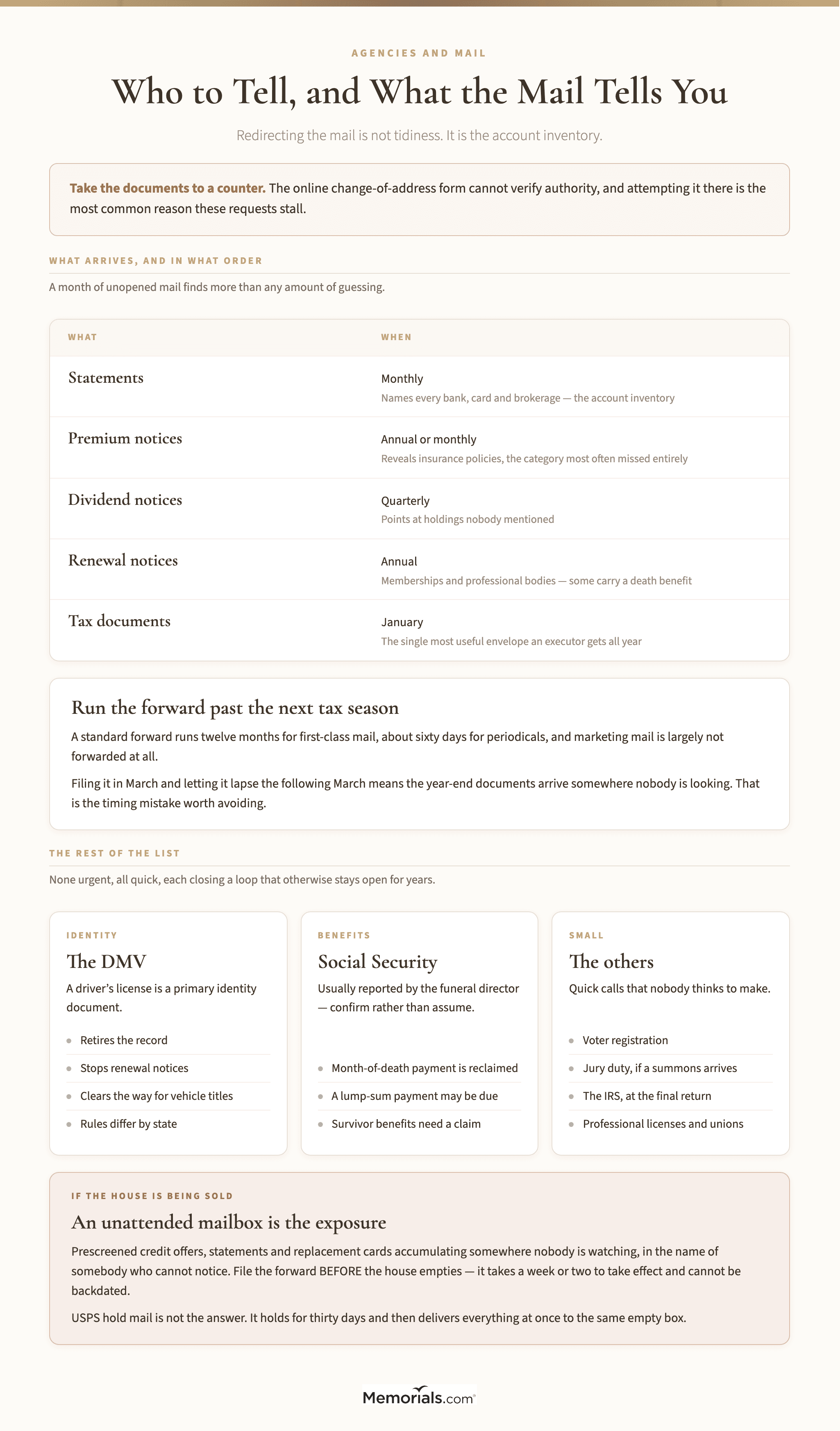
Working out how to forward mail for a deceased person is worth doing early, and not for the reason most people assume. It is not about tidiness. The mail is the most complete list you will get of what the estate actually contains.
Statements arrive from banks nobody mentioned. Premium notices arrive from policies nobody knew about. A single unremarkable envelope in month three is how most families discover the account that would otherwise have been missed entirely, which is why the estate affairs guide treats a month of unopened mail as a research tool rather than a chore.
Do You Notify the Post Office When Someone Dies?
Yes, and the answer to do you notify the post office when someone dies is more specific than a general notification: you file a change of address, and only certain people may.
USPS treats mail forwarding for deceased customers as an ordinary change of address with an extra requirement — proof that you are entitled to receive somebody else's mail. That is the whole difference.
Who may file it. The executor or administrator of the estate, or in practice a surviving spouse or immediate family member living at the same address. USPS deceased mail requests from anybody else are refused, and correctly so — redirecting another person's mail is otherwise a federal offense.
What you need. Your own photo ID, and documentation of your authority: letters testamentary, a small estate affidavit, or a death certificate together with evidence you are the next of kin.
Where to file it. In person at the Postal Service — take the paperwork to the local post office rather than trying the online form. The online change of address is built for people moving house and cannot verify what this needs. Attempting it online is the single most common reason a request for USPS mail forwarding for deceased mail stalls.
A month of unopened mail finds more accounts than any amount of guessing. Read it before you redirect it.
Read It Before You Redirect It
There is an argument for waiting a few weeks before filing anything, and it is worth hearing before you rush to the post office.
Forwarding mail for a deceased person moves it to your address, which is convenient. Leaving it arriving at the original address, where a family member can collect it weekly, keeps everything in one place and in date order — and if the house is occupied or being visited regularly, that is often the better arrangement for the first month.
What the first month tells you, roughly in the order it arrives:
Statements, monthly, naming every bank, card and brokerage. This is the account inventory, and it is more complete than anything a family can reconstruct from memory.
Premium notices, which reveal insurance policies — the category most often missed entirely, because a paid-up policy generates almost no other trace.
Dividend and interest notices, which point at holdings nobody mentioned.
Renewal notices for memberships, professional bodies and subscriptions, some of which carry a refund or a small death benefit.
Tax documents, in January, which is the single most useful envelope of the year for an executor filing a final return.
That last one is the reason a change of address for deceased mail should run at least through the following tax season. Filing the forward in March and letting it lapse the following March means the year-end documents arrive somewhere nobody is looking.
Keep the envelopes you have opened, sorted by institution. When a bank asks whether you hold a recent statement, the answer is usually yes and it saves a phone call.
What Forwarding Does and Does Not Do
The answer to how do I forward mail for a deceased person ends with a caveat worth understanding before you file.
A standard forward runs twelve months, and it moves first-class mail to your address. It does not move everything, and it stops without much warning.
Periodicals stop after about sixty days. Magazines and newspapers are forwarded briefly and then simply cease.
Marketing mail is largely not forwarded at all, which sounds like a mercy and is not — the prescreened credit offers keep going to the old address instead, where they sit in an unattended mailbox. That is a genuine identity-theft exposure and it is a reason to make sure the credit bureaus have been notified, which is what actually turns those offers off at the source.
Forwarding is not a substitute for telling senders. Every institution still needs its own notification. The forward is a safety net that catches what you missed, not a solution.
When the twelve months end, mail to the old address is returned to sender rather than delivered. If the house has been sold, that is fine. If a family member still lives there, arrange something before the clock runs out.
Notifying the DMV
Notifying the DMV of death is a small task that people skip and occasionally regret.
Why it matters. A driver's license is a primary identity document, and one belonging to a dead person is a useful thing for the wrong sort of person to hold. Reporting a DMV deceased record retires it. It also stops renewal notices, which arrive with unhelpful timing, and clears the way for transferring vehicle titles.
How to cancel a driver's license after death. Requirements are set state by state and there is no national process, but the shape is consistent: a certified copy of the death certificate, the license itself where you have it, and evidence of your authority. Some states accept it by mail, some want it in person, a few now take it online. Your state's DMV site is the authority.
Do the vehicles at the same time. If a car is being transferred or sold, the title work and the license cancellation are usually handled by the same office, and combining them saves a second trip. Most states have a simplified transfer route for a surviving spouse.
Organ donor registration ends with the license. This matters only in that families sometimes want to confirm the person's wishes were recorded and honored, and the DMV is where that record lives.
Social Security
The funeral director usually reports the death to Social Security directly, and usually does it within a few days. Confirm it rather than assume it — ask the director explicitly whether they filed, and note the date.
Two things follow from that report and both surprise people.
The month-of-death payment is reclaimed. Benefits are paid for the month before they arrive, and a person must live the entire month to be entitled to that month's payment. A payment landing after the death gets pulled back out of the account, sometimes weeks later and sometimes after the family thought everything was settled. Do not distribute it, and warn whoever holds the account.
There may be a small lump-sum death payment for a surviving spouse or a dependent child, and survivor benefits may be available. Neither is automatic. Both need a claim, and claiming is a phone call rather than a form.
The Rest of the List
None of these is urgent, all of them are quick, and each closes a loop that otherwise stays open for years.
Voter registration, through the county elections office. Often handled automatically from the death record, and often not.
Jury duty, if a summons arrives — replying with a copy of the certificate ends it.
The IRS, at the point a final return is filed. A return is generally still required for the year of death.
Professional licenses and union membership, both of which sometimes carry a death benefit nobody thinks to claim.
Veterans Affairs, where there are burial benefits and survivor benefits worth a separate look.
The passport office, which will cancel and return a passport if you want it kept.
None of these are urgent and all of them are quick. Each one closes a loop that otherwise stays open for years.
If the House Is Being Sold or Emptied
The mail becomes a problem the moment nobody is visiting the address, and this is where families get caught out.
An unattended mailbox is the exposure. Prescreened credit offers, statements, replacement cards and tax documents accumulate somewhere nobody is watching, in the name of somebody who cannot notice. This is precisely the situation the credit bureau notification is designed to defuse, and it is why that task belongs before this one rather than after.
File the forward before the house empties, not after. A forward takes a week or two to take effect and there is no way to backdate it. Mail delivered in the gap goes to the old address regardless.
Tell the buyer's agent. If the property is sold, the new owners will receive mail for months and most will hand it back if asked. A short note left with the agent, giving a forwarding address, works better than expecting them to work it out.
Hold mail is not the answer. USPS will hold mail for up to thirty days, which sounds useful and is not — at the end of it, everything is delivered at once to the same empty box. Hold is for vacations, not for estates.
A post office box is worth considering where an estate will stay open a long time or where several family members are involved. It gives one stable address that outlives the twelve-month forward, and it costs very little.
An unattended mailbox is the actual exposure. File the forward before the house empties, not after.
The mail is the account inventory. Read a month of it before deciding your list is complete.
Stopping the Marketing Mail
Long after everything else is settled, catalogs keep coming. It is a small, repeated distress and it is worth fifteen minutes.
Register with the Data & Marketing Association's deceased suppression service. It is the industry list most large mailers check, and it is the single most effective step. Registration is free.
Opt out of prescreened credit offers. There is a national opt-out for exactly this, and it is separate from the credit bureau notification even though it involves the same three companies.
Then wait. Mailing lists are prepared weeks or months in advance, so expect a tail of three months or so after registering. Mail arriving in month two is not evidence that it failed.
Charities are the persistent ones, because they trade lists among themselves. Those usually need contacting individually, and a short note asking them to remove the name generally works.
Expect a three-month tail after registering. Mail arriving in month two is not evidence it failed.
The Order That Works
First, redirect the mail — it feeds everything else.
Second, notify the credit bureaus, which is the one with a real downside for delay.
Third, the DMV, alongside any vehicle title work.
Fourth, confirm Social Security was told, and ask about survivor benefits.
Fifth, the small ones — voter roll, licenses, passport.
Last, the marketing suppression, which has no deadline and takes months to take effect anyway.
Frequently Asked Questions
Can I just have the mail redirected online like a normal move? No, in practice. The online form cannot verify authority and these requests are refused or stalled. Take the documents to a post office.
How long does the forward last? Twelve months for first-class mail, about sixty days for periodicals, and marketing mail mostly is not forwarded at all.
Nobody has been appointed executor. Can I still do it? Often yes, if you are the surviving spouse or immediate family living at that address. Take the death certificate and your own ID and ask; local offices have discretion.
Mail is still arriving after a year. The forward has expired. Contact the senders directly — by that point there should be few enough to handle one at a time.
Do I need a death certificate for all of these? For the DMV and Social Security, yes. For the post office, usually, though proof of your authority matters more. For marketing suppression, no.
Can I stop mail to a person who died decades ago? Sometimes it persists that long, usually through a list that was sold and resold. The suppression registration covers it, and individual senders will remove a name on request. There is no single switch.
Something arrived addressed to them that looks important. Open it. As executor you are entitled to, and the alternative is guessing.
In Closing
Redirect the mail, then read it for a month before deciding your list of institutions is complete. Everything else on this page is a form and twenty minutes.
The mail is the part that repays attention, because it is the only source that tells you what you do not already know to ask about.