🏬Supersize Online Funeral Retailer🪦1000's of Headstones⚱️Over 10,000 Cremation Urns⚰️Caskets Overnight Delivery🛒Funeral & Memorial Superstore🚚FREE Shipping on ALL Orders👨👩👧👦Helping Families for over 20 Years💰Lowest Price Guarantee🏬Supersize Online Funeral Retailer🪦1000's of Headstones⚱️Over 10,000 Cremation Urns⚰️Caskets Overnight Delivery🛒Funeral & Memorial Superstore🚚FREE Shipping on ALL Orders👨👩👧👦Helping Families for over 20 Years💰Lowest Price Guarantee
🏬Supersize Online Funeral Retailer🪦1000's of Headstones⚱️Over 10,000 Cremation Urns⚰️Caskets Overnight Delivery🛒Funeral & Memorial Superstore🚚FREE Shipping on ALL Orders👨👩👧👦Helping Families for over 20 Years💰Lowest Price Guarantee🏬Supersize Online Funeral Retailer🪦1000's of Headstones⚱️Over 10,000 Cremation Urns⚰️Caskets Overnight Delivery🛒Funeral & Memorial Superstore🚚FREE Shipping on ALL Orders👨👩👧👦Helping Families for over 20 Years💰Lowest Price Guarantee
What to Do When Someone Dies: Settling the Affairs
planning
Working out what to do when someone dies splits almost immediately into two jobs that feel like one. There is the funeral, which happens in about a week and which a funeral director will walk you through. And there is everything else — the certificates, the accounts, the benefits, the notifications, the phone calls to institutions that only answer on weekday afternoons — which takes a year and which nobody walks you through at all.
This guide is the second job.
If you are in the first few days and the funeral is still ahead of you, that is a different page and a better use of your time: the funeral planning guide covers arrangements, and the funeral planning checklist covers the first twenty-four hours. Come back here afterward. Almost nothing on this page is urgent in week one, and knowing that is itself worth something.
What This Guide Covers, and What It Does Not
The distinction is worth being explicit about, because the two halves get muddled and the muddling causes people to try to do everything at once.
Not here: the funeral. Choosing a funeral home, burial or cremation, the service, the or , the obituary, the flowers, who speaks. All of that is the first week and all of it is covered elsewhere on this site.
Here: what happens after the funeral director is finished. The estate. The certified documents every institution wants. Eight or ten banks. Three credit bureaus. The mail. The utilities. The phone. The digital accounts holding a decade of photographs. The benefits nobody claims because nobody knew they existed.
The two overlap in exactly one place — the death certificate, which the funeral director orders and which everything on this page then waits for.
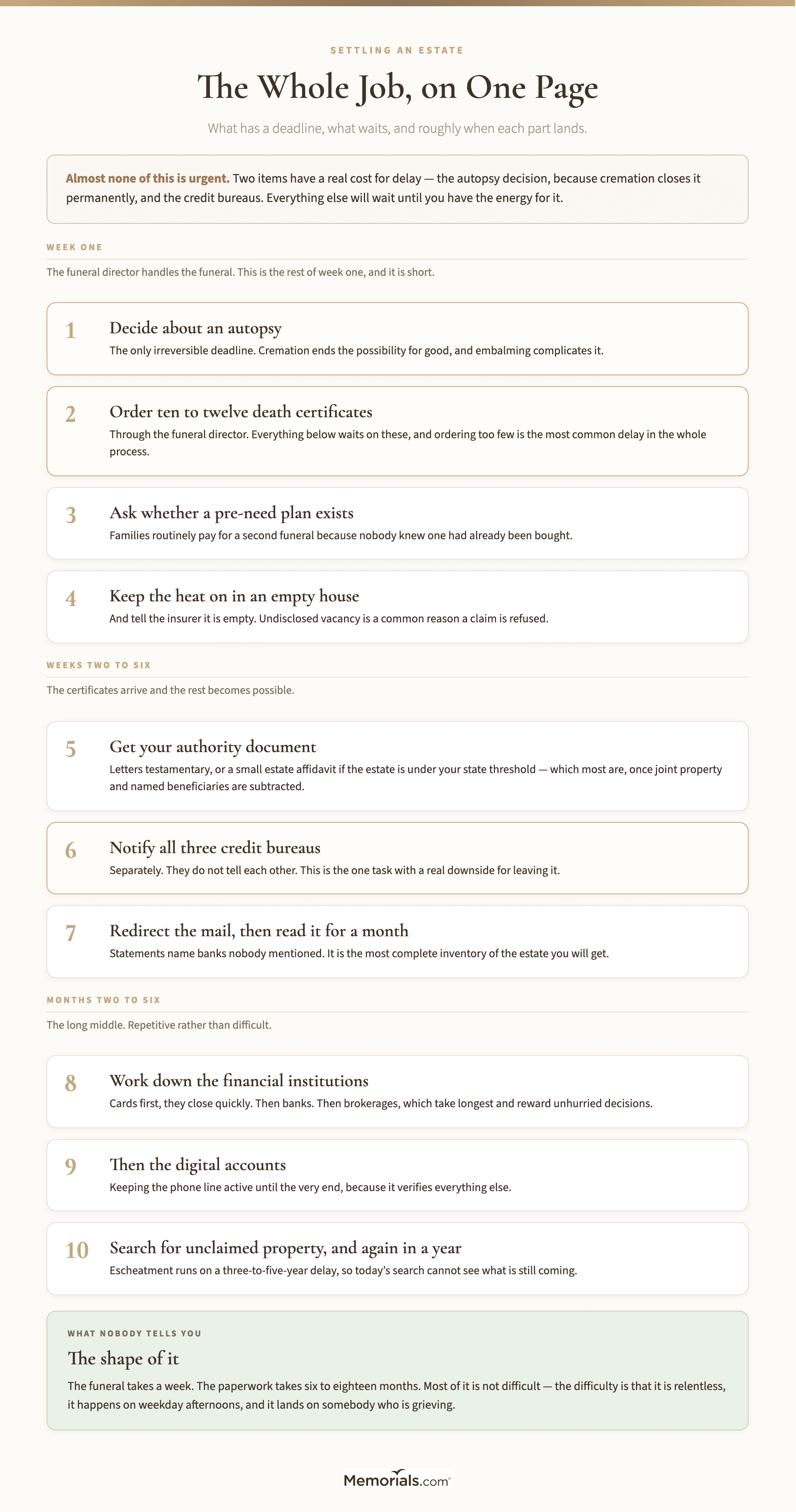
A rough shape of the whole thing: the funeral takes a week. The paperwork takes six to eighteen months. Most of it is not difficult, very little of it is urgent, and the entire difficulty is that it is relentless and it lands on somebody who is grieving.
The funeral takes a week. This takes a year. Almost none of it is urgent, which is the most useful thing to know.
The First Week: What Actually Has a Deadline
Very little, and the list is shorter than the panic suggests. The genuine first steps after death, on the administrative side, are these.
Decide about an autopsy, if there is any question at all. This is the one real deadline, because cremation ends the possibility permanently and embalming complicates it. If anything about the death is unexplained, or if there is a hereditary question the family needs answered, decide before the funeral rather than after. How much an autopsy costs sets out who pays and what the window is.
Tell the funeral director how many death certificates you want. Ten to twelve. This is the single most consequential number in the whole process and it is asked at a moment when nobody has any way of knowing — how many death certificates you need explains why the figure runs so high.
Ask about a pre-need plan before arranging anything. Families routinely pay for a second funeral because nobody knew one had been bought and paid for years earlier.
Take the time off properly. Some states guarantee it — California is one of the few with a statutory entitlement — and most do not. Either way, the days need not all be taken at once, and holding some back for the weekday phone calls later is worth doing deliberately.
Secure the house and keep the heat on. If a property is going to be empty, that is a decision with consequences, and utilities after a death covers why switching things off in a hurry is the expensive option.
And that is genuinely it for week one. Everything else on this page can wait, and doing it later will not cost you anything.
Weeks Two to Six: The Documents Everything Waits On
The certificates arrive, and suddenly the rest becomes possible. This is the phase where getting three things right saves months later.
The death certificates. Certified copies with a raised seal, not photocopies. Check the first one carefully the day it arrives — a misspelled name or a wrong date needs an amendment through the same office, and it takes as long as the original did.
Your authority to act. This is the document that decides whether each phone call takes ten minutes or ten weeks. Letters testamentary from a probate court is the strongest. A small estate affidavit is faster and cheaper and covers a great many estates — most families qualify for it and never find out, because nobody mentions that probate is optional below a threshold.
Who is entitled to decide.Next of kin is a legal order rather than a measure of closeness, and it governs funeral authority, cremation consent and who may claim what. It catches people out, particularly unmarried partners.
Then notify the credit bureaus. This is the one task with a real cost for leaving it — an obituary supplies a name, a date of birth and an address, and an unwatched credit file supplies the rest. Notifying all three bureaus takes an afternoon and it is the item to do early rather than when you get to it.
And redirect the mail. Not for tidiness — because the mail is the most complete inventory of the estate that exists. Statements name banks nobody mentioned; premium notices reveal insurance policies that leave almost no other trace. Forwarding mail and notifying agencies covers the post office, the DMV and Social Security together.
Two documents govern everything: a certified death certificate, and whatever proves you are entitled to ask.
Months Two to Six: The Accounts
This is the long middle, and it is the part that is genuinely repetitive rather than difficult. The same call, eight or ten times.
The financial institutions. Every bank, brokerage and card issuer has a department for this, and none of them calls it the same thing — Estate Services at one, Estate Care Center at another, Deceased Account Services at a third. Closing bank, brokerage and credit accounts is a directory of who to contact at eleven institutions, with the single most useful piece of advice in it being: search the institution's name plus "estate services", never "close account".
The distinction that matters in that phase: a bank holds money that becomes part of the estate, a credit card is a debt the estate owes, and a brokerage holds an asset that usually passes outside the estate entirely. Three different legal objects, and treating them alike is how people liquidate an investment account they should have transferred.
The digital accounts. A separate list with completely different rules, because no certified document opens a Google account — there is a web form somewhere and finding it is most of the work. Canceling digital accounts and subscriptions is the directory for those, and the individual pages go deeper on Apple, Instagram, Amazon and the phone.
The household. Utilities transferred rather than closed where somebody still lives there, and kept running where the house is empty and being sold.
Money coming in.Unclaimed money left by a deceased relative is a free ten-minute search that finds something more often than people expect, and there are several other categories — veterans' benefits, union death benefits, a final paycheck — that go unclaimed simply because nobody thinks to ask.
What Nobody Tells You About the Timeline
Six things that are true of nearly every estate and that almost nobody is warned about.
It is weekday work. Institutions answer between nine and five, and an estate consumes leave rather than evenings. Budget several days of it beyond whatever bereavement leave you get.
The frozen account keeps the mortgage unpaid. Notification freezes an account both ways, and the standing orders stop with it. Ask specifically what still needs paying before the freeze lands.
Social Security takes the last payment back. Benefits are paid for the month before they arrive and a person must live the whole month to be entitled to it. A payment landing after the death gets pulled back out, sometimes weeks later. Do not distribute it.
The paperwork you throw away is the paperwork you need. Old tax returns name institutions nobody remembers. An address history is what proves an unclaimed property claim. Keep the boxes until the estate closes.
Deleting the email account first strands everything else. It is the recovery address for every other account. It closes last, not first — and the phone line closes after that, because it is what verifies the rest.
There will be one thing nobody thought of. A storage unit, a timeshare, a business account, a safe deposit box with an annual fee nobody could identify. Hold a reserve and do not close the estate the moment the obvious items are done.
It is weekday work. Institutions answer nine to five, so an estate consumes leave rather than evenings.
Two items have a real deadline. Everything else waits until you have the energy for it.
A Checklist After Death, in the Order That Works
Not a list of everything — a sequence. What follows is a practical checklist after death for the administrative half, arranged so that each step unlocks the next rather than waiting on it.
Order ten to twelve certified death certificates through the funeral director. Everything below waits on these.
Decide about an autopsy if there is any question, before the funeral. This is the only irreversible deadline.
Get your authority document — letters testamentary, or a small estate affidavit if the estate qualifies.
Notify the three credit bureaus. Early, because this is the one with a real downside for delay.
Redirect the mail, and then read it for a month before deciding the list of institutions is complete.
Confirm Social Security was told, and ask about survivor benefits and the lump-sum payment.
Work down the financial institutions. Credit cards first because they close quickly, then banks, then brokerages, which take longest and reward unhurried decisions.
Deal with the household — utilities transferred or kept running, the DMV, the vehicle titles.
Search for unclaimed property in every state they lived in, and again in a year.
Then the digital accounts, with the phone line kept active until the very end because it verifies everything else.
File the final tax return, and the estate's own return if it needs one.
Hold a reserve for six months, then distribute, and get a signed receipt from each person.
The immediate steps after death that people expect to be on a list like this — registering the death, arranging the funeral, writing the obituary — are the funeral director's half of the job, and they belong on the step-by-step guide to arranging a funeral rather than here. What follows here is a what to do when someone dies checklist for the administrative side only, which is the half nobody hands you.
The same call, eight or ten times. Not difficult — relentless, which is a different problem.
The Things That Go Wrong
Not failures of effort. These are the specific mistakes that recur across almost every estate, and each one is avoidable by knowing it exists.
Ordering too few death certificates. The most common delay in the entire process, and the cheapest to prevent. Additional copies ordered at the same time usually cost less than the first.
Canceling the phone line early. It feels like an obvious saving. It locks you out of every account that texts a verification code to that number, which is most of them.
Deleting the email account first. It is the recovery address for everything else, and deleting it strands every other account permanently.
Distributing before paying the creditors. An executor who pays beneficiaries first can be personally liable for the shortfall. Debts come first, in the order the state sets, and a reserve stays back for six months.
Assuming probate is required. Most estates are under the state threshold once joint property, named beneficiaries and payable-on-death accounts are subtracted. Families go through months of court process without ever checking.
Believing the account is the estate. A brokerage account with a named beneficiary passes outside the will entirely, and so does a jointly held house. The probate estate is frequently a fraction of what somebody left behind.
Throwing away the paperwork. Old tax returns name the institutions. The address history proves an unclaimed property claim. The box somebody emptied in week two is the one that mattered.
Doing it alone. The single most common and least necessary. An estate splits well — one person on the financial institutions, another on the digital accounts, another on the household — and most families never think to divide it.
Doing It Before It Is Needed
Almost every difficulty on this page traces back to a decision somebody either made or did not make while they could. Four things take an evening between them and remove months of work from somebody else's worst year.
Name beneficiaries on every account, and check the old ones. A form naming a first spouse beats a will naming a second one, and reviewing them is the highest-value hour in estate planning.
Write a list of what exists. Not passwords — which banks, which insurers, which brokerages, and whether there is a safe deposit box. Families spend months reconstructing this from the mail.
Nominate a legacy contact on Apple and Google. Four minutes each, and it is the difference between a family getting a decade of photographs in a week or needing a court order.
Write down who should decide. If the person the law would pick is not the person you would pick — an unmarried partner, a chosen family member, a friend rather than an estranged sibling — a written designation overrides the statutory order in nearly every state. One page, often free, and almost nobody knows it exists.
Make a will, and tell somebody where it is.Online trust and will covers when a service is adequate and when the situation needs an attorney — and a perfectly drafted will nobody can find does nothing at all.
The Estate Affairs Hub Library
This guide is part of the Memorials.com estate affairs collection — twenty-one pages in all. Every page below answers one specific version of the question and goes considerably deeper than this overview.
Start Here: The Two Directories
Most of the work is contained in these two, and everything else is a page one of them links to.
Three questions that decide how long every other conversation takes.
How Many Death Certificates Do You Need? — Ten to twelve, and why. Who keeps a copy, who returns one, how long they take, and how to read the certificate when it arrives.
Are Executor Fees Taxable? — Yes, and that does not settle whether to take one. Sometimes taking a fee costs the family money.
Decisions With a Deadline
Two questions that cannot be revisited later.
How Much Does an Autopsy Cost? — Who pays depends on who ordered it. Cost is negotiable; the timing is not, because cremation closes the door permanently.
Bereavement Leave in California — Five days, per death, within three months. What the statute provides and what it does not.
The administrative half of a death is not hard. It is long, it is repetitive, it happens on weekday afternoons, and it arrives at exactly the moment somebody has the least capacity for it.
Which makes the two most useful things to know quite small ones. Order more death certificates than you think. And almost none of this is urgent — the autopsy decision and the credit bureaus are the only items with a real cost for delay, and everything else will wait until you have the energy for it.
Take the first week for the funeral. This will still be here.