🏬Supersize Online Funeral Retailer🪦1000's of Headstones⚱️Over 10,000 Cremation Urns⚰️Caskets Overnight Delivery🛒Funeral & Memorial Superstore🚚FREE Shipping on ALL Orders👨👩👧👦Helping Families for over 20 Years💰Lowest Price Guarantee🏬Supersize Online Funeral Retailer🪦1000's of Headstones⚱️Over 10,000 Cremation Urns⚰️Caskets Overnight Delivery🛒Funeral & Memorial Superstore🚚FREE Shipping on ALL Orders👨👩👧👦Helping Families for over 20 Years💰Lowest Price Guarantee
🏬Supersize Online Funeral Retailer🪦1000's of Headstones⚱️Over 10,000 Cremation Urns⚰️Caskets Overnight Delivery🛒Funeral & Memorial Superstore🚚FREE Shipping on ALL Orders👨👩👧👦Helping Families for over 20 Years💰Lowest Price Guarantee🏬Supersize Online Funeral Retailer🪦1000's of Headstones⚱️Over 10,000 Cremation Urns⚰️Caskets Overnight Delivery🛒Funeral & Memorial Superstore🚚FREE Shipping on ALL Orders👨👩👧👦Helping Families for over 20 Years💰Lowest Price Guarantee
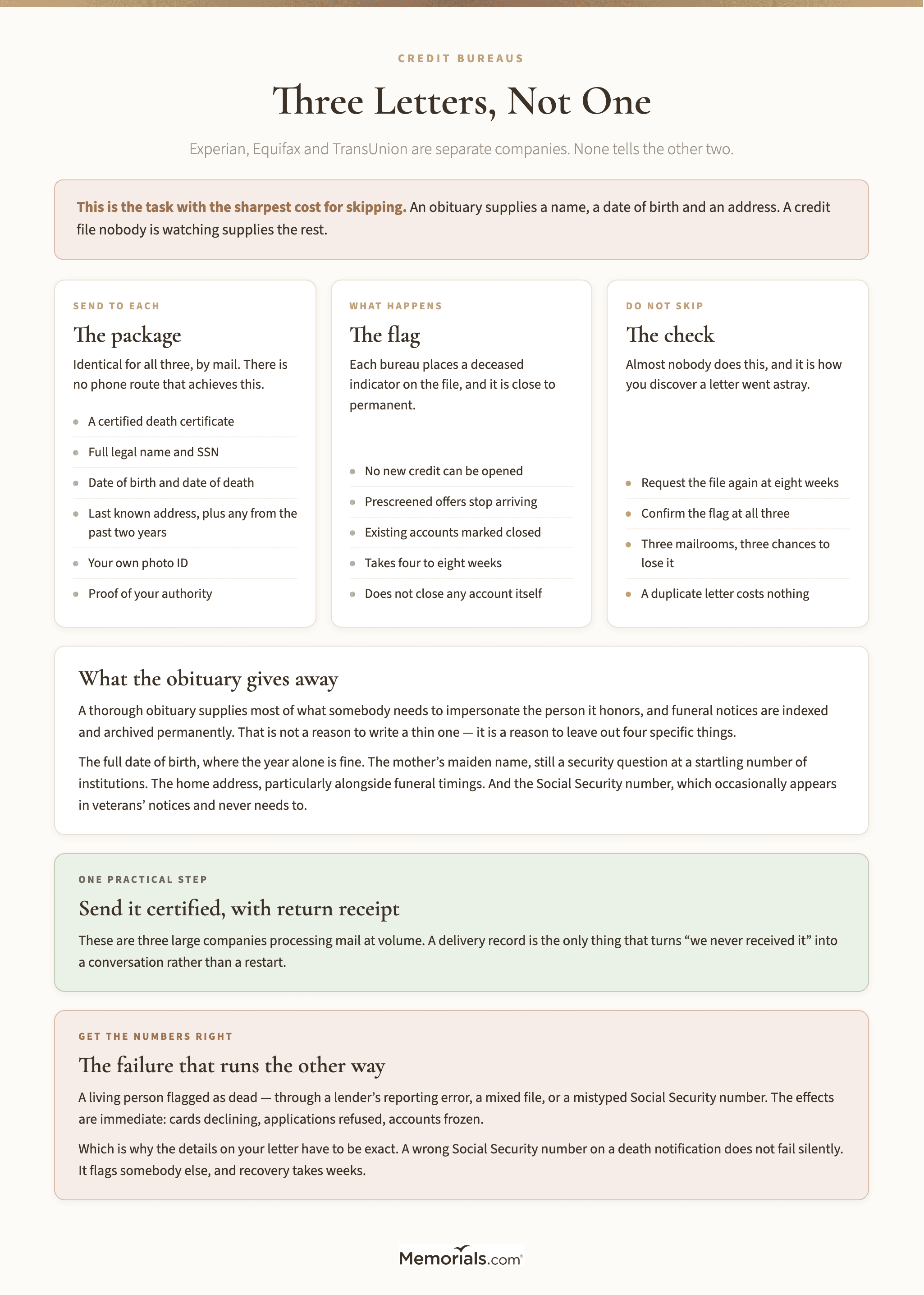
An Experian death notification is one of three letters, not one, and that is the part most families get wrong. Experian, Equifax and TransUnion are separate companies with separate files, and none of them tells the other two.
This is also the task with the sharpest cost for leaving undone. Identity theft against people who have recently died is a real and well-documented crime — the obituary supplies a name, a date of birth and an address, and a credit file that nobody is watching supplies the rest. Locking the file is what stops it.
It takes one afternoon. Of everything in the estate affairs guide, this is the item to do early rather than when you get to it.
What Actually Happens When You Notify Them
Each bureau places a deceased indicator on the file. Once it is there:
No new credit can be opened in that name. An application triggers a refusal rather than an approval.
The file stops being sold for prescreened credit offers, so the envelopes stop arriving.
Existing accounts are marked closed as reported by their lenders.
It is not the same as closing accounts. The bureaus record what lenders tell them; they do not close anything themselves. You still have to work down the institution directory separately.
The flag is effectively permanent, which is the reason to be sure before you send it. Which brings up the one thing that genuinely goes wrong here, further down.
What to Send
All three want broadly the same package, sent by mail. There is no phone route that achieves this and no email route worth using.
A certified copy of the death certificate. Not a photocopy. This is three of the copies from your stack — see how many death certificates you need, which is why the count runs higher than people expect.
A letter giving the full legal name, the Social Security number, the date of birth, the date of death, and the last known address. Include any address the person lived at in the previous two years — files follow addresses, and an old one is how a stray account gets missed.
Proof of who you are. A copy of your own government photo ID, and something showing your authority: letters testamentary, a small estate affidavit, or evidence that you are the surviving spouse.
Send it certified with return receipt. These are three large companies processing mail at volume, and a delivery record is the only thing that turns "we never received it" into a conversation rather than a restart.
Three letters, three companies, three certified copies. Certified mail with a return receipt is what makes "we never got it" answerable.
The Three, Separately
Experian. To make an Experian report a death request, mail the package to their consumer assistance address, which is published on their site under the deceased-notification pages. Experian is the one people search for most, which is probably why it is also the one most often done alone and assumed to be enough.
Equifax. An Equifax report a death submission goes to their consumer department. Equifax uses several names for the same thing across their own pages — an Equifax notification of death, an Equifax death notice and an Equifax notice of death all refer to the same process, which is worth knowing when a search sends you somewhere that looks different from what you were expecting. It is one procedure with three labels.
TransUnion. To notify TransUnion of death, mail the same package to their consumer relations address. TransUnion is the one most often forgotten, being third in every list.
Addresses change and we do not publish them here — a wrong address on a certified letter costs weeks. Each bureau's current mailing address is on its own site, on the page that carries the words "deceased" or "death notification".
Ask for the Credit Report While You Are There
Two of the three will send the deceased person's credit report to an authorized representative alongside the notification, and it is worth asking for.
The reason is practical: the report lists every open account, including ones the family has never heard of. A store card, an old line of credit, a loan taken out years ago. For an executor trying to work out what the estate actually contains, it is the single most complete list available, and considerably better than opening the mail for a month and hoping.
It also surfaces anything already fraudulent.
When It Goes Wrong: The Living Person Flagged as Dead
The failure worth knowing about runs in the other direction — Equifax reporting as dead someone who is very much alive. It happens through a lender's reporting error, a mixed file where two people share a name, or a mistyped Social Security number, and the effects are immediate and severe: cards declining, applications refused, accounts frozen.
If it happens to you, dispute it with the bureau in writing and simultaneously with the lender that reported it, because the bureau will generally not override its source. Ask each of the three whether the same error has propagated. Recovery takes weeks and it is a documented and frustrating problem.
This is the reason the details on your letter must be exact. A wrong Social Security number on a death notification does not fail silently — it flags somebody else.
Three separate companies, three separate letters. None of them tells the other two.
What the Obituary Gives Away
This is the part nobody connects, and it is the reason the credit bureaus matter at all.
An obituary is a public document, and a thorough one supplies most of what somebody needs to impersonate the person it honors: full legal name, date of birth, date of death, the town they lived in, the mother's maiden name in the list of survivors, and often the schools and employers used as security answers. Funeral notices are indexed and archived permanently.
None of that is a reason to write a thin obituary. It is a reason to leave out four specific things:
The full date of birth. The year is fine. The exact day paired with a name is a credential.
The mother's maiden name, which is still a security question at a startling number of institutions. "Survived by his mother, Margaret" is warmer and gives away less than the full name with the maiden name in parentheses.
The home address, particularly alongside funeral timings — which also tells anyone reading exactly when the house will be empty.
The Social Security number, which occasionally appears in veterans' notices and never needs to.
Write everything else. The person deserves the full account, and none of the four above is what anybody will remember them for.
Does This Affect a Surviving Spouse's Credit?
The common fear is that a spouse's own score falls when their partner dies. It does not, directly — credit files are individual and a flag on one does not transfer to another.
What can happen is indirect and worth planning around:
Joint accounts. A jointly held card or loan stays open in the survivor's name and its history stays on the survivor's file. Notify the lender so the account is reissued rather than left in a dead person's name — lenders occasionally close a joint account outright on a death notification, and a closed long-standing account can shorten an average account age, which is a real if modest score effect.
Authorized user status. If the survivor was only an authorized user on a card belonging to the person who died, that card closes and its history usually falls off the survivor's file entirely. Where that was a long-held account, the effect on the survivor's score can be noticeable. The remedy is to open a card in their own name before the old account closes, not after.
Household income on future applications. Not a credit-file issue, but the practical one: a survivor applying for anything after the estate settles is applying on one income. Worth knowing before a refinancing conversation rather than during one.
If the survivor has never held credit in their own name, this is the moment to fix it, and the easiest fix is a card issued while a joint account still shows an active history.
The Rest of the Notifications
The bureaus are the urgent ones. Several other organizations should be told and none of them carries the same risk:
Social Security, which the funeral director usually reports directly, though it is worth confirming rather than assuming.
The mobile carrier, last rather than first, because the number is a verification channel before it is a bill — what happens to someone's phone when they die covers why canceling it early makes every other notification harder.
The prescreened offers stop once the file is flagged. Until then they keep arriving, addressed to someone who has died.
Freezing the File as Well
A deceased indicator and a credit freeze are different mechanisms, and doing both is reasonable where there is any reason for concern.
The flag tells lenders the person has died. A freeze blocks access to the file altogether, so a lender running a check gets nothing back rather than a warning they might overlook. Freezes are free by law, and any of the three bureaus will place one on a deceased person's file at the request of an executor or surviving spouse with the same documentation.
When it is worth the extra step: where the death was reported widely, where the person's identity had already been misused, where mail has been going missing, or where the estate will stay open for a long time. A freeze does not expire.
When it is not: most ordinary estates. The deceased indicator does the work, and adding a freeze mainly adds paperwork.
There is one practical wrinkle. A freeze can make legitimate estate business slower — a lender verifying a final balance, or a mortgage servicer processing a transfer, may find itself blocked. If you freeze, expect to lift it temporarily once or twice, and keep the PIN each bureau issues somewhere the executor can find it. Which is the whole problem a dead man's switch exists to solve, one file at a time: a credential is worth nothing to the person who cannot find it, and almost nobody writes down where they put it.
A flag warns lenders. A freeze blocks the file outright — worth the extra step only where there is real concern.
Timing
Do this in the first few weeks, and before an obituary has been circulating long. The window where a name and a date of birth are public and the credit file is still open is exactly the window that gets exploited.
You do not need to wait for probate. You do not need to have closed a single account. All you need is the certificate and your own ID, which means this can happen while everything else is still stalled.
Then check it landed. Six to eight weeks later, request the file again and confirm the deceased indicator is present at all three. This is the step almost nobody does, and it is how you find out that one of the three letters went astray — which, with three separate companies and three separate mailrooms, happens more often than it should.
Frequently Asked Questions
Can I do this online or by phone? Broadly no. All three want documentation by mail, and the reason is sensible: a phone call cannot prove a death and the flag is close to permanent.
Do I have to send a death certificate to credit bureaus, or will a photocopy do? Send a certified copy. Some cases are accepted on a photocopy, but a refusal arrives weeks later and costs you the time you were trying to save.
I am the surviving spouse and our accounts were joint. Notify anyway. A joint account continues in your name, and your own file is unaffected by the flag on theirs — but tell each lender directly as well, because it is the lender that decides how a joint account is reported.
How long does the flag take to appear? Typically four to eight weeks. Do not assume it worked; check.
Someone has already opened an account in their name. Report it to the bureaus as fraud in writing, report it to the lender, and file a report with the police and with the Federal Trade Commission. An estate is not liable for fraudulent debt, but establishing that takes a paper trail and the paper trail should start immediately.
Is there any downside to doing this early? None that matters. The occasional complication is a joint or authorized-user card being closed sooner than a surviving spouse expected — which is an argument for having your own card in your own name, not an argument for delay.
Set a reminder for eight weeks. Checking the flag landed is the step almost nobody does.
In Closing
Three letters, three certified copies, one afternoon, certified mail. Then a reminder in the calendar for eight weeks' time to check all three took.
It is the least interesting task in an estate and the one with the clearest consequence for skipping, which is an unusual combination and the reason it belongs near the top of the list rather than at the bottom.