🏬Supersize Online Funeral Retailer🪦1000's of Headstones⚱️Over 10,000 Cremation Urns⚰️Caskets Overnight Delivery🛒Funeral & Memorial Superstore🚚FREE Shipping on ALL Orders👨👩👧👦Helping Families for over 20 Years💰Lowest Price Guarantee🏬Supersize Online Funeral Retailer🪦1000's of Headstones⚱️Over 10,000 Cremation Urns⚰️Caskets Overnight Delivery🛒Funeral & Memorial Superstore🚚FREE Shipping on ALL Orders👨👩👧👦Helping Families for over 20 Years💰Lowest Price Guarantee
🏬Supersize Online Funeral Retailer🪦1000's of Headstones⚱️Over 10,000 Cremation Urns⚰️Caskets Overnight Delivery🛒Funeral & Memorial Superstore🚚FREE Shipping on ALL Orders👨👩👧👦Helping Families for over 20 Years💰Lowest Price Guarantee🏬Supersize Online Funeral Retailer🪦1000's of Headstones⚱️Over 10,000 Cremation Urns⚰️Caskets Overnight Delivery🛒Funeral & Memorial Superstore🚚FREE Shipping on ALL Orders👨👩👧👦Helping Families for over 20 Years💰Lowest Price Guarantee
If you have gone looking for a small estate affidavit California PDF — or the equivalent form for whatever state you are in — you have already found the thing most families never hear about, which is that most estates never need probate at all. A great many go through it anyway because nobody mentioned there was another route.
That route is the small estate affidavit: a sworn statement saying, in effect, this estate is under the state's threshold, I am entitled to inherit, and here is the certified death certificate. A bank reads it, checks it, and releases the account. No court, no attorney, no months of waiting.
The form itself is straightforward and usually free from your county probate court. What is worth knowing first is whether it applies to you, because getting that wrong wastes weeks. This page sits with the rest of the paperwork in the estate affairs guide.
General information rather than legal advice. Thresholds and procedures are set state by state and change; your state's probate court publishes the authoritative version.
What It Is, and What It Replaces
Probate is the court process that appoints somebody to administer an estate, confirms the will if there is one, and supervises the distribution. It takes months, it costs money, and for a modest estate it is a great deal of machinery for very little.
A small estate affidavit short-circuits it. Where the estate qualifies, the affidavit is presented directly to whoever holds the asset — a bank, a brokerage, a transfer agent — and they release it to the person swearing the affidavit.
No judge sees it in most states. It is a document you sign under penalty of perjury, usually notarized, and hand over. That is the whole mechanism, and it is why it is fast.
It is not a loophole. Every state built this deliberately, because clogging the courts with small estates serves nobody. Using it is the intended path, not a shortcut around one.
Which makes the threshold the whole question. Above it, probate. Below it, an afternoon.
The Thresholds, and Why They Vary So Much
There is no national number, and the spread between states is enormous — some set the line at a few thousand dollars, others well into six figures. Two states with adjacent borders can treat identical estates completely differently.
Use the state where the person lived, not where you live or where the bank is.
What usually counts toward the threshold: bank accounts, investment accounts without a named beneficiary, personal property, vehicles in some states, and money owed to the person.
What usually does not: anything with a named beneficiary, jointly held property passing to the survivor, payable-on-death accounts, life insurance paid to a person rather than the estate, and — in many states — real estate, which frequently has its own separate procedure.
That exclusion list is why more estates qualify than people expect. A house held jointly, a retirement account with a beneficiary, and an insurance policy naming a spouse can be most of somebody's net worth and none of it counts. The estate that remains is often a checking account and a car.
There is usually a waiting period before the affidavit can be used — commonly thirty to forty-five days from the death. Institutions will refuse a premature one, so check the number before you make the trip.
The form is the easy part. Whether your estate qualifies is the question worth answering first.
Subtract everything that passes outside the estate. What is left is usually smaller than people assume.
What the Affidavit Asks For
Forms vary by state and the substance does not. Expect to state, under oath:
That the person has died, with the date and place, supported by a certified copy of the death certificate — one from the stack in how many death certificates you need.
That the required waiting period has passed.
That the estate's value is under the state threshold, often with an itemized list.
That no probate proceeding is pending or has been granted anywhere.
Who you are and why you are entitled — as a beneficiary under the will, or as an heir under the state's intestacy rules if there is none.
That you will pay the debts from what you receive, and distribute the rest correctly. This clause is the one people skim and it is the one that matters, because it is a personal undertaking.
Where to get the form. Your county probate court's website, usually free. Buying one from a form-selling site is unnecessary and the version you get may be out of date.
Notarization is required nearly everywhere. Banks and shipping stores commonly have a notary, and it costs very little.
When It Will Not Work
Worth checking before you file anything, because each of these means the affidavit is the wrong instrument.
The estate is over the threshold. No amount of arithmetic helps; probate is the route.
There is real property. Many states exclude real estate from the affidavit process entirely, or route it through a separate summary procedure. A house usually means a different form at minimum.
Somebody disputes it. The affidavit assumes agreement. A contested inheritance belongs in front of a judge, and swearing an affidavit into the middle of a family disagreement is a bad idea for the person signing it.
A creditor is pursuing the estate. Significant debts are a reason to want the court's protection rather than to avoid it — probate has a formal claims process with deadlines, and a small estate affidavit does not.
An institution simply refuses. They are entitled to be cautious, and some large institutions have internal policies stricter than the state's law. Ask for the refusal in writing and ask what they would accept instead; sometimes the answer is a different form of the same thing.
You are not sure who the heirs are. Where the family tree is unclear, resolve that first. Who inherits without a will is a legal order, not a family agreement — see next of kin hierarchy.
Do Wills Need to Be Filed With Court?
A separate question, and it catches people who assume that skipping probate means the will can stay in a drawer.
The answer to do wills need to be filed with court is usually yes, even where no probate follows. Most states require whoever holds the original will to lodge it with the probate court within a set period after the death — often thirty days to a few months.
Filing is not the same as opening probate. Lodging the will is a records act. It does not start a case, does not appoint anybody, and does not stop you using a small estate affidavit for the assets.
There are penalties for holding on to it, and they can be significant where somebody was found to be suppressing a will deliberately.
Send the original, keep copies. Courts generally want the original document with the original signatures, so photograph and photocopy it before it goes. If the will is what establishes your entitlement, you will want a copy in hand for the institutions. This is also the answer to whether an online trust and will is good enough: a document made online is filed and treated exactly like one drafted by a lawyer, provided it was signed and witnessed the way the state requires.
If there is no will at all, nothing needs filing. Becoming administrator of estate no will exists means applying to the court under your state's intestacy rules — unless the estate is small enough for the affidavit, which is exactly the situation this page is about.
Lodging the will is a records act, not a probate case. It does not stop you using the affidavit.
Community Property, If You Are Married
For a surviving spouse, this may be the fastest route of all and it is separate from the affidavit.
The answer to what are the community property states is a short list — Arizona, California, Idaho, Louisiana, Nevada, New Mexico, Texas, Washington and Wisconsin, with Alaska, Tennessee, South Dakota and a few others offering it by election.
What it means in practice. In those states, most property acquired during a marriage is owned equally by both spouses regardless of whose name is on it. On a death, the survivor already owns half, and only the other half is part of the estate.
Several of those states have a spousal property petition — a simplified court procedure confirming the survivor's ownership, usually far quicker than probate and available regardless of the estate's size.
Which sometimes beats the affidavit. A surviving spouse in a community property state should ask about the spousal route before assuming a small estate affidavit is the only alternative to full probate.
In the other forty-one states, property is separate unless it was deliberately held jointly, and a surviving spouse inherits under the will or under intestacy rules like any other beneficiary.
Notarized, sworn, handed over. In most states no judge ever sees it, which is why it takes days rather than months.
Working Out Whether You Qualify
Thirty minutes with the statements will usually answer it, and the arithmetic is subtraction rather than addition.
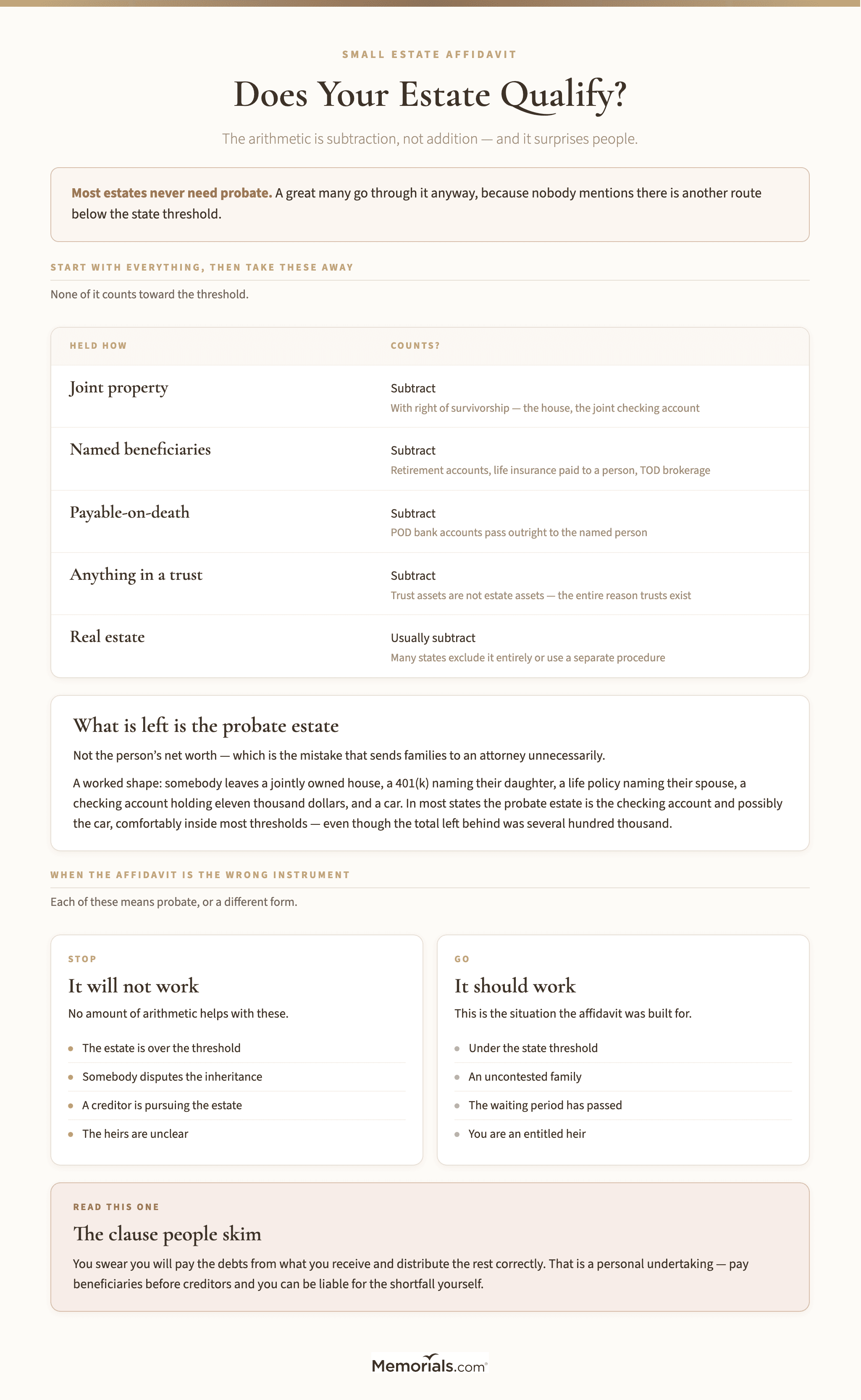
Start with everything, then take away each thing that passes outside the estate:
Anything jointly held with right of survivorship. The house, the joint checking account. Gone from the total.
Anything with a named beneficiary. Retirement accounts, life insurance paid to a person, transfer-on-death brokerage accounts. Gone.
Payable-on-death bank accounts. Gone.
Anything in a living trust. Trust assets are not estate assets, which is the entire reason trusts exist.
What is left is the probate estate, and it is that number the threshold applies to — not the person's net worth, which is the mistake that sends families to an attorney unnecessarily.
A worked shape. Somebody leaves a jointly owned house, a 401(k) naming their daughter, a life insurance policy naming their spouse, a checking account in their sole name holding eleven thousand dollars, and a car. In most states the probate estate is the checking account and possibly the car — comfortably inside most thresholds — even though the total left behind was several hundred thousand.
Vehicles often have their own route regardless. Many states let a DMV transfer a title to a surviving spouse or heir on a simple form, outside both probate and the affidavit.
If the number is close to the line, get an hour of an attorney's time. Being slightly over and using the affidavit anyway is the one version of this with real consequences.
Frequently Asked Questions
Can I use it at every bank? In principle yes; in practice some institutions are slower or fussier than others. The ones with dedicated estate teams — listed in the financial accounts directory — are generally the easiest.
Do I need a lawyer? Usually not. For a straightforward estate under the threshold with an uncontested family, the affidavit is designed to be used without one. An hour of an attorney's time is cheap insurance where anything is unclear.
What if I discover more assets later? If the total goes over the threshold, the affidavit no longer applies and probate may be required. Search properly first, including unclaimed property.
How long does it take? Days once the waiting period has passed, against months for probate. That gap is the whole point.
Can more than one person sign? In most states each entitled heir can file, and some require all of them to sign or consent. Coordinating that up front avoids an institution refusing later.
What happens if I get the value wrong? An honest mistake is usually correctable. A deliberate understatement is perjury, and the undertaking you signed to pay the debts is personally enforceable.
Vehicles often have their own route. Many states transfer a title on a single DMV form, outside both probate and the affidavit.
After the Affidavit Is Accepted
The affidavit releases the money. What happens next is your responsibility, and it is the part the sworn undertaking actually covers.
Pay the debts first. Funeral expenses, final medical bills, outstanding credit card balances, taxes. Most states set an order of priority and it is worth checking, because paying beneficiaries before creditors can leave you personally liable for the shortfall.
Keep a simple account. What came in, what went out, and to whom. A page in a notebook is enough. If any heir later asks, the record is what ends the conversation.
Do not distribute immediately. Bills arrive for months, and the final tax filing may be a year out. Holding a reserve for six months is ordinary prudence, not obstruction, and explaining that up front prevents it looking like delay.
File the final tax return. A return is generally still required for the year of death, and the estate may need one of its own. This is where whether executor fees are taxable becomes relevant if you are paying yourself anything.
Then distribute, and get a receipt. A one-line signed acknowledgment from each person receiving anything closes it properly and costs nothing.
In Closing
Check the threshold in the state where the person lived, subtract everything that passes outside the estate — joint property, named beneficiaries, payable-on-death accounts — and see what is left. For most families the number that remains is smaller than they assumed.
If it is under the line, the affidavit turns months into an afternoon. That is worth thirty minutes of checking before anybody calls an attorney.