🏬Supersize Online Funeral Retailer🪦1000's of Headstones⚱️Over 10,000 Cremation Urns⚰️Caskets Overnight Delivery🛒Funeral & Memorial Superstore🚚FREE Shipping on ALL Orders👨👩👧👦Helping Families for over 20 Years💰Lowest Price Guarantee🏬Supersize Online Funeral Retailer🪦1000's of Headstones⚱️Over 10,000 Cremation Urns⚰️Caskets Overnight Delivery🛒Funeral & Memorial Superstore🚚FREE Shipping on ALL Orders👨👩👧👦Helping Families for over 20 Years💰Lowest Price Guarantee
🏬Supersize Online Funeral Retailer🪦1000's of Headstones⚱️Over 10,000 Cremation Urns⚰️Caskets Overnight Delivery🛒Funeral & Memorial Superstore🚚FREE Shipping on ALL Orders👨👩👧👦Helping Families for over 20 Years💰Lowest Price Guarantee🏬Supersize Online Funeral Retailer🪦1000's of Headstones⚱️Over 10,000 Cremation Urns⚰️Caskets Overnight Delivery🛒Funeral & Memorial Superstore🚚FREE Shipping on ALL Orders👨👩👧👦Helping Families for over 20 Years💰Lowest Price Guarantee
When an ex husband or ex wife dies, the grief is real and the position is genuinely awkward, and almost nobody tells you what to do about either.
You may have been married to this person for twenty years. You may share children, a history, a house you both still think of as yours. And you may also have no formal standing at the funeral at all — no seat reserved, no mention in the obituary, and a current spouse who has every right to be there and may not want you to be.
This article is about how to handle that. It is a question of tact rather than rules, but there are patterns, and knowing them helps.
Should You Go?
Usually yes, if you want to, and if you can do it quietly.
The starting position for most families is that an ex-spouse who shows up respectfully is welcome. The exceptions are real but narrower than people fear: a bitter divorce, an explicit request not to come, or a current spouse for whom your presence would genuinely spoil the day.
Three questions settle it more reliably than any rule:
Do you have children together? If so, go. Your children have a parent to bury and the other parent present is usually a comfort to them, whatever the adults feel. This overrides almost everything else.
Would the person who died have wanted you there? You probably know. Trust that.
Has anyone asked you not to come? If they have, do not go. There are other ways to mark it, covered below.
If you are unsure, the useful move is to ask one person — an adult child, a sibling of the deceased, a mutual friend close to the family. Not the widow or widower on the day of the funeral. Someone a step removed, a few days out, by text so they can answer honestly without being watched.
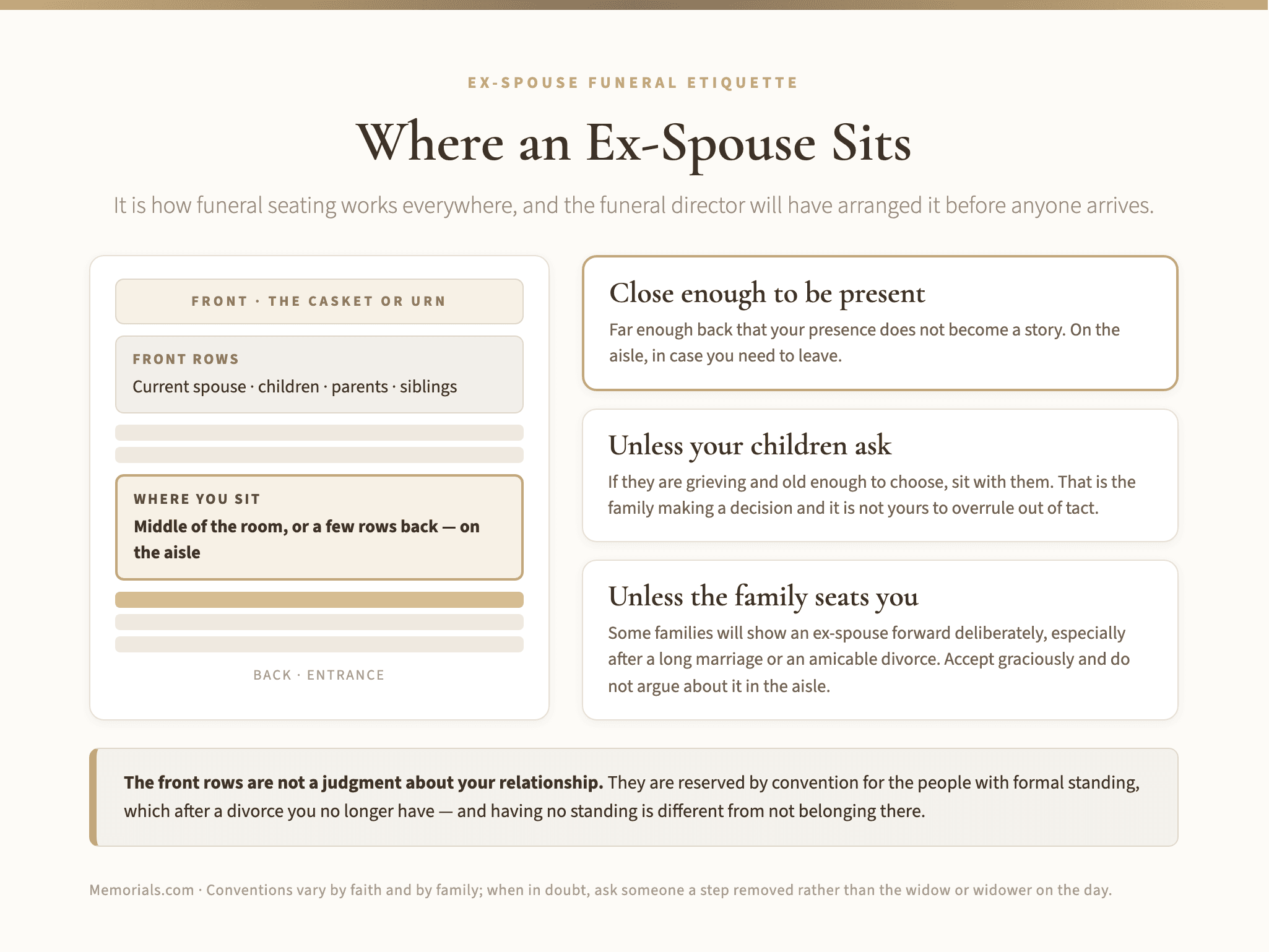
Where does an ex wife sit at a funeral? Concretely: not in the front row, unless the family has specifically invited you there.
The front rows belong to the current spouse, the children, the parents and the siblings. That is not a judgment about your relationship — it is how funeral seating works everywhere, and the funeral director will have arranged it that way before anyone arrives.
The right place for an ex-spouse is the middle of the room, or a few rows back, on the aisle if you may need to leave. Close enough to be present, far enough back that your presence does not become a story.
Two exceptions:
If you have children who are grieving, and they are old enough to choose, they may want you beside them. If they ask, sit with them. That is the family making a decision and it is not yours to overrule out of tact.
If the family seats you. Some families will show an ex-spouse to a seat near the front deliberately, especially after a long marriage or where the divorce was amicable. Accept graciously and do not argue about it in the aisle.
The front rows are reserved by convention for the people with formal standing, which after a divorce you no longer have. Having no standing is different from not belonging there.
Ex Spouse Funeral Etiquette: The Practical Rules
Most ex spouse funeral etiquette comes down to being present without being noticed. Arrive on time or early, not late. A late arrival turns heads, and heads turning toward you is the thing to avoid.
Dress conservatively, even if the family has asked for color. This is not the day to be noticed.
Greet the current spouse. This is the hardest sentence in the article and the most important. A brief, warm, ordinary condolence — "I'm very sorry. He spoke well of you" or simply "I'm so sorry for your loss" — costs you ten seconds and removes ninety percent of the tension in the room. Avoiding them creates far more awkwardness than speaking to them.
Do not tell stories about the marriage. Not to the current spouse, not to the children, not to the person next to you at the reception. Whatever the history, this is not the room for it.
Let others define you. If someone asks who you are, "I'm Michael's first wife" or "We were married a long time ago" is complete. No explanation required.
Leave the reception earlier than you want to. Presence at the service is the point. Lingering at the gathering afterward is where things tend to go wrong.
Do not post about it. Not that day. The family will see it.
The visitation is the easier room. It is longer, less structured and much simpler to attend briefly — pay respects, speak to whoever you need to, and leave.
If You Are Not Welcome
People search for ex wife not welcome at funeral more often than you would guess, which tells you how common this is. Being told directly — or sensing it without being told — is painful, and worth separating into two situations.
If you have been asked directly not to come, do not come. Whatever the justice of it, arriving after being asked not to turns a funeral into an incident, and the person it hurts most is usually your own children.
If nobody has said anything but you suspect it, you are probably reading more into it than exists. Families in the first week after a death are not thinking about you. Silence is almost always preoccupation rather than a message.
Either way, there are real alternatives:
Go to the visitation or wake instead. These are longer, less structured and much easier to attend briefly. You can pay respects, speak to whoever you need to, and leave.
Visit the grave afterward. A week later, alone, is a legitimate and often better way to say goodbye.
Write to the children. Whatever their age. A letter about their father from someone who knew him before they existed is a thing they will keep.
Send flowers or make a donation. A card signed with your full name and no explanation is appropriate and will be understood.
Hold your own small thing. Dinner with mutual friends. A walk somewhere you both went. Grief does not require an official venue.
A letter about their father from someone who knew him before they existed is a thing your children will keep. It works whatever their age, and it does not depend on anyone's permission.
If You Are the One Deciding
Sometimes the question runs the other way: you are the current spouse or an adult child, and the ex is asking whether to come.
Consider saying yes. The cost of their attendance is usually a few uncomfortable minutes. The cost of exclusion can run for years, particularly where children are involved, and it is a decision that gets revisited at every subsequent family event.
If you say yes, say it warmly enough to be believed. A grudging yes is worse than a clear no, because the person arrives braced for hostility and behaves accordingly.
If you say no, say it privately and early. Not at the door. A message a few days out, from one person rather than a committee.
You are allowed to say no. If the marriage ended badly, if there was harm done, if their presence would take the day away from you — that is a sufficient reason and you do not owe anyone the reasoning.
Where the Legal Questions Sit
Etiquette is one thing; authority is another, and divorce usually ends the second entirely.
The next of kin for funeral decisions is the current spouse, or if there is none, usually the adult children. A former spouse has no legal standing to direct the funeral, receive the remains or decide on disposition, regardless of how long the marriage lasted.
Where an ex-spouse does sometimes appear is in paperwork nobody updated. Life insurance beneficiaries, retirement account beneficiaries and pension survivor elections frequently still name a former spouse years after a divorce, and in many cases the named beneficiary prevails over a will. That is a legal matter rather than an etiquette one, and it is worth raising with an attorney rather than at a funeral.
If there are minor children, decisions about their care sit with the surviving parent — which may well be you, and which is a conversation for a different week.
Etiquette When an Ex Spouse Dies, With Children Involved
Etiquette when an ex spouse dies is much simpler when there are children, because the question stops being about the adults. This is the situation the whole thing usually turns on.
Your children have lost a parent. You are the person who knew that parent longest. What they need from you is not tact — it is a parent who is present, who does not make the day about the adults, and who can talk about their father or mother without bitterness.
Practically:
Go, unless asked not to. Your children will remember whether you came.
Sit with them if they want you to. Let them decide.
Do not compete with the current spouse. Your children are watching how the adults behave and will carry it.
Be available afterward. The week after a funeral is when it lands, and grief for a divorced parent is genuinely complicated for children. They may need to say things to you they cannot say to anyone else.
Speak well of the person who died, or say nothing. Whatever the marriage was, your children loved them.
A week later, alone, is a legitimate and often better way to say goodbye — and it is available to you whatever was decided about the day itself.
Grief That Has No Name
There is a reason this situation is so disorienting, and it is worth saying directly: there is no social role for a grieving ex-spouse.
A widow is a widow. A son is a son. A friend is a friend, and people know how to treat all three. A former spouse occupies a position with no name, no seat and no script, and the people around you frequently do not know whether to offer condolences at all. Many will say nothing, not from unkindness but because they cannot work out whether sympathy would be welcome.
Researchers call this disenfranchised grief — loss that a community does not fully recognize, and therefore does not fully support. It shows up for ex-spouses, for former in-laws, for people whose relationship was private, and for friends who were closer to the deceased than the family realized.
The practical consequence is that you may have to ask for support rather than receive it. Tell one or two people plainly: "My ex-husband died. We were married for eighteen years. I am not okay." Most people respond well once they are told how to think about it.
It is also worth expecting the grief to be strange rather than straightforward. People often describe mourning not the person as they last knew them but the person they married, and a version of their own life that has now definitively ended. That is a real loss and it does not require a current relationship to justify it.
Usually yes, if you want to and nobody has asked you not to. If you have children together, go — your presence is generally a comfort to them regardless of what the adults feel.
Where does an ex wife sit at a funeral?
The middle of the room or a few rows back, on the aisle. Front rows are for the current spouse, children, parents and siblings. If your children ask you to sit with them, do.
What if the ex wife is not welcome at the funeral?
If you have been asked directly not to attend, respect it. Go to the visitation instead, visit the grave later, write to the children, or send a card. If nobody has said anything, you are probably reading a message into what is really preoccupation.
Should I speak to my ex's current spouse?
Yes, briefly and warmly, early on. It is the single thing that most reduces tension in the room, and avoiding them creates more awkwardness than a ten-second condolence ever will.
Do I have any say in the funeral arrangements?
No. Divorce ends legal next-of-kin standing. The current spouse decides, or the adult children if there is no spouse. You may ask; you cannot direct.
Am I still a beneficiary on his life insurance?
Possibly, and this happens more often than people expect — beneficiary designations are frequently never updated after a divorce. It is a legal question rather than an etiquette one and worth asking an attorney about rather than the family.
How do I introduce myself at the funeral?
"I'm Sarah, David's first wife" is complete and needs no elaboration. Most people will simply say they are sorry and move on.
The Short Version
Go if you want to and nobody has asked you not to. Sit in the middle. Speak to the current spouse for ten seconds. Leave the reception early. Tell your children something true about their parent on the way home.
Grief after a divorce is a strange, ambiguous thing — you are mourning someone who was central and then was not, and there is no ritual designed for it. Our funeral planning guide covers the arrangements, and what to say instead of sorry for your loss may help with the conversations.