🏬Supersize Online Funeral Retailer🪦1000's of Headstones⚱️Over 10,000 Cremation Urns⚰️Caskets Overnight Delivery🛒Funeral & Memorial Superstore🚚FREE Shipping on ALL Orders👨👩👧👦Helping Families for over 20 Years💰Lowest Price Guarantee🏬Supersize Online Funeral Retailer🪦1000's of Headstones⚱️Over 10,000 Cremation Urns⚰️Caskets Overnight Delivery🛒Funeral & Memorial Superstore🚚FREE Shipping on ALL Orders👨👩👧👦Helping Families for over 20 Years💰Lowest Price Guarantee
🏬Supersize Online Funeral Retailer🪦1000's of Headstones⚱️Over 10,000 Cremation Urns⚰️Caskets Overnight Delivery🛒Funeral & Memorial Superstore🚚FREE Shipping on ALL Orders👨👩👧👦Helping Families for over 20 Years💰Lowest Price Guarantee🏬Supersize Online Funeral Retailer🪦1000's of Headstones⚱️Over 10,000 Cremation Urns⚰️Caskets Overnight Delivery🛒Funeral & Memorial Superstore🚚FREE Shipping on ALL Orders👨👩👧👦Helping Families for over 20 Years💰Lowest Price Guarantee
Before the list: if you are looking for what to say instead of sorry for your loss because you are worried the phrase is wrong, it is not. It is not offensive, it is not lazy, and a grieving person hears it exactly as you meant it. Nobody has ever been hurt by those five words.
What makes it fall flat is not the phrase. It is that it arrives alone — said by someone who then goes quiet, because they have used up the only sentence they had. The fix is usually one more sentence, not a different first one.
That said, most people arrive here wanting alternatives to sorry for your loss rather than a defense of it, so forty of them follow, sorted by who you are to the person. Take what fits. The sympathy and condolence guide is the wider starting point, and short condolence messages has the version you write in a card.
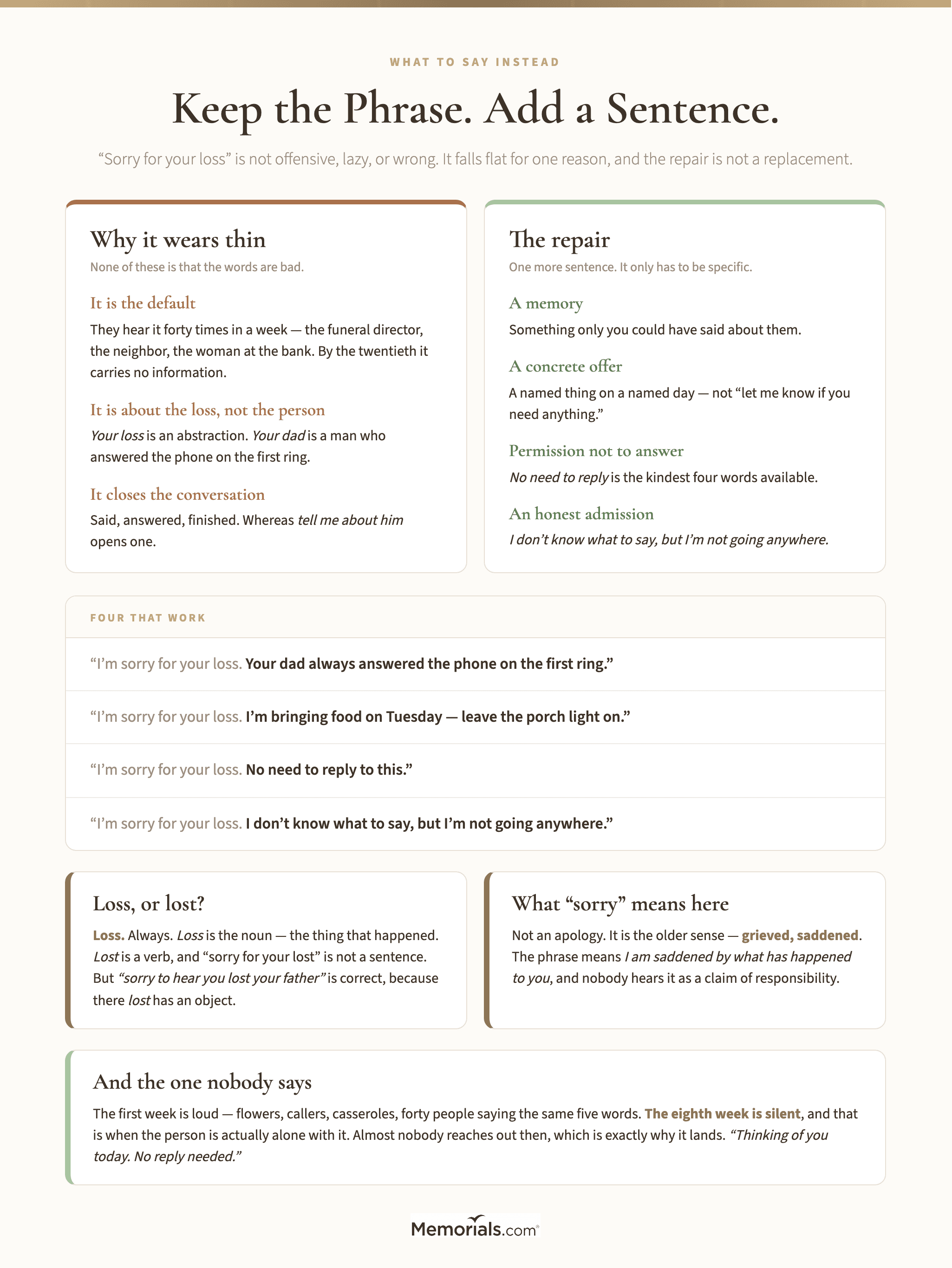
Keep the phrase and add something to it. Almost anything works, as long as it is specific:
I'm sorry for your loss. Your dad always answered the phone on the first ring.
I'm sorry for your loss. I'm bringing food on Tuesday — leave the porch light on.
I'm sorry for your loss. No need to reply to this.
I'm sorry for your loss. I don't know what to say, but I'm not going anywhere.
The second sentence is what makes the first one land, because it proves a person wrote it rather than a card. If you read nothing else on this page, use that.
The second sentence is what makes the first one land. Almost anything specific will do.
When Words Are Not the Right Instrument
Small enough to live on a desk, still there in March
Three reasons, and none is that the words are bad.
It is the default. A grieving person hears it forty times in a week, from the funeral director, the neighbor, the woman at the bank. By the twentieth it has stopped carrying information.
It is about the loss, not the person.Your loss is an abstraction. Your dad is a man who answered the phone on the first ring.
It closes the conversation. Said and answered — thank you — and there is nowhere to go. Whereas tell me about him opens one.
None of that makes it wrong to say. It makes it a poor only thing to say.
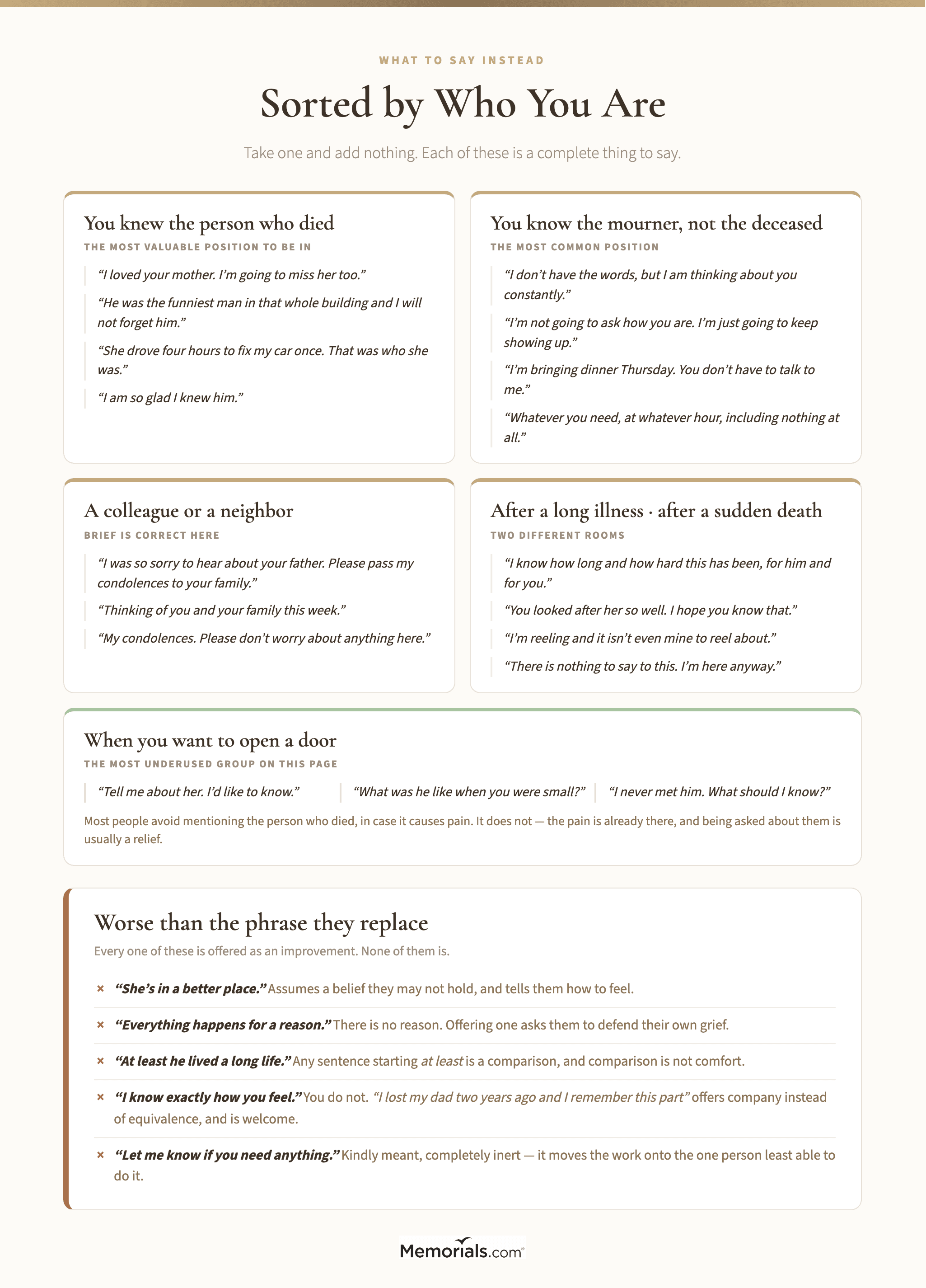
Alternatives by Who You Are
Ways to say sorry for your loss that carry more, sorted by how well you knew them.
When you knew the person who died
I loved your mother. I'm going to miss her too.
He was the funniest man in that whole building and I will not forget him.
I keep thinking about the time she drove four hours to fix my car. That was who she was.
She was very good to me when I needed it, and I never properly told her.
I am so glad I knew him.
When you know the grieving person, not the one who died
I don't have the words, but I am thinking about you constantly.
I can't imagine what this week has been. I'm here.
I'm not going to ask how you are. I'm just going to keep showing up.
Whatever you need, at whatever hour, including nothing at all.
I'm bringing dinner Thursday. You don't have to talk to me.
When you barely know them — a colleague, a neighbor
I was so sorry to hear about your father. Please pass my condolences to your family.
Thinking of you and your family this week.
I have been thinking about you since I heard. Take whatever time you need.
My condolences. Please don't worry about anything here.
When it was a long illness
I know how long and how hard this has been, for him and for you.
You looked after her so well. I hope you know that.
Tired and grieving at once is a lot. Be gentle with yourself.
When it was sudden
I'm reeling and it isn't even mine to reel about. I'm so sorry.
There is nothing to say to this. I'm here anyway.
I heard an hour ago and I've been sitting with it since.
When you want to open a door
Tell me about her. I'd like to know.
What was he like when you were small?
I never met him. What should I know?
That last group is the most underused and the most welcome. Most people avoid mentioning the person who died in case it causes pain. It does not — the pain is already there, and being asked about them is usually a relief. What to say at a funeral service covers the same instinct in person.
The bottom-right group is the most underused. Being asked about the person who died is usually a relief, not a wound.
What Not to Say Instead
Some popular replacements are worse than the phrase they replace.
"She's in a better place." Assumes a belief the mourner may not hold, and tells them how to feel about the worst thing that has happened to them.
"Everything happens for a reason." There is no reason. Offering one asks the grieving person to defend their own grief.
"At least he lived a long life." Any sentence beginning at least is a comparison, and comparison is not comfort.
"I know exactly how you feel." You do not, and it invites the reply no, you don't.I lost my dad two years ago and I remember this part is different and welcome — it offers company rather than equivalence.
"Let me know if you need anything." Kindly meant and completely inert. It moves the work onto the person least able to do it. Name a specific thing and a specific day instead.
"How are you?" Not wrong, but it obliges an answer from someone with no answer. No need to reply does more.
Is It "Sorry for Your Loss" or "Sorry for Your Lost"?
People search sorry for your loss or lost often enough that it deserves a plain answer: it is loss, always. Loss is the noun — the thing that happened. Lost is a verb, and sorry for your lost is not a sentence in English.
The confusion is common enough to be its own search, and it is worth getting right in writing, where it is visible. Two correct forms:
Sorry for your loss.
Sorry to hear you lost your father.
The second uses lost correctly, as a verb with an object.
What "Sorry for Your Loss" Actually Means
The sorry for your loss meaning is narrower than it sounds. Sorry here is not an apology — you are not claiming responsibility. It is the older sense of the word, meaning grieved or saddened. The phrase means, roughly, I am saddened by what has happened to you.
That is worth knowing because it answers the small anxiety people have about saying it: you are not implying it was your fault, and nobody hears it that way.
It is also why the phrase survives despite being worn out. It is short, it is accurate, and there is no way to get it wrong. When you cannot think of anything, it remains the correct thing to say.
Which is the real answer to how to say sorry for your loss well: not by finding better words for sympathy, but by adding something only you could have added. The vocabulary was never the problem.
If You Are Writing Rather Than Speaking
Written words get read more than once, so they carry further and they cost more to get wrong.
In a card, the four-part shape does most of the work: name the person, say one specific thing about them, offer something concrete, close warmly. Sympathy card messages has the full version.
In a text, shorter is better and no need to reply is the kindest thing you can add. Sending condolences by text covers the timing, which matters more than the wording.
In another language, do not translate this phrase literally. Estoy triste por tu pérdida is a word-for-word rendering that no Spanish speaker uses — condolences in Spanish has what to say instead.
At work, keep it brief and do not ask for a reply. Grief at work covers what happens when they come back.
Written words get read more than once. That is the argument for the second sentence.
Saying It Out Loud Is a Different Job
Everything above assumes you are writing. In person the words matter less and three other things matter more.
Say it early in the conversation, not late. People rehearse the sentence and then wait for an opening that never comes, and the whole exchange becomes about the thing neither of you said. Get it out in the first ten seconds and the rest of the conversation is free.
Then stop talking. The most common in-person mistake is filling the silence that follows. That silence is not a failure — it is the part where the other person gets to say something if they want to, and most of the time they do. Count to five.
Let your face do some of it. A hand on an arm, sitting down rather than standing over them, not looking away when they cry. This is most of what people remember, and none of it is vocabulary.
And if you get it wrong — if you say the at least sentence, or hear yourself explaining why it happened — say so plainly and move on. That came out wrong. I'm sorry. Grieving people are extraordinarily forgiving of clumsiness and much less forgiving of avoidance. The person who says the wrong thing is remembered more kindly than the person who crossed the street.
Months Later, Which Matters More
The best thing to say is often not said in the first week at all.
The first week is loud — flowers, callers, casseroles, forty people saying the same five words. The eighth week is silent, and that is when the person is actually alone with it. Almost nobody reaches out then, which is exactly why it lands.
Thinking of you today. No reply needed.
It's been a while and I'm still thinking about your mom.
I know what next Tuesday is. I'm around.
The eighth week, not the first. By then the callers have stopped and the person is actually alone with it.
Sometimes there is nothing to say and something to do instead.
Food, a lift, an afternoon of paperwork, a standing phone call. And occasionally an object — not because a thing replaces words, but because it is still in the house in March when the messages have stopped. Among personalized sympathy gifts, the pieces that work are small enough to live on a desk rather than demand a shelf; remembrance gifts for loss covers that range.
Send the words too. The object is not the message.
Keep the phrase. Add a sentence. That is the whole repair.
Frequently Asked Questions
Is it wrong to say "sorry for your loss"? No. It is correct, inoffensive, and understood exactly as intended. It only falls flat when it is the only thing you say.
What is a better alternative? The same phrase plus one specific sentence — a memory, a concrete offer, or no need to reply. If you want a replacement, I am thinking about you constantly and tell me about her both do more.
Is it "sorry for your loss" or "sorry for your lost"? Loss. Lost is a verb and does not work in that sentence. Sorry to hear you lost your father is the correct use of lost.
What does "sorry" mean in that phrase? Grieved or saddened — the older sense. It is not an apology and nobody hears it as one.
What should I not say? Anything beginning at least, anything explaining why it happened, I know exactly how you feel, and let me know if you need anything — which sounds generous and moves all the work onto them.
Is it too late to say something months later? No, and later is often better. The first week is crowded; the eighth is silent. That is when a message actually gets read.
In Closing
The reason people search for what to say instead of sorry for your loss is almost never that they found the phrase offensive. It is that they said it, felt it land flat, and wanted to do better.
The honest answer is that the phrase was never carrying the weight — the sentence after it was. Say the five words if you like. Then say one more thing that only you could have said.