🏬Supersize Online Funeral Retailer🪦1000's of Headstones⚱️Over 10,000 Cremation Urns⚰️Caskets Overnight Delivery🛒Funeral & Memorial Superstore🚚FREE Shipping on ALL Orders👨👩👧👦Helping Families for over 20 Years💰Lowest Price Guarantee🏬Supersize Online Funeral Retailer🪦1000's of Headstones⚱️Over 10,000 Cremation Urns⚰️Caskets Overnight Delivery🛒Funeral & Memorial Superstore🚚FREE Shipping on ALL Orders👨👩👧👦Helping Families for over 20 Years💰Lowest Price Guarantee
🏬Supersize Online Funeral Retailer🪦1000's of Headstones⚱️Over 10,000 Cremation Urns⚰️Caskets Overnight Delivery🛒Funeral & Memorial Superstore🚚FREE Shipping on ALL Orders👨👩👧👦Helping Families for over 20 Years💰Lowest Price Guarantee🏬Supersize Online Funeral Retailer🪦1000's of Headstones⚱️Over 10,000 Cremation Urns⚰️Caskets Overnight Delivery🛒Funeral & Memorial Superstore🚚FREE Shipping on ALL Orders👨👩👧👦Helping Families for over 20 Years💰Lowest Price Guarantee
How long should a eulogy be? Three to five minutes, which is roughly 500 to 750 words on a page. Under two minutes feels abrupt to the room. Over eight, and you can watch people begin to shift.
That is the whole answer, and almost nobody believes it until they have stood up with nine minutes of material and realized on about page three that the room has gone. This page is about hitting the length: what it converts to in words, an outline that fits inside it, short examples at each length, and what to do when you get there and cannot speak.
A eulogy is not an obituary — an obituary is written to be read, a eulogy to be spoken aloud to people who are already crying. How to write an obituary covers the written kind. For where the eulogy sits in the running order, see the funeral program guide.
Three to five minutes. Five is the ceiling at most services, not the target.
Roughly 500 to 750 words. Approximate — people slow down when they are upset.
Read it aloud with a timer before the day. Everything else on this page is optional; this is not.
If there are several speakers, three minutes each. Ask the funeral director how many there are.
Write it out in full and take it up with you, even if you never look down.
How Long Is a Eulogy, in Words?
How long is a eulogy once it is off the page? Read aloud at an unhurried pace, most people cover somewhere between 120 and 150 words a minute — slower than conversation, because a room and a microphone make you slow down whether you mean to or not. Grief slows you further. The usable eulogy length works out roughly like this:
Spoken time
Words on the page
When this is right
2 minutes
250–300
Several speakers, or a graveside committal
3 minutes
350–450
Two or three speakers sharing the service
5 minutes
600–750
The main eulogy, one speaker
7 minutes
850–1,050
Only when the family has explicitly asked for a long one
10 minutes
1,200+
Almost always too long
So how many words should a eulogy be? If you are the only speaker, aim at 600 and stop at 750. If you are one of three, aim at 400.
Time it out loud, not in your head. Silent reading runs at nearly double speaking pace, and a eulogy timed silently is the single most common reason people run over.
Print it in a size you can read at arm's length, on paper rather than a phone — a phone screen dims, and hands shake more than you expect. Number the pages, and do not staple them; you will want to slide each one aside rather than turn it.
An Outline That Fits Five Minutes
The reason eulogies run long is almost never the stories. It is the throat-clearing at the front and the summing-up at the back. This eulogy outline gives each part a share of the time so the middle survives.
Part
Share
What it does
Open
~30 seconds
Who you are and how you knew them. One sentence, no preamble.
Who they were
~1 minute
The shape of the life — where from, what they did, who they loved.
Two stories
~2 minutes
The heart of it. Specific, short, and true.
What they left
~1 minute
What people carry forward. Their phrase, their habit, their advice.
Close
~30 seconds
A line to the person or to the room. Then stop.
Two stories, not five. This is the single change that fixes most drafts. Five anecdotes at forty seconds each becomes a list; two at a minute each becomes a portrait. Pick the two that only you could tell.
Cut the biography, not the stories. If you are over, the material to lose is the résumé — dates, job titles, the chronology. Nobody in the room needs the sequence, and everybody wants the second story.
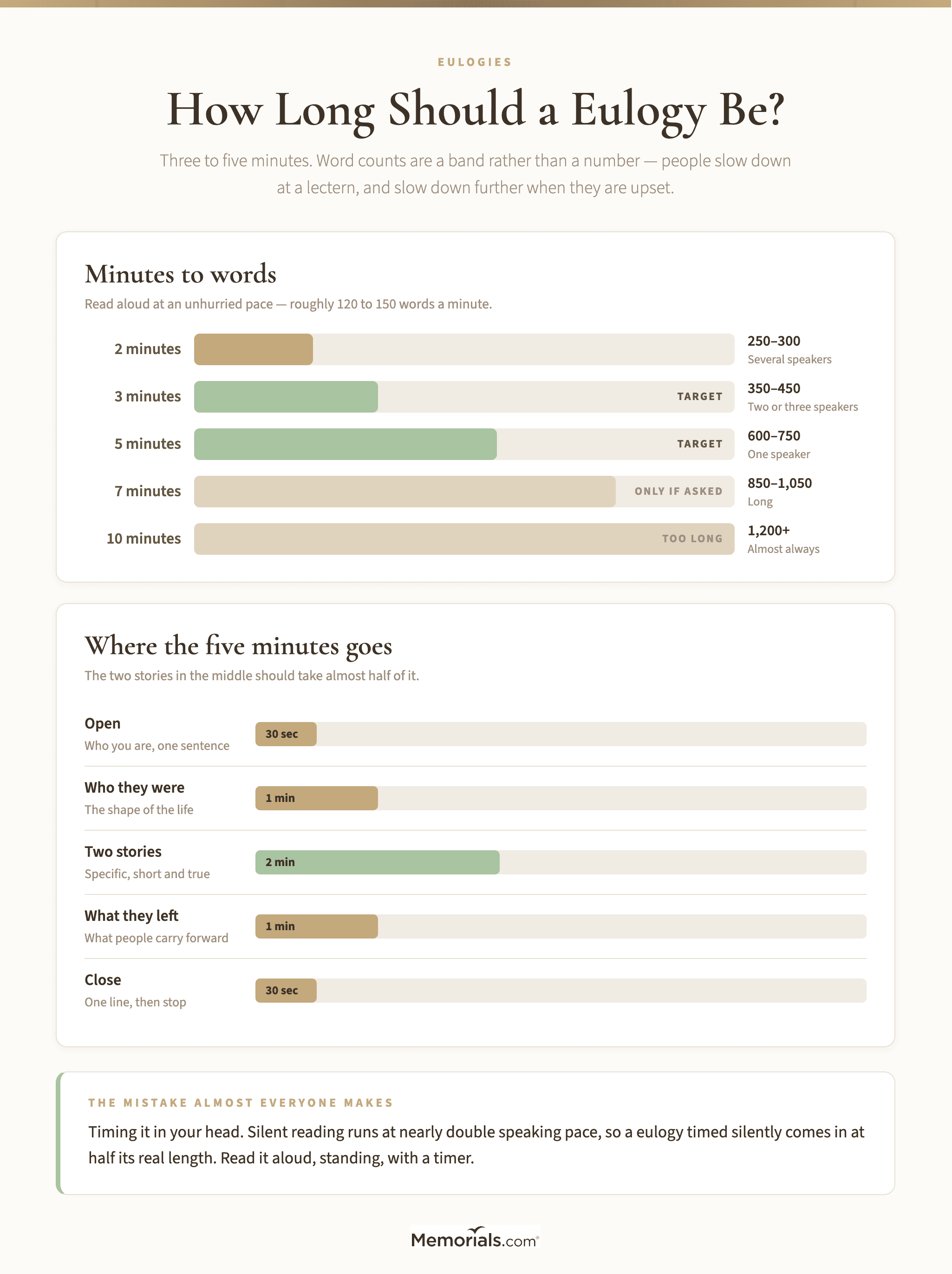
Minutes to words at an unhurried speaking pace, and where the time goes. Three to five minutes is the target — about 600 words for a single speaker, 400 when the service has two or three. The two stories in the middle should take almost half the total; the opening and the close are thirty seconds each.
Short Eulogy Examples
Short eulogy examples are easier to use as parts than as whole speeches, so here are two openings and two closes at the lengths that matter. Names are fictional.
A three-minute opening
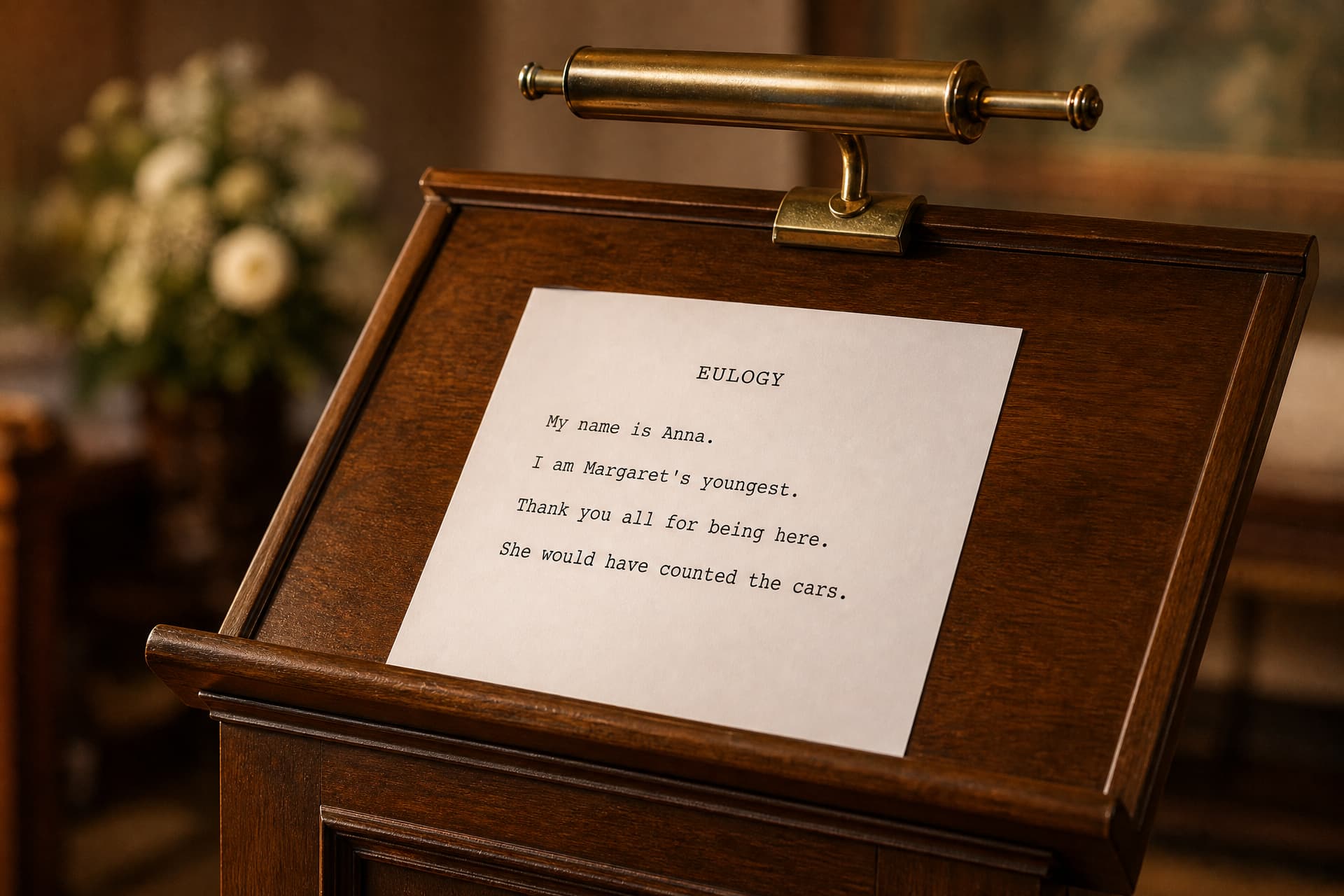
"I'm Anna, Margaret's youngest. Thank you all for being here — she'd have counted the cars."
"Mom taught fourth grade for thirty-one years in a town of four thousand people, which means half of you were in her class and the other half married someone who was."
A five-minute opening
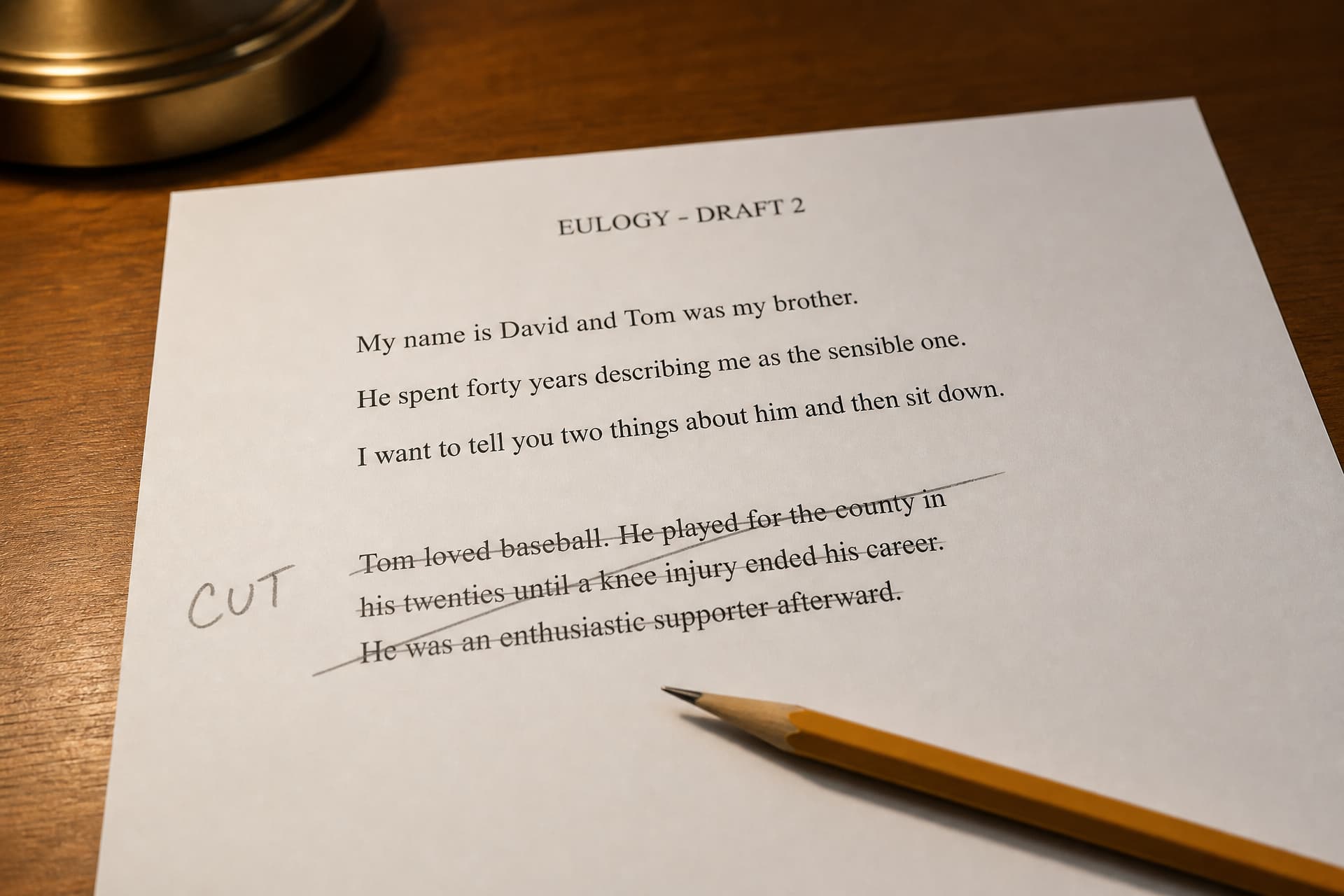
"For those who don't know me, I'm Tom's brother David. I'm the one he spent forty years describing as 'the sensible one', which anybody who knew Tom will understand was not a compliment."
"I want to tell you two things about my brother, and then I want to sit down, because he would have hated a long speech more than almost anything."
Closes
"He'd have said that was more than enough about him. So — thank you, Dad. We'll take it from here."
"She used to say that a job worth doing is worth doing before lunch. We'll be at the hall from twelve, and I think she'd approve of that."
"I don't have a tidy ending. I just have a mother I loved very much, and a room full of people who loved her too. Thank you for coming."
That last one is worth noticing. A eulogy does not need a resolution. Saying that you do not have one is truer than manufacturing one, and rooms respond to it.
Gathering the Material
An hour of asking produces better material than a day of remembering, and it gets other people into a task they are desperate to help with.
Ask three or four people the same three questions and write down what they actually say:
What did they always do that drove you mad? This produces the best material by a wide margin, because it is specific and affectionate at the same time.
What did they say all the time? Their phrase, in their words. Quote it exactly.
When did they most seem like themselves? Usually produces a scene rather than an adjective.
Avoid "tell me about them" — it produces a résumé from everyone you ask, and the résumé is the part you are going to cut.
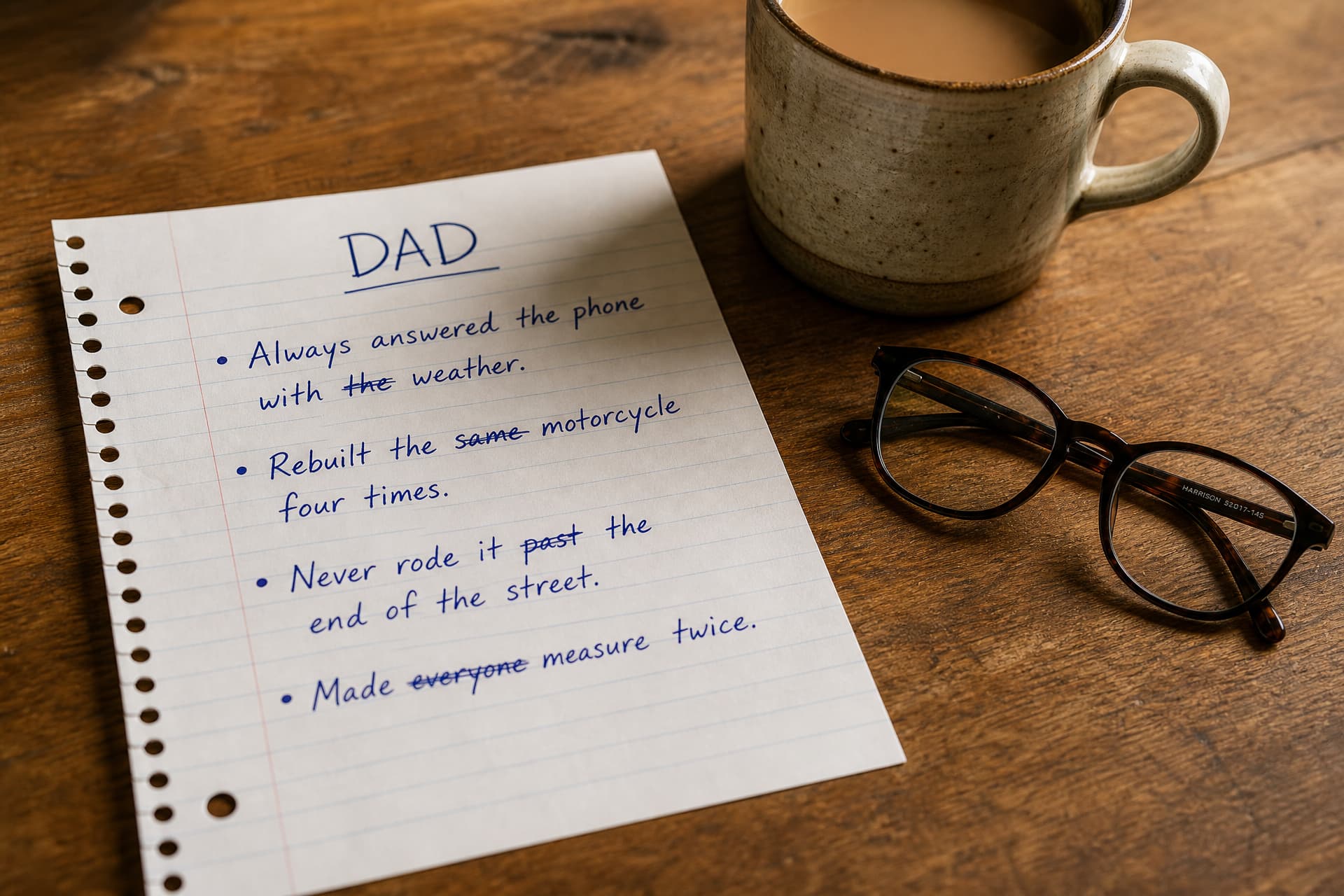
Write down what people actually say rather than tidying it. The half-sentence somebody blurts out — the phrase they always used, the thing that drove everyone mad — is the material. Tidied into a proper sentence, it stops being theirs.
Delivering It
The writing is most of the work but not all of it, and the practical part is short.
Read it aloud three times before the day, at least once standing.
Take the full text up with you. People who plan to speak from notes and then cannot are the ones who struggle; nobody has ever been criticized for reading.
Find one person to look at near the back, and return to them. Do not look at the front row.
Slow down deliberately at the start. Everybody starts too fast. Say your first sentence, then take a breath before the second.
Pause rather than apologize. If you stop, the room will wait. It is the one audience in the world that is entirely on your side.
Have a printed copy in somebody else's pocket, and tell them what it is for.
If You Cannot Get Through It
This is common enough that funeral directors plan for it, and it is not a failure of any kind.
Ask someone to stand beside you. Not to take over — just to be there. It helps more than it sounds like it will.
Agree a handover in advance. Give a copy to a second person and tell them: "If I stop and look at you, read from where I stopped." Knowing there is a net is often the thing that means you do not need it.
Ask someone else to read it entirely. A eulogy you wrote and someone else delivered is still your eulogy, and "David has asked me to read this on his behalf" is a sentence rooms hear with nothing but sympathy.
Sit down if you need to. Nobody will remember it. They will remember that you got up.
Funny Eulogies — When Humor Works
It works more often than people expect, and it fails in one specific way: when the joke is about the death rather than about the life.
Affection is the test. "He was a terrible driver and we all knew it" is a joke about who somebody was, and a room will laugh at it gratefully. Anything about the circumstances of their dying is a joke at the family's expense, even when the family are the ones laughing hardest at home.
Two practical notes. Land the joke early, in the first minute, so the room knows what kind of eulogy this is and gives itself permission. And follow it with something plain — humor that runs the whole way through starts to feel like avoidance, which is a different thing from lightness.
Look at one person near the back and keep returning to them. The front row is family, and family is where you will lose your composure — this is the one piece of advice that people who have done it always give and people who have not always ignore.
Cutting It Down
Most first drafts come in at eight or nine minutes, and the cut is a specific job rather than a general tightening. Do it in this order and it takes twenty minutes.
Cut the chronology first. Dates, schools, job titles, the sequence of towns. This is usually a third of the draft and almost none of what the room came for — and if the family wants the record kept, it belongs in the printed obituary, not the spoken eulogy.
Cut the third, fourth and fifth stories. Keep the two that only you could tell. The instinct is to shorten all five instead, and shortening a story is what turns it into a list item. Two stories at a minute each land; five at twenty seconds each vanish.
Cut the throat-clearing."I've been trying to write this for three days and I don't know where to start" is a sentence almost every first draft opens with. It is true, it is relatable, and it costs you fifteen seconds of the room's sharpest attention. Start with who you are.
Cut adjectives, keep verbs."He was generous" is a claim. "He paid for my first car and never once mentioned it" is the same information as a fact, and it is shorter than the sentence around it usually is once you commit.
Do not cut the pauses. When you time it aloud, leave the silences in — after the joke, after the hardest sentence. They are part of the five minutes and taking them out on the page means overrunning on the day.
Print it double-spaced and cut on paper. Whole paragraphs come out far more willingly with a pencil than on a screen, where the instinct is to shorten every sentence a little instead — which is how a nine-minute draft becomes an eight-minute one.
What you should have at the end is shorter and slower than what you started with. That combination is the one that works from a lectern.
What to Say If You Are Not the Eulogist
Most people at a funeral are not speaking from the lectern, and are far more worried about what to say to the family afterwards. That is a different question with a different answer, covered in what to say at a funeral service — including what to do if you are asked, without warning, to say a few words.
Who Should Give It, and How to Ask
Families often assume the eulogy falls to the eldest child, and it does not. It falls to whoever can stand up and speak, which is a different quality and not always the same person.
The best eulogist is usually someone one degree removed from the deepest grief — a nephew rather than a son, a close friend rather than a spouse. They knew the person well enough to have the stories and are not so wrecked that the first sentence is impossible. This is not a rule; plenty of people bury a parent and speak beautifully. But if a family is deciding and nobody has volunteered, that is the direction to look.
Ask directly and give them an exit."Would you be willing to give the eulogy? Say no if it's too much — nobody will think anything of it." The second sentence is what makes the first one askable, and people who say yes to it say yes properly.
Tell them the length when you ask, not later. Three to five minutes is a completely different task from a vague "say a few words", and somebody who is told the shape of the job can decide whether they can do it.
Two or three speakers is often kinder than one. Nobody has to carry the whole thing, and the service gets more than one angle on the same person. If you go that way, assign each speaker a subject — "you take the workshop years, I'll take family" — or all three will tell the same story about the caravan.
The officiant will give the eulogy themselves if the family prefers, and will say so without being asked. That is a normal choice and not a lesser one; see the funeral officiant's role for what they need from you and when.
Frequently Asked Questions
How long should a eulogy be at a funeral? Three to five minutes. Five is the ceiling, not the target.
How many words is a five-minute eulogy? Around 600 to 750, read aloud at an unhurried pace.
How long should a eulogy be if there are several speakers? About three minutes each. Ask the funeral director how many people are speaking — they will know, and families often do not.
Can a eulogy be too short? Under about two minutes tends to feel abrupt. Two good minutes still beats six padded ones.
Should I write it out in full or use notes? In full, and take it with you. You can always look up from a full text; you cannot fill a gap in notes.
Who normally gives the eulogy? A close family member, a lifelong friend, or the officiant if the family prefers. There is no rule and no obligation.
Can more than one person give one? Yes, and it is common. Agree who covers what beforehand or you will get three versions of the same story.
In Short
Three to five minutes, 600 words for a single speaker, two stories rather than five, and cut the biography before you cut the anecdotes. Write it out in full, time it aloud standing up, and give a copy to somebody else in case you cannot finish.
If you stop halfway, the room will wait. That is the one thing worth knowing before you stand up.