🏬Supersize Online Funeral Retailer🪦1000's of Headstones⚱️Over 10,000 Cremation Urns⚰️Caskets Overnight Delivery🛒Funeral & Memorial Superstore🚚FREE Shipping on ALL Orders👨👩👧👦Helping Families for over 20 Years💰Lowest Price Guarantee🏬Supersize Online Funeral Retailer🪦1000's of Headstones⚱️Over 10,000 Cremation Urns⚰️Caskets Overnight Delivery🛒Funeral & Memorial Superstore🚚FREE Shipping on ALL Orders👨👩👧👦Helping Families for over 20 Years💰Lowest Price Guarantee
🏬Supersize Online Funeral Retailer🪦1000's of Headstones⚱️Over 10,000 Cremation Urns⚰️Caskets Overnight Delivery🛒Funeral & Memorial Superstore🚚FREE Shipping on ALL Orders👨👩👧👦Helping Families for over 20 Years💰Lowest Price Guarantee🏬Supersize Online Funeral Retailer🪦1000's of Headstones⚱️Over 10,000 Cremation Urns⚰️Caskets Overnight Delivery🛒Funeral & Memorial Superstore🚚FREE Shipping on ALL Orders👨👩👧👦Helping Families for over 20 Years💰Lowest Price Guarantee
A funeral officiant is the person who leads the service — who welcomes people, holds the running order together, introduces the readings and the eulogy, and says the words at the graveside. They are the reason a funeral feels like one thing rather than a series of separate moments.
The part most families do not know: in the United States, no license or ordination is required to lead a funeral. Weddings are different and have legal requirements; a funeral has none. Anyone the family chooses may stand up and lead it, which means the question is not who is qualified but who can do it.
This page covers what the role actually involves, who normally takes it, a full funeral ceremony script you can adapt, and what officiants charge. For where this sits in the rest of the service, see the funeral program guide.
No license is needed. Clergy, a celebrant, the funeral director, or a family member — all are allowed.
A funeral officiant charges roughly $150 to $500 for a standard service; clergy usually take an honorarium instead.
The service runs 20 to 45 minutes. The script below fits that.
Their real job is the joins — moving the room between one part and the next without anybody feeling lost.
If a family member is doing it, give them the script and take the eulogy off them. One or the other, not both.
What Does a Funeral Officiant Do?
Most of the work happens before the day, and it is the part families never see.
Meets the family. An hour, usually, to learn who the person was and what the family wants said and not said.
Builds the order of service and hands it to whoever is printing the program.
Confirms the readings and the music, and who is doing each one.
Coordinates with the funeral director on timings, the procession, and the graveside.
Leads the service — the welcome, the transitions, the committal.
Holds the room. If a speaker breaks down, the officiant is the one who steps in.
That last one is the job. Everything else can be written on a card; the ability to stand in a silence and carry the room out of it is what a family is really choosing.
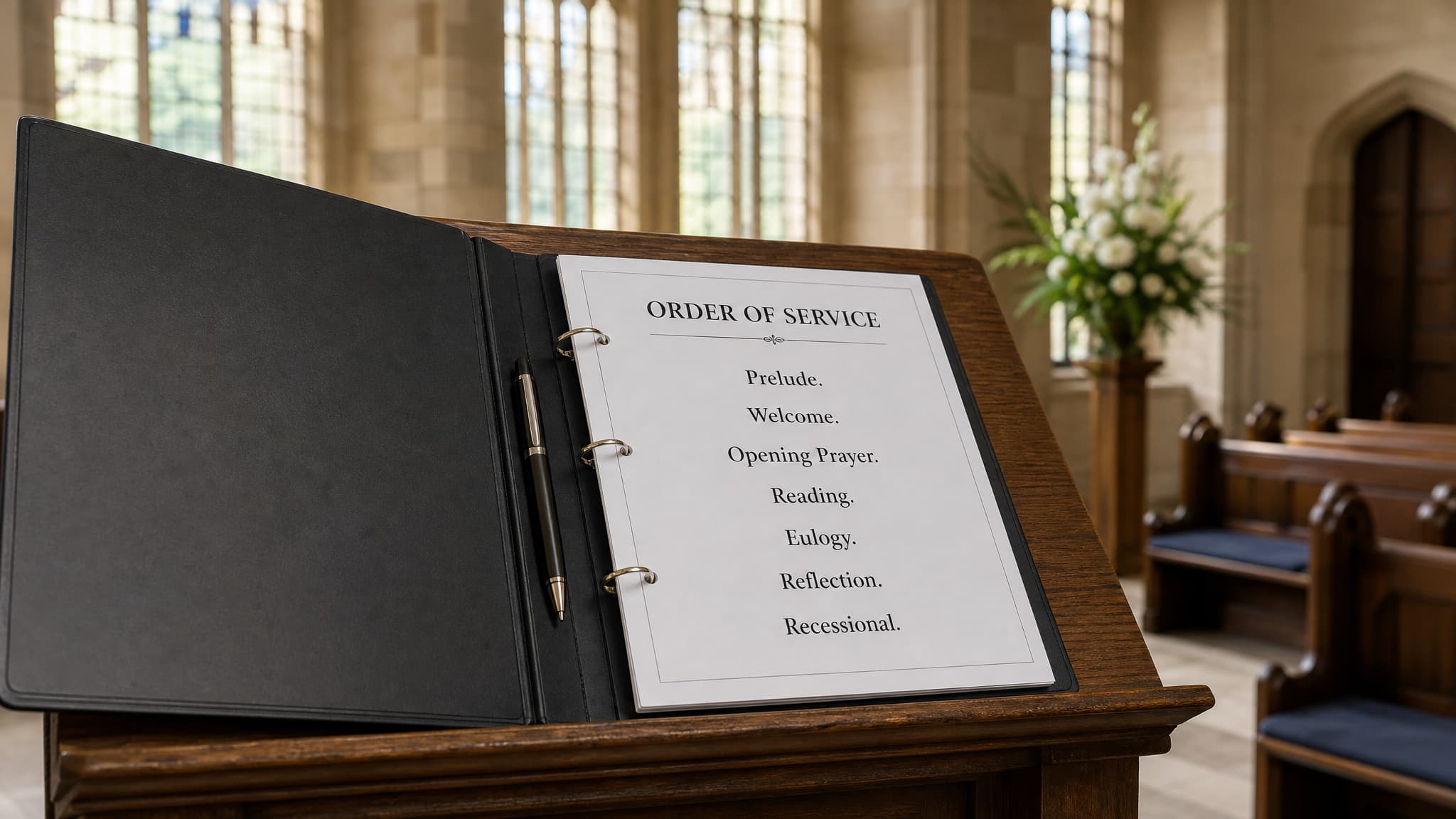
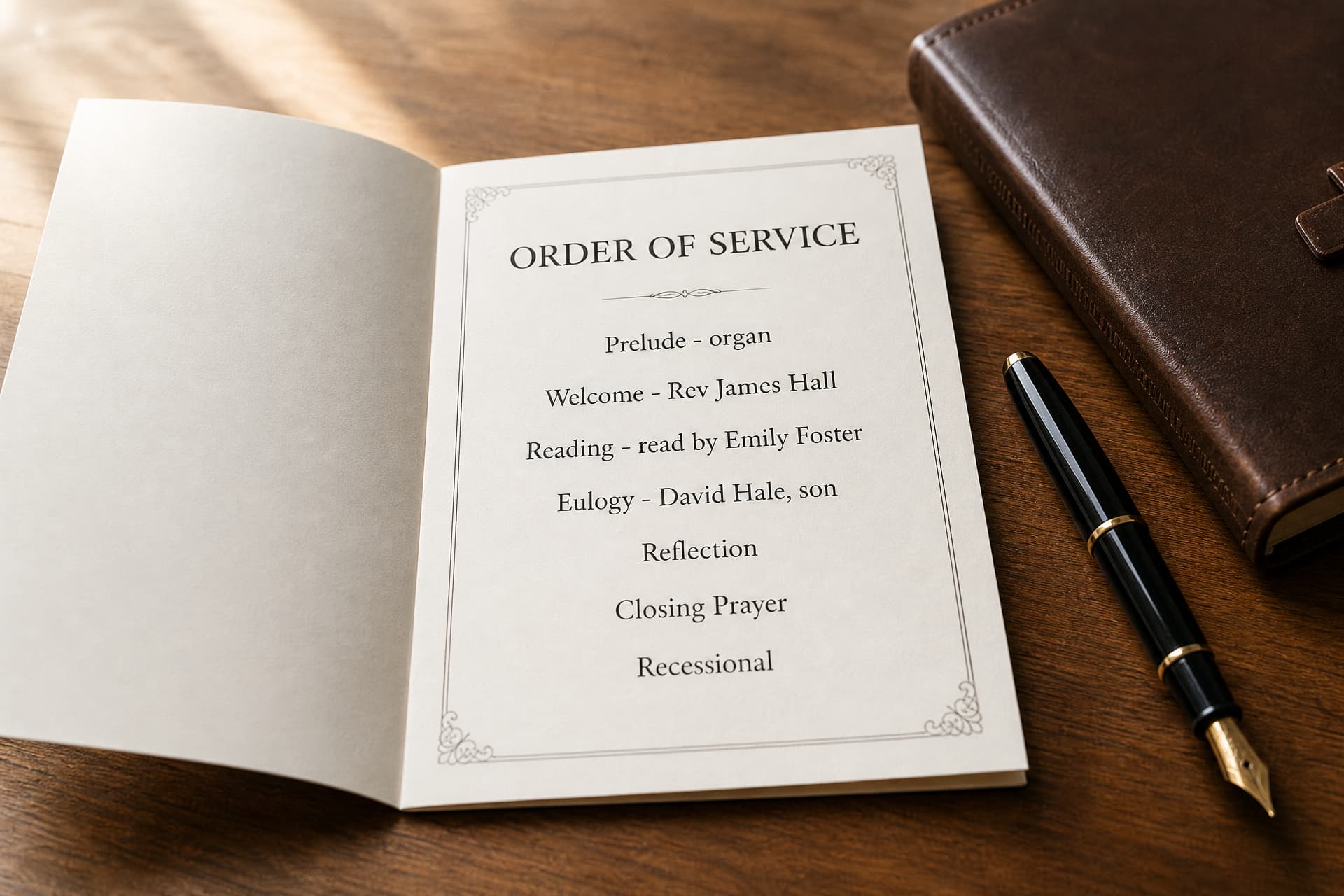
An officiant works from a printed order with the whole service on it, including the parts other people are delivering. The value of the binder is knowing what comes next when something goes off-script — a speaker who cannot finish, a late arrival, a piece of music that will not play.
Who Officiates a Funeral?
Four options, and no hierarchy between them.
Who
When this fits
Typical cost
Clergy
A religious service, or the family belongs to a congregation
An honorarium, often $100–$300
A celebrant
A non-religious or partly religious service, personalized
$150–$500
The funeral director
A short, simple service — many will do this at no extra charge
Often included
A family member or friend
The family wants it in their own voice
Nothing
A funeral celebrant is a trained non-clergy officiant. The training is real but not a legal requirement, and it shows in the meeting rather than the credential — a good celebrant will ask questions about the person that nobody in the family has thought to ask.
Ask the funeral director first. They know every officiant and celebrant working locally, they know who is good with children in the room and who is good with a large crowd, and they will tell you plainly. This is the single most useful question a family can ask them and very few do.
A Funeral Ceremony Script
A funeral officiant script is mostly the joins, and this is the standard shape for a 30-minute service. Adapt the wording; keep the order, because the order is what makes it feel held together.
Part
What the officiant says or does
Time
Gathering music
Nothing. Stands at the front so people know where to look.
5 min
Welcome
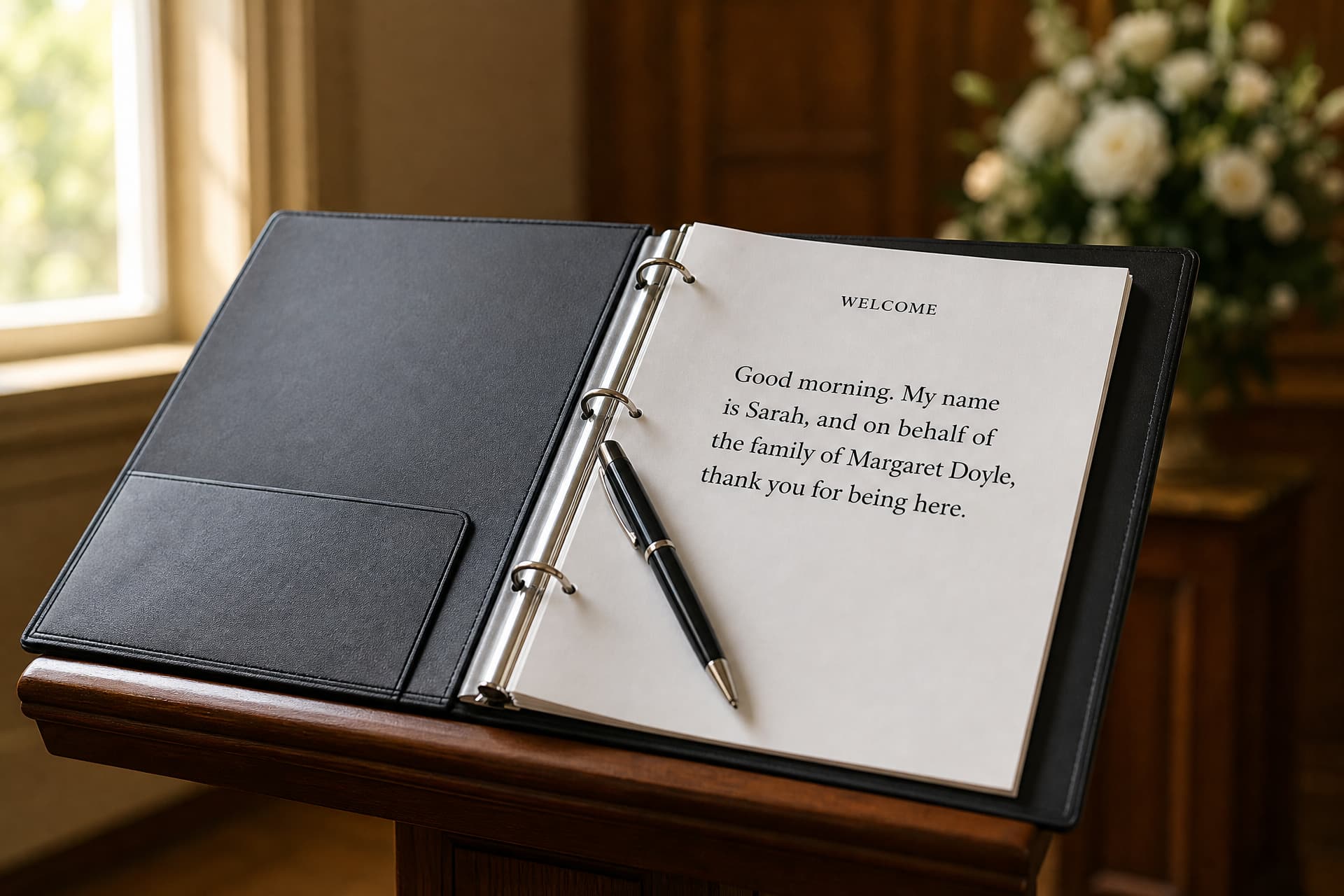
"Good morning. My name is ___, and on behalf of the family of ___, thank you for being here."
1 min
Opening words
"We are here to remember ___, who died on ___, and to be together while we do it."
1 min
Reading or prayer
Introduce the reader by name and their relationship.
3 min
The eulogy
"___ has asked to say a few words about ___." Then sit down.
5 min
Music or silence
"We are going to take a moment now." Say how long it will be.
3 min
Second reading or tribute
Same introduction pattern.
3 min
Reflection
The officiant's own words about the person, drawn from the family meeting.
4 min
Closing words
"___ would have thanked you for coming, so we thank you for them."
1 min
Practical notes
Where the graveside is, where the reception is, and where the restrooms are.
1 min
Recessional
Announces the pallbearers if there are any, then leads out.
3 min
Say the practical notes out loud even though they are printed. People are not reading the program, and a room that does not know where the reception is will stand in a parking lot asking each other.
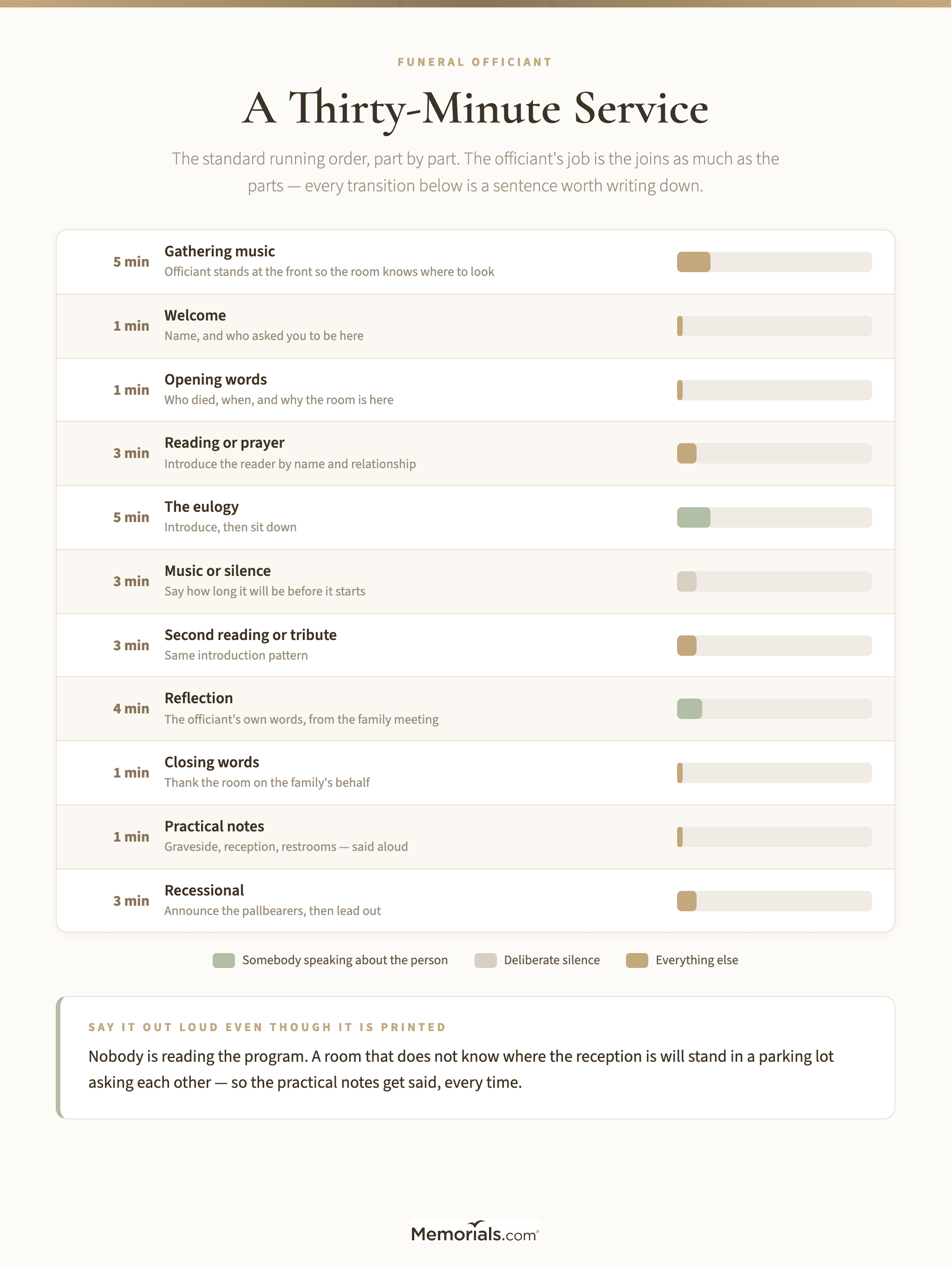
A thirty-minute service, part by part. The eulogy and the officiant's reflection take about a third of it between them; the rest is readings, music and the joins. The two silences are deliberate and should be announced rather than simply allowed to happen.
A Short Funeral Script
For a graveside committal, a cremation with no chapel service, or any service that needs to be twelve minutes rather than thirty. This is the whole thing.
Part
Wording
1
"Thank you all for coming. My name is ___."
2
"We are here to say goodbye to ___, who died on ___."
3
[A reading, a poem, or one minute of the officiant's own words.]
4
"___ will now say a few words." [Optional.]
5
"Let us take a moment of silence together." [Ten to twenty seconds. Say when it ends.]
6
"We commit ___ to their rest, with love and with thanks for the life they lived."
7
"The family invites you to join them at ___."
Nothing in a short funeral script is missing. It is not a lesser version of the full one — a graveside in bad weather with elderly mourners standing is better at twelve minutes than at thirty.
A Celebration of Life Script
The structure changes more than the wording does. A celebration of life is usually longer, less formal, and built around several people speaking rather than one.
Open the same way, then say explicitly what kind of event this is: "This is not a funeral, and ___ was very clear about that."
Invite people to speak from the floor rather than scheduling every speaker — but ask two or three in advance so the first silence is not a real one.
Cap it."We'll hear from a few people, and then there's food." Without a cap the open floor runs forty minutes and ends flat.
Close on something the person actually said, not a reading.
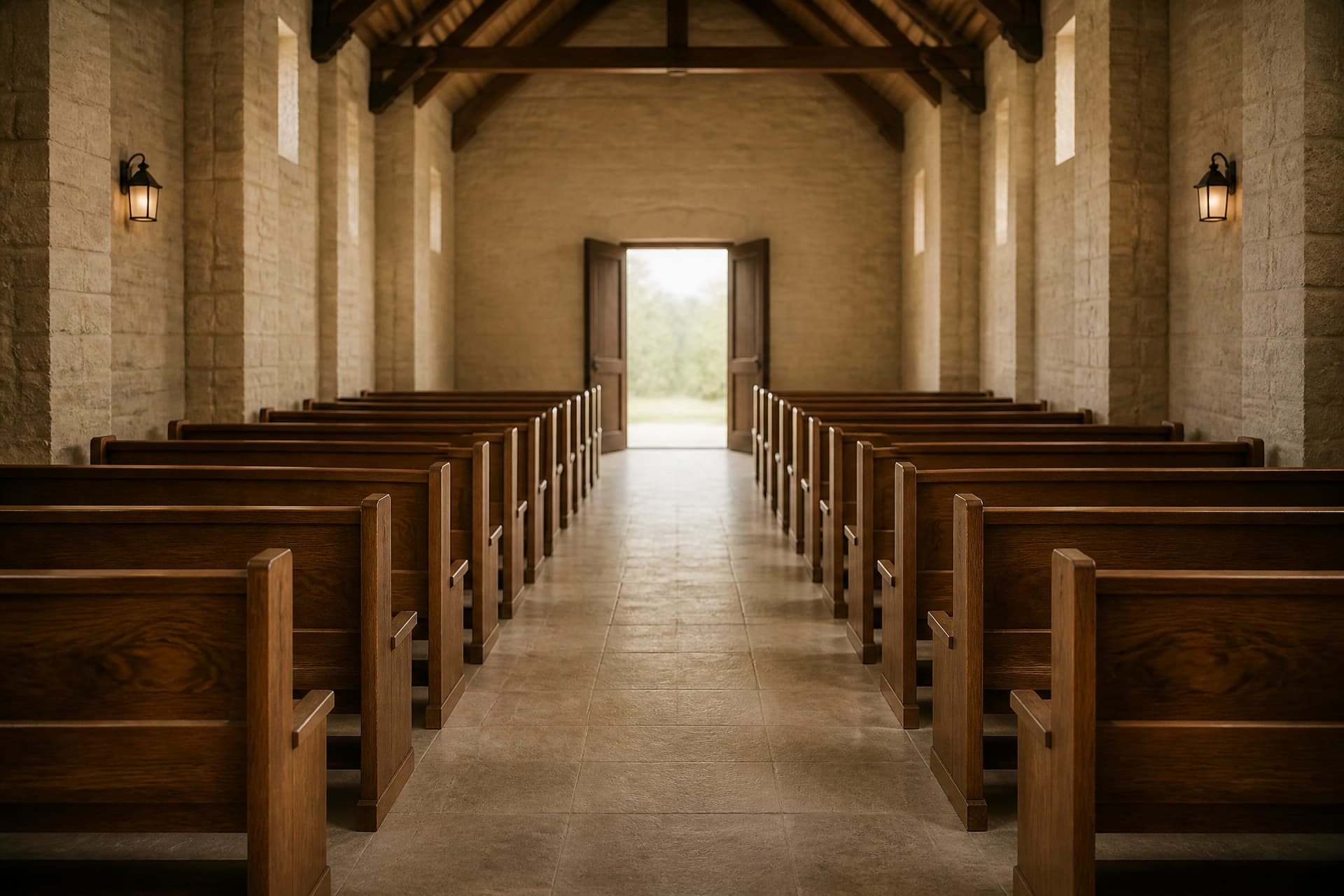
This is the officiant's view, and it is worth standing in it before anyone arrives. What you are checking is where the light falls, whether the back row can hear, and how far the walk to the graveside is — three things nobody thinks about until the service is running.
If a Family Member Is Officiating
Common, entirely allowed, and the version that goes wrong most often — always for the same reason.
Do not also give the eulogy. Leading the service and delivering the eulogy are two different jobs, and the second one is where people break down. An officiant who cannot continue has nobody to hand to. Take the eulogy and give the leading to someone else, or lead and let another person speak.
Write every word, including the links. Experienced officiants improvise the joins; first-timers freeze in them. "Thank you, Sarah. We're going to hear some music now" is a sentence worth having written down.
Agree a signal with the funeral director. They are at the back and they are watching. Establish beforehand what you will do if you need them to step in — a look is enough.
Read it aloud twice, standing. The same rule as a eulogy, and for the same reason: silent reading runs at nearly double speaking pace.
Working With the Family Beforehand
The meeting is where a service is actually made, and a family who knows what to expect from it gets far more out of it.
It usually runs an hour, at the family's house or the funeral home, a day or two after the death. The officiant is there to gather material and to find out what the family wants and does not want said — and the second half of that is the part nobody volunteers.
Say the things that are off limits. An estrangement, a first marriage, an illness the person never discussed publicly, a child who is not coming. An officiant who is told will work around it seamlessly. One who is not told will find it in the middle of the service.
Bring more people than you think you need. Grandchildren produce the material nobody else has, and they are usually the only people in the room not carrying the arrangements. An officiant who gets fifteen minutes with them will come away with the reflection half-written.
Do not prepare. Families sometimes arrive with a typed biography, which is the least useful thing in the room — it is the résumé, and the résumé is what gets cut. Turn up with photographs instead and let the officiant ask.
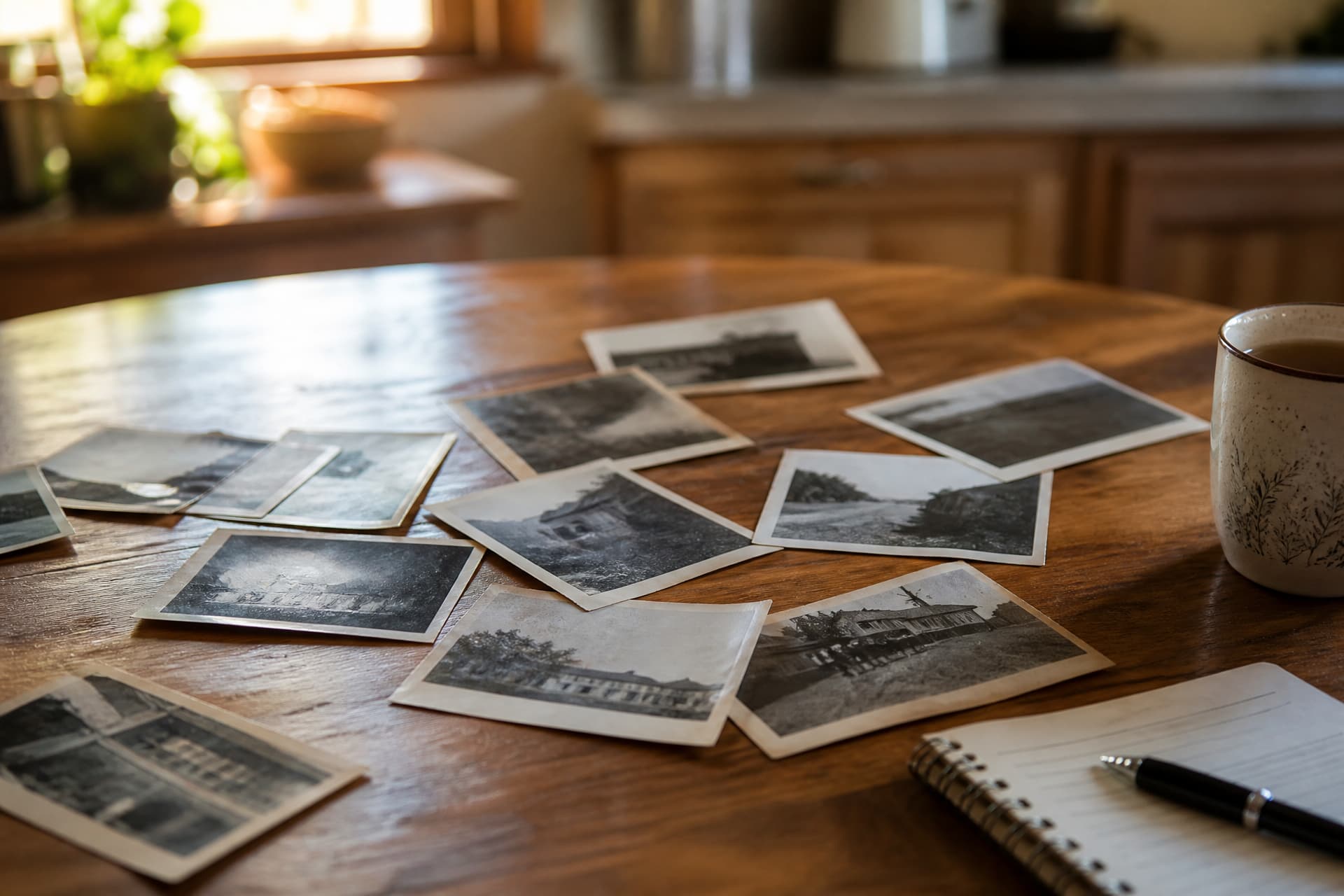
Bring photographs to the family meeting rather than a written biography. A typed résumé is the part an officiant cuts; a shoebox of pictures produces the two stories the reflection is built from, and it gets the quietest people in the room talking.
Be honest about the religion. Half-religious is a completely normal answer and officiants handle it constantly. "Dad wasn't religious but Mom would want the Lord's Prayer" is a sentence they will simply absorb.
Ask to see the draft. Any good officiant will send it. Read it for names, dates and pronunciations rather than for style — a mispronounced name is the error families remember, and it is entirely preventable in an email.
What Officiants Charge
Prices vary by region and by how much preparation the family wants.
Clergy rarely quote a fee. An honorarium of $100 to $300 is customary, given in an envelope through the funeral director.
Independent celebrants usually charge $150 to $500, which covers the family meeting, writing the service, and leading it.
Funeral directors often officiate a simple service at no extra cost, and will say so if asked.
Travel and a graveside committal after a chapel service are sometimes extra. Ask when you book, not afterwards.
If cost is a real constraint, say so plainly to the funeral director. Officiating a service for a family who cannot pay is something most of them have done many times.
The officiant builds this and hands it to whoever is printing, which is why the running order has to be settled before the program goes to press. Names of readers and speakers are the part that changes latest and matters most to get right.
When Things Go Off Script
Every officiant has a short list of things that go wrong, and they are the same things every time. None of them is a disaster if somebody has thought about it in advance.
A speaker cannot finish. The most common one by far. The officiant stands, moves toward them, and takes the page — not with a speech, just "thank you, let me read the rest." Then reads it, hands it back, and carries on. The whole thing takes fifteen seconds and rooms barely register it.
The music does not play. Fill the silence out loud rather than letting the room watch somebody crouched over a laptop: "While we sort this out, I'll tell you what ___ used to say about technology." Have one story held back for exactly this.
Someone arrives late, loudly. Say nothing and do not look. A room takes its cue from the front; if the officiant does not react, nobody else does either.
The service runs long. Cut your own reflection, not anybody else's. It is the only part you control, and it is the part nobody knows was meant to be longer.
A mourner becomes distressed. Keep going. Stopping makes them the subject, which is the opposite of what they want. The funeral director will handle it from the back — this is precisely what they are standing there for.
A name is mispronounced. If you do it, correct it once, plainly, and move on. Do not apologize twice; the second apology is what makes it awkward.
The thread running through all of these is that the room is following the officiant's composure rather than the plan. Almost nothing that goes wrong at a funeral is noticed by people who are not looking for it.
Frequently Asked Questions
Do you need a license to officiate a funeral? No. Unlike a wedding, a funeral has no legal officiant requirement anywhere in the United States.
Who officiates a funeral if the family has no church? A celebrant or the funeral director. Both are entirely normal choices.
How long is a funeral service? Usually 20 to 45 minutes for a chapel service; 10 to 15 for a graveside committal.
Can a friend officiate? Yes, and a friend who knew the person often does it better than a stranger who did not.
What is a funeral celebrant? A trained non-clergy officiant who builds a personalized service. The training is real; the requirement is not.
Is there a funeral script generator? Not one worth using. The short and full scripts on this page are the same thing without the guessing — copy either and fill in the names.
Who speaks first at a funeral? The officiant, always. They set the tone and tell the room what is about to happen.
A Religious Service With a Non-Religious Family
This comes up constantly and families rarely say it out loud, so it is worth naming: the person who died was religious and the people burying them are not, or the reverse.
An officiant handles this by separating what the service does from what it claims. A reading from scripture read as a poem lands entirely differently from one introduced as doctrine, and both are honest. "___ read this every Sunday for sixty years, and I'd like to read it now" is a sentence that works in a room of any belief or none.
Two practical routes. Split the roles — clergy for a committal at the graveside, a celebrant or family member for the service itself. This is common and no clergy member will be offended by it. Or name the difference in the welcome: "Mom was a churchgoer all her life and most of us here aren't, and she knew that perfectly well." Rooms relax at that sentence, because it tells them the thing they were quietly worried about has been noticed.
What does not work is a service that hedges — vaguely spiritual language chosen to offend nobody, which lands as a service about nobody. Pick the person's own tradition or pick plain speech, and commit to it.
If the family is Catholic, the structure is fixed and the officiant is a priest — how to plan a Catholic funeral covers what is and is not adjustable.
In Short
Anyone may lead a funeral, and the person who knew them is often the right one. Use the running order above, write the joins as well as the parts, say the practical notes aloud, and do not give the eulogy if you are also leading.
If you are choosing rather than doing it, ask the funeral director who they would recommend. It is the question that gets the best answer and almost nobody asks it.