🏬Supersize Online Funeral Retailer🪦1000's of Headstones⚱️Over 10,000 Cremation Urns⚰️Caskets Overnight Delivery🛒Funeral & Memorial Superstore🚚FREE Shipping on ALL Orders👨👩👧👦Helping Families for over 20 Years💰Lowest Price Guarantee🏬Supersize Online Funeral Retailer🪦1000's of Headstones⚱️Over 10,000 Cremation Urns⚰️Caskets Overnight Delivery🛒Funeral & Memorial Superstore🚚FREE Shipping on ALL Orders👨👩👧👦Helping Families for over 20 Years💰Lowest Price Guarantee
🏬Supersize Online Funeral Retailer🪦1000's of Headstones⚱️Over 10,000 Cremation Urns⚰️Caskets Overnight Delivery🛒Funeral & Memorial Superstore🚚FREE Shipping on ALL Orders👨👩👧👦Helping Families for over 20 Years💰Lowest Price Guarantee🏬Supersize Online Funeral Retailer🪦1000's of Headstones⚱️Over 10,000 Cremation Urns⚰️Caskets Overnight Delivery🛒Funeral & Memorial Superstore🚚FREE Shipping on ALL Orders👨👩👧👦Helping Families for over 20 Years💰Lowest Price Guarantee
Embalming: Process, Cost & What Families Should Know | Memorials.com Info Center
🏬Supersize Online Funeral Retailer🪦1000's of Headstones⚱️Over 10,000 Cremation Urns⚰️Caskets Overnight Delivery🛒Funeral & Memorial Superstore🚚FREE Shipping on ALL Orders👨👩👧👦Helping Families for over 20 Years💰Lowest Price Guarantee🏬Supersize Online Funeral Retailer🪦1000's of Headstones⚱️Over 10,000 Cremation Urns⚰️Caskets Overnight Delivery🛒Funeral & Memorial Superstore🚚FREE Shipping on ALL Orders👨👩👧👦Helping Families for over 20 Years💰Lowest Price Guarantee
Embalming is the process of chemically preserving a deceased person's body to slow decomposition, restore a natural appearance, and allow time for funeral services and visitation. For many families, understanding what embalming involves — and whether it is the right choice — is an important part of planning a cremation or traditional burial service. This guide walks through everything you need to know: how embalming works step by step, what it costs, how long it lasts, and the questions families ask most often.
What Is Embalming? Definition and Meaning
Embalming is the treatment of a deceased human body with chemical solutions — primarily formaldehyde-based fluids — to temporarily delay decomposition. The word itself comes from the practice of applying balms and preservative substances to the dead, a tradition that dates back thousands of years to ancient Egypt and beyond.
In modern funeral practice, embalming serves three primary purposes: sanitization (killing bacteria and pathogens to make the body safe for handling), preservation (slowing the natural breakdown of tissues), and presentation (restoring a peaceful, lifelike appearance for viewing). A licensed embalmer — someone trained in mortuary science, anatomy, chemistry, and thanatochemistry — performs the procedure at a funeral home.
Embalming is most commonly chosen when a family plans an open-casket funeral or public visitation, when the body needs to be transported a long distance, or when there will be a delay between death and final disposition. It is not a permanent solution — embalming slows decomposition but does not stop it entirely.
A Brief History of Embalming
The practice of preserving the dead stretches back to at least 5000 BCE, when the Chinchorro people of present-day Chile performed some of the earliest known artificial mummification. The ancient Egyptians refined embalming into an elaborate art, removing internal organs, treating the body with natron salts, and wrapping it in linen to prepare the deceased for the afterlife.
For much of European history, embalming was uncommon. Bodies were typically buried soon after death, and preservation was primarily a concern of anatomists during the Renaissance who needed specimens for study. Leonardo da Vinci is believed to have used embalming techniques to preserve cadavers for his anatomical drawings.
Modern embalming as we know it took shape during the American Civil War. Families in the North wanted their soldiers' remains returned from Southern battlefields for burial at home, and battlefield embalmers developed techniques to preserve bodies during long-distance transport. The discovery of formaldehyde in 1867 by chemists Alexander Butlerov and August Wilhelm von Hofmann replaced earlier arsenic- and alcohol-based methods and became the foundation of the embalming profession that continues today.
How the Embalming Process Works: Step by Step
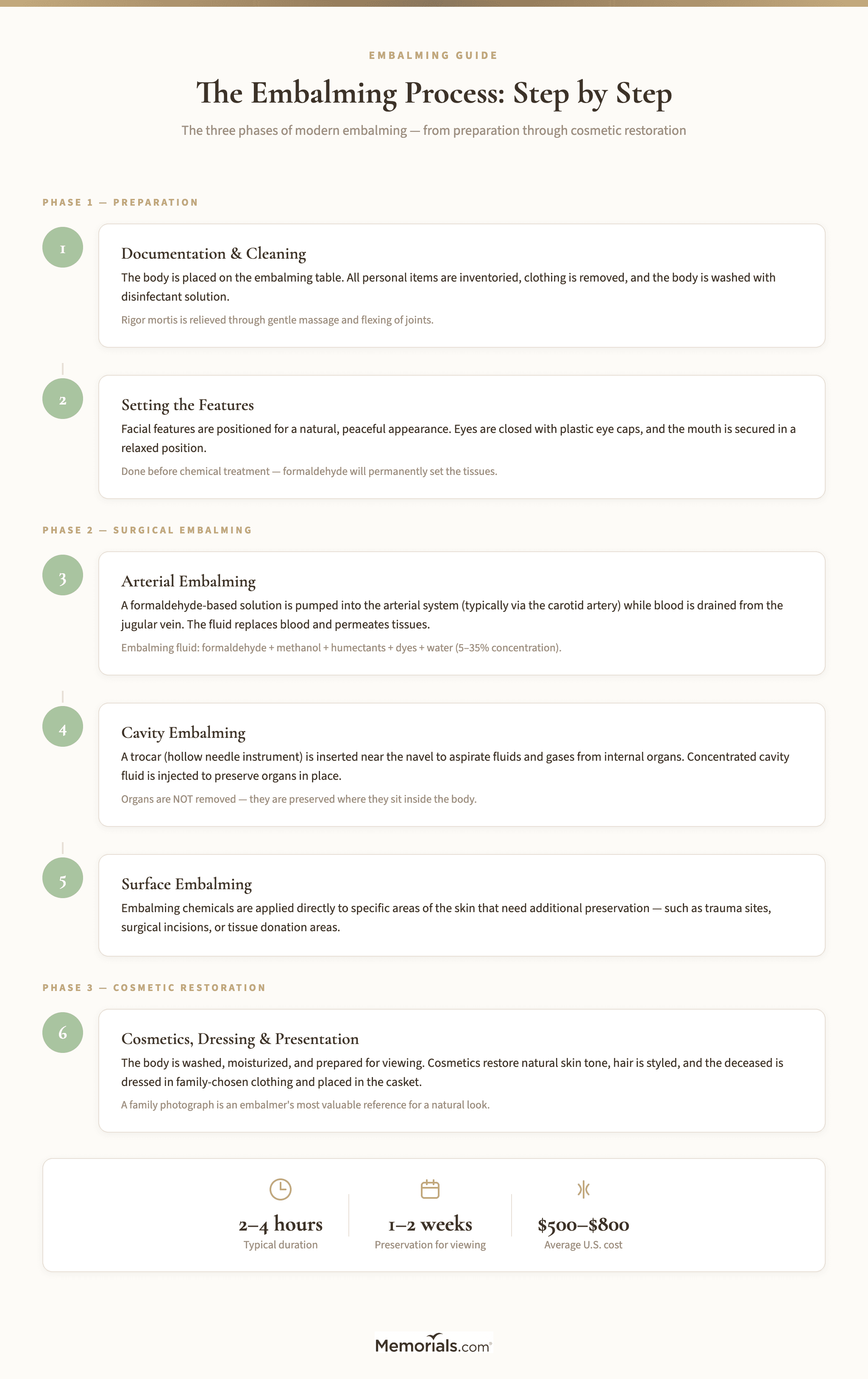
The modern embalming process involves three distinct phases — preparation, surgical embalming, and cosmetic restoration. The entire procedure typically takes two to four hours, though it may take longer depending on the condition of the body and any restorative work that is needed.
Step 1: Preparation and Positioning
When a body arrives at the funeral home, the embalmer completes an embalming report documenting any personal items, jewelry, visible marks, discolorations, or medical devices. All clothing, bandages, IV lines, and catheters are removed.
The body is placed face-up on a stainless steel embalming table and washed thoroughly with a disinfectant solution. If rigor mortis has set in — the natural stiffening of muscles that occurs within hours of death — the embalmer relieves it by gently flexing and massaging the joints and limbs.
Step 2: Setting the Features
Before any chemical treatment begins, the embalmer sets the facial features in the position they will hold during viewing. This step is done first because the formaldehyde solution will firm the tissues permanently once it reaches them.
The eyes are closed using small plastic eye caps placed over each eyeball, with a thin layer of adhesive cream to hold the lids in place. The mouth is closed and the jaw is secured, either by suturing through the gums and nasal septum or by using a needle injector gun that places small wires to hold the jaw in a natural, relaxed position. If the deceased is a man, facial hair is shaved unless the family requests otherwise.
Step 3: Arterial Embalming
Arterial embalming is the core of the procedure. The embalmer makes a small incision — typically at the carotid artery and jugular vein in the neck, or at the femoral artery and vein in the upper thigh. A formaldehyde-based embalming solution is pumped into the arterial system using a specialized embalming machine that carefully monitors pressure and flow rate.
As the preservation fluid enters the arteries and travels through the body's circulatory system, blood is simultaneously drained from the corresponding vein. The embalmer massages the body throughout this process to ensure even distribution of the fluid, relieve discoloration, and keep the skin and hands feeling soft and natural. The solution replaces the blood and permeates the tissues, preserving them from the inside out.
The embalming fluid itself is a mixture of formaldehyde (the primary preservative), methanol, glutaraldehyde, humectants that prevent tissue dehydration, dyes to restore natural skin tone, and water. Formaldehyde concentration varies from case to case — typically ranging from 5% to 35% depending on the body's condition and the embalmer's assessment.
In some areas where the fluid may not fully reach through the vascular system, the embalmer uses a hypodermic needle to inject embalming solution directly into the tissue. This ensures thorough preservation even in cases of compromised circulation.
Step 4: Cavity Embalming
After arterial embalming is complete, the embalmer turns to the body's internal organs. A small incision is made near the navel, and a sharp, hollow instrument called a trocar is inserted into the abdominal and thoracic cavities.
The trocar is used to aspirate — suction out — fluids and gases from the stomach, bladder, lungs, and large intestines. Once aspiration is complete, a concentrated cavity fluid (a stronger formaldehyde solution) is injected into the torso through the same opening to preserve the internal organs in place. The incision is then closed with sutures or a trocar button.
Step 5: Surface Embalming
Surface embalming addresses specific areas of the body's exterior that may need additional preservation. This technique involves applying embalming chemicals directly to the skin surface and is commonly used on areas affected by trauma, surgical incisions, skin ulcers, or tissue donation sites. The embalmer may apply gel-based or cream-based embalming compounds and seal them with plastic wrap to allow extended contact.
Step 6: Cosmetic Preparation and Dressing
The final stage of embalming is often called restoration or presentation. The embalmer's goal is to create a peaceful, natural appearance that gives the family comfort during viewing.
The body is washed again, and moisturizer is applied to prevent dehydration of the skin. Cosmetics are carefully applied to restore natural skin color, conceal any discoloration, and match the person's living appearance as closely as possible — a photograph provided by the family is an invaluable reference. Hair is washed, dried, and styled. Nails may receive attention as well.
Finally, the deceased is dressed in clothing chosen by the family and positioned in the casket for viewing. The embalmer adjusts lighting and positioning to ensure the person looks as natural and peaceful as possible.
Are Organs Removed During Embalming?
This is one of the most common questions families ask, and the answer is no — organs are not removed during modern embalming. Unlike the ancient Egyptian practice of removing and separately preserving internal organs in canopic jars, today's embalming preserves the organs in place within the body cavity.
During cavity embalming, the trocar punctures the organs to aspirate fluids and gases, and then concentrated preservative fluid is injected to treat them where they sit. The organs remain inside the body throughout the entire process.
The one exception involves cases where an autopsy has been performed prior to embalming. During an autopsy, the medical examiner removes internal organs for examination and weighing. After the autopsy is complete, the organs are returned to the body cavity (often in a bag with preservative powder), and the embalmer then proceeds with the standard embalming process. The same applies if the deceased was an organ donor — donated organs are removed before the body reaches the funeral home, and the embalmer works with the body as it is received.
Embalming Cost: What Families Can Expect
Embalming is a separate line item on most funeral home invoices. According to industry data, the average embalming fee in the United States ranges from approximately $500 to $800, though costs can be higher in major metropolitan areas or in cases requiring extensive restorative work.
The Federal Trade Commission's Funeral Rule requires all funeral homes to provide an itemized price list, so families can see exactly what embalming costs before agreeing to the service. Embalming is never required to be bundled with other services.
For families weighing total costs, embalming is one component within a broader funeral cost breakdown. A traditional funeral with embalming, viewing, and burial typically costs significantly more than direct cremation or other simplified arrangements. Understanding the full picture helps families make informed financial decisions during a difficult time.
It is worth noting that some funeral homes include embalming in their basic service packages, while others list it as an optional add-on. Always ask for the itemized General Price List (GPL) before making any decisions.
How Long Does Embalming Last?
Embalming is designed to temporarily preserve the body — primarily to allow enough time for funeral services, visitation, and burial. It is not intended as a permanent preservation method.
Under typical conditions, an embalmed body maintains a suitable appearance for approximately one to two weeks after the procedure. This gives families adequate time to plan services, allow out-of-town relatives to travel, and hold a viewing or open-casket funeral.
Several factors affect how long the preservation lasts. The condition of the body before embalming matters — a healthy body that is embalmed soon after death will preserve better than one affected by illness, trauma, or significant decomposition. The strength and formulation of the embalming chemicals play a role, as does the skill of the embalmer. Environmental conditions — temperature, humidity, and whether the body is stored in a climate-controlled environment — also influence how long the effects hold.
After burial, the timeline varies widely. In a sealed casket within a burial vault, an embalmed body may remain largely intact for several years, though eventually all organic matter decomposes. Cool, dry burial conditions slow the process; warm, wet soil accelerates it. Famous examples of long-term preservation — such as the embalmed remains of political leaders displayed for decades — require periodic re-embalming and carefully controlled environments.
Is Embalming Required by Law?
In most of the United States, embalming is not required by law. No federal law mandates embalming, and the Federal Trade Commission's Funeral Rule explicitly states that funeral homes cannot tell families that embalming is required by law unless it actually is in their state for their specific situation.
There are some circumstances where embalming may be legally required or practically necessary. Most states require embalming or refrigeration if the body is not buried or cremated within a certain timeframe — typically 24 to 48 hours, though this varies by state. Some states require embalming when remains are transported across state lines or by common carrier (such as airlines). International repatriation of remains almost always requires embalming.
Many funeral homes have their own policies requiring embalming for open-casket viewings or visitation services. This is a business policy, not a legal requirement, and families should be aware of the distinction. If a family chooses not to embalm, refrigeration is the primary alternative for short-term preservation, keeping the body at approximately 36°F (2°C) to slow decomposition.
For families considering cremation, embalming is generally unnecessary. Understanding how the cremation process works can help clarify why — the body is cremated relatively quickly, and there is typically no need for long-term preservation. That said, if a family wants to hold a viewing before cremation, embalming or refrigeration may still be needed.
Embalming vs. Cremation: Understanding Your Options
Families facing end-of-life decisions often weigh embalming and traditional burial against cremation. These are not mutually exclusive — a body can be embalmed and later cremated — but they represent different approaches to caring for a loved one's remains.
Embalming is most commonly associated with traditional burial services that include a viewing, funeral ceremony, and interment. The process preserves the body for a period of days or weeks, allowing families to hold a visitation where friends and loved ones can see the deceased one last time. For many families, this final viewing is an important part of the grieving process.
Cremation, on the other hand, reduces the body to cremated remains (ashes) through intense heat. It is typically less expensive than traditional burial, and it offers flexibility in how remains are memorialized — from placement in an urn to scattering to incorporation into cremation jewelry. Families comparing cremation and burial consider factors including cost, environmental impact, cultural and religious beliefs, and personal preference.
Some situations require embalming regardless of the family's plans. There are certain cremation restrictions and rules that may delay the timeline, and in those cases, embalming or refrigeration may be necessary to preserve the body in the interim.
Alternatives to Embalming
Not every family chooses embalming, and several alternatives exist for preserving or caring for a body before disposition.
Refrigeration is the most common alternative. Funeral homes store the body in a temperature-controlled cooler at approximately 36–39°F (2–4°C). Refrigeration can preserve a body adequately for three to four weeks, making it suitable for most funeral timelines without the use of chemicals.
Dry ice is sometimes used for home vigils or viewings held outside a funeral home setting. Blocks of dry ice placed around the body can keep it cool for several days, though this requires regular replenishment and careful handling.
Green or formaldehyde-free embalming uses plant-based or non-toxic preservation fluids instead of traditional formaldehyde solutions. This option appeals to families planning natural or green burials, where conventional embalming chemicals would not be permitted in the burial ground.
Immediate burial or cremation — some families choose to forgo preservation entirely and proceed with disposition as soon as legally permitted, usually within 24 to 48 hours. Direct cremation and direct burial are the simplest and typically least expensive options.
What Happens to an Embalmed Body Over Time?
After embalming, the body is in a temporarily preserved state. The formaldehyde solution has hardened the tissues, killed bacteria, and dehydrated the cells — all of which slow the natural decomposition process. But embalming does not halt decomposition permanently.
In the days following embalming, the body maintains a natural appearance suitable for viewing. Over weeks and months, gradual changes begin even in an embalmed body — subtle changes in skin texture, firmness, and color may develop, though these are generally not visible through clothing in a sealed casket.
After burial, the long-term timeline depends on burial conditions. A body in a sealed casket inside a concrete or metal burial vault in cool, dry soil may remain largely intact for years or even decades. A body buried without a vault in moist, warm soil will decompose more quickly, potentially within a few years. Eventually, all embalmed remains return to the earth.
Frequently Asked Questions
Does embalming hurt the deceased? No. Embalming is performed after death and the deceased cannot feel anything. The process is carried out with care and respect by trained, licensed professionals.
Can you have an open casket without embalming? Yes, though it depends on timing and conditions. If the funeral is held within a day or two of death and the body is refrigerated, a viewing without embalming is possible. Many funeral homes prefer embalming for open-casket services, but it is their policy — not typically a legal requirement.
How long after death can a body be embalmed? Embalming should ideally begin as soon as possible after death — typically within 24 to 48 hours. The sooner embalming occurs, the better the preservation results. Bodies that have begun to decompose can still be embalmed, but the process becomes more difficult and the results may be less natural.
Is embalming bad for the environment? Traditional embalming uses formaldehyde, which is classified as a probable human carcinogen. Over time, embalming chemicals can leach from buried remains into surrounding soil and groundwater. Green embalming alternatives using non-toxic, biodegradable fluids offer a lower environmental impact for families who are concerned about this issue.
What color is embalming fluid? Embalming fluid is typically a clear or slightly tinted liquid in its concentrated form. Dyes are often added to give the fluid a pink or reddish hue, which helps restore natural skin coloring as the fluid circulates through the body's tissues.
How long does an embalmed body last in a casket? The answer varies widely depending on casket type, burial vault, soil conditions, and climate. In a sealed casket with a burial vault in dry conditions, an embalmed body may remain largely intact for decades. Without a vault in warm, moist soil, significant decomposition may occur within a few years.
A gentle note: if you or your family are making decisions about embalming, your funeral director is your best resource. They can walk you through the options, explain costs, and help you choose the approach that best honors your loved one.