🏬Supersize Online Funeral Retailer🪦1000's of Headstones⚱️Over 10,000 Cremation Urns⚰️Caskets Overnight Delivery🛒Funeral & Memorial Superstore🚚FREE Shipping on ALL Orders👨👩👧👦Helping Families for over 20 Years💰Lowest Price Guarantee🏬Supersize Online Funeral Retailer🪦1000's of Headstones⚱️Over 10,000 Cremation Urns⚰️Caskets Overnight Delivery🛒Funeral & Memorial Superstore🚚FREE Shipping on ALL Orders👨👩👧👦Helping Families for over 20 Years💰Lowest Price Guarantee
🏬Supersize Online Funeral Retailer🪦1000's of Headstones⚱️Over 10,000 Cremation Urns⚰️Caskets Overnight Delivery🛒Funeral & Memorial Superstore🚚FREE Shipping on ALL Orders👨👩👧👦Helping Families for over 20 Years💰Lowest Price Guarantee🏬Supersize Online Funeral Retailer🪦1000's of Headstones⚱️Over 10,000 Cremation Urns⚰️Caskets Overnight Delivery🛒Funeral & Memorial Superstore🚚FREE Shipping on ALL Orders👨👩👧👦Helping Families for over 20 Years💰Lowest Price Guarantee
Cremation Planning Guide: Process, Costs, Options & What to Expect
cremation
Cremation has become the most common form of final disposition in the United States. The National Funeral Directors Association reports that the national cremation rate now exceeds 60 percent, and projections suggest it will surpass 80 percent by 2040. Families choosing cremation face a series of decisions that can feel overwhelming — from understanding what actually happens during the process to comparing costs, navigating religious considerations, and deciding what to do with cremated remains afterward.
This cremation planning guide walks through every major decision point in the cremation journey. Each section provides an overview and then links to a dedicated in-depth article where you can explore that topic further. Whether you are planning ahead for yourself, making arrangements for a loved one who has just passed, or simply researching your options, this guide is designed to give you clarity and confidence at every step.
What Is Cremation?
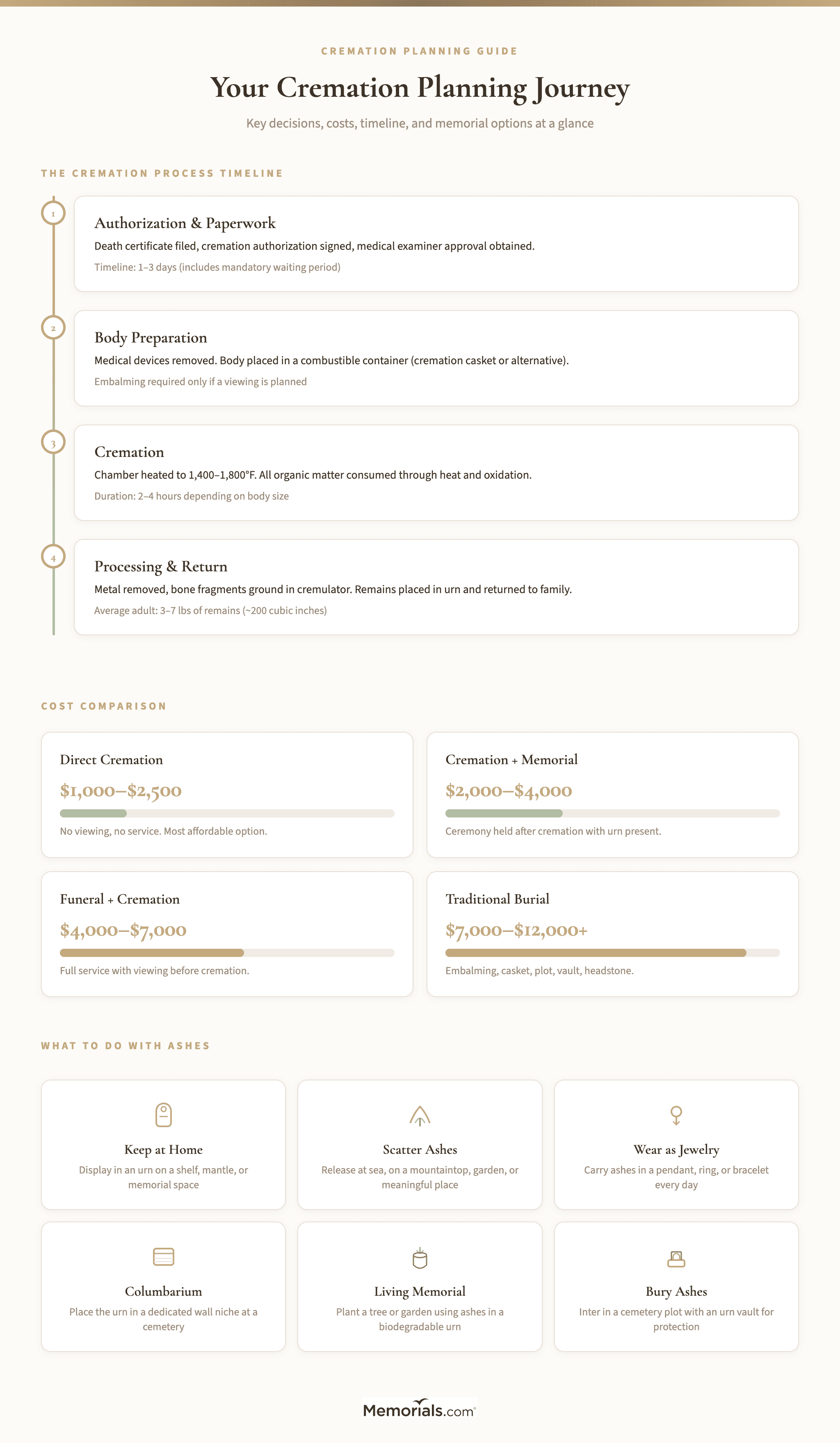
Cremation is the process of reducing a human body to its essential mineral components through intense heat. The body is placed inside a combustible container and transferred into a cremation chamber — also called a retort — where temperatures between 1,400°F and 1,800°F are sustained for two to four hours. All soft tissue is consumed through a combination of evaporation and oxidation. What remains are brittle bone fragments, which are then processed through a machine called a cremulator and ground into a coarse, sand-like consistency that families receive as cremated remains.
The entire process, from the moment the body enters the chamber to the time the family receives the remains, typically takes five to ten business days. Most of that wait is due to legal requirements — obtaining a death certificate, securing cremation authorization from a medical examiner, and observing state-mandated waiting periods of 24 to 72 hours.
For a detailed, step-by-step walkthrough of exactly what happens from start to finish, see our guide on what the cremation process involves.
The Cremation Process Step by Step
Understanding the cremation procedure helps families feel more prepared. Here is a condensed overview:
Identification and Authorization. A family member confirms the identity of the deceased. Legal paperwork — including the death certificate and cremation authorization — must be completed and signed before the crematory can proceed.
Body Preparation. Medical devices such as pacemakers and battery-operated implants are removed for safety. The body is placed in a rigid, combustible container. This does not need to be an expensive casket — cardboard alternative containers and simple wood containers satisfy this requirement.
Cremation. The container enters the cremation chamber. At temperatures between 1,400°F and 1,800°F, all organic matter is consumed. The process takes two to four hours depending on body size.
Processing. After cooling, metal remnants (surgical screws, joint replacements, dental work) are removed by hand and magnet. Remaining bone fragments enter the cremulator, which grinds them to a uniform granular consistency. This takes one to three hours.
Return of Remains. The processed cremated remains — typically three to seven pounds for an average adult — are placed in the urn the family provides or a temporary container. The urn or container is returned to the family.
Not everyone is eligible for cremation under all circumstances. Medical examiner holds, active criminal investigations, and certain state-specific restrictions can delay or prevent cremation. Our article on who cannot be cremated covers the rules, restrictions, and exceptions families should know about.
If you are curious about the physical characteristics of what families receive — color, texture, weight, and composition — our cremation weight guide explains how body size translates to ash volume and what the "one cubic inch per pound" sizing rule means in practice.
Cremation vs. Burial: How to Decide
The choice between cremation and burial is deeply personal and shaped by cultural traditions, religious beliefs, family preferences, and financial circumstances. Neither option is inherently better — the right choice is the one that honors the wishes of the person who passed and brings comfort to those left behind.
Cost. Cremation is generally less expensive than traditional burial. Direct cremation — cremation without a preceding funeral service — typically costs $1,000 to $2,500. A traditional funeral followed by burial can range from $7,000 to $12,000 or more when factoring in embalming, a casket, cemetery plot, vault, and headstone.
Flexibility. Cremation allows families to take time before deciding on a permanent memorial. Ashes can be kept at home, scattered, divided among family members, placed in a columbarium niche, or buried at a later date. Burial, by contrast, requires immediate decisions about cemetery selection, casket, and vault.
Portability. Families who relocate can bring cremated remains with them. A burial site is permanent and fixed to one location.
Environmental Considerations. Cremation eliminates the need for embalming chemicals, metal caskets, and concrete vaults. A single cremation does consume energy and produces some emissions, but the overall environmental footprint is smaller than maintaining a permanent burial site.
Cost is one of the most important factors families weigh when planning cremation. Here is a general breakdown:
Direct cremation (no viewing, no funeral service, no embalming): $1,000–$2,500. This is the most affordable cremation option. For a complete breakdown of what direct cremation includes and how to find reputable providers, see our direct cremation guide.
Cremation with memorial service (no embalming or viewing, but a ceremony after cremation): $2,000–$4,000.
Full funeral service followed by cremation (viewing, embalming, funeral ceremony, then cremation): $4,000–$7,000+.
Traditional burial with full funeral (embalming, casket, viewing, cemetery plot, vault, headstone): $7,000–$12,000+.
Those are national ranges, and the state you are in moves them more than most families expect. Our research into what cremation costs in each state reads the published price lists in all fifty and gives a median and a range for each.
One of the most effective ways to reduce costs is to purchase memorial products independently. Funeral homes frequently apply substantial markups to urns for ashes and other merchandise. Under the Federal Trade Commission's Funeral Rule, families have every legal right to provide their own urn, and doing so can save hundreds of dollars.
For a complete breakdown of every expense associated with end-of-life services — from transportation fees and facility charges to casket costs and cemetery fees — see our funeral cost breakdown. Families considering prepayment options to lock in today's prices may also want to explore whether burial insurance is worth it as a financial planning tool.
Religious Perspectives on Cremation
Religious beliefs play a significant role in many families' cremation decisions. Major faith traditions hold a range of views:
Christianity. The Roman Catholic Church permits cremation but expresses a preference for burial and requires that cremated remains be kept in a sacred place rather than scattered or divided. Most Protestant denominations leave the choice entirely to individual families. The history of Christian cremation practice is complex — for a thorough exploration of scriptural references and denominational positions, see our guide on what the Bible says about cremation. Families asking the specific question of whether their faith permits it can find answers in our article on whether Christians can be cremated.
Judaism. Orthodox Judaism generally prohibits cremation, viewing it as a desecration of the body. Reform and Conservative Judaism have become more accepting, though burial remains the traditional preference. Our article on Jewish views on cremation explores the theological reasoning and how different denominations approach the question today.
Islam. Islamic tradition prohibits cremation, requiring burial as soon as possible after death.
Hinduism, Buddhism, Sikhism. These traditions consider cremation a sacred or preferred practice, often viewed as a release of the soul from the physical body.
Understanding your faith tradition's position can bring peace of mind and help resolve family disagreements about the right path forward.
What Happens to Ashes After Cremation
Once you receive cremated remains, you have more options than most people realize. Here are the most common paths:
Keeping ashes at home. Many families display an urn on a mantelpiece, shelf, or dedicated memorial space. There is no federal law prohibiting keeping cremated remains in your home indefinitely.
Placing ashes in a columbarium. A columbarium is a structure with individual niches designed to hold urns. Many cemeteries and churches offer columbarium spaces as an alternative to in-ground burial.
Burying ashes in a cemetery. Cremated remains can be buried in a standard cemetery plot or a smaller cremation garden. Many cemeteries require an urn vault for in-ground placement to prevent ground settling.
Scattering ashes. Scattering remains in a meaningful location — the ocean, a mountaintop, a garden, or a favorite park — is a beautiful and increasingly popular choice. Laws vary by state and municipality, so it is important to understand the regulations before proceeding. Our guide on scattering ashes laws and etiquette covers federal, state, and local requirements. For families planning a scattering ceremony, our article on what to say when scattering ashes offers readings, prayers, and ceremony ideas. And for those wondering about the scriptural perspective, we cover what the Bible says about scattering ashes as well.
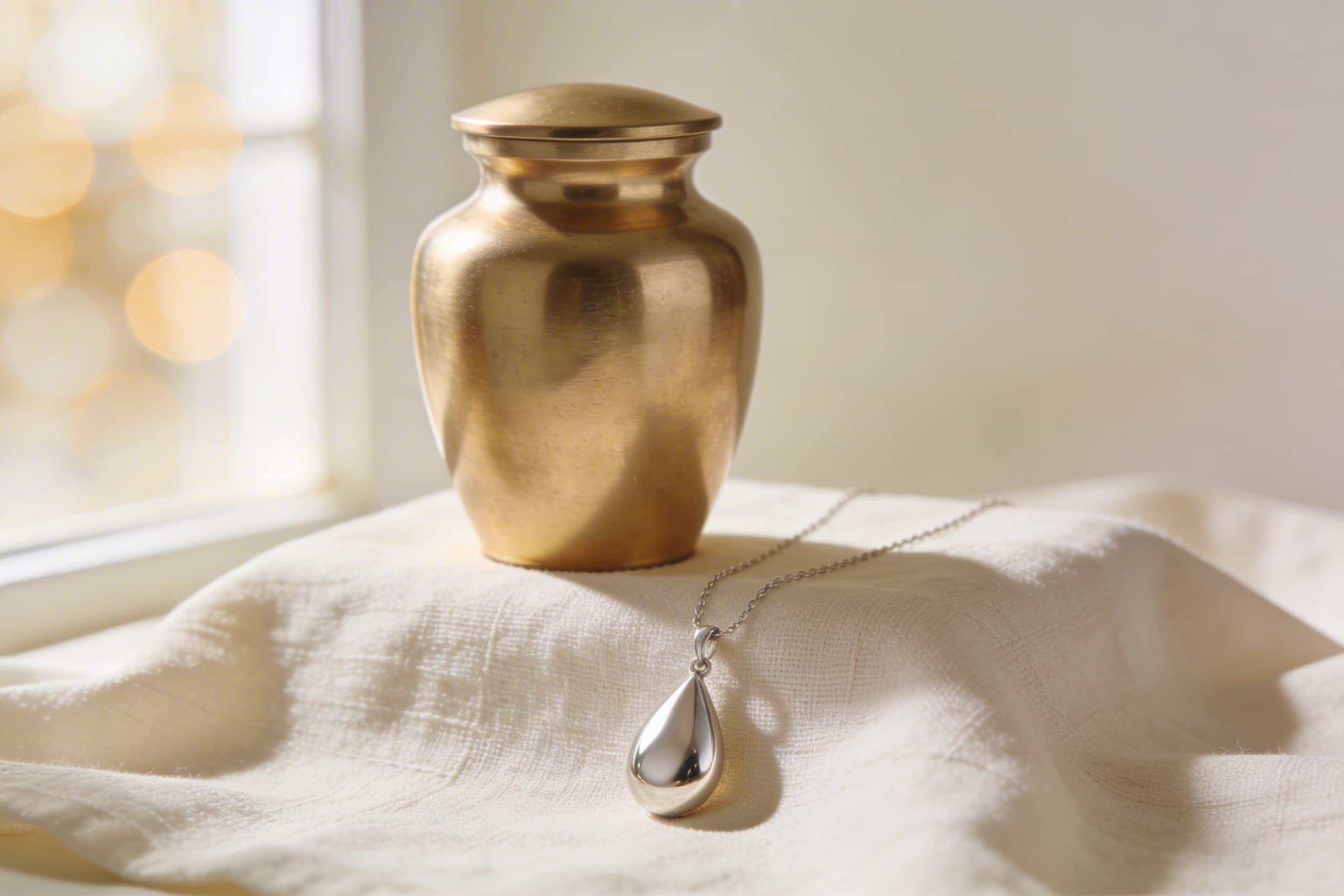
Wearing ashes as jewelry.Cremation jewelry allows you to carry a small portion of ashes in a pendant, ring, or bracelet — a discreet and portable way to keep your loved one close every day. For a complete overview of the cremation jewelry category, see our cremation jewelry guide.
Dividing ashes among family members.Keepsake urns hold a small portion of remains, allowing multiple family members to each keep a memorial. This is increasingly common and widely accepted.
Families also need to handle ashes with care and respect. Our article on disrespectful things to do with ashes provides practical guidance on what to avoid and why, helping families navigate this sensitive topic with dignity.
For a comprehensive look at all disposition options, our guide to human ashes covers the composition of cremated remains, handling, storage, travel regulations, and every memorialization method available.
Eco-Friendly Cremation Alternatives
Environmental concerns are increasingly influencing end-of-life decisions. Standard flame-based cremation consumes natural gas and produces carbon emissions, leading many families to explore greener alternatives.
Aquamation (alkaline hydrolysis). Also called water cremation, this process uses warm water and an alkaline solution instead of flame to reduce the body to bone fragments. It uses roughly one-tenth the energy of traditional cremation and produces no direct emissions. The resulting remains have a finer, whiter texture. Availability varies by state. Our full guide on aquamation and water cremation covers how it works, what it costs, and where it is currently legal.
Mushroom burial. Mushroom coffins and mushroom burial suits use mycelium — the root structure of mushrooms — to accelerate natural decomposition and neutralize toxins in the body. This is one of the newest eco-friendly disposition methods. Learn more in our guide to mushroom coffins and burial suits.
Tree burial. Tree pod burial systems use biodegradable urns to plant a seedling with cremated remains, creating a living memorial that grows over the years. Our article on tree burial and tree pod options explains how it works and what to expect.
Water burial. Burial at sea involves placing the body or cremated remains in the ocean following specific federal regulations. Our water burial guide covers the rules, costs, and logistics.
For families wondering about the broader ecological question, our article on whether cremation is bad for the environment compares the carbon footprint of cremation to burial and emerging alternatives.
Planning a Memorial Service After Cremation
One of cremation's greatest advantages is flexibility in memorial planning. Because cremation can happen quickly, families gain time to plan a meaningful service that truly reflects the person who passed. There is no rush — memorial services can be held days, weeks, or even months after cremation. This flexibility is especially valuable when family members need to travel from different parts of the country, or when the emotional weight of the loss makes immediate planning difficult.
Memorial service options include:
A traditional ceremony at a funeral home, church, or place of worship with the urn present. An informal celebration of life at a family home, park, restaurant, or favorite gathering place. A scattering ceremony at a location that held special meaning. A graveside service if ashes will be buried in a cemetery.
Our guide to hosting a memorial for cremation walks through the planning process, including venue selection, ceremony structure, and how to personalize the service. For broader memorial planning guidance that applies to both cremation and burial, see our memorial service planning guide.
Families who want to create a lasting outdoor tribute can find ideas in our guide to building a garden memorial for cremated ashes, which covers plant selection, memorial stone placement, and design tips for creating a sacred space.
Understanding the Embalming Process
Embalming is often discussed alongside cremation because families must decide whether to have the body embalmed before a viewing or funeral service. Embalming is not required by law in most states, and it is not necessary if you choose direct cremation. However, if the family wishes to hold a viewing with an open casket before cremation, embalming or refrigeration is typically required.
The embalming process involves replacing blood and bodily fluids with preservative chemicals to temporarily prevent decomposition. The procedure typically costs $200 to $800 and adds one to two days to the overall timeline. Understanding what embalming involves — and what it costs — can help families make informed decisions about whether to include it in their cremation plan. Many families find that a private, brief viewing without embalming (using refrigeration instead) provides the closure they need at a lower cost.
Choosing Cremation Products
Selecting the right cremation products is a meaningful part of the memorialization process. Here are the main categories families should consider:
Cremation urns. Urns come in every material, style, and size — from wood and marble to bronze and ceramic. The standard sizing rule is one cubic inch of capacity per pound of pre-cremation body weight, so an average adult requires an urn with roughly 200 cubic inches of capacity. Companion urns hold the remains of two people and are a meaningful choice for spouses who wish to rest together. For help choosing the right urn, our urn selection guide covers every factor to consider, from material durability to display location. For a broader overview of permanent memorialization options including headstones and markers, the headstones guide provides additional context.
Cremation caskets. If you plan to hold a funeral service before cremation, cremation caskets are designed specifically for this purpose — they are combustible and meet crematory requirements while providing a dignified presentation.
Memorial plaques and cemetery products. For families placing ashes in a columbarium or cemetery, memorial plaques and niche markers provide lasting personalization.
Engraving and inscriptions. Adding a name, dates, or a meaningful quote to an urn or memorial transforms it into a deeply personal tribute. Our memorial engraving guide covers inscription options, costs, and what to expect from the process.
Frequently Asked Questions About Cremation Planning
How long does the cremation process take from start to finish?
The physical cremation runs two to four hours in the chamber, followed by one to three hours of cooling and processing. However, due to mandatory waiting periods, death certificate processing, and scheduling, families typically receive ashes within five to ten business days after death.
Is embalming required before cremation?
No. Embalming is not legally required for cremation in most states. It is only necessary if the family wishes to hold a viewing with the body present before the cremation takes place. Direct cremation eliminates embalming entirely.
Can you have a funeral before cremation?
Yes. Many families hold a traditional funeral service with the body present (in a cremation casket) and proceed with cremation afterward. Others choose direct cremation first and hold a memorial service later with the urn present — this provides more flexibility in timing and planning.
How much do cremated remains weigh?
An average adult produces three to seven pounds of cremated remains, which occupy roughly 200 cubic inches of volume. The amount depends more on skeletal frame and bone density than on body weight at the time of death.
Is it legal to keep ashes at home?
Yes. There is no federal law in the United States prohibiting keeping cremated remains in your home. Some states have specific documentation requirements, but home display in an urn is entirely legal and very common.
What is the difference between cremation and aquamation?
Traditional cremation uses flame and heat (1,400–1,800°F) to reduce the body to bone fragments. Aquamation — also called alkaline hydrolysis or water cremation — uses warm water and an alkaline solution to achieve the same result. Aquamation uses roughly one-tenth the energy of flame cremation and produces remains with a finer, whiter texture.
Hub Library: Cremation Planning Guide Resources
Explore every topic in this hub through our in-depth articles, organized by subject:
Planning a cremation is one of the most significant decisions a family can make. Taking time to understand your options — from the type of cremation you choose to the memorial products that will honor your loved one for years to come — ensures that the tribute you create feels right.
Memorials.com carries thousands of cremation urns, cremation jewelry pieces, and memorial keepsakes — all available to browse at your own pace, with free ground shipping and a lowest price guarantee. There is no pressure and no markup. Explore our collection when you are ready, and know that we are here to help at every stage of this journey.