🏬Supersize Online Funeral Retailer🪦1000's of Headstones⚱️Over 10,000 Cremation Urns⚰️Caskets Overnight Delivery🛒Funeral & Memorial Superstore🚚FREE Shipping on ALL Orders👨👩👧👦Helping Families for over 20 Years💰Lowest Price Guarantee🏬Supersize Online Funeral Retailer🪦1000's of Headstones⚱️Over 10,000 Cremation Urns⚰️Caskets Overnight Delivery🛒Funeral & Memorial Superstore🚚FREE Shipping on ALL Orders👨👩👧👦Helping Families for over 20 Years💰Lowest Price Guarantee
🏬Supersize Online Funeral Retailer🪦1000's of Headstones⚱️Over 10,000 Cremation Urns⚰️Caskets Overnight Delivery🛒Funeral & Memorial Superstore🚚FREE Shipping on ALL Orders👨👩👧👦Helping Families for over 20 Years💰Lowest Price Guarantee🏬Supersize Online Funeral Retailer🪦1000's of Headstones⚱️Over 10,000 Cremation Urns⚰️Caskets Overnight Delivery🛒Funeral & Memorial Superstore🚚FREE Shipping on ALL Orders👨👩👧👦Helping Families for over 20 Years💰Lowest Price Guarantee
The American flag draped over a casket is one of the most recognizable honors given to a veteran of the United States Armed Forces. The tradition carries deep meaning — the flag that the service member defended in life now embraces them one final time. If you are helping plan a military funeral, understanding military funeral flag protocol ensures that every detail of this ceremony reflects the respect your loved one earned through their service. For a broader look at the honors, benefits, and memorial products available to military families, see .
This guide walks through exactly how the flag should be positioned on a closed casket, a half-couch (half-open) casket, and a full-couch (fully open) casket. It also covers the standard flag size, what happens during the folding ceremony at graveside, and who receives the flag after the service.
A Brief History of Draping the Flag Over a Casket
The practice of covering a fallen service member with the American flag dates back to the Napoleonic Wars era in the late 1700s. On battlefields, flags were originally used to mark and identify the dead so both sides could recover their fallen. Over time, the custom evolved from a practical necessity into a deeply symbolic act of honor and gratitude.
Today, the interment flag is draped over the casket before the funeral service begins and remains in place until the graveside ceremony, where it is carefully folded and presented to the veteran's next of kin. The U.S. Flag Code and military service regulations govern every aspect of how the flag is handled, ensuring uniformity and reverence across all branches.
What Size Flag Is Used for Military Funerals?
The standard burial flag — also called an interment flag or casket flag — measures 5 feet by 9½ feet. It is made from cotton with embroidered stars and sewn stripes, manufactured to U.S. government specifications (often referred to as "G-Spec"). This size is significantly larger than a typical residential flag, which allows it to drape fully over a standard casket with the proper proportions.
The Department of Veterans Affairs provides this flag at no cost to eligible veterans' families. You can request one through your funeral director or by filing VA Form 27-2008 at any VA regional office or U.S. post office. Civilians who wish to honor a patriotic non-veteran family member may also drape a flag over the casket, but they must purchase it privately — only veterans receive the flag free of charge.
How to Place the Flag on a Closed Casket
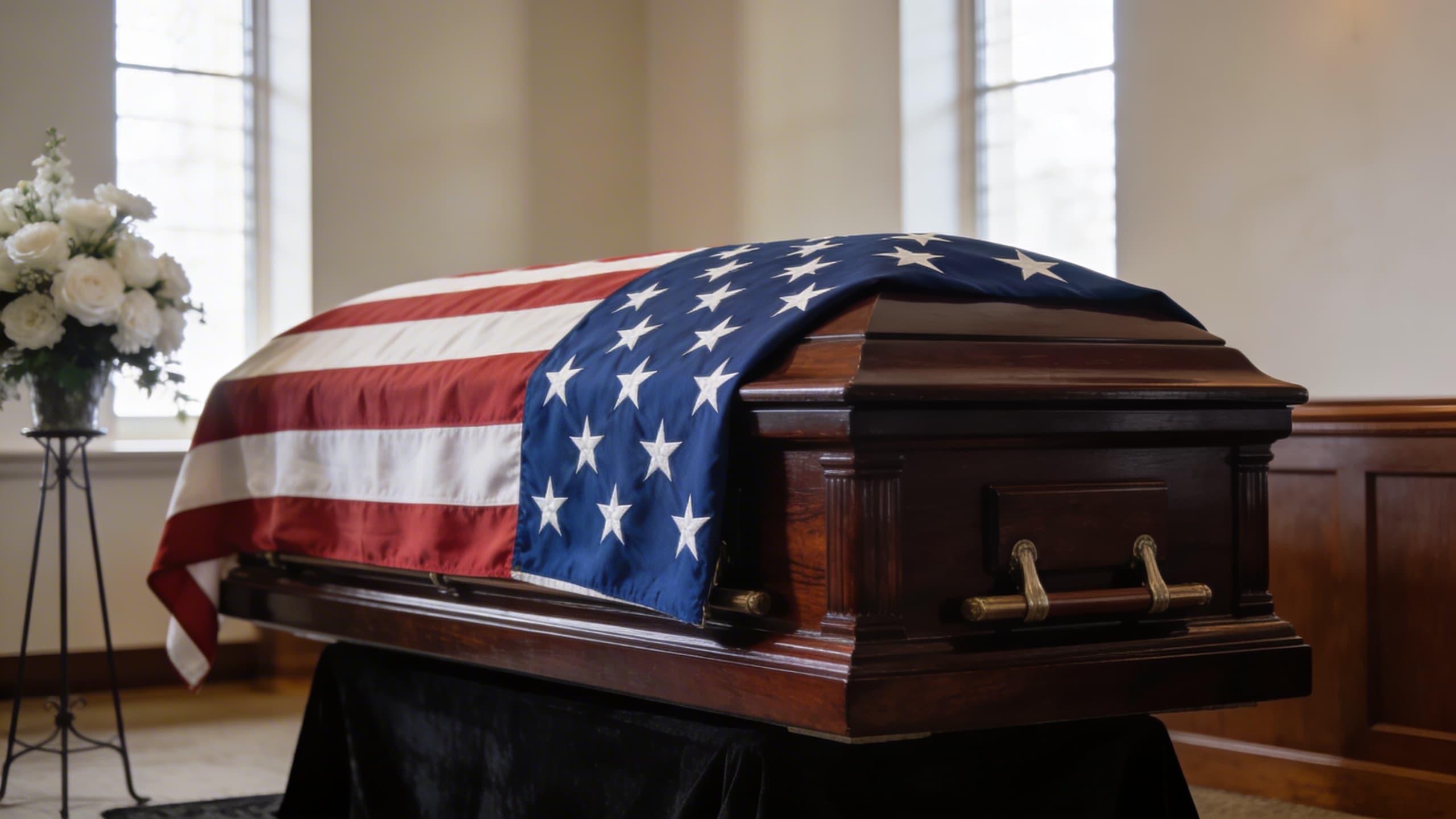
The closed casket position is the most common flag arrangement at military funerals. The protocol is straightforward but must be followed precisely:
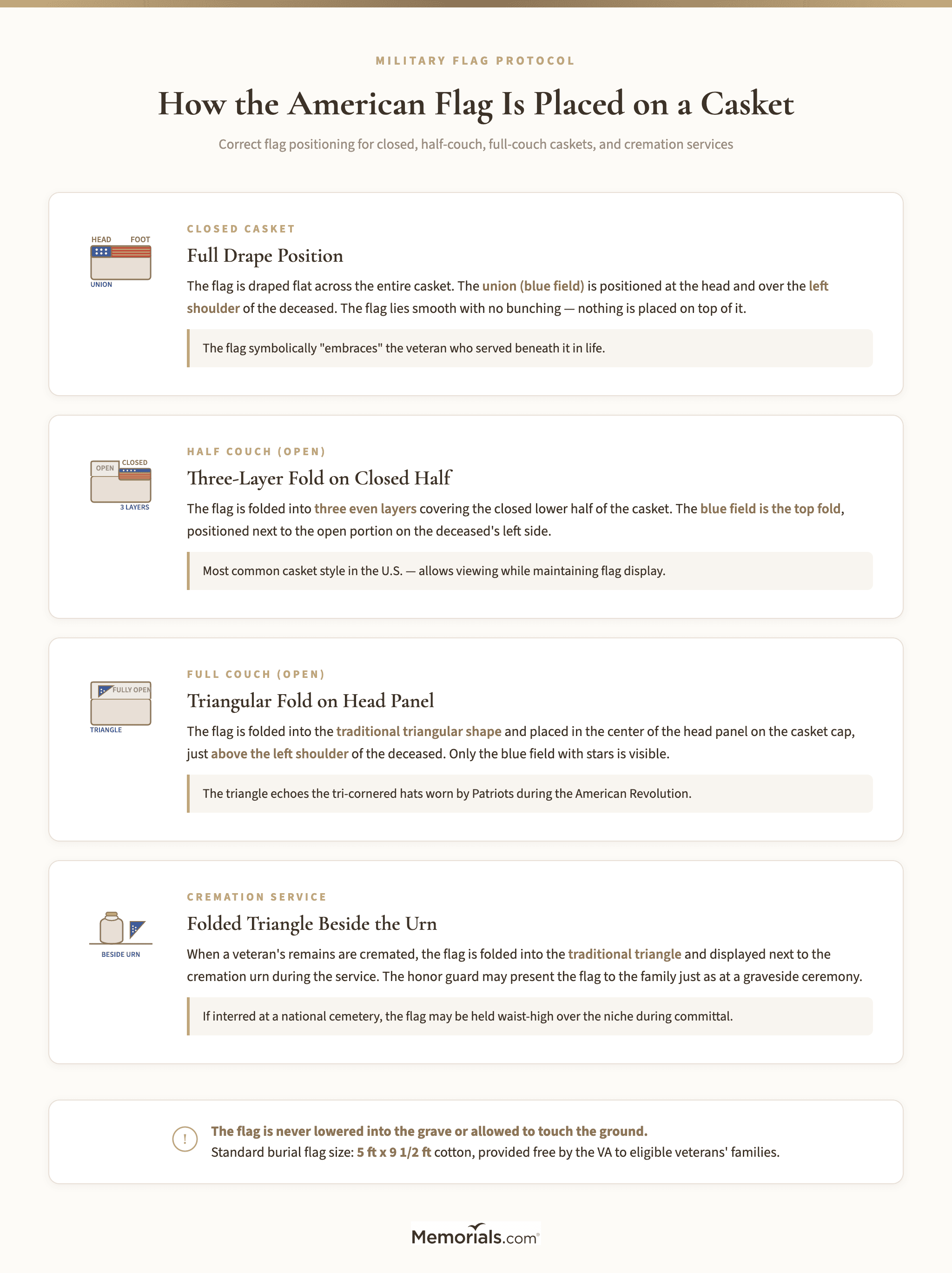
The union (blue field with stars) is placed at the head of the casket and over the left shoulder of the deceased.
This orientation means the canton — the blue rectangle containing the 50 white stars — covers the upper left portion of the casket when viewed from the foot end. The symbolism is intentional: the flag is said to be "embracing" the veteran who served beneath it during their lifetime.
Key rules for closed-casket flag placement:
The flag should lie flat and smooth across the entire casket, with no bunching or wrinkling
No part of the flag may touch the ground at any time
Nothing should be placed on top of the flag — no flowers, photographs, or other objects (with the possible exception of a religious text in certain faith traditions)
The flag remains in place throughout the funeral service and during transport to the cemetery
When selecting a casket for a veteran's service, families may want to explore military casket options by branch, as certain military caskets feature branch-specific emblems and interior appointments designed to complement the flag ceremony.
How to Drape a Flag on an Open Casket (Half Couch)
A half-couch casket — the most popular style in the United States — has a divided lid that allows the upper half to remain open during the viewing while the lower half stays closed. Flag placement on a half-couch casket requires a different technique than a fully closed casket.
The flag is folded into three even layers over the closed lower half of the casket. The blue field (union) must be the top fold, positioned next to the open portion of the casket on the deceased's left side.
To achieve this arrangement:
Fold the flag lengthwise so that the upper half (the half containing the canton) rests on top
Arrange the folded flag in three smooth layers over the closed lower section of the casket
Position the blue field as the topmost visible layer, adjacent to the open half on the deceased's left
Smooth the fabric so the folds are crisp and even, with no part of the flag hanging below the casket rail or touching the floor
This arrangement keeps the flag visible and properly oriented while allowing mourners to view the deceased during the visitation or service. The flag is repositioned to the full-drape (closed) position before transport to the cemetery if the casket will be closed for the committal service.
Flag Placement on a Full-Couch (Fully Open) Casket
A full-couch casket has a single lid that opens along its entire length, displaying the deceased from head to toe. Because the entire lid is raised during the viewing, the flag cannot be draped across the casket in the traditional manner.
The flag is folded into the traditional triangular shape and placed in the center of the head panel of the casket cap, just above the left shoulder of the deceased.
This triangle — the same shape used when the flag is formally presented to the family — rests on the interior satin panel of the raised lid. It serves as a visual tribute during the open-casket viewing while maintaining proper protocol. After the viewing, when the casket is closed for the committal, the flag is unfolded and draped in the standard closed-casket position with the union at the head and over the left shoulder.
Flag Protocol for Cremation Services
When a veteran's remains have been cremated, the traditional casket draping is not possible. Instead, the burial flag is folded into the triangular shape and displayed next to the cremation urn during the memorial service. Some families place the folded flag on a small stand or table beside the urn, while others request that the honor guard present the flag to the family during the service just as they would at a graveside ceremony.
If the veteran's cremated remains will be interred at a national cemetery, the flag may be held waist-high over the niche or gravesite by the pallbearers during the committal — following the same protocol used for a casketed burial.
What Happens at Graveside: The Flag Folding Ceremony
Once the casket reaches the gravesite and is positioned over the burial vault, the flag remains draped during the final ceremony. The sequence typically follows this order:
Rifle volleys — a firing detail fires three volleys, honoring the battlefield tradition of pausing combat to recover the fallen
Taps — a bugler sounds the 24-note melody that has served as the military's final farewell since the Civil War
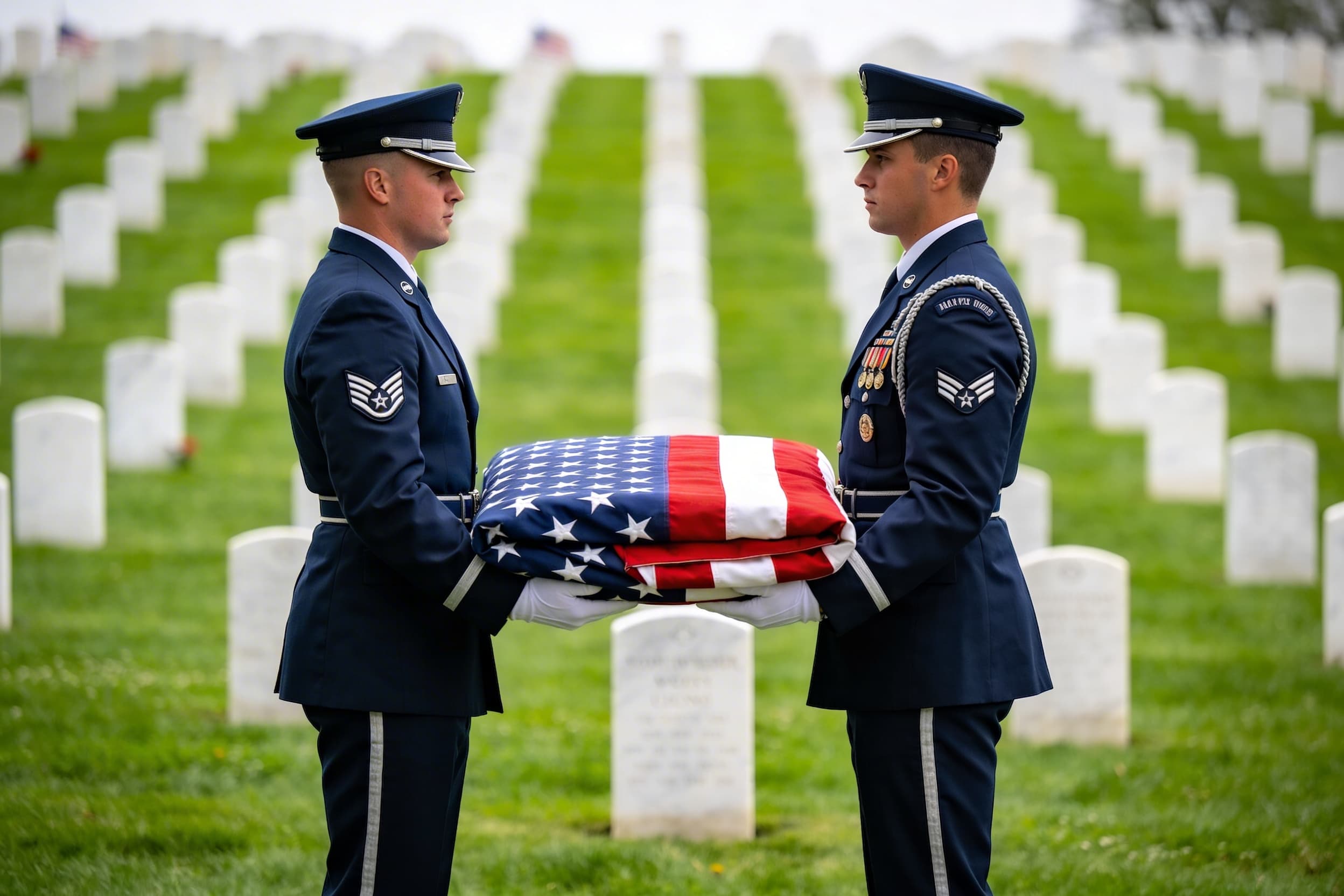
Flag removal and folding — immediately after Taps, the pallbearers (or honor guard detail) lift the flag from the casket, hold it waist-high and taut over the grave, and begin the folding ceremony
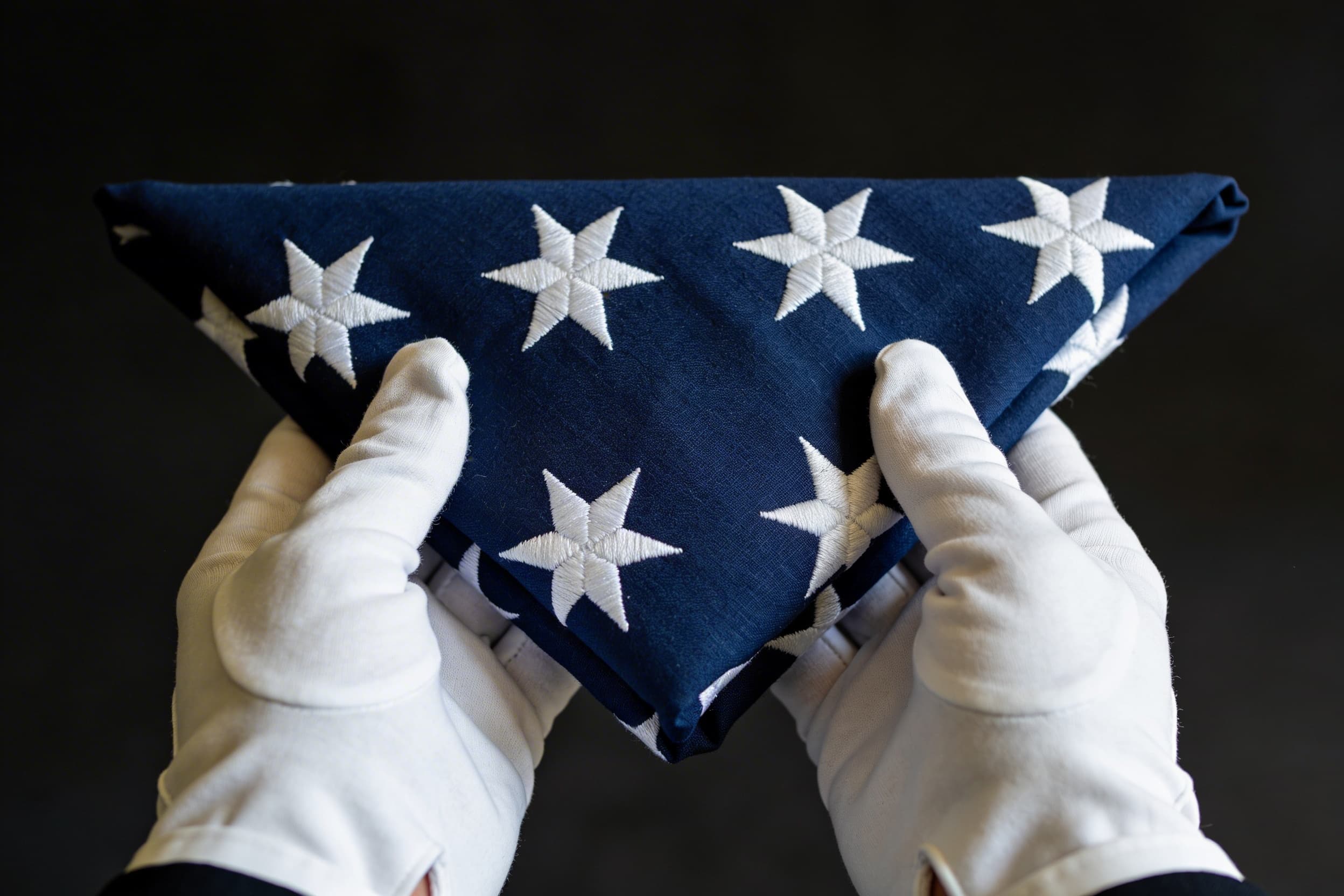
The flag is folded lengthwise in half twice, then folded into a series of triangles beginning at the striped end. A properly proportioned 5 × 9½-foot flag will produce 13 triangular folds — one for each of the original colonies. When completed, no red or white stripe should be visible; only the blue field with its white stars remains showing, forming the iconic tri-cornered shape that echoes the hats worn by soldiers during the American Revolution.
The flag is never lowered into the grave. It is held above the casket throughout the committal and removed before the casket is lowered. This is one of the most important rules in military funeral protocol — the flag must never touch the ground or enter the burial space.
Who Receives the Flag?
After folding, the lead pallbearer or honor guard member delivers the flag to the officiating chaplain or military representative, who presents it to the veteran's next of kin. The standard presentation includes a statement on behalf of the President of the United States and a grateful nation, thanking the family for the veteran's service.
The order of precedence for receiving the flag is:
That statement is one sentence, and the funeral flag presentation script gives it in full, with what changes between branches and what a family can ask to have said instead.
Surviving spouse or domestic partner
Children (by age)
Parents
Siblings (by age)
Any other relative or close friend designated in the veteran's records
If multiple family members wish to have a flag, additional burial flags can be purchased privately. Only one flag per veteran is provided free by the VA.
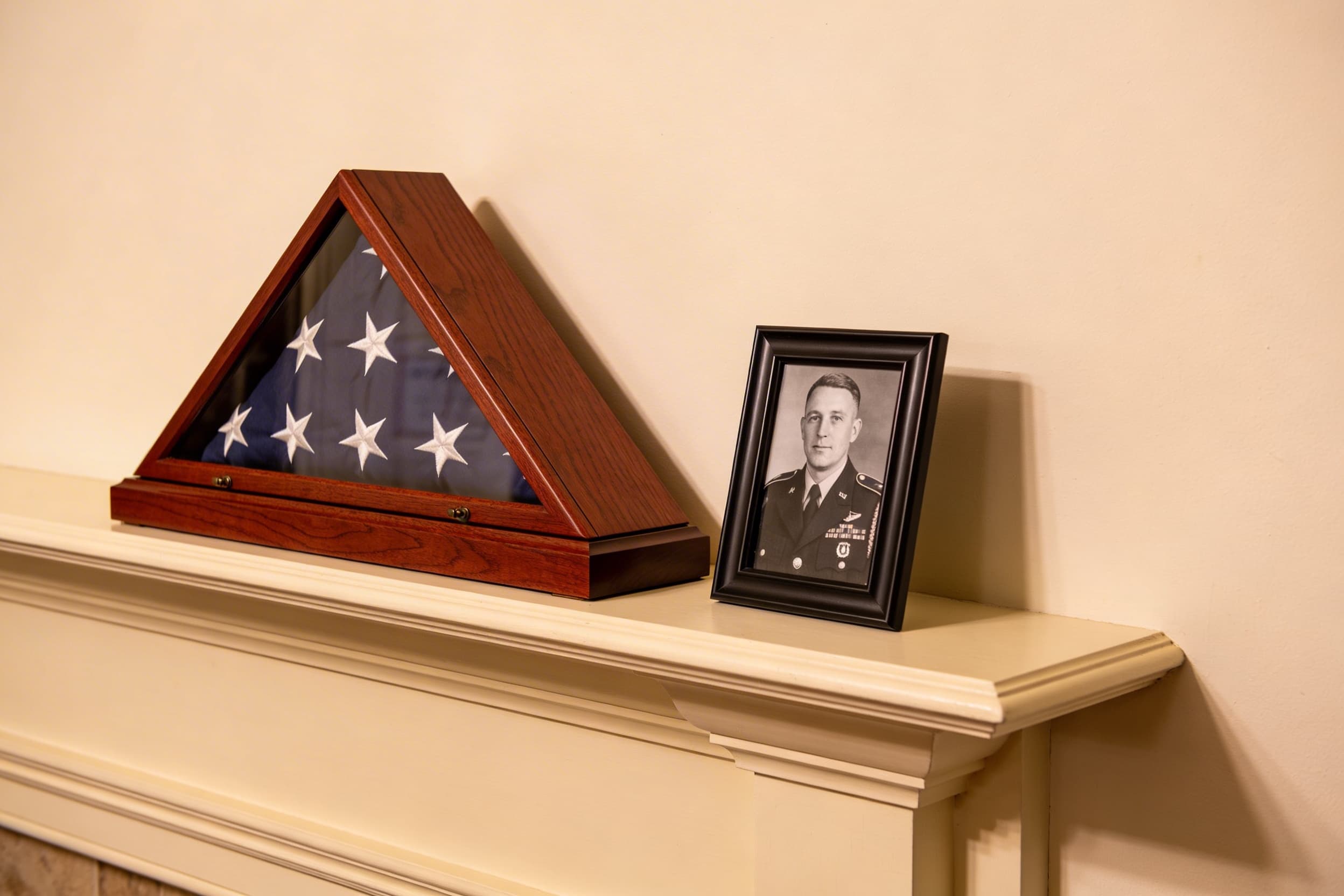
After the ceremony, many families choose to preserve the folded flag in a flag display case — a wood-and-glass case designed to hold the triangular fold and protect it from dust, humidity, and fading. For guidance on your options after the ceremony, see what to do with the burial flag after the service.
Who Is Eligible for a Flag-Draped Casket?
Not every funeral includes a flag-draped casket. The honor is available to veterans who served during wartime or peacetime and received an honorable or general discharge. Active-duty service members, certain reservists and National Guard members, and some former members of certain uniformed services also qualify.
The funeral director typically handles the flag request on the family's behalf, but understanding who qualifies for military funeral honors can help families plan ahead and ensure no benefits are overlooked.
Civilians may also choose to drape a privately purchased flag over a non-veteran's casket as a patriotic tribute. This is considered appropriate, though it is customary to acknowledge during the service that the flag represents the deceased's love of country rather than military service.
Common Questions About Flag Protocol
Many families encounter questions about flag handling as they prepare for the service. Here are some practical points that come up frequently.
Can anything be placed on top of the flag? Generally, no. The U.S. Flag Code states that nothing should be placed upon the flag. Some faith traditions — particularly Roman Catholic services — call for a white pall to be placed over the casket during the church service. In those cases, the flag is temporarily removed in the vestibule before the casket enters the church and replaced after the service concludes.
What if the flag gets wrinkled? Funeral directors and honor guard members typically steam or iron the burial flag before the service. A crisp, smooth drape is part of the protocol and reflects the precision of the military tradition.
Can two flags be placed on the same casket? No. If the veteran also held citizenship in another country or served as a first responder, only one flag drapes the casket at a time. A second flag may be mounted on a staff and placed behind the casket during the service.
What about the flag at a Catholic or other religious service? During a Roman Catholic funeral Mass, the flag is removed and a liturgical pall is placed over the casket at the church entrance. The honor guard carefully folds the flag, holds it during the service, and replaces it on the casket as it exits the church. Other faiths may have their own practices — the funeral director and chaplain can coordinate the details.
Frequently Asked Questions
How should a flag be placed over a casket?
On a closed casket, the blue field (union) goes at the head and over the left shoulder of the deceased. The flag lies flat across the entire casket. On a half-couch open casket, the flag is folded into three layers over the closed lower half with the blue field as the top fold. On a full-couch open casket, the flag is folded into a triangle and placed on the head panel above the left shoulder.
What size flag is used for military funerals?
The standard military burial flag measures 5 feet by 9½ feet. It is made from cotton with embroidered stars and sewn stripes, built to U.S. government specifications. The VA provides this flag free of charge to eligible veterans' families.
Can a non-veteran have a flag draped over their casket?
Yes. Any patriotic citizen may have a flag draped over their casket, but the family must purchase the flag privately. Only veterans and qualifying service members receive a free burial flag from the VA. It is customary to note during the service that the flag honors the person's patriotism rather than military service.
Is the flag buried with the casket?
No. The flag is never lowered into the grave. During the graveside ceremony, the flag is removed from the casket, folded into a triangle, and presented to the veteran's next of kin. The flag is a keepsake for the family, not a burial item.
Who folds the flag at a military funeral?
The honor guard or pallbearer detail folds the flag. They hold it waist-high over the grave, fold it lengthwise twice, then fold it into 13 triangles. The completed triangle is handed to the chaplain or ceremony leader, who presents it to the family with a statement of gratitude from the President and a grateful nation.
Honoring the Tradition
The way the American flag is placed over a casket carries the weight of more than two centuries of military tradition. Every detail — from the position of the canton over the left shoulder to the 13 precise folds at graveside — exists to honor the service member's dedication to their country. Understanding this protocol helps families participate in the ceremony with confidence, knowing that every element reflects the respect their loved one earned.
If your family is preparing for a military funeral, your funeral director and the local honor guard will guide you through each step. The flag ceremony is one of the most moving moments in the service, and families often describe it as the point where the full weight of their loved one's sacrifice becomes most real.
For families choosing cremation, explore our selection of military urns designed with branch emblems and patriotic themes. And after the ceremony, a quality flag display case ensures the burial flag remains a lasting tribute in your home.