🏬Supersize Online Funeral Retailer🪦1000's of Headstones⚱️Over 10,000 Cremation Urns⚰️Caskets Overnight Delivery🛒Funeral & Memorial Superstore🚚FREE Shipping on ALL Orders👨👩👧👦Helping Families for over 20 Years💰Lowest Price Guarantee🏬Supersize Online Funeral Retailer🪦1000's of Headstones⚱️Over 10,000 Cremation Urns⚰️Caskets Overnight Delivery🛒Funeral & Memorial Superstore🚚FREE Shipping on ALL Orders👨👩👧👦Helping Families for over 20 Years💰Lowest Price Guarantee
🏬Supersize Online Funeral Retailer🪦1000's of Headstones⚱️Over 10,000 Cremation Urns⚰️Caskets Overnight Delivery🛒Funeral & Memorial Superstore🚚FREE Shipping on ALL Orders👨👩👧👦Helping Families for over 20 Years💰Lowest Price Guarantee🏬Supersize Online Funeral Retailer🪦1000's of Headstones⚱️Over 10,000 Cremation Urns⚰️Caskets Overnight Delivery🛒Funeral & Memorial Superstore🚚FREE Shipping on ALL Orders👨👩👧👦Helping Families for over 20 Years💰Lowest Price Guarantee
Losing a veteran is never easy, and the prospect of arranging a military funeral can feel overwhelming at an already difficult time. Families often wonder what their loved one is entitled to — and the answer depends on rank, service history, and the circumstances of the veteran's passing. Our walks through every aspect of honoring a veteran's service, but this article focuses specifically on understanding the different levels of military funeral honors, who qualifies for each, and what the ceremony looks like in practice.
Since January 1, 2000, Public Law 106-65 has required the Department of Defense to provide military funeral honors for every eligible veteran upon the family's request. The ceremony is provided at no cost and can be held at any cemetery — public or private. However, "military funeral honors" is an umbrella term that covers three distinct levels of ceremony, and not every veteran receives the same elements. Knowing which level your loved one is entitled to helps you plan with confidence and ensure no honors are overlooked.
Three Levels of Military Funeral Honors
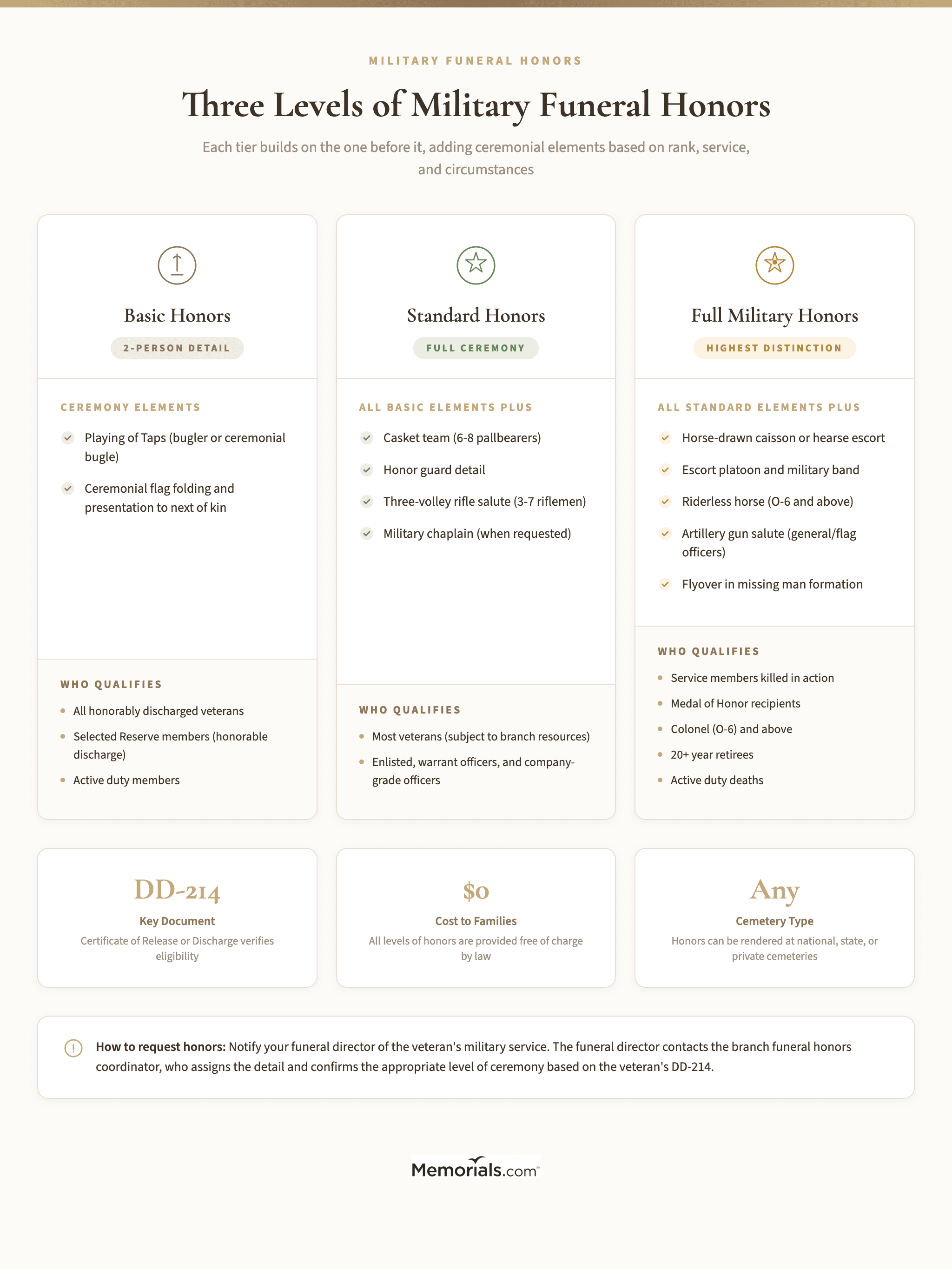
The Department of Defense recognizes three tiers of military funeral honors. Each builds on the one before it, adding ceremonial elements based on the veteran's rank, service status, and manner of death.
Basic Military Funeral Honors
Every eligible veteran is entitled to at least basic honors. The ceremony requires a minimum of two uniformed service members — one of whom must represent the veteran's branch of service. Basic honors include two core elements:
The playing of Taps. A bugler performs the 24-note melody. When a live bugler is unavailable, a ceremonial bugle with an electronic insert may be used.
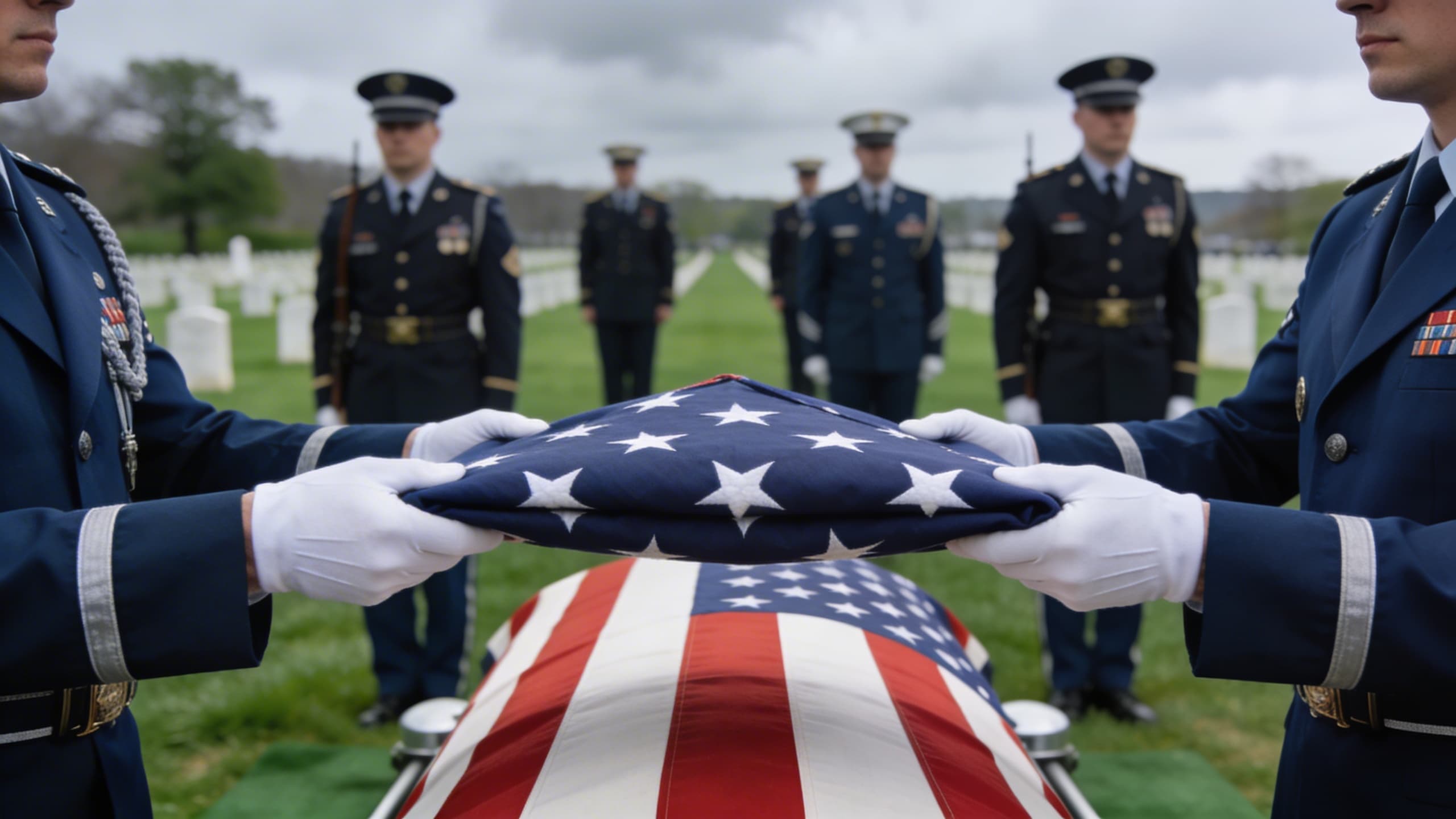
Flag folding and presentation. The American flag draped over the casket or placed alongside the urn is ceremonially folded into a triangular shape and presented to the next of kin with the words, "On behalf of the President of the United States, the United States [branch of service], and a grateful nation, please accept this flag as a symbol of our appreciation for your loved one's honorable and faithful service."
Basic honors are sometimes called "two-person detail" honors because of the minimum staffing requirement. Most families find the simplicity of this ceremony deeply moving, even without additional elements.
Standard Military Funeral Honors
Standard honors expand on the basic ceremony with several additional elements. This level is commonly rendered for enlisted service members, warrant officers, and company-grade officers (O-1 through O-3). Standard honors typically include:
Everything in basic honors (Taps and flag presentation)
A casket team of six to eight service members who serve as pallbearers and position the casket at graveside
An honor guard detail representing the veteran's branch
A firing party of three to seven service members who render a three-volley rifle salute — a tradition often mistakenly called a "21-gun salute," which is actually a different ceremony reserved for heads of state and certain high-ranking officials
A military chaplain (when requested and available)
The three-volley salute is one of the most recognizable elements of a military funeral. Each of the three volleys carries historical significance, and the crisp report of the rifles followed by the mournful notes of Taps creates a ceremony that families remember for a lifetime.
Full Military Honors
Full military honors represent the highest level of funeral ceremony the armed forces provide. This level is reserved for specific categories of service members and includes every element of standard honors plus additional ceremonial components:
A horse-drawn caisson (Army) or hearse escort transporting the casket to the gravesite
An escort platoon — a marching contingent whose size reflects the deceased's rank
A military band performing during the procession and ceremony
A riderless horse (caparisoned horse) with boots reversed in the stirrups for funerals of colonels (O-6) and above, symbolizing a fallen leader who will ride no more
Gun salutes using artillery for general and flag officers: 17 guns for a four-star general, 15 for three-star, 13 for two-star, and 11 for one-star
Flyovers in missing man formation (when Air Force resources are available)
Full honors are extraordinary ceremonies that reflect the nation's deepest gratitude. They are most commonly seen at Arlington National Cemetery, though eligible services can be held at any location.
The three levels of military funeral honors. Every eligible veteran receives the two-person detail, Taps and the flag; what is added above that depends on rank, circumstance and what the branch can staff.
Who Qualifies for Each Level of Honors
Eligibility depends on the veteran's discharge status, rank, and the circumstances of their death. Here is how qualification works at each tier.
Basic and Standard Honors Eligibility
The following individuals are eligible for at least basic military funeral honors, and most will receive standard honors depending on branch availability and resources:
Active duty service members and members of the Selected Reserve (including National Guard) who die while in service
Veterans who served on active duty and received an honorable discharge or were discharged under honorable conditions
Former members of the Selected Reserve who completed at least one enlistment or initial period of obligated service and received an honorable or under-honorable-conditions discharge
Reserve members discharged for disability incurred or aggravated in the line of duty, even if they did not complete their initial service obligation
Commissioned Officers of the Public Health Service and the National Oceanic and Atmospheric Administration (NOAA)
The key document for establishing eligibility is the DD Form 214, Certificate of Release or Discharge from Active Duty. If the family cannot locate a copy, the funeral director can help submit an emergency request through the National Archives.
Full Military Honors Eligibility
Full military honors are reserved for a narrower group. Qualifying individuals include:
Service members killed in action or who die from wounds received in combat — regardless of rank
Medal of Honor recipients — automatically entitled to full honors in recognition of the nation's highest award for valor
Officers holding the rank of colonel (O-6) or above, including all general and flag officers
Veterans who retired after 20 or more years of military service
Active duty service members who die while serving, regardless of the circumstances
Each branch of service maintains its own funeral honors coordinator who works with the family and funeral director to determine the appropriate level of ceremony. Branch-specific traditions — such as the Navy's use of a ship's bell or the Marines' additional rifle detail — may add elements beyond the standard protocol.
Families navigating this process can learn more about the VA burial benefits that accompany military funeral honors, including free burial in a national cemetery, a government headstone or marker, and a Presidential Memorial Certificate.
Who Is Not Eligible for Military Funeral Honors
Federal law explicitly excludes certain individuals from receiving any level of military funeral honors:
Anyone separated from the armed forces under dishonorable conditions or whose service record bars them from VA benefits
Individuals convicted of a federal or state capital crime where the conviction is final and the sentence was not commuted
Persons found to have committed a capital crime but who were not convicted due to death or flight from prosecution
Anyone convicted of a crime that classifies them as a Tier III sex offender
Individuals who were ordered to report to an induction station but never actually inducted into military service
Any person whose eligibility is specifically denied by the Secretary of the relevant military department
The state military funeral honors coordinator verifies eligibility before providing an honor detail. If the veteran's discharge status is unclear or disputed, families should work with a veterans service organization such as the American Legion, VFW, or Disabled American Veterans for guidance on discharge upgrades.
How to Request Military Funeral Honors
The process begins with a single step: tell your funeral director that the deceased was a veteran. Experienced funeral directors handle military funeral coordination regularly and will contact the appropriate branch of service on the family's behalf. Here is the general sequence:
1. Gather documentation. Locate the veteran's DD Form 214 or any discharge document showing honorable service. If unavailable, request an emergency copy from the National Personnel Records Center.
2. Notify the funeral director. The funeral director contacts the military funeral honors coordinator for the veteran's branch of service. Each branch maintains regional coordinators who assign honor guard details.
3. Confirm the level of honors. The branch coordinator determines whether the veteran qualifies for basic, standard, or full honors based on rank, service record, and discharge status.
4. Coordinate logistics. The honor detail works with the funeral home and cemetery to schedule the ceremony. National and state veterans cemeteries have staff experienced in military honors and can assist with coordination.
5. Plan the broader service. Military funeral honors are rendered at the graveside or committal point. Families are free to hold a separate religious or memorial service before or after the honors ceremony.
For a detailed walkthrough of VA benefits timeline and application steps, including how long each benefit takes to process, our companion guide covers the full sequence from initial request through final approval.
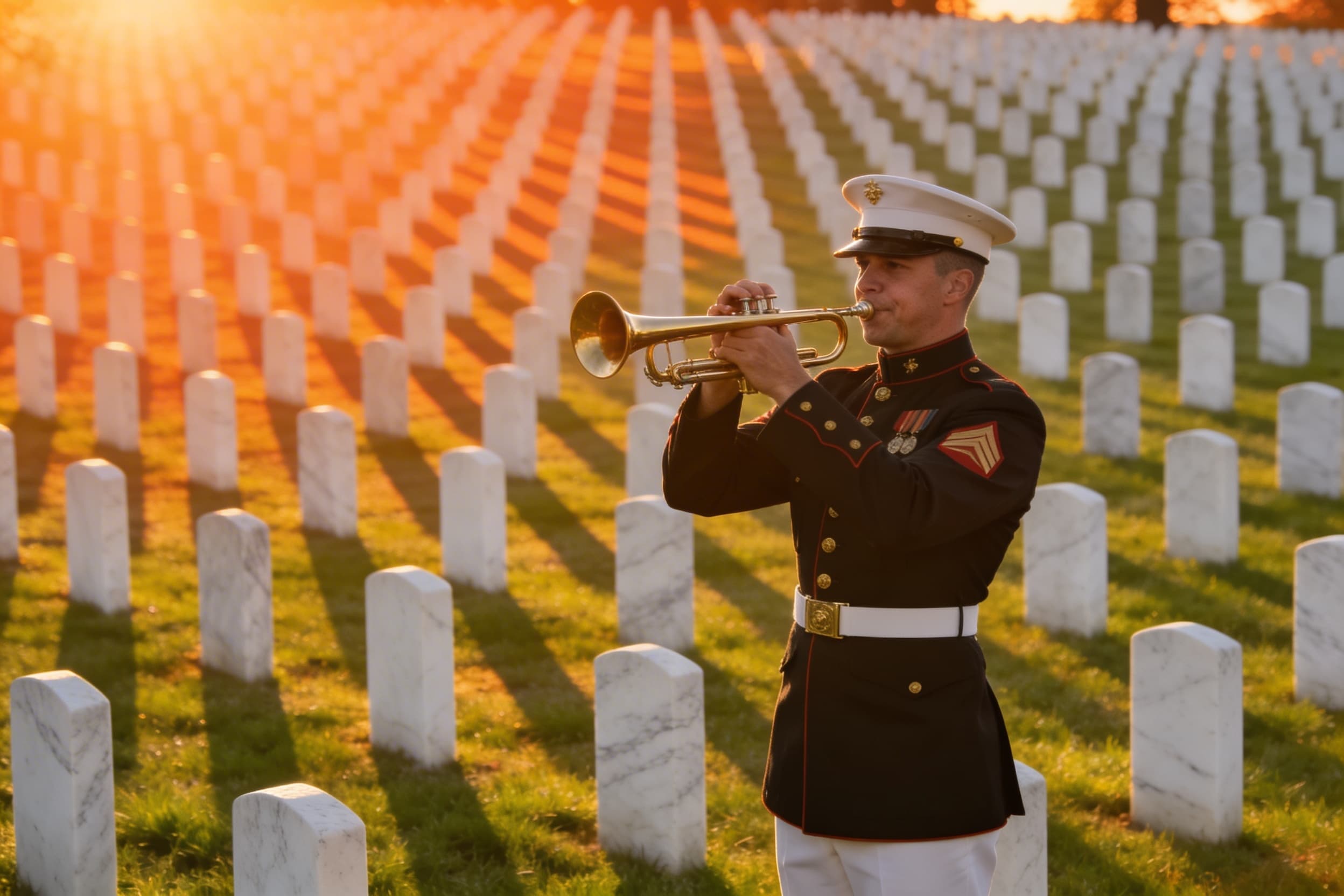
Taps is one of the two elements the law guarantees. A live bugler is requested through the funeral director; where none is available, a ceremonial bugle plays the recording.
What to Expect During the Ceremony
Understanding the ceremony's flow helps families and attendees feel prepared. While branch-specific traditions vary, the general sequence for a standard or full honors ceremony follows a consistent pattern.
The Procession
The casket or urn arrives at the burial site accompanied by the casket team and, for full honors, the escort platoon. At ceremonies using a caisson, the horse-drawn carriage moves at a slow, deliberate pace while the military band plays a funeral march. The family follows in procession behind the caisson.
Graveside Service
Once the casket is positioned, the chaplain (if present) delivers a brief service. The honor guard stands at attention throughout. Attendees who are unsure about proper behavior during the ceremony can review our guide to saluting protocol at military funerals, which covers when civilians should stand, when veterans may salute, and how to show respect without military training.
The Three-Volley Salute
The firing party stands at a distance from the gravesite, typically in a line formation. On command, they fire three volleys of blank cartridges in unison. The sharp crack of the rifles echoes across the cemetery and is followed by a moment of silence.
Taps
A lone bugler sounds Taps — 24 notes that have closed military funerals since the Civil War. The melody takes about 60 seconds to play. During Taps, military personnel salute and civilians stand with their hand over their heart.
Flag Folding and Presentation
The honor detail lifts the flag from the casket and folds it into a tight triangular bundle with only the blue field and white stars visible. The flag is then presented to the next of kin by a representative of the veteran's branch of service.
The presentation carries a spoken sentence, offered quietly to one person rather than announced to the gathering. Our funeral flag presentation script gives the wording in full, along with what a family can ask to have said differently.
Understanding flag etiquette at military funerals — including when the flag is draped, how it should be handled, and what happens to it after the ceremony — ensures that families honor the tradition correctly.
A 21-Gun Salute and a Three-Volley Salute Are Not the Same Ceremony
Families planning a military funeral often ask whether their veteran will receive a 21-gun salute. The answer is almost always no, and it has nothing to do with the veteran's record. These are two different traditions, fired with different weapons for different reasons, and the one rendered at a graveside is the three-volley salute.
What a 21-Gun Salute Actually Is
A 21-gun salute is fired with artillery. Arlington National Cemetery traces the cannon salute to the 14th century and calls the 21-gun salute the highest honor rendered. The United States fires it in honor of a national flag, the chief of state of a foreign nation, a member of a reigning royal family, and the president, former presidents and the president-elect — and on a fixed calendar: at noon on George Washington's birthday, Presidents Day, Memorial Day, Independence Day, and on the day of the funeral of a president, former president or president-elect.
An individual veteran's funeral has never been on that list. That is not a judgment about anyone's service — the 21-gun salute is a salute to an office and to a nation, not a funeral honor rendered to service members.
Why the Two Are So Often Confused
The confusion is arithmetic. A firing party of seven, firing three volleys, puts twenty-one shots in the air, and twenty-one shots sound like a 21-gun salute. But the party is not always seven: Army doctrine sets a separate firing party at no fewer than five riflemen and no more than eight, and in a nine-person funeral detail the six pallbearers serve as the firing party themselves. The number of shots follows the size of the party. It was never meant to reach twenty-one. Arlington states the distinction plainly — the three-volley salute "should not be confused with a 21-gun salute, which uses artillery guns."
The three volleys carry a meaning of their own. They come from a battlefield custom of halting the fighting so each side could carry its dead and wounded off the field, then firing three shots to signal that the dead had been cared for and the fight could resume. The Army traces the practice further back still, to Roman funeral rites in which the dead were called by name three times before the mourners departed.
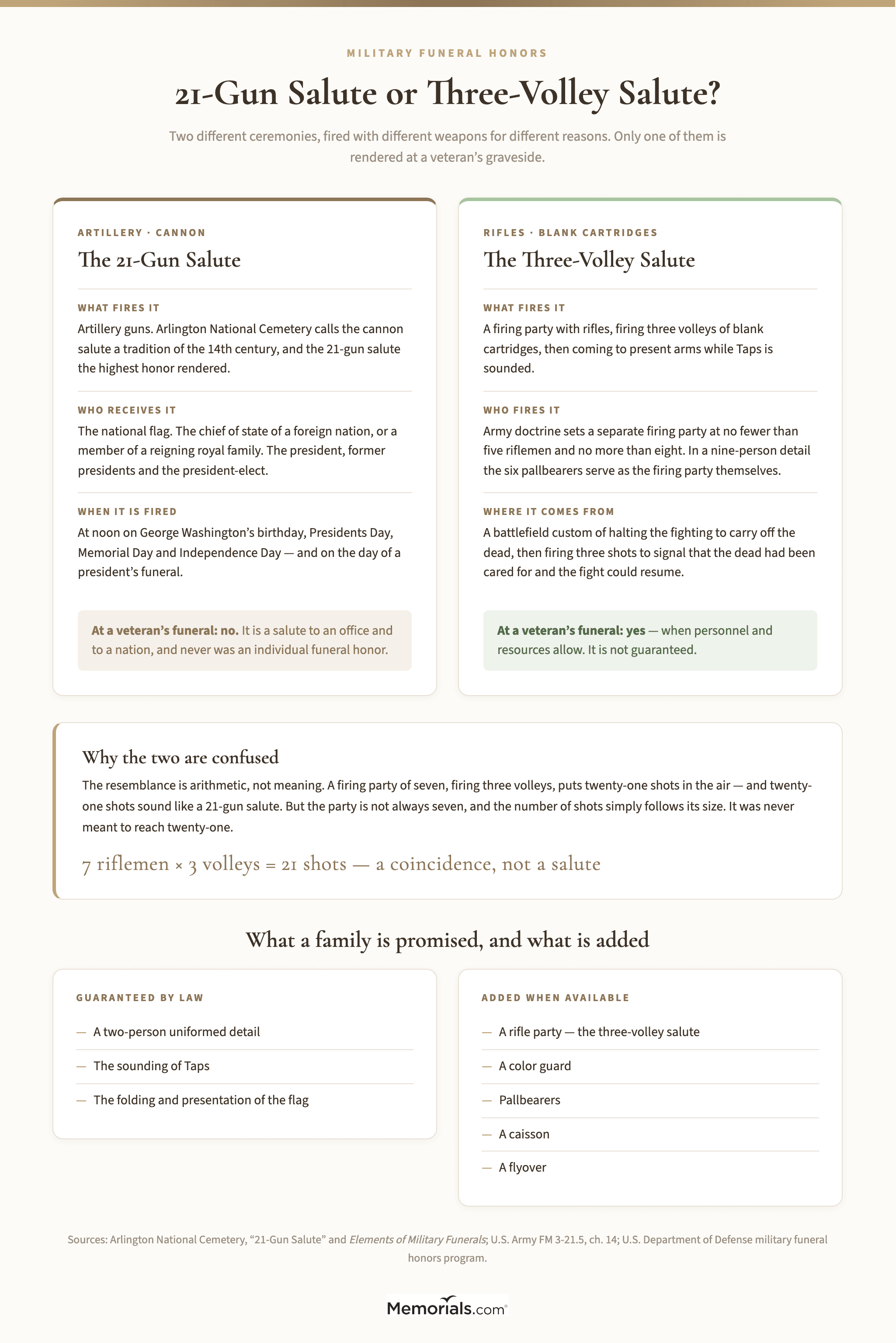
The two ceremonies compared. Seven riflemen firing three volleys put twenty-one shots in the air, which is where the confusion starts — but the count follows the size of the party, and the party is not always seven.
Whether Your Family Will Hear a Rifle Volley at All
This is the part worth knowing before the day, and it is a question about resources rather than eligibility. The rifle volley is not guaranteed. By law the minimum is a two-person uniformed detail, and what that detail must provide is the sounding of Taps and the folding and presentation of the flag. A rifle party, a color guard, pallbearers, a caisson and a flyover are added when personnel and resources allow — which is why a veteran with an identical record to another may receive a different ceremony in a different place or a different week.
If a rifle salute matters to your family, say so when honors are requested. The funeral director raises it with the branch funeral honors coordinator, and the earlier that conversation happens, the more likely a firing party can be scheduled.
Memorial Products for Military Families
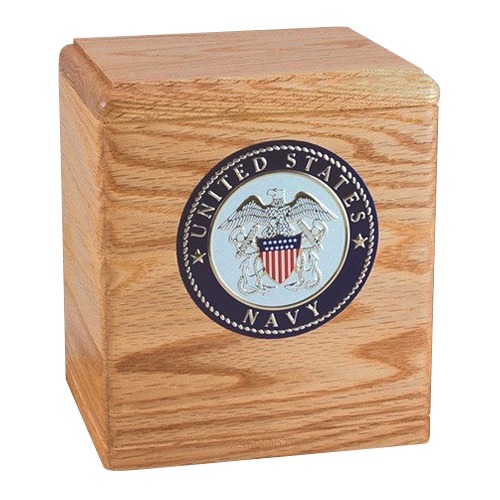
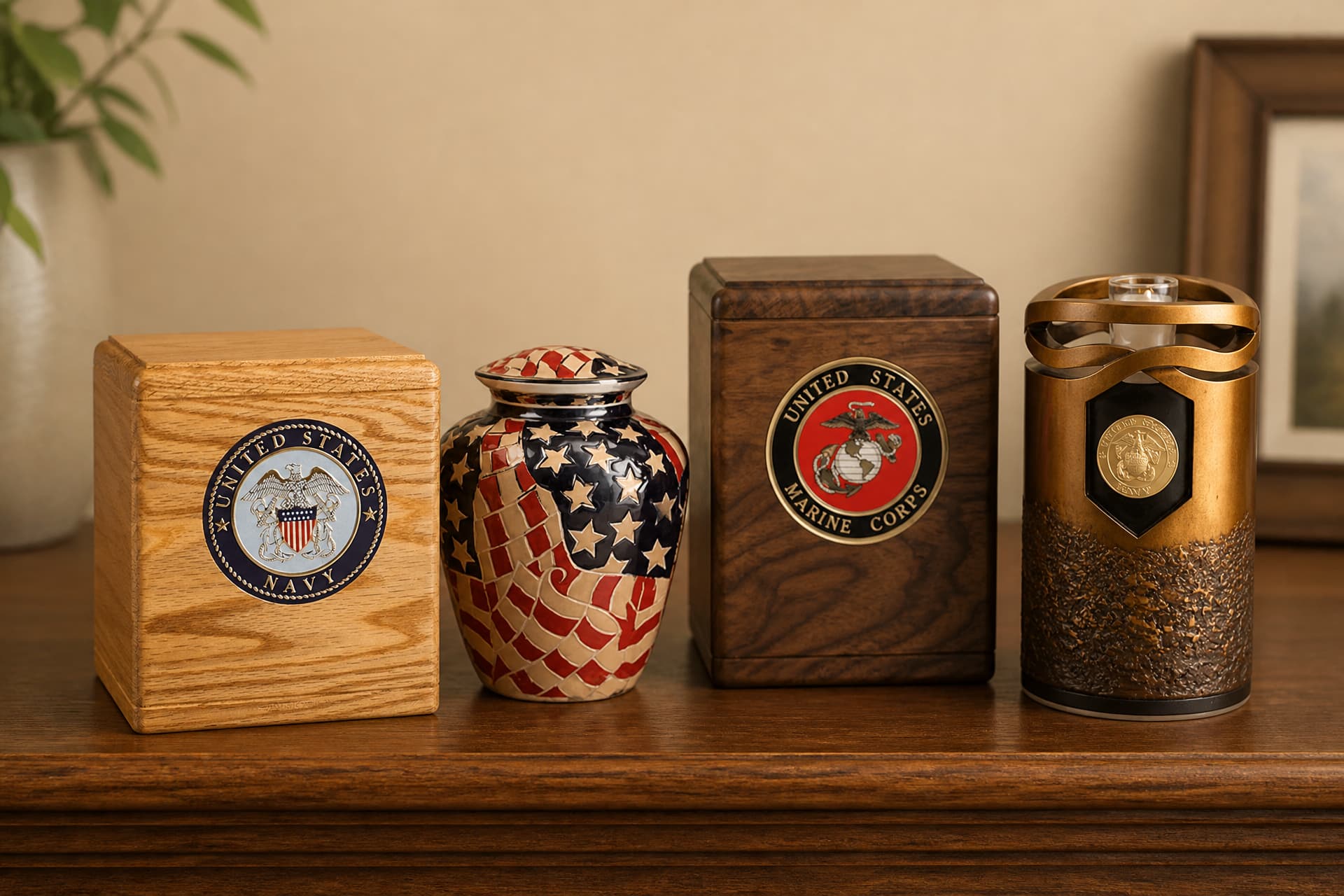
Beyond the ceremony itself, many families choose memorial products that reflect their loved one's service. Military urns are available in designs representing each branch, featuring service emblems, branch colors, and patriotic motifs. Families choosing burial may select military caskets adorned with service insignia and branch-specific design elements.
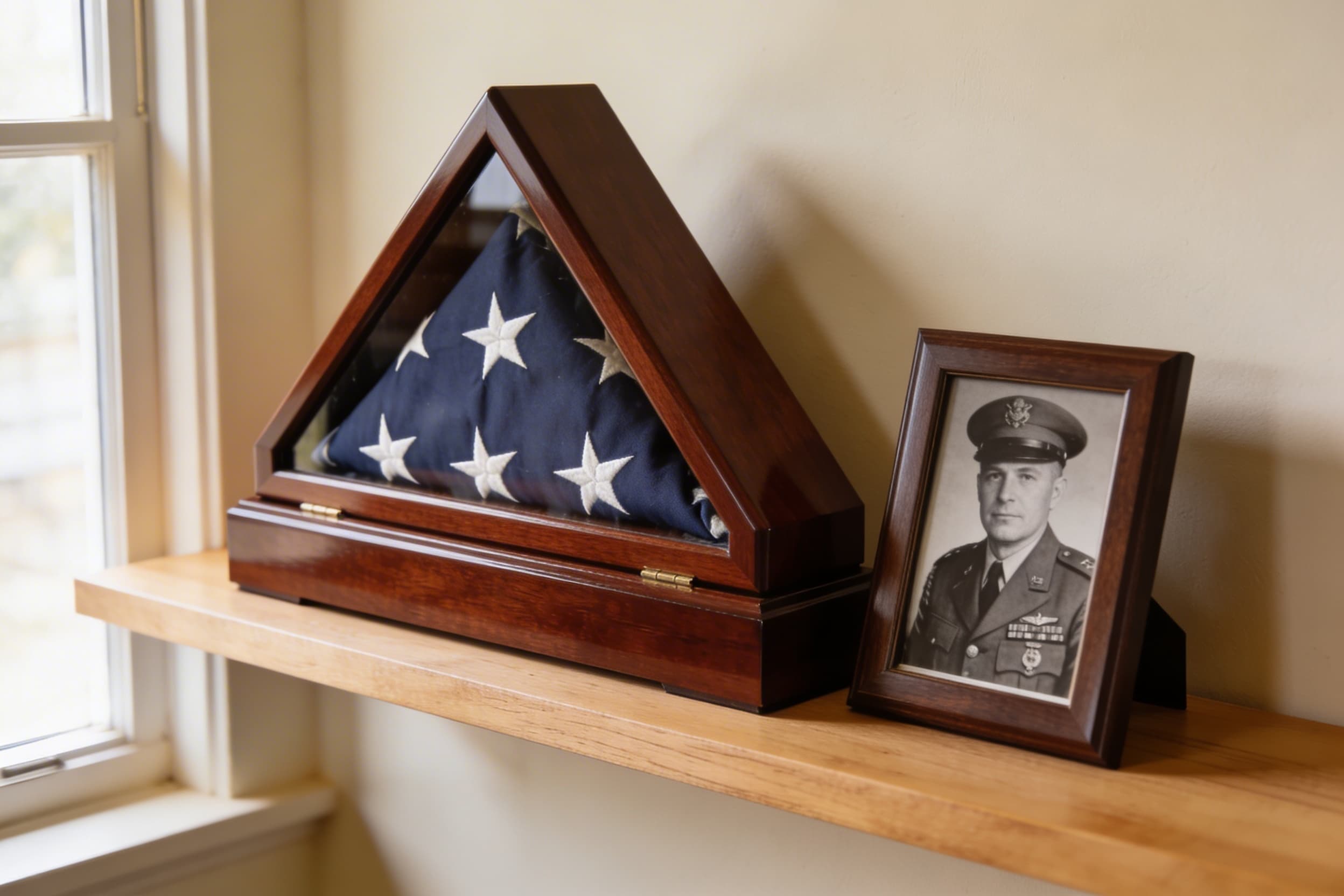
The VA provides a free government headstone or marker for eligible veterans, but families who want more options can explore purchased military grave markers that offer additional customization. After the ceremony, the burial flag can be preserved in a flag display case that protects the fabric and allows the family to display it with dignity in their home.
Military and Veteran Urns
Service emblems for each branch, in wood, bronze and ceramic
No. The three-volley rifle salute — fired by a party of five to eight riflemen, or by the six pallbearers themselves in a smaller detail — is commonly part of standard and full honors ceremonies, but it is a different tradition from the 21-gun salute. A true 21-gun salute uses artillery and is reserved for the president, former presidents and the president-elect, for foreign heads of state and reigning royalty, and for the national flag. The terms are often confused in casual conversation.
Can a veteran receive military funeral honors at a private cemetery?
Yes. Military funeral honors can be rendered at any cemetery, whether it is a national cemetery, a state veterans cemetery, or a private burial ground. The family simply needs to coordinate through the funeral director, who will contact the branch funeral honors coordinator.
What if we cannot find the DD Form 214?
The funeral director can submit an emergency records request to the National Personnel Records Center in St. Louis, Missouri. Emergency requests for funeral purposes are typically processed within 24 to 72 hours. Any discharge document showing honorable service can substitute for the DD-214 if the original is unavailable.
Are reservists and National Guard members eligible?
Yes. Members and former members of the Selected Reserve — which includes the National Guard — are eligible for military funeral honors if they received an honorable or under-honorable-conditions discharge and completed at least one enlistment or initial obligated service period. Those discharged early due to a service-connected disability are also eligible.
Can the family request specific elements like a flyover?
Families can request additional ceremonial elements beyond the standard detail, but availability depends on the branch of service, resources, and scheduling. Flyovers, full band participation, and caisson services are typically limited to full honors ceremonies and may require advance coordination. The funeral honors coordinator can advise on what is available in your area.
The burial flag is presented to the next of kin at the graveside. A display case is what most families use to keep it folded and out of the light afterwards.
Honoring Their Service
A military funeral is more than a ceremony — it is the nation's way of acknowledging a life devoted to service. Whether your loved one qualifies for the quiet dignity of basic honors or the full pageantry of a caisson procession and rifle salute, the core message remains the same: their sacrifice mattered, and it will not be forgotten.
If you are beginning to plan a veteran's memorial, start by gathering the DD Form 214 and contacting your funeral director. The military funeral honors system is designed to be accessible to every eligible family, and the men and women who render these honors take deep pride in paying tribute to their fellow service members.