🏬Supersize Online Funeral Retailer🪦1000's of Headstones⚱️Over 10,000 Cremation Urns⚰️Caskets Overnight Delivery🛒Funeral & Memorial Superstore🚚FREE Shipping on ALL Orders👨👩👧👦Helping Families for over 20 Years💰Lowest Price Guarantee🏬Supersize Online Funeral Retailer🪦1000's of Headstones⚱️Over 10,000 Cremation Urns⚰️Caskets Overnight Delivery🛒Funeral & Memorial Superstore🚚FREE Shipping on ALL Orders👨👩👧👦Helping Families for over 20 Years💰Lowest Price Guarantee
🏬Supersize Online Funeral Retailer🪦1000's of Headstones⚱️Over 10,000 Cremation Urns⚰️Caskets Overnight Delivery🛒Funeral & Memorial Superstore🚚FREE Shipping on ALL Orders👨👩👧👦Helping Families for over 20 Years💰Lowest Price Guarantee🏬Supersize Online Funeral Retailer🪦1000's of Headstones⚱️Over 10,000 Cremation Urns⚰️Caskets Overnight Delivery🛒Funeral & Memorial Superstore🚚FREE Shipping on ALL Orders👨👩👧👦Helping Families for over 20 Years💰Lowest Price Guarantee
Choosing a casket for a veteran is one of the most personal decisions a family will make during funeral planning. A military caskets selection honors the branch of service your loved one dedicated years — sometimes decades — to, and it becomes a visible centerpiece of the funeral ceremony itself. This guide walks through what makes these distinct, how each branch is represented, which materials and features matter most, and what families should expect to pay. If you are working through the full scope of funeral, burial, and memorial decisions, our overview of covers every benefit and product category in one place.
What Makes a Military Casket Different from a Standard Casket
A military casket is built on the same structural foundation as any high-quality burial casket — steel shell, interior lining, hardware, and a sealed or unsealed lid. The difference is in the details that transform a standard casket into a tribute to service.
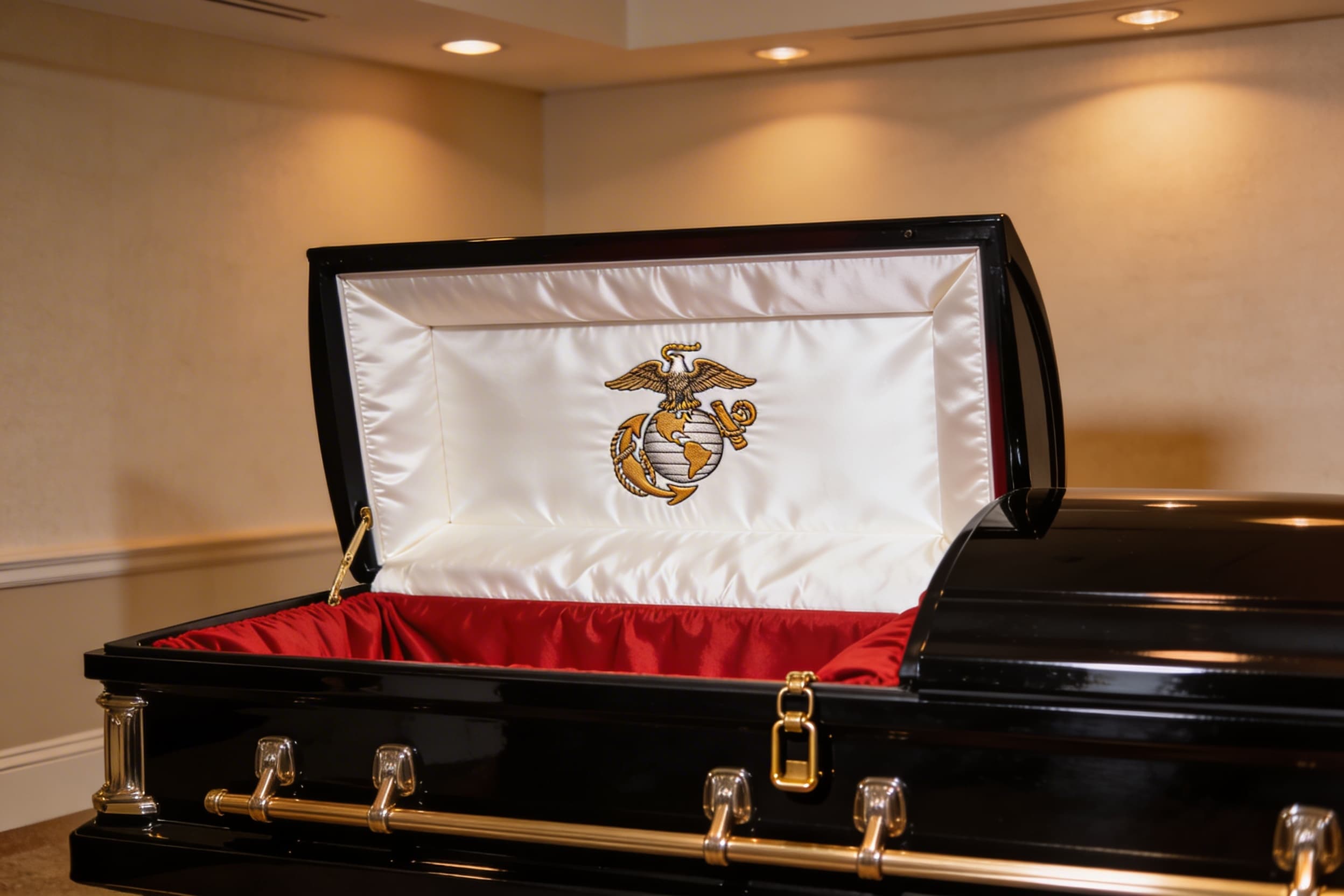
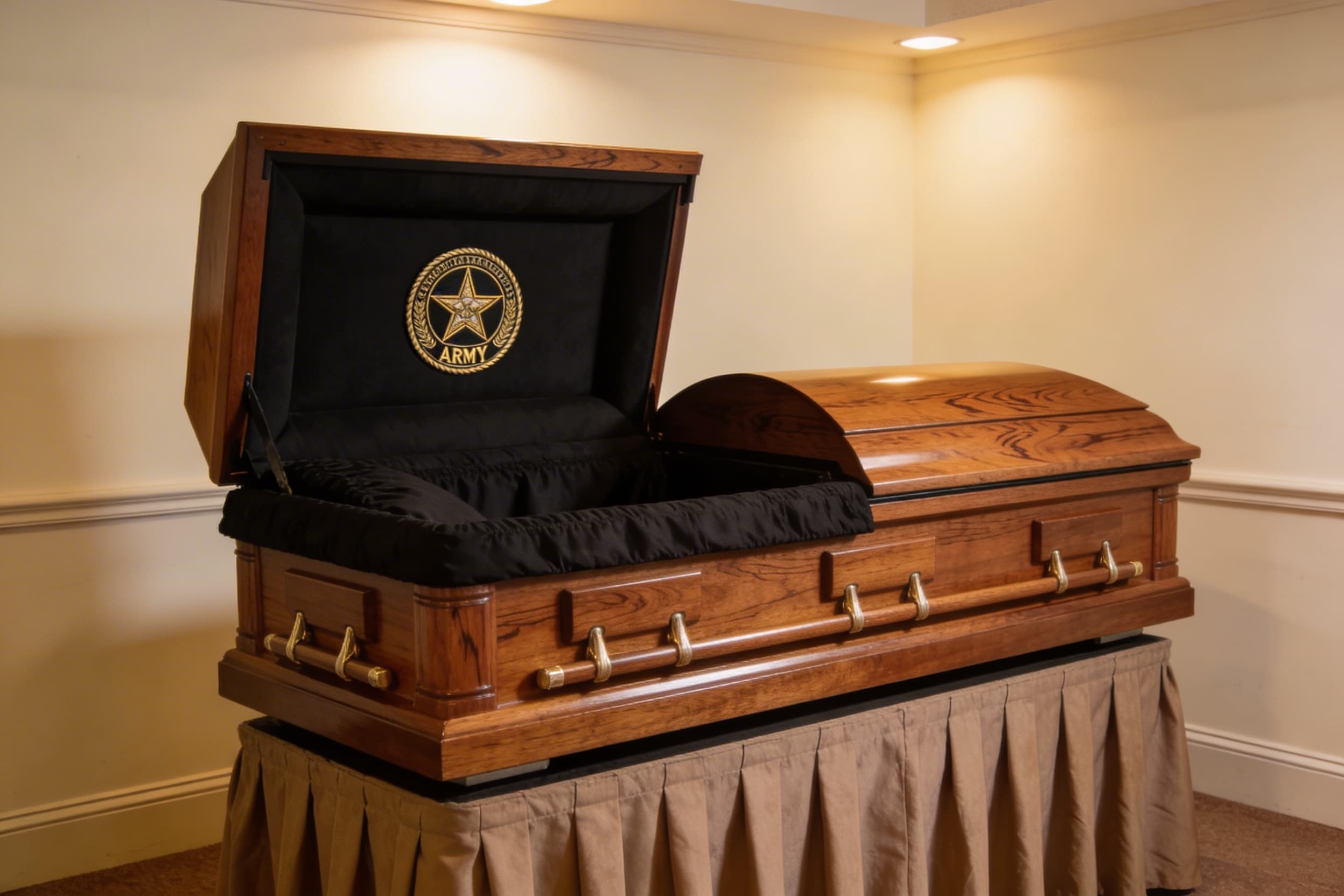
The most recognizable feature is the head panel emblem. Every military casket includes an interior head panel displaying the official seal or insignia of the veteran's branch of service. This panel is visible during an open-casket viewing and sits directly above the deceased's head, serving as a permanent mark of affiliation.
Beyond the emblem, military caskets differ from standard models in three ways:
Branch-specific color schemes. Exterior finishes and interior linings are matched to the colors associated with each service branch. An Army casket typically features a black exterior, while a Navy casket may use dark blue or white. These are not decorative afterthoughts — they are intentional design choices that reflect the identity of each branch.
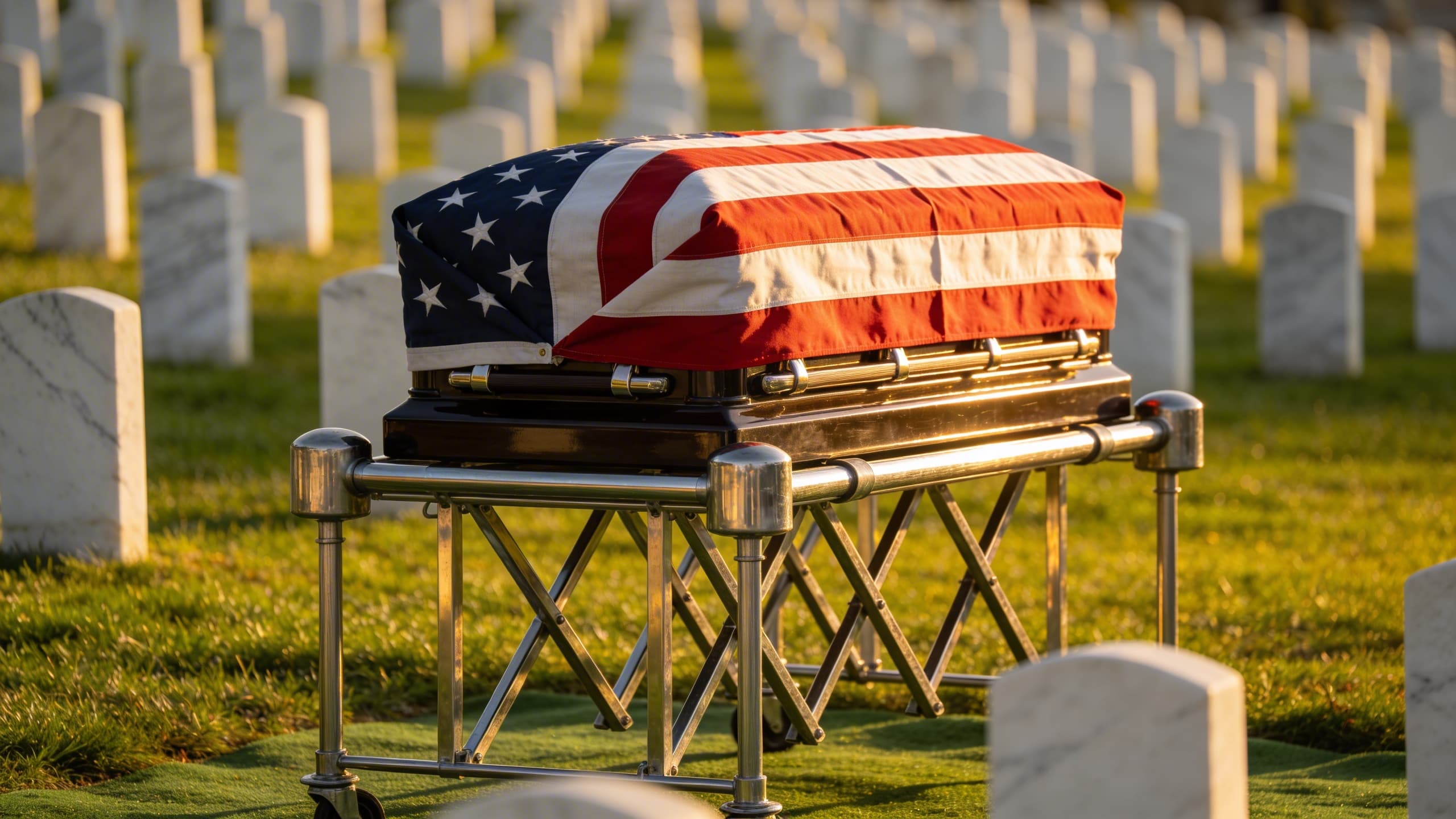
Flag-draping compatibility. Military caskets are designed to accommodate the standard burial flag drape. The exterior dimensions, lid profile, and hardware placement all account for the flag being stretched taut over the casket during the ceremony. Understanding how the flag should be placed over a military casket is an important part of ceremony preparation, and the casket itself is built with this protocol in mind.
Customization options. Many military caskets offer additional personalization: embroidered interior fabric, rank insignia engraving on exterior hardware, branch-specific corner accents, and the option to wrap the exterior in patriotic or camouflage imagery.
Branch Emblems and Color Schemes by Service
Each branch of the U.S. Armed Forces has a distinct visual identity, and military caskets reflect that identity through emblem placement, exterior finish, and interior lining color.
Army
Army caskets feature a black exterior with gold or red accents. The Army seal is embossed or applied to the head panel. Interior linings are typically black crepe or poly-blend fabric, though some families opt for a camouflage-pattern lining or exterior wrap to reflect the Army's field identity. Gold-toned swingbar handles are standard on most models.
Navy
Navy caskets are available in dark blue or white exterior finishes. The interior is often lined in navy blue fabric with white or silver accents, and the Navy seal is displayed on the head panel. White exterior models pair well with the formal dress traditions of the Navy and provide a crisp, distinguished appearance during the viewing.
Marine Corps
Marine Corps caskets use a black exterior paired with a vivid scarlet red interior lining — the branch's signature color combination. The Eagle, Globe, and Anchor emblem is prominently featured on the head panel. The contrast between the dark exterior and bright red interior creates one of the most visually striking military casket designs.
Air Force
Air Force caskets display a dark blue exterior, both inside and out, with the Air Force seal on the head panel. Some models use silver-toned hardware to complement the blue finish. Interior linings may be a matching blue poly-blend or a lighter blue crepe, depending on the manufacturer and price point.
Coast Guard
Coast Guard caskets follow a similar dark blue exterior scheme with branch-specific emblems on the head panel. While less widely stocked than Army or Marine Corps models, Coast Guard caskets are available through most military casket retailers and can be customized with the Coast Guard seal and racing-stripe accents.
Steel Gauge, Materials, and Construction
The majority of military caskets are constructed from steel, which offers durability, a polished presentation, and compatibility with burial vault requirements at national cemeteries.
20-Gauge Steel
This is the most common option and provides a solid, protective shell at an accessible price point. A 20-gauge metal casket uses thinner steel than an 18-gauge model, but it is more than adequate for burial. Most military caskets in the $2,000–$4,000 range use 20-gauge construction with a high-gloss painted finish.
18-Gauge Steel
Roughly 20% thicker than 20-gauge, 18-gauge steel caskets offer greater structural rigidity and are often marketed as a premium option. The heavier gauge produces a more substantial feel, which some families prefer. Price typically ranges from $3,500 to $6,000 depending on finish and customization.
Rubber Gasket Seal
Both gauges may include a rubber gasket seal around the lid perimeter. This feature creates an airtight closure between the lid and the base, marketed as added protection against outside elements. Federal regulations require sellers to disclose that no casket — gasketed or not — can prevent decomposition indefinitely, but many families still choose the gasketed option for peace of mind.
Wood Options
While steel dominates the military casket market, wood caskets are available with military emblem customization. Hardwood options include oak, cherry, walnut, and mahogany. These can be fitted with branch-specific head panels, embroidered linings, and engraved nameplates. Wooden military caskets generally cost more than steel equivalents, ranging from $3,000 to $8,000 or higher depending on the wood species and craftsmanship.
Hardware and Interior Features
Standard military casket hardware includes reinforced swingbar handles — designed to lift smoothly away from the casket body for secure transport by the casket team during the funeral procession. Interior beds are adjustable at both the head and foot to allow proper positioning. Half-couch lids (split lids that open on the upper half for viewing) are standard, though full-couch models are available.
Flag Draping and Ceremony Compatibility
Military caskets are purpose-built to accommodate the burial flag — a full-size United States flag provided at no cost by the VA to honor the veteran's service.
During a military funeral with full honors, the flag is draped over the closed casket with the union (the blue field of stars) positioned at the head and over the left shoulder of the deceased. The casket's exterior finish, hardware placement, and lid profile are all designed so the flag lies flat and taut without bunching or slipping.
After the ceremony — following the three-volley salute and the sounding of Taps — the flag is folded into its traditional triangle by the casket team and presented to the next of kin. Many families choose to display this flag afterward in a flag display case as a permanent tribute.
For open-casket viewings, the flag is folded and placed inside the casket to the left side of the deceased, or displayed on a stand nearby. The half-couch lid design allows the upper portion of the casket to remain open while the flag rests folded on the closed lower half.
National Cemetery Requirements and Compatibility
Veterans who are buried in a VA national cemetery must meet certain casket and vault standards. Understanding these requirements before purchasing a casket helps avoid last-minute complications.
Outer burial container. Most national cemeteries require an outer burial container — a vault or liner — to prevent the ground above the grave from settling over time. Military caskets are sized to fit standard burial vaults, but families should confirm dimensions with both the casket seller and the cemetery's scheduling office.
No casket restrictions by type. National cemeteries do not mandate a specific type of casket. Steel, wood, and even biodegradable caskets are permitted as long as they meet the cemetery's outer burial container requirements. Choosing a military-themed casket is a family decision, not a VA requirement.
VA-provided items vs. family-purchased items. The VA provides a gravesite, headstone or marker, burial flag, and perpetual care at no cost in national cemeteries. The casket itself is not provided by the VA — it is a family expense. However, the VA burial allowance for veterans may offset a portion of the funeral and burial costs, and families should file the appropriate claims to receive these benefits.
Cremation as an alternative. Veterans who choose cremation receive the same honors at national cemeteries as those with casketed burial. Cremated remains are inurned or buried with identical ceremony and respect. Families exploring this path can review our guide to military urn selection by branch for branch-specific urn options that mirror the emblem and color traditions of military caskets.
How Much Does a Military Casket Cost?
Military caskets span a wide price range depending on material, gauge, finish, and customization level.
Budget range ($1,500–$3,000). Entry-level 20-gauge steel caskets with branch emblem head panels and standard interior linings. These caskets are well-made and dignified — the lower price reflects simpler finishes and fewer customization options, not lower quality construction.
Mid-range ($3,000–$5,000). 18-gauge steel caskets with high-gloss finishes, rubber gasket seals, upgraded interior fabrics, and additional emblem or insignia detailing. This is the most popular price range for families purchasing directly from an online retailer.
Premium range ($5,000–$10,000+). Solid hardwood caskets, stainless steel or bronze models, and fully customized designs with embroidered linings, rank-specific engravings, and branch-color exterior wraps. Families purchasing through a funeral home should expect to pay a markup of 200–400% over the manufacturer's price.
Saving money without sacrificing quality. The FTC's Funeral Rule requires funeral homes to accept caskets purchased from outside vendors. Buying a military casket directly from an online retailer and having it shipped to the funeral home is legal and can reduce the casket expense by thousands of dollars. Many online retailers offer free ground shipping and delivery within 2–7 business days.
Choosing the Right Military Casket: A Decision Framework
With dozens of options across five service branches, narrowing the choice comes down to a few key questions:
Which branch did the veteran serve in? This determines the emblem, color scheme, and interior lining. If the veteran served in multiple branches, families typically select the branch associated with the longest or most meaningful period of service.
Steel or wood? Steel is the standard for military caskets and is available at every price point. Wood offers a warmer aesthetic and may appeal to families planning a memorial that emphasizes natural materials or who want a casket that pairs with a specific wood-finish flag display case.
Gasketed or non-gasketed? A rubber gasket seal adds cost but provides an airtight closure. This is a personal preference — it does not affect burial eligibility at any cemetery.
Open or closed casket? For open-casket viewings, the interior lining color and head panel emblem become the focal visual elements. A scarlet-lined Marine Corps casket or a white-exterior Navy casket creates a powerful visual impression during the service.
Budget and purchasing channel. Families who purchase directly from an online casket retailer rather than through a funeral home will typically save 50–70% on the casket cost alone. The casket can be delivered directly to the funeral home for the service.
For families who are also selecting a permanent memorial marker, our comparison of veteran grave marker options covers VA-provided markers versus privately purchased bronze veteran grave markers and can help coordinate the overall memorial plan.
Frequently Asked Questions
Does the VA provide a casket for veterans?
No. The VA does not provide caskets. The VA's burial benefits include a gravesite in a national cemetery, a government headstone or marker, a burial flag, and a Presidential Memorial Certificate — all at no cost. The casket is a separate expense that the family covers, though a VA burial allowance may help offset funeral and burial costs.
Can I buy a military casket online and have it delivered to a funeral home?
Yes. Under the FTC's Funeral Rule, funeral homes are required to accept caskets purchased from outside sources without charging a handling fee. Several online retailers specialize in military caskets and offer direct-to-funeral-home shipping, often with free ground delivery and arrival within a few business days.
Are military caskets required for a military funeral?
No. A military-themed casket is not a requirement for receiving military funeral honors. The flag draping, three-volley salute, Taps, and flag presentation are performed regardless of casket type. A military casket is a personal choice that adds a visual tribute to the veteran's branch of service.
What is the difference between a 20-gauge and 18-gauge steel casket?
The gauge number refers to the thickness of the steel. A lower gauge number means thicker steel — 18-gauge steel is approximately 20% thicker than 20-gauge. Both are suitable for burial and meet all national cemetery requirements. The choice between them is a matter of preference and budget, not regulatory compliance.
Can a military casket be used for cremation?
While any casket can technically be used for a cremation viewing service, the casket is typically not cremated with the body. Rental caskets are a cost-effective option for families who want a military-themed viewing followed by cremation. The veteran's cremation urns can then carry the same branch-of-service emblems and colors as the casket.