🏬Supersize Online Funeral Retailer🪦1000's of Headstones⚱️Over 10,000 Cremation Urns⚰️Caskets Overnight Delivery🛒Funeral & Memorial Superstore🚚FREE Shipping on ALL Orders👨👩👧👦Helping Families for over 20 Years💰Lowest Price Guarantee🏬Supersize Online Funeral Retailer🪦1000's of Headstones⚱️Over 10,000 Cremation Urns⚰️Caskets Overnight Delivery🛒Funeral & Memorial Superstore🚚FREE Shipping on ALL Orders👨👩👧👦Helping Families for over 20 Years💰Lowest Price Guarantee
🏬Supersize Online Funeral Retailer🪦1000's of Headstones⚱️Over 10,000 Cremation Urns⚰️Caskets Overnight Delivery🛒Funeral & Memorial Superstore🚚FREE Shipping on ALL Orders👨👩👧👦Helping Families for over 20 Years💰Lowest Price Guarantee🏬Supersize Online Funeral Retailer🪦1000's of Headstones⚱️Over 10,000 Cremation Urns⚰️Caskets Overnight Delivery🛒Funeral & Memorial Superstore🚚FREE Shipping on ALL Orders👨👩👧👦Helping Families for over 20 Years💰Lowest Price Guarantee
When a veteran passes, the medals, challenge coins, rank insignia, and service memorabilia left behind carry enormous weight. These small objects tell a story that words often cannot — of duty stations, deployments, promotions, and sacrifices made over years or decades of service. A medallion case gives those objects a permanent, protected home where the story stays visible and intact for generations.
This guide is part of our veteran memorial planning guide, which walks families through every option for honoring a loved one's military service. Here, we focus specifically on medallion cases and related memento displays — what they hold, how they differ from shadow boxes and flag cases, which branch medallions are available, and how to choose the right size and style for your situation.
What Is a Medallion Case?
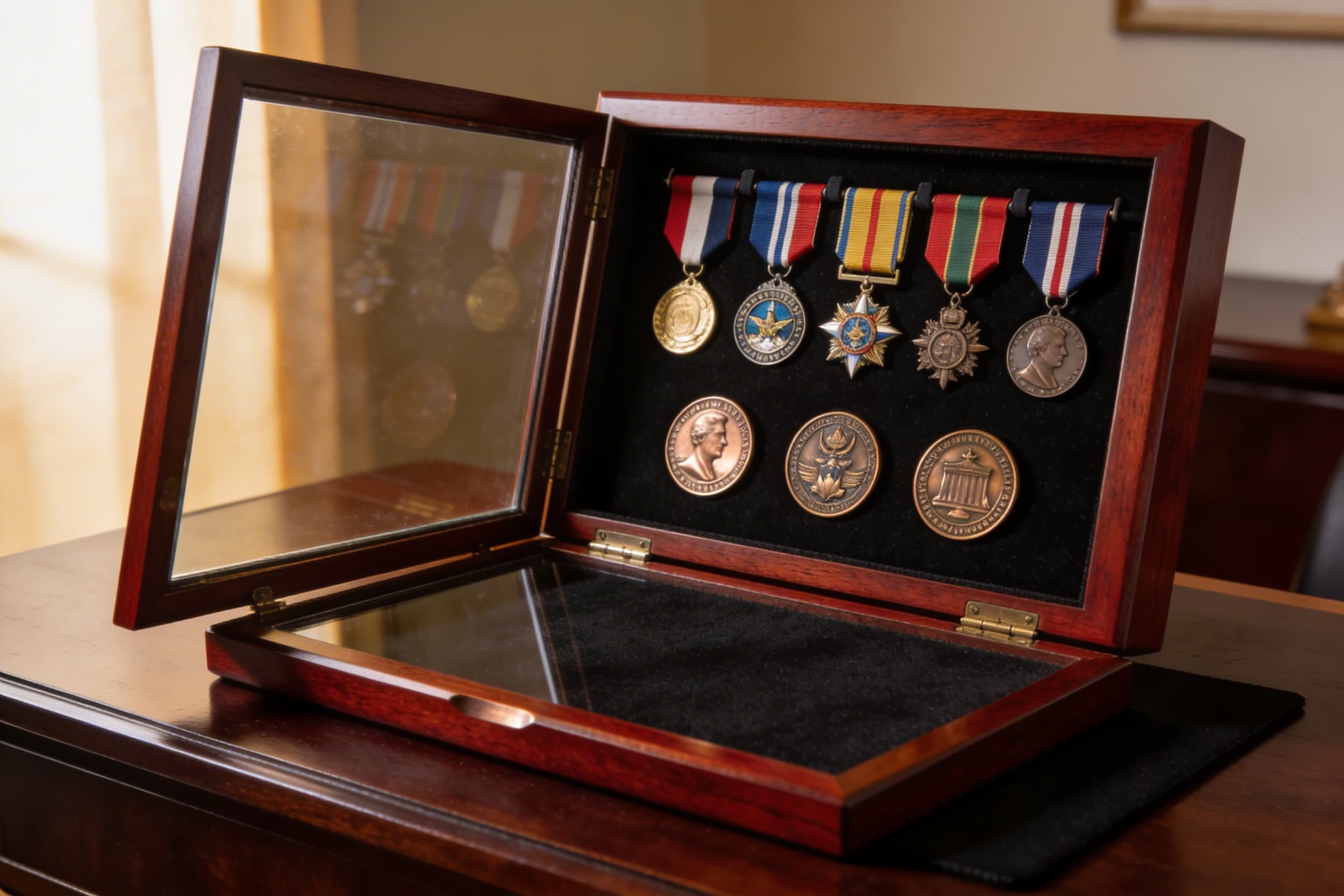
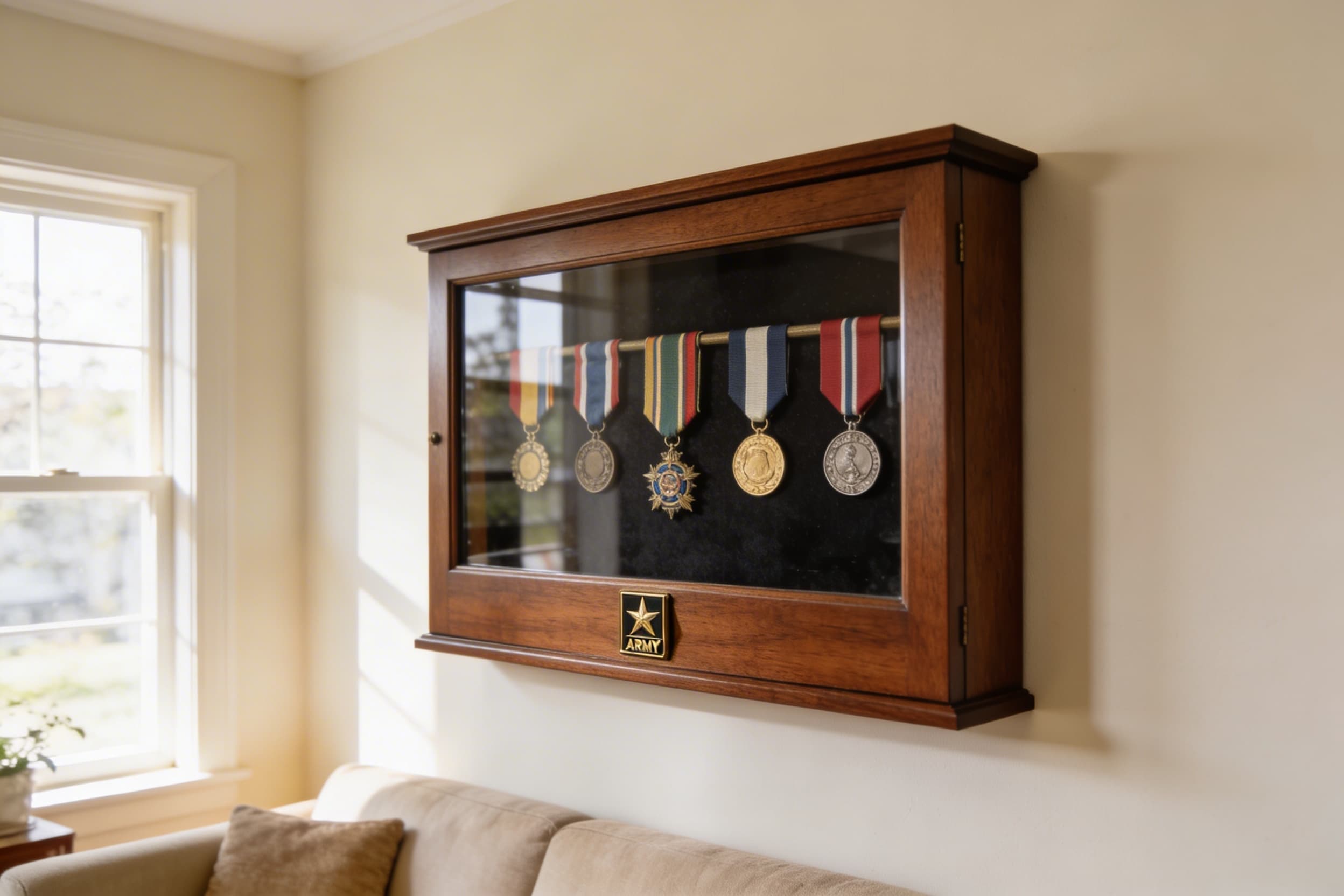
A medallion case is a purpose-built display designed to showcase military medallions, service medals, challenge coins, rank insignia, and other small memorabilia associated with a veteran's career. Most medallion cases are constructed from solid hardwood — cherry, walnut, oak, or mahogany — with a glass or acrylic front panel that protects the contents while keeping them visible.
Unlike a simple storage box, a medallion case is meant to be displayed. Many models mount directly to a wall, while others sit on a shelf or mantel. The interior typically features a felt-lined or velcro-friendly backdrop where items can be pinned, mounted, or arranged in a layout that mirrors how medals and ribbons would appear on a dress uniform.
Some medallion cases include a built-in compartment for a folded burial flag, combining two display functions in one unit. Others focus exclusively on medals and coins, leaving the flag display to a separate flag display case.
What Medallion Cases Display
The contents of a medallion case vary depending on the veteran's service history, but families commonly display:
Service medals and ribbons. These are the awards earned throughout a military career — Purple Hearts, Bronze Stars, campaign medals, unit citations, and good conduct medals. Arranging them in the correct order of precedence (as they would appear on the uniform) adds authenticity to the display.
Challenge coins. Challenge coins are a deeply personal military tradition. Service members collect them from commanding officers, units, deployments, and special events. A single veteran may accumulate dozens over a career, and each one represents a specific moment or relationship within their service.
Branch insignia and rank devices. Collar brass, shoulder boards, cap devices, and unit crests identify the veteran's branch, rank, and assignments. Displaying these alongside medals gives context to the career progression.
Campaign ribbons and patches. Fabric patches from units, deployments, and special assignments add color and identity to the display. Many families arrange patches chronologically to tell the story of the veteran's career from enlistment to retirement or separation.
Personal memorabilia. Dog tags, photographs, letters, news clippings, and small personal items round out the display. Some families include a copy of the veteran's DD-214 discharge papers or a certificate of service.
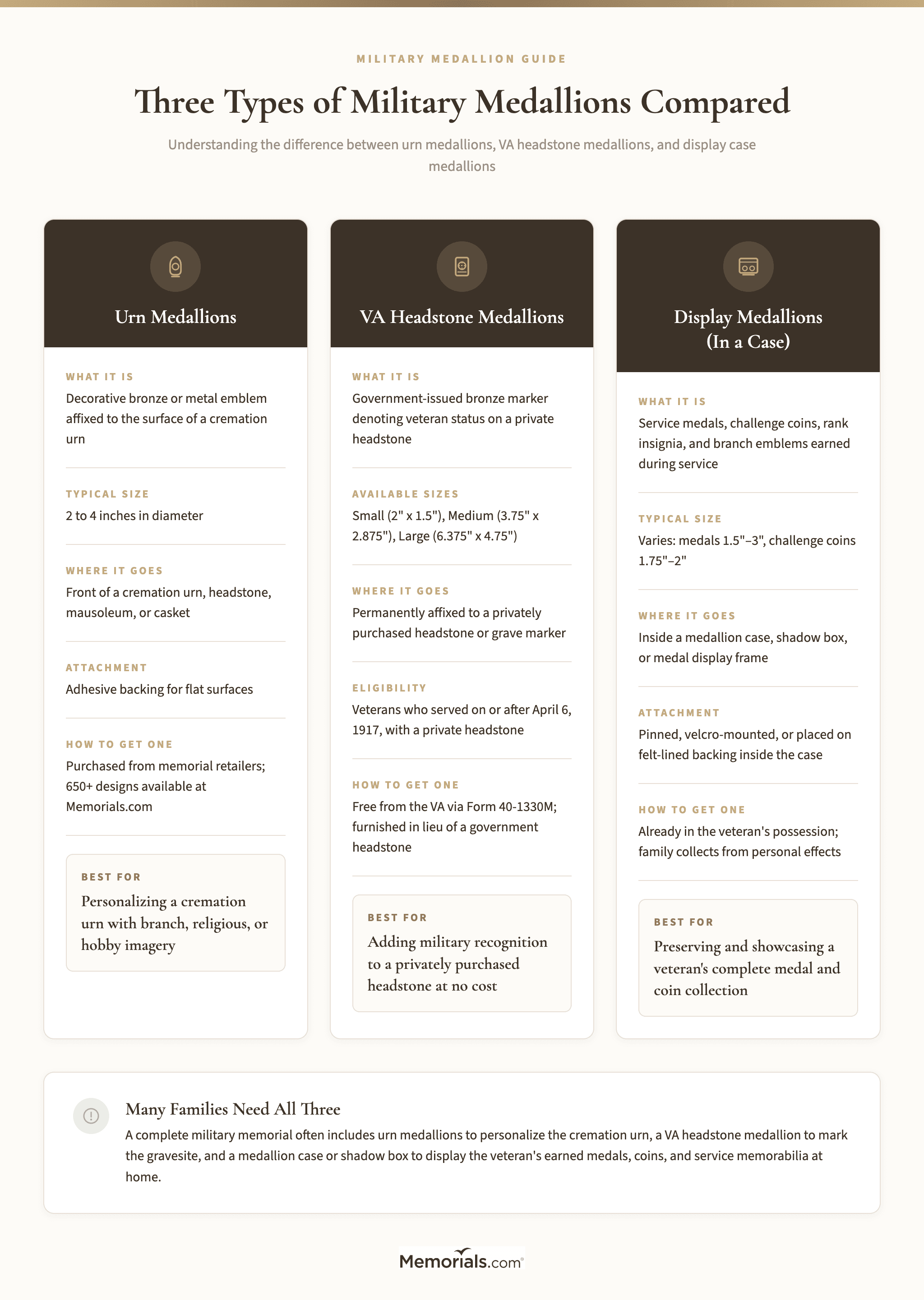
Urn Medallions vs. Headstone Medallions vs. Display Medallions
The word "medallion" appears in several different contexts within military memorials, and the distinctions matter when choosing products.
Urn medallions are decorative bronze or metal emblems designed to be affixed to the surface of a cremation urn. Memorials.com carries over 650 options — from branch-specific military emblems (Army, Navy, Air Force, Marines, Coast Guard, Space Force) to religious symbols, fraternal organizations, hobby icons, and personalized photo frames. These medallions attach with adhesive backing and typically measure two to four inches across. They are a way to personalize a cremation urn with imagery that reflects the veteran's identity and service. If you are choosing an urn for a veteran, our guide to military urn selection and medallions covers branch-specific designs, sizing, and medallion pairing in detail.
Headstone medallions are a specific VA benefit. The Department of Veterans Affairs provides bronze medallions — available in small (2" × 1.5"), medium (3.75" × 2.875"), and large (6.375" × 4.75") sizes — that can be affixed to a privately purchased headstone or marker to denote the deceased's veteran status. These are furnished through VA Form 40-1330M and are available in lieu of a government-furnished headstone. Families who already have a private headstone and want to add military recognition should explore veteran grave marker emblem options to understand the full range of VA-provided and privately purchased marker choices.
Display medallions — the kind housed inside a medallion case — are the physical medals, coins, and branch emblems that a veteran earned and collected during service. These are the objects the family already possesses and wants to preserve and showcase.
Understanding these three categories prevents confusion when shopping. A family might need all three: a display medallion case for the veteran's medal collection, urn medallions to personalize their cremation urn, and a VA headstone medallion to mark their gravesite.
Branch Medallions Available
Every branch of the United States Armed Forces has an official emblem that appears on medallions, display cases, and memorial products:
Army. The Army emblem features the familiar black, gold, and white design. Army medallions are among the most commonly requested and appear on urn appliques, flag case fronts, and shadow box plaques.
Navy. The Navy emblem showcases the eagle, anchor, and ship. Navy medallions carry a strong nautical tradition, fitting for a branch whose shadow box custom originated aboard sailing ships.
Air Force. The Air Force emblem — the wings and star — appears on everything from flag cases to certificate frames. Air Force medallions are popular for retirement shadow boxes.
Marine Corps. The Eagle, Globe, and Anchor is one of the most recognizable military emblems. Marine Corps medallions tend to be among the most detailed and ornate.
Coast Guard. The Coast Guard emblem features the crossed anchors and shield. Though sometimes overlooked, Coast Guard veterans are fully eligible for the same memorial benefits and display options.
Space Force. The newest branch's delta emblem is increasingly available on medallions and memorial products as the inventory of Space Force memorabilia grows.
Most medallion cases and flag cases allow you to select a branch-specific brass medallion that mounts to the exterior of the case, instantly identifying which branch the veteran served in.
Medallion Case vs. Shadow Box vs. Memento Box
Families often encounter three related product categories when looking for a way to display military memorabilia. Each serves a different purpose, and some families use more than one.
Medallion case. Focused specifically on medals, coins, rank devices, and small memorabilia. Compact, wall-mountable, and designed with a felt or velcro interior for precise arrangement. Best for families who want a clean, formal display of military decorations without including the burial flag. Typical dimensions range from 12" × 16" to 18" × 22", with depths of 1.5" to 3".
Shadow box. A larger display that combines the burial flag with medals, ribbons, insignia, photographs, patches, and other memorabilia in a single frame. Shadow boxes tell a more complete story of the veteran's service and are the traditional retirement or memorial gift in military culture. For creative layout ideas and arrangement tips, see our guide to military shadow box ideas. Shadow boxes typically range from 20" × 26" to 24" × 36".
Memento boxes. These are chests or decorative boxes designed to store — not necessarily display — personal keepsakes, letters, jewelry, news clippings, and other memorabilia. Unlike cases with glass fronts, memento boxes open and close, allowing family members to revisit the contents whenever they choose. Some models include photo frames on the exterior and are large enough to hold a cremation urn insert.
Quick Comparison
A simple way to decide: if you want to display medals and coins on the wall in a formal arrangement, choose a medallion case. If you want to combine the burial flag with medals and tell the full story, choose a shadow box. If you need a private, hands-on way to store letters, jewelry, and personal keepsakes, choose a memento box. Many families choose two — a shadow box or flag case for the flag and medals, plus a memento box for the more personal, private items.
Choosing the Right Size
The size of your medallion case depends on how much memorabilia you need to display. Before purchasing, lay out all the items you plan to include on a flat surface and measure the arrangement.
Small cases (12" × 16" or smaller) work well for veterans with a modest collection — a few medals, a set of rank insignia, and one or two challenge coins. These are also appropriate for displaying a single campaign's worth of awards.
Medium cases (16" × 20" to 18" × 22") accommodate a fuller career collection — multiple rows of medals and ribbons, several challenge coins, patches, and unit crests. This is the most popular size range for memorial displays.
Large cases (20" × 26" and above) are necessary for long-career veterans with extensive collections, or for families who want to include photographs, certificates, or other larger items alongside the medals.
Pay attention to case depth as well. Standard medallion cases are 1.5" to 2" deep, which is sufficient for flat medals and ribbons. If you plan to include three-dimensional items like challenge coins, dog tags, or figurines, look for cases with 2.5" to 3" depth.
Materials, Finishes, and Construction
Quality medallion cases are built from solid hardwood — not MDF or particleboard. The most common wood species and finishes include:
Cherry. A warm, reddish-brown tone that deepens with age. Cherry is the most popular finish for military display cases and pairs well with brass hardware and branch medallions.
Walnut. A rich, dark brown with distinctive grain patterns. Walnut conveys a more formal, traditional look and is often chosen for heirloom-quality pieces.
Oak. A lighter, golden-toned option with visible grain. Oak is durable and versatile, fitting both traditional and contemporary settings.
Mahogany. A deep, warm reddish tone associated with fine furniture. Mahogany cases are typically at the higher end of the price range.
The front panel should be glass or high-quality acrylic. Acrylic is lighter, shatter-resistant, and often includes UV protection that prevents medals and fabrics from fading over time. Glass offers a more traditional look and slightly better optical clarity.
Look for cases with a rear-loading design — a removable back panel secured with turn buttons or screws — so you can arrange and rearrange items without removing the case from the wall.
Personalizing Your Medallion Case
Most medallion cases can be customized with an engraved brass or gold plaque that identifies the veteran. Common plaque inscriptions include:
Full name and rank
Branch of service
Years of service (e.g., "1968–1992")
Dates of birth and passing
A short tribute phrase ("In Honor of His Service" or "With Grateful Appreciation")
The plaque typically attaches to the exterior below the glass panel with adhesive backing. Some manufacturers offer laser-engraved glass fronts that display the branch emblem, the veteran's name, and service dates directly on the viewing surface.
If you are choosing a flag case to complement the medallion case, look for choosing a case for the veteran's burial flag — our guide covers wood matching, sizing for the standard 5' × 9.5' burial flag, and how to coordinate a flag case and medallion case as a matched set.
How to Arrange Items in a Medallion Case
Arrangement matters both for visual impact and for accurately representing the veteran's service. Follow these guidelines:
Start with the most prestigious awards. Place the highest-ranking medals (Purple Heart, Bronze Star, Silver Star) in the most prominent position — typically the upper center of the case.
Follow the order of precedence. Military decorations have an official order of precedence that dictates how they appear on the uniform. Recreating this order inside the display case adds authenticity and shows respect for military tradition.
Group related items. Keep medals and their corresponding ribbons together. Place unit patches and insignia near the rank devices from that period of service.
Leave breathing room. Resist the urge to fill every square inch. A well-spaced arrangement looks more dignified and allows each item to be seen clearly.
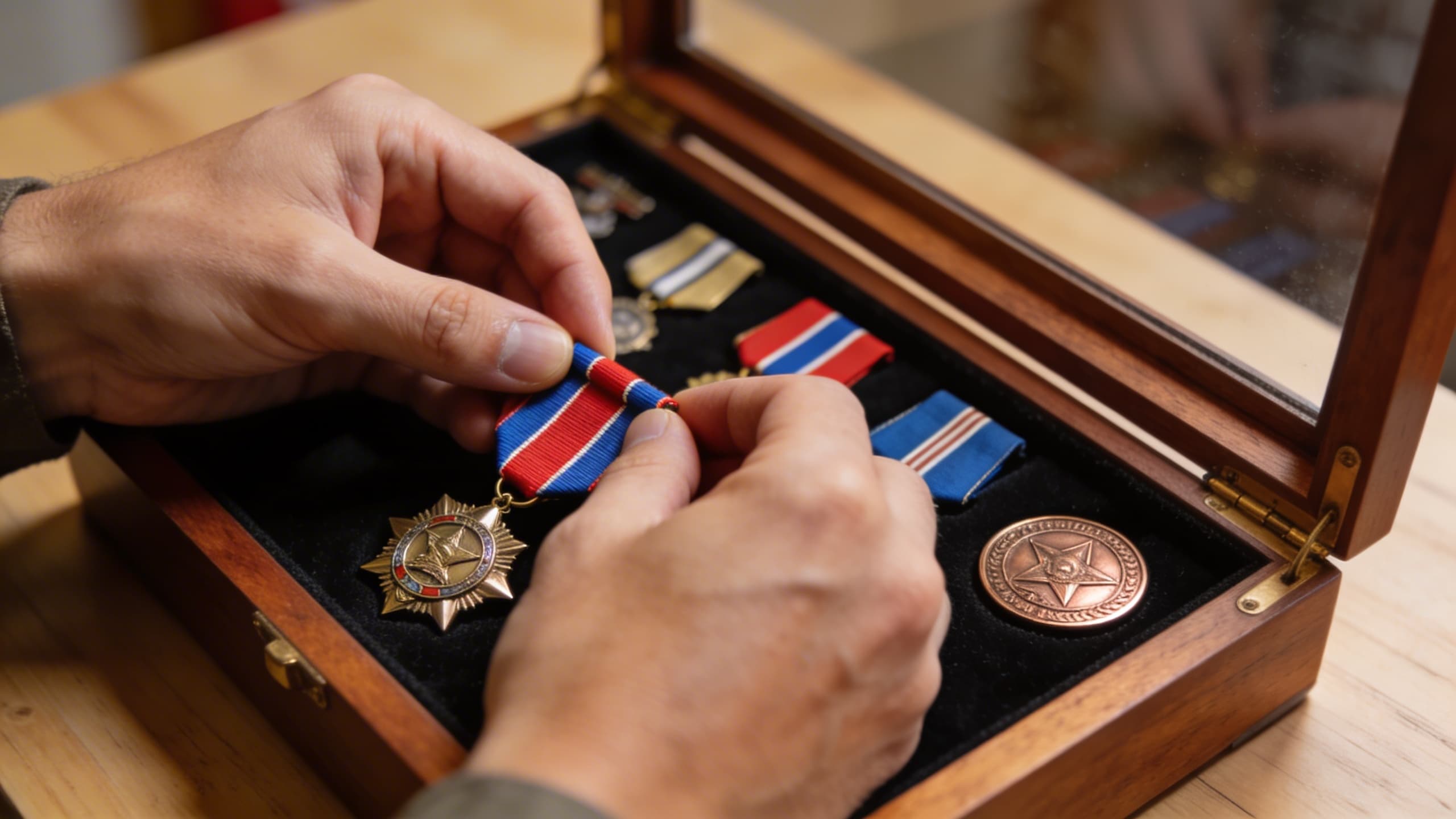
Pin or mount securely. Use push pins for fabric items like patches and ribbons. Use velcro strips for heavier items like challenge coins and metal insignia. For medals with pin backs, push directly into the felt backing.
Photograph the uniform first. If the veteran's dress uniform is available, photograph the medal and ribbon layout before disassembling. This gives you a reference for the correct arrangement inside the case.
How to Order a Medallion Case
Ordering a medallion case is straightforward, but a few decisions need to be made upfront:
Determine what you will display. Gather all items and measure the total space needed.
Choose the case type. Medallion case only, or a combination flag-and-medallion case?
Select the wood and finish. Match the finish to existing furniture, the flag case, or the veteran's personal taste.
Choose the branch medallion. Most cases include an optional brass branch emblem for the exterior.
Add personalization. Order an engraved plaque with the veteran's name, rank, and service dates.
Memorials.com carries medallion cases in multiple styles and finishes, along with complementary memento boxes for families who need both display and storage options. All orders ship with free delivery.
Frequently Asked Questions
What is the difference between a medallion case and a shadow box?
A medallion case is a compact display focused on medals, coins, and small insignia. A shadow box is larger and typically includes a compartment for the burial flag alongside medals, photographs, patches, and other memorabilia. Shadow boxes tell a broader story; medallion cases focus on the decorations themselves.
Can I use a medallion case for non-military items?
Yes. Medallion cases work for displaying any collection of small, meaningful items — police and fire department awards, scout badges, fraternal organization pins, or family heirlooms. The felt-lined interior and glass front protect any small keepsakes you want to preserve.
How do VA headstone medallions differ from display medallions?
VA headstone medallions are bronze markers provided by the Department of Veterans Affairs (via VA Form 40-1330M) to be permanently affixed to a privately purchased headstone. They signify the deceased's veteran status. Display medallions are the service medals, challenge coins, and branch emblems that a veteran earned during service — these go inside a display case, not on a headstone.
What size medallion case do I need?
Lay out all items you plan to display on a flat surface and measure the total arrangement. Add 2–3 inches of margin on each side for breathing room. Small cases (12" × 16") suit a modest collection; medium cases (16" × 20") handle a full career; large cases (20" × 26"+) accommodate extensive collections with photographs or certificates.
Do medallion cases come with mounting hardware?
Most wall-mount medallion cases include mounting brackets or keyhole slots. Check the product description to confirm. For heavy cases (over 10 pounds when loaded), use wall anchors rated for the total weight.
Creating a Lasting Military Tribute
A medallion case is more than a display — it is a curated tribute to a life of service. The medals inside represent courage under fire, years of dedication, deployments far from home, and a commitment that shaped not just the veteran's life but the lives of everyone around them. By choosing a quality case, arranging the contents with care, and personalizing it with the veteran's name and story, you create something that future generations can stand in front of and understand exactly who this person was and what they gave.
Browse our complete collection of medallion cases, flag cases, and memento boxes to find the right combination for your family's tribute.