🏬Supersize Online Funeral Retailer🪦1000's of Headstones⚱️Over 10,000 Cremation Urns⚰️Caskets Overnight Delivery🛒Funeral & Memorial Superstore🚚FREE Shipping on ALL Orders👨👩👧👦Helping Families for over 20 Years💰Lowest Price Guarantee🏬Supersize Online Funeral Retailer🪦1000's of Headstones⚱️Over 10,000 Cremation Urns⚰️Caskets Overnight Delivery🛒Funeral & Memorial Superstore🚚FREE Shipping on ALL Orders👨👩👧👦Helping Families for over 20 Years💰Lowest Price Guarantee
🏬Supersize Online Funeral Retailer🪦1000's of Headstones⚱️Over 10,000 Cremation Urns⚰️Caskets Overnight Delivery🛒Funeral & Memorial Superstore🚚FREE Shipping on ALL Orders👨👩👧👦Helping Families for over 20 Years💰Lowest Price Guarantee🏬Supersize Online Funeral Retailer🪦1000's of Headstones⚱️Over 10,000 Cremation Urns⚰️Caskets Overnight Delivery🛒Funeral & Memorial Superstore🚚FREE Shipping on ALL Orders👨👩👧👦Helping Families for over 20 Years💰Lowest Price Guarantee
Every veteran who served honorably earned the right to a marked grave — and the Department of Veterans Affairs will provide a headstone or marker at no cost to the family. But the government-issued options come with fixed designs, limited personalization, and specific size constraints that don't always match what a family envisions. That gap is why many families explore privately purchased bronze markers that offer greater creative control, custom sizing, and the ability to honor a spouse alongside the veteran. Our covers the full range of memorial decisions military families face, from burial benefits to flag display. This article focuses on one of the most important choices: which type of best honors your loved one's service.
Understanding the differences between VA-provided and purchased markers — and knowing you can use both — helps families make a confident decision during an already difficult time. For a full overview of every benefit available, including burial allowances and cemetery eligibility, see our guide to VA burial benefits and headstone provision.
What the VA Provides at No Cost
The VA furnishes headstones, markers, and medallions free of charge through the National Cemetery Administration. Eligibility extends to any veteran discharged under conditions other than dishonorable, active-duty service members who die in service, and certain Reserve and National Guard members. Spouses and dependent children are eligible for government-furnished markers only when buried in a national or state veterans cemetery.
Flat Markers
Flat grave markers are the most common VA-provided option for veterans buried in private cemeteries. They are available in three materials:
Granite or marble flat markers measure 24 inches long by 12 inches wide by 4 inches thick and weigh approximately 130 pounds. Color variations occur naturally in marble, which may show light to moderate veining.
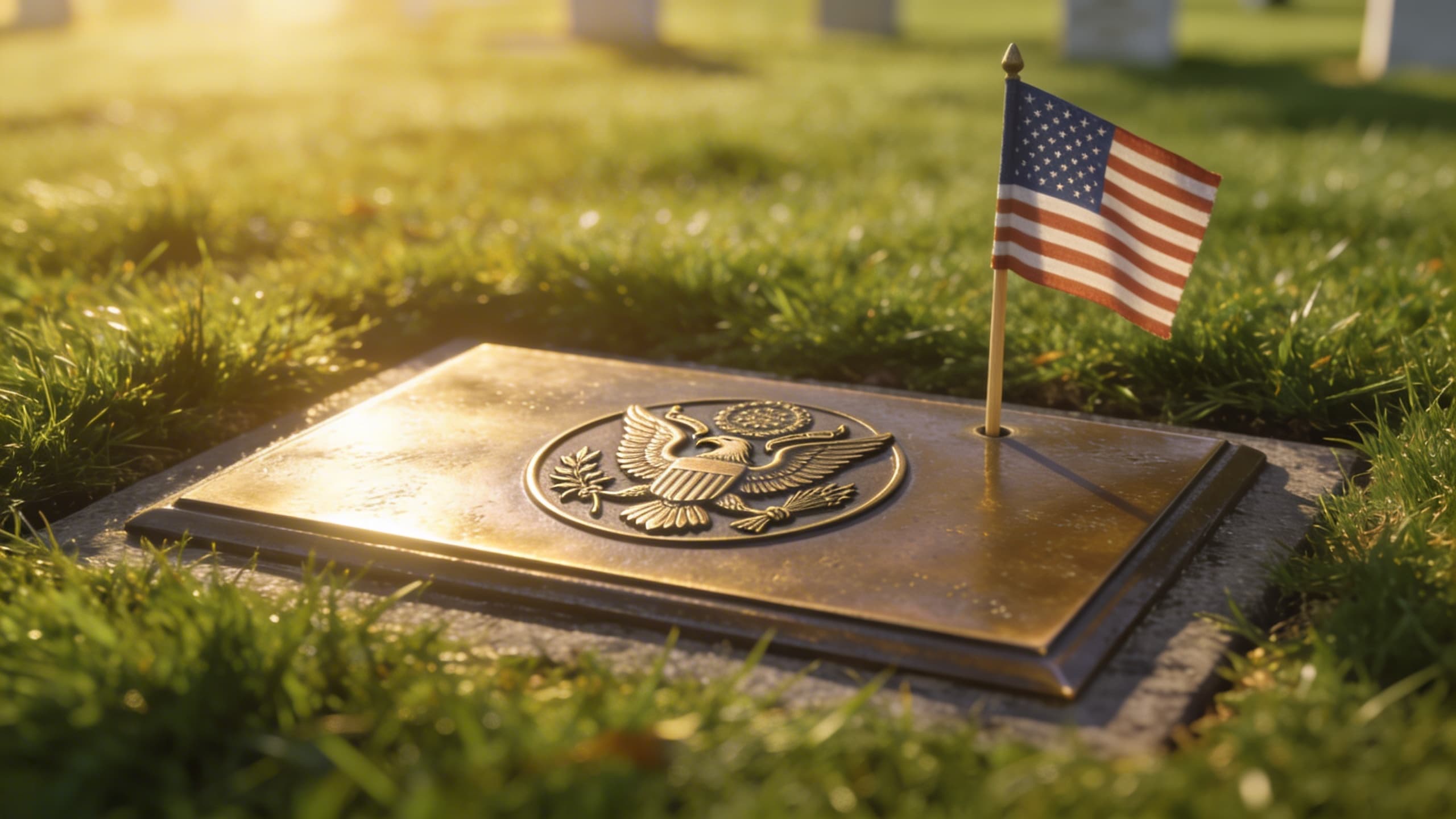
Bronze flat markers measure 24 inches long by 12 inches wide with a 3/4-inch rise and weigh approximately 18 pounds. The VA supplies anchor bolts, nuts, and washers for mounting, but does not furnish the concrete or granite base the marker sits on.
Upright Headstones
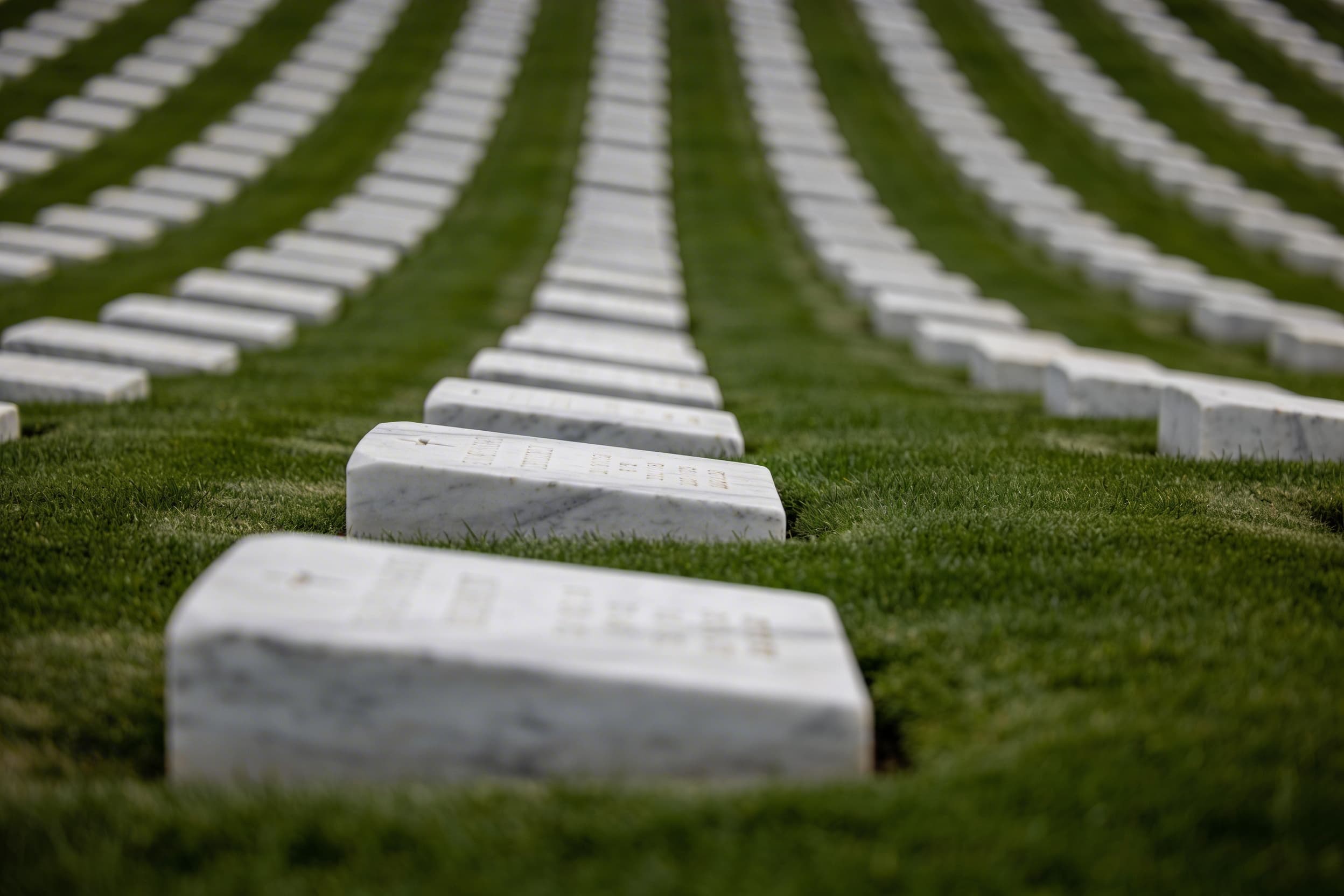
Upright headstones in granite or marble are available for veterans buried in national cemeteries, state veterans cemeteries, or private cemeteries that permit upright markers. These are the tall, rectangular stones most people picture when they think of Arlington National Cemetery. The style chosen must comply with the regulations of the cemetery where it will be placed.
Bronze Niche Markers
For veterans whose cremated remains are placed in a columbarium niche, the VA provides a bronze niche marker measuring 8.5 inches long by 5.5 inches wide with a 7/16-inch rise. Mounting bolts and washers are included.
Memorial Headstones
When a veteran's remains are not recovered, were buried at sea, donated to science, or cremated and scattered, the VA furnishes a memorial headstone or marker inscribed with "In Memory Of" as the first line. These markers may be placed in any recognized cemetery.
VA Medallions
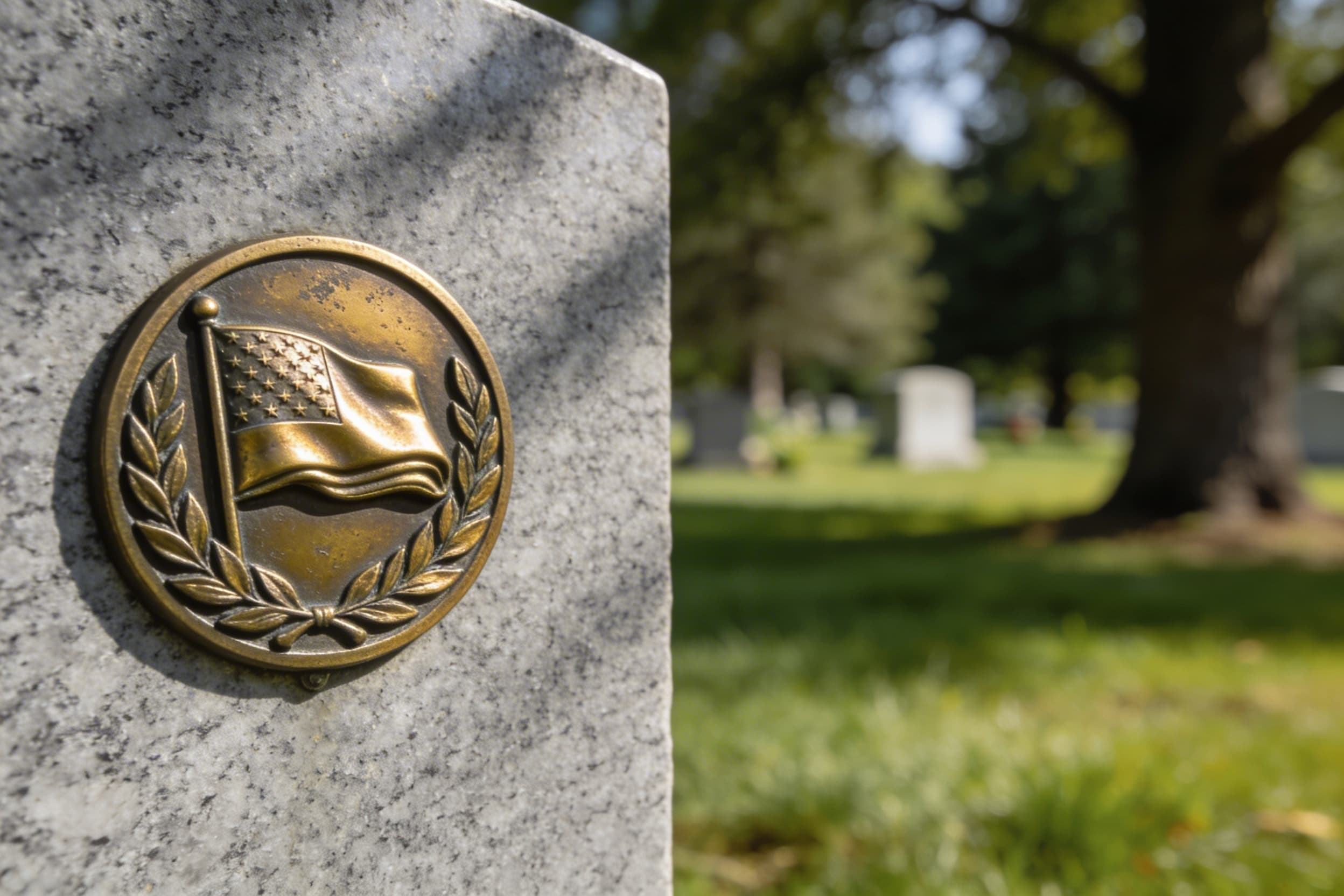
Veterans who served on or after April 6, 1917, and whose grave in a private cemetery is already marked with a privately purchased headstone, may receive a bronze medallion instead of a government marker. The medallion is inscribed with "VETERAN" across the top and the branch of service at the bottom. It comes in three sizes — small (2 inches wide), medium (3.75 inches), and large (6.375 inches) — along with a mounting kit for the family or cemetery staff to affix it to the existing stone.
An important limitation: eligible veterans may receive either a government headstone/marker or a medallion, but not both.
Mandatory and Optional Inscriptions on VA Markers
Every government-furnished marker must include the veteran's legal name, branch of service, and year of birth and death. Beyond those required elements, families may request additional inscriptions if space allows:
Month and day of birth and death
Highest rank attained
War service (e.g., "Vietnam," "World War II")
Military awards and decorations
Unit designations
An approved emblem of belief (the VA currently offers nearly 80 options)
The VA does not permit commercial advertising, political statements, or obscene language on government markers. All inscription content must be approved, and the next of kin or authorized representative provides the details.
Limitations of VA-Provided Markers
While the government program is a meaningful benefit, it comes with constraints that prompt many families to consider alternatives:
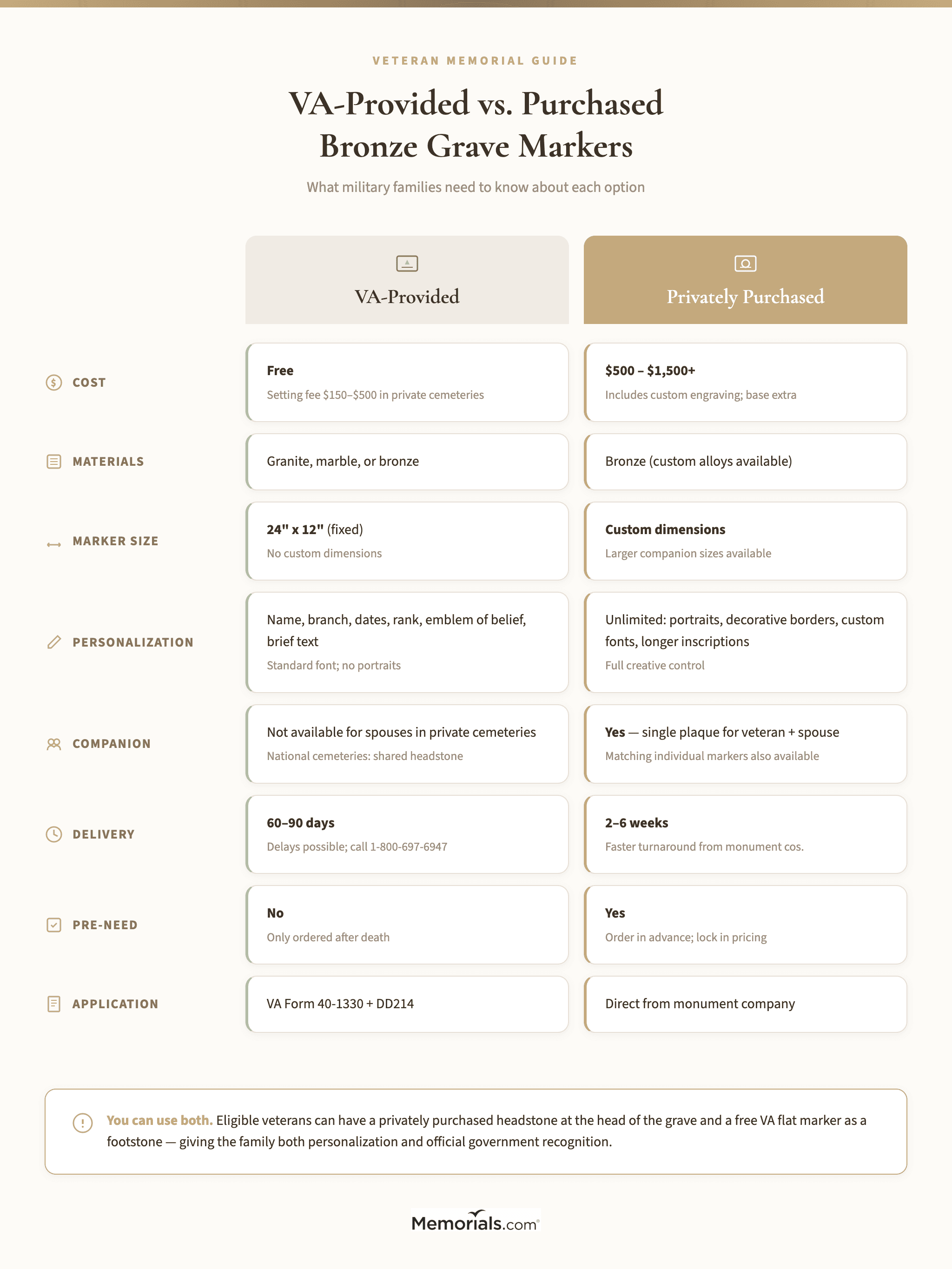
Fixed dimensions. All flat markers are the same 24 × 12-inch size. Upright headstones follow standard sizing for the cemetery type. There is no option for a larger, more prominent marker.
Limited design flexibility. The overall shape, layout, and font are standardized. You cannot choose a custom font, add a laser-etched portrait, or incorporate decorative borders.
No companion marker for spouses in private cemeteries. The VA does not furnish headstones or markers for spouses or dependents buried in private cemeteries. A spouse buried beside a veteran in a private cemetery will need a privately purchased marker — and many families want both markers to match.
No base furnished for bronze markers. The flat bronze marker comes with mounting hardware, but the concrete or granite base must be sourced and paid for separately.
Installation is the family's responsibility in private cemeteries. While national and state veterans cemeteries install government markers at no cost, private cemetery setting fees — typically $150 to $500 depending on the cemetery and marker type — fall on the family.
Delivery timeline. Government markers typically arrive 60 to 90 days after the application is approved, though delays can occur. If more than 60 days have passed without delivery, the VA's Applicant Assistance line (1-800-697-6947) can help track the order.
Many families start with the intention of using only the free VA marker — then discover a specific need that the government program doesn't address. The most common reasons families purchase a private bronze marker include:
Matching a spouse's marker. Because the VA won't provide a marker for a non-veteran spouse in a private cemetery, families often purchase a bronze marker that matches the veteran's government-issued bronze plaque so the two markers sit side by side with a unified appearance.
Greater personalization. Private military grave markers for veterans allow for custom dimensions, laser-etched photos, decorative borders, unique fonts, and longer inscriptions than the VA permits. A family can incorporate a portrait, a favorite scripture, or a unit insignia rendered in full artistic detail.
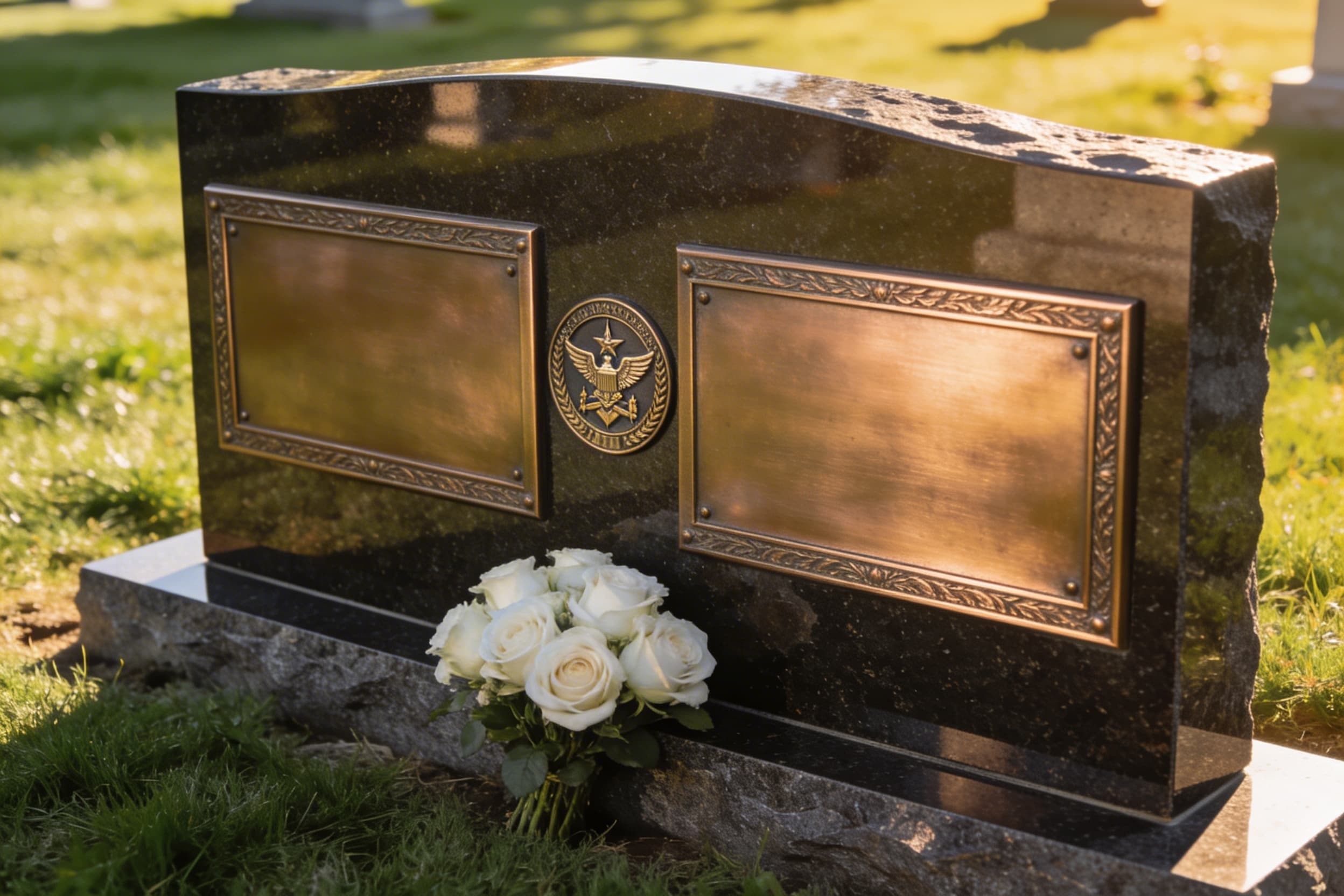
Companion markers for couples. A single companion bronze marker can honor both the veteran and their spouse on one shared plaque, eliminating the need for two separate stones. This is especially popular when both individuals have passed and the family wants one cohesive memorial.
Pre-need planning. Government headstones cannot be ordered until after the veteran's death. Families who are planning ahead sometimes purchase a private marker in advance so the memorial is ready when the time comes — a purchase that also locks in today's pricing.
Faster delivery. Private monument companies typically deliver within two to six weeks, compared to the 60- to 90-day timeline for VA markers.
Companion vs. Individual Markers
One of the biggest decisions is whether to mark the veteran's grave with an individual marker or a companion marker shared with a spouse.
Individual markers are the standard choice. The veteran receives their own marker — either VA-provided or privately purchased — and the spouse receives a separate, matching marker beside it. This works well when both markers can be identical in material and dimensions.
Companion markers place both names on a single, wider bronze plaque or stone. They create a unified look and often cost less than two separate markers. Companion markers are especially practical in cemeteries that restrict the number of monuments per plot.
If the veteran is buried in a national cemetery, the VA will provide one headstone that includes both the veteran's and the eligible spouse's inscriptions on the same stone. In a private cemetery, however, a companion marker must be privately purchased — the VA provides individual markers only.
What About Cremation?
Veterans who chose cremation have their own set of marker options. If the urn is interred in a columbarium niche, the VA provides a bronze niche marker at no cost. If the urn is buried in a cemetery plot, a standard flat or upright VA marker can be ordered just as it would for a casket burial.
For families exploring urn options, our guide to choosing a military veteran urn covers VA-provided commemorative urns, national cemetery requirements, and how to select a cremation urn that reflects the veteran's branch of service. Those choosing a traditional casket burial can review military casket options and features to understand what's available.
If a veteran's remains were scattered, donated, or lost, the VA will still furnish an "In Memory Of" memorial marker that can be placed in any recognized cemetery.
A marker with a name and no remains beneath it is not an improvised arrangement; it is an old and recognized form, and the cenotaph meaning is the word a cemetery office and a monument company will both understand when you ask for one.
How to Order a VA Marker
Ordering a government headstone, marker, or medallion involves a straightforward application process:
Step 1: Gather discharge documents. You'll need a copy of the veteran's DD214 or other separation papers. Do not send originals — the VA cannot return them.
Step 2: Complete the correct form.
For a headstone or marker: Submit VA Form 40-1330, Claim for Standard Government Headstone or Marker.
For a medallion: Submit VA Form 40-1330M, Claim for Government Medallion for Placement in a Private Cemetery.
Step 3: Submit by mail or fax. Send the completed form and a copy of the DD214 to the NCA FP Evidence Intake Center, P.O. Box 5237, Janesville, WI 53547, or fax to 1-800-455-7143.
Step 4: Arrange installation. If the veteran is buried in a private cemetery, the family is responsible for coordinating and paying for marker installation. The cemetery or funeral director can typically handle the setting. National and state veterans cemeteries install markers at no additional cost.
For questions about an existing order, the VA's Applicant Assistance Unit is available Monday through Friday, 8:00 a.m. to 5:00 p.m. Eastern, at 1-800-697-6947.
How to Choose the Right Marker for Your Family
Start by asking these questions:
Is the veteran buried in a national/state veterans cemetery or a private cemetery? National cemeteries handle marker ordering automatically and only allow the standard marker style used at that location. In private cemeteries, families have the full range of VA and private options.
Does the spouse need a marker too? If the spouse is or will be buried in a private cemetery beside the veteran, a VA marker is not available for the spouse. A privately purchased matching marker or companion marker is the best path to a cohesive memorial.
How important is personalization? If the family wants a portrait, decorative elements, or inscription length beyond VA limits, a privately purchased marker is the clear choice.
Is timing a factor? Families who need a marker in place quickly — for a Memorial Day gathering, a family reunion, or simply for personal closure — may prefer the faster turnaround of a private monument company.
Budget considerations. The VA marker is free (aside from private-cemetery setting fees of $150 to $500). Privately purchased bronze markers for veterans typically start around $500 for a basic individual plaque and can reach $1,500 or more for larger companion markers with custom engraving and portrait etching.
Can You Use Both?
Yes. For veterans who died on or after November 1, 1990, and whose grave in a private cemetery is already marked with a privately purchased headstone, the VA will still provide a government marker. Many families use the government flat marker as a footstone at the base of the grave while a privately purchased headstone stands at the head. This approach gives the grave both the personalized memorial the family wanted and the official government recognition of the veteran's service.
The one restriction: if you request a VA medallion instead of a marker, the veteran is not eligible for a government headstone or marker afterward. Choose one or the other.
Emblems of Belief and Branch Insignia
Both VA and privately purchased markers can incorporate military symbolism. The VA currently recognizes nearly 80 emblems of belief — from crosses and Stars of David to lesser-known symbols — and each branch of service has its own official emblem. Families selecting a private marker have even more flexibility, as they can reproduce any insignia, unit patch, or campaign ribbon the family wishes to include.
Frequently Asked Questions
Does the VA provide grave markers for a veteran's spouse?
Only if the spouse is buried in a national or state veterans cemetery. In private cemeteries, the VA does not furnish markers for spouses or dependents. Families typically purchase a matching bronze marker from a private monument company.
How long does it take to receive a VA grave marker?
Most orders are fulfilled within 60 to 90 days. If more than 60 days pass without delivery, contact the VA Applicant Assistance Unit at 1-800-697-6947 to check status.
Can I order a VA marker before the veteran passes away?
No. Government headstones and markers can only be ordered after the veteran's death. Families who want to plan ahead can purchase a private marker in advance.
What if the cemetery doesn't allow the VA marker style I want?
Private cemeteries set their own rules about marker styles and materials. Some only allow flat markers; others restrict upright monuments. Always confirm with cemetery officials before submitting a VA application.
Can I add a photo to a VA marker?
No. Government markers use standard text inscriptions and approved emblems only. If you want a laser-etched portrait or photo ceramic, a privately purchased marker is the way to go.
Honoring Service With the Right Marker
Choosing a grave marker is one of the most visible and lasting decisions a military family makes. The VA's free marker program ensures every eligible veteran receives dignified recognition, and privately purchased bronze markers give families the creative freedom to tell a fuller story of the person behind the service record. Whether you use one option or combine both, the goal is the same — a permanent tribute that reflects the honor your veteran earned.
Explore our full collection of bronze veteran grave markers at Memorials.com to see companion and individual designs with military emblems and custom engraving options.