🏬Supersize Online Funeral Retailer🪦1000's of Headstones⚱️Over 10,000 Cremation Urns⚰️Caskets Overnight Delivery🛒Funeral & Memorial Superstore🚚FREE Shipping on ALL Orders👨👩👧👦Helping Families for over 20 Years💰Lowest Price Guarantee🏬Supersize Online Funeral Retailer🪦1000's of Headstones⚱️Over 10,000 Cremation Urns⚰️Caskets Overnight Delivery🛒Funeral & Memorial Superstore🚚FREE Shipping on ALL Orders👨👩👧👦Helping Families for over 20 Years💰Lowest Price Guarantee
🏬Supersize Online Funeral Retailer🪦1000's of Headstones⚱️Over 10,000 Cremation Urns⚰️Caskets Overnight Delivery🛒Funeral & Memorial Superstore🚚FREE Shipping on ALL Orders👨👩👧👦Helping Families for over 20 Years💰Lowest Price Guarantee🏬Supersize Online Funeral Retailer🪦1000's of Headstones⚱️Over 10,000 Cremation Urns⚰️Caskets Overnight Delivery🛒Funeral & Memorial Superstore🚚FREE Shipping on ALL Orders👨👩👧👦Helping Families for over 20 Years💰Lowest Price Guarantee
For families honoring a veteran who chose cremation, selecting the right urn is both a practical decision and a deeply personal one. Military service shaped your loved one's identity, and the urn you choose can reflect that service with dignity — whether it bears the insignia of the Army, Navy, Air Force, Marine Corps, Coast Guard, or Space Force.
This guide walks through veteran urn options, explains VA burial benefits related to cremation, and covers the specific requirements for placing an urn in a VA national cemetery. Understanding these details now can save your family from costly confusion later, especially around the VA's commemorative urn program and its permanent trade-offs. For a broader overview of urn materials, sizes, and styles, see our guide on — this article focuses on the options and benefits unique to military families. Our guide covers the full scope of honors, benefits, and products available to service members' families.
The Department of Veterans Affairs provides several memorial benefits to eligible veterans and their families, and cremation does not disqualify anyone from receiving them. Cremated remains are buried or inurned in national cemeteries with the same honors as casketed remains.
Here is what qualifying families can receive at no cost:
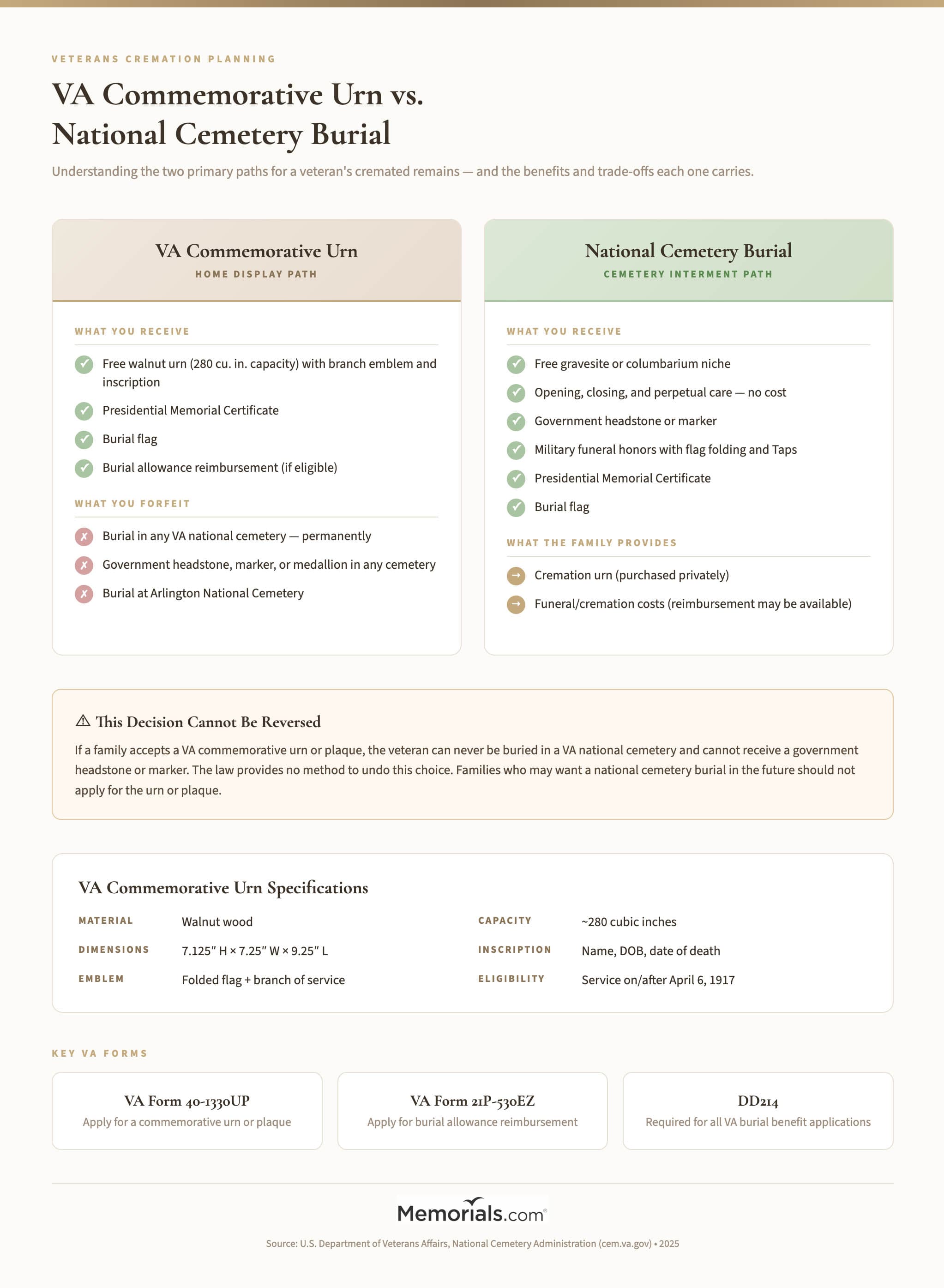
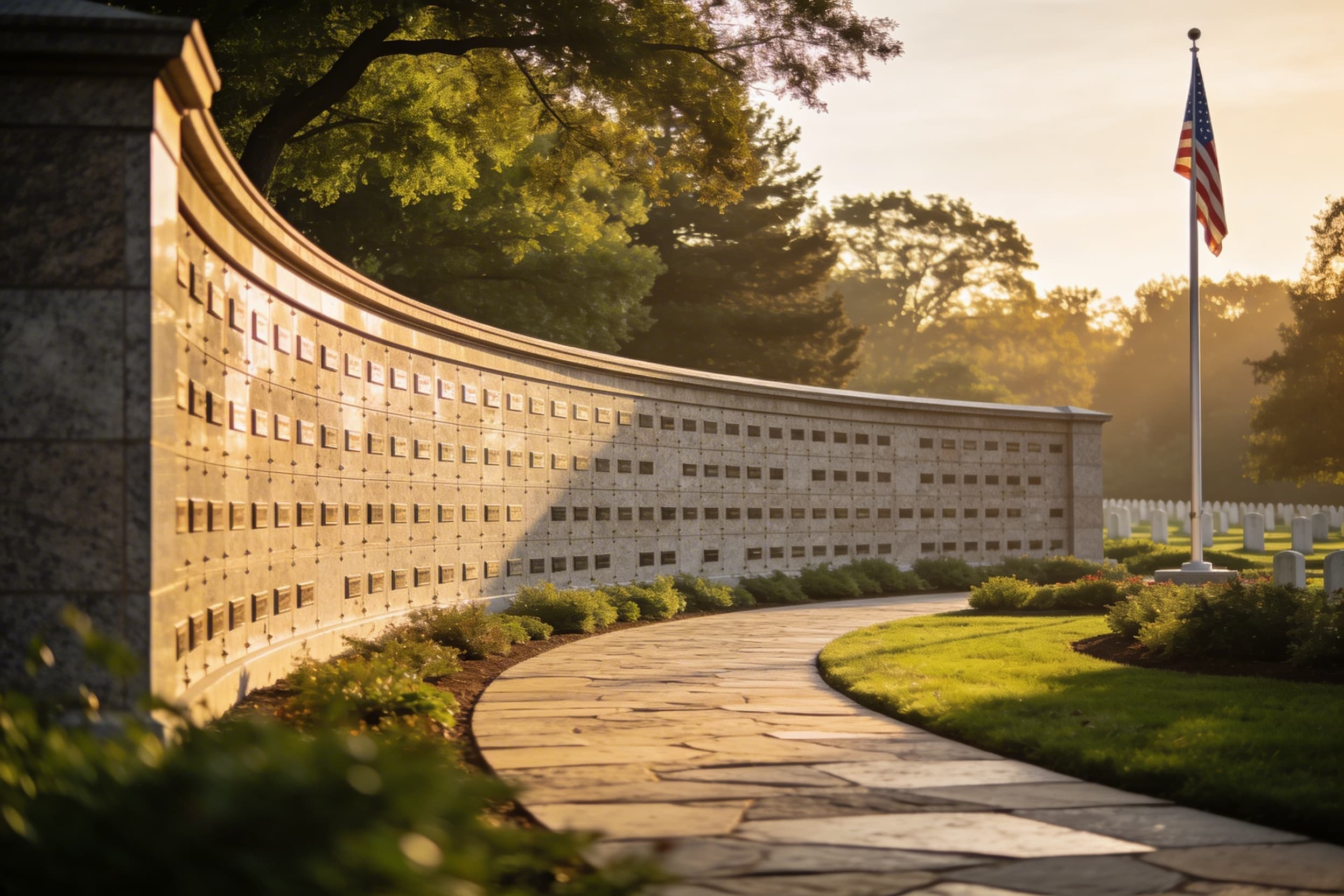
At a VA national cemetery: A gravesite or columbarium niche, opening and closing of the grave or niche, perpetual care, a government headstone or grave marker, a burial flag, and a Presidential Memorial Certificate.
At a private cemetery: A burial allowance reimbursement (up to $2,000 for a service-connected death or $978 for a non-service-connected death as of October 2024), a government-furnished headstone, marker, or medallion, a burial flag, and a Presidential Memorial Certificate.
For all eligible veterans: Military funeral honors, including at minimum a two-person honor guard detail, flag folding, and the playing of Taps.
Eligibility generally requires that the veteran was discharged under conditions other than dishonorable. The veteran's DD214 or other discharge documents are essential for establishing eligibility. Families who want to plan ahead can apply for pre-need eligibility determination through the VA. For a comprehensive overview of what veterans and their families are entitled to, see our guide to VA burial benefits for veterans.
To schedule a burial at a national cemetery, contact the National Cemetery Scheduling Office at 800-535-1117.
The VA Burial Allowance and Cremation Costs
The VA does not pay for cremation directly. Instead, the burial allowance reimburses families after they have already covered the costs. To apply, complete VA Form 21P-530EZ and submit it along with a copy of the veteran's DD214 and death certificate. Claims for non-service-connected deaths should be filed within two years of the burial, though exceptions exist for veterans who died under VA care. For details on the VA's commemorative urn program and other no-cost options, see our guide to free urns and VA cremation benefits.
The burial allowance is a flat-rate payment — it may not cover all funeral and cremation expenses, but it meaningfully reduces the financial burden on the family. For a broader look at how much cremation urns cost, including private purchase options across materials and sizes, see our pricing guide.
The VA Commemorative Urn and Plaque Program
Since January 2023, the VA has offered a commemorative urn or plaque to honor veterans whose cremated remains have not been interred. This is an important program to understand, because accepting a VA-issued urn or plaque permanently forfeits several other benefits.
What the VA Provides
The VA commemorative urn is made of walnut with a cuboid shape. It holds approximately 280 cubic inches of cremated remains and measures 7.125 inches high, 7.25 inches wide, and 9.25 inches long. One side features a 5-inch etched emblem of a folded flag with the word "Veteran" and the veteran's branch of service. A black plate on the top is inscribed with the veteran's name, date of birth, and date of death.
The commemorative plaque is an alternative — a walnut wall piece measuring 10 inches by 8 inches with similar etching and inscription. Families may choose either the urn or the plaque, but not both.
The Trade-Off You Must Understand
Accepting a VA commemorative urn or plaque is an irreversible decision. Once the VA furnishes either item, federal law prohibits the VA from:
Interring the veteran's remains in any VA national cemetery
Providing a government headstone, marker, niche cover, or medallion for placement in any cemetery
The law provides no method to reverse this choice. Given that burial in a national cemetery — including a free gravesite, perpetual care, and military honors — represents significant value, families should think carefully before accepting a commemorative urn or plaque.
Who Is Eligible
To qualify for the commemorative urn or plaque, the veteran must have served in the Armed Forces on or after April 6, 1917, must be eligible for a headstone or marker, and the veteran's cremated remains must not have been interred at any location. A family member — spouse, child, parent, sibling, or lineal descendant — may apply using VA Form 40-1330UP, accompanied by a copy of the veteran's DD214.
Choosing an Urn for a VA National Cemetery
If you plan to have your veteran's cremated remains placed in a VA national cemetery — either in a ground burial or a columbarium niche — there are practical requirements to keep in mind.
Urn Size for Columbarium Niches
National cemeteries do not mandate a specific urn brand or material, but the urn must fit within the available niche dimensions. Niche sizes vary by cemetery, so confirm the exact measurements with the specific national cemetery where the burial is planned. As a general guideline, standard adult cremation urns hold approximately 200 cubic inches, though a person's remains may require more or less depending on their body size. A good rule of thumb is that one pound of body weight yields roughly one cubic inch of cremated remains.
Ground Burial of Cremated Remains
For ground interment at a national cemetery, the family provides the urn and the cemetery handles opening and closing the grave. There are no strict material restrictions for standard ground burial, though green burial sections do require a completely biodegradable urn. For more on selecting an urn that meets cemetery standards, see our guide to cremation urns for burial.
Working With Your Funeral Director
Your funeral director coordinates directly with the National Cemetery Scheduling Office to arrange the interment. They will need the veteran's discharge documentation, a certificate of cremation, and details about whether the family is providing a private vault or requesting a government-furnished grave liner. Our guide to urn vault requirements explains the differences and when a vault is necessary.
Types of Military and Veteran Urns
Families choosing a military urn to honor their loved one's service have a wide range of styles, materials, and designs to consider.
By Branch of Service
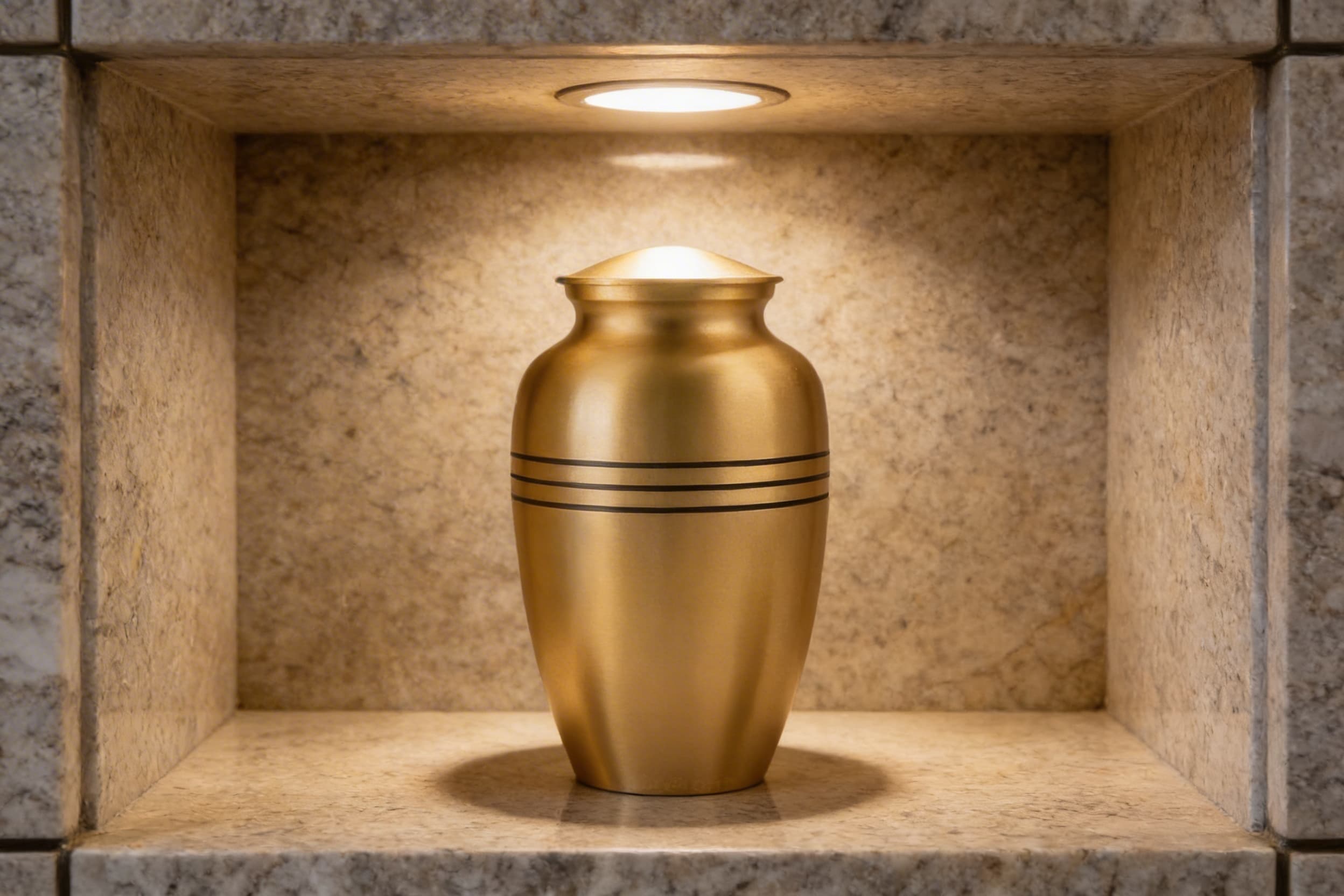
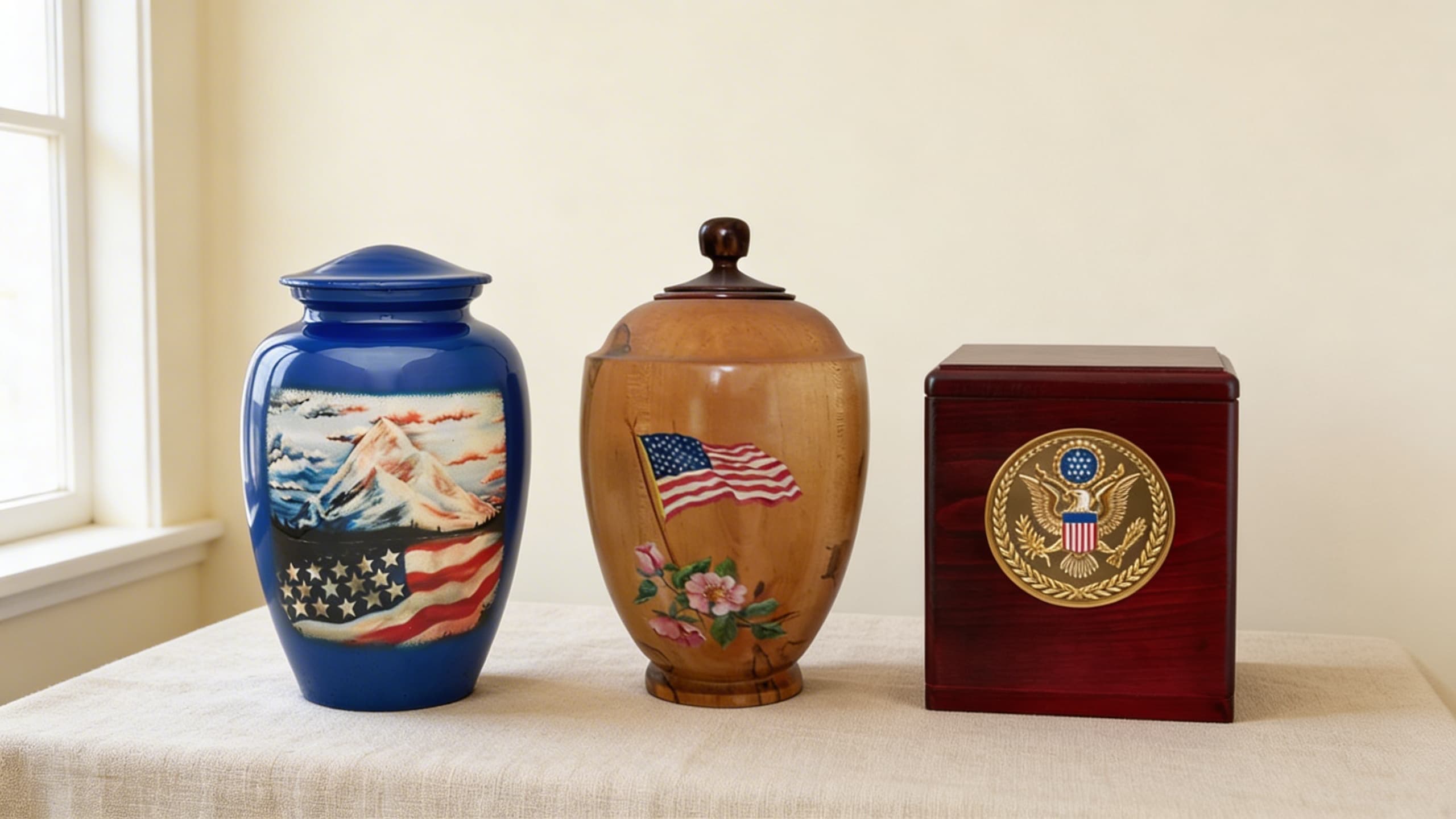
Most veteran urns feature official branch insignia or emblems. These designs are available for all six branches: Army, Navy, Air Force, Marine Corps, Coast Guard, and Space Force. Branch-specific urns allow the family to immediately communicate the veteran's proud affiliation, whether displayed at home, placed in a private cemetery, or inurned at a national cemetery.
By Material
Wood: Warm and natural, wooden urns are among the most popular choices. Species like oak, walnut, cherry, and mahogany offer different tones and grain patterns. Many wooden cremation urns feature a military medallion or laser-engraved branch emblem on the front face.
Metal: Brass and bronze urns provide a substantial, enduring feel and often feature detailed patriotic imagery — American flags, bald eagles, or military seals — rendered with fine craftsmanship. Metal urns resist damage over time and are well-suited for both display and burial.
Ceramic and Porcelain: These urns allow for hand-painted patriotic scenes and custom artwork. They tend to be more decorative and are best suited for home display rather than burial.
Marble and Granite:Stone urns offer permanence and a dignified, understated presence. Many feature etched military emblems and are heavy enough to serve as a lasting memorial on a mantel or shelf.
For a deeper comparison of these and other urn materials, see our guide to types of cremation urns.
By Style and Placement
Adult urns hold 200 or more cubic inches and serve as the primary vessel for a veteran's cremated remains. These are appropriate for display at home, burial, or placement in a columbarium niche (size permitting).
Keepsake urns hold a small portion of remains and allow multiple family members to each keep a personal tribute. Military-themed keepsake urns are available in miniature versions of full-size designs.
Companion urns hold the remains of two individuals — typically a veteran and their spouse. These are a meaningful option for couples who want to rest together, and many feature dual military and civilian design elements.
Cremation jewelry allows family members to wear a small amount of cremated remains in a pendant, bracelet, or ring. Military-themed cremation jewelry pieces featuring dog tags, flags, or branch insignia offer a private, wearable connection to the veteran.
Personalizing a Military Urn
Personalization transforms an urn from a general tribute into a specific memorial for your veteran. Common engraving options include the veteran's full name, rank, branch of service, service dates, unit designation, and a short personal message or quote. Our urn engraving guide covers inscription methods, font choices, and costs in detail.
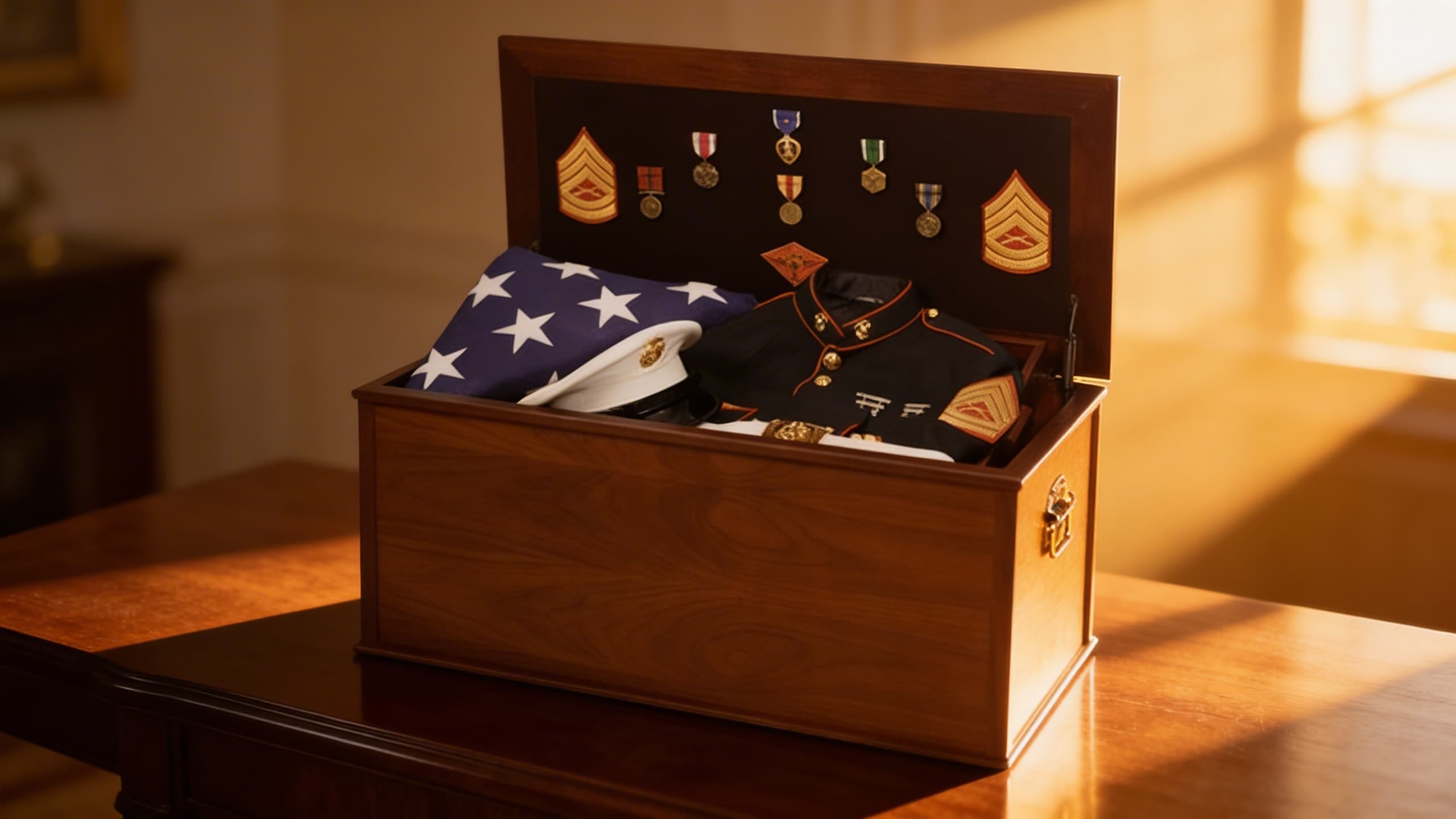
Many families also choose to add military medals, service ribbons, or challenge coins to the urn display. Some urn designs include a built-in photo frame or a shadow box compartment where medals and small mementos can be placed alongside the urn. For families interested in dedicated display pieces, our guide to medallion and memento display options covers cases designed specifically for military memorabilia.
If the veteran received specific commendations — a Purple Heart, Bronze Star, or campaign medals — incorporating references to those awards on or near the urn adds a layer of meaning that speaks to their individual story.
How to Decide: National Cemetery, Private Cemetery, or Home Display
The urn you select may depend on where the veteran's remains will ultimately rest. Each setting has different considerations.
VA National Cemetery: Free gravesite or columbarium niche, perpetual care, and military honors are provided at no cost. The family provides the urn. Confirm niche dimensions with the specific cemetery. Do not accept a VA commemorative urn if you plan to use this option.
Private Cemetery: The family covers cemetery fees but may receive the VA burial allowance reimbursement, a government headstone or marker, and a burial flag. Urn material and size restrictions vary by cemetery — check with the cemetery directly. Families weighing cremation against a traditional burial may also want to explore choosing a military casket for burial, which covers branch-specific options and features.
Home Display: Keeping an urn at home gives the family flexibility and daily proximity to their loved one's memory. This is the setting where the VA commemorative urn or plaque may be a fitting choice, provided the family understands and accepts the trade-offs. Alternatively, a privately purchased military-themed urn offers more design variety and does not affect any VA burial benefits.
Scattering: If the family chooses to scatter ashes, biodegradable urns designed for water or earth scattering are available with military themes. A keepsake urn can hold a small portion of remains for families who want a lasting physical memorial alongside the scattering.
Frequently Asked Questions
Does the VA provide a free urn for veterans?
The VA offers a commemorative urn made of walnut at no cost for eligible veterans whose cremated remains have not been interred. Accepting this urn, however, permanently disqualifies the veteran from burial in a VA national cemetery and from receiving a government headstone or marker. Families should weigh this trade-off carefully before applying with VA Form 40-1330UP.
Can a veteran's cremated remains be buried in a national cemetery?
Yes. Cremated remains are buried or inurned in VA national cemeteries with the same honors as casketed remains. The family provides the urn, and the cemetery provides the gravesite or columbarium niche, opening and closing, perpetual care, and a government headstone or marker — all at no cost.
What size urn fits in a VA columbarium niche?
Niche dimensions vary by cemetery. Contact the specific national cemetery to confirm their niche measurements before purchasing an urn. Standard adult cremation urns holding around 200 cubic inches will fit most niches, but always verify first.
Does the VA reimburse families for cremation costs?
The VA provides a burial allowance that can help offset cremation, funeral, and interment expenses. For service-connected deaths, the reimbursement can reach $2,000. For non-service-connected deaths, it is up to $978 (as of October 2024). Apply using VA Form 21P-530EZ within two years of the burial.
Can a spouse be buried with a veteran in a national cemetery?
Yes. Eligible spouses and dependents may be buried with the veteran in a national cemetery at no cost. The spouse's name and dates of birth and death are inscribed on the veteran's headstone. Spouses may be buried even if they predecease the veteran.
Honoring Their Service With the Right Choice
Choosing an urn for a veteran is one of the last acts of service a family can offer. Whether you select a military urn with a branch emblem for display at home, a standard urn sized for a columbarium niche at a national cemetery, or a combination of keepsake urns and cremation jewelry so that multiple family members can carry a connection — the right choice is the one that reflects your veteran's life and your family's needs.
Take the time to understand the VA benefits available to you, confirm any cemetery-specific requirements, and explore the full range of cremation urns designed to honor those who served.