🏬Supersize Online Funeral Retailer🪦1000's of Headstones⚱️Over 10,000 Cremation Urns⚰️Caskets Overnight Delivery🛒Funeral & Memorial Superstore🚚FREE Shipping on ALL Orders👨👩👧👦Helping Families for over 20 Years💰Lowest Price Guarantee🏬Supersize Online Funeral Retailer🪦1000's of Headstones⚱️Over 10,000 Cremation Urns⚰️Caskets Overnight Delivery🛒Funeral & Memorial Superstore🚚FREE Shipping on ALL Orders👨👩👧👦Helping Families for over 20 Years💰Lowest Price Guarantee
🏬Supersize Online Funeral Retailer🪦1000's of Headstones⚱️Over 10,000 Cremation Urns⚰️Caskets Overnight Delivery🛒Funeral & Memorial Superstore🚚FREE Shipping on ALL Orders👨👩👧👦Helping Families for over 20 Years💰Lowest Price Guarantee🏬Supersize Online Funeral Retailer🪦1000's of Headstones⚱️Over 10,000 Cremation Urns⚰️Caskets Overnight Delivery🛒Funeral & Memorial Superstore🚚FREE Shipping on ALL Orders👨👩👧👦Helping Families for over 20 Years💰Lowest Price Guarantee
Military grave traditions run deeper than most visitors realize. From ancient coins placed with the dead for safe passage to quiet tributes left at headstones across VA national cemeteries today, each small object on a veteran's grave carries meaning — a silent message between the living and the fallen, and between service members who share a bond that outlasts a lifetime. If you are exploring ways to honor a veteran's memory, our covers benefits, products, and planning options beyond graveside tributes.
This article expands on the well-known coin tradition and explores the full range of military graveside customs: challenge coins, stones and rocks, buddy poppies, flags, ribbons, and other tributes that families and fellow service members leave at the graves of those who served. You will also find practical etiquette guidance so you can participate respectfully.
The Coin Tradition: A Brief Overview
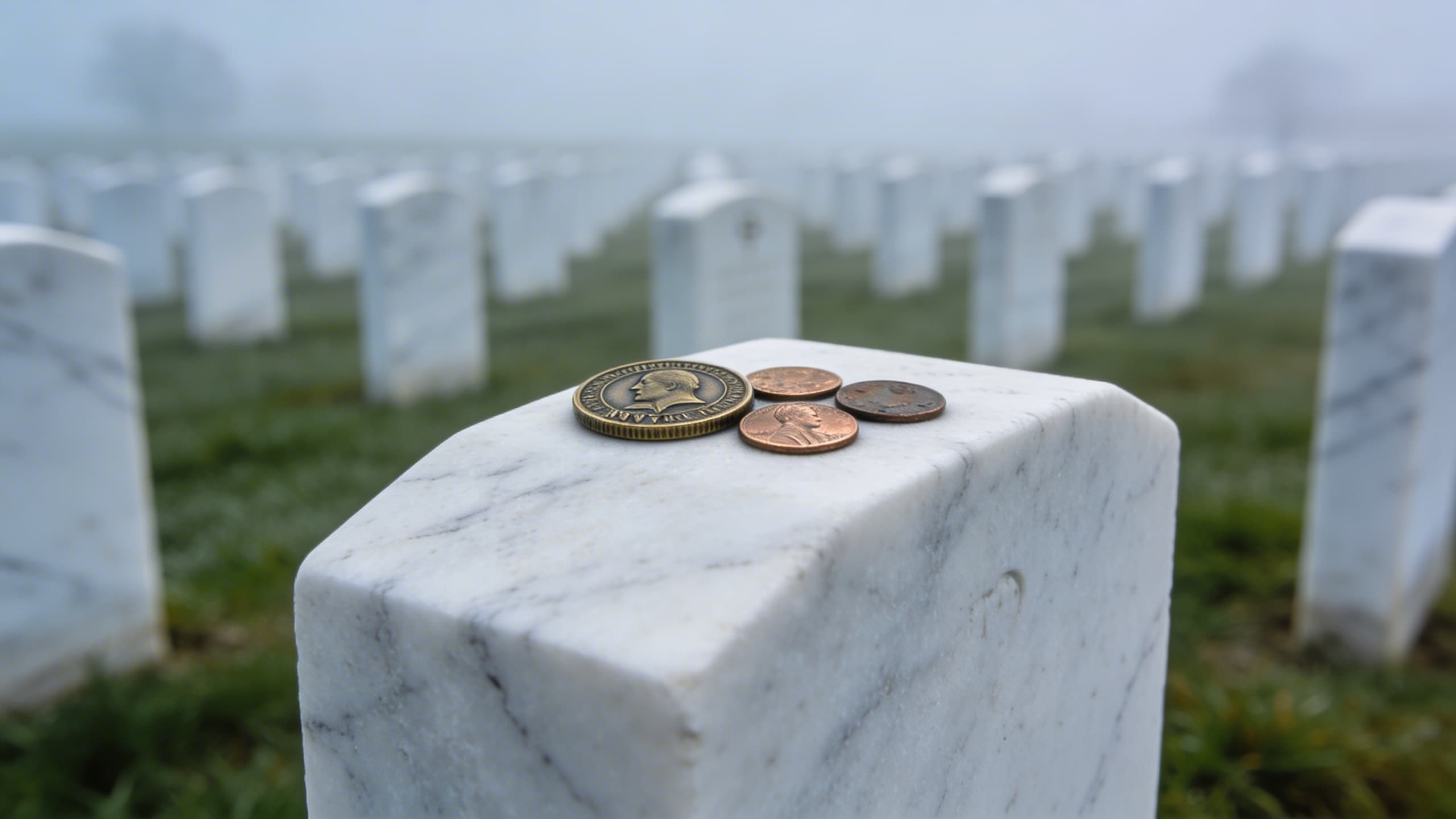
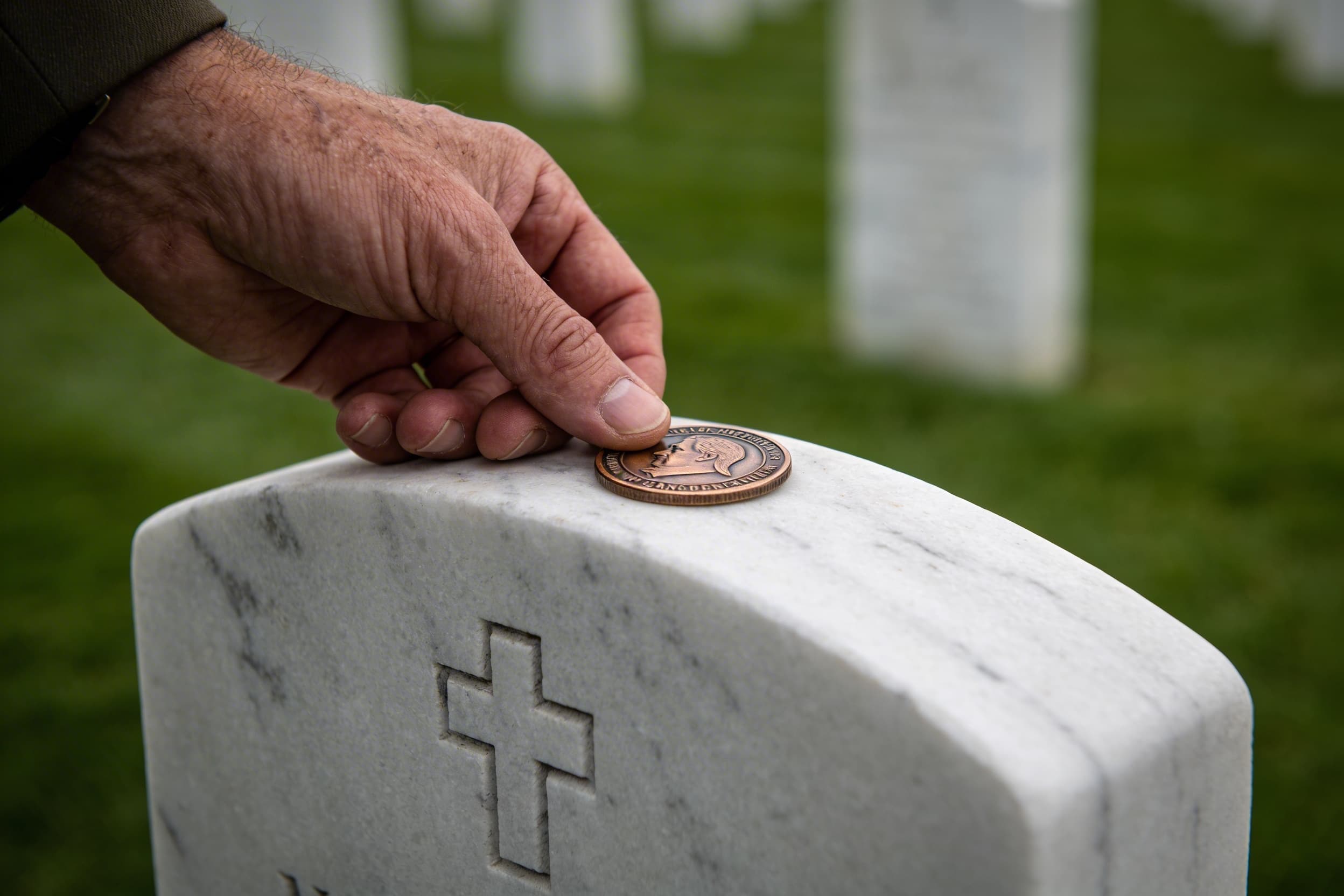
Leaving coins on military graves became a widely recognized practice in the United States during the Vietnam War. The political divisiveness of that conflict made personal contact with a fallen soldier's family feel risky — a visit could become an uncomfortable political argument. Leaving a coin became a practical, wordless way to say, "I was here, and I remember."
The tradition draws on much older roots. In ancient Greece, families placed coins in the mouths or on the eyes of the dead as payment to Charon, the mythological ferryman who carried souls across the River Styx into the afterlife. Roman soldiers carried forward the custom, and variations spread throughout Western Europe over the centuries. That coin is called an obol, and what Greek graves actually contain turns out to be a good deal less tidy than the legend. The ferryman himself worked for a god who is routinely confused with another one: Thanatos and Hades are not the same figure.
What Each Coin Denomination Means
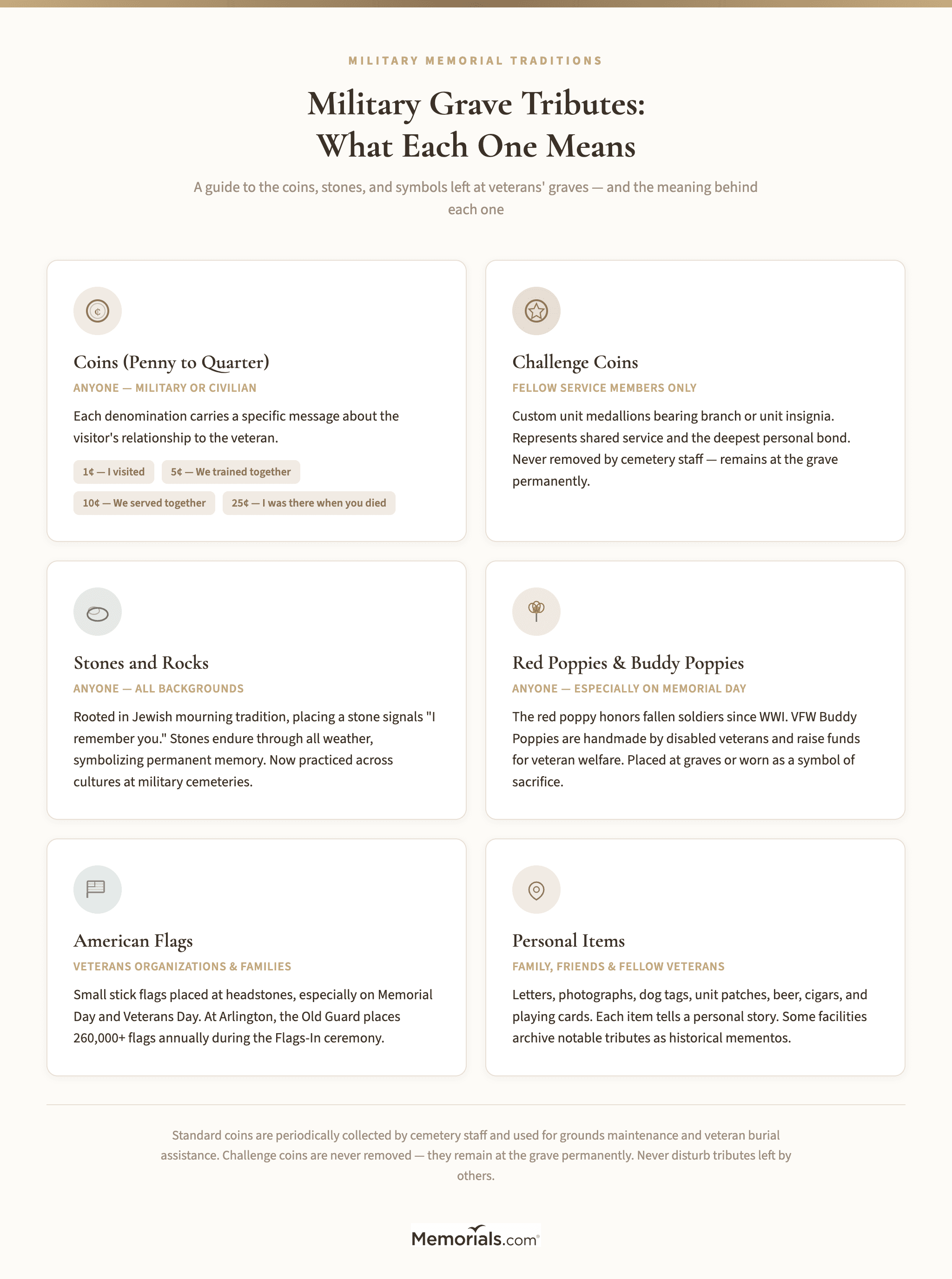
Each coin left on a veteran's headstone communicates a specific relationship between the visitor and the deceased:
Penny — Someone visited the grave and paid their respects. This is the most common denomination and can be left by anyone, military or civilian.
Nickel — The visitor trained at boot camp with the deceased.
Dime — The visitor served alongside the deceased in some capacity.
Quarter — The visitor was present when the service member died. This is the most solemn and personal tribute in the coin tradition.
These meanings are not codified in any official military regulation. They developed organically within the veteran community, and some regional variation exists. Still, the system is widely understood at national cemeteries, state veterans cemeteries, and military sections of private cemeteries across the country.
What Happens to the Coins
At national and state veterans cemeteries, staff periodically collect standard coins from gravesites. The funds typically go toward cemetery maintenance — washing headstones, mowing grounds, and landscaping — or toward burial costs for indigent veterans who cannot afford a proper service. Challenge coins, which carry deeper personal significance, are generally left in place indefinitely.
Challenge Coins: A Tribute Among Comrades
While pennies through quarters follow a denomination-based code, challenge coins occupy a different category entirely. These small medallions — typically 1.5 to 2 inches in diameter — bear the insignia of a specific military unit, branch, or organization. Commanders present them to service members as recognition of achievement, unit membership, or shared experience.
Challenge coins gained prominence during the Vietnam War era, when Special Forces units used them to confirm group membership. Each coin was unique to its unit, making it both a personal keepsake and a form of identification among brothers and sisters in arms.
When a veteran leaves a challenge coin on a fallen comrade's grave, it is among the most personal tributes possible. The coin says: "We served in the same unit. I carry this symbol of our shared mission, and I am leaving it with you." Because challenge coins are prized possessions — not currency — finding one on a headstone signals a deeply personal visit.
Challenge Coin Etiquette at Gravesites
Never remove a challenge coin from a veteran's grave. Unlike standard currency, challenge coins are not collected by cemetery staff. They remain as permanent markers of a comrade's visit. If you see a challenge coin bearing a unit insignia, it was placed there intentionally and holds irreplaceable meaning for the family and the veteran community.
Stones and Rocks: An Ancient Practice at Military Graves
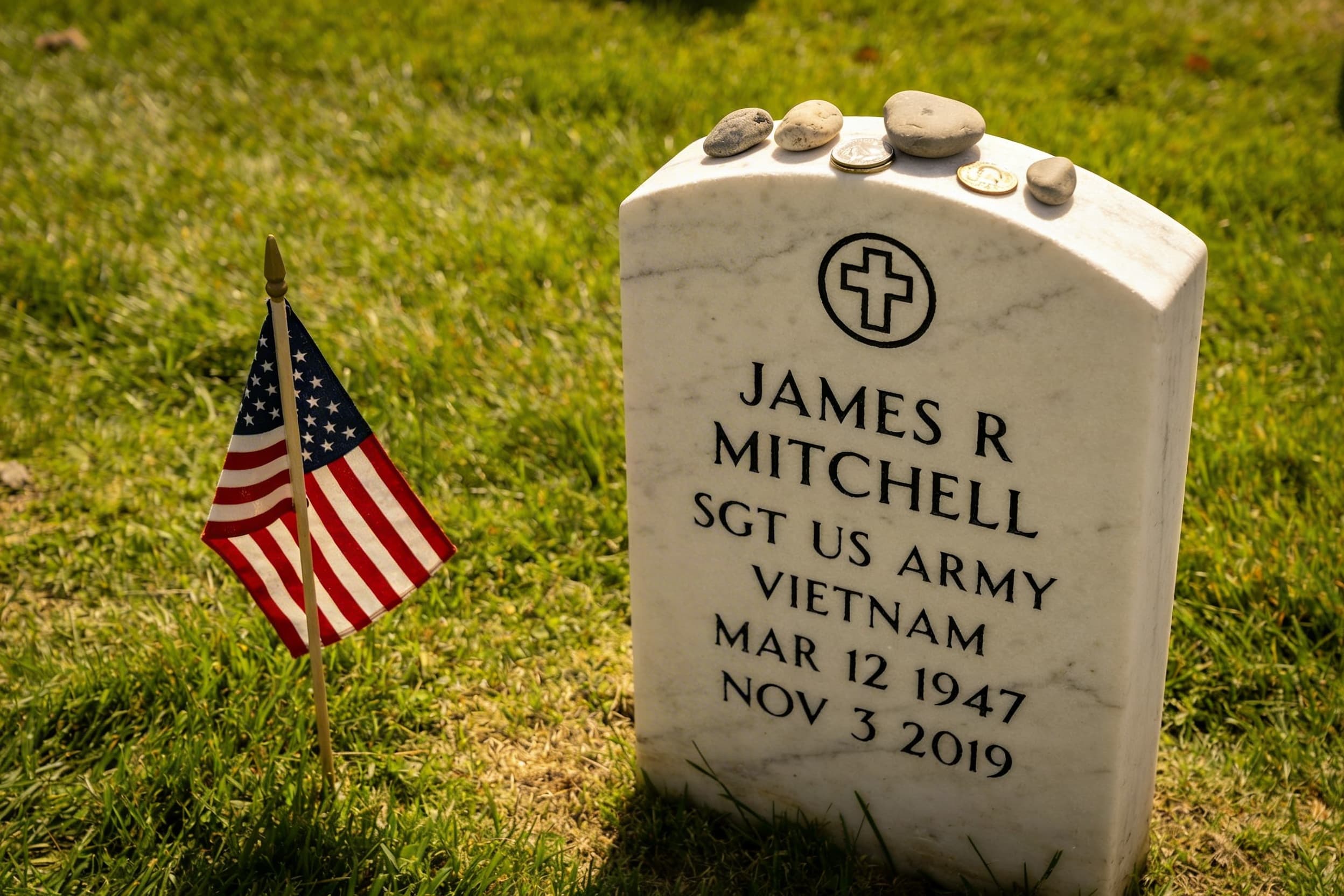
Visitors to Arlington National Cemetery and other military burial grounds sometimes notice small stones resting on headstones alongside coins. This practice is rooted in Jewish mourning tradition, where placing a stone on a grave indicates that someone has visited and remembers the deceased.
The custom reaches back thousands of years. Before modern grave markers existed, cairns — piles of stones — served as burial markers. Visitors would replace stones that had fallen away, maintaining the grave's integrity as an act of care. Over time, the practical necessity evolved into a ritual of remembrance. Stones endure through weather and seasons in a way that flowers cannot, making them a symbol of permanent memory.
At military cemeteries, the tradition has crossed religious and cultural boundaries. Service members and civilians of all backgrounds leave small stones on the graves of veterans as a universal gesture of respect. Audie Murphy's headstone at Arlington, for instance, routinely accumulates both coins and stones left by visitors.
A Note on Stone Placement
If you choose to leave a stone, select a small, smooth one that will not scratch or stain the headstone surface. Sandstone or rough rocks can leave mineral deposits on polished marble or granite — the standard materials used for government-issued military headstones. Place the stone gently on the top or base of the marker, and keep the tribute modest.
Buddy Poppies and Red Poppies: The Flower of Remembrance
The red poppy is one of the most recognized symbols of military remembrance worldwide. Its connection to fallen service members traces back to World War I and a poem written in 1915 by Canadian Army physician Lieutenant Colonel John McCrae. Serving near Flanders, Belgium, McCrae observed bright red poppies growing among the graves of soldiers killed in battle. His poem captured the image of resilience blooming in devastated ground, and the poppy became a lasting symbol of sacrifice.
In the United States, the poppy was adopted as an official memorial flower through the efforts of Moina Michael, a Georgia professor who began wearing and distributing silk poppies after the war. By 1920, the American Legion had adopted the poppy as its memorial symbol. Two years later, the Veterans of Foreign Wars organized the first nationwide poppy distribution before Memorial Day, launching the Buddy Poppy program that continues today.
What Makes Buddy Poppies Unique
VFW Buddy Poppies are handmade by disabled, hospitalized, and aging veterans. The VFW trademarked the name "Buddy" in 1924 — a term coined by the veteran poppy makers in memory of their fallen friends. Every Buddy Poppy sold raises funds for veteran welfare programs and provides supplemental income to the veterans who assemble them. More than 14 million Buddy Poppies are distributed annually in the United States.
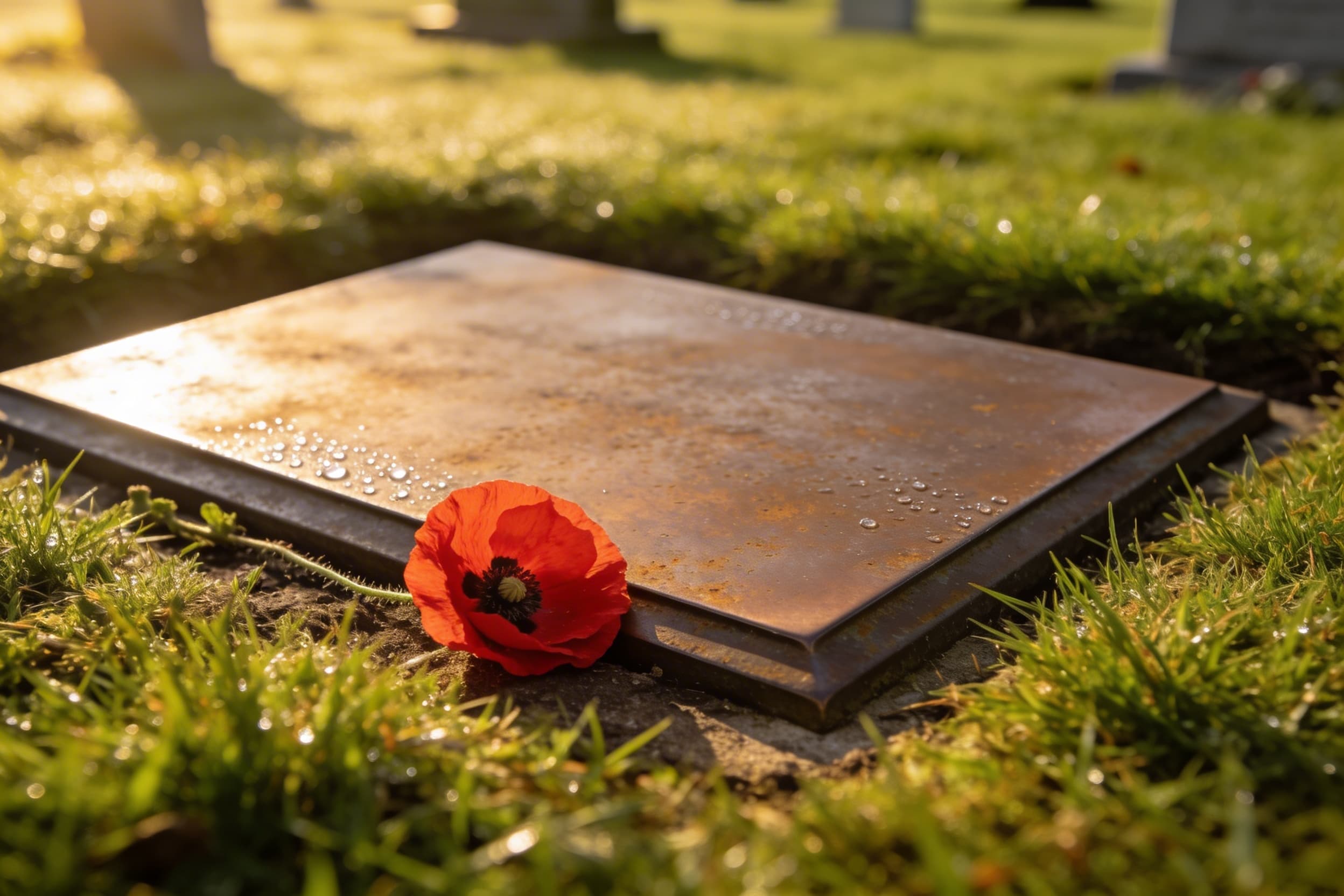
Families often place a red poppy at a veteran's grave during Memorial Day visits, sometimes tucking it into a small flag holder or laying it at the base of the headstone. The gesture connects a personal moment of grief to a century of collective remembrance.
Flags, Ribbons, and Decoration Day Origins
Before coins, challenge coins, or poppies became common at military graves, there were flowers, ribbons, and flags. Memorial Day itself was originally called Decoration Day — a holiday established after the Civil War specifically for decorating the graves of fallen soldiers.
The tradition of placing small American flags at veterans' graves remains one of the most visible military cemetery customs. At Arlington National Cemetery, soldiers from the 3rd U.S. Infantry Regiment (The Old Guard) place more than 260,000 flags at headstones each year during the annual "Flags-In" ceremony before Memorial Day weekend. The practice is replicated at national cemeteries and community cemeteries across the country by VFW posts, American Legion chapters, Boy Scout troops, and individual families.
Proper Memorial Day flag etiquette includes flying the flag at half-staff from sunrise until noon and then raising it to full staff for the remainder of the day. At gravesites, small stick flags are typically placed to the left of the headstone (as you face it) or in a flag holder attached to the marker.
Ribbons — particularly red, white, and blue ribbons — are sometimes tied around veteran grave marker options or nearby fencing during patriotic holidays. While less codified than coin or flag traditions, ribbons serve a similar purpose: marking the grave as remembered and honored.
Personal Items and Unique Tributes
Beyond coins, stones, poppies, and flags, some visitors leave deeply personal items at military graves:
Letters and notes — Handwritten messages to the deceased, sometimes sealed in plastic bags to protect them from weather. These are especially common at Section 60 of Arlington National Cemetery, where service members killed in Iraq and Afghanistan are buried.
Photographs — Small laminated photos of the veteran, their family, or shared moments from service. Some families tuck photos into the base of the headstone or lean them against the marker.
Beer, cigars, and playing cards — A tradition rooted in the promise many Vietnam-era veterans made to their fallen friends: "I'll buy you a beer when we meet again." Full cans of beer and packs of cigarettes or cigars appear regularly on graves, particularly on Memorial Day and Veterans Day.
Unit patches and insignia — Cloth patches from the deceased veteran's unit, sometimes pinned or weighted at the base of the headstone.
Dog tags — A duplicate set or a personal memento tag left by a fellow service member.
Each of these items tells a story. Cemetery staff at national cemeteries handle personal items with care, and some facilities — like the Section 60 collection at Arlington — archive notable tributes as part of a historical memento project.
Tributes are left at memorial markers as well as at graves. A stone carrying a name with no remains beneath it draws coins and flags in exactly the same way, and the cenotaph meaning is the word for it — a marker for someone lost at sea, missing in action, or buried somewhere the family cannot reach.
Graveside Ceremony Traditions
Military grave tributes extend beyond objects left on headstones. Active-duty service members and veterans who visit graves of fallen comrades sometimes observe quiet ceremonies that reflect military training and discipline.
Saluting at a military funeral is one such tradition — active-duty and retired service members in uniform or wearing headgear may render a hand salute when passing a veteran's grave or during a moment of reflection. Civilians may place their hand over their heart as an equivalent gesture of respect.
Standing at attention for a moment of silence, reciting a prayer or passage, and pouring a small drink at the graveside are all customs practiced by veterans visiting fallen comrades. None of these traditions require special permission or prior arrangement — they are personal acts of honor that happen quietly, often when no one else is watching.
Etiquette for Visiting Military Graves
Whether you are a veteran, a family member, or a civilian who wants to pay respects, a few principles apply:
Never remove coins, challenge coins, stones, or personal items from a grave. Each tribute was placed intentionally and carries emotional weight for the family and the military community. Removing them is considered deeply disrespectful.
Approach the headstone quietly and with intention. Take a moment to read the inscription. Many government-issued military headstones include the veteran's name, rank, branch of service, dates of birth and death, and an optional emblem of belief. The headstone emblems and inscriptions tell a story worth pausing to absorb.
Leave your tribute gently. Place coins flat on the top of the headstone. Set stones on the base or edge. Lay poppies or flowers at the foot of the marker. Avoid leaning items against the headstone face, which can cause staining or scratching over time.
Photograph respectfully. If you are taking photos — which is permitted at most military cemeteries — avoid photographing other visitors without their permission, and never stage or rearrange tributes for a better shot.
Follow cemetery-specific rules. National cemeteries, state veterans cemeteries, and private cemeteries may have different policies regarding what can be left on graves and when items are collected. Check with the cemetery office if you are unsure.
Dispose of your own waste. If you bring flowers, food, or beverages, take any packaging or containers with you when you leave. Cemetery maintenance staff should not have to clean up after your visit.
A Living Connection to Those Who Served
Military grave traditions are not museum relics. They are living practices that evolve with each generation of service members and the families who honor them. A penny on a headstone at a small-town cemetery in Texas carries the same weight as a challenge coin at Arlington — both say, "You are not forgotten."
If you are a family member of a veteran choosing how to mark a gravesite, Memorials.com offers military urns with branch-specific emblems and insignia, as well as flag display cases for preserving the burial flag at home. These products complement graveside traditions by giving families permanent, dignified ways to honor a veteran's service beyond the cemetery.
The traditions described here — coins, challenge coins, stones, poppies, flags, and personal tributes — all share one thing in common. They are acts of presence. They say: I came here. I remember. And that is enough.
Frequently Asked Questions
Is it okay for civilians to leave coins on military graves?
Yes. Anyone can leave a coin on a veteran's headstone. A penny is the most appropriate choice for civilians, as it simply signals that someone visited and paid their respects. Nickels, dimes, and quarters carry specific military relationship meanings, so most civilians stick with pennies.
Why should you never touch coins left on a gravestone?
Coins on a military grave represent personal messages from visitors to the deceased and their family. Removing or rearranging them disrupts that communication and is considered disrespectful within the military community. At national cemeteries, only cemetery staff collect standard coins — and even then, the funds go toward cemetery maintenance and veteran burial assistance.
What is the difference between a regular coin and a challenge coin on a grave?
Regular coins (penny through quarter) follow a denomination-based code indicating the visitor's relationship to the veteran. Challenge coins are custom medallions bearing unit or branch insignia, presented to service members for achievement or membership. Leaving a challenge coin on a grave is a deeply personal tribute from a fellow service member, and these coins are not collected by cemetery staff — they remain at the grave indefinitely.
Can I leave flowers or personal items at a military grave?
Most cemeteries allow flowers, small flags, and modest personal items. However, policies on how long items may remain vary by cemetery. At national cemeteries, items may be collected or removed after holidays to maintain the grounds. Fresh flowers are generally welcomed; artificial flowers may be restricted at some locations. Check with the specific cemetery for guidance.
What does leaving a rock on a headstone mean?
Leaving a stone on a headstone is a tradition rooted in Jewish mourning customs, signifying that someone visited and remembers the deceased. The practice has been adopted more broadly at military cemeteries as a universal gesture of remembrance. Unlike flowers, stones endure through all weather, symbolizing permanent memory.