🏬Supersize Online Funeral Retailer🪦1000's of Headstones⚱️Over 10,000 Cremation Urns⚰️Caskets Overnight Delivery🛒Funeral & Memorial Superstore🚚FREE Shipping on ALL Orders👨👩👧👦Helping Families for over 20 Years💰Lowest Price Guarantee🏬Supersize Online Funeral Retailer🪦1000's of Headstones⚱️Over 10,000 Cremation Urns⚰️Caskets Overnight Delivery🛒Funeral & Memorial Superstore🚚FREE Shipping on ALL Orders👨👩👧👦Helping Families for over 20 Years💰Lowest Price Guarantee
🏬Supersize Online Funeral Retailer🪦1000's of Headstones⚱️Over 10,000 Cremation Urns⚰️Caskets Overnight Delivery🛒Funeral & Memorial Superstore🚚FREE Shipping on ALL Orders👨👩👧👦Helping Families for over 20 Years💰Lowest Price Guarantee🏬Supersize Online Funeral Retailer🪦1000's of Headstones⚱️Over 10,000 Cremation Urns⚰️Caskets Overnight Delivery🛒Funeral & Memorial Superstore🚚FREE Shipping on ALL Orders👨👩👧👦Helping Families for over 20 Years💰Lowest Price Guarantee
Arlington National Cemetery is the most requested burial ground in the United States and one of the hardest to enter. Burial there costs the family nothing. Qualifying for it is the difficulty, and the rules are considerably narrower than most people assume.
This page covers who is eligible, what actually happens when a family requests a burial, and where to find the graves people come to see — including the one most visitors are looking for.
Where Is the Arlington National Cemetery Located
Where is the arlington national cemetery located, for anyone planning a visit: in Arlington, Virginia, directly across the Potomac River from Washington, D.C., on ground that was once Robert E. Lee's estate. The Memorial Bridge runs from the Lincoln Memorial almost to its gates, which is not an accident of planning.
It covers around 639 acres and holds roughly 400,000 graves. About 25 burials take place there on a normal weekday, which is the detail that surprises people most — it is a working cemetery, not a monument, and a visit will usually coincide with someone's funeral.
Who can be buried at arlington national cemetery is a narrower question than it sounds, and the answer differs sharply between two kinds of burial.
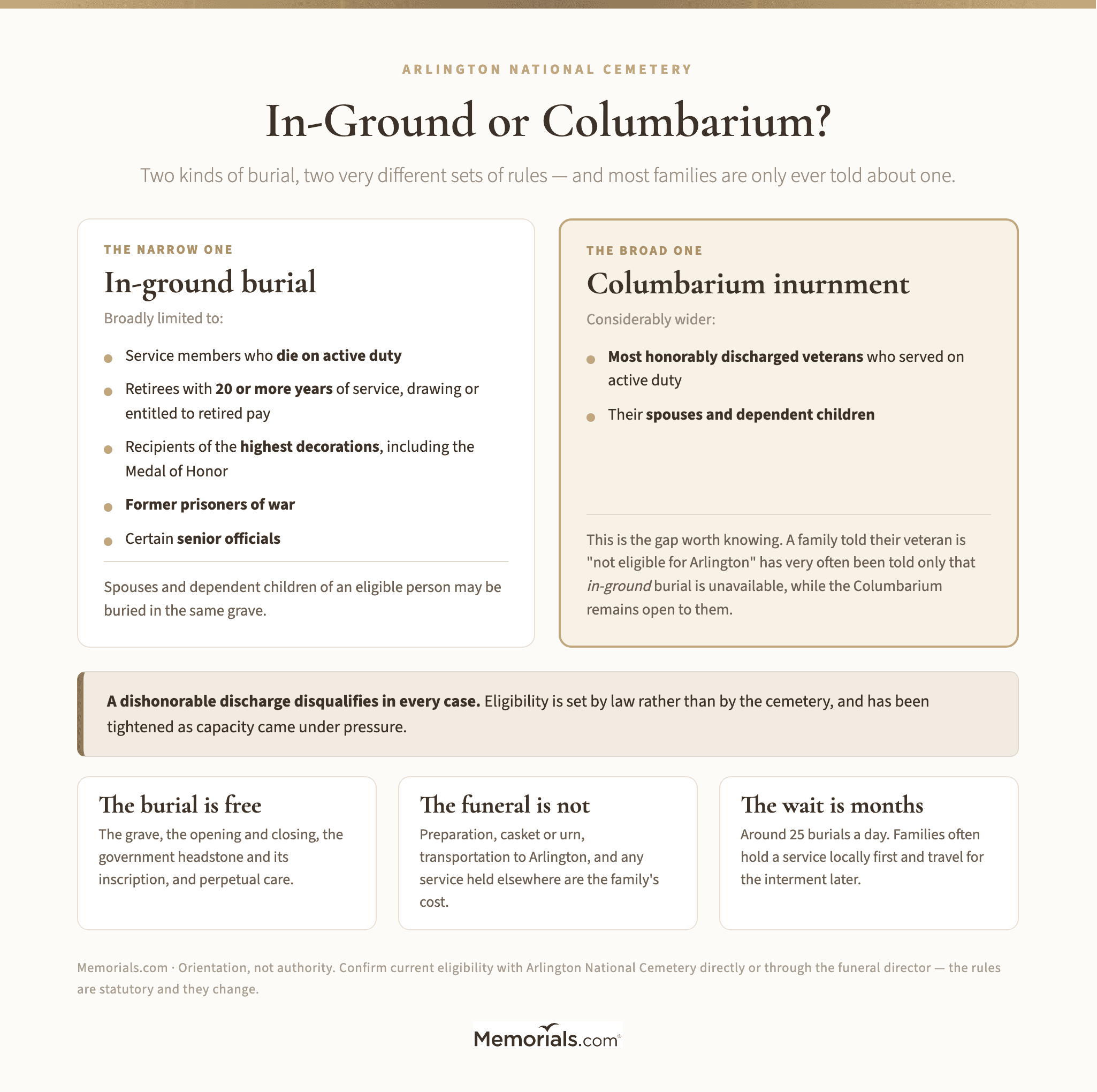
In-ground burial — the most restricted. Broadly, it is available to service members who die on active duty; retirees with 20 or more years of service who are drawing or entitled to retired pay; recipients of the highest decorations, including the Medal of Honor; former prisoners of war; and certain senior officials. Spouses and dependent children of an eligible person may be buried in the same grave.
Above-ground inurnment in the Columbarium — considerably broader. Most honorably discharged veterans who served on active duty qualify, along with their spouses and dependent children.
That gap between the two is the single most useful thing to understand. A family told their veteran is "not eligible for Arlington" has very often been told only that in-ground burial is unavailable, while the Columbarium remains open to them.
A dishonorable discharge disqualifies in every case.
Eligibility rules have been tightened over the years as capacity has come under pressure, and they are set by law rather than by the cemetery. Confirm current eligibility with Arlington directly or through the funeral director — this page is orientation, not authority. Our guide to military funeral eligibility and honors covers the wider set of entitlements, and VA burial benefits covers what is furnished at national cemeteries generally.
The gap between the two columns is the single most useful thing on this page. "Not eligible for Arlington" usually means only that the left-hand column does not apply.
What It Costs, and How Long It Takes
The burial itself is free. The grave, the opening and closing, the government headstone and its inscription, and perpetual care are furnished at no cost to the family. This is true at every national cemetery, not only Arlington.
The family still pays for a funeral. Preparation, casket or urn, transportation to Arlington, and any service held elsewhere are the family's costs. Arlington furnishes the ground and the marker, not the funeral.
The wait is long. Scheduling a service at Arlington commonly takes months rather than weeks, because of the volume. Families frequently hold a service locally soon after the death and then travel for the interment later — this is normal, expected, and worth planning for rather than discovering.
The headstone is standard. Arlington uses uniform government markers, and the uniformity is the point: rank, decoration and wealth are not visible in the rows. A limited set of approved emblems of belief may be carved, and the inscription follows a fixed format. Our guide to military headstone inscription examples covers what is permitted.
Where Is JFK Buried
Where is jfk buried is the single commonest question asked at the gates, and the answer is: on the hillside below Arlington House, directly on the axis of the Memorial Bridge.
President John F. Kennedy was buried at Arlington in November 1963, initially in a temporary plot, and moved to the permanent gravesite in 1967. The Eternal Flame at its center was requested by Jacqueline Kennedy and has burned since the day of the funeral.
Buried at the same site are Jacqueline Kennedy Onassis and two of their children who died in infancy. Robert F. Kennedy and Edward M. Kennedy are buried nearby, in plots marked far more plainly — a white cross and a simple marker respectively, which visitors often walk past without noticing.
The site is a short uphill walk from the Welcome Center and is signposted throughout.
Presidential Burial Sites
Presidential burial sites are scattered, and Arlington holds fewer of them than people expect. Only two presidents are buried there: John F. Kennedy and William Howard Taft.
Most presidents are buried in their home states, frequently at their presidential libraries — a convention that has strengthened over the twentieth century. Washington is at Mount Vernon, Jefferson at Monticello, Lincoln in Springfield, Illinois. There is no national presidential cemetery and never has been.
Taft is the answer to the trivia question, and he is worth a moment for a different reason: he is the only person to have served as both President and Chief Justice, and it was the latter role that made Arlington the obvious choice.
The Graves People Come to See
Beyond the Kennedy gravesite, a short list accounts for most visits.
The Tomb of the Unknown Soldier. Guarded continuously since 1937, in all weather, by sentinels of the 3rd US Infantry Regiment. The Changing of the Guard happens every hour in winter and every half hour in summer, and it is the thing most visitors plan their day around.
Arlington also holds memorial markers for service members whose remains were never recovered. A stone with a name and no grave beneath it has its own word, and the cenotaph meaning is worth knowing before you ask a cemetery office for one, because it is a different application from a burial.
Arlington House. The Lee family mansion at the top of the hill, which is why the cemetery is where it is — the land was seized during the Civil War and burials were begun around the house deliberately.
The Memorial Amphitheater, behind the Tomb, where the national observances are held.
The Space Shuttle Challenger and Columbia memorials.
The USS Maine Mast Memorial, built around the recovered mast of the battleship.
A practical note for a visit: Arlington is large, hilly and exposed, and the walk to the Kennedy gravesite and the Tomb is more than most people anticipate. There is a paid tram. Nobody has ever regretted taking it.
What to Expect if You Are Attending a Funeral
A service at Arlington is unlike one at a local cemetery, and families are frequently unprepared for the scale of it.
The honors are full where eligibility allows — a caisson drawn by horses for some services, a military band, a firing party, and a bugler. This is what Arlington is known for and it is genuinely affecting.
It runs to a timetable. With around 25 burials a day, services are scheduled tightly and start on time. Arriving late means missing part of it.
The family is escorted. Arlington staff manage everything, and the family is told where to be at each point. There is very little for anyone to organize on the day.
Photography is permitted at most services but with restraint, and the cemetery publishes guidance. Ask rather than assume.
Our guide to military funeral flag etiquette covers the flag's handling through the service, and the funeral flag presentation script covers the words said when it is handed to the family.
The honors are the part families are least prepared for. Where eligibility allows they run to a caisson, a band, a firing party and a bugler, and the whole thing is managed for you.
Planning a Visit
Arlington is free to enter and open every day of the year, and a visit rewards a little preparation.
Start at the Welcome Center. Maps, restrooms and the tram all begin there, and the staff will locate a specific grave for you from a name — which is the fastest way to find one among 400,000.
Look up the grave beforehand if you can. Arlington publishes a searchable gravesite locator, and arriving with a section and grave number turns a long search into a short walk.
Allow three hours for the standard route — Kennedy gravesite, Tomb of the Unknown Soldier, Arlington House — and more if you are visiting a specific grave away from those.
Dress for a cemetery and for weather. It is exposed, it is hilly, and the ground is grass. Comfortable shoes matter more than anything else you bring.
Remember what it is. Around 25 funerals take place on a normal weekday. If you encounter one, stop, stand still, and wait. Everyone does, and it is the only etiquette the place asks of visitors.
The Headstones Themselves
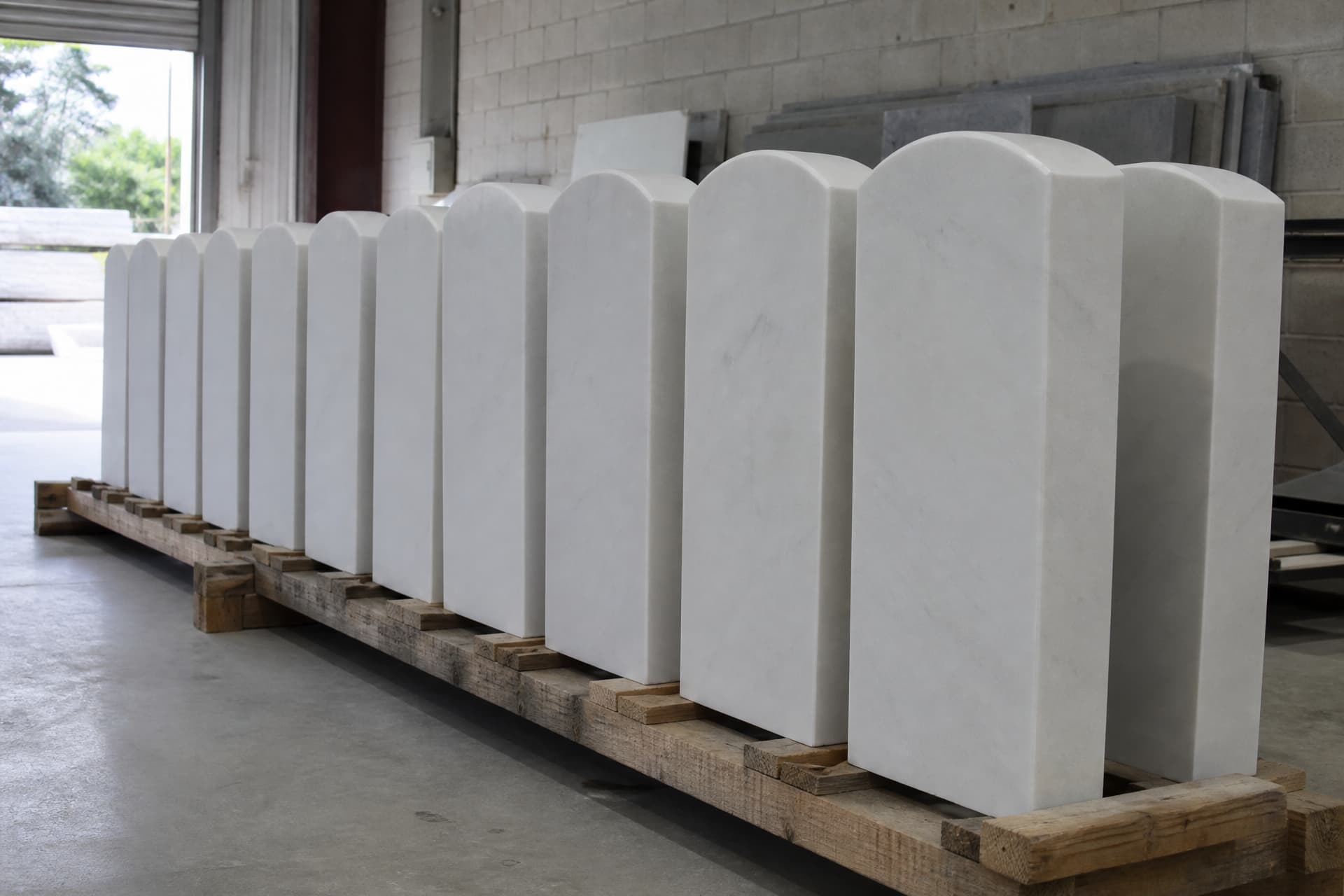
The uniform white markers are the image most people carry away, and the uniformity is deliberate policy rather than economy.
Every marker is the same size and material regardless of rank, decoration or means. A general and a private have identical stones. The only permitted variations are the inscription itself and an approved emblem of belief, of which the cemetery recognizes a long and periodically updated list — well over seventy, from the major faiths to Humanist and Atheist emblems.
The inscription format is fixed: name, rank, branch, war or conflict, dates, and where applicable the highest decoration. A short personal inscription may be permitted on the reverse in some circumstances, and the rules for it are narrower than at private cemeteries.
Families accustomed to choosing a stone sometimes find this constraining. Most come to see it as the point: in those rows, nobody outranks anybody.
Before the inscription, every marker is this. A general and a private are handed the same stone, and the only permitted variations are the words and an approved emblem of belief.
If Arlington Is Not Available
For most veteran families it will not be, and the alternatives are better than the disappointment suggests.
Any other national cemetery. There are more than 150 across the country, the benefits are identical — free grave, free marker, perpetual care — and eligibility is far broader than at Arlington. A grave in a national cemetery twenty minutes from the family is visited; one at Arlington is visited once.
State veterans cemeteries. Run by the states with federal support, usually with residency requirements and often with capacity where the national system has none.
A private cemetery with a government marker. The VA furnishes a headstone or marker for an eligible veteran buried anywhere, including a private plot. This is the option families most often overlook.
The Columbarium at Arlington, if in-ground burial was the barrier. As above, the eligibility is much wider.
The request does not come from the family directly, and knowing the route saves a week.
The funeral home makes the request to Arlington on the family's behalf, and it needs the discharge paperwork — usually the DD Form 214 — to establish eligibility. Finding that document is the commonest delay in the whole process.
Arlington confirms eligibility before anything is scheduled. This is a determination against the statute, not a judgment call, and the cemetery will say plainly which kind of burial is available.
A date is then offered. Families rarely get to choose it. Where relatives are traveling from a distance, say so when the request is made rather than after a date is set.
Cremated remains are common and are interred in the Columbarium or, where eligible, in ground. The eligibility rules are the same either way; the form of the remains does not change them.
Finding the discharge paperwork is the commonest delay in the whole process. It is worth locating the DD Form 214 before it is needed rather than after.
Frequently Asked Questions
Where is JFK buried?
At Arlington National Cemetery, on the hillside below Arlington House on the axis of the Memorial Bridge, beneath the Eternal Flame. Jacqueline Kennedy Onassis is buried at the same site; Robert and Edward Kennedy are nearby in much plainer graves.
Who can be buried at Arlington National Cemetery?
In-ground burial is restricted — broadly, those who die on active duty, retirees with 20 years of service, recipients of the highest decorations, former prisoners of war, and certain officials, plus their spouses and dependent children. The Columbarium is open to most honorably discharged veterans. A dishonorable discharge disqualifies.
Does burial at Arlington cost anything?
No. The grave, opening and closing, government headstone and perpetual care are all furnished. The family pays for the funeral itself and for transportation.
How long is the wait for a burial at Arlington?
Commonly months rather than weeks. Many families hold a service locally soon after the death and travel for the interment later.
How many presidents are buried at Arlington?
Two — John F. Kennedy and William Howard Taft. Most presidents are buried in their home states, often at their presidential libraries.
Where is Arlington National Cemetery?
In Arlington, Virginia, across the Potomac from Washington, D.C., at the end of the Memorial Bridge from the Lincoln Memorial.
The Short Version
Burial at Arlington is free and hard to qualify for. If your family has been told no, ask specifically whether the Columbarium is available — the two have different rules and the difference catches people out.
And if it is not available at all, a national cemetery near the people who will actually visit is the better memorial. Our military memorial guide covers the full set of honors and entitlements wherever the burial happens.