🏬Supersize Online Funeral Retailer🪦1000's of Headstones⚱️Over 10,000 Cremation Urns⚰️Caskets Overnight Delivery🛒Funeral & Memorial Superstore🚚FREE Shipping on ALL Orders👨👩👧👦Helping Families for over 20 Years💰Lowest Price Guarantee🏬Supersize Online Funeral Retailer🪦1000's of Headstones⚱️Over 10,000 Cremation Urns⚰️Caskets Overnight Delivery🛒Funeral & Memorial Superstore🚚FREE Shipping on ALL Orders👨👩👧👦Helping Families for over 20 Years💰Lowest Price Guarantee
🏬Supersize Online Funeral Retailer🪦1000's of Headstones⚱️Over 10,000 Cremation Urns⚰️Caskets Overnight Delivery🛒Funeral & Memorial Superstore🚚FREE Shipping on ALL Orders👨👩👧👦Helping Families for over 20 Years💰Lowest Price Guarantee🏬Supersize Online Funeral Retailer🪦1000's of Headstones⚱️Over 10,000 Cremation Urns⚰️Caskets Overnight Delivery🛒Funeral & Memorial Superstore🚚FREE Shipping on ALL Orders👨👩👧👦Helping Families for over 20 Years💰Lowest Price Guarantee
One of the most common questions people ask after losing a dog is whether their companion could still hear them in those final moments. The question carries enormous emotional weight — especially for owners who were present during euthanasia or a natural passing and spoke to their dog as they said goodbye.
The short answer, based on what science currently knows, is that hearing is very likely the last sense to fade as a dog dies. A landmark 2020 study measuring brain activity in dying human patients found that the auditory cortex continued responding to sound even after other brain functions had ceased. While no equivalent study has been conducted specifically on dogs, veterinarians widely believe the same principle applies to canine companions — and they encourage owners to keep talking to their dog throughout the dying process and for several minutes afterward.
For families navigating the loss of a dog, our complete guide to pet memorials covers every option for honoring your companion's memory, from urns and cremation jewelry to headstones and garden tributes.
The Science: Hearing Is the Last Sense to Fade
The 2020 EEG Study
In 2020, researchers at the University of British Columbia published a study in Scientific Reports that measured the brain waves of dying patients using electroencephalography (EEG). The study compared auditory responses in three groups: healthy individuals, responsive hospice patients, and unresponsive hospice patients who were actively dying.
The results showed that even patients who had become completely unresponsive — unable to move, speak, or open their eyes — still showed measurable brain activity in response to sound. Their auditory cortex was processing tones and familiar voices, even as other brain systems shut down. This was the first controlled scientific evidence confirming what hospice workers and families had long suspected: dying people can hear you, even when they cannot respond.
What This Means for Dogs
No equivalent EEG study has been published for dogs or other companion animals. Direct extrapolation from human data requires caution — dogs have different brain structures, different sensory hierarchies (their sense of smell is far more dominant than in humans), and different dying processes depending on the cause of death.
That said, several factors support the likelihood that dogs also retain hearing longer than other senses:
Dogs have a highly developed auditory system. They can hear frequencies up to 65,000 Hz, compared to 20,000 Hz in humans. Their ears contain approximately 18 muscles, allowing them to orient toward sound sources with remarkable precision. This sophisticated auditory architecture suggests the hearing system is robust and deeply integrated into the canine brain.
Veterinary professionals who work in end-of-life care consistently observe that dogs appear to respond to familiar voices — through subtle ear movements, changes in breathing pattern, or slight body relaxation — even when they are otherwise unresponsive. Dr. Lauren Barrow, a veterinarian specializing in pet hospice care, has noted that smell may actually be the last sense for dogs given its dominance in the canine brain, but hearing is likely the second-to-last and remains active well into the dying process.
How Long Does Hearing Persist?
There is no precise timeline. In the 2020 human study, auditory brain responses were measurable up to the point of clinical death and potentially for minutes afterward. For dogs undergoing euthanasia — which involves a rapid, controlled shutdown of brain function through anesthetic overdose — the window is likely brief, perhaps a few minutes after the heart stops. For dogs dying naturally from disease or old age, where the dying process can unfold over hours, hearing may persist much longer, potentially remaining active until very near the end.
The honest answer is that we do not know exactly how long a dog can hear after death. But the evidence strongly suggests that talking to your dog during their final moments is not futile — they can very likely hear you.
Why This Matters: Talking to Your Dog
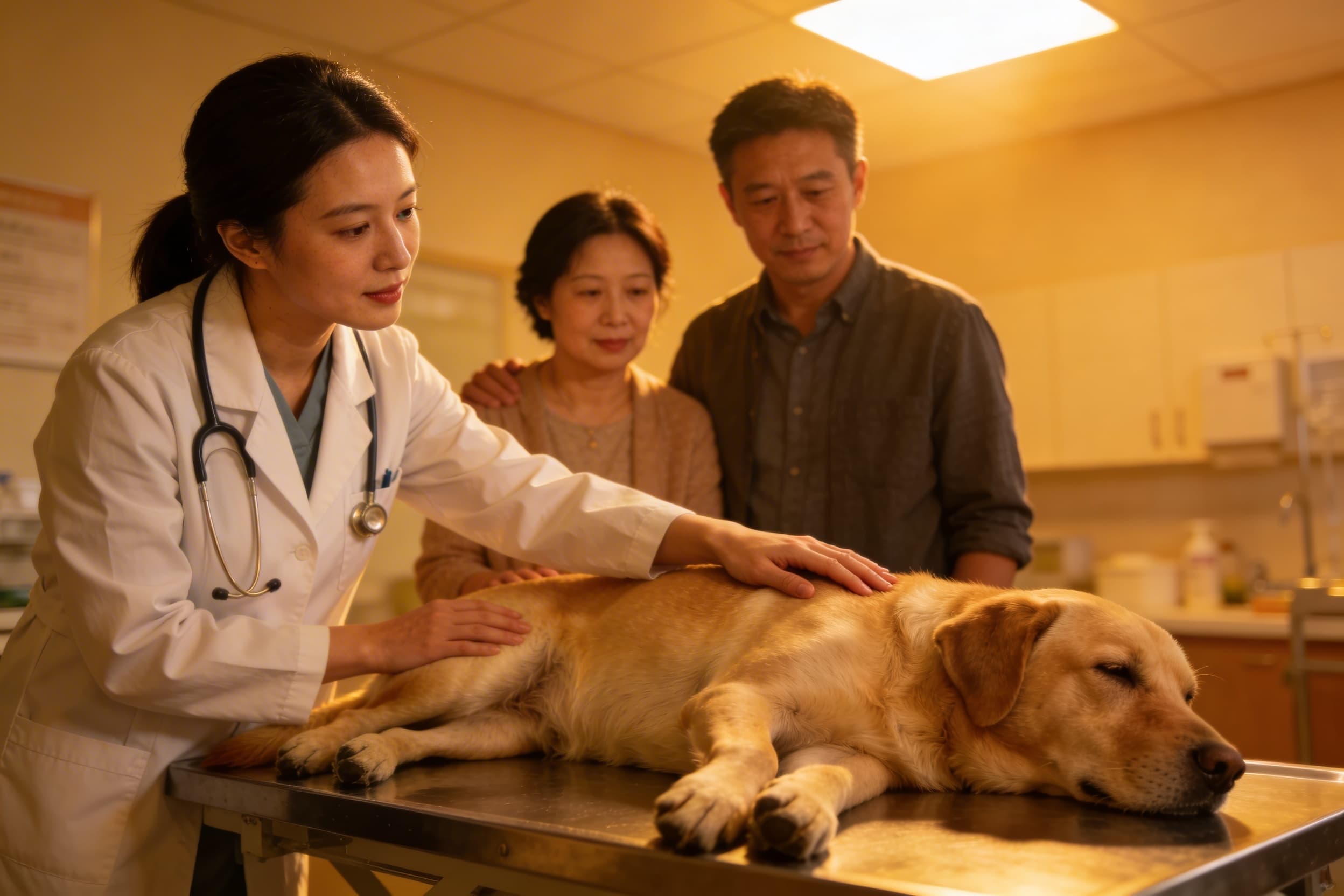
Many veterinarians encourage owners to speak to their dog throughout the euthanasia process and for several minutes after the dog has passed. This guidance is grounded in the science described above, and it serves two purposes.
For Your Dog
If hearing is indeed the last sense to go, your voice is one of the last things your dog experiences. Dogs are deeply attuned to the sound of their owner's voice — research has shown that dogs process human speech in the left hemisphere of their brain, the same region associated with language processing in humans. Your voice, your tone, and your words carry meaning to your dog in a way that goes beyond simple sound recognition. Speaking calmly and lovingly during their final moments may be the most comforting thing you can offer.
For You
Saying goodbye out loud — telling your dog you love them, thanking them for their companionship, assuring them it is okay to go — is also profoundly important for your own grieving process. Families who speak to their dog during euthanasia or at the time of death consistently report feeling more at peace with the experience afterward. The words you say are not just for your dog. They are for you. They become part of how you remember the goodbye, and they can ease the regret and second-guessing that often accompanies grief.
What Happens When a Dog Dies
Understanding the physical process can help prepare you for what you will see and feel. Whether your dog passes through euthanasia or naturally, the body goes through a predictable sequence:
During Euthanasia
Euthanasia involves an overdose of an anesthetic drug, usually pentobarbital. Your dog first relaxes, then becomes drowsy, and within seconds falls deeply unconscious — the same sensation as going under anesthesia for surgery. The heart slows and stops, typically within 30 to 60 seconds. Your dog feels no pain during this process. It is, by all medical accounts, one of the most peaceful ways to die.
After the heart stops, the brain continues to receive residual oxygen for a brief period. This is the window during which hearing and other senses may still be active. Reflex movements — muscle twitches, a gasp, or a release of the bladder — may occur and are normal postmortem reflexes, not signs of consciousness or distress. The same is true of the slow, deep, open-mouthed gasping that can precede death by a few minutes: agonal breathing in dogs looks like a struggle for air and is a brainstem reflex in an animal who is already unconscious.
During Natural Death
When a dog dies naturally from illness or age, the process is more gradual. Breathing becomes irregular, the heart rate slows, and the dog drifts in and out of consciousness. Throughout this process, the senses fade in roughly the same order as in humans — vision first, followed by taste and smell, with touch and hearing persisting longest. This is why simply being physically present and speaking softly can be so meaningful, even when your dog appears to be sleeping or unresponsive.
What Veterinarians Recommend
Veterinarians who specialize in end-of-life care offer remarkably consistent advice for families saying goodbye to a dog:
Talk to your dog. Use a calm, reassuring voice. Say their name. Tell them they are a good dog. Tell them you love them. Tell them it is okay to let go.
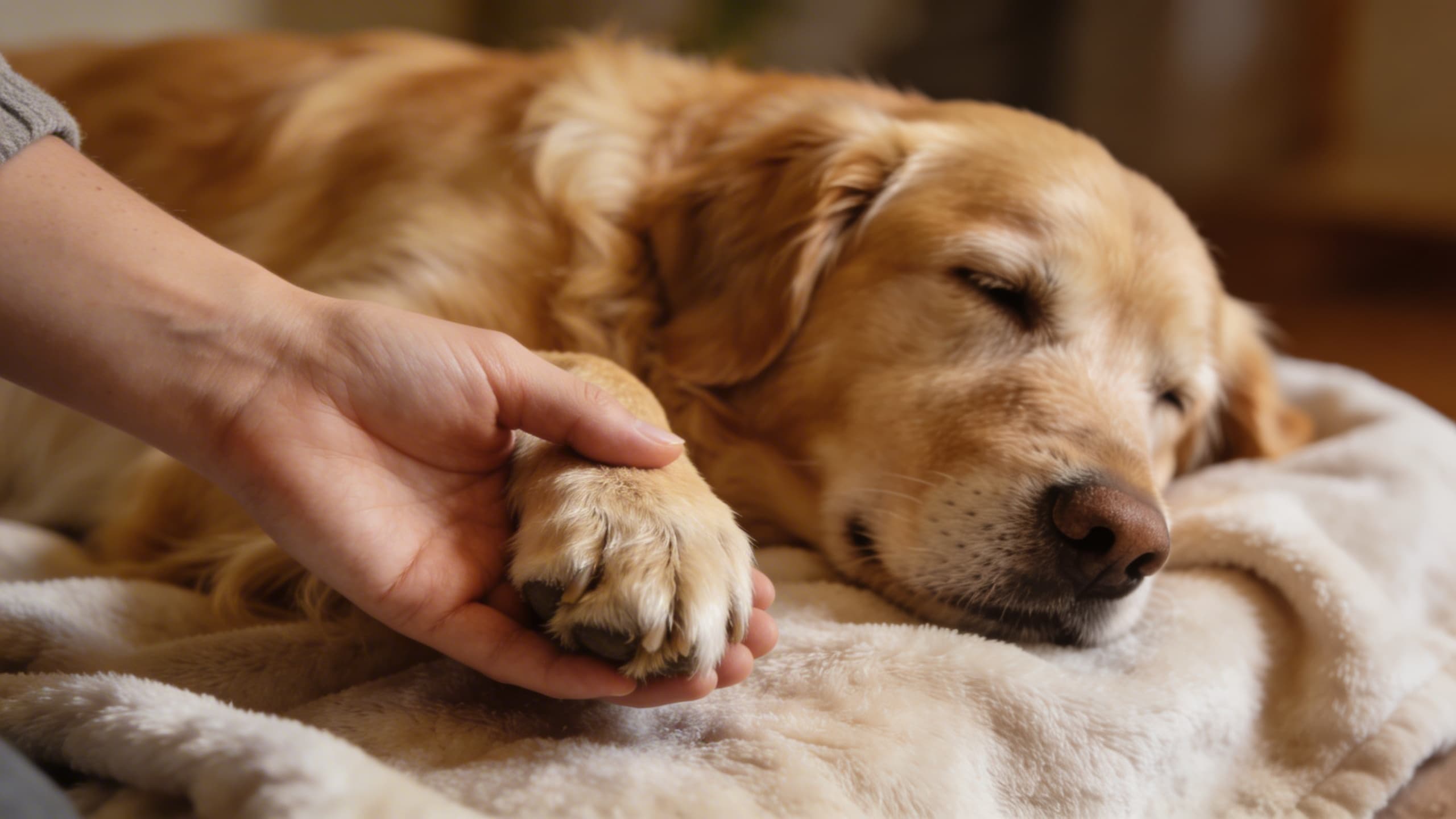
Touch them. Hold their paw, stroke their head, or simply sit beside them with a hand resting on their body. Touch is the second-to-last sense to fade, and physical contact provides comfort.
Surround them with familiar scents. Place a worn shirt, a favorite blanket, or a beloved toy near them. For dogs, smell may be the strongest remaining sense, and familiar scents can create a feeling of safety and home.
Stay as long as you need. After your dog has passed, there is no rush to leave. Sit with them. Continue talking. Many families find that the minutes immediately after death are the most important for their own emotional processing.
Know that it is okay if you cannot be present. Distance, timing, or emotional capacity may prevent you from being there. Your veterinary team will provide gentle, compassionate care in your absence. Your dog will not be alone.
Honoring Your Dog's Memory
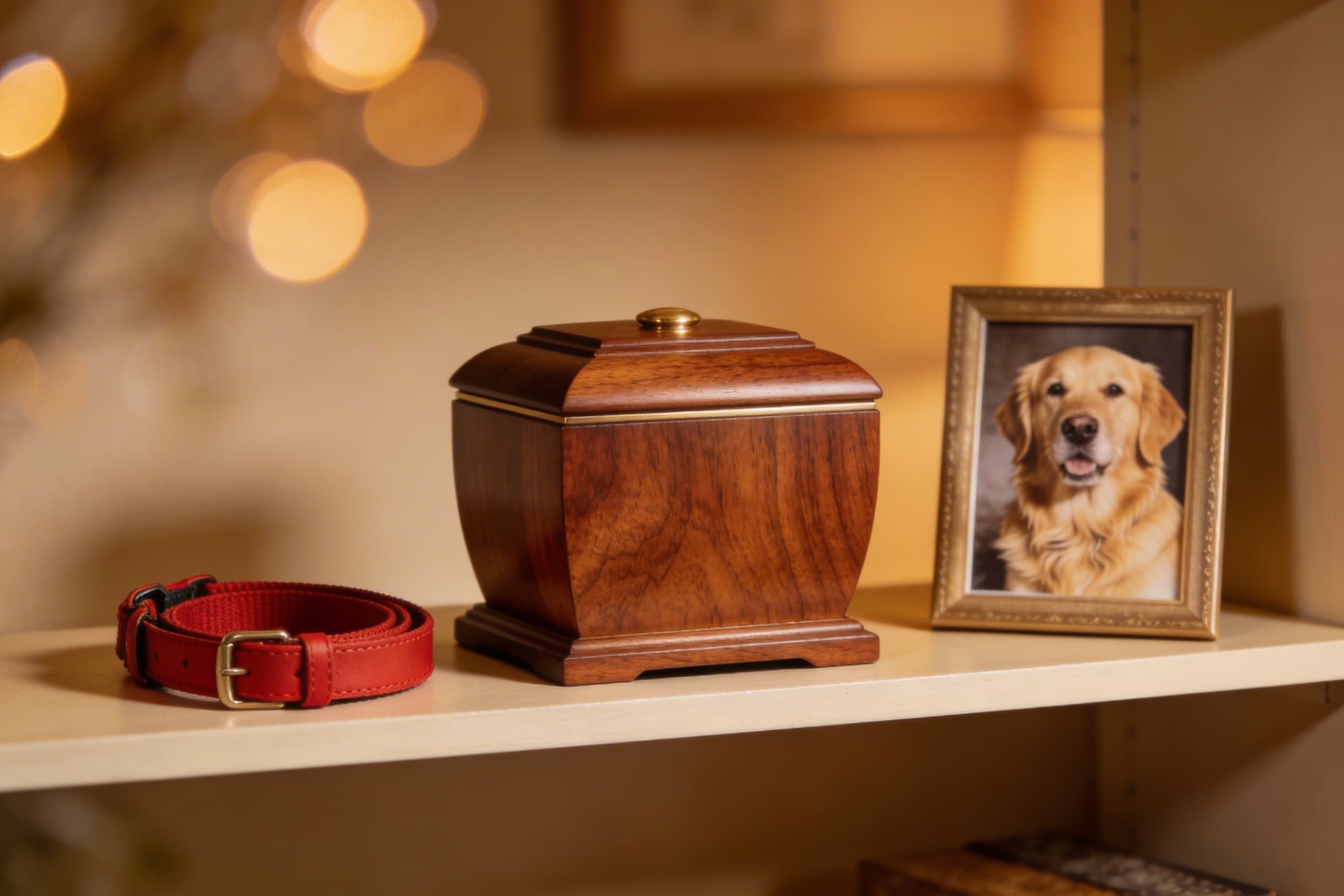
After saying goodbye, many families find comfort in creating a lasting tribute. The act of choosing an urn, placing a pet memorial stone, or wearing a piece of cremation jewelry transforms grief from something internal into something you can hold and see.
Pet urns are available in wood, metal, ceramic, and stone, with sizes for every breed from Chihuahuas to Great Danes. Dog memorial stones offer a permanent outdoor tribute in granite, bronze, and cultured stone with personalized engraving and photo etching. For a wearable keepsake, pet cremation jewelry — pendants, bracelets, and rings — holds a small amount of cremated remains close to your heart.
For families exploring what to do after cremation, our guide on what to do with pet ashes covers every option from scattering and burial to pet cremation memorials that incorporate ashes into stone. And for a wider collection of memorial options, browse pet memorial gifts including memory boxes, paw print kits, ornaments, and sympathy cards.
If you are looking for more ways to honor your companion, our guide on what to do when your dog dies walks through every practical step from the first hours through long-term memorialization.
Frequently Asked Questions
Can a dog hear you during euthanasia?
Very likely, yes. Euthanasia causes rapid unconsciousness through anesthetic overdose, but the auditory system appears to remain active for a period after the dog loses consciousness and even after the heart stops. Veterinarians encourage you to keep talking throughout the process.
Is hearing really the last sense to go?
In humans, a 2020 EEG study confirmed that the auditory cortex responds to sound even in actively dying, unresponsive patients. For dogs, hearing is almost certainly one of the last senses to fade, though some veterinary experts believe smell — a dog's dominant sense — may persist even longer.
Should I be in the room when my dog is euthanized?
This is a deeply personal decision. If you can be present, your voice and touch provide comfort during your dog's final moments. If you cannot be there — due to distance, timing, or emotional overwhelm — know that your veterinary team will ensure your dog is treated with kindness and compassion. There is no wrong choice.
How long after death should I keep talking to my dog?
There is no firm scientific answer, but many veterinarians recommend continuing to speak to your dog for at least 2 to 5 minutes after they have passed. Some families continue for much longer. Speak for as long as feels right to you — it helps both you and your dog.
What are signs my dog heard me before they died?
Subtle signs that a dog is processing sound include ear twitches, changes in breathing rhythm, slight relaxation of body tension, or a barely perceptible turn of the head. These responses can occur even when a dog appears to be unconscious or unresponsive.
Your Dog Heard You
If you were with your dog at the end and you spoke to them — told them you loved them, told them they were good, told them it was okay — the science tells us they very likely heard every word. And if you were not there, know this: the bond you built over years of walks, meals, couch naps, and quiet evenings together does not require a final sentence to be complete.
Your dog knew. They always knew.
Memorials.com carries hundreds of pet memorials for dogs, cats, and all companions. Every order ships free.