🏬Supersize Online Funeral Retailer🪦1000's of Headstones⚱️Over 15,000 Cremation Urns⚰️Caskets Overnight Delivery🛒Funeral & Memorial Superstore🚚FREE Shipping on ALL Orders👨👩👧👦Helping Families for over 20 Years💰Lowest Price Guarantee🏬Supersize Online Funeral Retailer🪦1000's of Headstones⚱️Over 15,000 Cremation Urns⚰️Caskets Overnight Delivery🛒Funeral & Memorial Superstore🚚FREE Shipping on ALL Orders👨👩👧👦Helping Families for over 20 Years💰Lowest Price Guarantee
🏬Supersize Online Funeral Retailer🪦1000's of Headstones⚱️Over 15,000 Cremation Urns⚰️Caskets Overnight Delivery🛒Funeral & Memorial Superstore🚚FREE Shipping on ALL Orders👨👩👧👦Helping Families for over 20 Years💰Lowest Price Guarantee🏬Supersize Online Funeral Retailer🪦1000's of Headstones⚱️Over 15,000 Cremation Urns⚰️Caskets Overnight Delivery🛒Funeral & Memorial Superstore🚚FREE Shipping on ALL Orders👨👩👧👦Helping Families for over 20 Years💰Lowest Price Guarantee
When someone you love dies, you will likely hear the words "wake," "funeral," and "viewing" used in quick succession — sometimes almost interchangeably. Each of these gatherings plays a distinct role in how families mourn, remember, and support one another, and understanding what sets them apart can help you make decisions during an already overwhelming time. For a broader look at every step of the process, see our complete funeral planning guide.
This article explains what a wake is, how it differs from a funeral or a viewing, what actually happens at each type of service, and how to choose the right option for your family.
What Is a Wake?
A wake is a gathering held to honor and remember someone who has died. It brings together family, friends, neighbors, and community members in a setting that is typically more relaxed and personal than a formal funeral service. The deceased's body may or may not be present, depending on the family's wishes and cultural traditions.
The word "wake" comes from the Old English term wacu, meaning "a watch" or "vigil." In earlier centuries, family members would stay awake through the night to keep watch over the body before burial — partly out of respect, partly out of a practical desire to confirm that death had truly occurred. Over time, the all-night vigil evolved into the social gathering we recognize today, but the core purpose remains the same: bringing people together to acknowledge loss and share comfort.
Catholic Roots and Religious Tradition
Wakes have deep roots in Catholic practice. In the traditional Catholic wake, prayers — often the Rosary — are recited over the body of the deceased, and a priest or deacon may lead a brief vigil service. The wake usually takes place the evening before the funeral Mass and is held at a funeral home, the family's home, or the parish church.
While the custom began as a Catholic tradition, modern wakes are observed by people of many faiths and by families with no particular religious affiliation. Today, a wake can be as structured or as informal as the family prefers. Some include scripture readings and hymns; others are entirely secular gatherings centered on food, conversation, and memory. If you are planning a Catholic funeral, the wake is typically a standard part of the sequence of events leading up to the funeral Mass.
Irish Wake Traditions
One of the most well-known expressions of the wake custom comes from Ireland. Traditional Irish wake traditions include bringing the deceased's body home, keeping a continuous watch with candles lit beside the coffin, and gathering mourners for storytelling, music, food, and drink. Historically, keening — a form of poetic vocal lament led by women — accompanied the body throughout the vigil. While some of these customs have faded over time, the warmth and communal spirit of the Irish wake continues to influence how wakes are held in the United States and around the world.
Is a Wake Before or After the Funeral?
This depends on the family's culture and preference. In most American and Irish traditions, the wake takes place before the funeral — typically the evening before or one to two days prior. However, in parts of the United Kingdom and in other cultural traditions, wakes are often held after the funeral service and burial, functioning more like a reception for mourners. Neither approach is more correct than the other; what matters is what feels right for the people gathered.
What Happens at a Wake
If you have never attended a wake before, knowing what to expect can ease some of the uncertainty. While every wake is unique, most follow a general flow.
Arrival and greeting. Guests arrive at the wake venue — commonly a funeral home, but sometimes a private residence, church hall, or community space. A guest book is often available near the entrance for visitors to sign and leave a short message for the family.
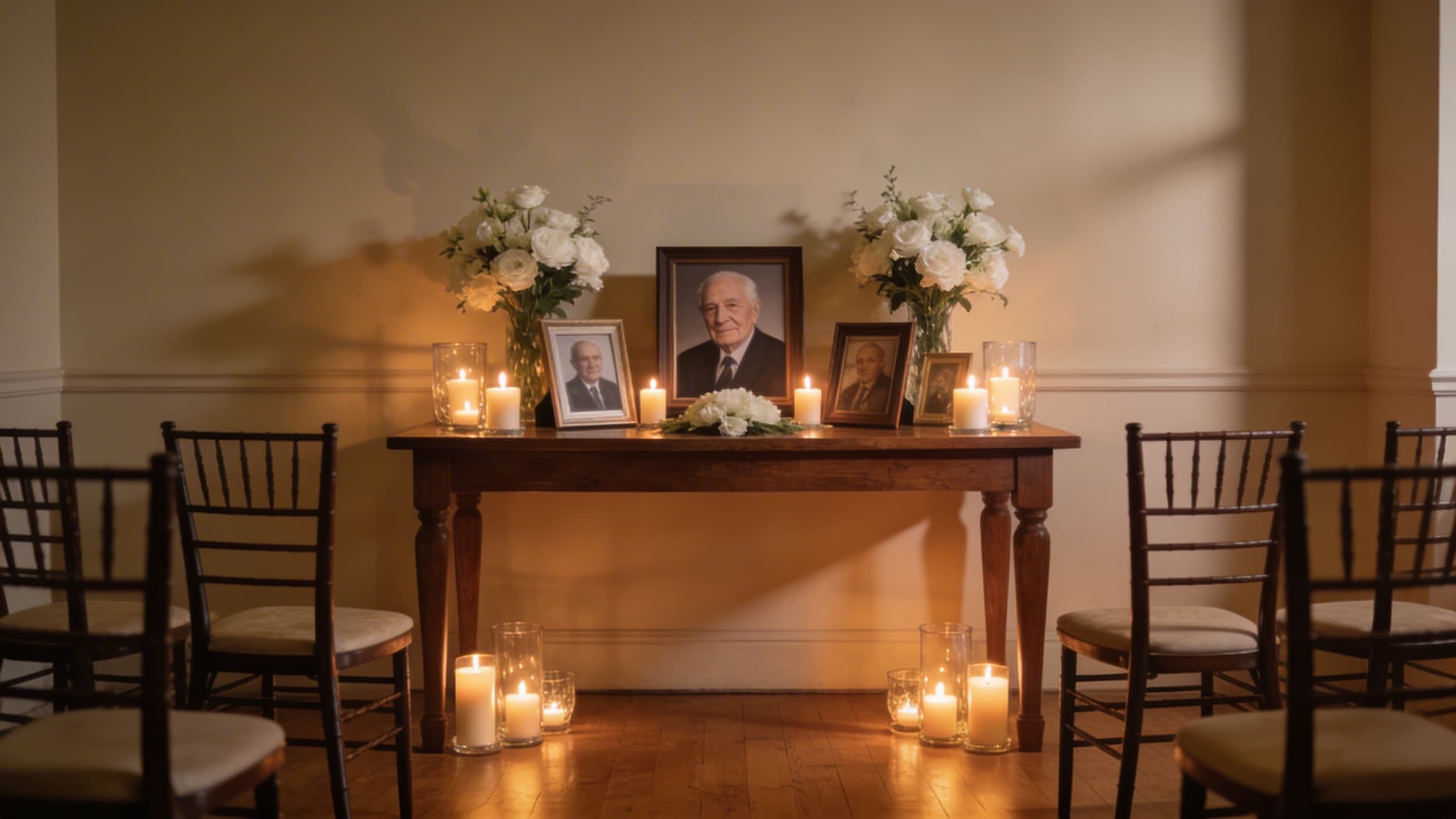
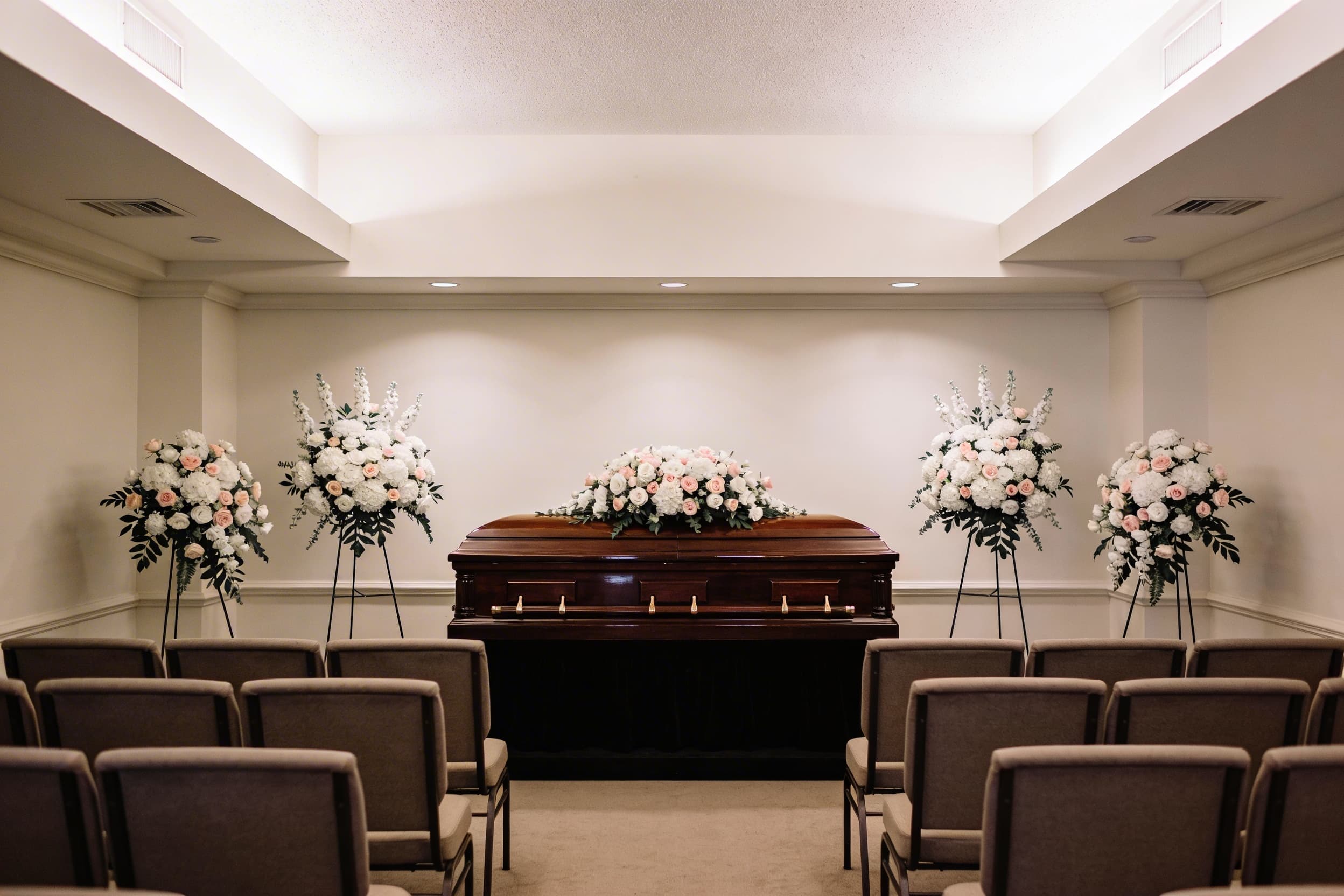
Viewing the deceased. If the family has chosen an open-casket wake, the casket is typically positioned at the front of the room with flower arrangements nearby. Visitors may approach the casket to say a quiet prayer, pause in silence, or simply pay their respects. Closed-casket wakes, or wakes without the body present, may feature a framed photograph, an urn, or a memorial display instead.
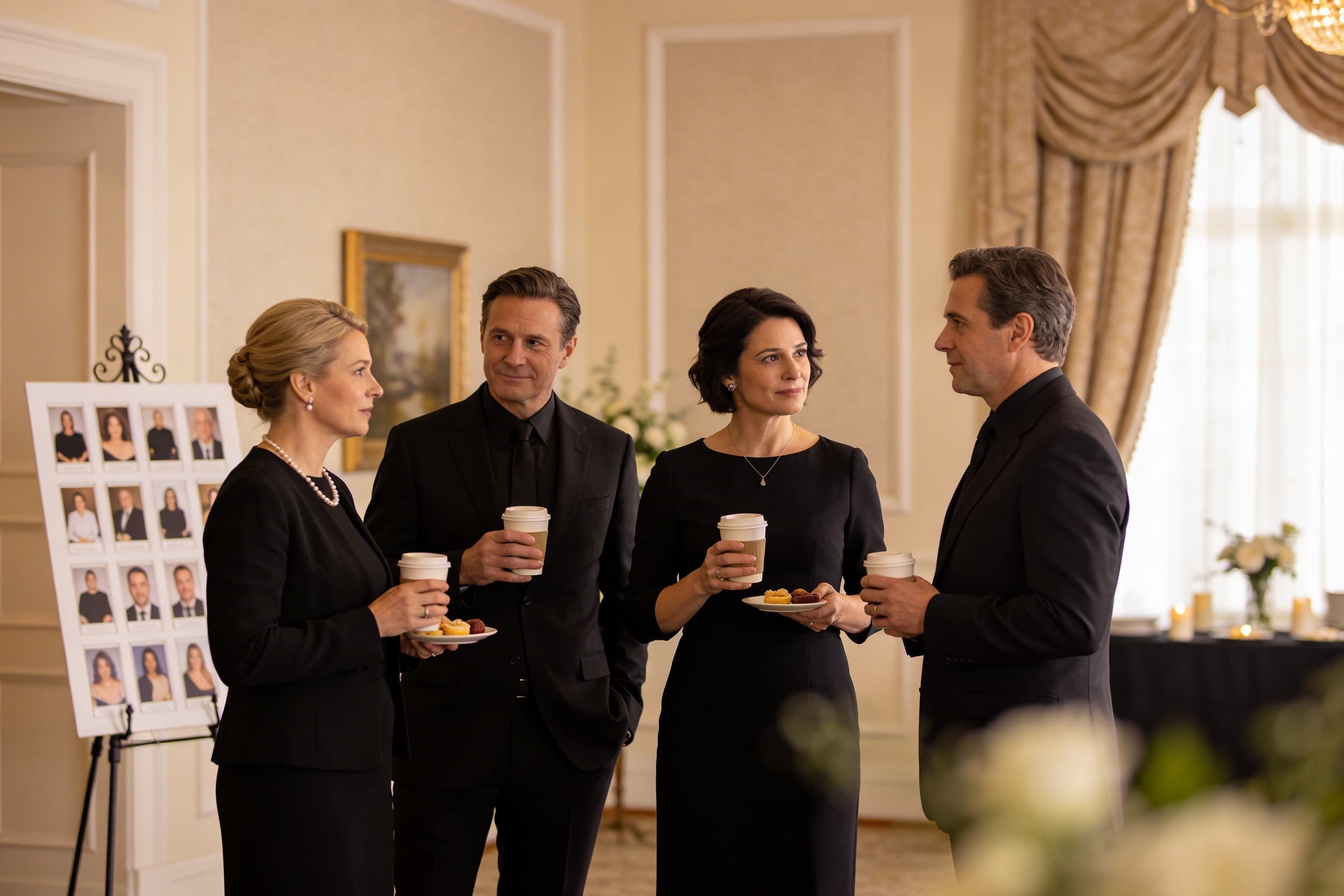
Sharing memories. This is the heart of the wake. Guests mingle, tell stories about the deceased, and offer comfort to the bereaved family. There are no formal speakers or set program — the conversation flows naturally. Some families place photo boards, memory tables, or video slideshows around the room to spark reminiscence.
Receiving line or informal greetings. Some families form a receiving line near the casket so guests can offer condolences individually. Others prefer a less structured approach where family members circulate throughout the room. If you are unsure what to say at a funeral or wake, a simple "I'm sorry for your loss" or "Your mother meant so much to me" is always appropriate.
Food and drink. Light refreshments — coffee, tea, finger sandwiches, pastries — are common at American wakes. In Irish and some other traditions, a more substantial spread of food and alcoholic beverages may be served. The shared meal is an ancient gesture of hospitality, inviting mourners to stay, talk, and support one another.
Prayer or religious observance. At Catholic wakes and those of other faith traditions, a formal prayer service may take place at a scheduled time during the gathering. This typically lasts 15 to 30 minutes and may include scripture readings, hymns, and the Rosary.
Duration. Wakes typically last two to six hours. Some families hold them for a single evening; others hold visitation hours across two days, particularly if a large number of guests are expected or if out-of-town relatives need time to travel.
What Is a Funeral?
A funeral is a formal ceremony held to honor the life of the deceased, typically led by a member of the clergy, a celebrant, or a funeral director. Unlike a wake, a funeral follows a structured order of service: eulogies, readings, prayers, hymns, and a final farewell.
Funerals are most often held in a church, chapel, funeral home, or other house of worship, though they can take place outdoors or in other meaningful locations. The body is usually present, either in a casket for burial or in an urn if the family has chosen cremation. An actual burial or cremation typically follows the funeral service.
During the funeral, family members and close friends may deliver eulogies — personal tributes that reflect on the deceased's life, character, and impact. Prayers and scripture readings may follow a specific religious tradition, or a secular celebrant may lead a non-religious ceremony tailored to the family's wishes.
The tone of a funeral tends to be more somber and reflective than a wake, though modern services often include moments of warmth, humor, and celebration. A growing number of families now plan "celebrations of life" in place of or alongside traditional funerals, placing the emphasis on honoring the person's passions, accomplishments, and personality rather than on formal mourning rituals.
A reception or repast often follows the funeral, giving mourners a chance to gather in a less formal setting — similar in spirit to a wake, but positioned after the ceremony rather than before it.
What Is a Viewing?
A viewing — sometimes called a visitation or calling hours — is a scheduled period during which close family and friends can see the deceased for the last time. The viewing usually takes place at a funeral home, though it can also be held in a church or private residence.
To learn more about how a viewing works and who typically attends, see our article on what a funeral visitation is.
During an open-casket viewing, the deceased's body has been embalmed and prepared by the funeral director so that the person appears peaceful and at rest. Guests may approach the casket to say a private goodbye, leave a small token like a flower or letter, or simply sit nearby in quiet reflection. In a closed-casket viewing, the casket remains sealed, and a photograph of the deceased is often placed on top or beside it.
Viewings tend to be quieter and more subdued than wakes. There is usually no formal program or scheduled prayers — the focus is entirely on giving individuals a personal, unhurried opportunity to grieve and say farewell. Funeral home staff are present to assist visitors and ensure the environment remains respectful and comfortable.
Calling hours are typically set within a window — for example, 4:00 p.m. to 8:00 p.m. — and guests are free to arrive and depart at any point during that time. Some families schedule viewing hours the day before the funeral, while others hold a brief viewing period immediately before the funeral service begins on the same day.
Wake vs Funeral vs Viewing: Key Differences
Understanding these three gatherings becomes easier when you see them side by side.
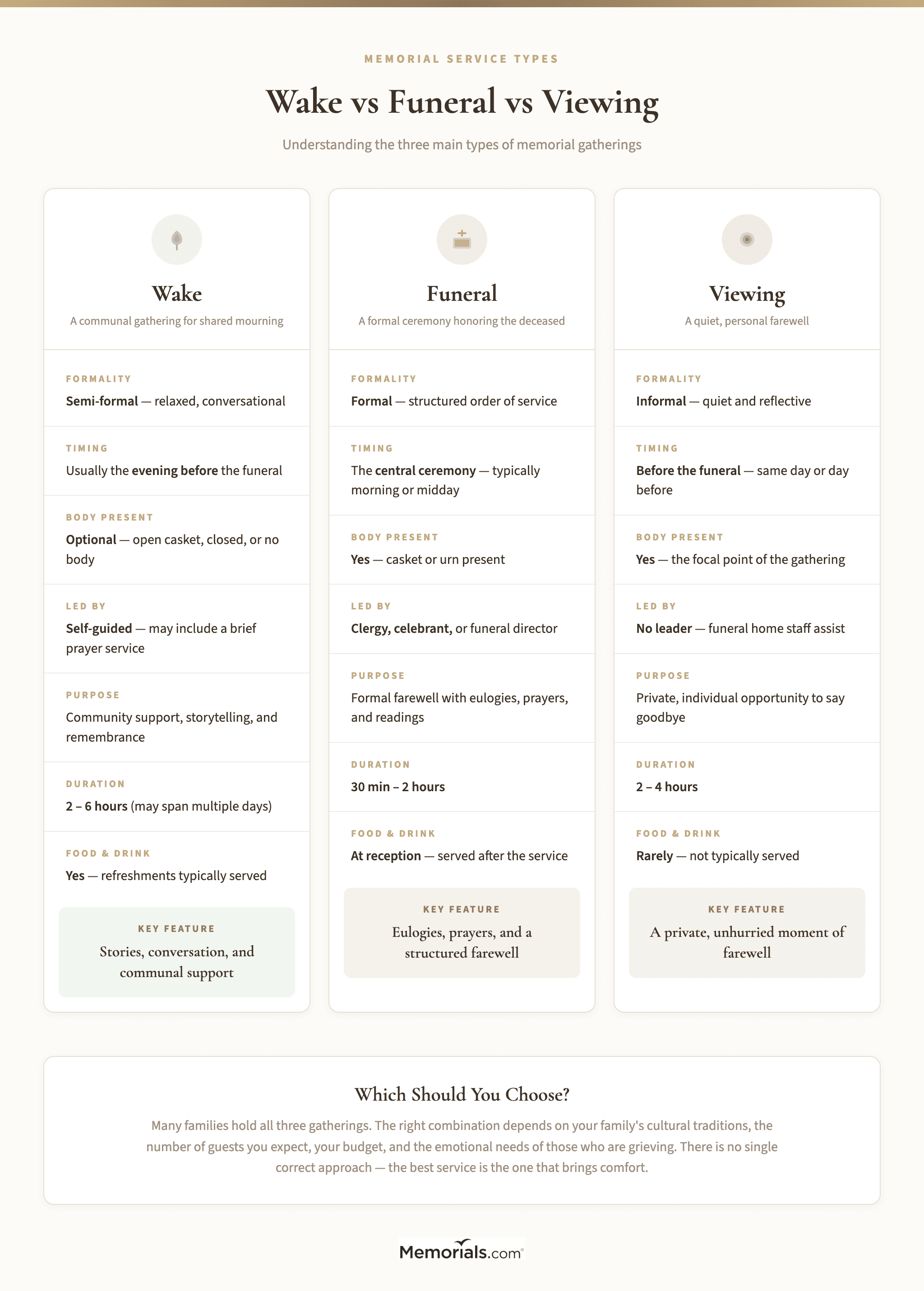
Formality. A funeral is the most structured event, following a set order of service with designated speakers. A wake is semi-formal, blending prayer or remembrance with open socializing. A viewing is the least formal — there is no program, just an open window for visitors to come and go.
Timing. Wakes and viewings are usually held before the funeral, often the evening prior. Funerals are the central ceremony. In some traditions, the wake occurs after the funeral service and burial, serving as a reception.
Body present. The deceased's body is usually present at all three, though it is not required at a wake. At a viewing, the body is always the focal point. At a funeral, the body (or cremated remains) is present for the service and committal.
Leadership. A funeral is led by clergy, a celebrant, or a funeral director. A wake may include a brief prayer service led by a priest or minister, but the gathering itself is largely self-guided. A viewing has no leader — funeral home staff simply facilitate the space.
Purpose. A funeral is a formal farewell. A wake brings the community together for shared mourning and support. A viewing gives individuals a private moment to grieve and see the deceased one last time.
Duration. Viewings typically last two to four hours. Wakes range from two to six hours and may span multiple days. Funeral services usually run 30 minutes to two hours.
Wake vs Viewing: What Is the Difference?
Because wakes and viewings both take place before the funeral and both may involve the deceased's body being present, the two are frequently confused. The key distinction is atmosphere and activity.
A wake is a social gathering. People talk, eat, share stories, and support one another. Music may be playing, prayers may be said, and the mood can range from somber to celebratory depending on the family's culture and preference.
A viewing is a personal farewell. The room is quiet. Visitors approach the casket, pay their respects, offer brief condolences to the family, and move on. There is no shared meal, no storytelling circle, and no formal program.
In some regions, the terms "wake" and "viewing" are used interchangeably, even though the experiences they describe are meaningfully different. If you are invited to either one, reading the obituary or speaking with a family member can help clarify what to expect.
Should You Attend the Wake, the Funeral, or Both?
Attending both the wake and the funeral is a generous expression of support, but it is not expected of every guest. Close family and friends typically attend both. Acquaintances, colleagues, and more distant connections may choose one or the other based on their schedule and their relationship with the deceased.
If you can only attend one, the funeral is generally the more significant event — it is the family's formal farewell and the moment when the community collectively honors the person who died. However, if you were particularly close to the deceased or their family and want to offer personal condolences, the wake may feel more appropriate because of its intimate, conversational atmosphere.
When in doubt, attending either one is meaningful. Your presence matters far more than how long you stay or what you say. For guidance on appropriate behavior, attire, and communication, see our article on funeral etiquette. If the question is specifically clothing, what to wear to a wake handles all three settings and where they differ — a wake at a family home is not a viewing at a funeral home, and neither is the service.
How to Decide Which Service Is Right for Your Family
If you are planning services for a loved one, you do not have to choose between a wake, a funeral, and a viewing — many families hold all three. However, your decision may be shaped by several factors.
Religious or cultural expectations. Catholic families, for example, often hold a wake the evening before the funeral Mass. Families from traditions that emphasize immediate burial may skip the wake entirely. Consider what customs are meaningful to you and what the deceased would have wanted.
Number of guests. If you expect a large turnout from many different social circles — family, work colleagues, community members, old friends — hosting a wake or extended viewing hours gives everyone time and space to pay respects without crowding the funeral service.
Budget. Every gathering carries costs, from venue rental to catering to funeral home staffing. Wakes held at home can be less expensive than those held at a funeral home. Viewings typically have lower associated costs than full wakes since they require less setup and no food service.
Emotional needs. Some families find comfort in the extended gathering of a wake, where stories and laughter intermingle with grief. Others prefer the formality and closure of a funeral service. There is no right or wrong choice — the best service is the one that helps the bereaved begin to heal.
Practical logistics. Consider travel time for out-of-town relatives, work schedules, and the availability of your preferred venue and clergy. If family members are traveling from far away, spreading services across two days (a wake or viewing one evening, the funeral the next morning) can be more manageable for everyone.
A thoughtful sympathy gift — a memorial candle, a personalized keepsake, or a simple card — can also be a meaningful gesture for guests who attend any of these services and want to offer something tangible to the grieving family.
Frequently Asked Questions
What is the difference between a wake and a funeral?
A wake is a gathering — usually informal — held to honor the deceased, share memories, and support the bereaved. A funeral is a formal ceremony led by clergy or a celebrant that typically includes eulogies, prayers, and readings. Wakes are most often held before the funeral, while the funeral is followed by burial or cremation.
Is a wake only for Catholics?
No. Wakes have strong roots in Catholic tradition, but people of all faiths and no particular religious background hold wakes today. The format varies — some include prayers and scripture, others are entirely secular and focused on food, conversation, and remembrance.
What happens at a wake?
Guests arrive at the venue, sign a guest book, and spend time with the family. If the casket is open, visitors may approach to pay their respects. People share stories, eat and drink together, offer condolences, and sometimes participate in a prayer service. Wakes are typically two to six hours long.
Is a wake before or after the funeral?
In most American and Irish traditions, the wake is held before the funeral — typically the evening before. In parts of the United Kingdom and other cultures, wakes take place after the funeral and burial, serving as a post-service reception.
What is the difference between a wake and a viewing?
A wake is a social gathering with conversation, food, and often prayer. A viewing is a quieter, more personal event where visitors see the deceased's body and offer brief condolences. Wakes are communal; viewings are individual.
Why is it called a wake?
The word "wake" comes from the Old English wacu, meaning "a watch" or "vigil." Historically, family members would stay awake through the night to keep watch over the body of the deceased before burial.