🏬Supersize Online Funeral Retailer🪦1000's of Headstones⚱️Over 10,000 Cremation Urns⚰️Caskets Overnight Delivery🛒Funeral & Memorial Superstore🚚FREE Shipping on ALL Orders👨👩👧👦Helping Families for over 20 Years💰Lowest Price Guarantee🏬Supersize Online Funeral Retailer🪦1000's of Headstones⚱️Over 10,000 Cremation Urns⚰️Caskets Overnight Delivery🛒Funeral & Memorial Superstore🚚FREE Shipping on ALL Orders👨👩👧👦Helping Families for over 20 Years💰Lowest Price Guarantee
🏬Supersize Online Funeral Retailer🪦1000's of Headstones⚱️Over 10,000 Cremation Urns⚰️Caskets Overnight Delivery🛒Funeral & Memorial Superstore🚚FREE Shipping on ALL Orders👨👩👧👦Helping Families for over 20 Years💰Lowest Price Guarantee🏬Supersize Online Funeral Retailer🪦1000's of Headstones⚱️Over 10,000 Cremation Urns⚰️Caskets Overnight Delivery🛒Funeral & Memorial Superstore🚚FREE Shipping on ALL Orders👨👩👧👦Helping Families for over 20 Years💰Lowest Price Guarantee
A Catholic funeral is one of the most structured and meaningful ceremonies in the Christian tradition. Rooted in centuries of liturgical practice, it follows a specific order designed to commend the soul of the deceased to God, affirm the Church's belief in bodily resurrection, and offer comfort to the family and community left behind. For families navigating this process for the first time, the rules and rituals can feel overwhelming — but they exist to carry you through grief, not to add to it.
This guide walks through every aspect of planning a Catholic funeral, from the vigil and funeral Mass to the Rite of Committal at the graveside. If you are coordinating a funeral alongside other end-of-life decisions, our complete funeral planning guide covers the broader process from notification through memorialization. This article focuses specifically on Catholic funeral traditions and what families need to know at each stage; for how Catholic practice compares with Jewish, Islamic, Hindu, and other rites, see our guide to .
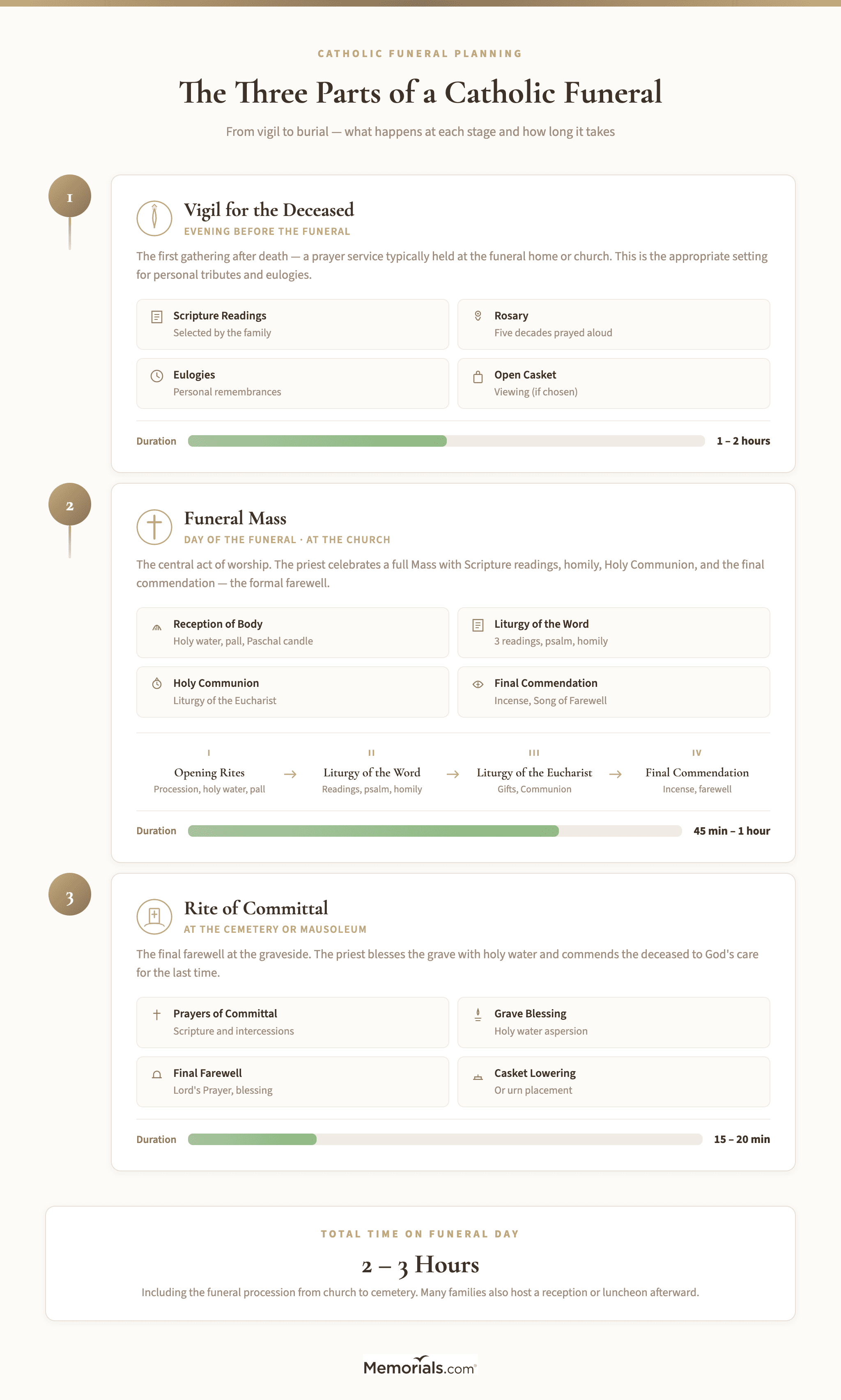
The Order of Christian Funerals — the official liturgical text governing Catholic funeral rites — outlines three distinct ceremonies. Each serves a purpose in the journey from death to burial, and families may participate in one, two, or all three depending on circumstances and preference.
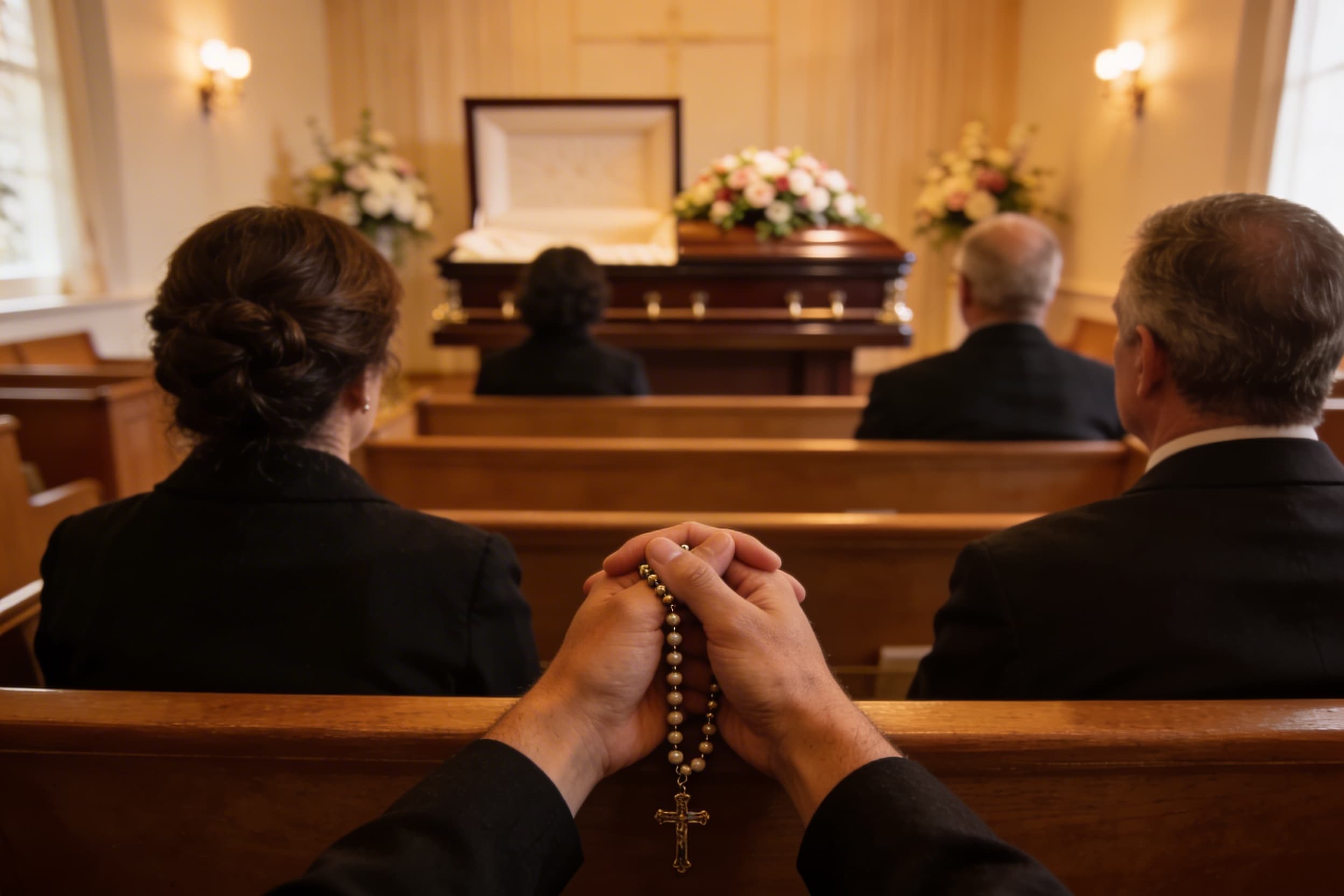
The vigil for the deceased (also called the wake or rosary service) is the first gathering after death. It typically takes place the evening before the funeral Mass, either at a funeral home, the family's home, or the parish church. The vigil includes Scripture readings, prayers, and a rosary. This is usually the appropriate time for eulogies and personal remembrances, since the funeral Mass itself has a more structured format with limited room for personal tributes.
The funeral Mass (sometimes called a requiem Mass) is the central act of worship. Celebrated in a Catholic church by a priest, it includes the full Liturgy of the Word, the Liturgy of the Eucharist with Holy Communion, and the final commendation — a formal farewell in which the priest, the congregation, and the deceased are entrusted to God's mercy. The funeral Mass is considered the highest form of prayer the Church offers for the dead.
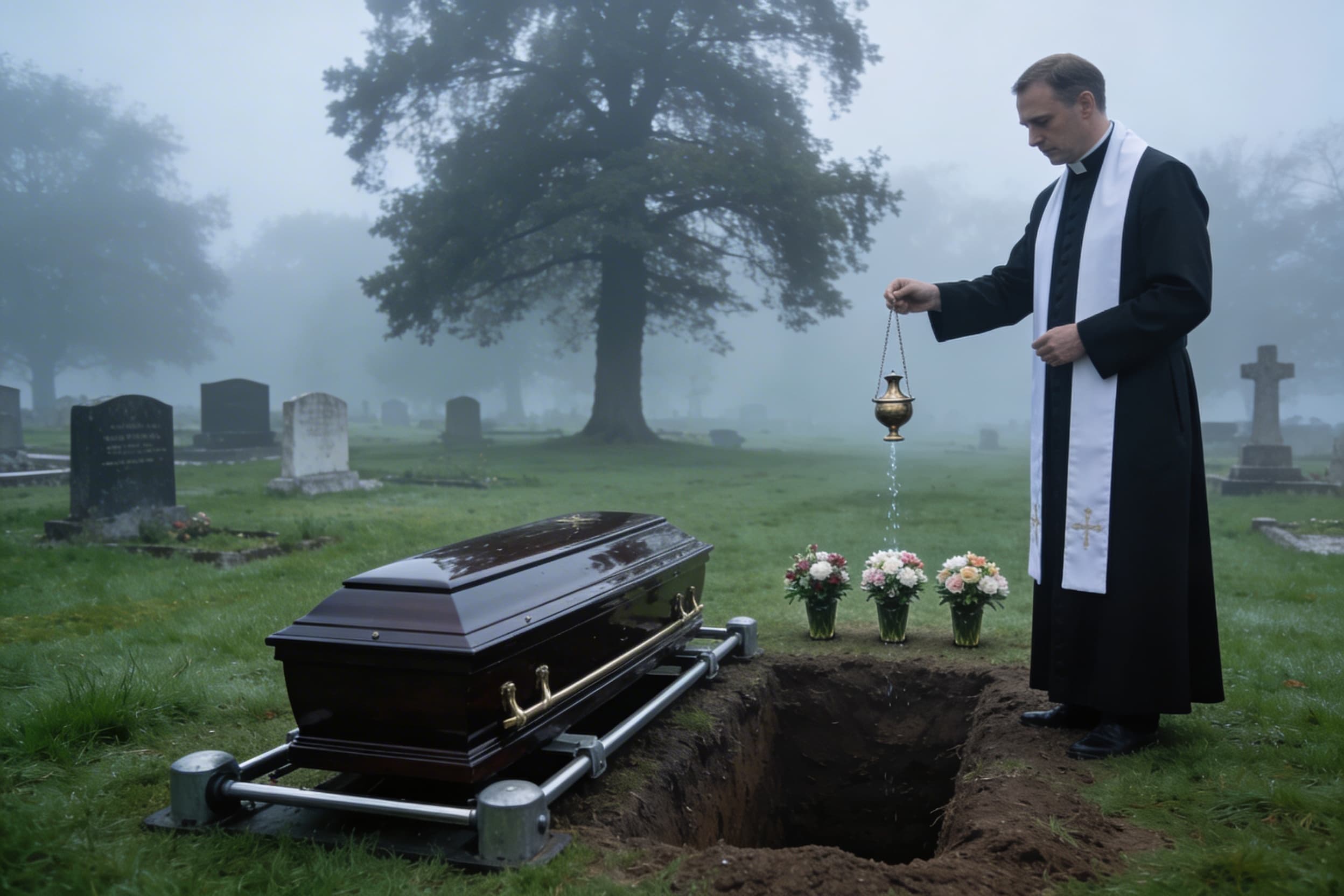
The Rite of Committal is the final ceremony, held at the graveside or mausoleum. The priest or deacon blesses the grave with holy water, recites prayers of committal, and leads the family in a final farewell. For families choosing cremation, the committal takes place when the urn is interred in a cemetery or placed in a columbarium niche.
Understanding the relationship between these three stages helps families plan appropriately and set expectations for everyone attending. For a broader look at how these events compare to non-Catholic services, the article on the difference between a wake and funeral explains the terminology and format differences across traditions.
The Order of a Catholic Funeral Mass
The funeral Mass follows a prescribed structure that mirrors a regular Sunday Mass but includes additional rites specific to the funeral. Knowing this order helps families select readings, assign roles, and prepare participants who may not be familiar with Catholic worship.
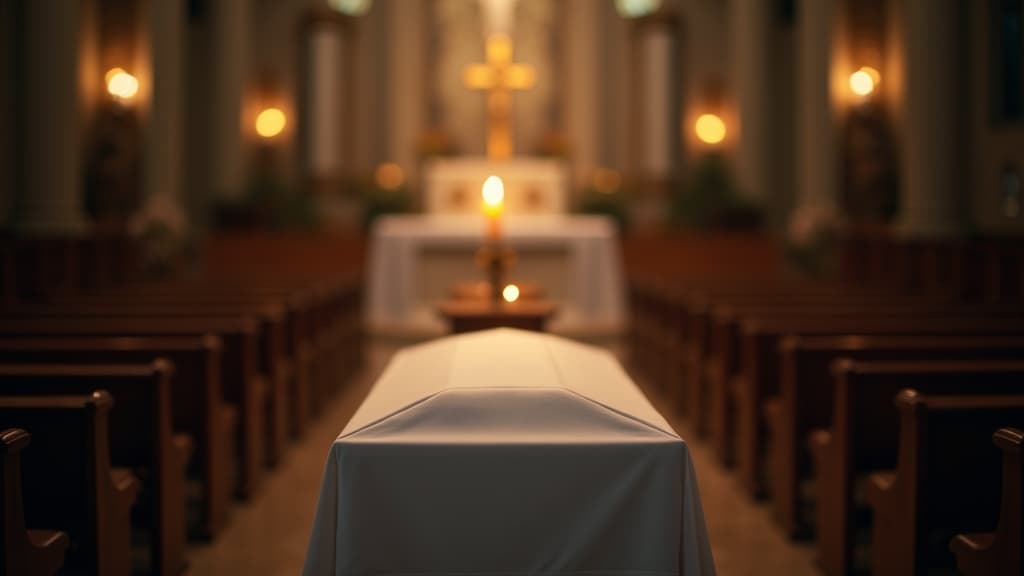
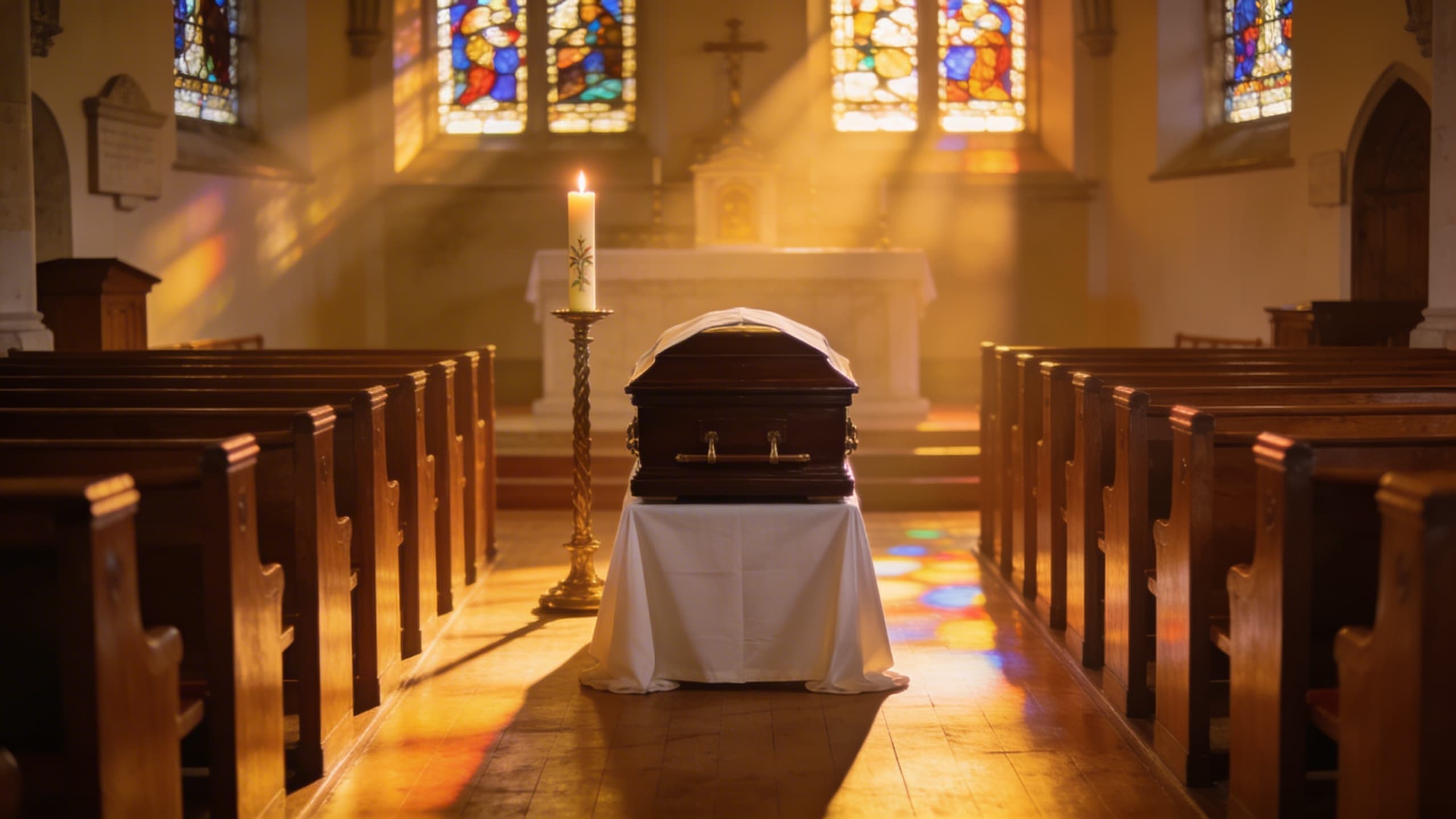
Reception of the Body. The ceremony begins as the casket is brought into the church. Family members or pallbearers carry the casket up the center aisle while the priest sprinkles it with holy water — a reminder of the deceased's baptism. A white cloth called a pall is placed over the casket, symbolizing the baptismal garment and the equality of all believers before God. The Paschal candle, representing the light of Christ, is lit and placed near the casket.
Opening Rites. The priest greets the congregation and leads the opening prayer. A hymn is sung during the entrance procession or immediately after.
Liturgy of the Word. This is the scriptural heart of the Mass. It typically includes three readings: an Old Testament reading, a New Testament reading (usually from Paul's letters), and a Gospel passage. Between the first two readings, a Responsorial Psalm is sung or recited. The priest then delivers the homily — a reflection on the readings and their meaning in light of the deceased's life and the promise of resurrection. The Church's guidelines specify that the homily should not be a eulogy; it focuses on faith, hope, and God's mercy rather than on the achievements of the deceased.
Families choose the readings from a selection of passages approved for funeral liturgies. The parish priest or pastoral staff will provide a booklet listing available options, and a family member or friend may serve as a lector for the Old Testament and New Testament readings (the Gospel is always read by the priest or deacon).
Prayers of the Faithful. Also called intercessory prayers or the General Intercessions, these are brief petitions read aloud — usually by a family member — asking God's mercy for the deceased, comfort for the bereaved, and peace for all the faithful departed.
Liturgy of the Eucharist. The bread and wine are brought to the altar by family members (the gift bearers), and the priest consecrates them. Holy Communion is then offered to the congregation. Only baptized Catholics in a state of grace should receive Communion; non-Catholic guests may approach the altar with arms crossed over their chest to receive a blessing instead.
Final Commendation and Farewell. After Communion, the priest moves to the casket for the final commendation — the most emotionally powerful moment in the Mass. He incenses the casket while the congregation sings a hymn of farewell, entrusting the deceased to God. The priest then leads the recessional as the casket is carried out of the church.
How Long Is a Catholic Funeral?
One of the most common questions families and guests ask is how long a Catholic funeral lasts. The answer depends on which parts of the funeral rites are included.
The funeral Mass itself typically lasts 45 minutes to one hour. If Holy Communion is included — which is standard for a funeral Mass — the service runs closer to a full hour, since Communion adds time for the congregation to process to and from the altar. A funeral liturgy without Mass (called a Funeral Liturgy Outside Mass) is shorter, usually around 30 to 40 minutes, and may be chosen when the deceased had been away from the Church or when circumstances make a full Mass impractical.
The vigil or wake held the evening before usually lasts one to two hours, depending on how many people attend and whether a full rosary is prayed.
The Rite of Committal at the graveside takes approximately 15 to 20 minutes, though families often remain at the cemetery longer to greet mourners and spend time together.
Including the funeral procession from the church to the cemetery — which can take 15 to 45 minutes depending on distance — the full sequence from the start of Mass to the end of the committal often spans two to three hours. Many families also host a reception or luncheon afterward, which may last another one to two hours.
Catholic Wake and Vigil Traditions
The Catholic vigil is not just a social gathering — it is a formal prayer service governed by the Order of Christian Funerals. A priest, deacon, or lay minister leads the vigil, which includes Scripture readings, a brief reflection, and the rosary. The casket is typically open during the vigil (if the family has chosen an open-casket viewing), and guests pay their respects, offer condolences, and spend time with the family.
The rosary is a distinctive element of Catholic wakes. The five decades of the rosary are prayed aloud, with the congregation responding to each Hail Mary. For families with Irish heritage, the vigil may incorporate elements of the traditional Irish wake — a more animated gathering with storytelling, music, and food shared in the home or funeral parlor. The Irish wake tradition reflects the belief that death, while sorrowful, is also a homecoming deserving of celebration.
Some families combine the vigil and funeral on the same day to accommodate guests traveling from out of town. In this arrangement, the rosary is prayed in the church before the funeral Mass begins. The parish staff can help coordinate the timing.
What to Wear to a Catholic Funeral
Catholic funerals are formal occasions, and attire should reflect that. The expectation is modest, dark-colored clothing. Black remains the traditional choice, though dark navy, charcoal, and dark gray are equally appropriate.
For men, a suit and tie or dress slacks with a button-down shirt and jacket is standard. For women, a dark dress, skirt and blouse, or pantsuit works well. Clothing should cover the shoulders and knees — sleeveless tops, short skirts, and low-cut necklines are not appropriate for a church setting. Jewelry should be understated. A Catholic funeral sits at the formal end of a range — what to wear to a funeral covers the rest of the range, and what changes between a church service, a graveside, and the reception afterward.
Head coverings are not required at Catholic funerals, though some women choose to wear a mantilla (a lace veil) as a sign of reverence, particularly in more traditional parishes. There is no obligation to do so.
For guests unfamiliar with Catholic customs, reviewing general funeral etiquette beforehand can help you feel more confident about what to expect.
How Much Does a Catholic Funeral Cost?
The total cost of a Catholic funeral varies widely depending on the choices the family makes, but understanding the main expense categories helps with budgeting.
Church fees. Most parishes charge a stipend for the funeral Mass, typically ranging from $200 to $500. This may cover the priest's time, use of the church, and coordination with the parish staff. Organist and cantor fees are often separate and can add $200 to $400 combined. Some parishes waive or reduce fees for active parishioners.
Funeral home services. The largest portion of funeral costs comes from the funeral home — including embalming, preparation, use of the facility for the vigil, transportation, and coordination. The national median cost for a full-service funeral with viewing and burial is approximately $8,300 to $9,500, though this figure varies significantly by region.
Casket. The casket is typically the single most expensive item. Catholic funerals traditionally use full-body caskets for burial, and families can choose from a range of casket materials and styles — from simple cloth-covered wood to polished hardwood or metal. A hardwood or wood casket is a popular choice for traditional Catholic burials, with prices ranging from $1,500 to $5,000 depending on the wood species and finish. When deciding between options, our guide on how to choose a casket walks through the practical and financial considerations.
Cemetery costs. The burial plot, grave opening and closing, and the outer burial container (vault) required by most cemeteries add $1,500 to $5,000 or more, depending on whether the cemetery is a Catholic diocesan cemetery or a secular one.
Additional expenses. Flowers, printed programs, memorial cards, obituary notices, and the reception meal add to the total. Many families spend $500 to $2,000 on these combined items.
Altogether, a Catholic funeral with burial typically costs between $10,000 and $15,000, though simpler arrangements can bring the total under $8,000 and more elaborate services can exceed $20,000. Families who want to reduce costs without sacrificing dignity should ask about parish hardship provisions, compare funeral home pricing, and consider whether cremation (with proper interment) may be a more affordable path.
Choosing a Casket for a Catholic Funeral
The Catholic Church does not mandate a specific type of casket, but tradition and practical considerations guide the choice. For a funeral Mass with the body present, a standard full-size casket is expected. The casket will be visible throughout the Mass, covered by the pall during the service but on display during the vigil and viewing.
Wood caskets — particularly oak, cherry, mahogany, and poplar — are a traditional and widely chosen option for Catholic burials. They carry a warmth and dignity that many families associate with the Church's reverence for the body. Metal caskets in bronze, copper, or steel are also common, particularly when families want maximum durability for in-ground burial.
For families choosing cremation before the funeral (discussed below), a smaller urn replaces the casket during the Mass. The parish priest can advise on appropriate placement of the urn during the liturgy.
Catholic Rules on Cremation
The Catholic Church has permitted cremation since 1963, and the practice was formally codified in the 1983 Code of Canon Law. However, the Church attaches specific conditions that families must follow.
The Church's strong preference is that the body be present for the funeral Mass, with cremation taking place afterward. This preserves the full symbolism of the funeral rites — the sprinkling of holy water on the casket, the placement of the pall, and the final commendation with incense. When cremation must occur before the funeral due to practical circumstances (distance, timing, cost), the priest may celebrate the funeral Mass in the presence of the urn rather than the body.
The most important rule: cremated remains must be interred in a sacred place. The 2016 Vatican instruction Ad resurgendum cum Christo prohibits scattering ashes, dividing them among family members, or keeping them permanently at home. The ashes must be buried in a cemetery, placed in a columbarium niche, or entombed in a mausoleum — all in consecrated ground. Families who choose cremation should select a religious urn worthy of permanent interment.
For a deeper understanding of how Catholic teaching on cremation fits within the broader Christian landscape, the article on whether Christians can be cremated explores the denominational differences in detail.
Music and Hymns at a Catholic Funeral
Music plays an integral role in the funeral Mass, but the Church places limits on what may be performed. All music at a Catholic funeral must be sacred — secular songs, pop music, and non-religious poetry are not permitted during the Mass itself. Many families choose to play secular favorites at the vigil, the reception, or at the graveside, where the liturgical restrictions do not apply.
The funeral Mass typically requires music at four points: the entrance procession, the offertory (when the gifts of bread and wine are brought forward), Communion, and the recessional. A Responsorial Psalm is also sung or recited between the first and second readings. The parish music director or cantor can help families select appropriate hymns from the parish's repertoire.
Common Catholic funeral hymns include "Be Not Afraid," "On Eagle's Wings," "Ave Maria," "How Great Thou Art," "Amazing Grace" (which, while Protestant in origin, is widely used in Catholic settings), and "Song of Farewell." Families with strong preferences should discuss their choices with the parish music director early in the planning process, as not all hymns are part of every parish's standard repertoire.
For families exploring music options more broadly, our collection of funeral songs includes selections appropriate for both the liturgy and the reception.
Catholic Funeral Etiquette for Guests
Attending a Catholic funeral when you are not Catholic — or when you have not attended Mass in many years — can feel uncertain. A few guidelines make the experience more comfortable.
During the Mass, follow the lead of the congregation. Stand when they stand, sit when they sit, and kneel when they kneel (or remain seated if kneeling is physically difficult — no one will judge you). You do not need to recite the prayers or responses if you are unfamiliar with them.
Holy Communion is reserved for baptized Catholics who are in a state of grace. If you are not Catholic, you may remain seated during Communion, or you may approach the altar with your arms crossed over your chest to receive a blessing from the priest. Both choices are perfectly acceptable.
Phones and recording devices should be silenced and put away for the duration of the Mass. Recording the funeral Mass is not appropriate.
After the Mass, guests typically follow the funeral procession to the cemetery for the Rite of Committal. If you cannot attend the burial, it is acceptable to express your condolences at the church and depart.
Gifts and condolences.Sympathy gifts, flowers, and condolence cards are all welcome. Flowers are traditionally sent to the funeral home for display during the vigil. Mass cards — cards indicating that a Mass has been offered for the repose of the deceased's soul — are a particularly meaningful Catholic gesture and can be obtained from most parish offices.
Planning Checklist for a Catholic Funeral
Working through these steps in order will help families coordinate with the parish, the funeral home, and the cemetery without overlooking important details.
Immediately after death, contact your parish priest or the parish office. The priest will help schedule the funeral Mass and discuss the liturgical options. If the deceased was not an active parishioner, the parish will still assist — funeral ministry is a core duty of every Catholic church.
Within the first day or two, select a funeral director. The funeral home handles the care of the body, coordinates transportation, manages the vigil logistics, and works with the parish on scheduling. Many Catholic parishes have established relationships with nearby funeral homes and can recommend one.
Before the vigil, choose the readings, hymns, and participants. Decide who will serve as lectors (readers), gift bearers, pallbearers, and who will lead the Prayers of the Faithful. The parish staff will provide a booklet of approved readings and a list of available hymns.
Decide on disposition — burial or cremation. If burial, select a casket, a cemetery plot, and an outer burial container. If cremation, confirm with the priest whether the body will be present for the Mass (preferred) or whether the urn will be used, and select a permanent interment location for the ashes.
Coordinate the reception. Many parishes have a hall or gathering space available for a post-funeral luncheon. Alternatively, families may host at a restaurant or private home. The reception is where personal stories, secular music, and informal tributes are most naturally shared.
Notify family, friends, and community. Publish an obituary, contact the deceased's employer or organizations, and inform anyone who should attend. Include the times for both the vigil and the funeral Mass in the notice.
Frequently Asked Questions
How long is a Catholic funeral Mass?
A Catholic funeral Mass with Holy Communion typically lasts 45 minutes to one hour. A funeral liturgy without Mass runs approximately 30 to 40 minutes. The overall funeral experience — including the vigil the night before, the funeral procession, and the graveside Rite of Committal — often spans two to three hours on the day of the funeral.
How much does a Catholic funeral mass cost?
Church fees for the funeral Mass typically range from $200 to $500, plus $200 to $400 for the organist and cantor. The total cost of a Catholic funeral with burial — including the funeral home, casket, cemetery, and reception — usually falls between $10,000 and $15,000. Cremation with proper interment can reduce the total by $2,000 to $4,000.
What should I wear to a Catholic funeral?
Dark, modest, formal attire is expected. Black, navy, or charcoal clothing is appropriate. Clothing should cover the shoulders and knees. Men typically wear a suit or dress slacks with a jacket. Women typically wear a dress, skirt and blouse, or pantsuit. Head coverings are not required but are acceptable.
Can Catholics be cremated?
Yes. The Catholic Church has permitted cremation since 1963. However, the Church requires that cremated remains be interred in a sacred place — a cemetery, columbarium, or church crypt. Scattering ashes, dividing them, or keeping them at home is not permitted under Catholic teaching. The Church also prefers that the body be present for the funeral Mass, with cremation occurring afterward.
What is the difference between a Catholic funeral Mass and a funeral liturgy?
A funeral Mass includes the full Liturgy of the Eucharist with Holy Communion. A funeral liturgy outside of Mass includes Scripture readings, prayers, and a homily but omits the Eucharist. The funeral Mass is the preferred and more common option, but a liturgy without Mass may be appropriate in certain circumstances — for example, if the deceased was not a practicing Catholic or if no priest is available to celebrate Mass.
Are eulogies allowed at a Catholic funeral?
The Catholic Church discourages eulogies during the funeral Mass itself. The revised Roman Missal specifies that there should "usually be a short homily, but to the exclusion of a funeral eulogy of any kind." However, many parishes allow brief "words of remembrance" — limited to one speaker for three to five minutes — either before the Mass begins or after the final commendation. The vigil service is the more appropriate setting for longer personal tributes and storytelling.
A Catholic funeral is designed to carry families through one of the most difficult passages of life with structure, dignity, and the consolation of faith. The rites may feel formal, but every element — from the holy water sprinkled on the casket to the final blessing at the grave — is an act of care for both the deceased and the living.
Memorials.com offers a complete selection of caskets, religious urns, and sympathy gifts to help families honor a Catholic loved one with reverence and warmth.