🏬Supersize Online Funeral Retailer🪦1000's of Headstones⚱️Over 10,000 Cremation Urns⚰️Caskets Overnight Delivery🛒Funeral & Memorial Superstore🚚FREE Shipping on ALL Orders👨👩👧👦Helping Families for over 20 Years💰Lowest Price Guarantee🏬Supersize Online Funeral Retailer🪦1000's of Headstones⚱️Over 10,000 Cremation Urns⚰️Caskets Overnight Delivery🛒Funeral & Memorial Superstore🚚FREE Shipping on ALL Orders👨👩👧👦Helping Families for over 20 Years💰Lowest Price Guarantee
🏬Supersize Online Funeral Retailer🪦1000's of Headstones⚱️Over 10,000 Cremation Urns⚰️Caskets Overnight Delivery🛒Funeral & Memorial Superstore🚚FREE Shipping on ALL Orders👨👩👧👦Helping Families for over 20 Years💰Lowest Price Guarantee🏬Supersize Online Funeral Retailer🪦1000's of Headstones⚱️Over 10,000 Cremation Urns⚰️Caskets Overnight Delivery🛒Funeral & Memorial Superstore🚚FREE Shipping on ALL Orders👨👩👧👦Helping Families for over 20 Years💰Lowest Price Guarantee
Life changes in ways nobody can predict. Maybe your family has moved across the country, maybe cremation now feels like the right choice, or maybe you inherited burial plots from a relative who never used them. Whatever brought you here, the question is the same: can you sell a cemetery plot, and if so, how do you actually do it?
The short answer is yes — in most states, you can sell or transfer a cemetery plot you own. The process is more involved than selling other personal property, though, because cemetery plots occupy an unusual legal space. When you bought (or inherited) a plot, you did not purchase the land itself. You purchased what is called a right of interment — the legal right to have someone buried in that specific space. The cemetery retains ownership of the actual ground. That distinction shapes everything about how a sale works, from through the final deed transfer.
This guide walks you through each step so you can move forward with confidence.
Confirm You Have the Legal Right to Sell
Before you price the plot or start looking for buyers, you need to verify two things: that you actually own the burial rights, and that the cemetery and your state allow private resale.
Locate your deed or certificate of interment rights. This is the document that proves you hold the burial rights. If you have lost it, contact the cemetery's administration office — they should have a copy on file. In some jurisdictions, the county recorder of deeds also maintains records.
Check your state's cemetery laws. Regulations vary widely. Some states, like New York, require you to offer the plot back to the cemetery in writing (by certified mail) before you can sell privately. Others allow private sales with minimal restrictions. A handful of states prohibit the use of brokers entirely, while most do not. There is no single federal law governing cemetery plot resale — it is handled at the state level, and sometimes at the municipal level.
Review the original contract. Your purchase agreement with the cemetery may include clauses about resale rights, transfer fees, or a right-of-first-refusal clause that obligates you to offer the plot back to the cemetery before listing it elsewhere. Some cemetery rules and regulations can restrict or even prohibit third-party sales. Read the fine print before investing time in a private sale.
Confirm family consent. If the plot was purchased jointly — with a spouse, sibling, or as part of a family plot — you will likely need written agreement from all co-owners before proceeding. Selling a jointly owned plot without consent can create legal headaches and family conflict.
Determine What Your Plot Is Worth
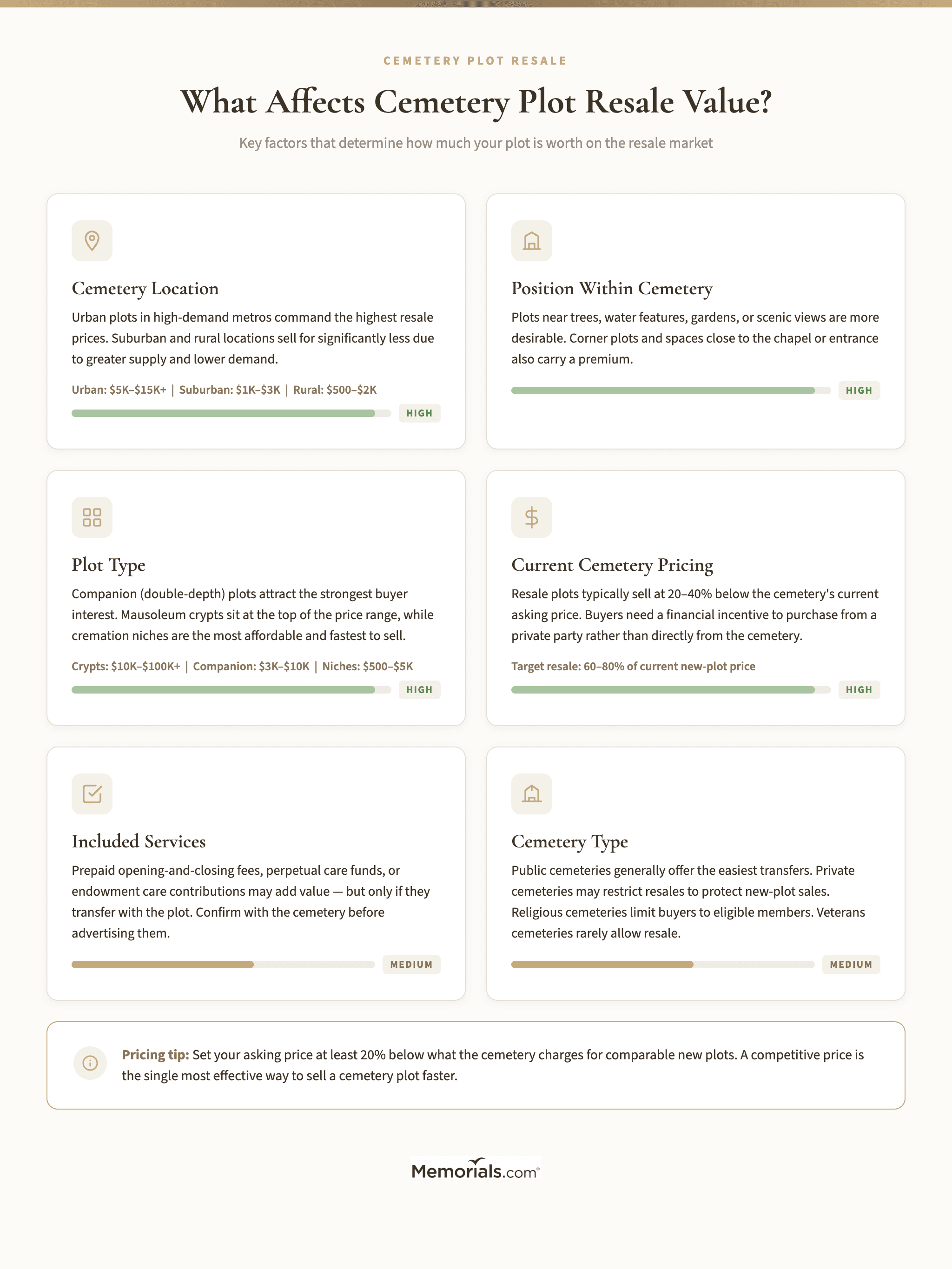
Pricing a cemetery plot for resale is not as straightforward as checking comparable real estate listings. Several factors drive value:
Location of the cemetery. Urban plots in high-demand metro areas can be worth $5,000 to $15,000 or more, while plots in smaller suburban or rural cemeteries may sell for $500 to $2,000. A prestigious or historically significant cemetery commands higher resale prices.
Position within the cemetery. Plots near trees, water features, or scenic views are generally more desirable. Corner plots, family sections, and spaces close to a chapel or entrance also tend to carry a premium.
Plot type. A single adult plot, a companion (double-depth) plot, a cremation plot, a mausoleum crypt, and a columbarium niche all occupy different price ranges. Companion plots often attract stronger buyer interest because they allow a couple to be buried together in one space.
Current cemetery pricing. Call the cemetery and ask what comparable new plots are selling for. Resale plots typically sell at 20 to 40 percent below the cemetery's current asking price. If the cemetery is selling new single plots for $4,000, a realistic resale price might be $2,400 to $3,200. Buyers need a financial incentive to purchase from a private party rather than directly from the cemetery.
Included services. Some plot purchases include prepaid opening-and-closing fees, perpetual care funds, or other services. If your purchase included any of these, they may add value to your listing — or they may not transfer, depending on the cemetery's policies.
To understand how much cemetery plots cost in your area, research both cemetery retail pricing and current private listings on resale platforms.
Explore Your Selling Options
Once you know what the plot is worth, you have three main paths to completing the sale.
Sell the Plot Back to the Cemetery
This is often the simplest path but rarely the most profitable. Many cemeteries will buy back unused plots, but they typically offer the original purchase price — or even less — regardless of how much values have increased. Some cemeteries will not buy plots back at all.
The advantage is speed and simplicity. The cemetery handles all the paperwork, and you do not need to find an outside buyer. If your priority is convenience over price, this may be the right choice.
Use a Cemetery Plot Broker
Licensed cemetery brokers specialize in connecting plot sellers with buyers. They maintain networks of funeral homes, mortuaries, and pre-need buyers that a private seller cannot easily reach. A broker will typically handle listing, marketing, buyer communication, and the transfer paperwork.
Broker fees vary. Some charge a flat listing fee, others take a commission (often 10 to 20 percent of the sale price), and some charge both. Before signing with a broker, ask about their fee structure, average time to sell, and whether they are licensed in your state (if licensing is required). Reputable brokers should be transparent about all costs.
Sell Privately
Private sales — where you find the buyer yourself — can yield the highest return but require more effort. You will need to create a listing, respond to inquiries, negotiate the price, and coordinate the legal transfer with the cemetery.
Online platforms dedicated to cemetery plot resale have made this easier than it used to be. Sites like BurialLink, GraveSolutions, and The Cemetery Exchange connect private sellers with motivated buyers. Some sellers also list on general marketplaces like Craigslist or eBay, though these carry higher risks of scams and abandoned inquiries.
If you sell privately, be cautious about sharing personal information before verifying a buyer's legitimacy. Never finalize a transaction outside of the cemetery's formal transfer process.
Understand the Transfer Process
Regardless of how you find a buyer, the actual transfer of burial rights follows a similar sequence. The cemetery is always involved — you cannot simply hand someone a receipt and walk away.
Step 1: Notify the cemetery. Contact the cemetery's administrative office and inform them of your intent to transfer the plot. They will explain their specific process, required forms, and any applicable fees.
Step 2: Complete a transfer or quitclaim form. Both the seller and buyer will need to sign transfer documents. Some cemeteries use their own proprietary forms; others accept a standard quitclaim deed. Many cemeteries require these signatures to be notarized.
Step 3: Provide supporting documents. You will typically need to submit the original certificate of interment rights (or a signed affidavit if it has been lost), a copy of a will or trust if the plot was inherited, and valid government-issued identification. If the plot is jointly owned, all co-owners must sign.
Step 4: Pay the transfer fee. Nearly every cemetery charges a transfer fee, which can range from $100 to over $500 depending on the facility. Clarify upfront who will pay this fee — seller, buyer, or split — and include that agreement in your negotiations.
Step 5: Update county records. In some jurisdictions, the deed transfer must also be recorded with the county. The cemetery may handle this automatically, or you may need to file the paperwork yourself.
Step 6: Receive confirmation. Once the transfer is processed, the buyer should receive a new certificate of interment rights in their name. Confirm with the cemetery that the records have been updated before considering the sale finalized.
The timeline from start to finish varies. A straightforward sale with a cooperative cemetery and ready buyer can close in a few weeks. Complex situations involving inherited plots, multiple co-owners, or uncooperative cemeteries can take several months.
How Cemetery Type Affects Transferability
Not all cemeteries handle resale the same way. Understanding cemetery types helps you anticipate what you are dealing with.
Public (municipal) cemeteries tend to have the most straightforward transfer processes, since they operate under local government oversight. Fees are often lower, and policies are publicly documented.
Private cemeteries set their own rules. Some actively facilitate resales; others discourage or restrict them to protect their own new-plot sales. Transfer fees at private cemeteries can be higher, and some require all resales to go through the cemetery itself rather than allowing private transactions.
Religious cemeteries may have restrictions on who can be buried there (members of the congregation, for example). This limits your pool of potential buyers to people who meet the cemetery's eligibility requirements.
Veterans cemeteries (national and state) generally do not allow resale of plots, since burial spaces are granted based on military service eligibility rather than purchased outright.
Tips for Selling Faster
Cemetery plots can take time to sell — months, and sometimes over a year. The market is small, hyper-local, and driven by specific buyer needs. Here are practical strategies to reduce your wait.
Price competitively from the start. Overpricing is the most common reason plots sit unsold. Set your asking price at least 20 percent below the cemetery's current rate for comparable new plots. A great deal attracts attention in a niche market.
Emphasize desirable features. In your listing, highlight anything that makes your plot stand out: proximity to a garden or water feature, double-depth capability, included prepaid services, or a prestigious section of the cemetery. If the cemetery has historical significance, mention it.
List on multiple platforms. Do not rely on a single marketplace. Use a dedicated cemetery plot resale site, post in local classified ads, and consider reaching out to funeral homes in the area. Funeral directors occasionally know families who are actively searching for plots.
Keep paperwork organized. Buyers are more confident when a seller can show that the deed, cemetery policies, and transfer forms are already in order. Having your documents ready signals that you are a serious, prepared seller.
Be patient and responsive. When inquiries come, respond promptly. Delays in communication can cause a motivated buyer to move on. At the same time, recognize that this is not a liquid market. Patience is part of the process.
Tax Implications and Financial Considerations
Selling a cemetery plot may trigger tax obligations depending on whether you sell for more or less than the original purchase price.
If you sell for a profit — meaning the sale price exceeds what you (or the person you inherited it from) originally paid — the difference may be considered a capital gain. Long-term capital gains tax rates typically apply if you have owned the plot for more than a year.
If you sell at a loss, you generally cannot deduct that loss on your federal tax return, because the IRS considers cemetery plots personal-use property rather than investment property.
If you donate a plot to a charitable organization (such as a religious congregation or veterans group), you may be able to claim a tax deduction. You will need a formal appraisal to establish the fair market value. The cemetery or a licensed broker may be able to provide or refer you to an appraiser.
Tax rules can be complex, and this article is not a substitute for professional tax advice. Consult a tax professional or accountant to understand your specific situation.
What to Do If You Cannot Sell
Not every cemetery plot will find a buyer, especially in areas where the cemetery has plenty of unsold inventory or where cremation rates are high. If selling proves difficult, you have alternatives:
Donate the plot. Religious organizations, veterans groups, and charities that assist the homeless sometimes accept donated burial plots. You may be able to claim a tax deduction with a qualifying appraisal.
Transfer to a family member. Even if you do not need the plot, a relative might. Transfers within families are often simpler and may involve lower (or no) fees.
Hold the plot. In some regions, cemetery plot values have appreciated significantly over the decades. If you are not in a financial rush, holding the plot as a long-term asset may be a viable strategy — particularly in urban cemeteries where land is increasingly scarce.
Let it revert. As a last resort, some states allow unused plots to revert to the cemetery or the state after a set period of inactivity (often 50 years or more). This is typically not a deliberate strategy but rather what happens if no action is taken.
Frequently Asked Questions
Can you sell a cemetery plot that was inherited?
Yes, in most states you can sell an inherited cemetery plot once ownership has been legally transferred to you. You will need documentation proving your right to the plot, such as a will, trust, or probate court order. The cemetery will also need to update their records to reflect the new owner before a sale to a third party can proceed.
How long does it take to sell a cemetery plot?
There is no guaranteed timeline. Some plots sell within a few weeks, especially in high-demand urban cemeteries. Others take six months to a year or longer. Pricing the plot competitively, listing on multiple platforms, and having your paperwork organized all help speed up the process.
Do I have to offer the plot back to the cemetery before selling privately?
It depends on your state and your original contract. States like New York require sellers to offer the plot back to the cemetery in writing before pursuing a private sale. Other states have no such requirement. Check your purchase agreement and local laws.
What fees are involved in selling a cemetery plot?
Expect to pay a transfer fee to the cemetery, which ranges from roughly $100 to $500 or more. If you use a broker, you will also pay their listing fee or sales commission. There may be additional fees for notarization, certified mailings, or county deed recording depending on your jurisdiction.
Is it legal to sell a cemetery plot on eBay or Craigslist?
Listing a cemetery plot on general marketplaces is not illegal in most states, but it does carry risks. These platforms are not designed for cemetery property transactions, and buyers and sellers have less protection against fraud. Dedicated cemetery plot resale platforms or licensed brokers are safer options.
Moving Forward
Selling a cemetery plot requires more patience and paperwork than most people expect, but it is a reasonable step when a plot no longer fits your family's plans. Start by confirming your legal right to sell, set a competitive price, choose the selling method that fits your timeline and comfort level, and work with the cemetery to complete the transfer properly. The cemetery products and grave markers that families choose for a final resting place are deeply personal decisions — and so is the decision to let go of a plot that is no longer needed.